
Digital Voice and Data ICOM DStar The Cutting
- Slides: 26
Digital Voice and Data ICOM D-Star The Cutting Edge? San Diego Six Shooters August 20, 2007
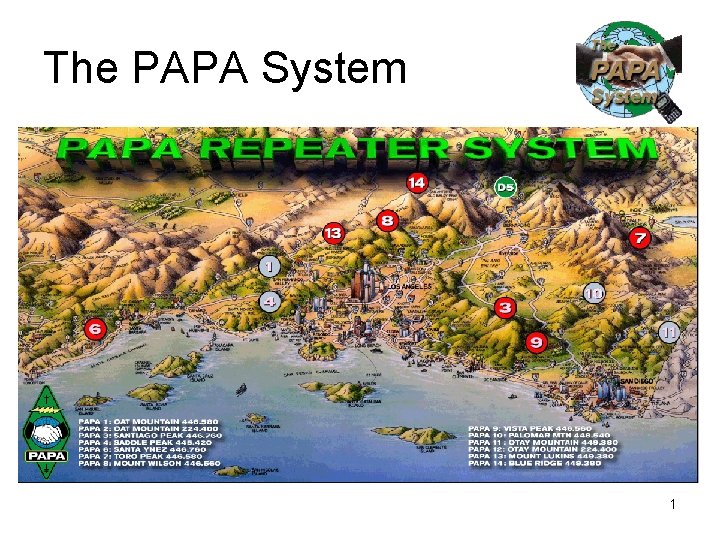
The PAPA System 1
Contents • Introduction to PAPA • About D-Star – Key Benefits • • • Stand alone system operation Gateway (“Linked”) system operation RF configuration of repeaters Additional Benefits Resources Conclusion 2
What Is D-Star • ICOM’s implementation of JARL open standard for UHF/VHF digital voice and data communications • Gaussian Minimum Shift Keying (GMSK) with forward error correction • Consists of radios, repeaters, and (optional) gateway hardware and software • 2 Meter, 440 MHz and 1. 2 GHz 3
Key Benefits • Digital quality voice communication simplex or via repeater • Very easy setup of repeater/controller • Coverage on 440 equal to or better than analog • Alphanumeric call sign ID, call sign squelch (can be bypassed for emergency traffic), and code squelch • Wireless internet access via router (part 97 presumably applies to content) • Nationwide routed call sign calling via Gateway • Data Transmission – Low-Speed Data on UHF and VHF – ISDN rate data transmission simplex or via repeater (1. 2 GHz only, half duplex) 4
Call Sign Squelch (DSQL) • Configuration option on your radio • If enabled, squelch opens only when your call sign is received • Call sign squelch is bypassed if calling station operates in EMR mode 5
Code Squelch (CSQL) • Configuration option on your radio • Squelch opens only when a preset code is received • Programmable codes: 0 -99 • Code squelch is bypassed if calling station operates in EMR mode 6
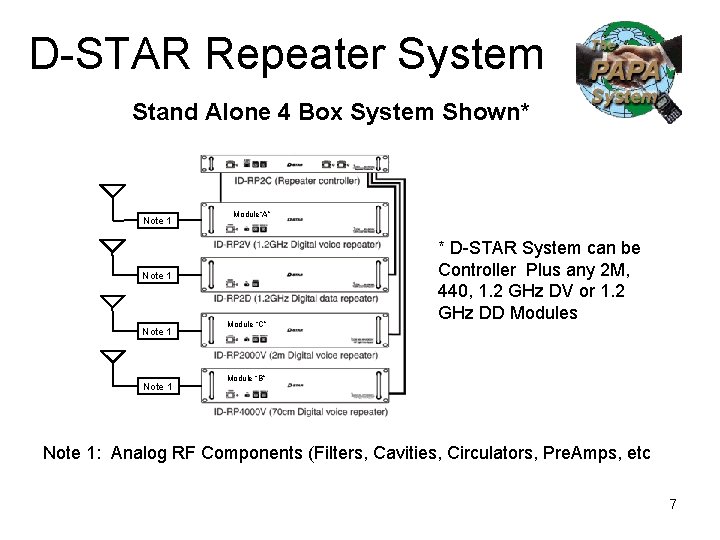
D-STAR Repeater System Stand Alone 4 Box System Shown* Note 1 Module“A” Note 1 Module “C” * D-STAR System can be Controller Plus any 2 M, 440, 1. 2 GHz DV or 1. 2 GHz DD Modules Module “B” Note 1: Analog RF Components (Filters, Cavities, Circulators, Pre. Amps, etc 7
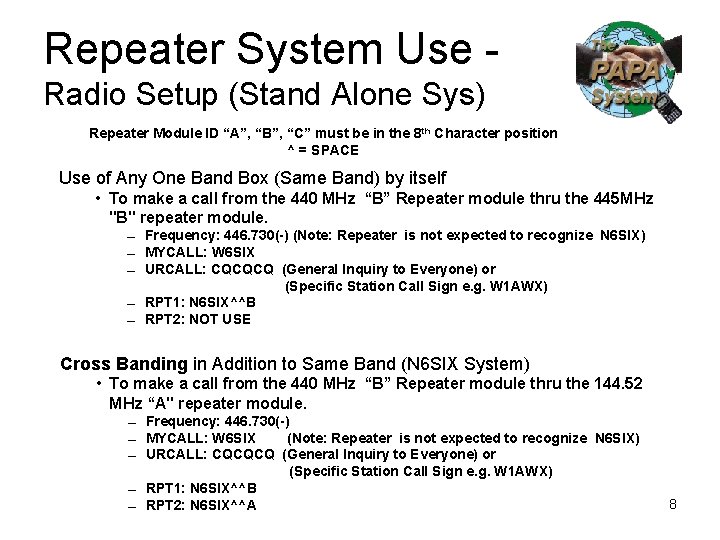
Repeater System Use Radio Setup (Stand Alone Sys) Repeater Module ID “A”, “B”, “C” must be in the 8 th Character position ^ = SPACE Use of Any One Band Box (Same Band) by itself • To make a call from the 440 MHz “B” Repeater module thru the 445 MHz "B" repeater module. Frequency: 446. 730(-) (Note: Repeater is not expected to recognize N 6 SIX) MYCALL: W 6 SIX URCALL: CQCQCQ (General Inquiry to Everyone) or (Specific Station Call Sign e. g. W 1 AWX) RPT 1: N 6 SIX^^B RPT 2: NOT USE Cross Banding in Addition to Same Band (N 6 SIX System) • To make a call from the 440 MHz “B” Repeater module thru the 144. 52 MHz “A" repeater module. Frequency: 446. 730(-) MYCALL: W 6 SIX (Note: Repeater is not expected to recognize N 6 SIX) URCALL: CQCQCQ (General Inquiry to Everyone) or (Specific Station Call Sign e. g. W 1 AWX) RPT 1: N 6 SIX^^B RPT 2: N 6 SIX^^A 8
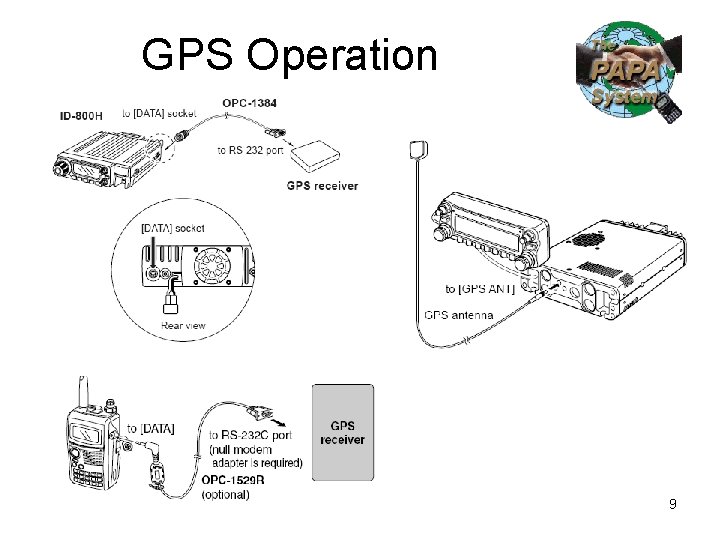
GPS Operation 9
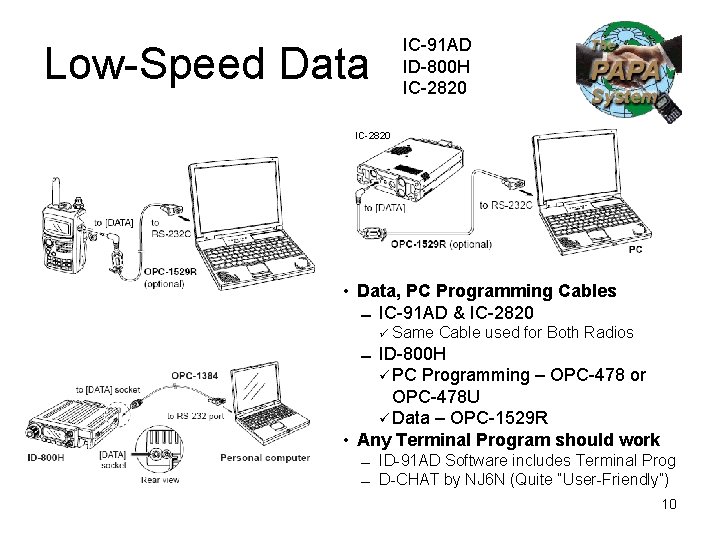
IC-91 AD ID-800 H IC-2820 Low-Speed Data IC-2820 • Data, PC Programming Cables IC-91 AD & IC-2820 ü Same Cable used for Both Radios ID-800 H ü PC Programming – OPC-478 or OPC-478 U ü Data – OPC-1529 R • Any Terminal Program should work ID-91 AD Software includes Terminal Prog D-CHAT by NJ 6 N (Quite “User-Friendly”) 10
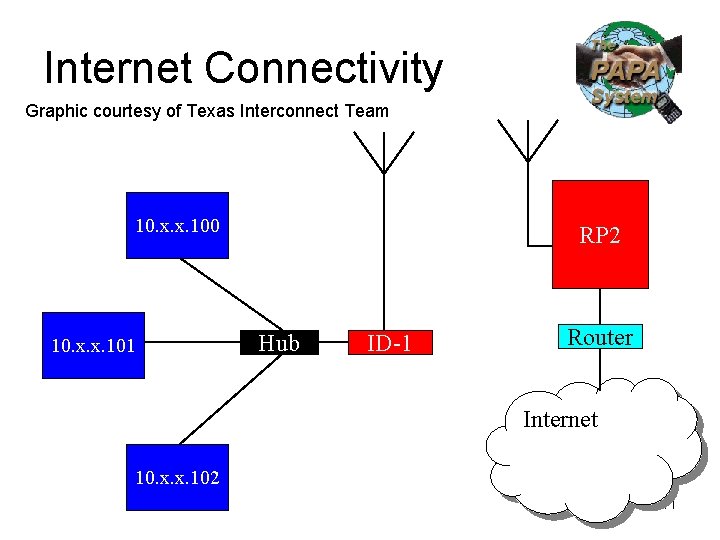
Internet Connectivity Graphic courtesy of Texas Interconnect Team 10. x. x. 100 10. x. x. 101 RP 2 Hub ID-1 Router Internet 10. x. x. 102 11
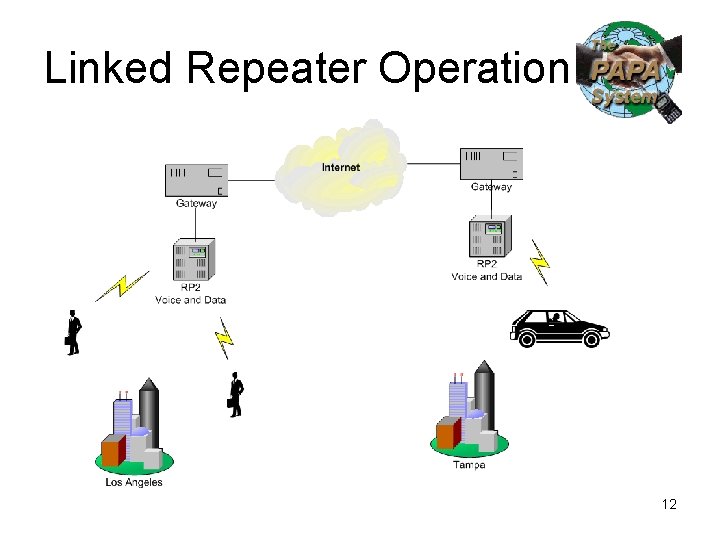
Linked Repeater Operation 12
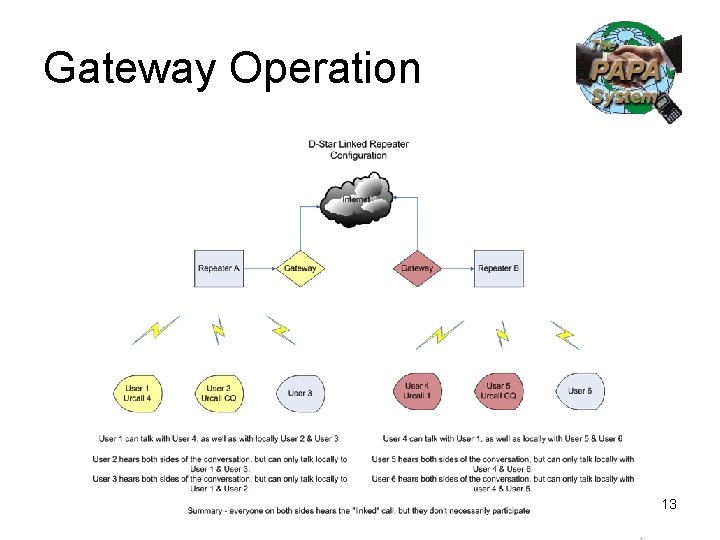
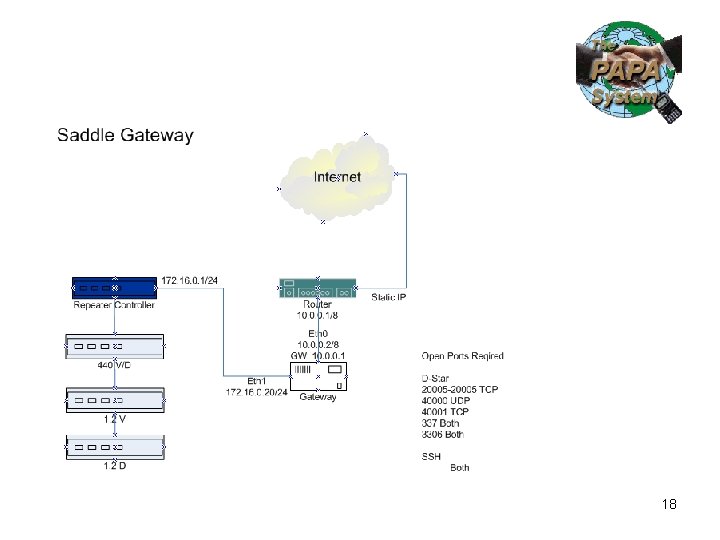
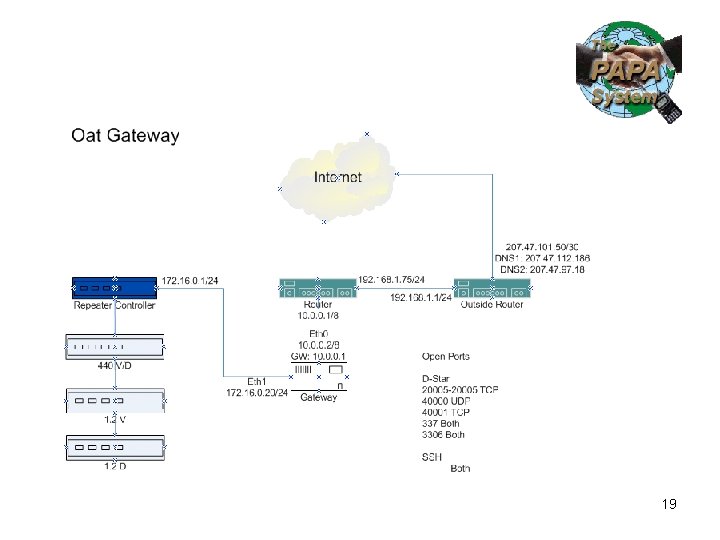
Gateway Operation 13
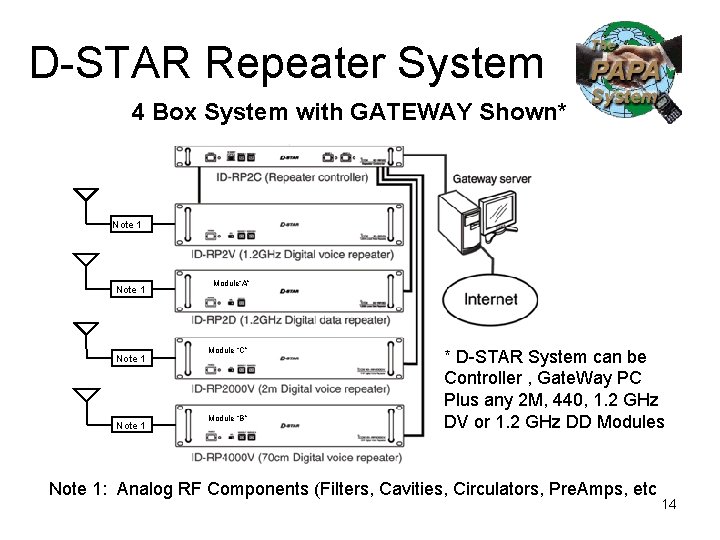
D-STAR Repeater System 4 Box System with GATEWAY Shown* Note 1 Module“A” Module “C” Module “B” * D-STAR System can be Controller , Gate. Way PC Plus any 2 M, 440, 1. 2 GHz DV or 1. 2 GHz DD Modules Note 1: Analog RF Components (Filters, Cavities, Circulators, Pre. Amps, etc 14
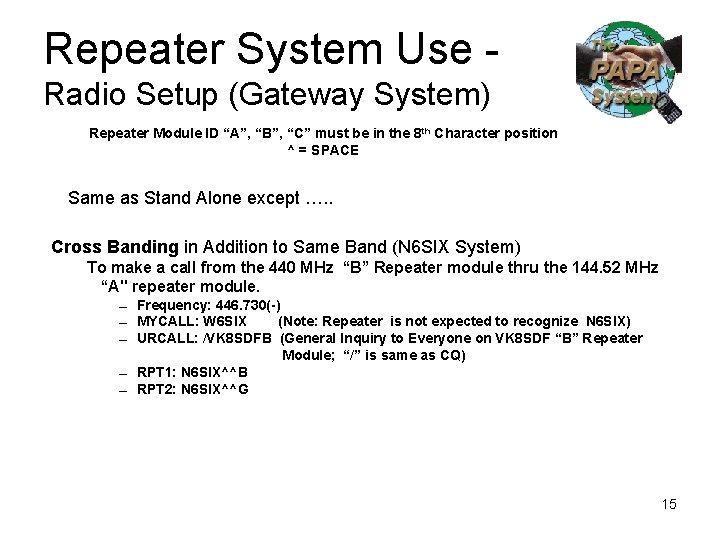
Repeater System Use Radio Setup (Gateway System) Repeater Module ID “A”, “B”, “C” must be in the 8 th Character position ^ = SPACE Same as Stand Alone except …. . Cross Banding in Addition to Same Band (N 6 SIX System) To make a call from the 440 MHz “B” Repeater module thru the 144. 52 MHz “A" repeater module. Frequency: 446. 730(-) MYCALL: W 6 SIX (Note: Repeater is not expected to recognize N 6 SIX) URCALL: /VK 8 SDFB (General Inquiry to Everyone on VK 8 SDF “B” Repeater Module; “/” is same as CQ) RPT 1: N 6 SIX^^B RPT 2: N 6 SIX^^G 15
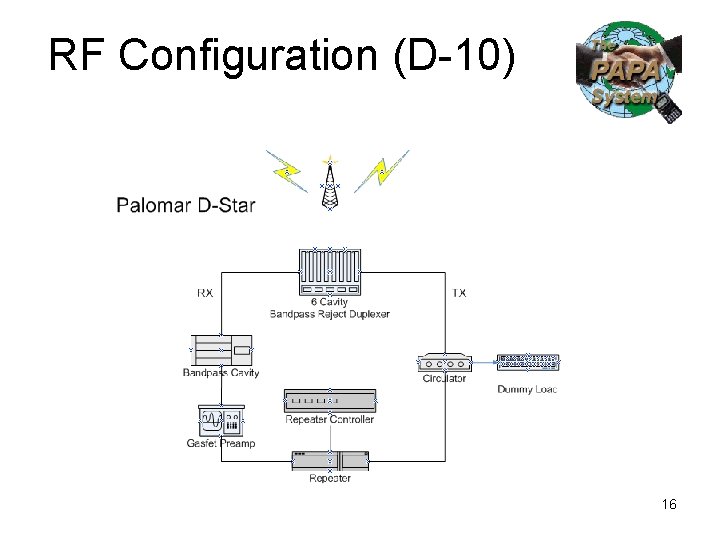
RF Configuration (D-10) 16
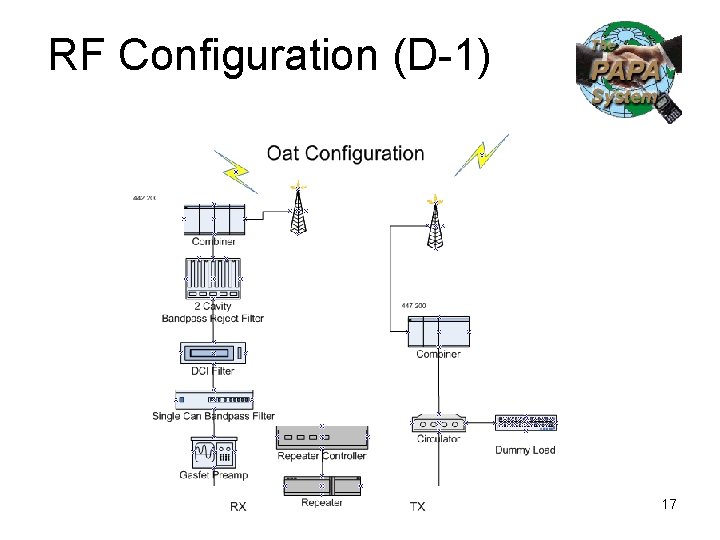
RF Configuration (D-1) 17
18
19
Additional Benefits • Extensive support via forums and user groups • Radios work in both digital and analog modes and dual banders are available • 53 repeaters now on Gateway network • Probably between 80 -100 repeaters on the air • Lower bandwidth requirements (6. 25 KHz vs. 10 KHz) • Digital messaging in Digital Voice mode (i. e. , works on 2 M, 440 or 1. 2 GHz) • Location services (e. g. , D-PRS/APRS) • IP compatible, open JARL standard 20
Resources • http: //www. icomamerica. com/amateur/dstar/default. asp Icom D-Star Home • illinoisdigitalham (Yahoo Group, digital radio in general, including D-Star) • http: //www. hamradio-dv. org/ Digital Radio Audio Comparisons • http: //www. icomamerica. com/support/forums/ D-Star Forums (ICOM hosted) • http: //www. arrl-al. org/D-STAR_class_2. pdf DSTAR Radios • http: //www. icomamerica. com/downloads/manuals. asp Icomamerica manuals downloads (ICOM hosted) • http: //www. ccdastronomy. org/D-Star (this presentation, in the “about D-Star” section) 21
Radios Now Available • ID-1 1. 2 GHz Mobile (10 Watts, High Speed Digital Data, Digital Voice, Analog Voice) -- $979 • ID-800 H 2 M/440 Mobile (55 Watt VHF/50 Watt UHF Digital Voice and Data, Analog Voice -- $610 • IC-2200 H 2 M Mobile (65 Watt VHF Digital Voice and Data -- $350 with optional digital module • IC-V 82/U 82 2 M/440 HT (Digital Voice and Data) -- $390 with optional digital module • IC-91 AD 2 M/440 HT (Digital Voice and Data, Analog Voice) -- $628 with digital module • IC-2820 Dual Band Mobile (Analog and Digital) -- approx. $950 with optional DV module • Home brew 2 -meter demonstrated at Dayton this year 22
Requirements • Filters required for repeater in dense RF environments • Internet access required for Gateway – Static IP required, DSL bandwidth • Gateway software runs only on Linux (Fedora Core 4 is recommended) • Repeaters must have unique call signs • Gateway operation requires certification – Take and Pass (Complete) ICOM Administrator Course • Familiarity with basic Linux terminal commands is very helpful for Gateway configuration 23
Challenges • Getting coordinated pairs on 440 (may be able to allocate an existing pair) • ICOM controller lacks many features – Linkcom will develop D-Star capable controller • ICOM proprietary components – Codec (has been replicated) – Gateway (opendstar. org to develop open source version) • 10 GHz link system is not available in US 24
The Cutting Edge? • Not the only digital game in town, but it works out of the box • Excellent performance on 440 • ISDN rate internet access via ID-1 • Transparent call routing throughout the DStar Network • Significant experimentation and innovation is occurring (e. g. , home brew radios, openstar. org) 25