
Digital Transmission Line coding 2 nd semester 1439

- Slides: 43
Digital Transmission Line coding 2 nd semester 1439 -1440 NET 205: Data Transmission and Digital Communication
2 205 NET CLO 1 -Introduction to Communication Systems and Networks architecture OSI Reference Model. 2 - Data Transmission Principles 3 - Transmission medias 4 - Data modulation and encoding
3 Outline ü Digital to Digital Conversion ü Some Properties of Line Coding ü Line Coding Schemes ü Block Coding
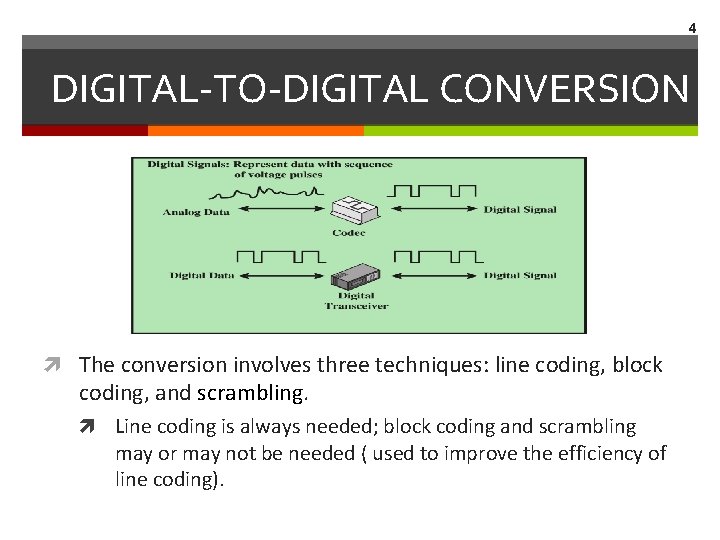
4 DIGITAL-TO-DIGITAL CONVERSION The conversion involves three techniques: line coding, block coding, and scrambling. Line coding is always needed; block coding and scrambling may or may not be needed ( used to improve the efficiency of line coding).
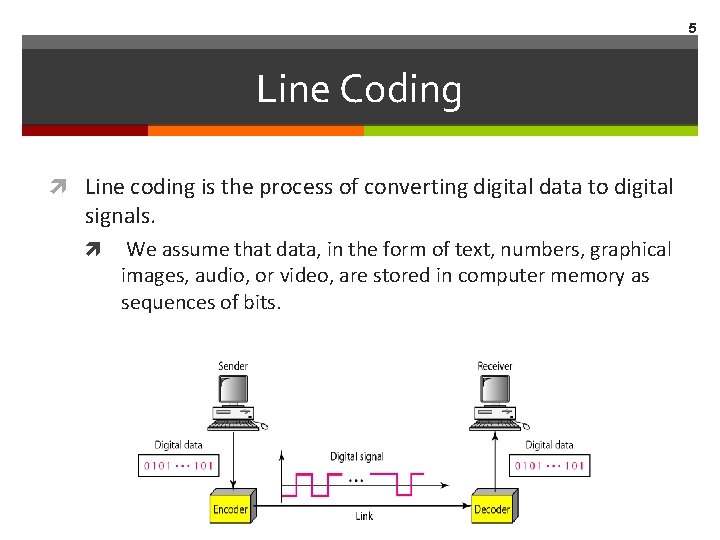
5 Line Coding Line coding is the process of converting digital data to digital signals. We assume that data, in the form of text, numbers, graphical images, audio, or video, are stored in computer memory as sequences of bits.
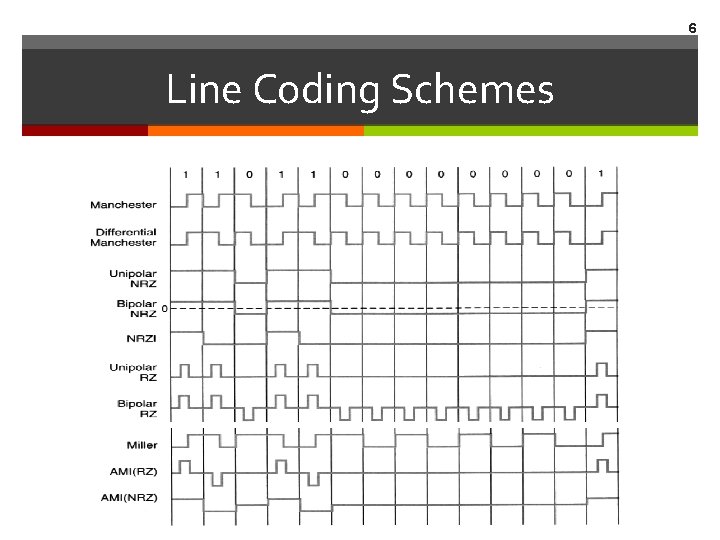
6 Line Coding Schemes
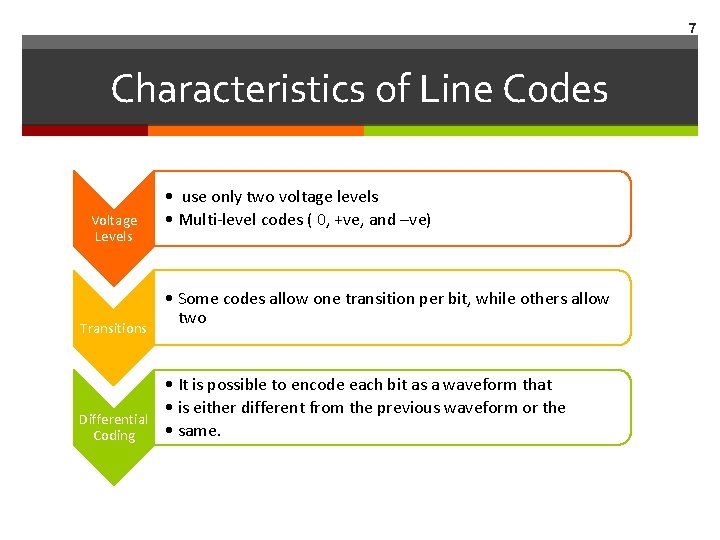
7 Characteristics of Line Codes Voltage Levels Transitions • use only two voltage levels • Multi-level codes ( 0, +ve, and –ve) • Some codes allow one transition per bit, while others allow two • It is possible to encode each bit as a waveform that • is either different from the previous waveform or the Differential • same. Coding
8 Outline ü Digital to Digital Conversion ü Some Properties of Line Coding ü Data Elements versus Signal Elements ü Data Rate and Signal rate ü Bandwidth of a Digital Signal ü Baseline Wandering ü DC Components ü Self-synchronization ü Other Characteristics ü Line Coding Schemes ü Block Coding
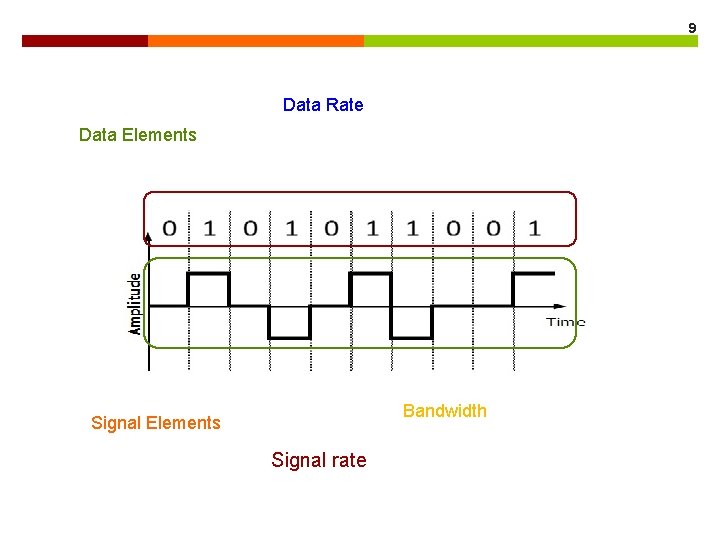
9 Data Rate Data Elements Bandwidth Signal Elements Signal rate
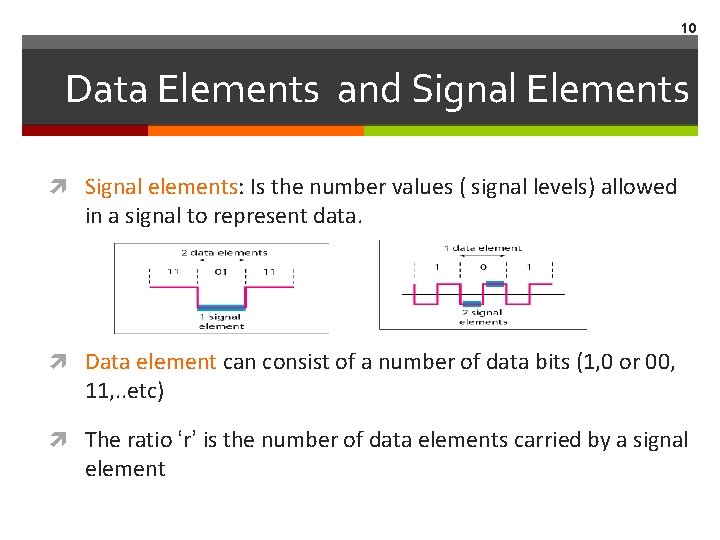
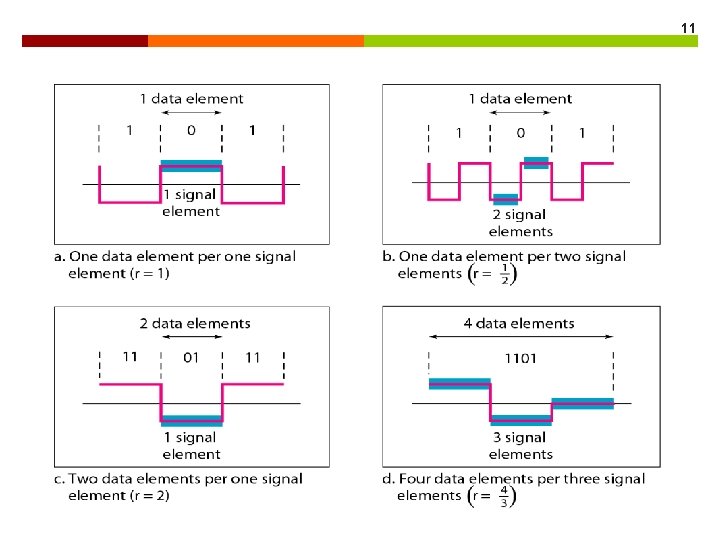
10 Data Elements and Signal Elements Signal elements: Is the number values ( signal levels) allowed in a signal to represent data. Data element can consist of a number of data bits (1, 0 or 00, 11, . . etc) The ratio ‘r’ is the number of data elements carried by a signal element
11
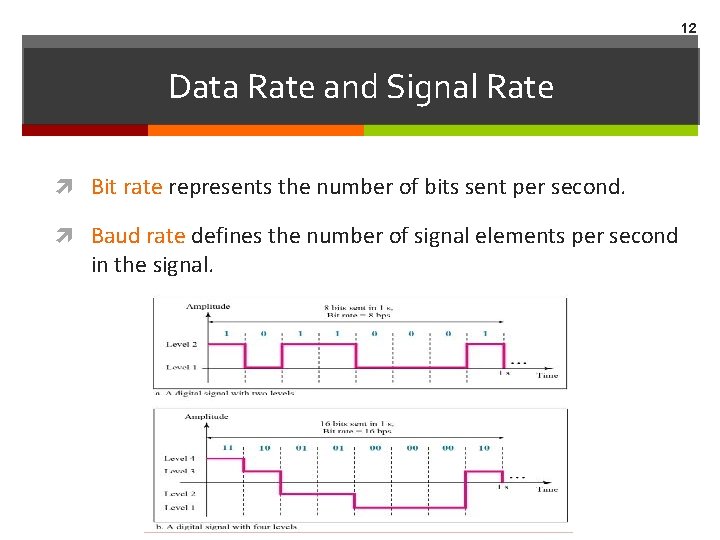
12 Data Rate and Signal Rate Bit rate represents the number of bits sent per second. Baud rate defines the number of signal elements per second in the signal.
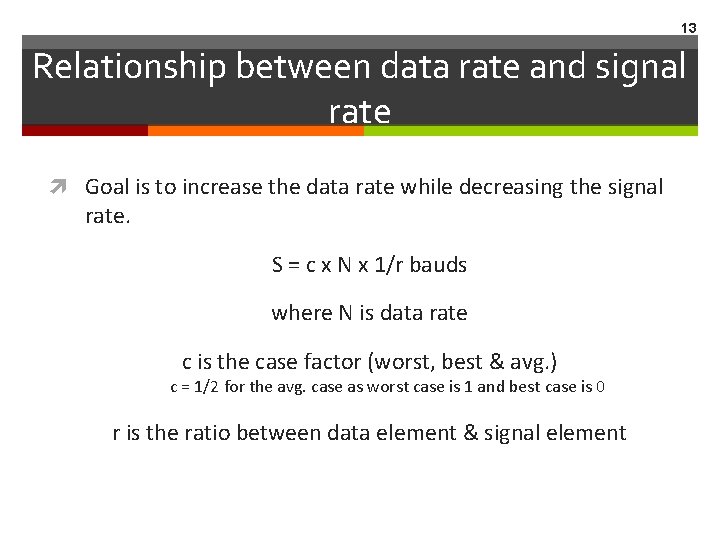
13 Relationship between data rate and signal rate Goal is to increase the data rate while decreasing the signal rate. S = c x N x 1/r bauds where N is data rate c is the case factor (worst, best & avg. ) c = 1/2 for the avg. case as worst case is 1 and best case is 0 r is the ratio between data element & signal element
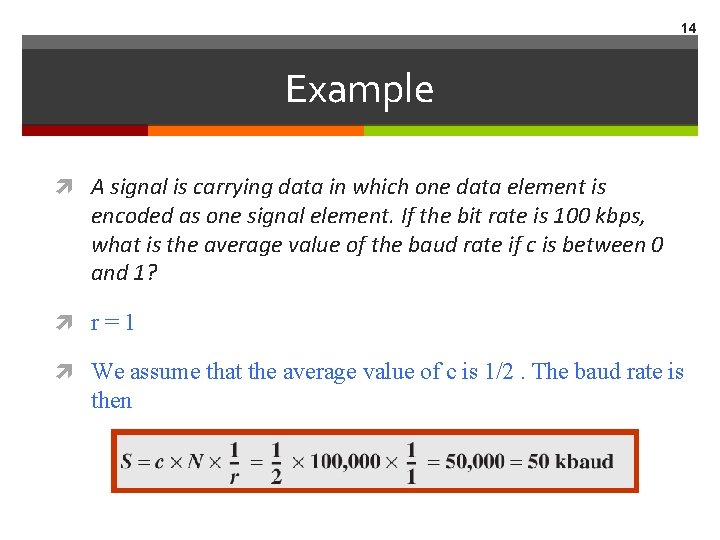
14 Example A signal is carrying data in which one data element is encoded as one signal element. If the bit rate is 100 kbps, what is the average value of the baud rate if c is between 0 and 1? r=1 We assume that the average value of c is 1/2. The baud rate is then
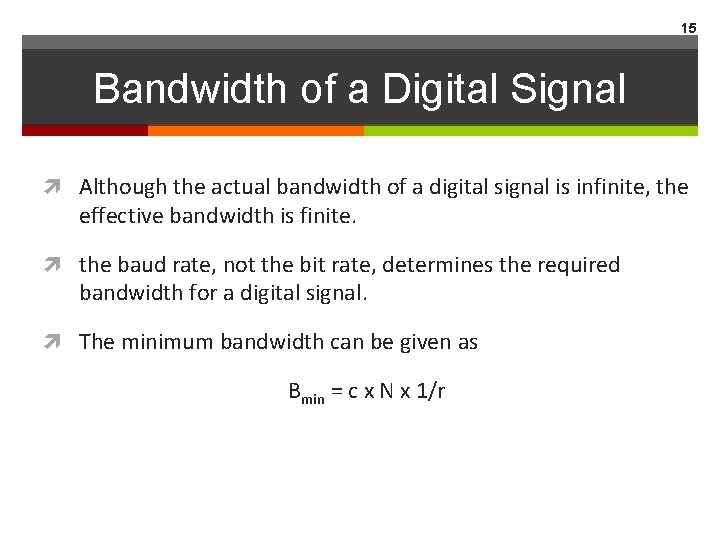
15 Bandwidth of a Digital Signal Although the actual bandwidth of a digital signal is infinite, the effective bandwidth is finite. the baud rate, not the bit rate, determines the required bandwidth for a digital signal. The minimum bandwidth can be given as Bmin = c x N x 1/r
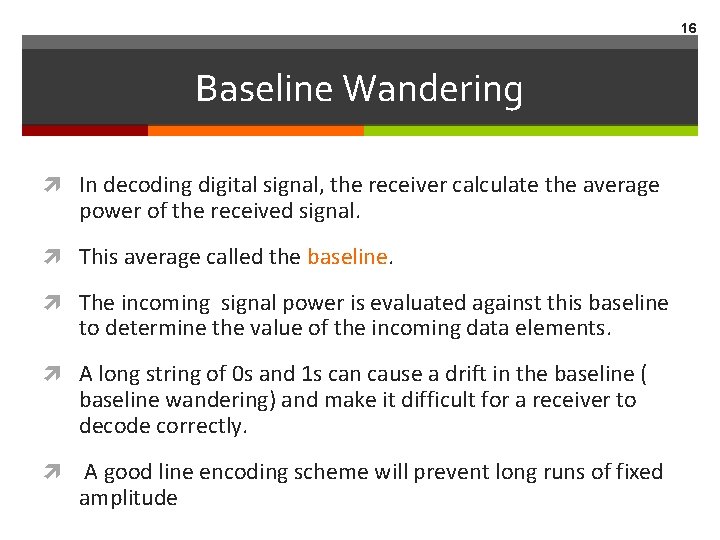
16 Baseline Wandering In decoding digital signal, the receiver calculate the average power of the received signal. This average called the baseline. The incoming signal power is evaluated against this baseline to determine the value of the incoming data elements. A long string of 0 s and 1 s can cause a drift in the baseline ( baseline wandering) and make it difficult for a receiver to decode correctly. A good line encoding scheme will prevent long runs of fixed amplitude
17 DC Components When the voltage level in a digital signal remains constant for long periods of time, there is an increase in the low frequencies of the signal. These frequencies around zero, called DC (direct-current) components. Most channels are band-pass and may not support the low frequencies. This will require the removal of the dc component of a transmitted signal.
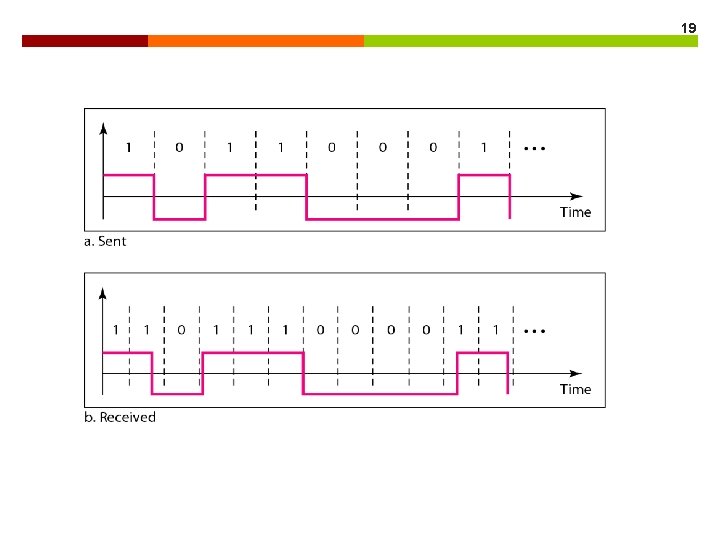
18 Self-synchronization The receiver's bit intervals must correspond exactly to the sender's bit intervals, to correctly interpret the received signals. If the receiver clock is faster or slower, the bit intervals are not matched and the receiver might misinterpret the signals. A self-synchronizing digital signal includes timing information in the data being transmitted. (transitions in the signal that alert the receiver to the beginning, middle, or end of the pulse).
19
20 Other Characteristics Built-in Error Detection It is desirable to have a built-in error-detecting capability in the generated code to detect some of or all the errors that occurred during transmission. Complexity: A complex scheme is more costly to implement than a simple one. Immunity to Noise and Interference: Another desirable code characteristic
21 Outline ü Digital to Digital Conversion ü Some properties of Line Coding ü Line Coding Schemes ü Block Coding
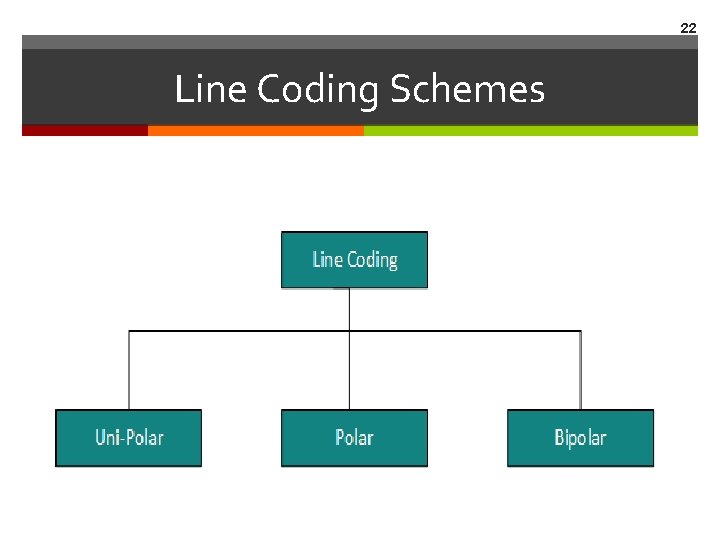
22 Line Coding Schemes
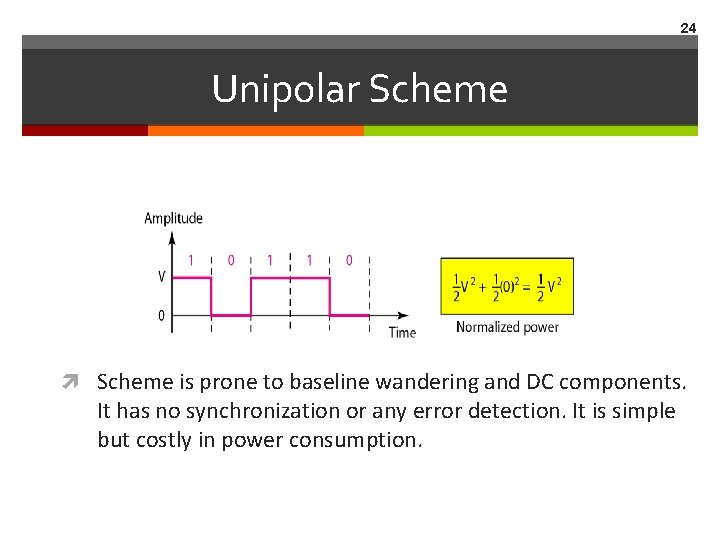
23 Unipolar Scheme It is very simple and very primitive. Unipolar encoding is so named because it uses only one polarity. This polarity is assigned to one of the two binary states, usually the 1. The other state, usually the 0, is represented by zero voltage. all the signal levels are on one side of the time axis, either above or below.
24 Unipolar Scheme is prone to baseline wandering and DC components. It has no synchronization or any error detection. It is simple but costly in power consumption.
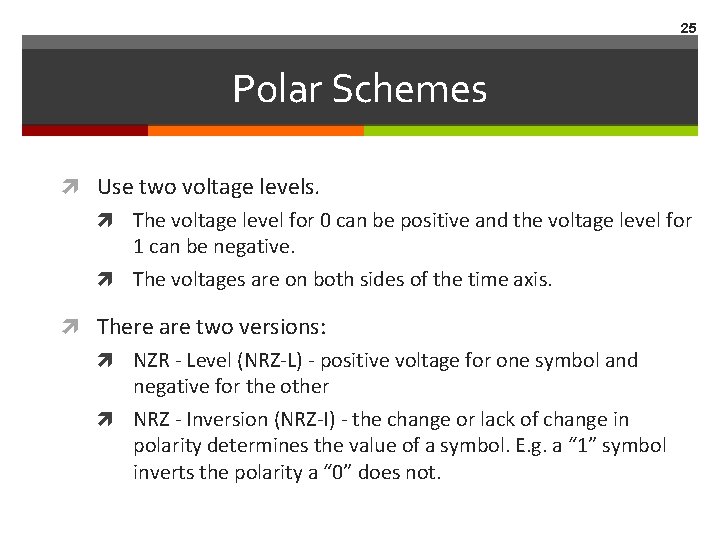
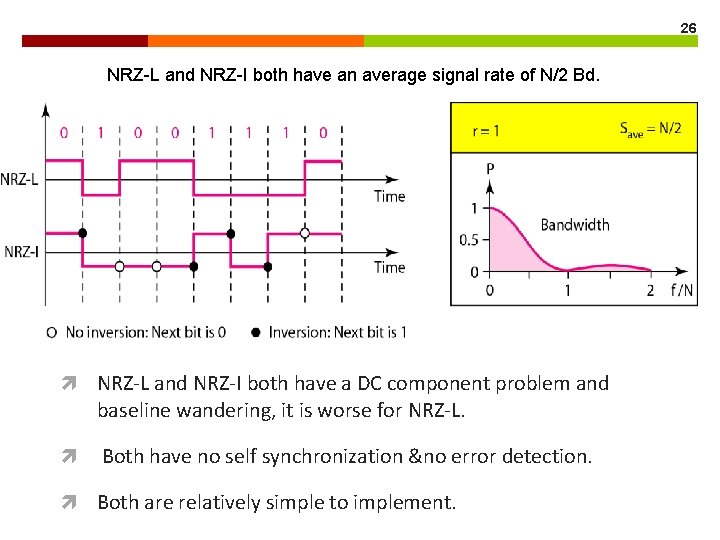
25 Polar Schemes Use two voltage levels. The voltage level for 0 can be positive and the voltage level for 1 can be negative. The voltages are on both sides of the time axis. There are two versions: NZR - Level (NRZ-L) - positive voltage for one symbol and negative for the other NRZ - Inversion (NRZ-I) - the change or lack of change in polarity determines the value of a symbol. E. g. a “ 1” symbol inverts the polarity a “ 0” does not.
26 NRZ-L and NRZ-I both have an average signal rate of N/2 Bd. NRZ-L and NRZ-I both have a DC component problem and baseline wandering, it is worse for NRZ-L. Both have no self synchronization &no error detection. Both are relatively simple to implement.
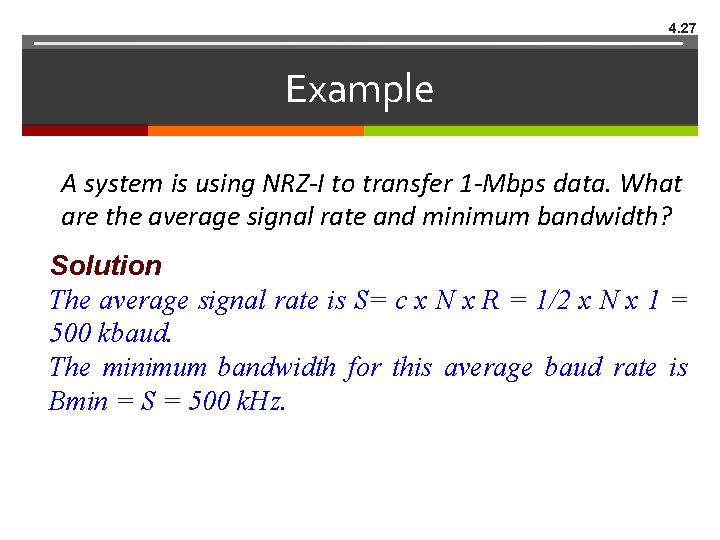
4. 27 Example A system is using NRZ-I to transfer 1 -Mbps data. What are the average signal rate and minimum bandwidth? Solution The average signal rate is S= c x N x R = 1/2 x N x 1 = 500 kbaud. The minimum bandwidth for this average baud rate is Bmin = S = 500 k. Hz.
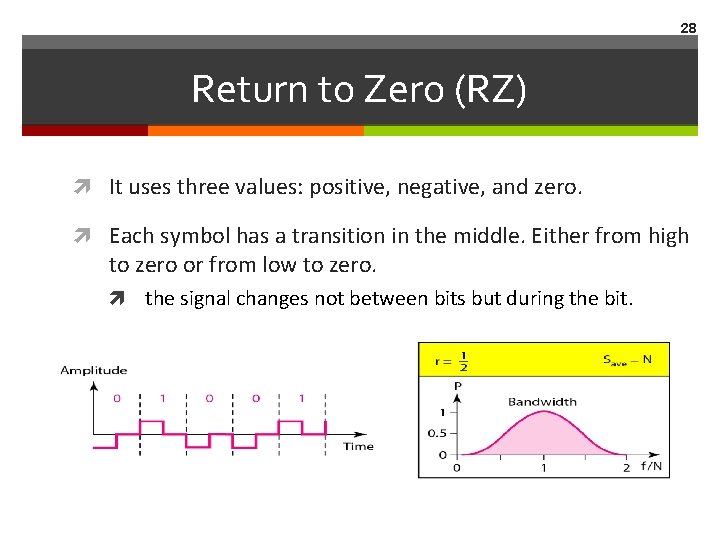
28 Return to Zero (RZ) It uses three values: positive, negative, and zero. Each symbol has a transition in the middle. Either from high to zero or from low to zero. the signal changes not between bits but during the bit.
29 Return to Zero (RZ) This scheme has more signal transitions (two per symbol) and therefore requires a wider bandwidth. No DC components or baseline wandering. Self synchronization. More complex as it uses three voltage level. It has no error detection capability.
30 Manchester and Differential Manchester coding consists of combining the NRZ-L and RZ schemes. Every symbol has a level transition in the middle: from high to low or low to high. Uses only two voltage levels. Differential Manchester coding consists of combining the NRZ -I and RZ schemes. Every symbol has a level transition in the middle. But the level at the beginning of the symbol is determined by the symbol value. One symbol causes a level change the other does not.
31
32 Manchester and Differential Manchester In Manchester and differential Manchester encoding, the transition at the middle of the bit is used for synchronization The minimum bandwidth of Manchester and differential Manchester is 2 times that of NRZ. The is no DC component and no baseline wandering. None of these codes has error detection
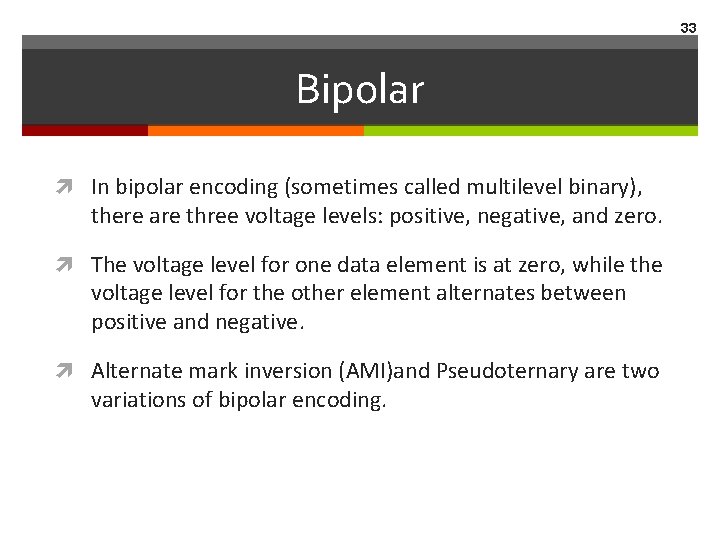
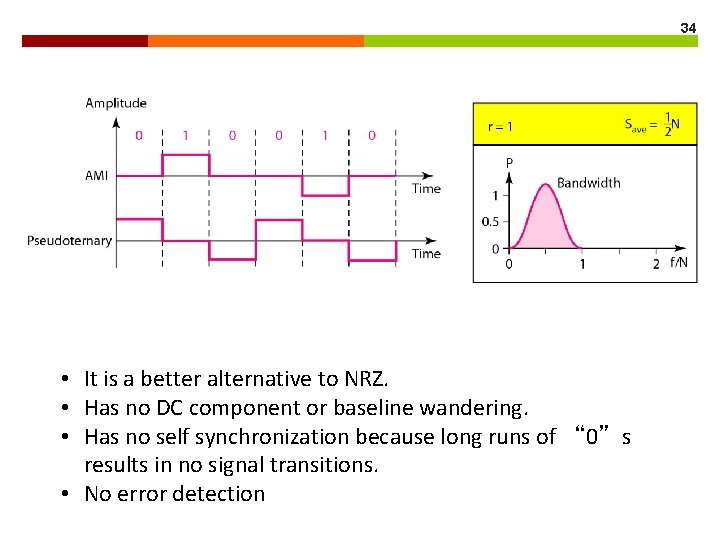
33 Bipolar In bipolar encoding (sometimes called multilevel binary), there are three voltage levels: positive, negative, and zero. The voltage level for one data element is at zero, while the voltage level for the other element alternates between positive and negative. Alternate mark inversion (AMI)and Pseudoternary are two variations of bipolar encoding.
34 • It is a better alternative to NRZ. • Has no DC component or baseline wandering. • Has no self synchronization because long runs of “ 0”s results in no signal transitions. • No error detection
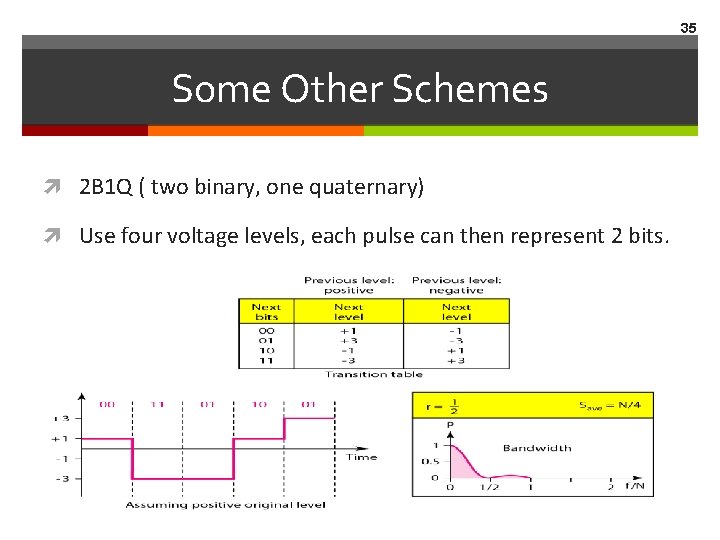
35 Some Other Schemes 2 B 1 Q ( two binary, one quaternary) Use four voltage levels, each pulse can then represent 2 bits.
36 Outline ü Digital to Digital Conversion ü Some Characteristics of Line Coding ü Line Coding Schemes ü Block Coding
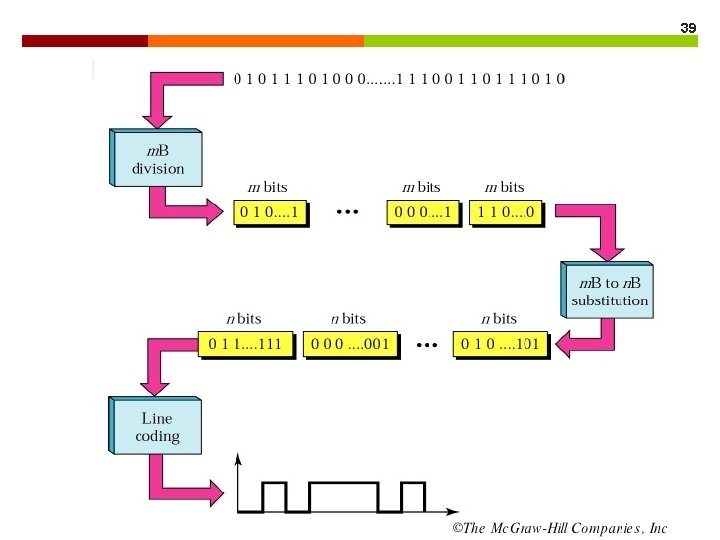
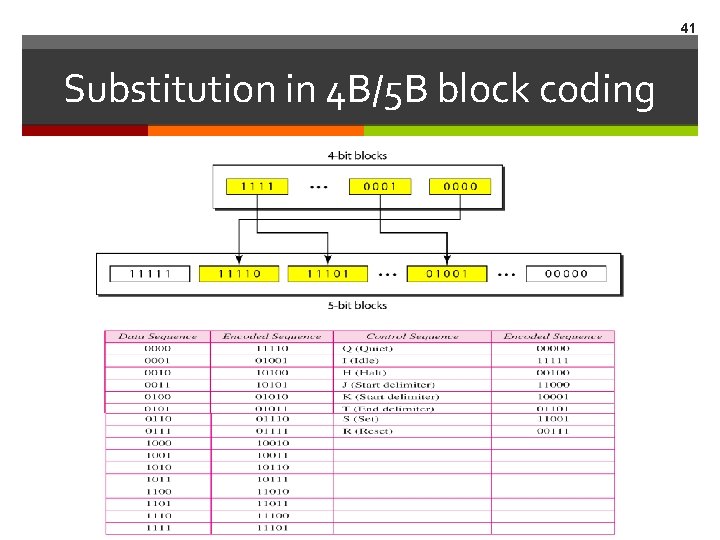
37 Block Coding Two improve the performance of line coding, block coding was introduced. Adding redundancy (extra bits to the data bits) help to ensure synchronization and to provide some kind of inherent error detecting. In general, block coding changes a block of m bits into a block of n bits, where n is larger than m. Block coding is referred to as an m. B/n. B encoding technique. Block coding normally involves three steps: division, substitution, and combination
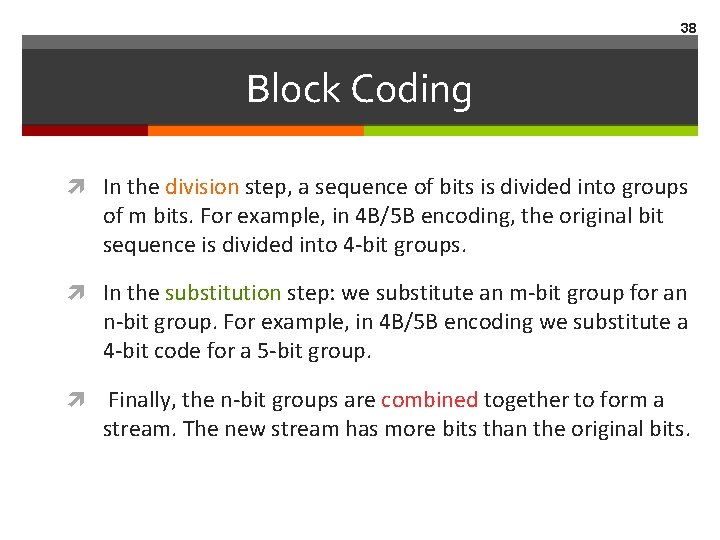
38 Block Coding In the division step, a sequence of bits is divided into groups of m bits. For example, in 4 B/5 B encoding, the original bit sequence is divided into 4 -bit groups. In the substitution step: we substitute an m-bit group for an n-bit group. For example, in 4 B/5 B encoding we substitute a 4 -bit code for a 5 -bit group. Finally, the n-bit groups are combined together to form a stream. The new stream has more bits than the original bits.
39
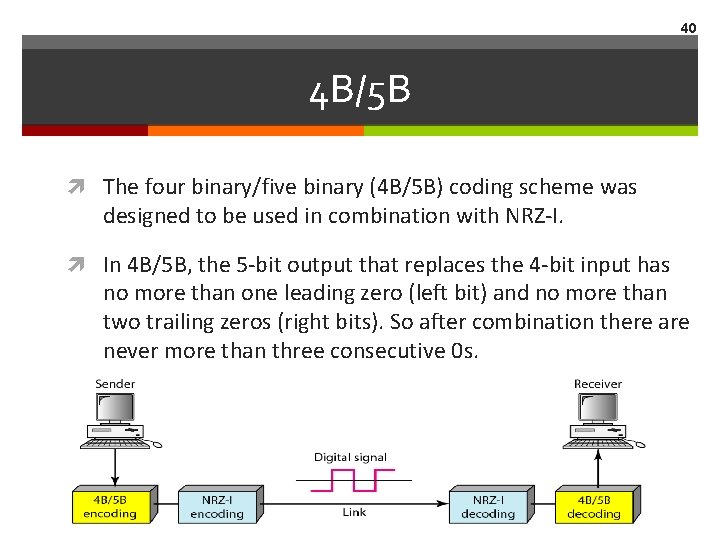
40 4 B/5 B The four binary/five binary (4 B/5 B) coding scheme was designed to be used in combination with NRZ-I. In 4 B/5 B, the 5 -bit output that replaces the 4 -bit input has no more than one leading zero (left bit) and no more than two trailing zeros (right bits). So after combination there are never more than three consecutive 0 s.
41 Substitution in 4 B/5 B block coding
42 Redundancy A 4 bit can have 16 combinations. A 5 bit can have 32 combinations. We therefore have 32 - 16 = 16 extra groups that are not used for 4 B/5 B encoding. Some of the extra groups are used for control/signalling purposes. Error detection: If a 5 -bit group arrives that belongs to the unused portion of the table, the receiver knows that there is an error in the transmission.
43 Any Questions ?