
Digital Transformation in Tax Administration Manila Philippines June



- Slides: 42
Digital Transformation in Tax Administration Manila, Philippines June 28, 2019 Behavioral design in tax administration Jaffar Al-Rikabi Economist Macroeconomics, Trade and Investment Global Practice
Behavioral designin tax administration: Contents 1. Understanding Taxpayer Behavior 2. Nudging 3. When nudges fail Behavioral design in tax administration 2
Behavioral designin tax administration: Contents 1. Understanding Taxpayer Behavior 2. Nudging 3. When nudges fail Behavioral design in tax administration 3
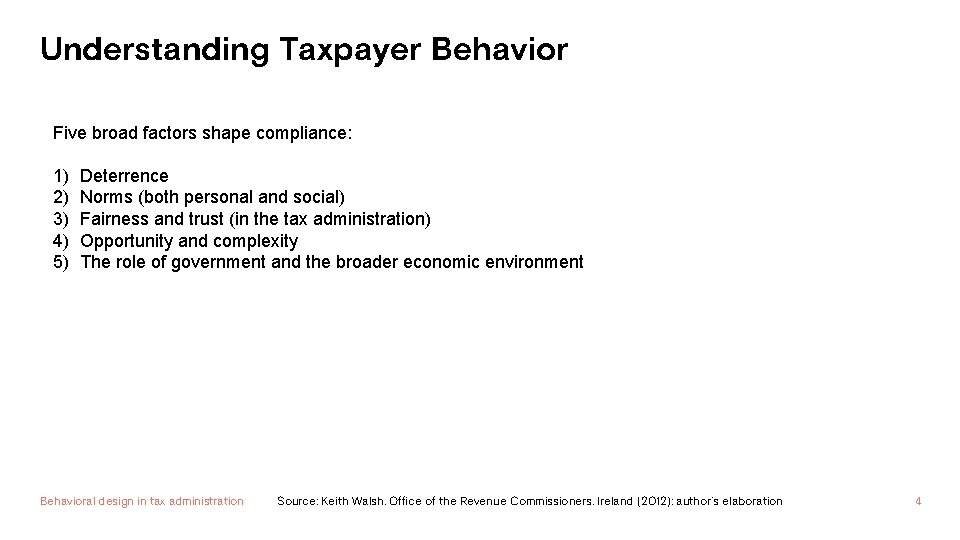
Understanding Taxpayer Behavior Five broad factors shape compliance: 1) Deterrence 2) Norms (both personal and social) 3) Fairness and trust (in the tax administration) 4) Opportunity and complexity 5) The role of government and the broader economic environment Behavioral design in tax administration Source: Keith Walsh, Office of the Revenue Commissioners, Ireland (2012); author’s elaboration 4
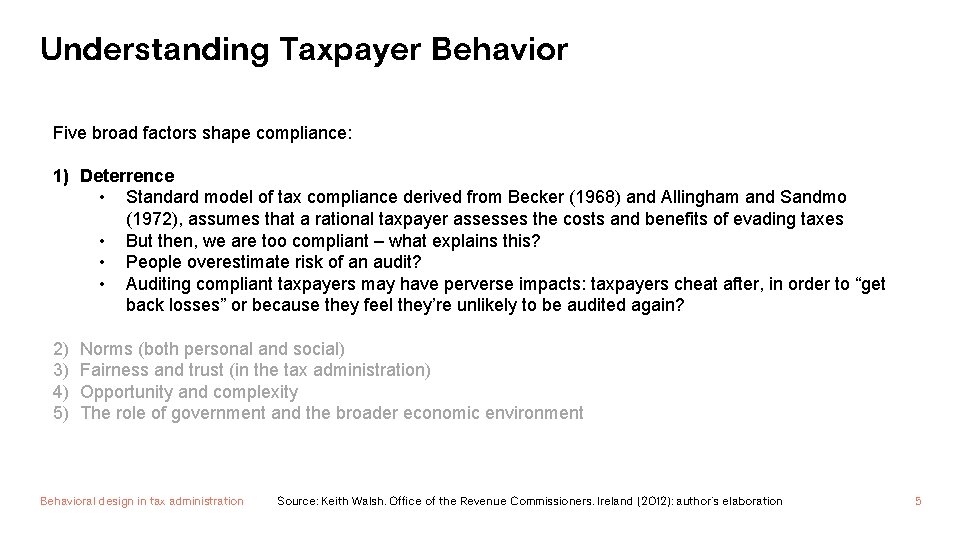
Understanding Taxpayer Behavior Five broad factors shape compliance: 1) Deterrence • Standard model of tax compliance derived from Becker (1968) and Allingham and Sandmo (1972), assumes that a rational taxpayer assesses the costs and benefits of evading taxes • But then, we are too compliant – what explains this? • People overestimate risk of an audit? • Auditing compliant taxpayers may have perverse impacts: taxpayers cheat after, in order to “get back losses” or because they feel they’re unlikely to be audited again? 2) 3) 4) 5) Norms (both personal and social) Fairness and trust (in the tax administration) Opportunity and complexity The role of government and the broader economic environment Behavioral design in tax administration Source: Keith Walsh, Office of the Revenue Commissioners, Ireland (2012); author’s elaboration 5
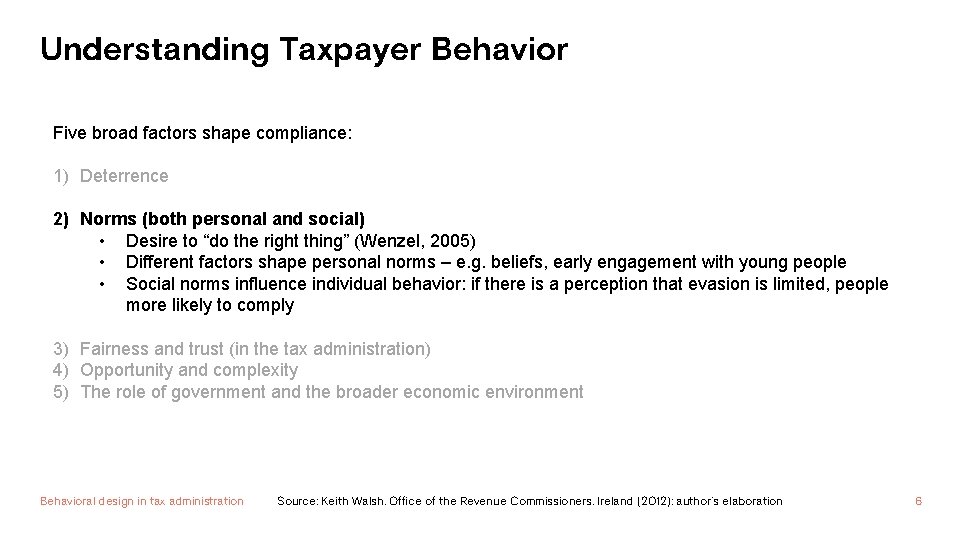
Understanding Taxpayer Behavior Five broad factors shape compliance: 1) Deterrence 2) Norms (both personal and social) • Desire to “do the right thing” (Wenzel, 2005) • Different factors shape personal norms – e. g. beliefs, early engagement with young people • Social norms influence individual behavior: if there is a perception that evasion is limited, people more likely to comply 3) Fairness and trust (in the tax administration) 4) Opportunity and complexity 5) The role of government and the broader economic environment Behavioral design in tax administration Source: Keith Walsh, Office of the Revenue Commissioners, Ireland (2012); author’s elaboration 6
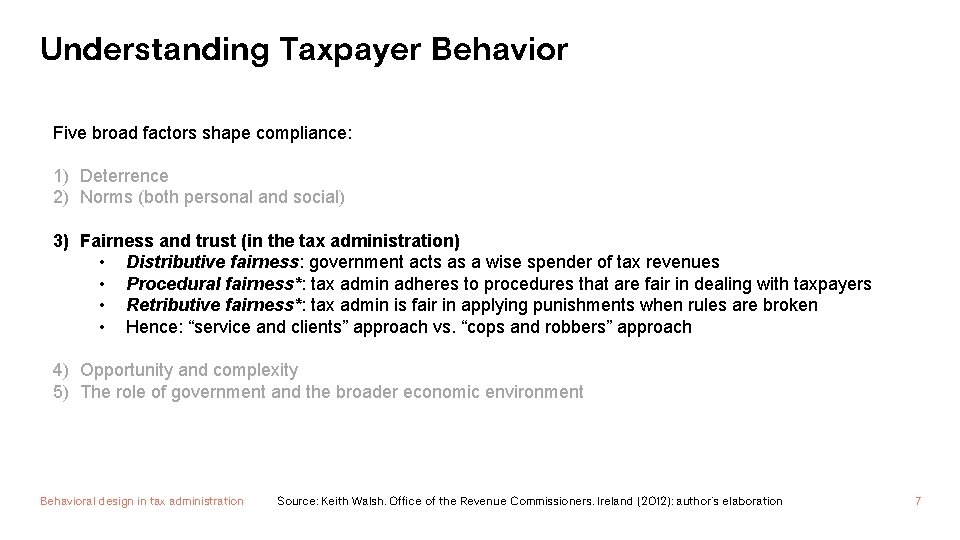
Understanding Taxpayer Behavior Five broad factors shape compliance: 1) Deterrence 2) Norms (both personal and social) 3) Fairness and trust (in the tax administration) • Distributive fairness: government acts as a wise spender of tax revenues • Procedural fairness*: tax admin adheres to procedures that are fair in dealing with taxpayers • Retributive fairness*: tax admin is fair in applying punishments when rules are broken • Hence: “service and clients” approach vs. “cops and robbers” approach 4) Opportunity and complexity 5) The role of government and the broader economic environment Behavioral design in tax administration Source: Keith Walsh, Office of the Revenue Commissioners, Ireland (2012); author’s elaboration 7
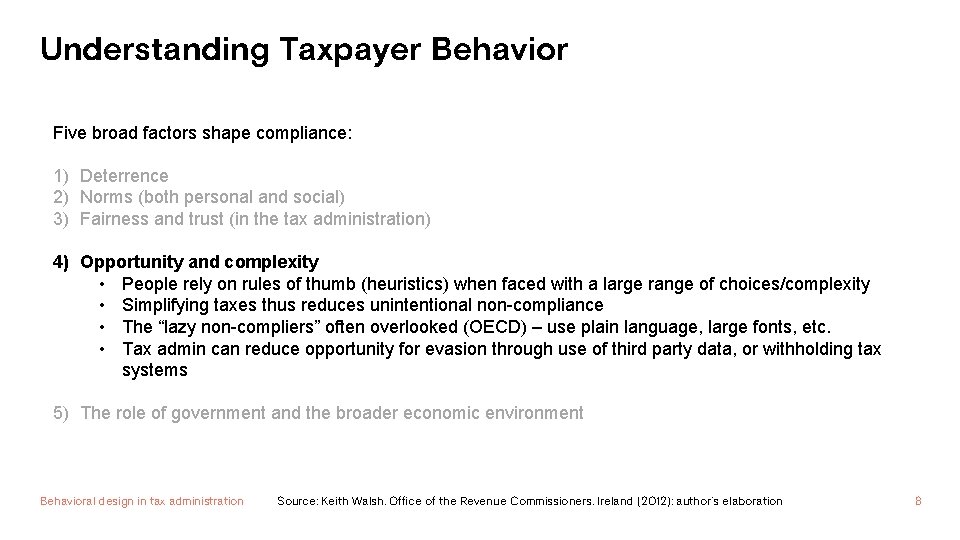
Understanding Taxpayer Behavior Five broad factors shape compliance: 1) Deterrence 2) Norms (both personal and social) 3) Fairness and trust (in the tax administration) 4) Opportunity and complexity • People rely on rules of thumb (heuristics) when faced with a large range of choices/complexity • Simplifying taxes thus reduces unintentional non-compliance • The “lazy non-compliers” often overlooked (OECD) – use plain language, large fonts, etc. • Tax admin can reduce opportunity for evasion through use of third party data, or withholding tax systems 5) The role of government and the broader economic environment Behavioral design in tax administration Source: Keith Walsh, Office of the Revenue Commissioners, Ireland (2012); author’s elaboration 8
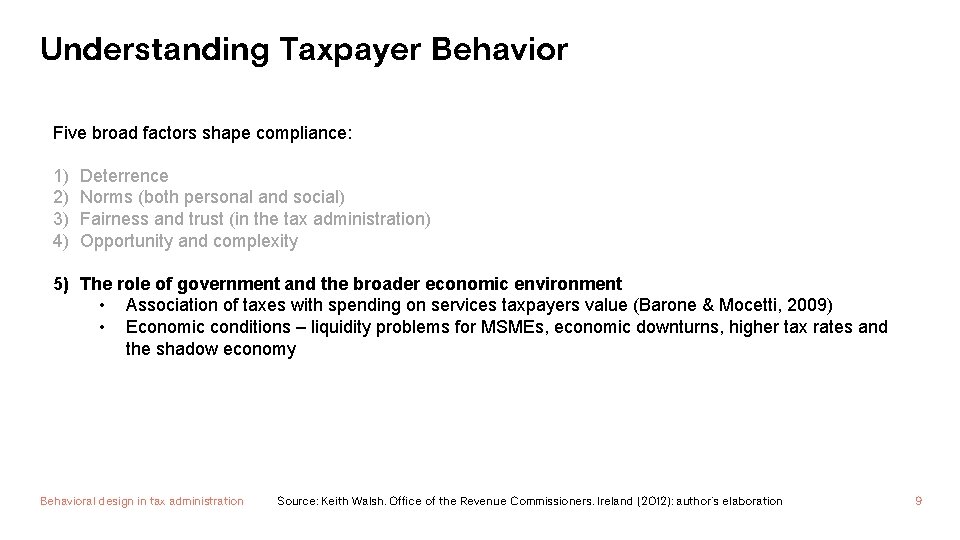
Understanding Taxpayer Behavior Five broad factors shape compliance: 1) 2) 3) 4) Deterrence Norms (both personal and social) Fairness and trust (in the tax administration) Opportunity and complexity 5) The role of government and the broader economic environment • Association of taxes with spending on services taxpayers value (Barone & Mocetti, 2009) • Economic conditions – liquidity problems for MSMEs, economic downturns, higher tax rates and the shadow economy Behavioral design in tax administration Source: Keith Walsh, Office of the Revenue Commissioners, Ireland (2012); author’s elaboration 9
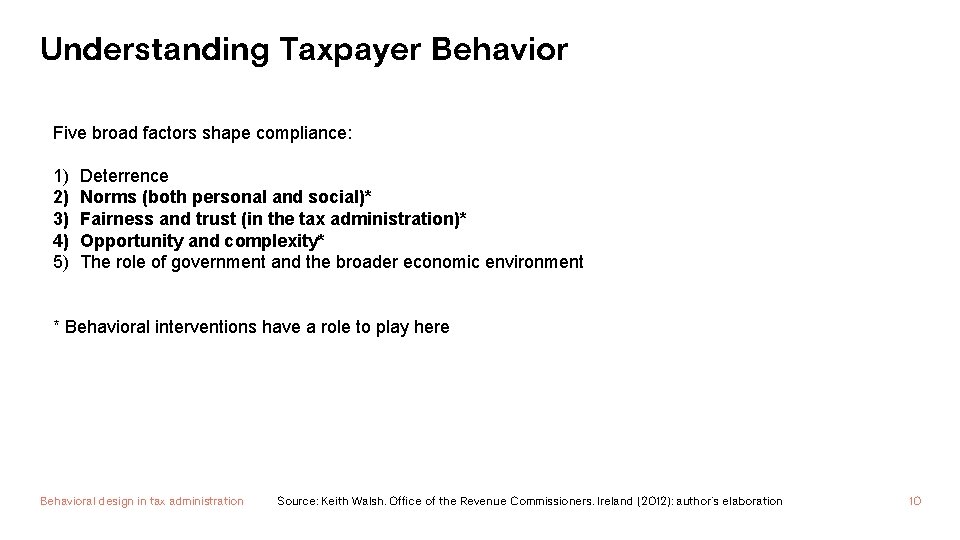
Understanding Taxpayer Behavior Five broad factors shape compliance: 1) Deterrence 2) Norms (both personal and social)* 3) Fairness and trust (in the tax administration)* 4) Opportunity and complexity* 5) The role of government and the broader economic environment * Behavioral interventions have a role to play here Behavioral design in tax administration Source: Keith Walsh, Office of the Revenue Commissioners, Ireland (2012); author’s elaboration 10
Behavioral designin tax administration: Contents 1. Understanding Taxpayer Behavior 2. Nudging 3. When nudges fail Behavioral design in tax administration 11
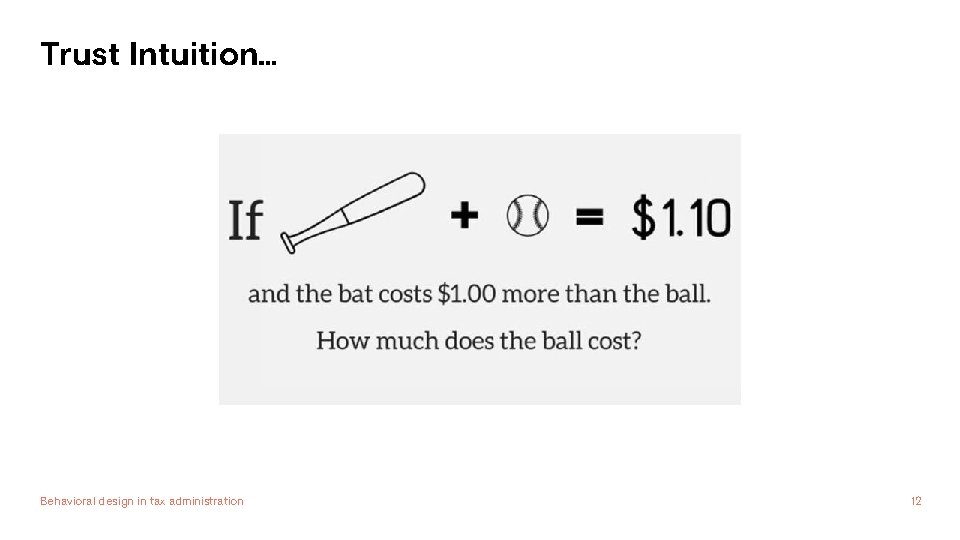
Trust Intuition… Behavioral design in tax administration 12
Why nudge? Behavioral design in tax administration 13
Why nudge? Behavioral design in tax administration 14
Why nudge? Behavioral design in tax administration 15
Why nudge? Behavioral design in tax administration 16
Why nudge? Behavioral design in tax administration 17
Why nudge? Behavioral design in tax administration 18
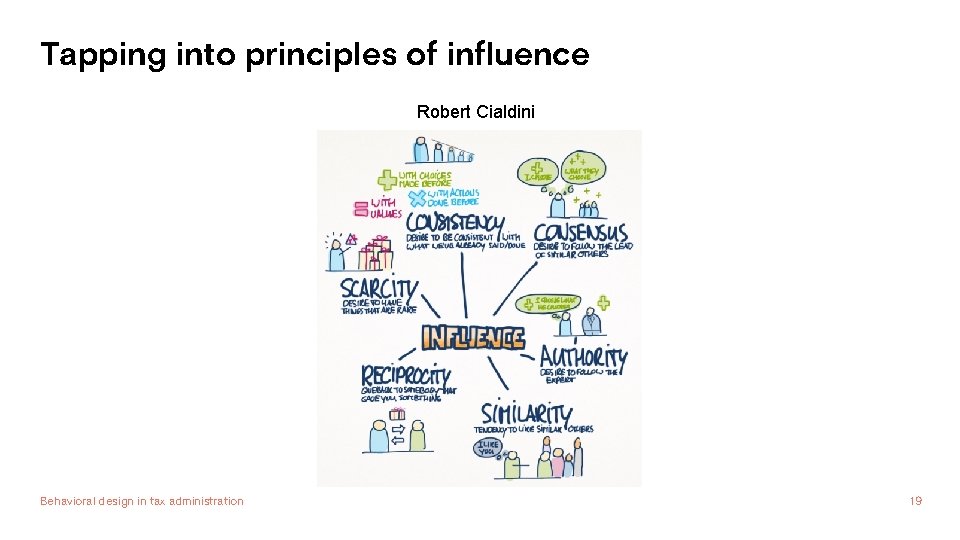
Tapping into principles of influence Robert Cialdini Behavioral design in tax administration 19
The Nudge Unit and tax… UK’s Nudge Unit helped collect +£ 200 Million more in taxes Behavioral design in tax administration Source: Behavioural Insights Team; author’s elaboration 20
Why nudge when you can just regulate? Behaviorally informed policy • Emphasizes the importance of context for decision making and behavior - a behaviorally informed diagnosis takes account of social, psychological, economic influences • Addresses details in bureaucracies, technologies, and service delivery that are sometimes overlooked in standard policy design but that dramatically affect development policies and initiatives, especially in a low-income context • Helps policy makers themselves avoid some of the decision traps and biases that affect all individuals, sparking the use of innovative, low-cost solutions Behavioral design in tax administration 21
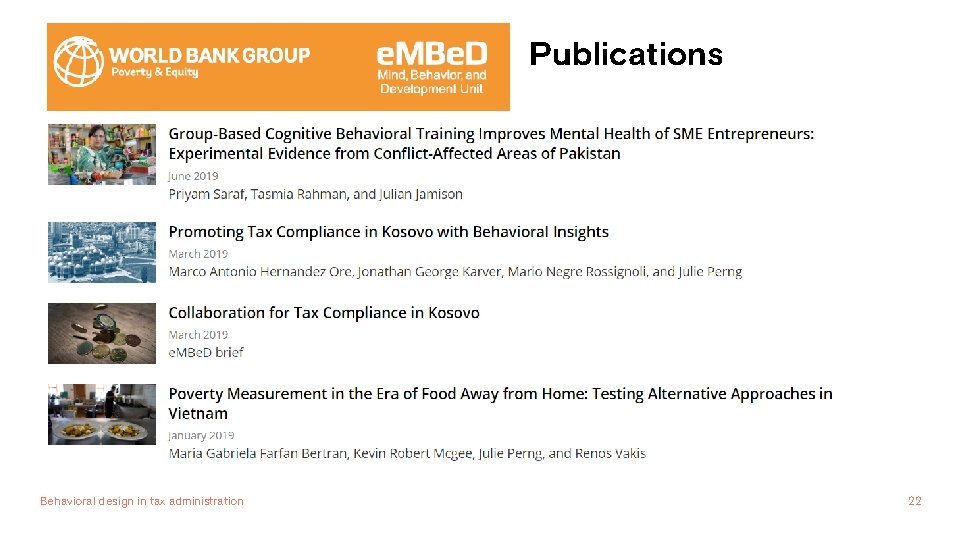
Publications Behavioral design in tax administration 22
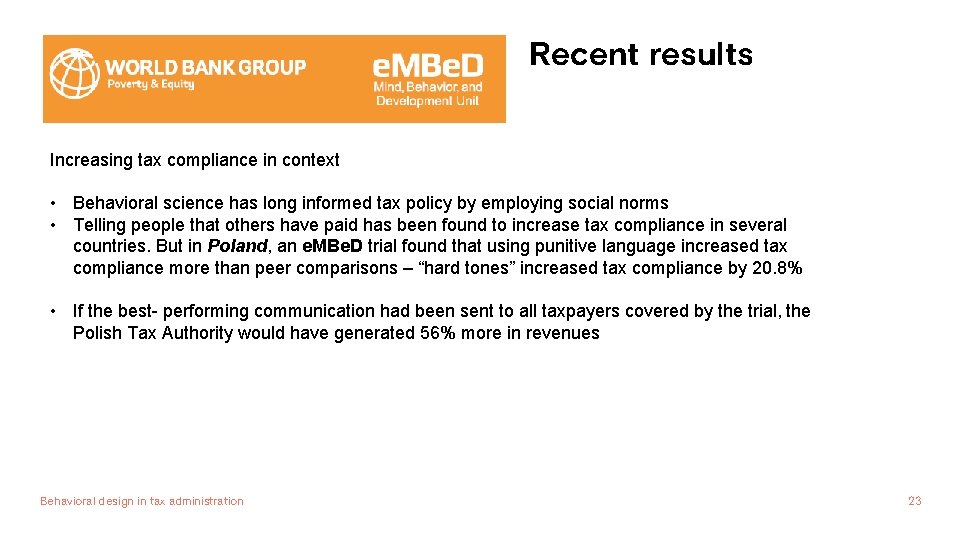
Recent results Increasing tax compliance in context • Behavioral science has long informed tax policy by employing social norms • Telling people that others have paid has been found to increase tax compliance in several countries. But in Poland, an e. MBe. D trial found that using punitive language increased tax compliance more than peer comparisons – “hard tones” increased tax compliance by 20. 8% • If the best- performing communication had been sent to all taxpayers covered by the trial, the Polish Tax Authority would have generated 56% more in revenues Behavioral design in tax administration 23
Canada Revenue Agency example Can we focus on internal motivators to foster higher compliance? T 1 Return – Modify certification prompt Behavioral design in tax administration Source: Canada Revenue Agency; author’s elaboration 24
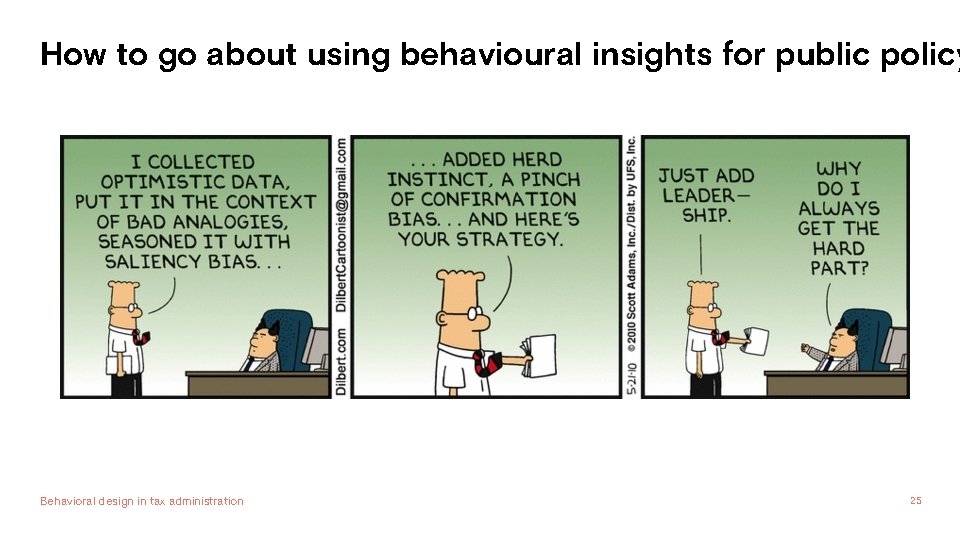
How to go about using behavioural insights for public policy Behavioral design in tax administration 25
How to go about using behavioural insights for public policy 6 key principles: 1) Be strategic 2) Data 3) Replicate 4) Segment & target 5) Evaluate 6) Publish results Organizational behavior focus Behavioral design in tax administration Source: “Behavioural Insights and Public Policy”, The OECD (2017); author’s elaboration 26
Behavioral designin tax administration: Contents 1. Understanding Taxpayer Behavior 2. Nudging 3. When nudges fail Behavioral design in tax administration 27
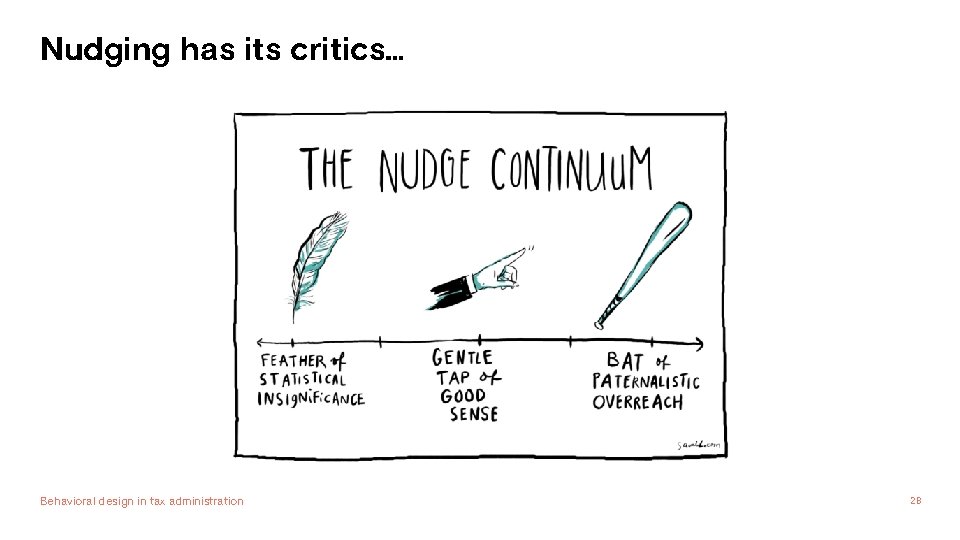
Nudging has its critics… Behavioral design in tax administration 28
…because it’s not a magic bullet… “Dodging the Taxman” (Carrillo, Pomeranz and Singhal, 2014) • When notified about revenue discrepancies in previously filed CIT returns, firms in Ecuador increase reported revenues • But then also increase costs by 96 cents for every dollar of revenue adjustment… • Resulting in minor increases in total tax collection Behavioral design in tax administration Source: Carrillo, Pomeranz and Singhal, “Dodging the Taxman”, NBER (2014); author’s elaboration 29
Why nudges fail… Cass Sunstein (2017) identifies 2 factors why nudges may fail: 1) Presence of strong contrary preferences on the part of the chooser, who will therefore be willing to exert an “effort” to break the default rule 2) Impact of counternudges, in the form of compensating behavior on the part of those whose economic interests are at stake, who may be able to move choosers in their preferred direction (often with the assistance of behavioral insights) Behavioral design in tax administration Source: Cass Sunstein, “Nudges that fail, ” Behavioural Public Policy (2017); author’s elaboration 30
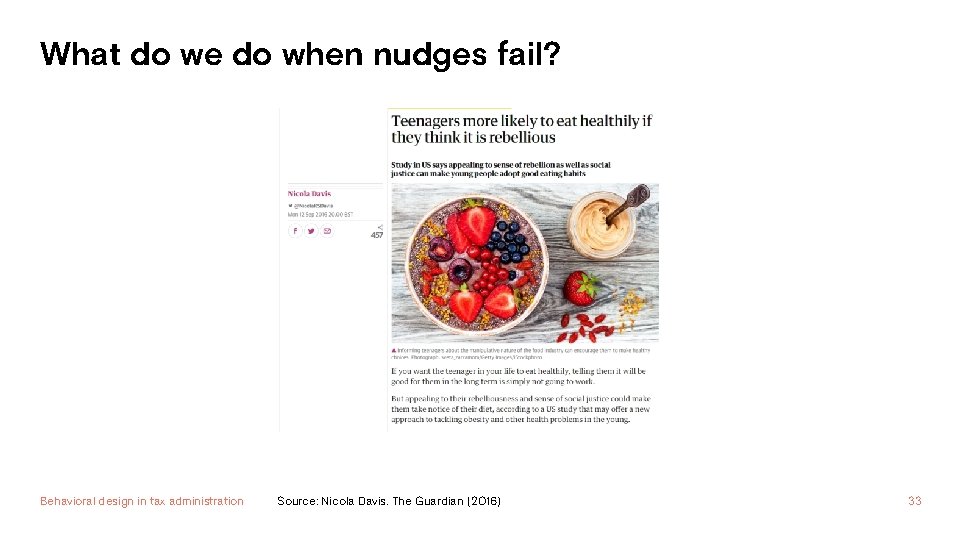
Why nudges fail… 1) If a nudge is based on a plausible but inaccurate understanding of behavior, and of the kinds of things to which people respond, it might have no impact (e. g. willingness to pay vs. timeliness) 2) If information is confusing or complex to process, people might be unaffected by it (e. g. general effectiveness of disclosure strategies) 3) People might show reactance to some nudges, rejecting an official effort to steer because it is an official effort to steer (Arad & Rubinstein, 2015; Duncan et al. , 2016; Hedlin & Sunstein, 2016). Similarly, an effort to invoke social norms might not work if people do not care about social norms, or if they want to defy them (e. g. teenagers smoking) 4) Nudges might have only a short-term effect (Frey & Rogers, 2014) (habits die hard) 5) Some nudges might have an influence on the desired conduct, but also produce compensating behavior, nullifying the overall effect (e. g. eat veggie in canteen, chips later) Behavioral design in tax administration Source: Cass Sunstein, “Nudges that fail, ” Behavioural Public Policy (2017); author’s elaboration 31
What do we do when nudges fail? 1) Decide freedom worked (women changing surnames in USA) 2) Try a different kind of nudge, with continued testing 3) Take stronger measures – counter-counternudges, mandates, bans (justified if decision to optout is considered harmful for many or most) On (2), there are some key lessons on improving nudges: • Make it easy • People’s acts often depend on their social meaning, which can be a subsidy or a tax; if a nudge affects meaning, it can change a subsidy into a tax, or vice versa (Lessig, 1995) • Example: Tax Amnesty Program in Indonesia (2016) • Value of refining the nudge. Information disclosure might be ineffective if it is complex, but succeed if it is simple. Social norms might move behavior, but only if they are the norms in the particular community, not in the nation as a whole. A reminder might fail if it is long and poorly worded, but succeed if it is short and simple Behavioral design in tax administration Source: Cass Sunstein, “Nudges that fail, ” Behavioural Public Policy (2017); author’s elaboration 32
What do we do when nudges fail? Behavioral design in tax administration Source: Nicola Davis, The Guardian (2016) 33
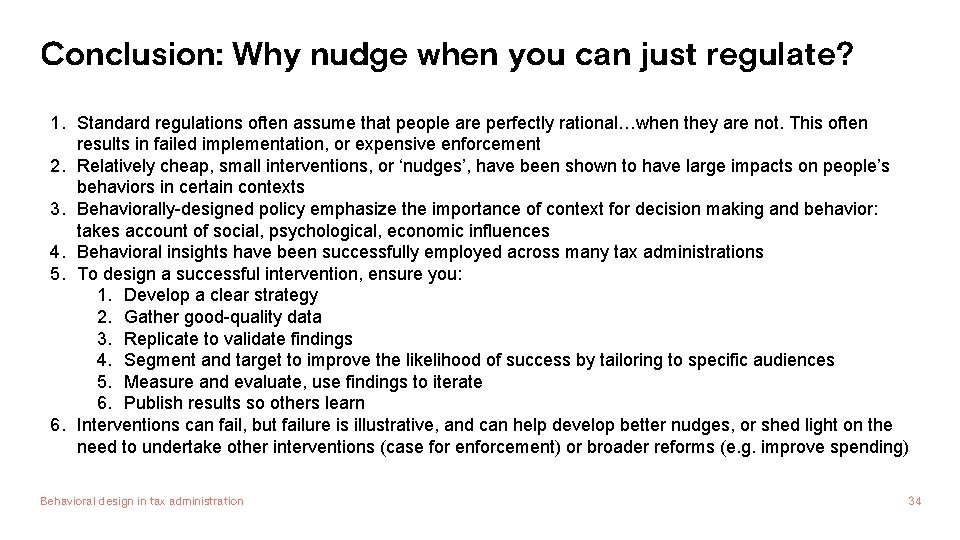
Conclusion: Why nudge when you can just regulate? 1. Standard regulations often assume that people are perfectly rational…when they are not. This often results in failed implementation, or expensive enforcement 2. Relatively cheap, small interventions, or ‘nudges’, have been shown to have large impacts on people’s behaviors in certain contexts 3. Behaviorally-designed policy emphasize the importance of context for decision making and behavior: takes account of social, psychological, economic influences 4. Behavioral insights have been successfully employed across many tax administrations 5. To design a successful intervention, ensure you: 1. Develop a clear strategy 2. Gather good-quality data 3. Replicate to validate findings 4. Segment and target to improve the likelihood of success by tailoring to specific audiences 5. Measure and evaluate, use findings to iterate 6. Publish results so others learn 6. Interventions can fail, but failure is illustrative, and can help develop better nudges, or shed light on the need to undertake other interventions (case for enforcement) or broader reforms (e. g. improve spending) Behavioral design in tax administration 34
Thank You Jaffar Al-Rikabi jalrikabi@worldbank. org 35
Annex Behavioral design in tax administration 36
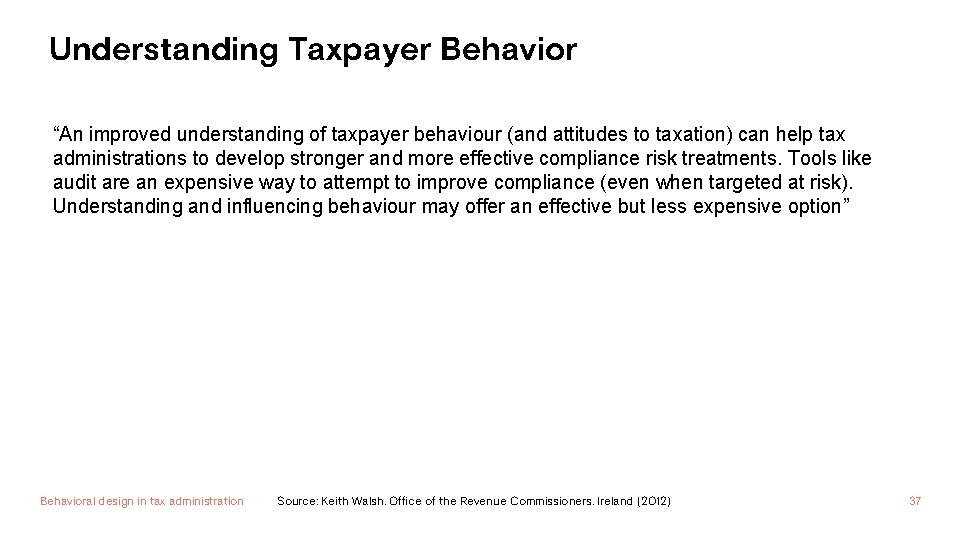
Understanding Taxpayer Behavior “An improved understanding of taxpayer behaviour (and attitudes to taxation) can help tax administrations to develop stronger and more effective compliance risk treatments. Tools like audit are an expensive way to attempt to improve compliance (even when targeted at risk). Understanding and influencing behaviour may offer an effective but less expensive option” Behavioral design in tax administration Source: Keith Walsh, Office of the Revenue Commissioners, Ireland (2012) 37
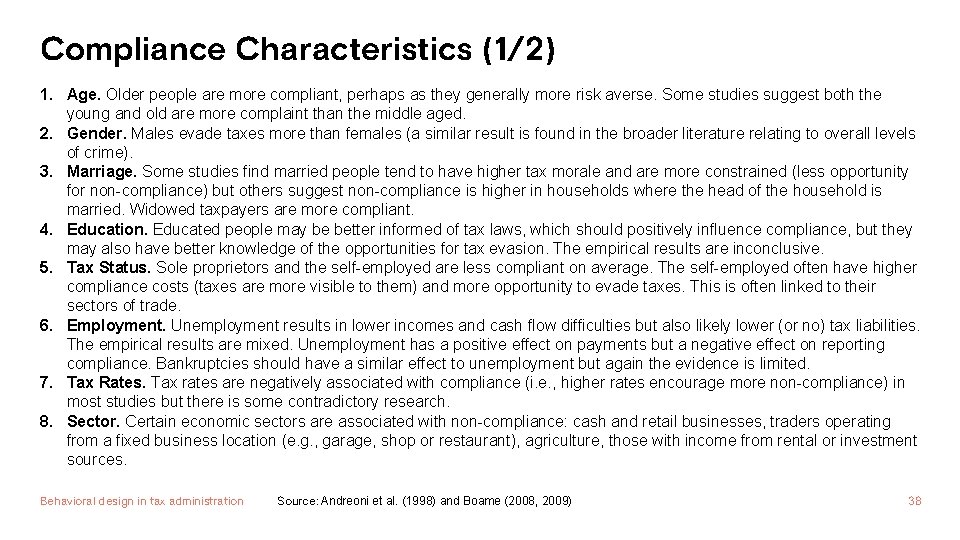
Compliance Characteristics (1/2) 1. Age. Older people are more compliant, perhaps as they generally more risk averse. Some studies suggest both the young and old are more complaint than the middle aged. 2. Gender. Males evade taxes more than females (a similar result is found in the broader literature relating to overall levels of crime). 3. Marriage. Some studies find married people tend to have higher tax morale and are more constrained (less opportunity for non-compliance) but others suggest non-compliance is higher in households where the head of the household is married. Widowed taxpayers are more compliant. 4. Education. Educated people may be better informed of tax laws, which should positively influence compliance, but they may also have better knowledge of the opportunities for tax evasion. The empirical results are inconclusive. 5. Tax Status. Sole proprietors and the self-employed are less compliant on average. The self-employed often have higher compliance costs (taxes are more visible to them) and more opportunity to evade taxes. This is often linked to their sectors of trade. 6. Employment. Unemployment results in lower incomes and cash flow difficulties but also likely lower (or no) tax liabilities. The empirical results are mixed. Unemployment has a positive effect on payments but a negative effect on reporting compliance. Bankruptcies should have a similar effect to unemployment but again the evidence is limited. 7. Tax Rates. Tax rates are negatively associated with compliance (i. e. , higher rates encourage more non-compliance) in most studies but there is some contradictory research. 8. Sector. Certain economic sectors are associated with non-compliance: cash and retail businesses, traders operating from a fixed business location (e. g. , garage, shop or restaurant), agriculture, those with income from rental or investment sources. Behavioral design in tax administration Source: Andreoni et al. (1998) and Boame (2008, 2009) 38
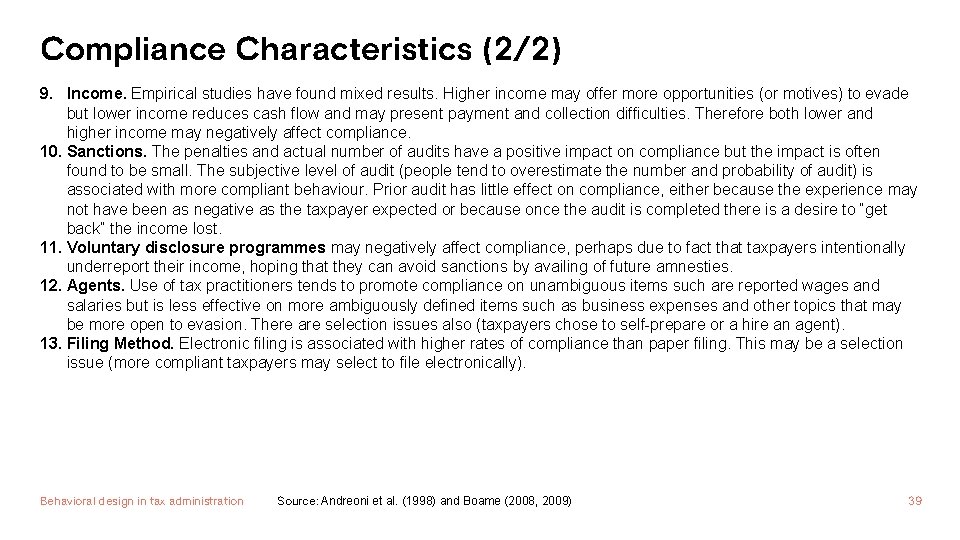
Compliance Characteristics (2/2) 9. Income. Empirical studies have found mixed results. Higher income may offer more opportunities (or motives) to evade but lower income reduces cash flow and may present payment and collection difficulties. Therefore both lower and higher income may negatively affect compliance. 10. Sanctions. The penalties and actual number of audits have a positive impact on compliance but the impact is often found to be small. The subjective level of audit (people tend to overestimate the number and probability of audit) is associated with more compliant behaviour. Prior audit has little effect on compliance, either because the experience may not have been as negative as the taxpayer expected or because once the audit is completed there is a desire to “get back” the income lost. 11. Voluntary disclosure programmes may negatively affect compliance, perhaps due to fact that taxpayers intentionally underreport their income, hoping that they can avoid sanctions by availing of future amnesties. 12. Agents. Use of tax practitioners tends to promote compliance on unambiguous items such are reported wages and salaries but is less effective on more ambiguously defined items such as business expenses and other topics that may be more open to evasion. There are selection issues also (taxpayers chose to self-prepare or a hire an agent). 13. Filing Method. Electronic filing is associated with higher rates of compliance than paper filing. This may be a selection issue (more compliant taxpayers may select to file electronically). Behavioral design in tax administration Source: Andreoni et al. (1998) and Boame (2008, 2009) 39
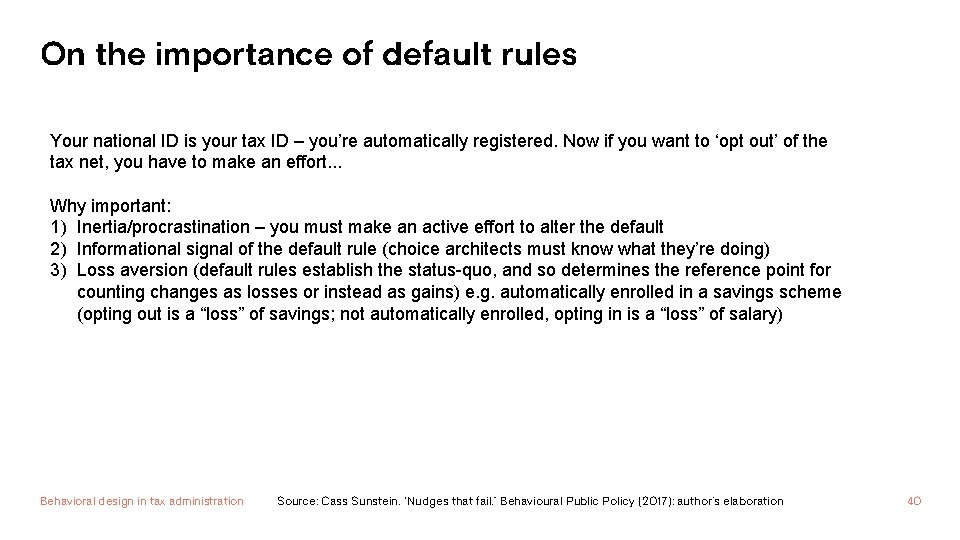
On the importance of default rules Your national ID is your tax ID – you’re automatically registered. Now if you want to ‘opt out’ of the tax net, you have to make an effort. . . Why important: 1) Inertia/procrastination – you must make an active effort to alter the default 2) Informational signal of the default rule (choice architects must know what they’re doing) 3) Loss aversion (default rules establish the status-quo, and so determines the reference point for counting changes as losses or instead as gains) e. g. automatically enrolled in a savings scheme (opting out is a “loss” of savings; not automatically enrolled, opting in is a “loss” of salary) Behavioral design in tax administration Source: Cass Sunstein, “Nudges that fail, ” Behavioural Public Policy (2017); author’s elaboration 40
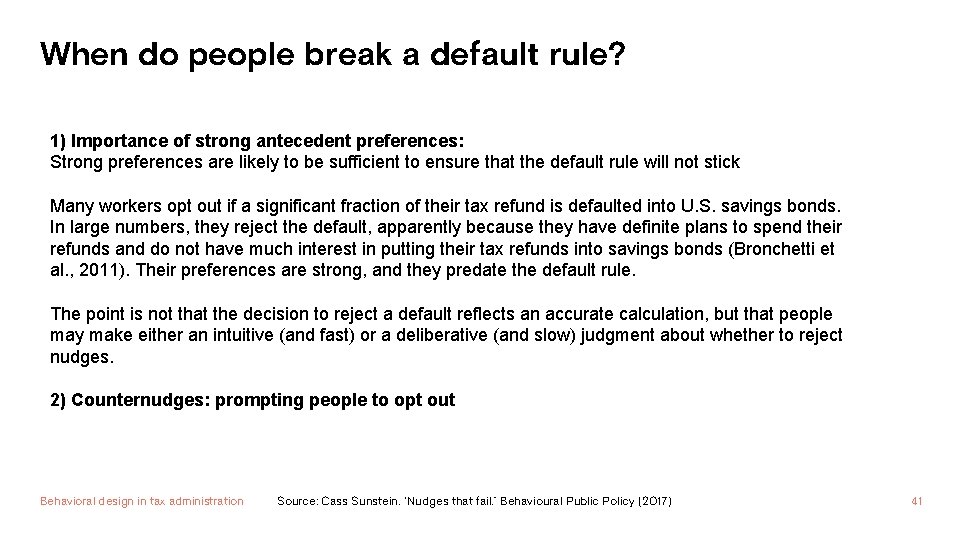
When do people break a default rule? 1) Importance of strong antecedent preferences: Strong preferences are likely to be sufficient to ensure that the default rule will not stick Many workers opt out if a significant fraction of their tax refund is defaulted into U. S. savings bonds. In large numbers, they reject the default, apparently because they have definite plans to spend their refunds and do not have much interest in putting their tax refunds into savings bonds (Bronchetti et al. , 2011). Their preferences are strong, and they predate the default rule. The point is not that the decision to reject a default reflects an accurate calculation, but that people may make either an intuitive (and fast) or a deliberative (and slow) judgment about whether to reject nudges. 2) Counternudges: prompting people to opt out Behavioral design in tax administration Source: Cass Sunstein, “Nudges that fail, ” Behavioural Public Policy (2017) 41
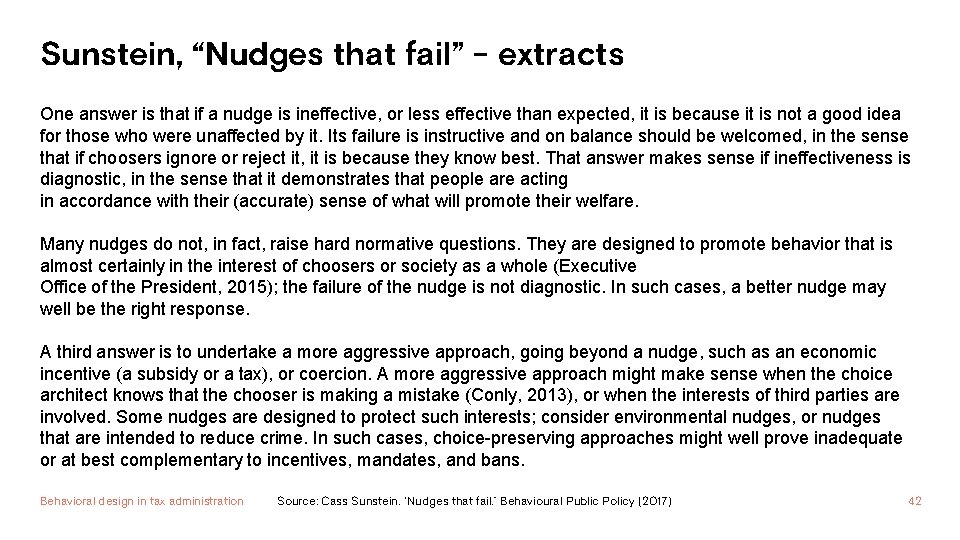
Sunstein, “Nudges that fail” - extracts One answer is that if a nudge is ineffective, or less effective than expected, it is because it is not a good idea for those who were unaffected by it. Its failure is instructive and on balance should be welcomed, in the sense that if choosers ignore or reject it, it is because they know best. That answer makes sense if ineffectiveness is diagnostic, in the sense that it demonstrates that people are acting in accordance with their (accurate) sense of what will promote their welfare. Many nudges do not, in fact, raise hard normative questions. They are designed to promote behavior that is almost certainly in the interest of choosers or society as a whole (Executive Office of the President, 2015); the failure of the nudge is not diagnostic. In such cases, a better nudge may well be the right response. A third answer is to undertake a more aggressive approach, going beyond a nudge, such as an economic incentive (a subsidy or a tax), or coercion. A more aggressive approach might make sense when the choice architect knows that the chooser is making a mistake (Conly, 2013), or when the interests of third parties are involved. Some nudges are designed to protect such interests; consider environmental nudges, or nudges that are intended to reduce crime. In such cases, choice-preserving approaches might well prove inadequate or at best complementary to incentives, mandates, and bans. Behavioral design in tax administration Source: Cass Sunstein, “Nudges that fail, ” Behavioural Public Policy (2017) 42