
DIGITAL TRADE ROADMAP Digital Trade in Financial Services
- Slides: 7
DIGITAL TRADE ROADMAP Digital Trade in Financial Services A Communication Tool for Policy Makers VERSION 1. 0
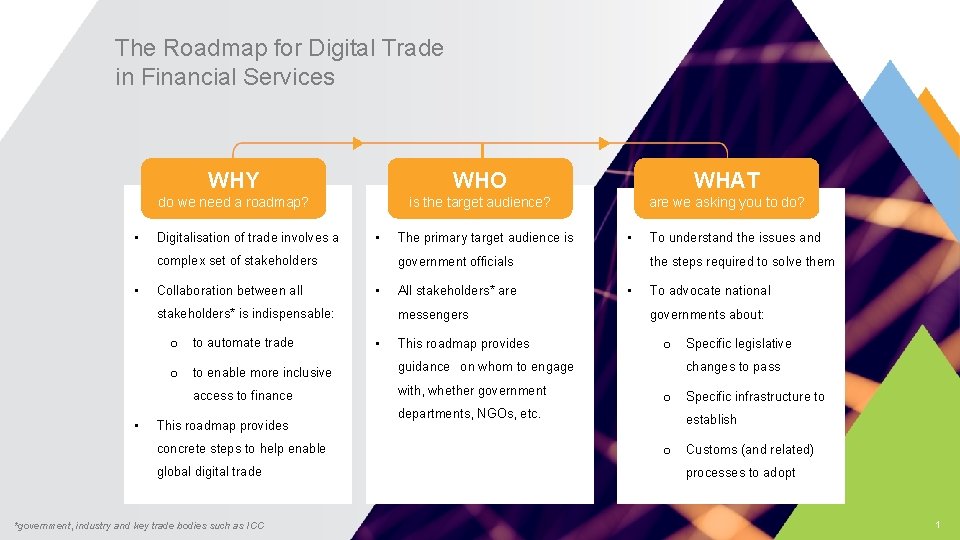
The Roadmap for Digital Trade in Financial Services • WHY WHO WHAT do we need a roadmap? is the target audience? are we asking you to do? Digitalisation of trade involves a • complex set of stakeholders • Collaboration between all • All stakeholders* are messengers o to automate trade o to enable more inclusive guidance on whom to engage access to finance with, whether government This roadmap provides concrete steps to help enable global digital trade *government, industry and key trade bodies such as ICC • • This roadmap provides To understand the issues and the steps required to solve them government officials stakeholders* is indispensable: • The primary target audience is • To advocate national governments about: o Specific legislative changes to pass o departments, NGOs, etc. Specific infrastructure to establish o Customs (and related) processes to adopt 1
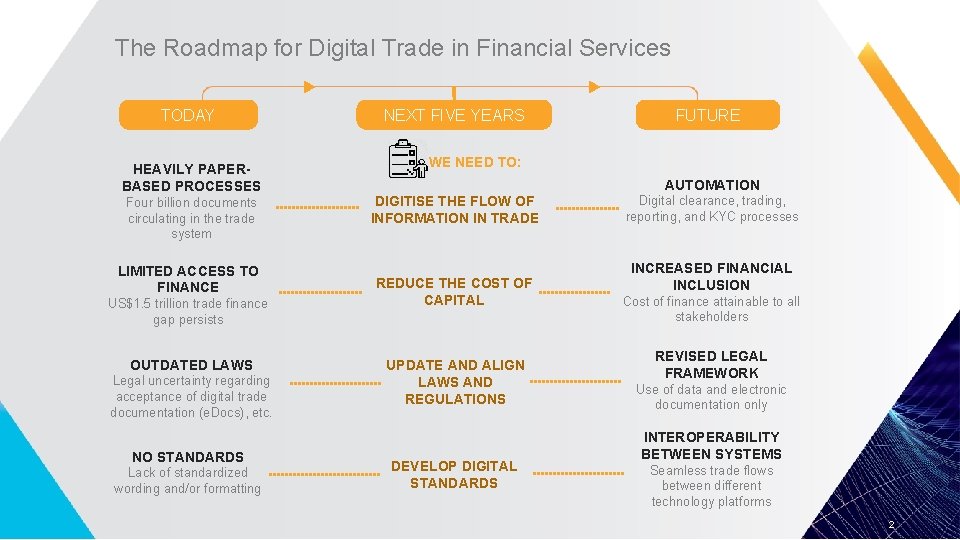
The Roadmap for Digital Trade in Financial Services TODAY HEAVILY PAPERBASED PROCESSES Four billion documents circulating in the trade system LIMITED ACCESS TO FINANCE US$1. 5 trillion trade finance gap persists OUTDATED LAWS Legal uncertainty regarding acceptance of digital trade documentation (e. Docs), etc. NO STANDARDS Lack of standardized wording and/or formatting NEXT FIVE YEARS FUTURE WE NEED TO: AUTOMATION DIGITISE THE FLOW OF INFORMATION IN TRADE REDUCE THE COST OF CAPITAL UPDATE AND ALIGN LAWS AND REGULATIONS DEVELOP DIGITAL STANDARDS Digital clearance, trading, reporting, and KYC processes INCREASED FINANCIAL INCLUSION Cost of finance attainable to all stakeholders REVISED LEGAL FRAMEWORK Use of data and electronic documentation only INTEROPERABILITY BETWEEN SYSTEMS Seamless trade flows between different technology platforms 2
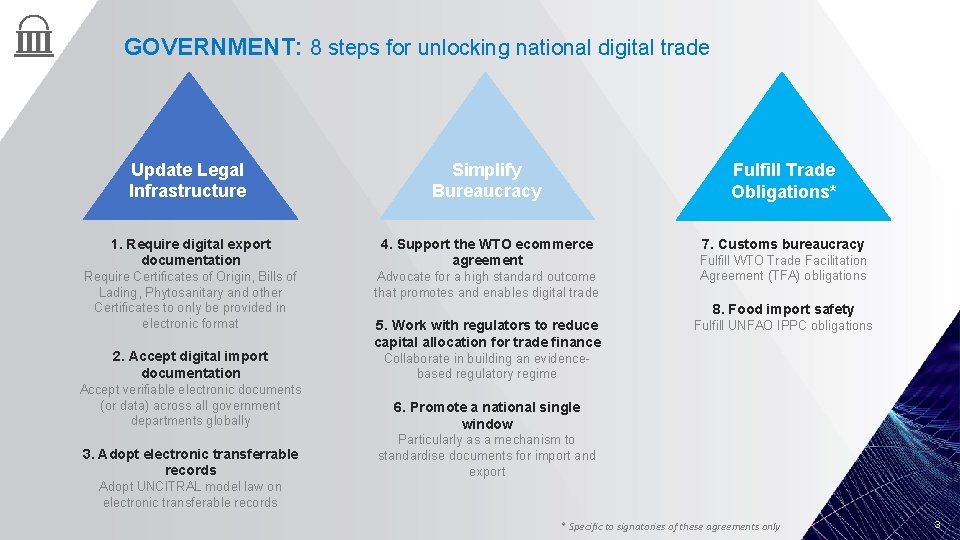
GOVERNMENT: 8 steps for unlocking national digital trade Update Legal Infrastructure Simplify Bureaucracy Fulfill Trade Obligations* 1. Require digital export documentation 4. Support the WTO ecommerce agreement 7. Customs bureaucracy Require Certificates of Origin, Bills of Lading, Phytosanitary and other Certificates to only be provided in electronic format Advocate for a high standard outcome that promotes and enables digital trade 2. Accept digital import documentation Fulfill WTO Trade Facilitation Agreement (TFA) obligations 8. Food import safety 5. Work with regulators to reduce capital allocation for trade finance Fulfill UNFAO IPPC obligations Collaborate in building an evidencebased regulatory regime Accept verifiable electronic documents (or data) across all government departments globally 6. Promote a national single window 3. Adopt electronic transferrable records Particularly as a mechanism to standardise documents for import and export Adopt UNCITRAL model law on electronic transferable records * Specific to signatories of these agreements only 3
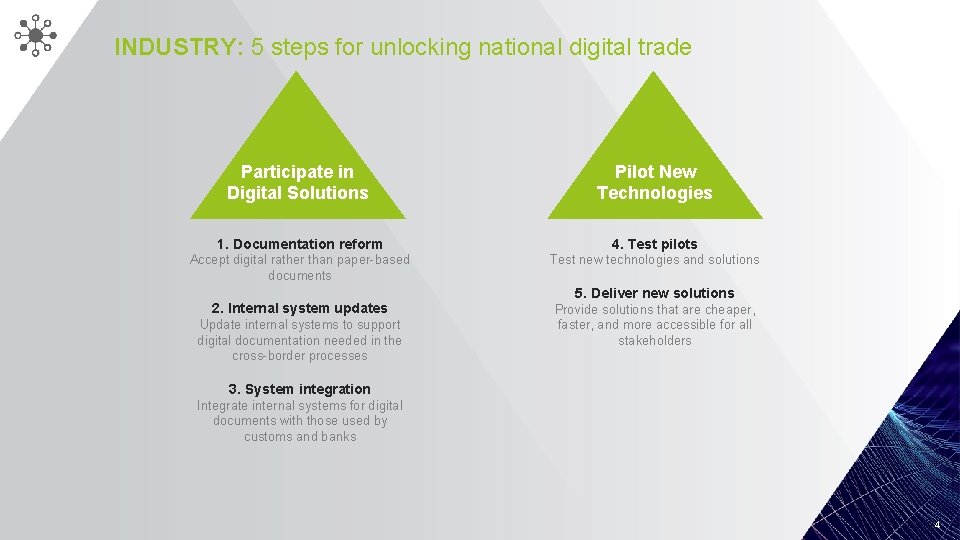
INDUSTRY: 5 steps for unlocking national digital trade Participate in Digital Solutions Pilot New Technologies 1. Documentation reform 4. Test pilots Accept digital rather than paper-based documents Test new technologies and solutions 2. Internal system updates Update internal systems to support digital documentation needed in the cross-border processes 5. Deliver new solutions Provide solutions that are cheaper, faster, and more accessible for all stakeholders 3. System integration Integrate internal systems for digital documents with those used by customs and banks 4
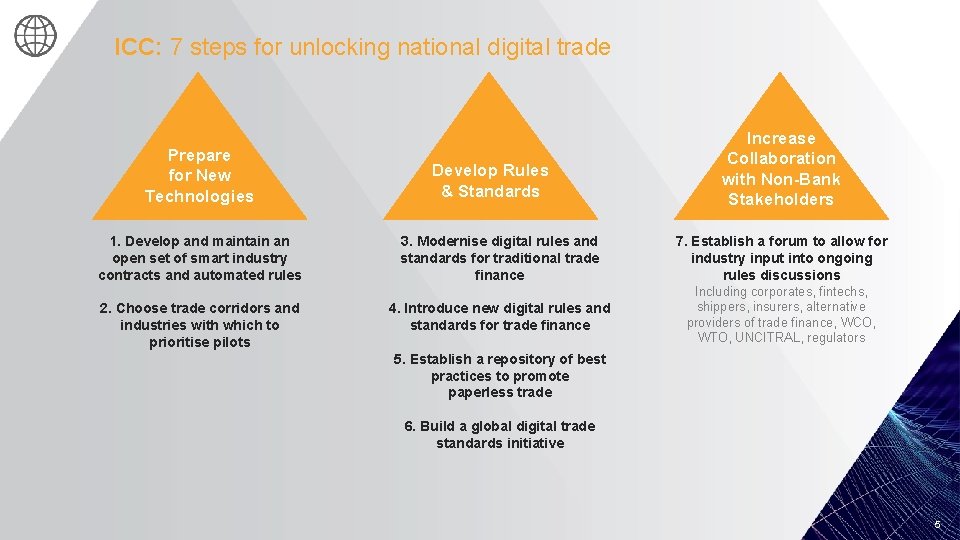
ICC: 7 steps for unlocking national digital trade Prepare for New Technologies 1. Develop and maintain an open set of smart industry contracts and automated rules 2. Choose trade corridors and industries with which to prioritise pilots Develop Rules & Standards Increase Collaboration with Non-Bank Stakeholders 3. Modernise digital rules and standards for traditional trade finance 7. Establish a forum to allow for industry input into ongoing rules discussions 4. Introduce new digital rules and standards for trade finance Including corporates, fintechs, shippers, insurers, alternative providers of trade finance, WCO, WTO, UNCITRAL, regulators 5. Establish a repository of best practices to promote paperless trade 6. Build a global digital trade standards initiative 5