
DIGITAL TERRESTRIAL TELEVISION DTT ROLLOUT and CONTENT DEVELOPMENT
- Slides: 20
DIGITAL TERRESTRIAL TELEVISION (DTT) ROLL-OUT and CONTENT DEVELOPMENT DIGITAL CONTENT OPPORTUNITIES 28 May 2014 CSIR CONFERENCE CENTER by Department of Communications : ICT Policy & Strategy Development Making South Africa a Global Leader in Harnessing ICTs for Socio-economic Development 1
Global Trends ) Digital technologies – neutral platforms regime as means of delivery. ) Broadband Technologies particularly fibre-to-thepremises or home will transform the delivery means of content in South Africa in the near future. ) Content is king – 3 G/LTE Networks including digital transmission network (Sentech) is capable of delivering content in portable means (mobile devices) ) Broadcasting is also showing increasing demand for content. ) Content creators must take advantage of this opportunity. Making South Africa a Global Leader in Harnessing ICTs for Socio-economic Development 2
Policy Landscape: Content Opportunities ) Broadcasting White Paper of 1999 – provides for broadcast content market (3 tier system). ) Broadcasting Digital Migration Policy adopted in 2008 and 2012 – acknowledges content as the key driver for multi-channel digital broadcasting update. ) The process of ICT Policy review which is now at the Green Paper Phase, locate content at the centre of digital technologies; ) Regulation of content is conducted by both ICASA and the Films and Publications Board. Making South Africa a Global Leader in Harnessing ICTs for Socio-economic Development 3
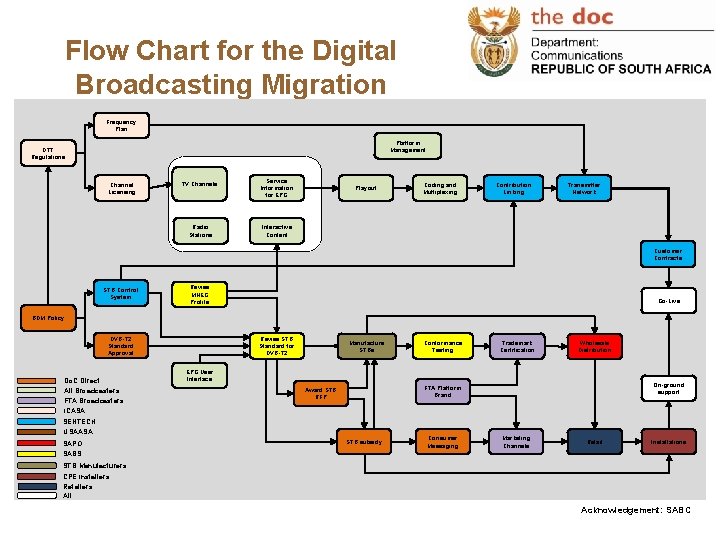
Flow Chart for the Digital Broadcasting Migration Frequency Plan Platform Management DTT Regulations Channel Licensing TV Channels Radio Stations Service Information for EPG Playout Coding and Multiplexing Contribution Linking Transmitter Network Interactive Content Customer Contracts STB Control System Revise MHEG Profile Go-Live BDM Policy DVB-T 2 Standard Approval Do. C Direct All Broadcasters FTA Broadcasters ICASA Revise STB Standard for DVB-T 2 Manufacture STBs Trademark Certification Wholesale Distribution EPG User Interface On-ground support FTA Platform Brand Award STB RFP SENTECH USAASA SAPO SABS Conformance Testing STB subsidy Consumer Messaging Marketing Channels Retail Installations STB Manufacturers CPE Installers Retailers All Acknowledgement: SABC
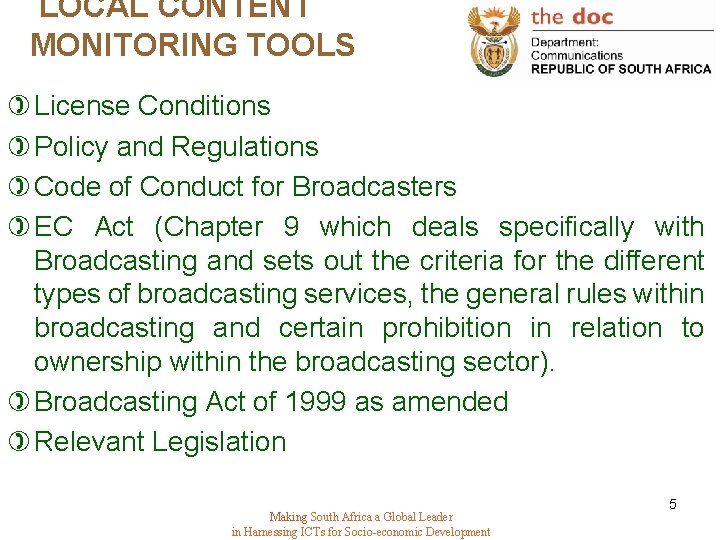
LOCAL CONTENT MONITORING TOOLS ) License Conditions ) Policy and Regulations ) Code of Conduct for Broadcasters ) EC Act (Chapter 9 which deals specifically with Broadcasting and sets out the criteria for the different types of broadcasting services, the general rules within broadcasting and certain prohibition in relation to ownership within the broadcasting sector). ) Broadcasting Act of 1999 as amended ) Relevant Legislation Making South Africa a Global Leader in Harnessing ICTs for Socio-economic Development 5
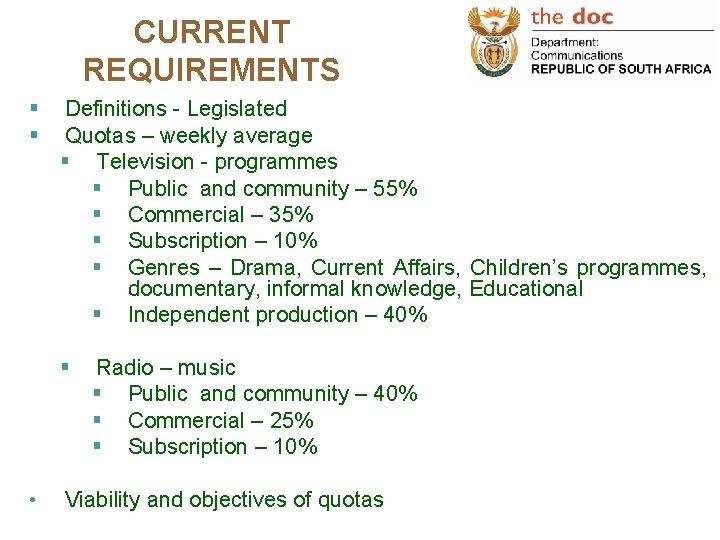
CURRENT REQUIREMENTS § § Definitions - Legislated Quotas – weekly average § Television - programmes § Public and community – 55% § Commercial – 35% § Subscription – 10% § Genres – Drama, Current Affairs, Children’s programmes, documentary, informal knowledge, Educational § Independent production – 40% § • Radio – music § Public and community – 40% § Commercial – 25% § Subscription – 10% Viability and objectives of quotas
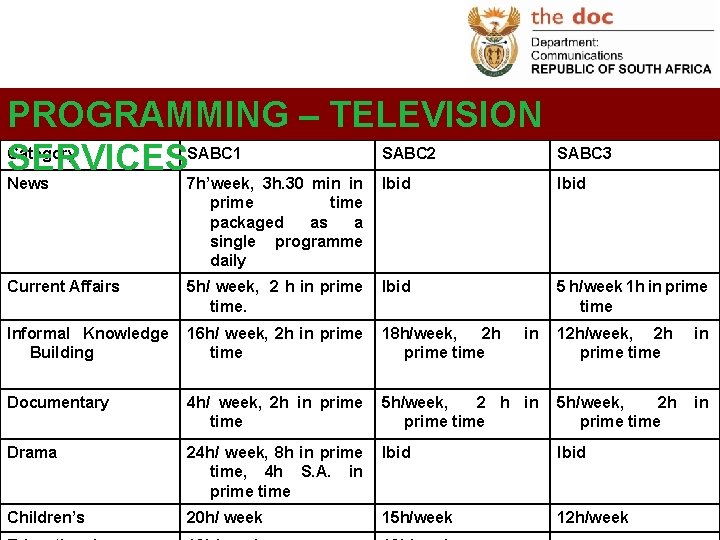
PROGRAMMING – TELEVISION Category SABC 2 SERVICESSABC 1 SABC 3 News 7 h’week, 3 h. 30 min in prime time packaged as a single programme daily Ibid Current Affairs 5 h/ week, 2 h in prime time. Ibid 5 h/week 1 h in prime time Informal Knowledge Building 16 h/ week, 2 h in prime time 18 h/week, 2 h prime time in 12 h/week, 2 h prime time in Documentary 4 h/ week, 2 h in prime time 5 h/week, 2 h prime time in Drama 24 h/ week, 8 h in prime time, 4 h S. A. in prime time Ibid Children’s 20 h/ week 15 h/week 12 h/week
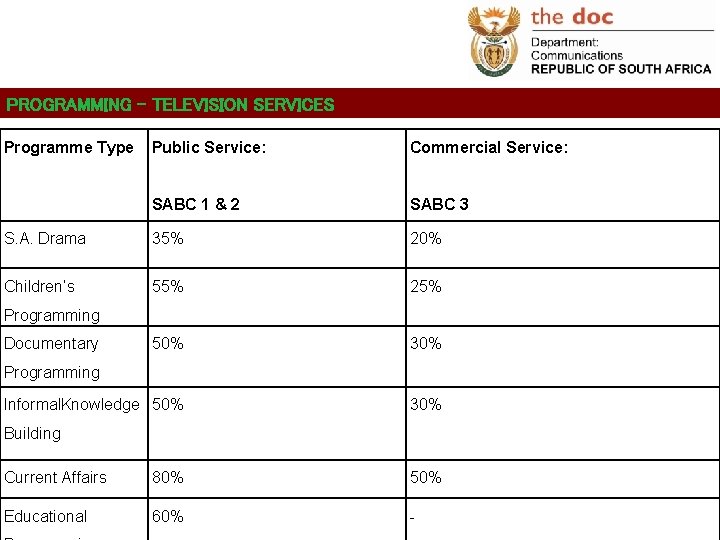
PROGRAMMING – TELEVISION SERVICES Programme Type Public Service: Commercial Service: SABC 1 & 2 SABC 3 S. A. Drama 35% 20% Children’s 55% 25% 50% 30% Informal. Knowledge 50% 30% Programming Documentary Programming Building Current Affairs 80% 50% Educational 60% -
Digital Opportunities ) The Department views Content Creation / Development as a potential area of growth for SMMEs (new and young producers) support of job creation targets. ) Promotion of Content development as professional career choice for young people. ) Content – lever for deepening democracy and freedom. ) Content can also help South Africa to promote reconciliation, social cohesion and altimately nation building Making South Africa a Global Leader in Harnessing ICTs for Socio-economic Development 9
What’s To Be Done (Content Fund) ) We must in line with IPAP Action Plan establish and grow the Create Industries to be on Par with Countries such As Australia and India (curb Youth Unemployment) ) Consolidate and streamline existing funding initiatives to maximise Impact. ) Establish a Content Creative Industries Fund in order to promote local content generation to meet growing demand. Making South Africa a Global Leader in Harnessing ICTs for Socio-economic Development 10
Local Digital Strategy Content ) The Local Digital Content Development Strategy is formulated to promote content development, distribution and job creation. ) In the context of this strategy, local content means texts, images (moving and/or still) that is of cultural or creative nature that is written, presented, produced and/or otherwise contributed to and owned by persons from South Africa transmitted over electronic platforms. ) Equally, digital content refers to any sound, text, still picture or other audio-visual representation, tactile representation or any other preceding, which is capable of being created, manipulated, stored, 11 Making South Africa a Global Leader retrieved or communicated electronically. in Harnessing ICTs for Socio-economic Development
PURPOSE OF THE STRATEGY ) This strategy is developed to address the current market structure and its impact on the content industry in South Africa (i. e. ): )Domination of the sector by a few role-players; )Slow-paced transformation of the ownership of the content sector; )Development of the alternative voices in the content sector ; )Insufficient support mechanism for emerging content creators; )Complementing the Commissioning–driven nature of South African content industry; )Insufficient use of Unlimited platforms available to distribute this content; 12 Making South Africa a Global Leader )insufficient infrastructure encourage in Harnessing ICTs forto Socio-economic Developmentcontent development;
ENVIRONMENTAL SCAN ) In a multichannel environment the demand for the content will be heightened. As a result the local digital content development strategy envisages that the promotion of local content will be able to fulfill the demand. ) To encourage entry by new role-players in the industry, a comprehensive support is provided through the establishment of the Content Generation Hubs (CGHs). ) The Government should establish content generation hubs to accelerate content development. ) The strategy encourages the utilization of local content 13 Making South Africa a Global Leader in Harnessing ICTs for Socio-economic Development preserved in public museums and, the development of
LOCAL CONTENT PRIORITIES AND APPROACH ) The following content areas are prioritized to launch content industry in South Africa: animation, music, wild -life, documentaries, games and ring-tones. ) South Africa’s cultural diversity and untold stories packaged in those formats will be saleable. ) Local content contributes to realization of developmental goals such as new industrial development plan, growth path, job creation, empowerment of rural communities and access to egovernment services. ) The development of local content should be promoted in regional markets. 14 Making South Africa a Global Leader in Harnessing ICTs for Socio-economic Development
LOCAL PRIORITIES APPROACH CONTENT AND ) South Africa should use amongst others; trade shows as marketing platforms, to promote and expand the local content market. ) Other key strategic vehicles to show-case local content include the South African Airways and the International Broadcasting Services. Making South Africa a Global Leader in Harnessing ICTs for Socio-economic Development 15
INTER-DEPARTMENTAL INTER-SECTORAL RESPONSIBILITY OR ) The promotion of the local and digital content is an interdepartmental or inter-sectoral responsibility. ) Collaborative efforts are crucial for building a sustainable digital content sector in the South Africa. This ensures that content activities are coordinated and monitored in accordance with the objectives of this strategy. ) The South African Broadcasting Production Advisory Body representing government, industry has been established to advise the Minister on the issues local content development, production and promotion in the digital platform. Making South Africa a Global Leader in Harnessing ICTs for Socio-economic Development 16
National Digital Repository on Cultural Heritage ) The Department in partnership with IKAMVA Institute as our SOC has initiated a National Digital Repository on Cultural Heritage. ) Its focus is to document South Africa’s Cultural Heritage and host it in digital platforms for dissemination. ) In year 2012 this programme managed to deliver 12 stories for repository and broadcasting in the form of documentaries. ) A total of 192 jobs were created out of this 17 programme. Making South Africa a Global Leader in Harnessing ICTs for Socio-economic Development
Military Veterans Programme ) The Do. C has also initiated a Digitisation Programme on Military Veterans ) The thrust of the programme is to record the experiences of Military Veterans both statutory and non-statutory forces ) It is also meant to recognise the contribution of Military Vterans to South Africa’s liberation ) Furthermore to profile ordinary Military Veterans ) This programme is meant to be located within the broadcast digital migration Making South Africa a Global Leader in Harnessing ICTs for Socio-economic Development 18
Conclusion and Recommendations ) Funding for the Creative Industries sector ) Stakeholder platform for sharing best practice and identify challenges that government must address. ) Address institutional overlaps through policy making processes and legitimising their role. ) Accelerate skills training and development for increasing content creators pool. Making South Africa a Global Leader in Harnessing ICTs for Socio-economic Development 19
THANK YOU Making South Africa a Global Leader in Harnessing ICTs for Socio-economic Development 20