
Digital Supply Chain Standardized Data Exchange July 17
- Slides: 63
Digital Supply Chain Standardized Data Exchange July 17, 2019 API Overview
Minutes This was not in the original presentation Notes within presentation are in red
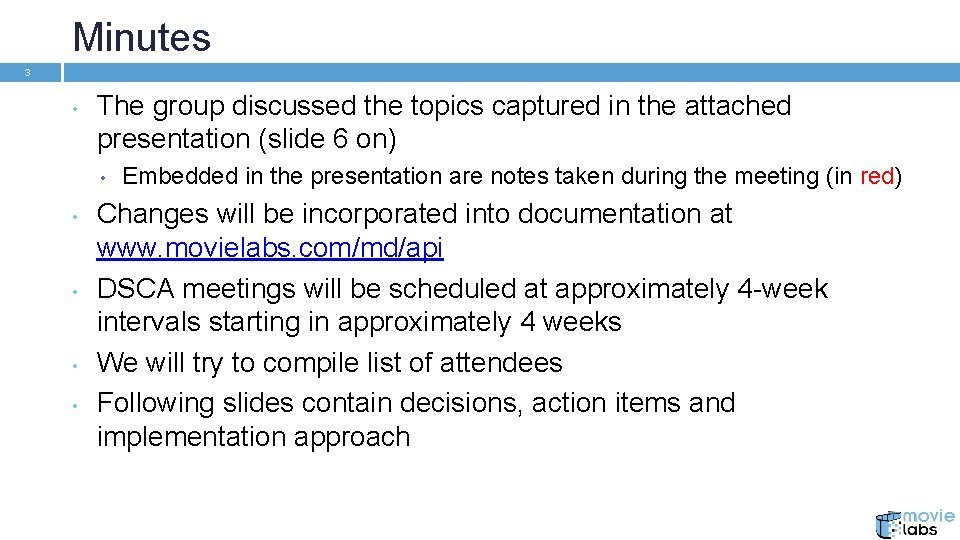
Minutes 3 • The group discussed the topics captured in the attached presentation (slide 6 on) • • • Embedded in the presentation are notes taken during the meeting (in red) Changes will be incorporated into documentation at www. movielabs. com/md/api DSCA meetings will be scheduled at approximately 4 -week intervals starting in approximately 4 weeks We will try to compile list of attendees Following slides contain decisions, action items and implementation approach
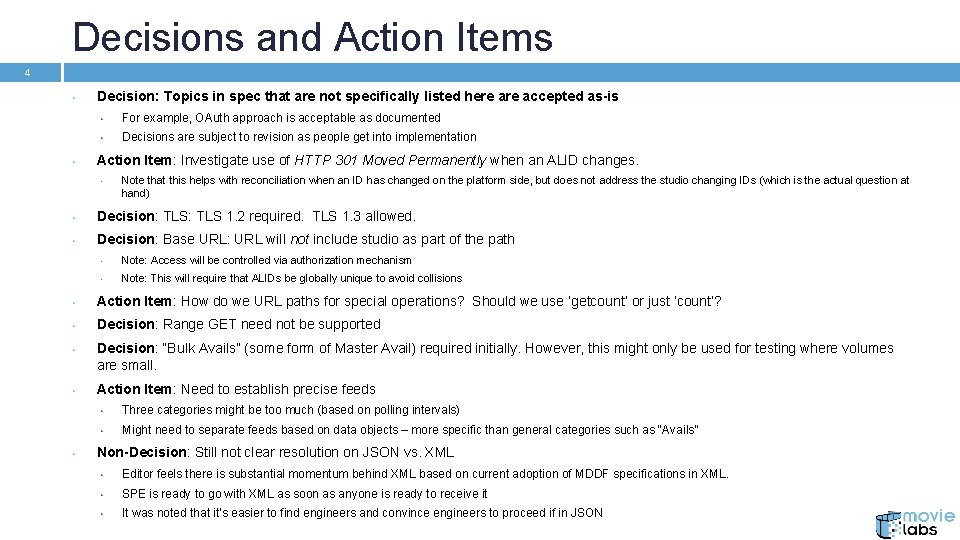
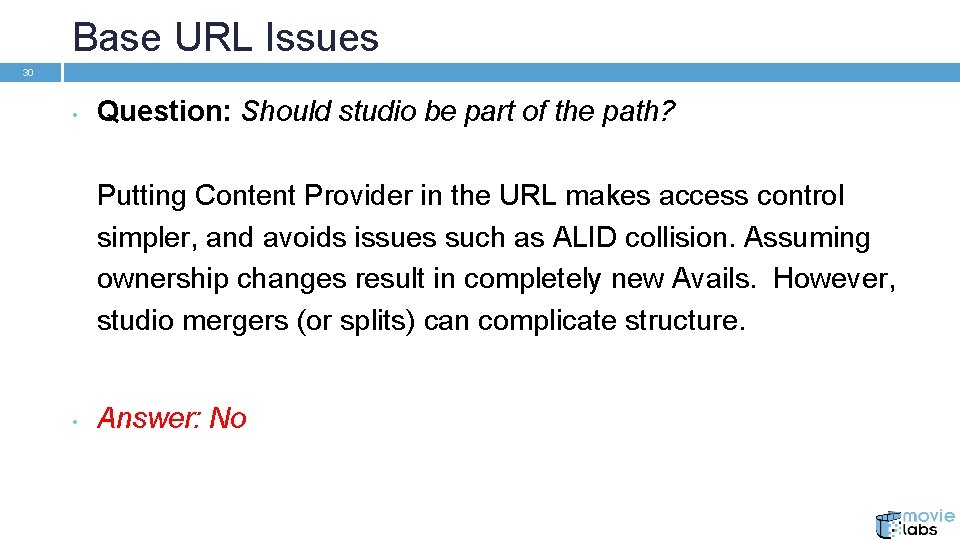
Decisions and Action Items 4 • • Decision: Topics in spec that are not specifically listed here accepted as-is • For example, OAuth approach is acceptable as documented • Decisions are subject to revision as people get into implementation Action Item: Investigate use of HTTP 301 Moved Permanently when an ALID changes. • Note that this helps with reconciliation when an ID has changed on the platform side, but does not address the studio changing IDs (which is the actual question at hand) • Decision: TLS 1. 2 required. TLS 1. 3 allowed. • Decision: Base URL: URL will not include studio as part of the path • Note: Access will be controlled via authorization mechanism • Note: This will require that ALIDs be globally unique to avoid collisions • Action Item: How do we URL paths for special operations? Should we use ‘getcount’ or just ‘count’? • Decision: Range GET need not be supported • • • Decision: “Bulk Avails” (some form of Master Avail) required initially. However, this might only be used for testing where volumes are small. Action Item: Need to establish precise feeds • Three categories might be too much (based on polling intervals) • Might need to separate feeds based on data objects – more specific than general categories such as “Avails” Non-Decision: Still not clear resolution on JSON vs. XML • Editor feels there is substantial momentum behind XML based on current adoption of MDDF specifications in XML. • SPE is ready to go with XML as soon as anyone is ready to receive it • It was noted that it’s easier to find engineers and convince engineers to proceed if in JSON
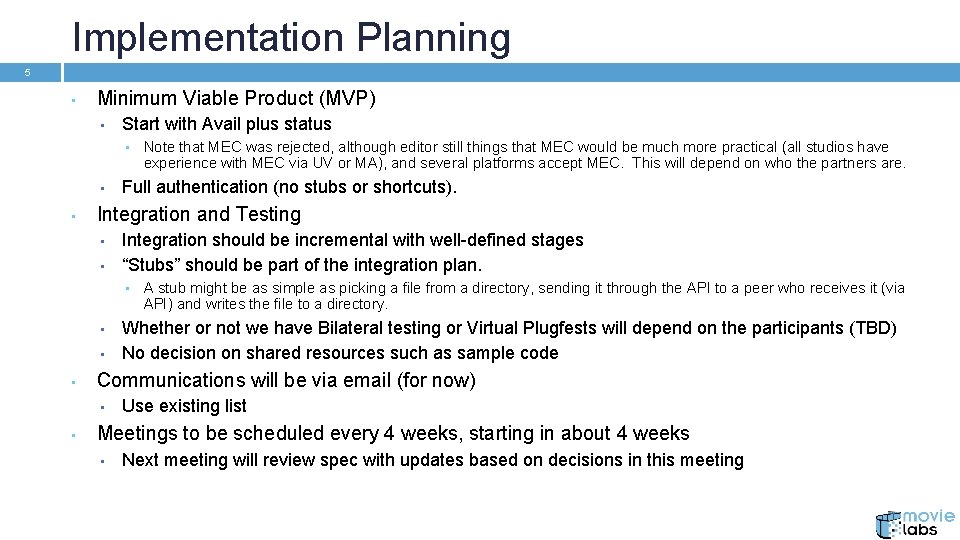
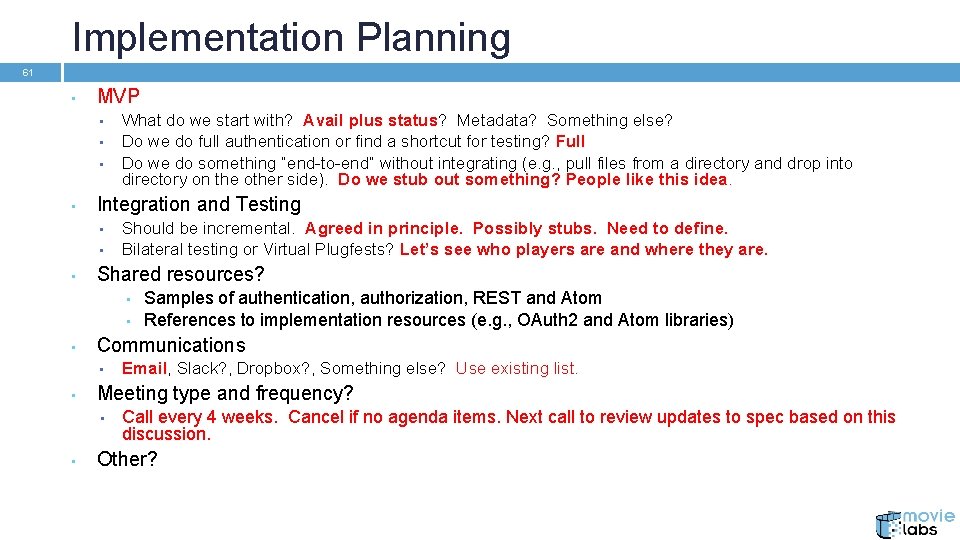
Implementation Planning 5 • Minimum Viable Product (MVP) • Start with Avail plus status • • • Full authentication (no stubs or shortcuts). Integration and Testing • • Integration should be incremental with well-defined stages “Stubs” should be part of the integration plan. • • A stub might be as simple as picking a file from a directory, sending it through the API to a peer who receives it (via API) and writes the file to a directory. Whether or not we have Bilateral testing or Virtual Plugfests will depend on the participants (TBD) No decision on shared resources such as sample code Communications will be via email (for now) • • Note that MEC was rejected, although editor still things that MEC would be much more practical (all studios have experience with MEC via UV or MA), and several platforms accept MEC. This will depend on who the partners are. Use existing list Meetings to be scheduled every 4 weeks, starting in about 4 weeks • Next meeting will review spec with updates based on decisions in this meeting
Digital Supply Chain Standardized Data Exchange July 17, 2019 API Overview
Agenda 7 • • • Meeting Introductions Goals for today API Project Introduction Technical Approach Overview Decisions to review, spec updates • • • General Approach HTTP, TLS, Endpoints Atom XML vs. JSON Authentication and Authorization Implementation Planning
Part 1: Context
Introduction
Motivation 10 • • • Platforms and Studios looking for opportunities to streamline operations and more tightly integrate supply chain Standards reaching critical mass of adoption Platform-specific portals can help studios self-manage content, but does not support automation Platform-specific APIs allows automation, but are non-standard and therefore non-scalable A standardized API is essential to maximize automation: • Reduce cost, reduce errors, reduce time to market, improve visibility, increase quality, and support business models that increase revenue
Challenges to Address 11 • Following considered in spec design • • • Uniformity Security Policies Platform Challenges Studio Challenges Continue to validate against platform and studio requirements
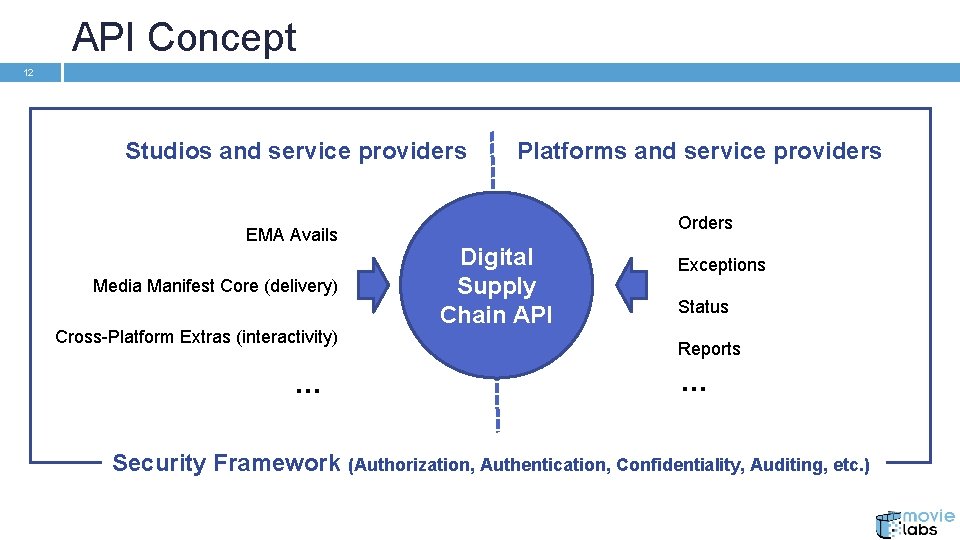
API Concept 12 Studios and service providers EMA Avails Media Manifest Core (delivery) Cross-Platform Extras (interactivity) … Platforms and service providers Orders Digital Supply Chain API Exceptions Status Reports … Security Framework (Authorization, Authentication, Confidentiality, Auditing, etc. )
13 Movie. Labs Digital Distribution Framework (MDDF)
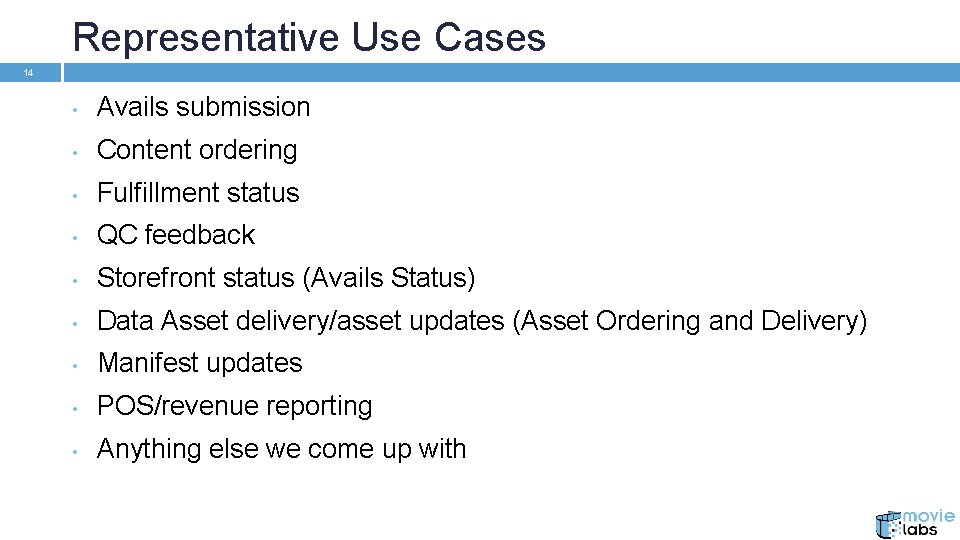
Representative Use Cases 14 • Avails submission • Content ordering • Fulfillment status • QC feedback • Storefront status (Avails Status) • Data Asset delivery/asset updates (Asset Ordering and Delivery) • Manifest updates • POS/revenue reporting • Anything else we come up with
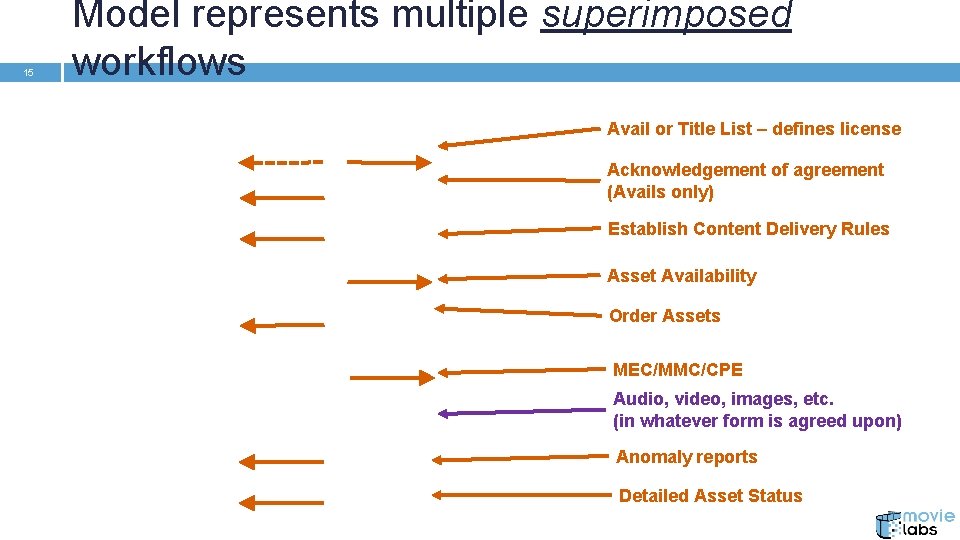
15 Model represents multiple superimposed workflows Avail or Title List – defines license Acknowledgement of agreement (Avails only) Establish Content Delivery Rules Asset Availability Order Assets MEC/MMC/CPE Audio, video, images, etc. (in whatever form is agreed upon) Anomaly reports Detailed Asset Status
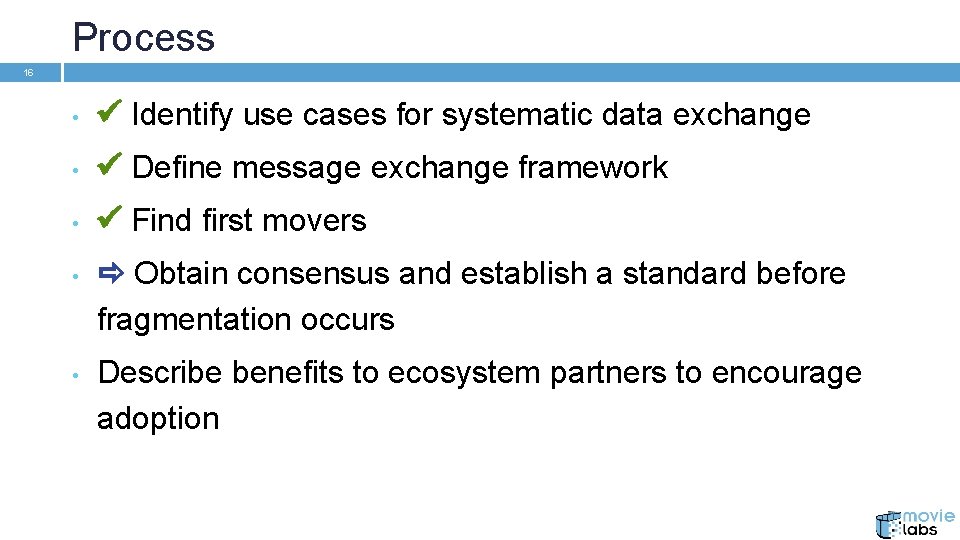
Process 16 • Identify use cases for systematic data exchange • Define message exchange framework • Find first movers • • Obtain consensus and establish a standard before fragmentation occurs Describe benefits to ecosystem partners to encourage adoption
Tech. Approach
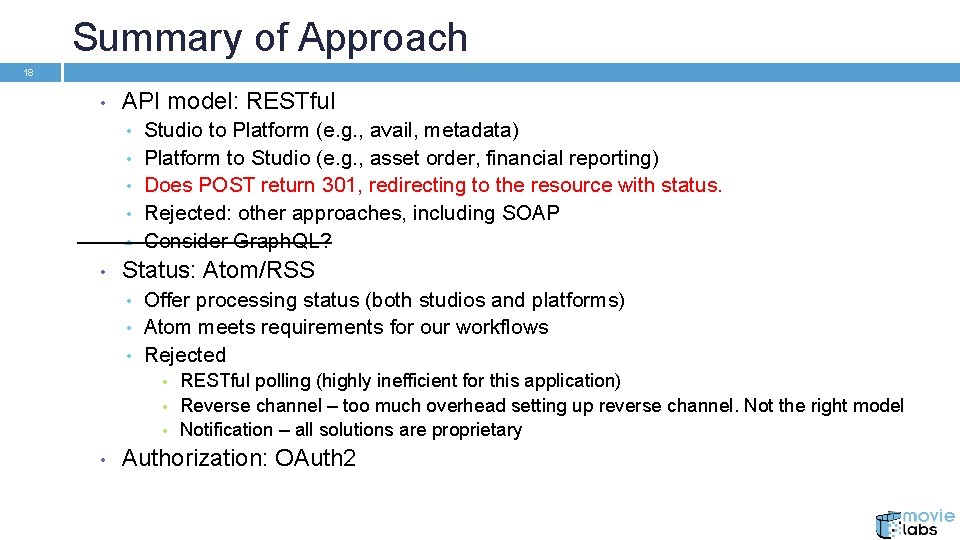
Summary of Approach 18 • API model: RESTful • • • Studio to Platform (e. g. , avail, metadata) Platform to Studio (e. g. , asset order, financial reporting) Does POST return 301, redirecting to the resource with status. Rejected: other approaches, including SOAP Consider Graph. QL? Status: Atom/RSS • • • Offer processing status (both studios and platforms) Atom meets requirements for our workflows Rejected • • RESTful polling (highly inefficient for this application) Reverse channel – too much overhead setting up reverse channel. Not the right model Notification – all solutions are proprietary Authorization: OAuth 2
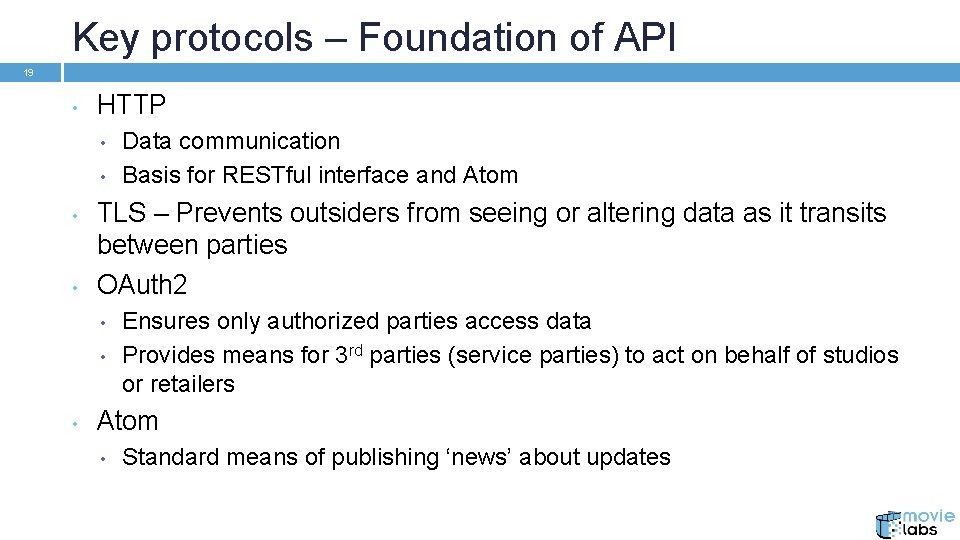
Key protocols – Foundation of API 19 • HTTP • • TLS – Prevents outsiders from seeing or altering data as it transits between parties OAuth 2 • • • Data communication Basis for RESTful interface and Atom Ensures only authorized parties access data Provides means for 3 rd parties (service parties) to act on behalf of studios or retailers Atom • Standard means of publishing ‘news’ about updates
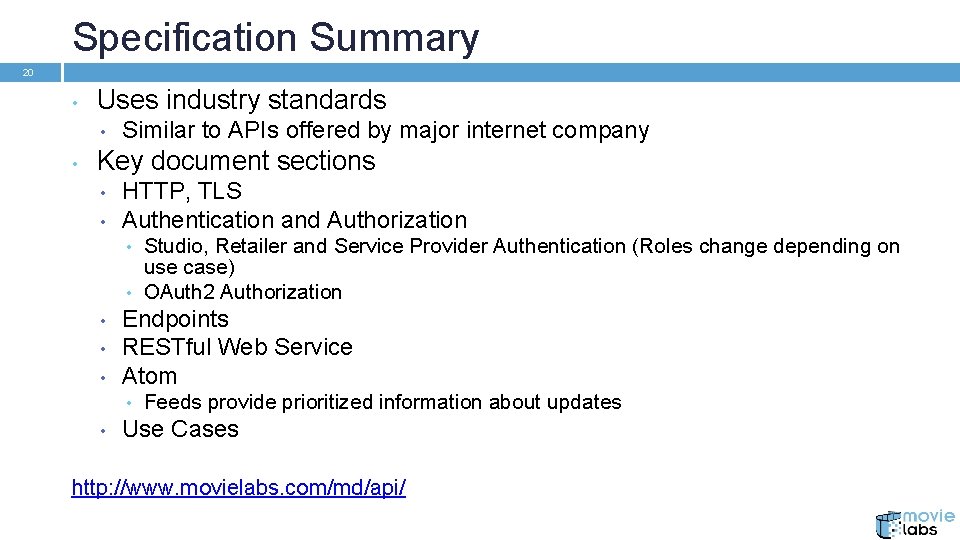
Specification Summary 20 • Uses industry standards • • Similar to APIs offered by major internet company Key document sections • • HTTP, TLS Authentication and Authorization • • • Endpoints RESTful Web Service Atom • • Studio, Retailer and Service Provider Authentication (Roles change depending on use case) OAuth 2 Authorization Feeds provide prioritized information about updates Use Cases http: //www. movielabs. com/md/api/
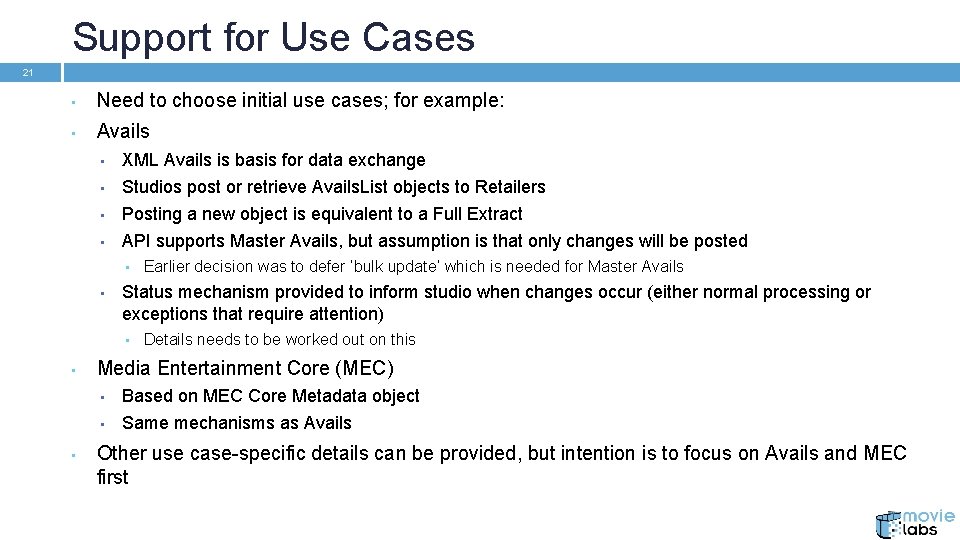
Support for Use Cases 21 • Need to choose initial use cases; for example: • Avails • XML Avails is basis for data exchange • Studios post or retrieve Avails. List objects to Retailers • Posting a new object is equivalent to a Full Extract • API supports Master Avails, but assumption is that only changes will be posted • • Status mechanism provided to inform studio when changes occur (either normal processing or exceptions that require attention) • • • Earlier decision was to defer ‘bulk update’ which is needed for Master Avails Details needs to be worked out on this Media Entertainment Core (MEC) • Based on MEC Core Metadata object • Same mechanisms as Avails Other use case-specific details can be provided, but intention is to focus on Avails and MEC first
Why you should be an early implementer 22 • General principle: • • • A spec is not complete until there is at least one implementation A spec is not interoperable until there at least two implementations As parties move closer to implementation, refinements will be needed In practice, early implementers have a large voice in specification refinement We need parties to sign up for implementation
Next Steps 23 • Specification • • Complete specification Develop support material • • • Reference implementations? Use cases/MVP • • • Best Practices Detail specific use cases (Avails? MEC? Other? ) Priority and timing for other use cases Start implementing • No spec survives first contact with implementers
Part 2: Technical Discussion
Decisions • • • General Approach HTTP, TLS, Endpoints Atom XML vs. JSON Authentication and Authorization
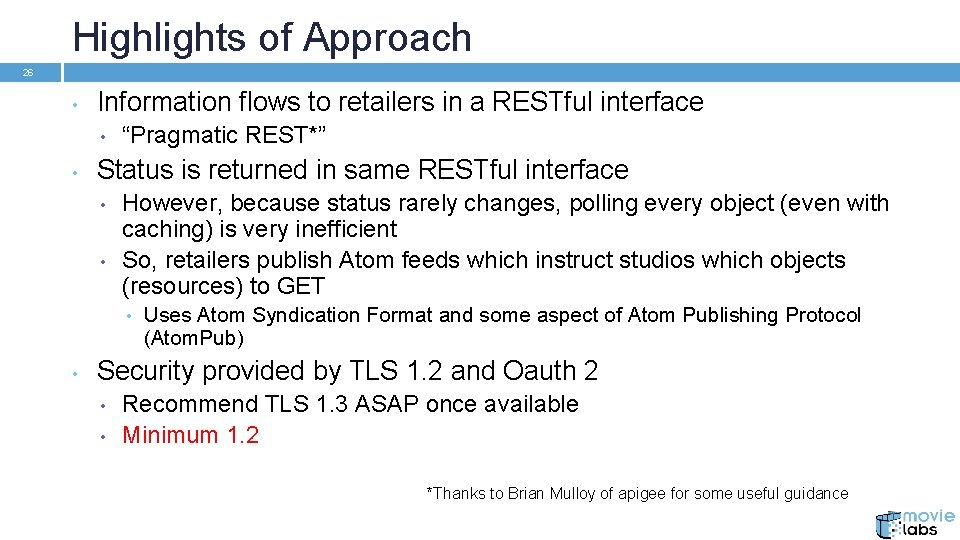
Highlights of Approach 26 • Information flows to retailers in a RESTful interface • • “Pragmatic REST*” Status is returned in same RESTful interface • • However, because status rarely changes, polling every object (even with caching) is very inefficient So, retailers publish Atom feeds which instruct studios which objects (resources) to GET • • Uses Atom Syndication Format and some aspect of Atom Publishing Protocol (Atom. Pub) Security provided by TLS 1. 2 and Oauth 2 • • Recommend TLS 1. 3 ASAP once available Minimum 1. 2 *Thanks to Brian Mulloy of apigee for some useful guidance
HTTP
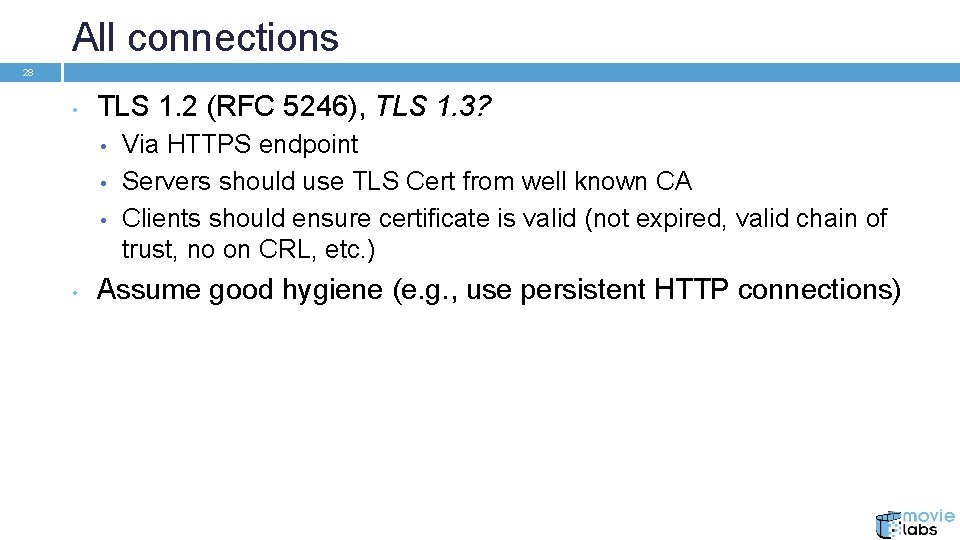
All connections 28 • TLS 1. 2 (RFC 5246), TLS 1. 3? • • Via HTTPS endpoint Servers should use TLS Cert from well known CA Clients should ensure certificate is valid (not expired, valid chain of trust, no on CRL, etc. ) Assume good hygiene (e. g. , use persistent HTTP connections)
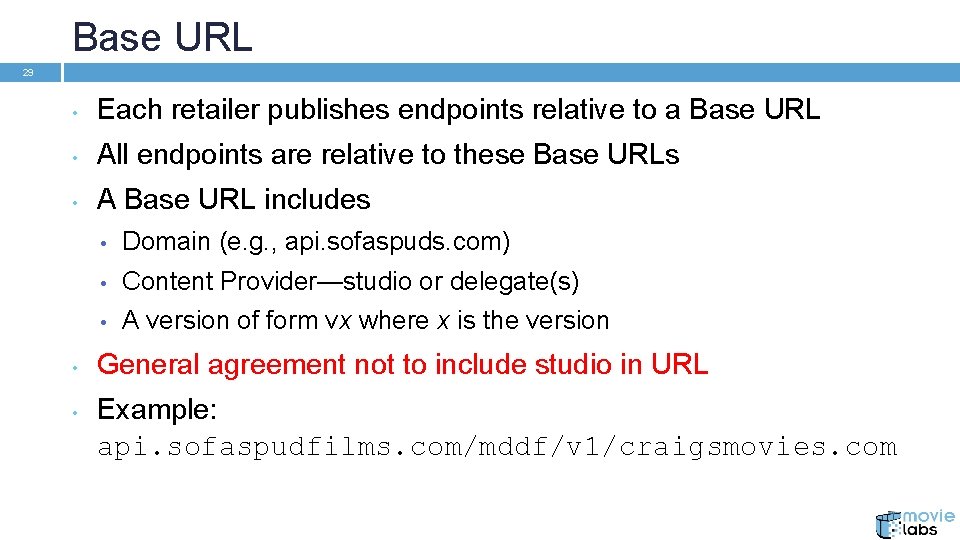
Base URL 29 • Each retailer publishes endpoints relative to a Base URL • All endpoints are relative to these Base URLs • A Base URL includes • • • Domain (e. g. , api. sofaspuds. com) • Content Provider—studio or delegate(s) • A version of form vx where x is the version General agreement not to include studio in URL Example: api. sofaspudfilms. com/mddf/v 1/craigsmovies. com
Base URL Issues 30 • Question: Should studio be part of the path? Putting Content Provider in the URL makes access control simpler, and avoids issues such as ALID collision. Assuming ownership changes result in completely new Avails. However, studio mergers (or splits) can complicate structure. • Answer: No
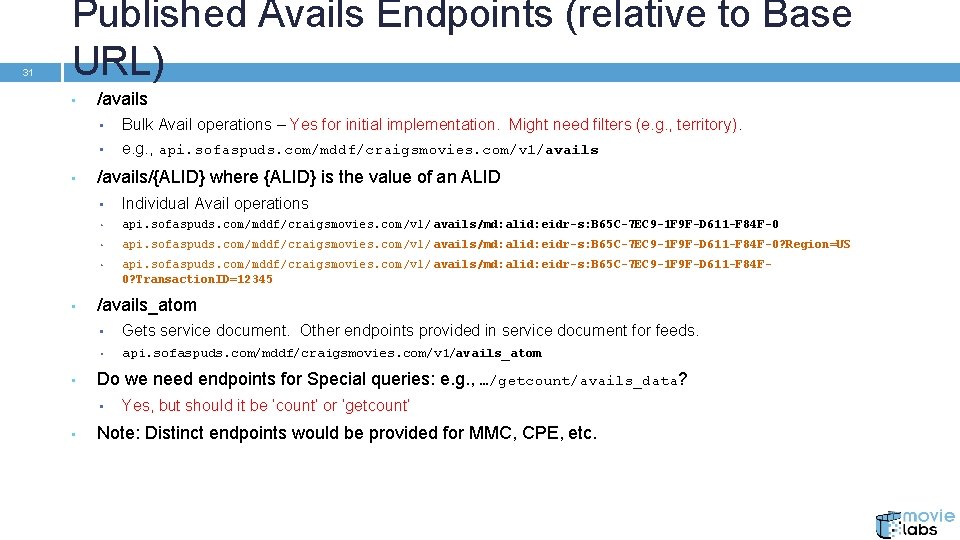
31 Published Avails Endpoints (relative to Base URL) • /avails • • • /avails/{ALID} where {ALID} is the value of an ALID • Individual Avail operations • api. sofaspuds. com/mddf/craigsmovies. com/v 1/ avails/md: alid: eidr-s: B 65 C-7 EC 9 -1 F 9 F-D 611 -F 84 F-0? Region=US • api. sofaspuds. com/mddf/craigsmovies. com/v 1/ avails/md: alid: eidr-s: B 65 C-7 EC 9 -1 F 9 F-D 611 -F 84 F 0? Transaction. ID=12345 /avails_atom • Gets service document. Other endpoints provided in service document for feeds. • api. sofaspuds. com/mddf/craigsmovies. com/v 1/avails_atom Do we need endpoints for Special queries: e. g. , …/getcount/avails_data? • • Bulk Avail operations – Yes for initial implementation. Might need filters (e. g. , territory). e. g. , api. sofaspuds. com/mddf/craigsmovies. com/v 1/avails Yes, but should it be ‘count’ or ‘getcount’ Note: Distinct endpoints would be provided for MMC, CPE, etc.
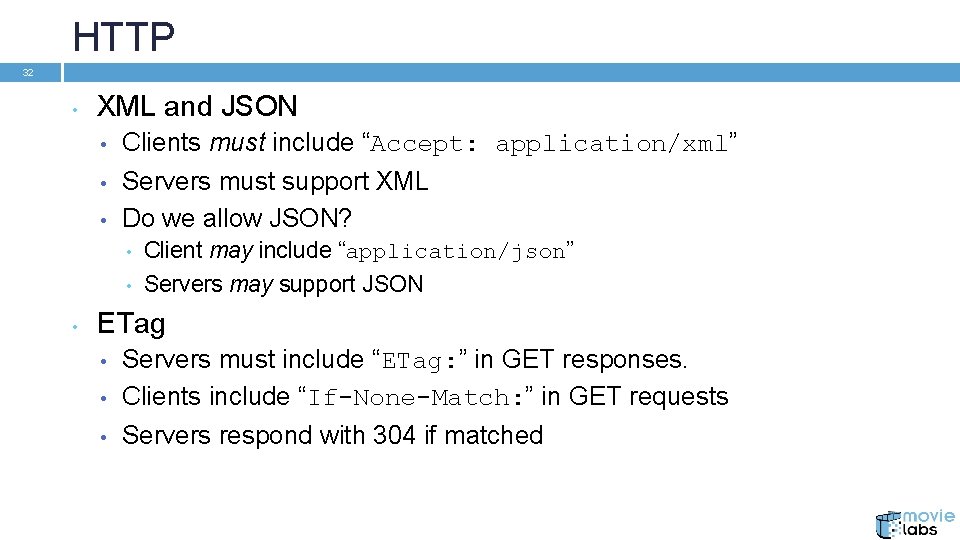
HTTP 32 • XML and JSON • Clients must include “Accept: application/xml” • Servers must support XML Do we allow JSON? • • • Client may include “application/json” • Servers may support JSON ETag • Servers must include “ETag: ” in GET responses. Clients include “If-None-Match: ” in GET requests • Servers respond with 304 if matched •
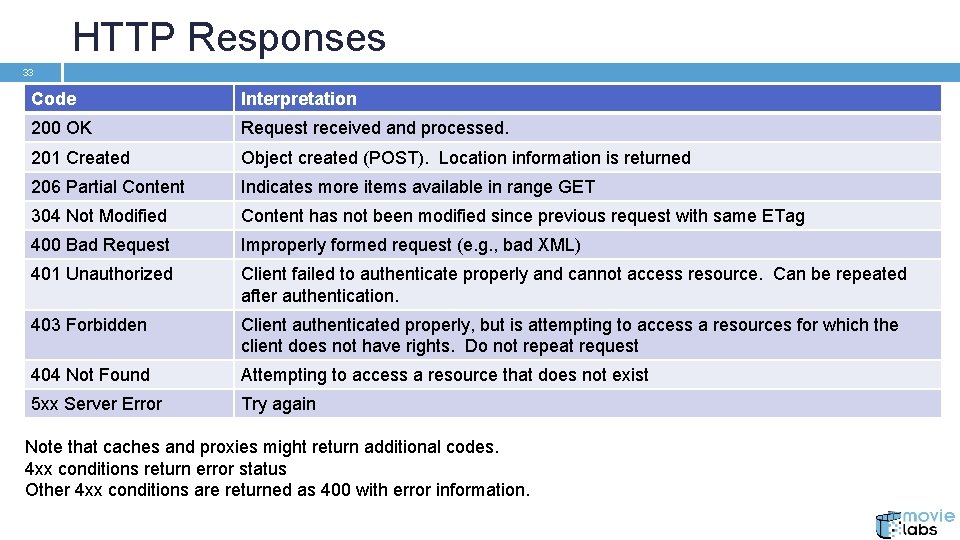
HTTP Responses 33 Code Interpretation 200 OK Request received and processed. 201 Created Object created (POST). Location information is returned 206 Partial Content Indicates more items available in range GET 304 Not Modified Content has not been modified since previous request with same ETag 400 Bad Request Improperly formed request (e. g. , bad XML) 401 Unauthorized Client failed to authenticate properly and cannot access resource. Can be repeated after authentication. 403 Forbidden Client authenticated properly, but is attempting to access a resources for which the client does not have rights. Do not repeat request 404 Not Found Attempting to access a resource that does not exist 5 xx Server Error Try again Note that caches and proxies might return additional codes. 4 xx conditions return error status Other 4 xx conditions are returned as 400 with error information.
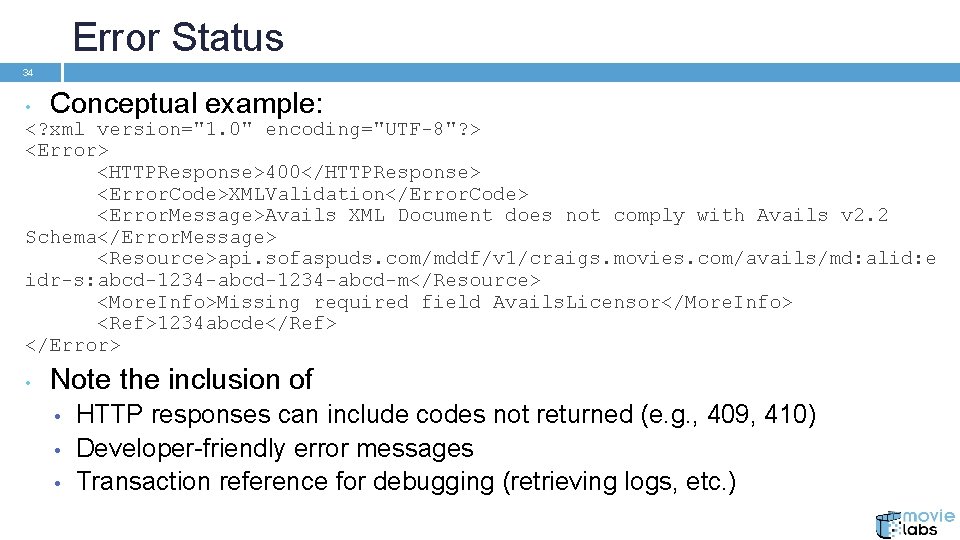
Error Status 34 • Conceptual example: <? xml version="1. 0" encoding="UTF-8"? > <Error> <HTTPResponse>400</HTTPResponse> <Error. Code>XMLValidation</Error. Code> <Error. Message>Avails XML Document does not comply with Avails v 2. 2 Schema</Error. Message> <Resource>api. sofaspuds. com/mddf/v 1/craigs. movies. com/avails/md: alid: e idr-s: abcd-1234 -abcd-m</Resource> <More. Info>Missing required field Avails. Licensor</More. Info> <Ref>1234 abcde</Ref> </Error> • Note the inclusion of • • • HTTP responses can include codes not returned (e. g. , 409, 410) Developer-friendly error messages Transaction reference for debugging (retrieving logs, etc. )
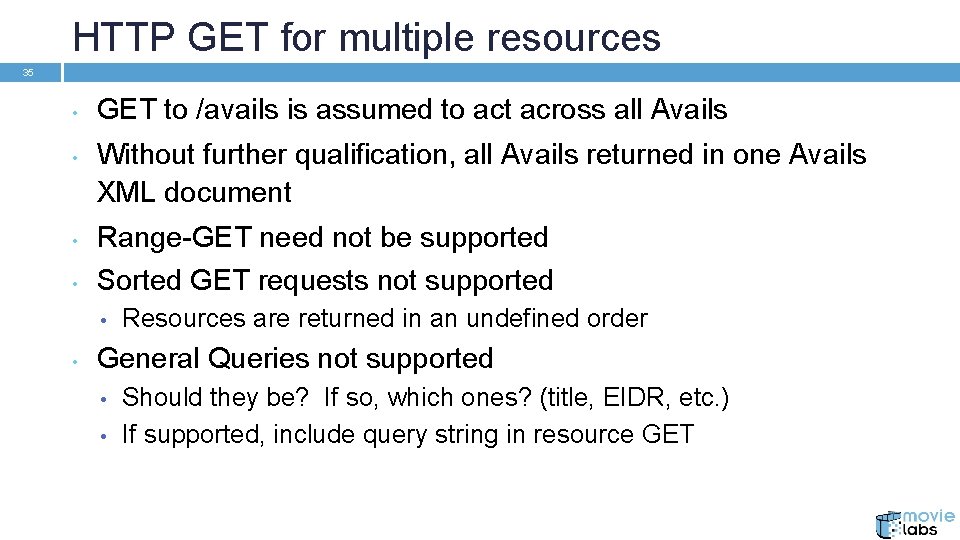
HTTP GET for multiple resources 35 • • GET to /avails is assumed to act across all Avails Without further qualification, all Avails returned in one Avails XML document Range-GET need not be supported Sorted GET requests not supported • • Resources are returned in an undefined order General Queries not supported • • Should they be? If so, which ones? (title, EIDR, etc. ) If supported, include query string in resource GET
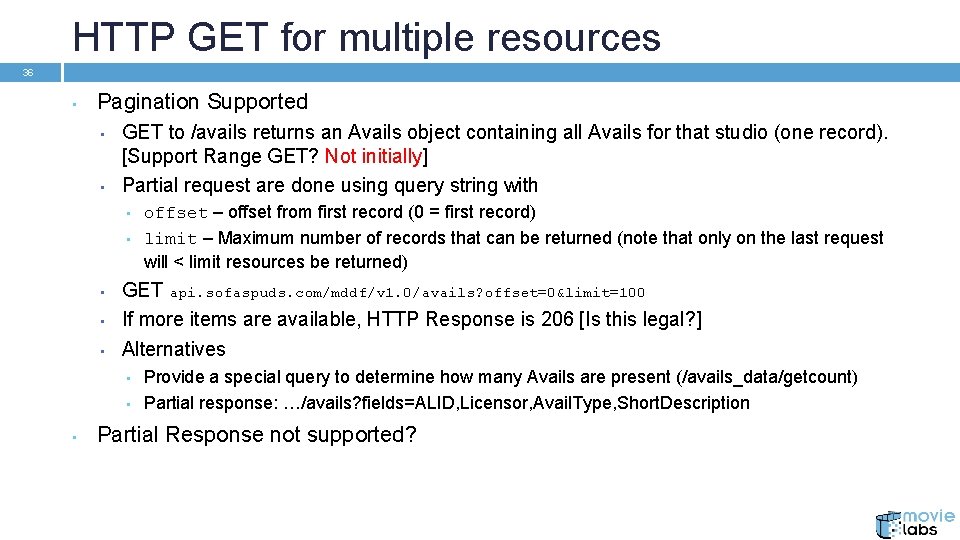
HTTP GET for multiple resources 36 • Pagination Supported • • GET to /avails returns an Avails object containing all Avails for that studio (one record). [Support Range GET? Not initially] Partial request are done using query string with • • • GET api. sofaspuds. com/mddf/v 1. 0/avails? offset=0&limit=100 If more items are available, HTTP Response is 206 [Is this legal? ] Alternatives • • • offset – offset from first record (0 = first record) limit – Maximum number of records that can be returned (note that only on the last request will < limit resources be returned) Provide a special query to determine how many Avails are present (/avails_data/getcount) Partial response: …/avails? fields=ALID, Licensor, Avail. Type, Short. Description Partial Response not supported?
Authentication and Authorization
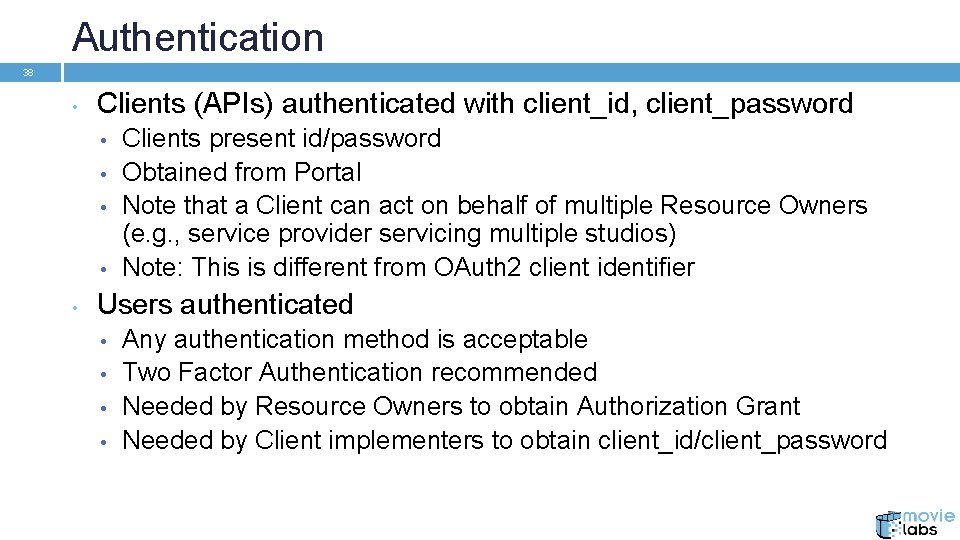
Authentication 38 • Clients (APIs) authenticated with client_id, client_password • • • Clients present id/password Obtained from Portal Note that a Client can act on behalf of multiple Resource Owners (e. g. , service provider servicing multiple studios) Note: This is different from OAuth 2 client identifier Users authenticated • • Any authentication method is acceptable Two Factor Authentication recommended Needed by Resource Owners to obtain Authorization Grant Needed by Client implementers to obtain client_id/client_password
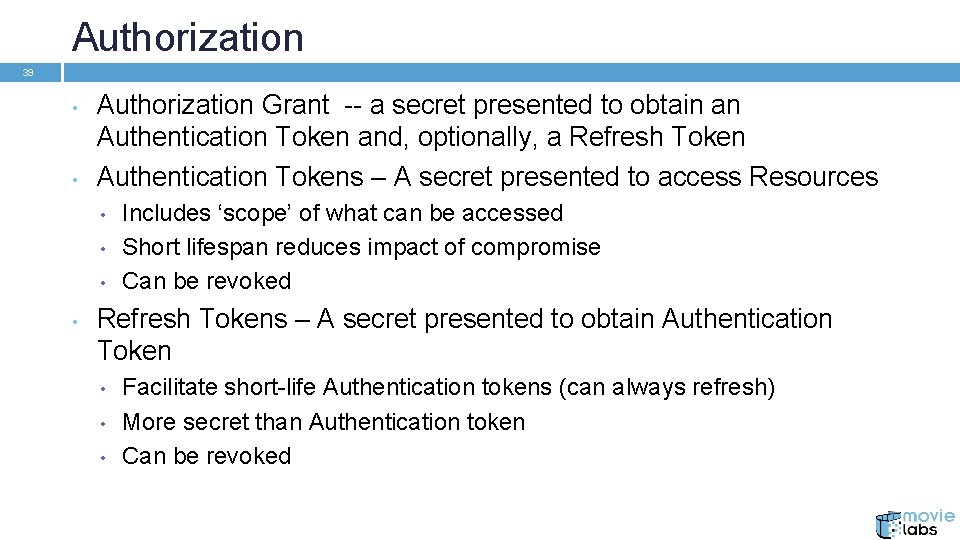
Authorization 39 • • Authorization Grant -- a secret presented to obtain an Authentication Token and, optionally, a Refresh Token Authentication Tokens – A secret presented to access Resources • • Includes ‘scope’ of what can be accessed Short lifespan reduces impact of compromise Can be revoked Refresh Tokens – A secret presented to obtain Authentication Token • • • Facilitate short-life Authentication tokens (can always refresh) More secret than Authentication token Can be revoked
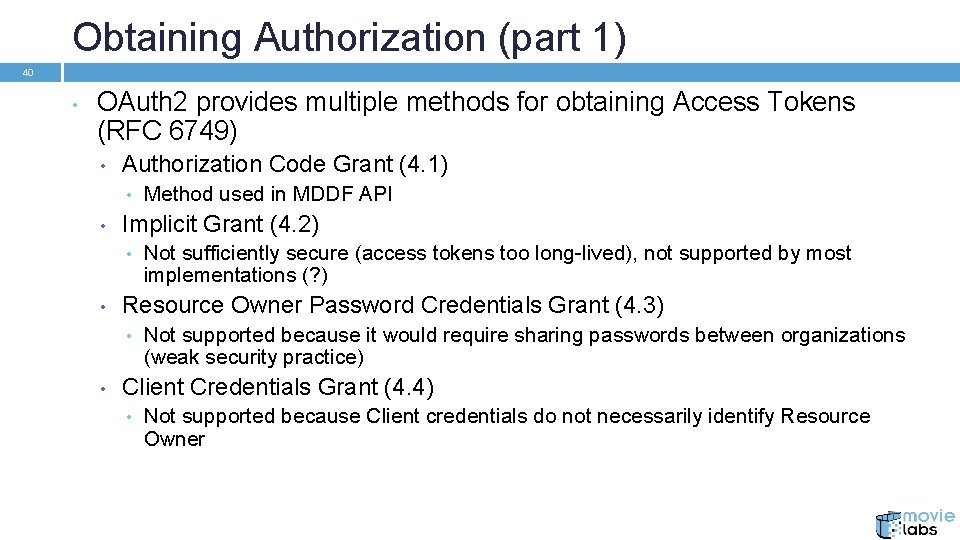
Obtaining Authorization (part 1) 40 • OAuth 2 provides multiple methods for obtaining Access Tokens (RFC 6749) • Authorization Code Grant (4. 1) • • Implicit Grant (4. 2) • • Not sufficiently secure (access tokens too long-lived), not supported by most implementations (? ) Resource Owner Password Credentials Grant (4. 3) • • Method used in MDDF API Not supported because it would require sharing passwords between organizations (weak security practice) Client Credentials Grant (4. 4) • Not supported because Client credentials do not necessarily identify Resource Owner
Obtaining Authorization Grant (part 1) 41 • Model is for a user to obtain Authorization Grant through a Portal • • For example, a studio logs into a retailer portal to get Authorization information In all cases • • User must provide credentials (username/password) to obtain Authorization Grant User specifies the scope (e. g. , avails, metadata) of the authorization
Obtaining Authorization Grant (part 2) 42 • OAuth 2 supports multiple methods for acquiring access tokens • Authorization code
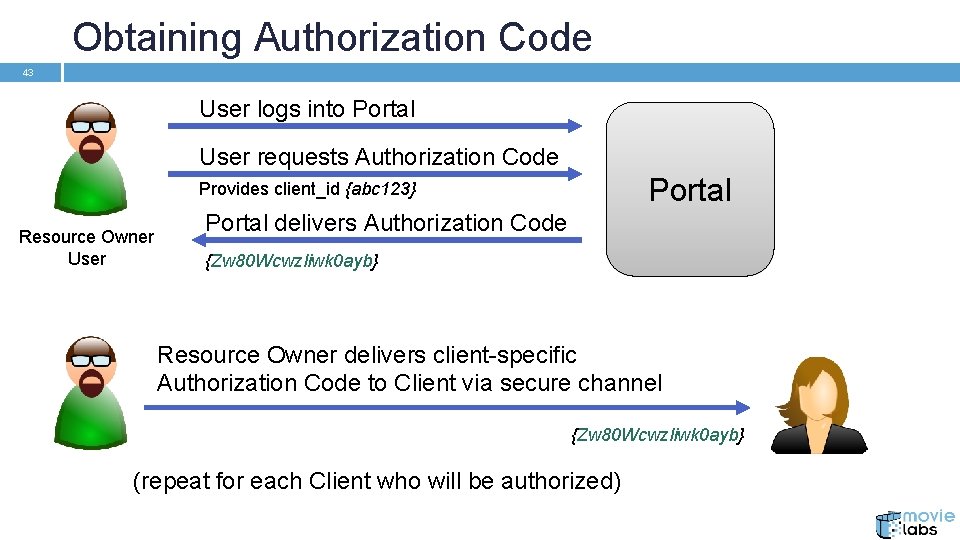
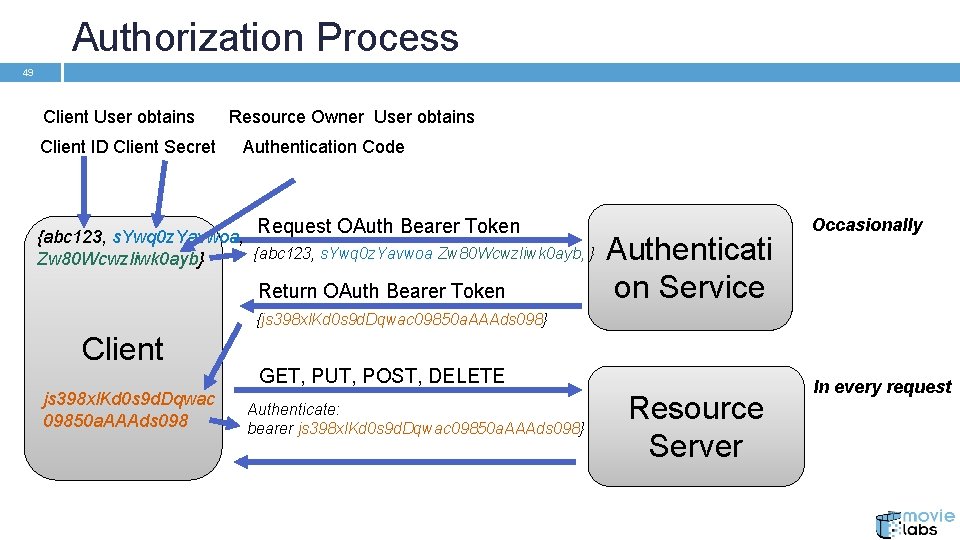
Obtaining Authorization Code 43 User logs into Portal User requests Authorization Code Portal Provides client_id {abc 123} Resource Owner User Portal delivers Authorization Code {Zw 80 Wcwzliwk 0 ayb} Resource Owner delivers client-specific Authorization Code to Client via secure channel {Zw 80 Wcwzliwk 0 ayb} (repeat for each Client who will be authorized)
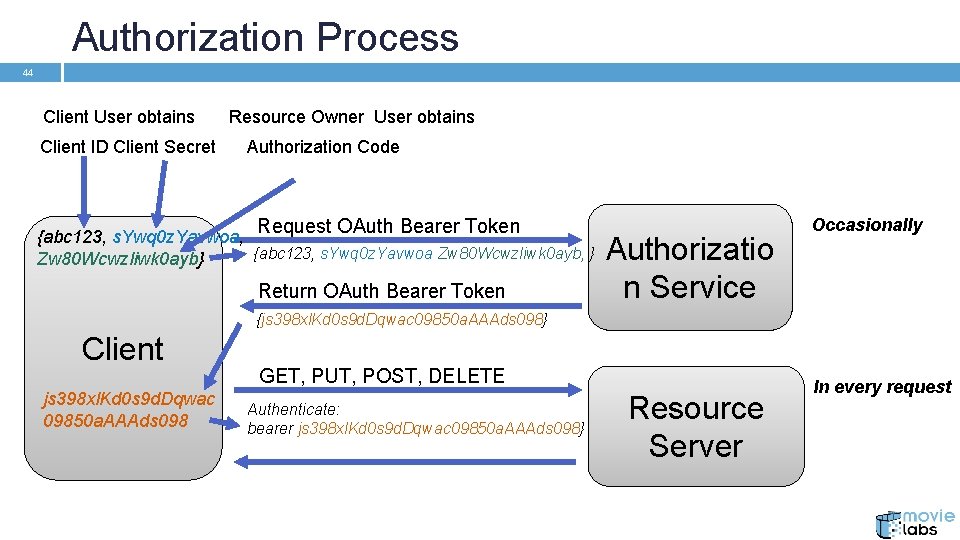
Authorization Process 44 Client User obtains Client ID Client Secret Resource Owner User obtains Authorization Code Request OAuth Bearer Token {abc 123, s. Ywq 0 z. Yavwoa, {abc 123, s. Ywq 0 z. Yavwoa Zw 80 Wcwzliwk 0 ayb, } Zw 80 Wcwzliwk 0 ayb} Return OAuth Bearer Token Authorizatio n Service Occasionally {js 398 xl. Kd 0 s 9 d. Dqwac 09850 a. AAAds 098} Client js 398 xl. Kd 0 s 9 d. Dqwac 09850 a. AAAds 098 GET, PUT, POST, DELETE Authenticate: bearer js 398 xl. Kd 0 s 9 d. Dqwac 09850 a. AAAds 098} Resource Server In every request
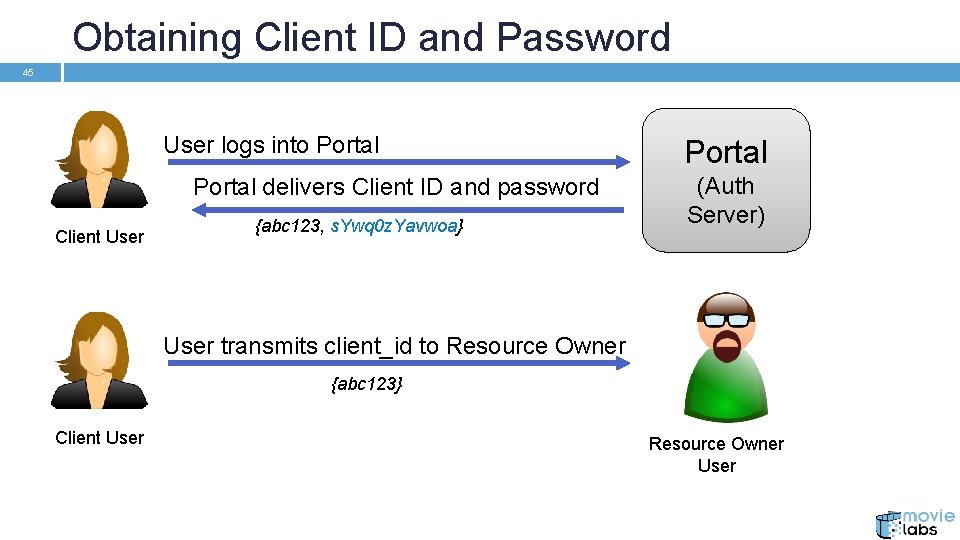
Obtaining Client ID and Password 45 User logs into Portal delivers Client ID and password Client User {abc 123, s. Ywq 0 z. Yavwoa} Portal (Auth Server) User transmits client_id to Resource Owner {abc 123} Client User Resource Owner User
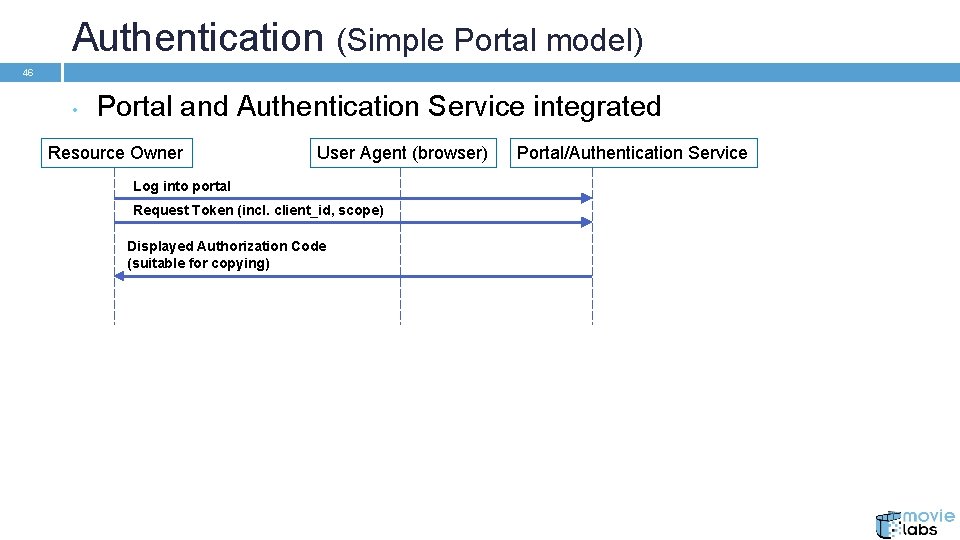
Authentication (Simple Portal model) 46 • Portal and Authentication Service integrated Resource Owner User Agent (browser) Log into portal Request Token (incl. client_id, scope) Displayed Authorization Code (suitable for copying) Portal/Authentication Service
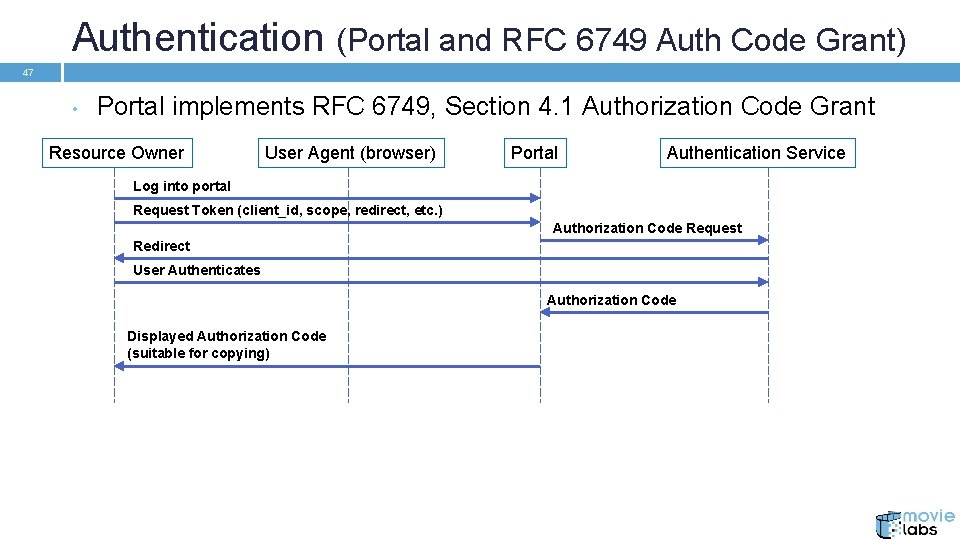
Authentication (Portal and RFC 6749 Auth Code Grant) 47 • Portal implements RFC 6749, Section 4. 1 Authorization Code Grant Resource Owner User Agent (browser) Portal Authentication Service Log into portal Request Token (client_id, scope, redirect, etc. ) Authorization Code Request Redirect User Authenticates Authorization Code Displayed Authorization Code (suitable for copying)
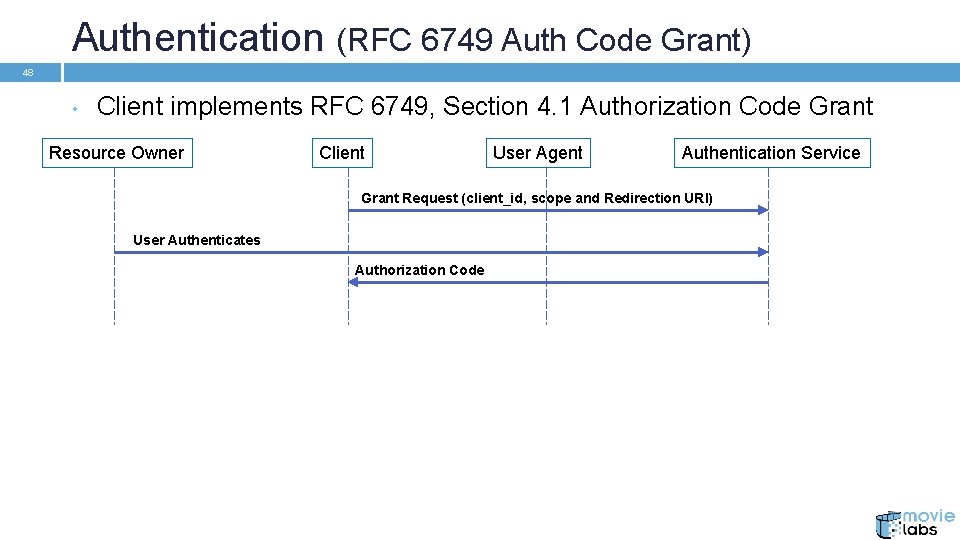
Authentication (RFC 6749 Auth Code Grant) 48 • Client implements RFC 6749, Section 4. 1 Authorization Code Grant Resource Owner Client User Agent Authentication Service Grant Request (client_id, scope and Redirection URI) User Authenticates Authorization Code
Authorization Process 49 Client User obtains Client ID Client Secret Resource Owner User obtains Authentication Code Request OAuth Bearer Token {abc 123, s. Ywq 0 z. Yavwoa, {abc 123, s. Ywq 0 z. Yavwoa Zw 80 Wcwzliwk 0 ayb, } Zw 80 Wcwzliwk 0 ayb} Return OAuth Bearer Token Authenticati on Service Occasionally {js 398 xl. Kd 0 s 9 d. Dqwac 09850 a. AAAds 098} Client js 398 xl. Kd 0 s 9 d. Dqwac 09850 a. AAAds 098 GET, PUT, POST, DELETE Authenticate: bearer js 398 xl. Kd 0 s 9 d. Dqwac 09850 a. AAAds 098} Resource Server In every request
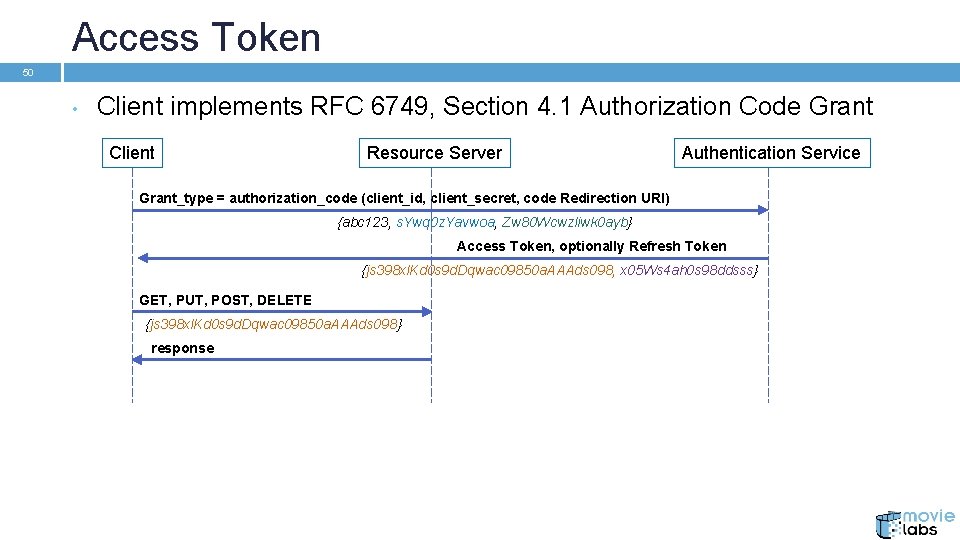
Access Token 50 • Client implements RFC 6749, Section 4. 1 Authorization Code Grant Client Resource Server Authentication Service Grant_type = authorization_code (client_id, client_secret, code Redirection URI) {abc 123, s. Ywq 0 z. Yavwoa, Zw 80 Wcwzliwk 0 ayb} Access Token, optionally Refresh Token {js 398 xl. Kd 0 s 9 d. Dqwac 09850 a. AAAds 098, x 05 Ws 4 ah 0 s 98 ddsss} GET, PUT, POST, DELETE {js 398 xl. Kd 0 s 9 d. Dqwac 09850 a. AAAds 098} response
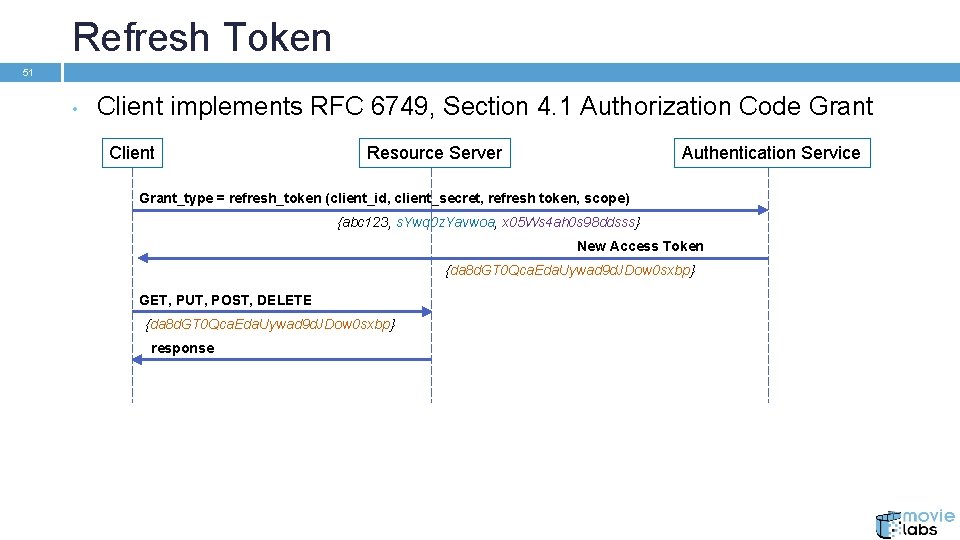
Refresh Token 51 • Client implements RFC 6749, Section 4. 1 Authorization Code Grant Client Resource Server Authentication Service Grant_type = refresh_token (client_id, client_secret, refresh token, scope) {abc 123, s. Ywq 0 z. Yavwoa, x 05 Ws 4 ah 0 s 98 ddsss} New Access Token {da 8 d. GT 0 Qca. Eda. Uywad 9 d. JDow 0 sxbp} GET, PUT, POST, DELETE {da 8 d. GT 0 Qca. Eda. Uywad 9 d. JDow 0 sxbp} response
ATOM
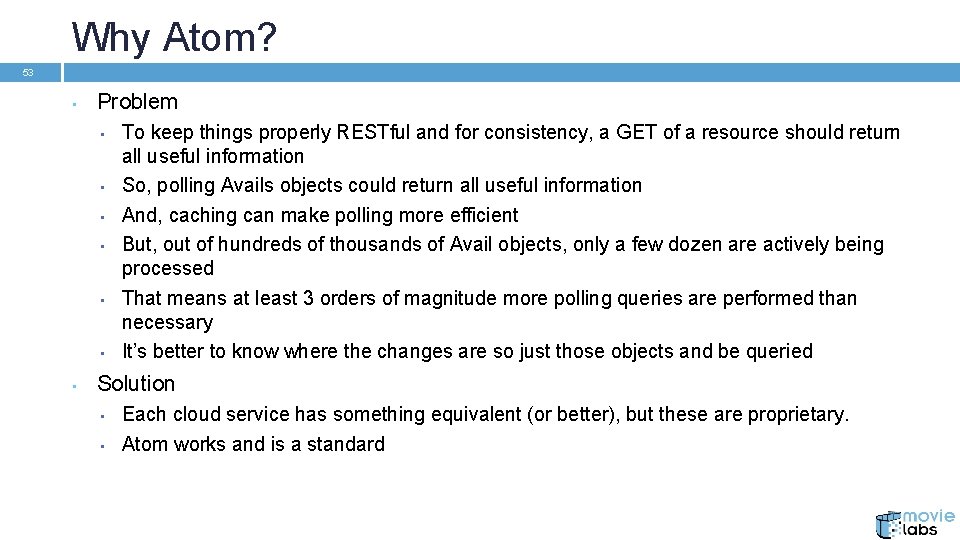
Why Atom? 53 • Problem • • To keep things properly RESTful and for consistency, a GET of a resource should return all useful information So, polling Avails objects could return all useful information And, caching can make polling more efficient But, out of hundreds of thousands of Avail objects, only a few dozen are actively being processed That means at least 3 orders of magnitude more polling queries are performed than necessary It’s better to know where the changes are so just those objects and be queried Solution • • Each cloud service has something equivalent (or better), but these are proprietary. Atom works and is a standard
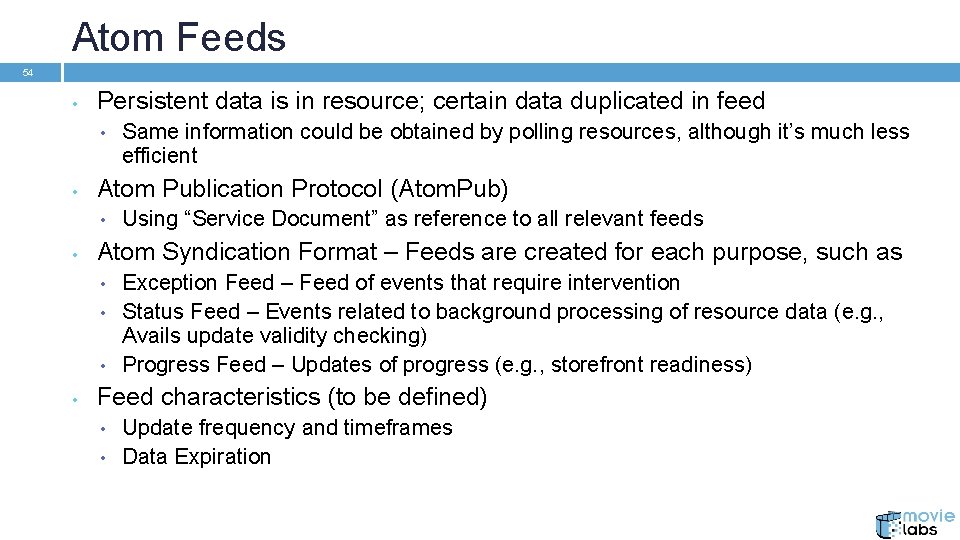
Atom Feeds 54 • Persistent data is in resource; certain data duplicated in feed • • Atom Publication Protocol (Atom. Pub) • • Using “Service Document” as reference to all relevant feeds Atom Syndication Format – Feeds are created for each purpose, such as • • Same information could be obtained by polling resources, although it’s much less efficient Exception Feed – Feed of events that require intervention Status Feed – Events related to background processing of resource data (e. g. , Avails update validity checking) Progress Feed – Updates of progress (e. g. , storefront readiness) Feed characteristics (to be defined) • • Update frequency and timeframes Data Expiration
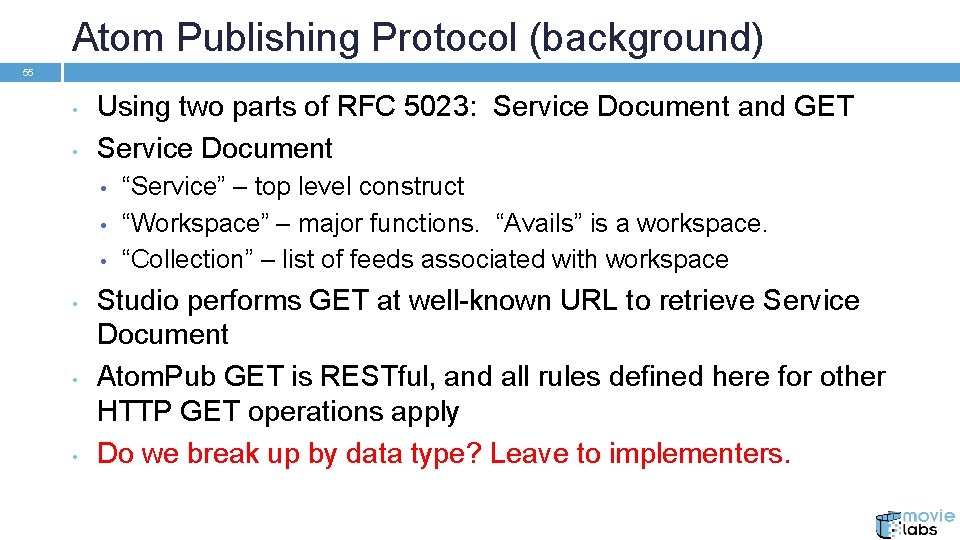
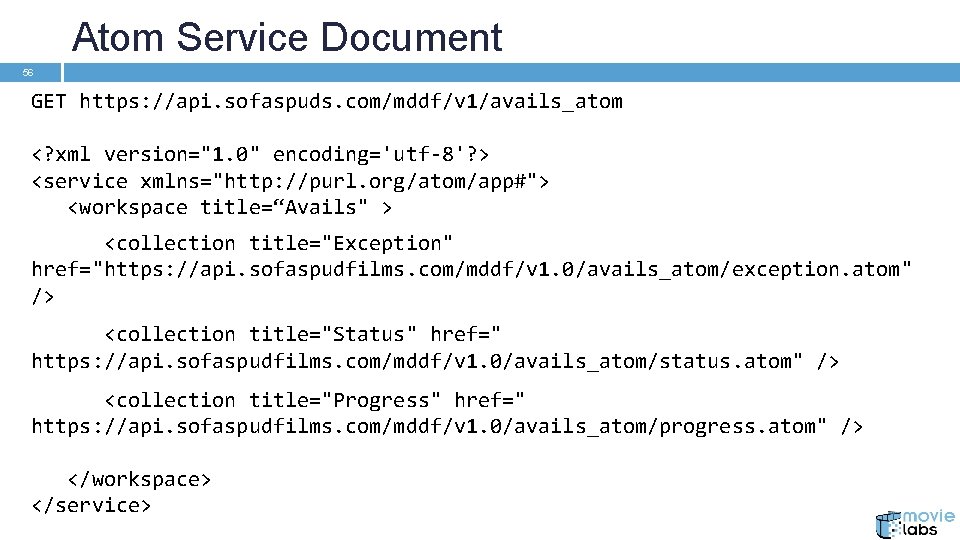
Atom Publishing Protocol (background) 55 • • Using two parts of RFC 5023: Service Document and GET Service Document • • • “Service” – top level construct “Workspace” – major functions. “Avails” is a workspace. “Collection” – list of feeds associated with workspace Studio performs GET at well-known URL to retrieve Service Document Atom. Pub GET is RESTful, and all rules defined here for other HTTP GET operations apply Do we break up by data type? Leave to implementers.
Atom Service Document 56 GET https: //api. sofaspuds. com/mddf/v 1/avails_atom <? xml version="1. 0" encoding='utf-8'? > <service xmlns="http: //purl. org/atom/app#"> <workspace title=“Avails" > <collection title="Exception" href="https: //api. sofaspudfilms. com/mddf/v 1. 0/avails_atom/exception. atom" /> <collection title="Status" href=" https: //api. sofaspudfilms. com/mddf/v 1. 0/avails_atom/status. atom" /> <collection title="Progress" href=" https: //api. sofaspudfilms. com/mddf/v 1. 0/avails_atom/progress. atom" /> </workspace> </service>
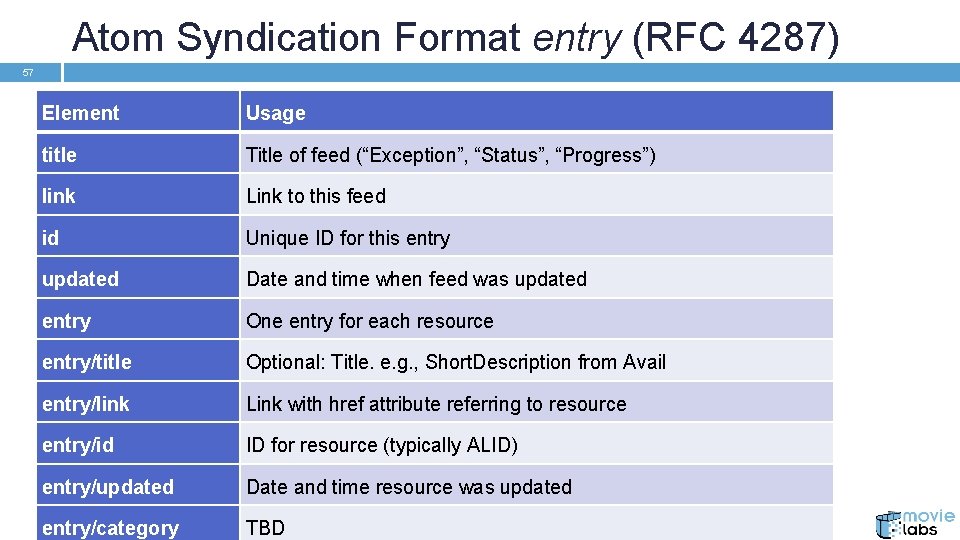
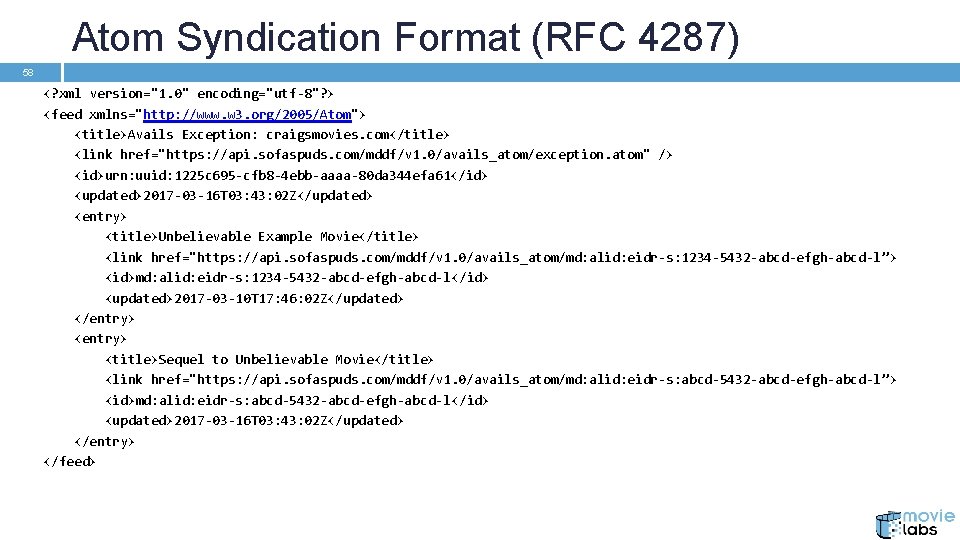
Atom Syndication Format entry (RFC 4287) 57 Element Usage title Title of feed (“Exception”, “Status”, “Progress”) link Link to this feed id Unique ID for this entry updated Date and time when feed was updated entry One entry for each resource entry/title Optional: Title. e. g. , Short. Description from Avail entry/link Link with href attribute referring to resource entry/id ID for resource (typically ALID) entry/updated Date and time resource was updated entry/category TBD
Atom Syndication Format (RFC 4287) 58 <? xml version="1. 0" encoding="utf-8"? > <feed xmlns="http: //www. w 3. org/2005/Atom"> <title>Avails Exception: craigsmovies. com</title> <link href="https: //api. sofaspuds. com/mddf/v 1. 0/avails_atom/exception. atom" /> <id>urn: uuid: 1225 c 695 -cfb 8 -4 ebb-aaaa-80 da 344 efa 61</id> <updated>2017 -03 -16 T 03: 43: 02 Z</updated> <entry> <title>Unbelievable Example Movie</title> <link href="https: //api. sofaspuds. com/mddf/v 1. 0/avails_atom/md: alid: eidr-s: 1234 -5432 -abcd-efgh-abcd-l”> <id>md: alid: eidr-s: 1234 -5432 -abcd-efgh-abcd-l</id> <updated>2017 -03 -10 T 17: 46: 02 Z</updated> </entry> <title>Sequel to Unbelievable Movie</title> <link href="https: //api. sofaspuds. com/mddf/v 1. 0/avails_atom/md: alid: eidr-s: abcd-5432 -abcd-efgh-abcd-l”> <id>md: alid: eidr-s: abcd-5432 -abcd-efgh-abcd-l</id> <updated>2017 -03 -16 T 03: 43: 02 Z</updated> </entry> </feed>
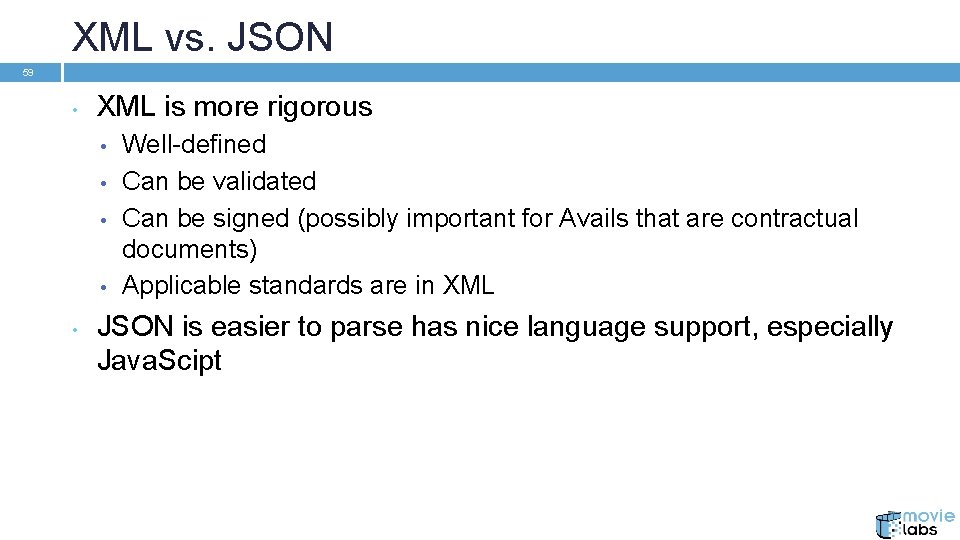
XML vs. JSON 59 • XML is more rigorous • • • Well-defined Can be validated Can be signed (possibly important for Avails that are contractual documents) Applicable standards are in XML JSON is easier to parse has nice language support, especially Java. Scipt
Part 3: Implementation Planning
Implementation Planning 61 • MVP • • Integration and Testing • • • What do we start with? Avail plus status? Metadata? Something else? Do we do full authentication or find a shortcut for testing? Full Do we do something “end-to-end” without integrating (e. g. , pull files from a directory and drop into directory on the other side). Do we stub out something? People like this idea. Should be incremental. Agreed in principle. Possibly stubs. Need to define. Bilateral testing or Virtual Plugfests? Let’s see who players are and where they are. Shared resources? • • • Communications • • Email, Slack? , Dropbox? , Something else? Use existing list. Meeting type and frequency? • • Samples of authentication, authorization, REST and Atom References to implementation resources (e. g. , OAuth 2 and Atom libraries) Call every 4 weeks. Cancel if no agenda items. Next call to review updates to spec based on this discussion. Other?
Thank You
Postel’s Law 63 Be liberal in what you accept, and conservative in what you send