
Digital Storage Options A Transitional Perspective For Small
- Slides: 17
Digital Storage Options: A Transitional Perspective For Small Archives How Do We Provide a Safety Net for Small Archives? John Spencer BMS/Chace JTS 2007
LTO - Another Solution for Small Archives • the debate over “which media do i use” is so 20 th century. . . . if you are a small archive and basing your media carrier on “shelf-life”, you have not done your homework • LTO data storage tapes provide a cost-effective alternative (or companion) to optical media and hard disk drives
LTO - Another Solution for Small Archives • LTO technology has become the leading tape-based storage media within the IT industry • small archives cannot make the same mistake the professional audio industry made - the assumption that proprietary formats and media carriers will be developed for their specific needs - the reality is that many content creators are moving away from proprietary solutions
LTO - A Quick Overview • LTO has a “roadmap” currently published through LTO-6 (1. 6 TB native storage) • LTO vendors are currently shipping LTO-4 tape drives and media (800 GB native storage) • LTO drives provide “N-1” read/ write and “N-2” read-only capability • LTO media and drives are created by many vendors - as opposed to other data storage tape suppliers that are essentially “sole-source” (one manufacturer)
“But I Can’t Afford it!” • not true - LTO-2 tape drives (200 GB native capacity) are approximately $1200 USD • LTO-3 tape drives are now under $2500 USD, and LTO-4 drives under $4000 USD • can’t afford that? then make a copy of your HDD and find a vendor that will write the tape for you (usually $50 - $75 per tape written) • LTO-3 and beyond also have the ability to be written as “Write Once Read Many” (WORM)
Small Archives: Do We Need a Transitional Repository? • we have discussed during this panel how various media carriers (gold cd-r, hdd, lto) can play a supporting role in the storage of digital preservation files • however, there a number of other issues that threaten the viability of small digital migration projects
Small Archives: Do We Need a Transitional Repository? • this topic was presented at the 2006 CLIR Engineers Roundtable as a white paper and will be published later this year • the assoc. of recorded sound collections (arsc) technical committee has created a sub-committee to determine a baseline of needs/ assistance for small archives
Small Archives: Do We Need a Transitional Repository? • THESE ISSUES INCLUDE: • structured metadata and templates (GIUs) to streamline the gathering of technical and descriptive documentation • generation of checksums, unique identifiers, etc. • workflow optimization • allocation of funds within a grant proposal • other tools/ hardware/ software not currently owned by the archive
Small Archives: Do We Need a Transitional Repository? • WHAT OTHER SERVICES/ TOOLS/ APPLICATIONS ARE NEEDED? • we need a survey to help determine what small archives need • are there any suggestions from the participants of this conference? • are there other organizations that are undertaking a similar project?
Small Archives: Do We Need a Transitional Repository? • archival vendors/ service providers see poorly written grants that do not properly budget for the i. t. needs to maintain access and viability of the digital preservation files • we as a community must do a better job of “sharing the burden” by peer review or other methods to assist the small archive in the planning process - before the grant has been awarded and has to be modified due to the unanticipated additional costs related to digital preservation
A BRIEF OVERVIEW OF 2 PROJECTS
Beale Street Caravan, ® the most widely distributed Blues radio program in the world, attracts more than 2. 4 million listeners each week. Produced in The Home of the Blues - Memphis, Tennessee - Beale Street Caravan covers the world with the heartfelt sounds and colorful stories of the Blues and its music makers.
BMS/Chace provided Beale Street Caravan with: • a standardized template for metadata collection (that will also allow for export to various metadata schema) • a hard disk drive to copy preservation files, send them to our office, and write LTO tapes • the cost to do this was very minimal, yet the archive is more robust because of our assistance
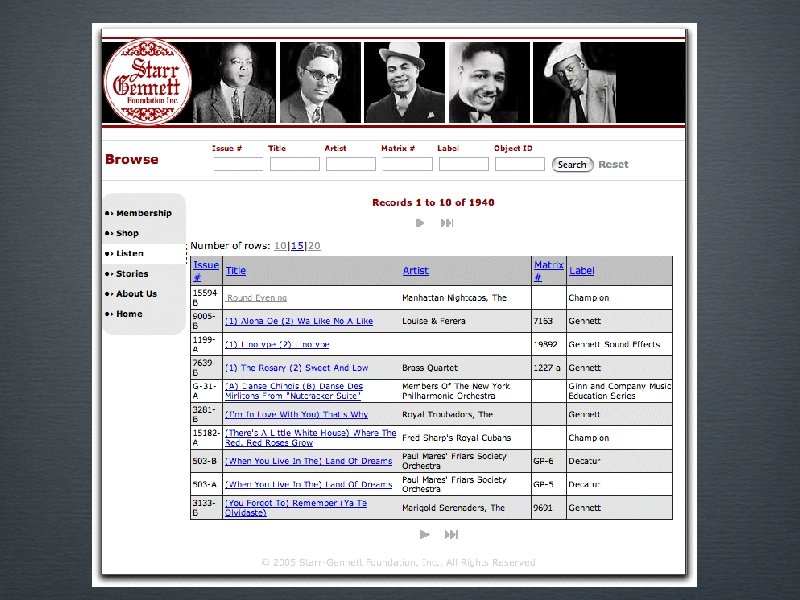
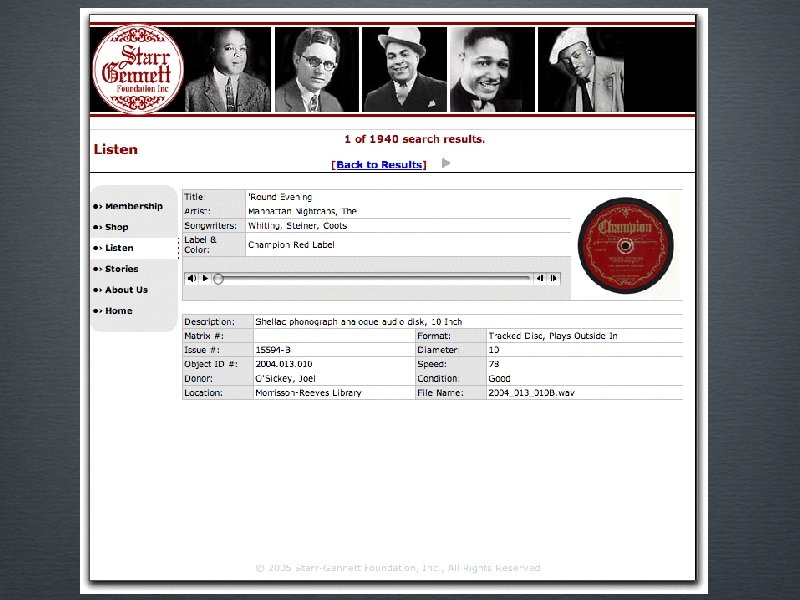
BMS/Chace provided Starr-Gennett Foundation with: • migration of 450 78 rpm discs • “data cleansing” of existing metadata (entered by volunteers using Past. Perfect) • import of newly-created metadata into Past. Perfect • creating the infrastructure for streaming (coming soon!) from their website