
Digital Signatures to Ensure the Authenticity and Integrity







- Slides: 43
Digital Signatures to Ensure the Authenticity and Integrity of Synthetic DNA Molecules Diptendu Mohan Kar, Indrajit Ray, Jenna Gallegos and Jean Peccoud Colorado State University
Outline Introduction and motivation. Existing methods vs. our approach. Domain constraints. Challenges and design decisions. Signature Scheme. Error tolerance. Associating a physical DNA with its digital version. Experiments and future work.
Introduction and motivation
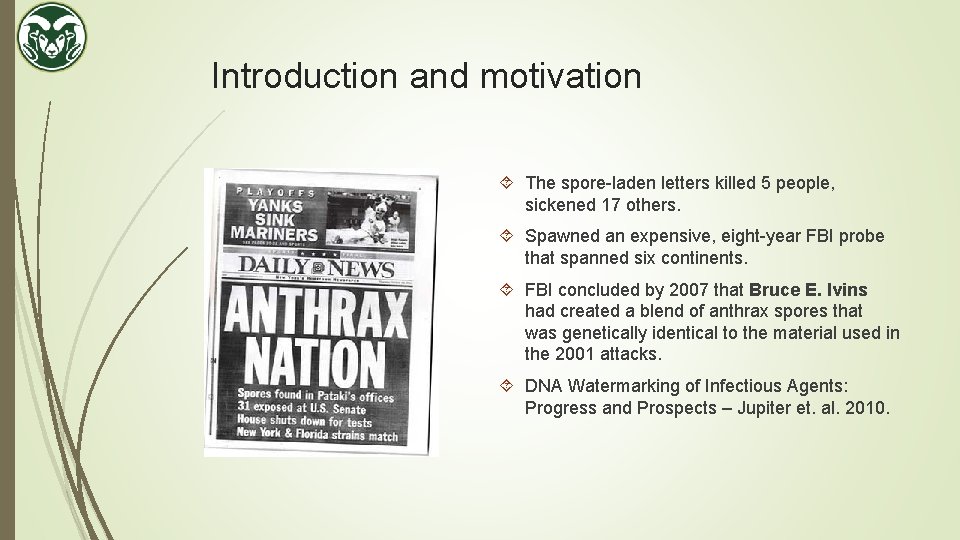
Introduction and motivation The spore-laden letters killed 5 people, sickened 17 others. Spawned an expensive, eight-year FBI probe that spanned six continents. FBI concluded by 2007 that Bruce E. Ivins had created a blend of anthrax spores that was genetically identical to the material used in the 2001 attacks. DNA Watermarking of Infectious Agents: Progress and Prospects – Jupiter et. al. 2010.
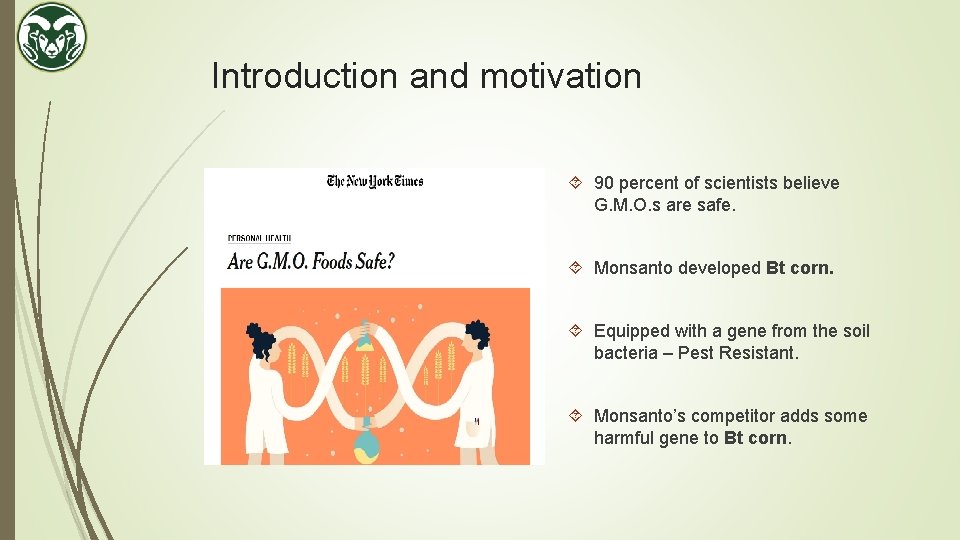
Introduction and motivation 90 percent of scientists believe G. M. O. s are safe. Monsanto developed Bt corn. Equipped with a gene from the soil bacteria – Pest Resistant. Monsanto’s competitor adds some harmful gene to Bt corn.
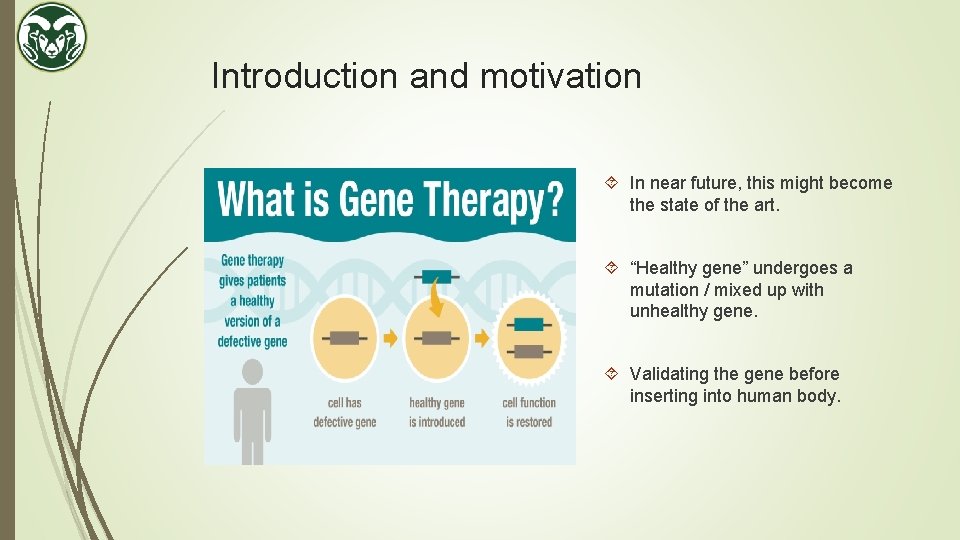
Introduction and motivation In near future, this might become the state of the art. “Healthy gene” undergoes a mutation / mixed up with unhealthy gene. Validating the gene before inserting into human body.
Introduction and motivation DNA synthesis is common and many synthetic DNA samples are licensed IP. Molecular biologists study these samples and manipulate them – to observe the new properties added or removed, improvements such as antibiotic resistance. Samples are shared between many researchers, academic labs or new samples ordered from gene synthesis companies. Attribution of a physical DNA sample is difficult with the existing technologies.
Introduction and motivation Sequence in a DNA sample is documented electronically as well. Include origin information in the digital DNA file. Problems Very loose, sample may change hands many times more than the digital file. Sharing full pathogen sequences is a bio-security risk. Bio-tech companies don’t disclose some sequence information. Protect IP. Problem cannot be solved digital DNA file. Needs to be in the physical DNA sample.
Existing methods vs. Our approach
Existing methods Present day solutions use watermarks to identify origin. Jupiter et. al, DNA Watermarking of Infectious Agents. Liss et. al, Embedding Permanent Watermarks in Synthetic Genes. Limitations Independent of the DNA sequence in which the watermark is applied. No integrity to the original DNA. Watermark can remain intact while other parts of the DNA can mutate. The watermark sequence can be identified and used by an attacker placing it into other harmful virus DNA.
Existing methods Present day solutions use watermarks to identify origin. Heider et. al, DNA-based Watermarks using the DNA-Crypt Algorithm. One of the most cited papers in this domain. Limitations The watermark is generated from a binary data e. g. image or name and added to the original sequence. Compromising the binary data results in generating the same watermark. Has option for symmetric key encryption of the watermark. But keys need to be exported. Has provision for export. Has option for asymmetric key encryption. RSA only. But does not talk about the challenges.
Our approach Digital Signatures instead of watermarks. Widely used in any digital domain. Identity based signatures. Private Key Infrastructure (PKI) is not well known to biologists. All of them have an unique identification - ORCID. Open Researcher and Contributor ID – a 16 digit unique identification number. More suited to our domain.
Domain constraints
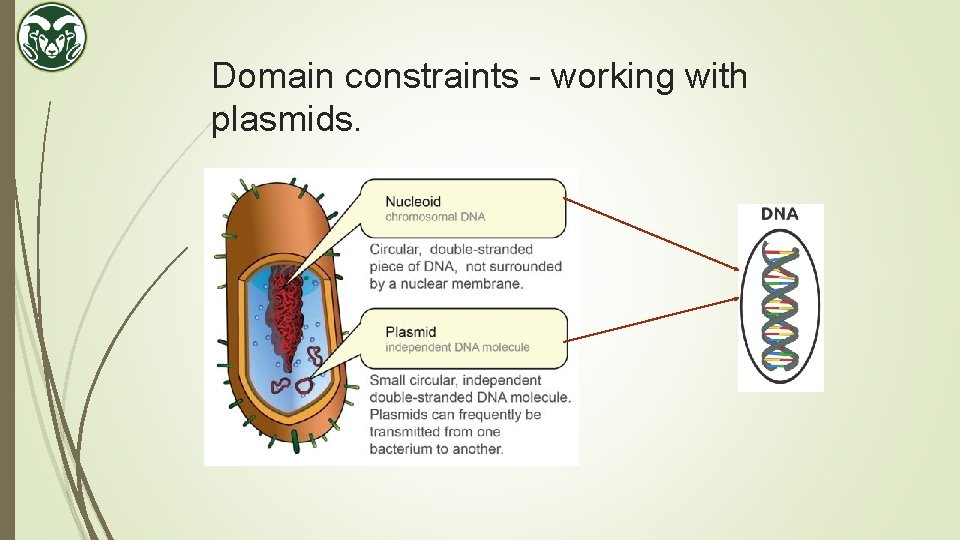
Domain constraints - working with plasmids.
Domain constraints – why plasmids. Can isolate them in large quantities. Can cut and splice them, adding whatever DNA we choose. (tweak with features) Can put them back into bacteria, where they'll replicate along with the bacteria's own DNA. Can isolate them again - getting billions of copies of whatever DNA we inserted into the plasmid! Plasmid are limited to sizes of 2. 5 - 20 kilo bases (kb), in general. A base is one of the four building blocks of DNA – A, C, G, T.
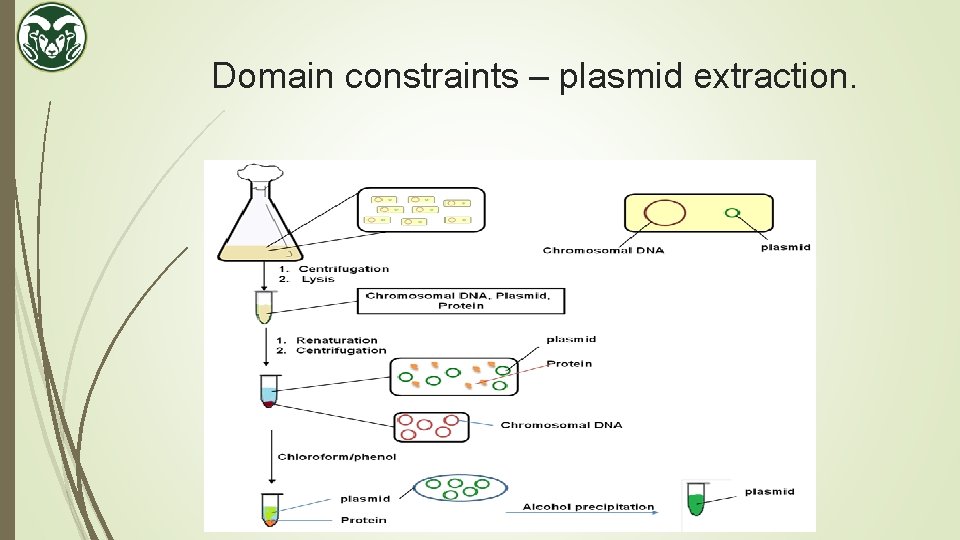
Domain constraints – plasmid extraction.
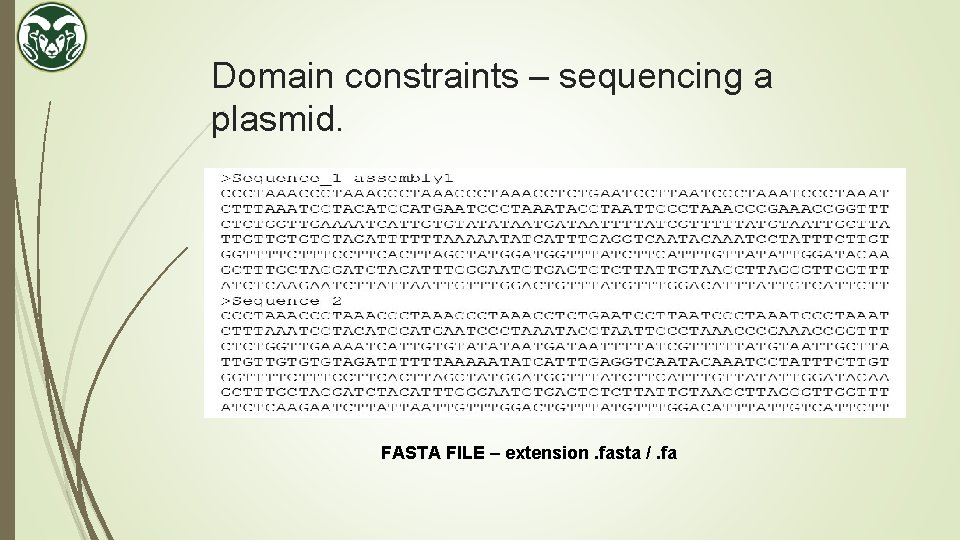
Domain constraints – sequencing a plasmid. FASTA FILE – extension. fasta /. fa
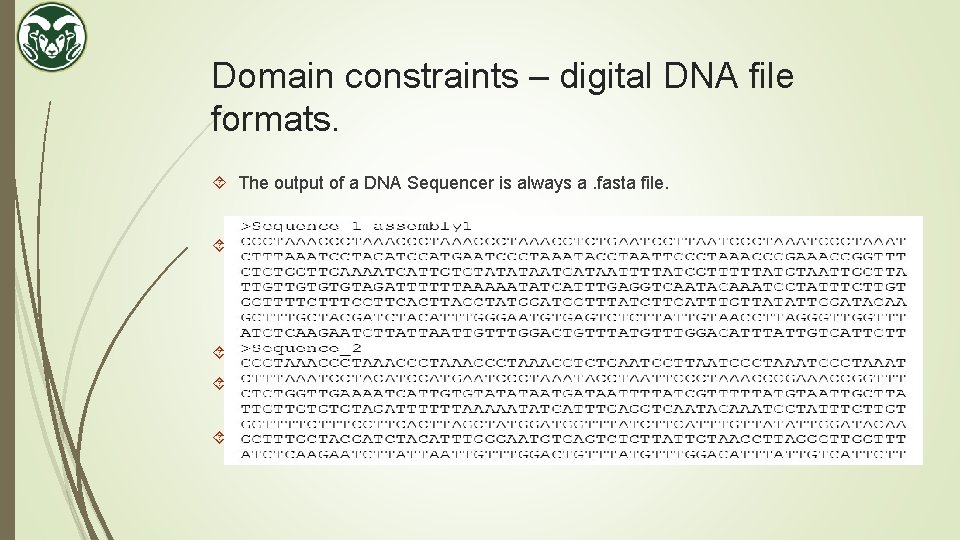
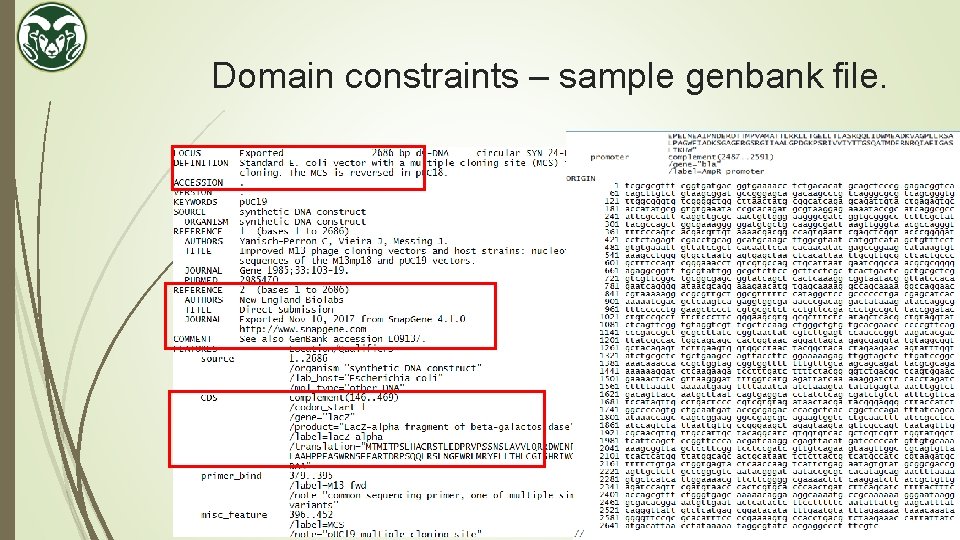
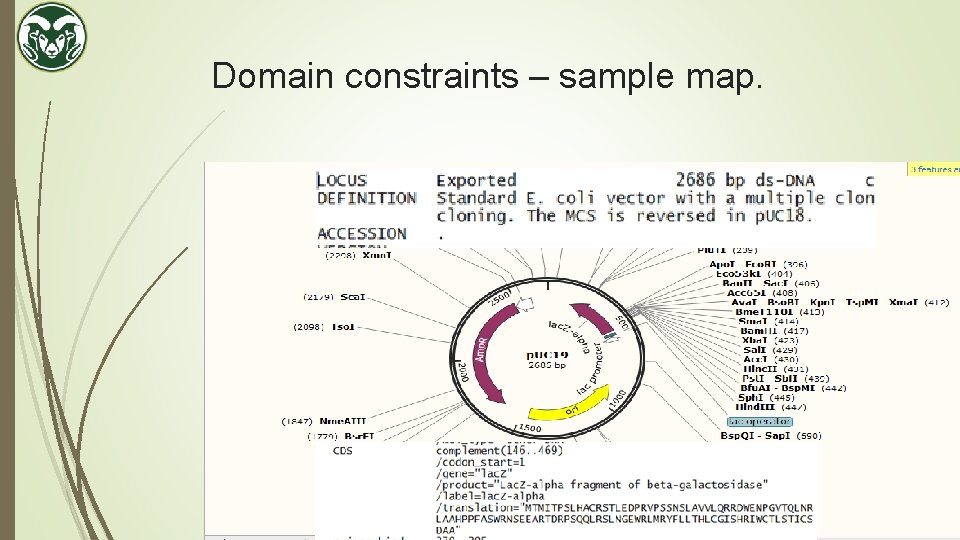
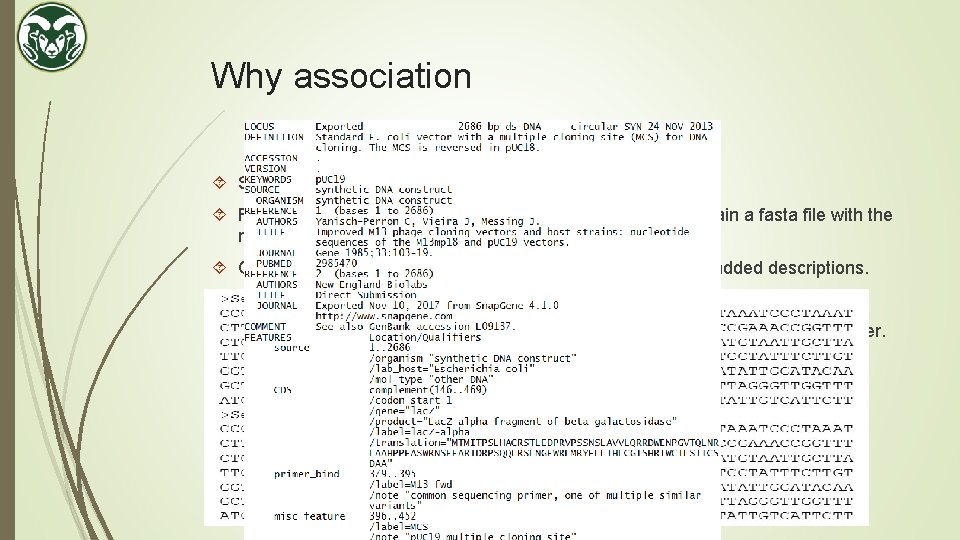
Domain constraints – digital DNA file formats. The output of a DNA Sequencer is always a. fasta file. Contains the raw sequences only. The sequences can be converted to a annotated file called genbank (. gb) file which contains the sequences along with their descriptions. Sequence manipulation software e. g. Snapgene can be used to do so. Contains a database of descriptions. Will try to automatically annotate any matching sub-sequence. The user can add, delete or overwrite. Provides a more visual map than just a sequence of ACGT.
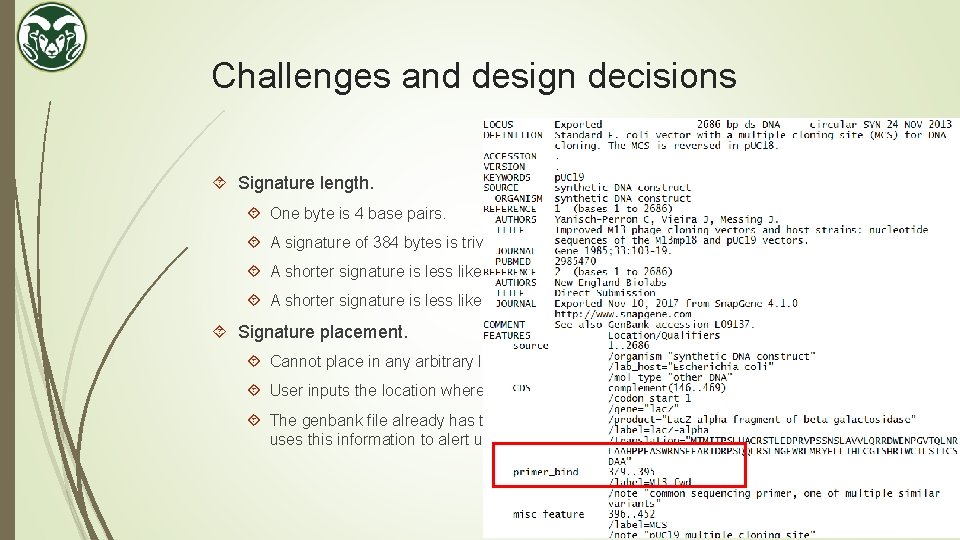
Domain constraints – sample genbank file.
Domain constraints – sample map.
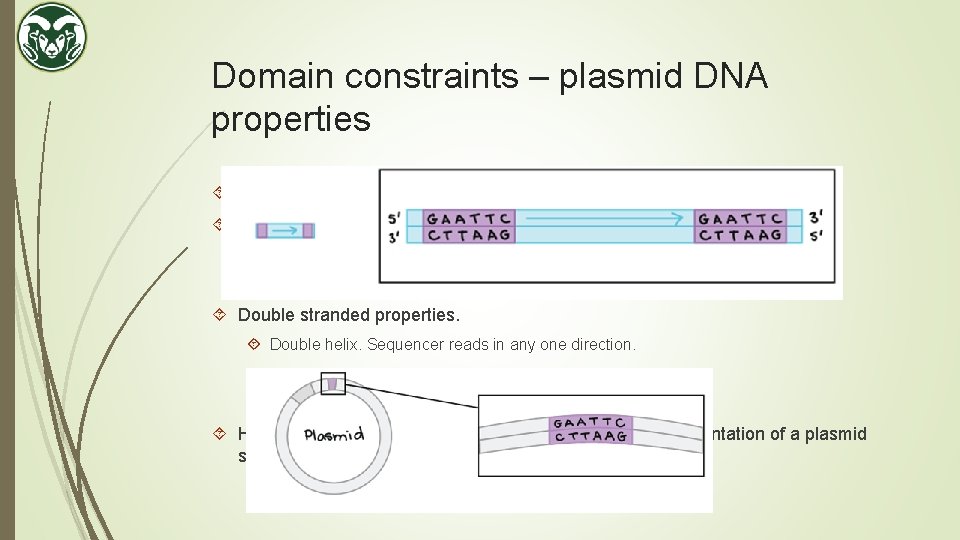
Domain constraints – plasmid DNA properties A plasmid DNA is double stranded and circular. Circular properties. Sequence a sample. Output is ACGGTTCA. Sequence the sample again. Output is TCAACGGT. Double stranded properties. Double helix. Sequencer reads in any one direction. May read in the other direction next time. Reverse Complement. Hence, there can be 2 N number of possible correct representation of a plasmid sequence.
Challenges and design decisions
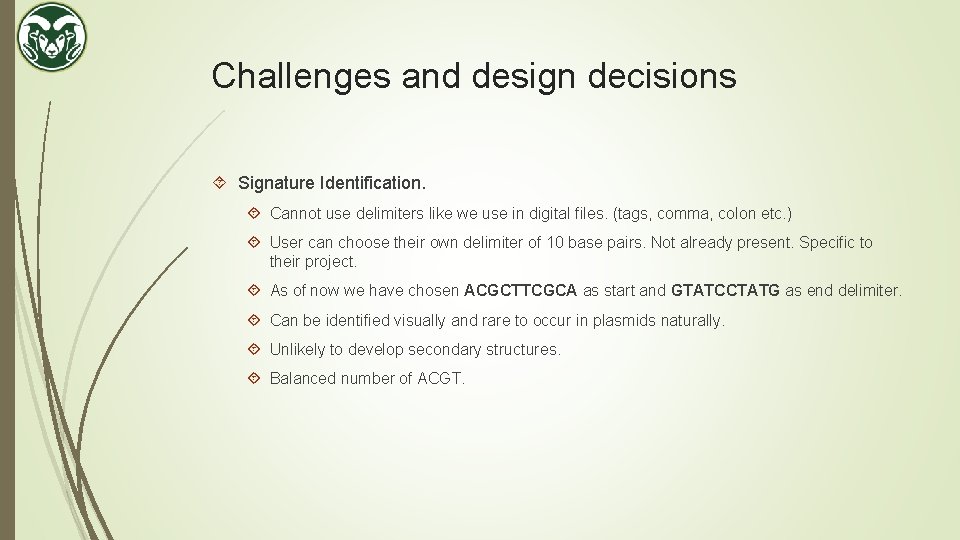
Challenges and design decisions Signature Identification. Cannot use delimiters like we use in digital files. (tags, comma, colon etc. ) User can choose their own delimiter of 10 base pairs. Not already present. Specific to their project. As of now we have chosen ACGCTTCGCA as start and GTATCCTATG as end delimiter. Can be identified visually and rare to occur in plasmids naturally. Unlikely to develop secondary structures. Balanced number of ACGT.
Challenges and design decisions Signature length. One byte is 4 base pairs. A signature of 384 bytes is trivial. But 1536 base pairs is not. A shorter signature is less likely to introduce a new function or impact stability. A shorter signature is less likely to mutate and will be cheaper to synthesize. Signature placement. Cannot place in any arbitrary location. There might be an existing feature there. User inputs the location where to place the signature e. g. 104 from the start. The genbank file already has the list of features that are present in the plasmid. Our tool uses this information to alert user in case of collision.
Challenges and design decisions Error tolerance. Signature ensures that change in a single base pair will result in failed verification. But, DNA are prone to naturally occurring mutations. Cannot just resend the sample like resending email. Use error correction code – we used Reed-Solomon code. The user provides how many error to tolerate. More the error tolerance, more the length of the code.
Signature scheme
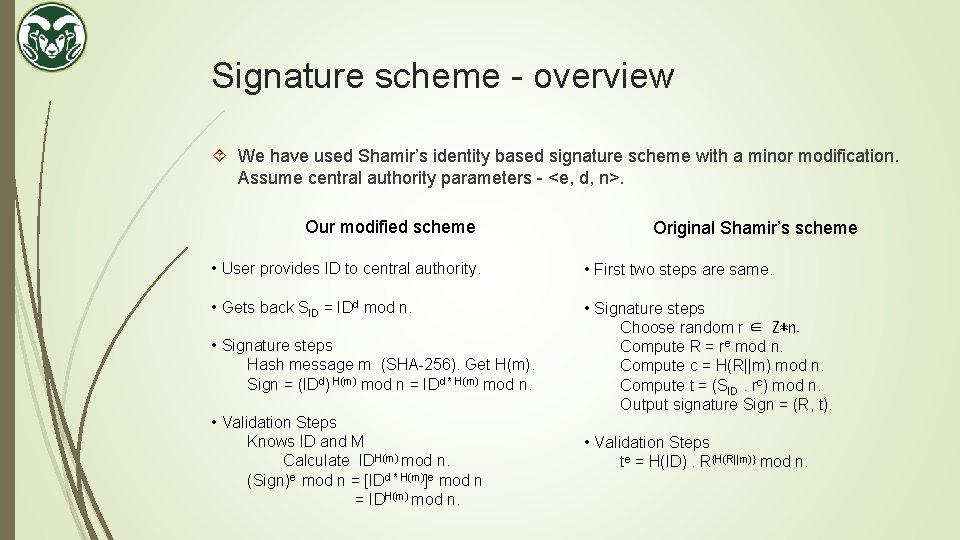
Signature scheme - overview We have used Shamir’s identity based signature scheme with a minor modification. Assume central authority parameters - <e, d, n>. Our modified scheme Original Shamir’s scheme • User provides ID to central authority. • First two steps are same. • Gets back SID = IDd mod n. • Signature steps Choose random r ∈ Z*n. Compute R = re mod n. Compute c = H(R||m) mod n. Compute t = (SID. rc) mod n. Output signature Sign = (R, t). • Signature steps Hash message m (SHA-256). Get H(m). Sign = (IDd) H(m) mod n = IDd * H(m) mod n. • Validation Steps Knows ID and M Calculate IDH(m) mod n. (Sign)e mod n = [IDd * H(m)]e mod n = IDH(m) mod n. • Validation Steps te = H(ID). R{H(R||m)} mod n.
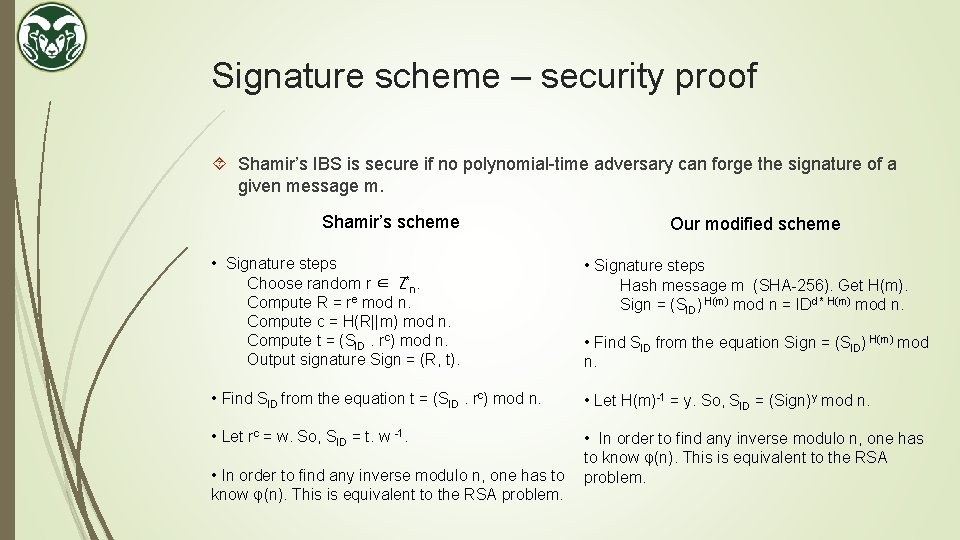
Signature scheme – security proof Shamir’s IBS is secure if no polynomial-time adversary can forge the signature of a given message m. Shamir’s scheme Our modified scheme • Signature steps Choose random r ∈ Z*n. Compute R = re mod n. Compute c = H(R||m) mod n. Compute t = (SID. rc) mod n. Output signature Sign = (R, t). • Signature steps Hash message m (SHA-256). Get H(m). Sign = (SID) H(m) mod n = IDd * H(m) mod n. • Find SID from the equation t = (SID. rc) mod n. • Let H(m)-1 = y. So, SID = (Sign)y mod n. • Let rc = w. So, SID = t. w -1. • In order to find any inverse modulo n, one has to know φ(n). This is equivalent to the RSA problem. • Find SID from the equation Sign = (SID) H(m) mod n.
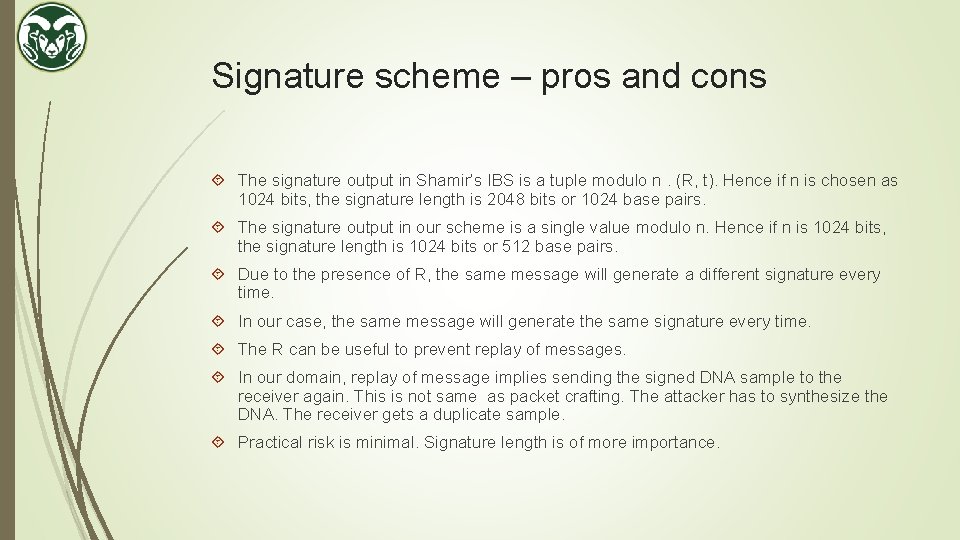
Signature scheme – pros and cons The signature output in Shamir’s IBS is a tuple modulo n. (R, t). Hence if n is chosen as 1024 bits, the signature length is 2048 bits or 1024 base pairs. The signature output in our scheme is a single value modulo n. Hence if n is 1024 bits, the signature length is 1024 bits or 512 base pairs. Due to the presence of R, the same message will generate a different signature every time. In our case, the same message will generate the same signature every time. The R can be useful to prevent replay of messages. In our domain, replay of message implies sending the signed DNA sample to the receiver again. This is not same as packet crafting. The attacker has to synthesize the DNA. The receiver gets a duplicate sample. Practical risk is minimal. Signature length is of more importance.
Error tolerance
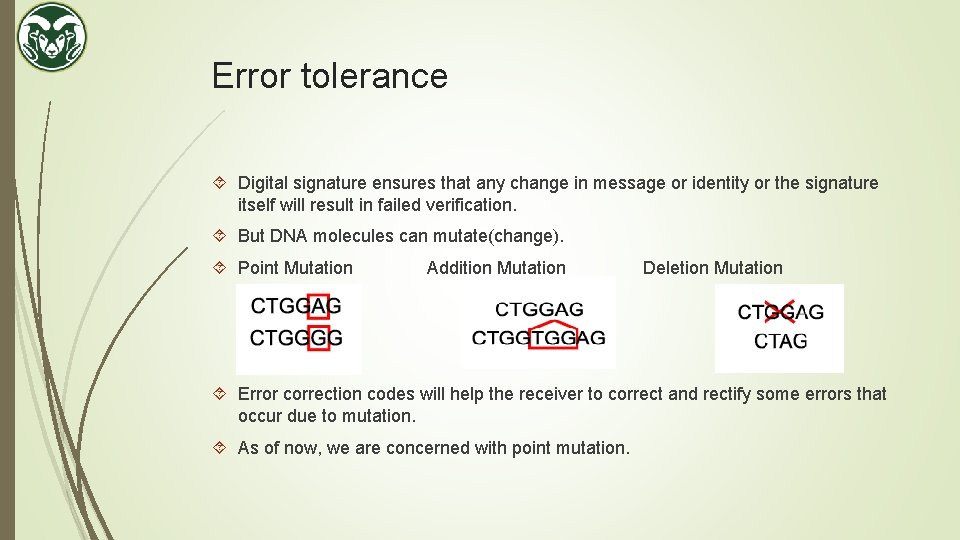
Error tolerance Digital signature ensures that any change in message or identity or the signature itself will result in failed verification. But DNA molecules can mutate(change). Point Mutation Addition Mutation Deletion Mutation Error correction codes will help the receiver to correct and rectify some errors that occur due to mutation. As of now, we are concerned with point mutation.
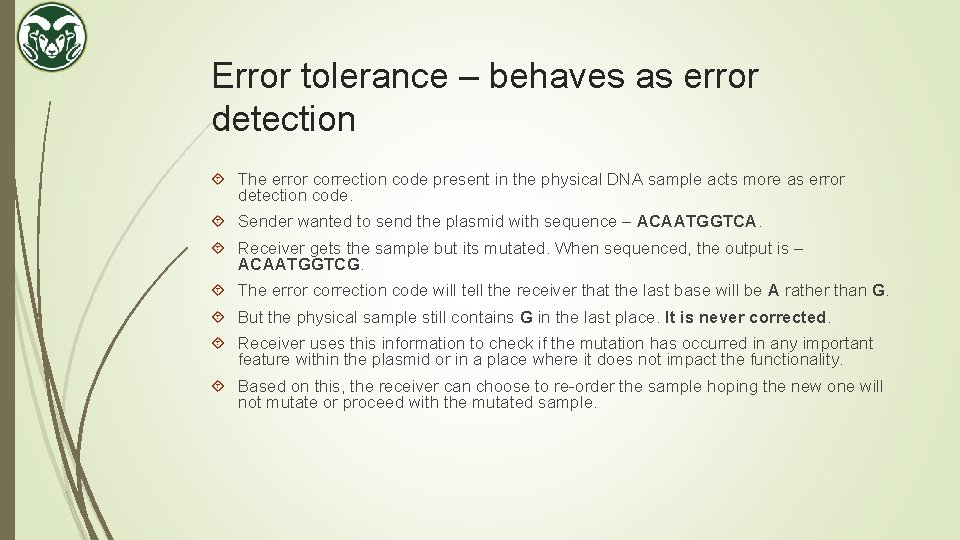
Error tolerance – behaves as error detection The error correction code present in the physical DNA sample acts more as error detection code. Sender wanted to send the plasmid with sequence – ACAATGGTCA. Receiver gets the sample but its mutated. When sequenced, the output is – ACAATGGTCG. The error correction code will tell the receiver that the last base will be A rather than G. But the physical sample still contains G in the last place. It is never corrected. Receiver uses this information to check if the mutation has occurred in any important feature within the plasmid or in a place where it does not impact the functionality. Based on this, the receiver can choose to re-order the sample hoping the new one will not mutate or proceed with the mutated sample.
Associating the physical DNA with its digital representation
Why association Sender shares the signed physical DNA sample. Receiver gets the physical DNA sample, sequences it to obtain a fasta file with the raw sequences. Can be converted to genbank. But will not get the manually added descriptions. Receiver needs the genbank file which the sender worked on. Need to ensure that the genbank file and physical DNA is somehow tied together.
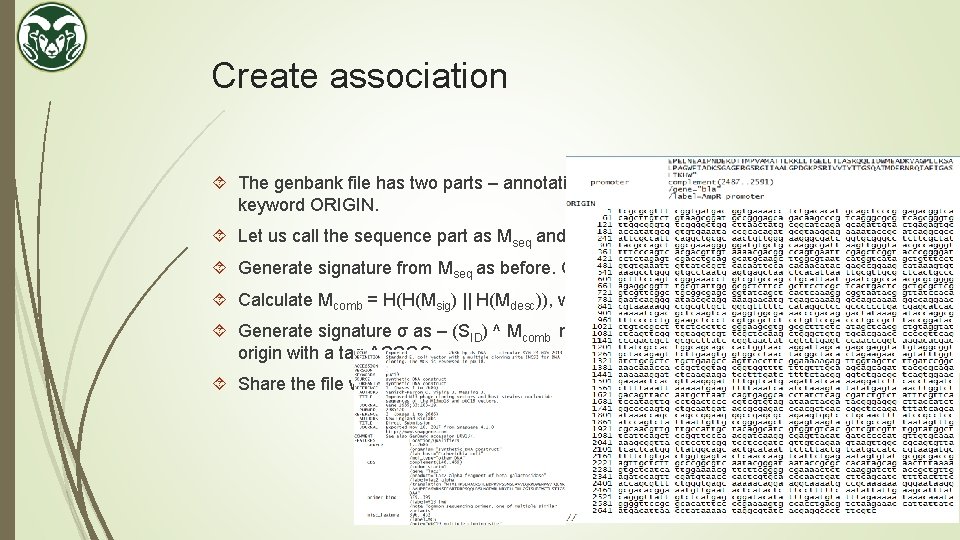
Create association The genbank file has two parts – annotations and sequence, separated by the keyword ORIGIN. Let us call the sequence part as Mseq and annotations as Mdesc. Generate signature from Mseq as before. Call this signature sequence as Msig. Calculate Mcomb = H(H(Msig) || H(Mdesc)), where || is concatenation. Generate signature σ as – (SID) ^ Mcomb mod n. Put this signature before keyword origin with a tag ASSOC. Share the file with the recipient.
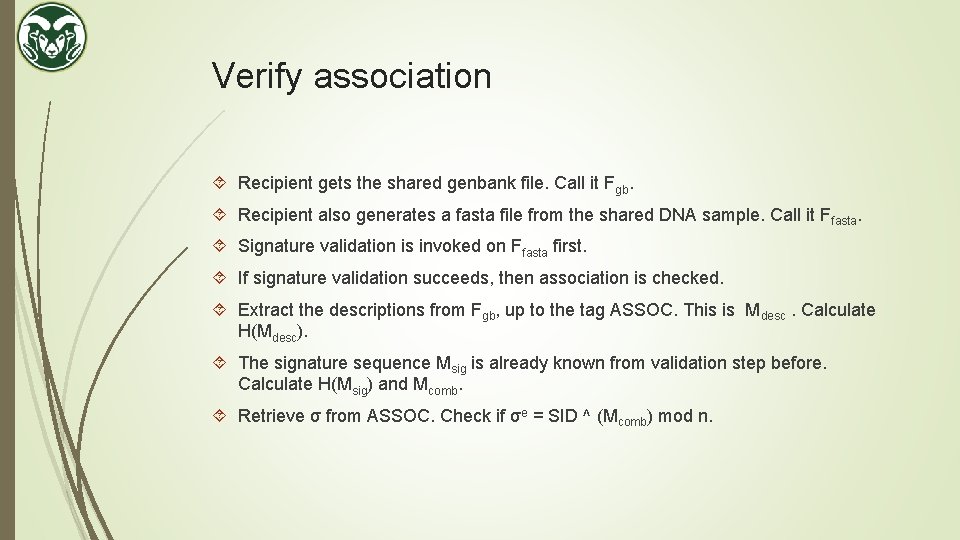
Verify association Recipient gets the shared genbank file. Call it Fgb. Recipient also generates a fasta file from the shared DNA sample. Call it Ffasta. Signature validation is invoked on Ffasta first. If signature validation succeeds, then association is checked. Extract the descriptions from Fgb, up to the tag ASSOC. This is Mdesc. Calculate H(Mdesc). The signature sequence Msig is already known from validation step before. Calculate H(Msig) and Mcomb. Retrieve σ from ASSOC. Check if σe = SID ^ (Mcomb) mod n.
Experiments and future work
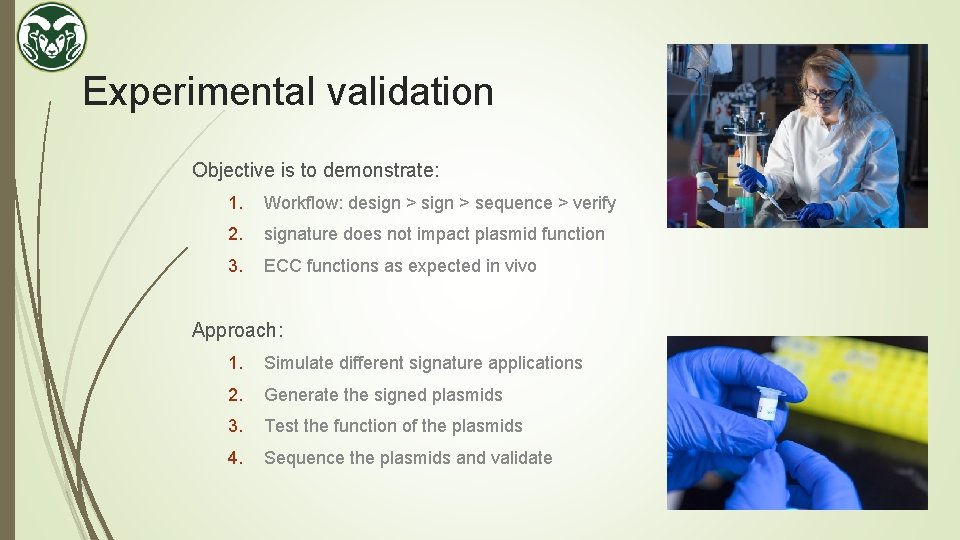
Experimental validation Objective is to demonstrate: 1. Workflow: design > sequence > verify 2. signature does not impact plasmid function 3. ECC functions as expected in vivo Approach: 1. Simulate different signature applications 2. Generate the signed plasmids 3. Test the function of the plasmids 4. Sequence the plasmids and validate
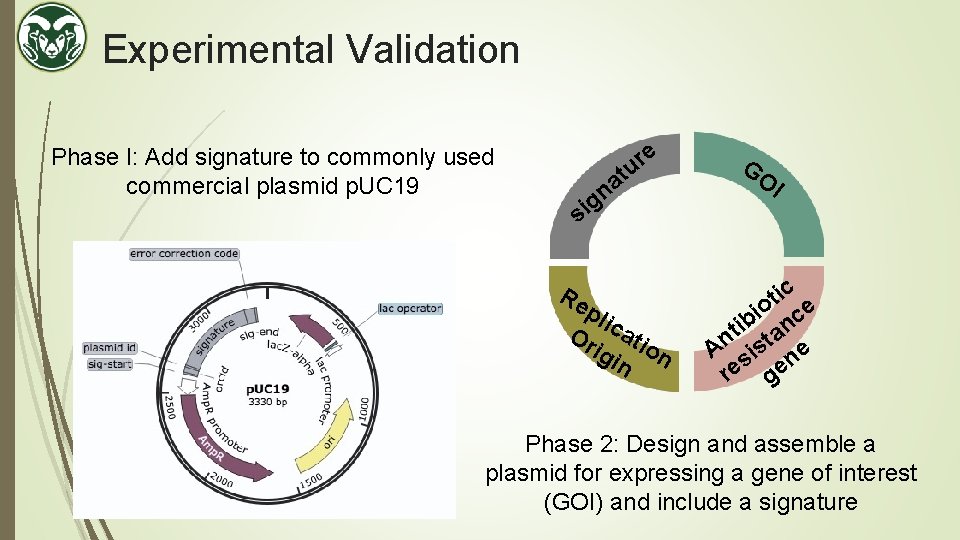
Experimental Validation Phase I: Add signature to commonly used commercial plasmid p. UC 19 e r tu a n g si Re pli Or cati igi on n GO I ic t o ce i ib an t An sist ne re ge Phase 2: Design and assemble a plasmid for expressing a gene of interest (GOI) and include a signature
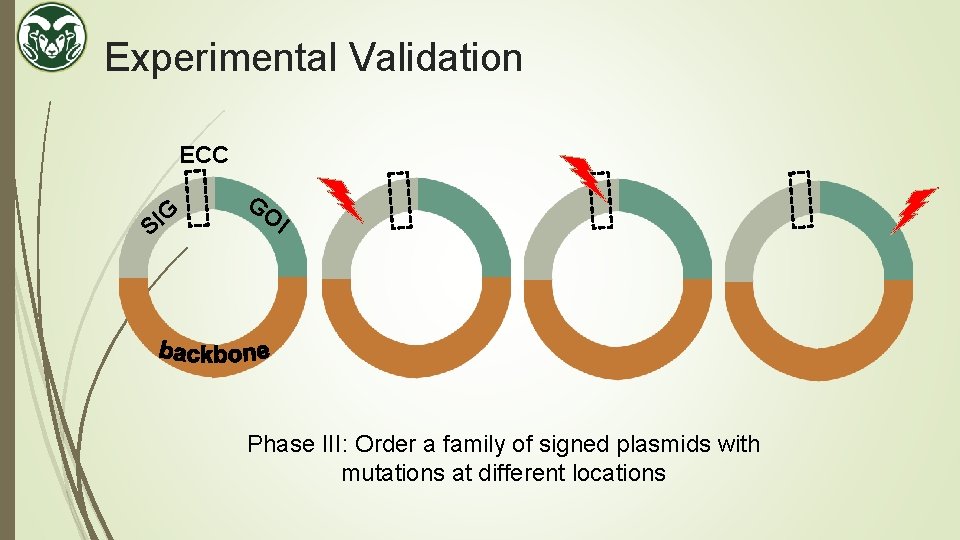
Experimental Validation ECC G I S GO I Phase III: Order a family of signed plasmids with mutations at different locations
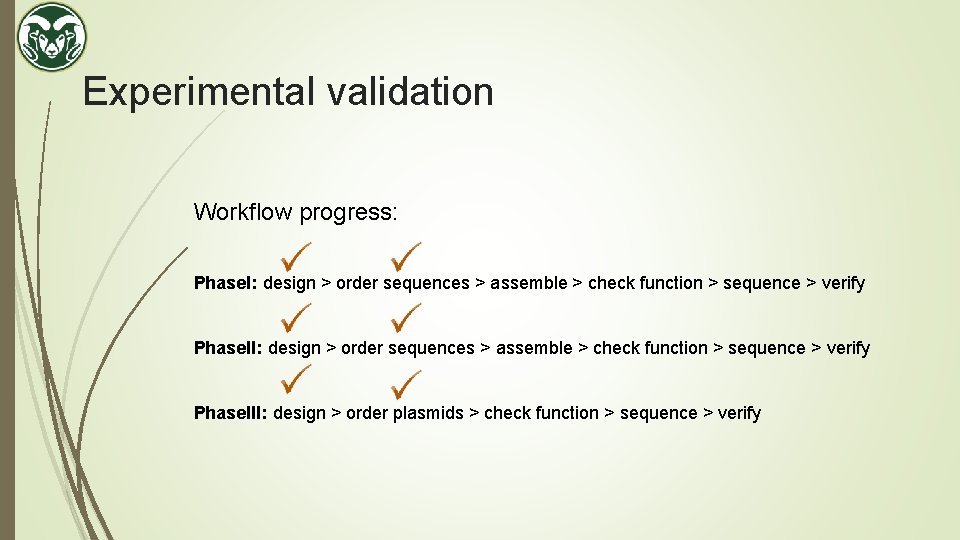
Experimental validation Workflow progress: Phase. I: design > order sequences > assemble > check function > sequence > verify Phase. III: design > order plasmids > check function > sequence > verify
Future work Need to generate shorter signatures. This will be both cost effective and will have less impact on the functionality of the plasmid. We did not address addition and deletion mutation. We assumed that the start and end tag which contains the signature will not mutate. Otherwise, the signature could not be located. Association between the digital file and physical sample needs to be more concrete. Addressing the cyclic permutation and reverse complement such that the receivers fasta file does not have to be aligned with the sender genbank file before validation.
Thank you ! Questions and feedback !