
Digital Signatures have looked at message authentication but

Digital Signatures have looked at message authentication but does not address issues of lack of trust digital signatures provide the ability to: verify author, date & time of signature authenticate message contents be verified by third parties to resolve disputes hence include authentication function with additional capabilities 浙江大学计算机学院 陈刚 2

Digital Signature Properties must depend on the message signed must use information unique to sender to prevent both forgery and denial must be relatively easy to produce must be relatively easy to recognize & verify be computationally infeasible to forge with new message for existing digital signature with fraudulent digital signature for given message be practical save digital signature in storage 浙江大学计算机学院 陈刚 3
Direct Digital Signatures involve only sender & receiver assumed receiver has sender’s public-key digital signature made by sender signing entire message or hash with private-key can encrypt using receivers public-key important that sign first then encrypt message & signature security depends on sender’s private-key 浙江大学计算机学院 陈刚 4

Arbitrated Digital Signatures involves use of arbiter A validates any signed message then dated and sent to recipient requires suitable level of trust in arbiter can be implemented with either private or public-key algorithms arbiter may or may not see message 浙江大学计算机学院 陈刚 5
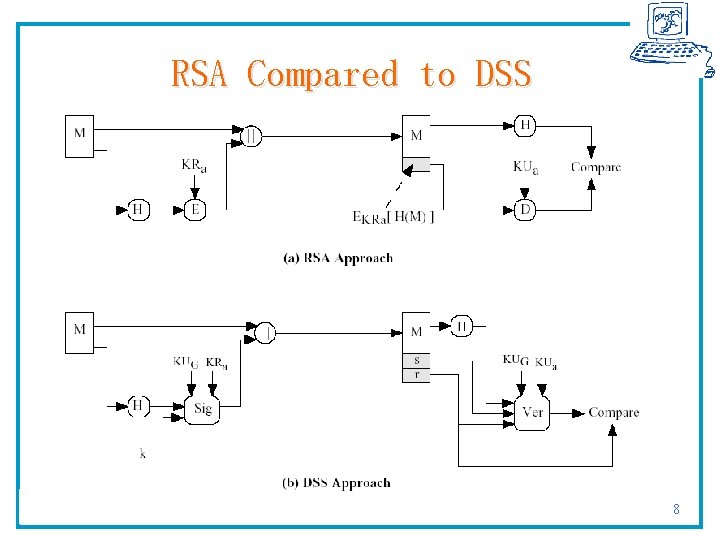
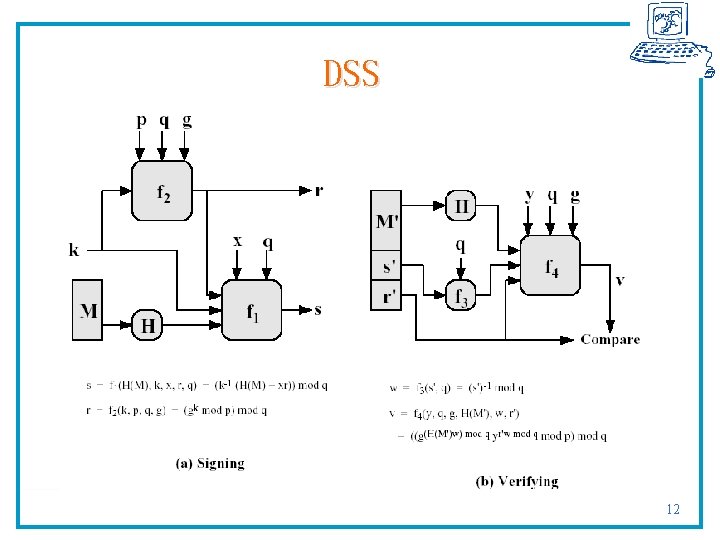
Digital Signature Standard (DSS) US Govt approved signature scheme designed by NIST & NSA in early 90's published as FIPS-186 in 1991 revised in 1993, 1996 & then 2000 uses the SHA hash algorithm DSS is the standard, DSA is the algorithm FIPS 186 -2 (2000) includes alternative RSA & elliptic curve signature variants 浙江大学计算机学院 陈刚 6
Digital Signature Algorithm (DSA) creates a 320 bit signature with 512 -1024 bit security smaller and faster than RSA a digital signature scheme only security depends on difficulty of computing discrete logarithms variant of El. Gamal & Schnorr schemes 浙江大学计算机学院 陈刚 7
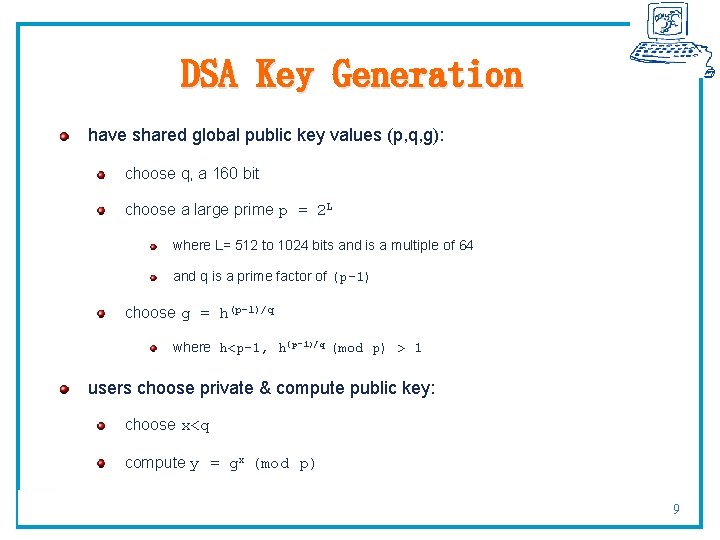
DSA Key Generation have shared global public key values (p, q, g): choose q, a 160 bit choose a large prime p = 2 L where L= 512 to 1024 bits and is a multiple of 64 and q is a prime factor of (p-1) choose g = h(p-1)/q where h<p-1, h(p-1)/q (mod p) > 1 users choose private & compute public key: choose x<q compute y = gx (mod p) 浙江大学计算机学院 陈刚 9
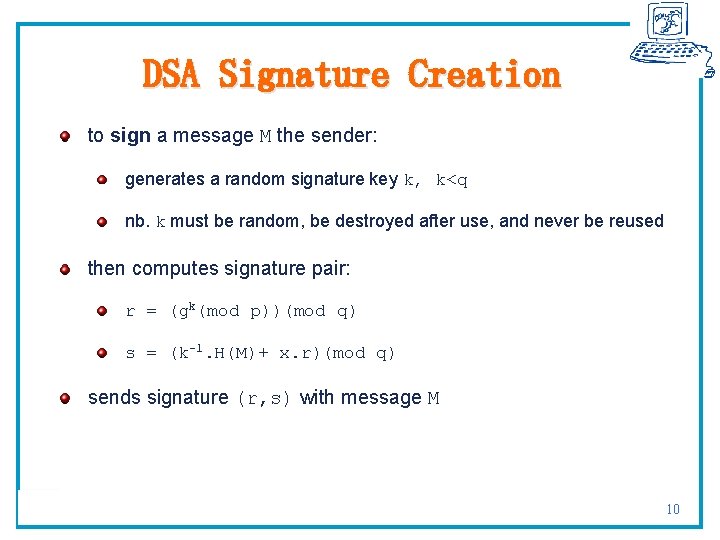
DSA Signature Creation to sign a message M the sender: generates a random signature key k, k<q nb. k must be random, be destroyed after use, and never be reused then computes signature pair: r = (gk(mod p))(mod q) s = (k-1. H(M)+ x. r)(mod q) sends signature (r, s) with message M 浙江大学计算机学院 陈刚 10
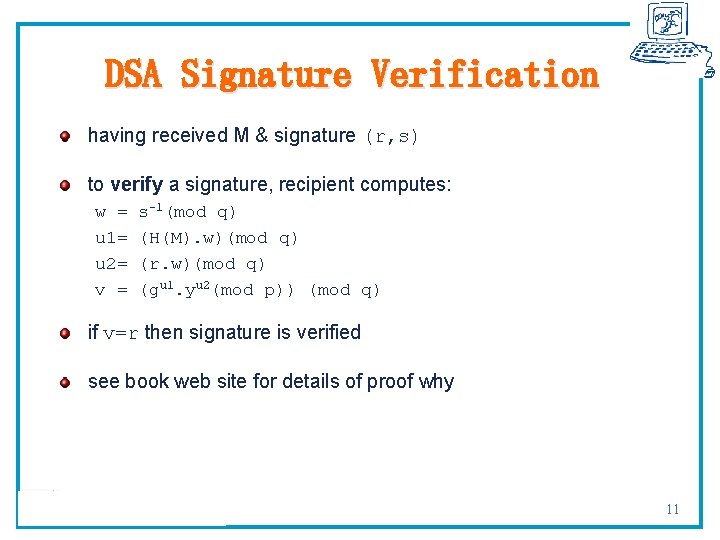
DSA Signature Verification having received M & signature (r, s) to verify a signature, recipient computes: w = u 1= u 2= v = s-1(mod q) (H(M). w)(mod q) (r. w)(mod q) (gu 1. yu 2(mod p)) (mod q) if v=r then signature is verified see book web site for details of proof why 浙江大学计算机学院 陈刚 11
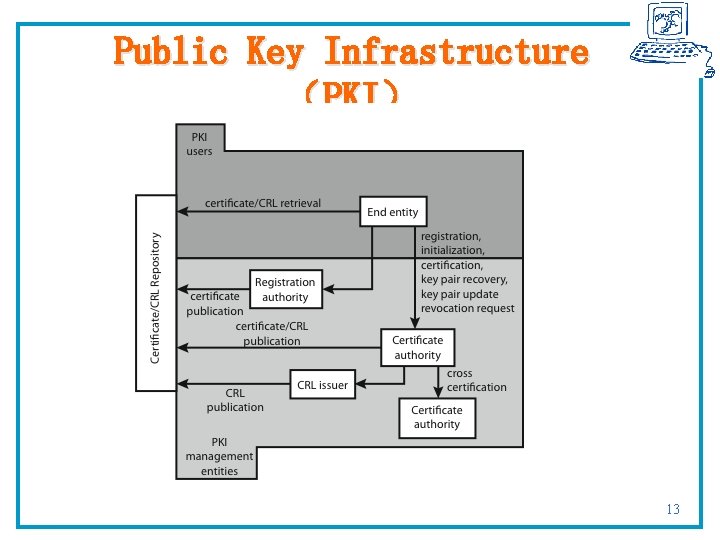
Public Key Infrastructure (PKI) 浙江大学计算机学院 陈刚 13
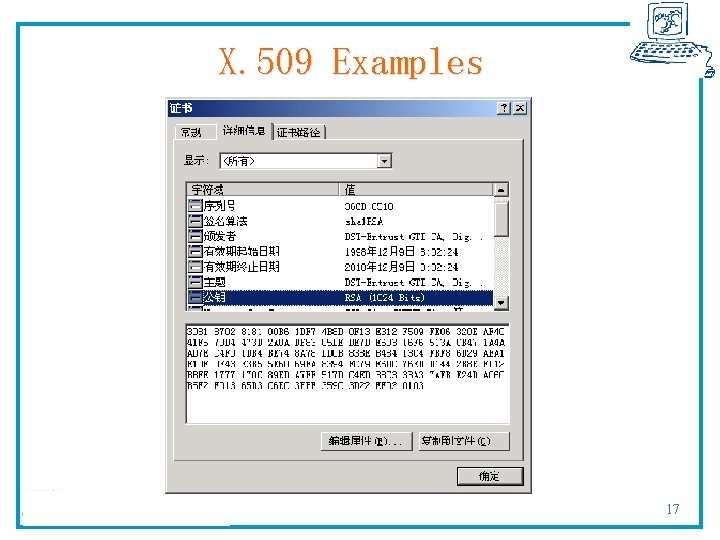
X. 509 Authentication Service part of CCITT X. 500 directory service standards distributed servers maintaining user info database defines framework for authentication services directory may store public-key certificates with public key of user signed by certification authority also defines authentication protocols uses public-key crypto & digital signatures algorithms not standardised, but RSA recommended X. 509 certificates are widely used 浙江大学计算机学院 陈刚 14
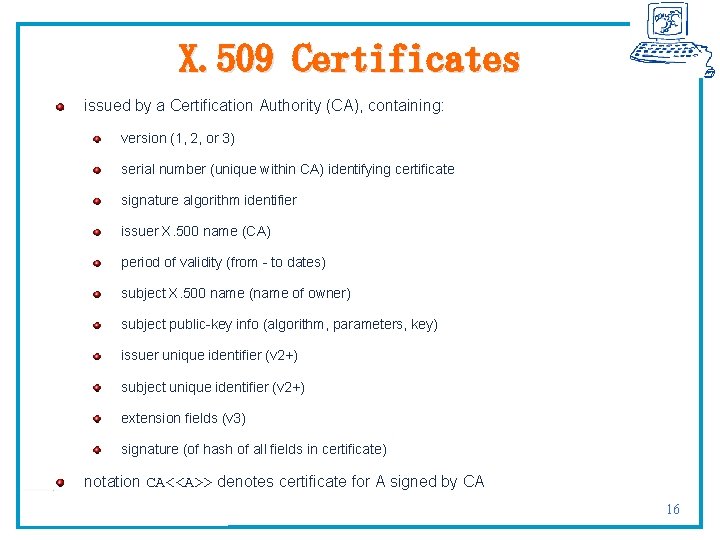
X. 509 Certificates issued by a Certification Authority (CA), containing: version (1, 2, or 3) serial number (unique within CA) identifying certificate signature algorithm identifier issuer X. 500 name (CA) period of validity (from - to dates) subject X. 500 name (name of owner) subject public-key info (algorithm, parameters, key) issuer unique identifier (v 2+) subject unique identifier (v 2+) extension fields (v 3) signature (of hash of all fields in certificate) notation CA<<A>> denotes certificate for A signed by CA 浙江大学计算机学院 陈刚 16
Obtaining a Certificate any user with access to CA can get any certificate from it only the CA can modify a certificate because cannot be forged, certificates can be placed in a public directory 浙江大学计算机学院 陈刚 18
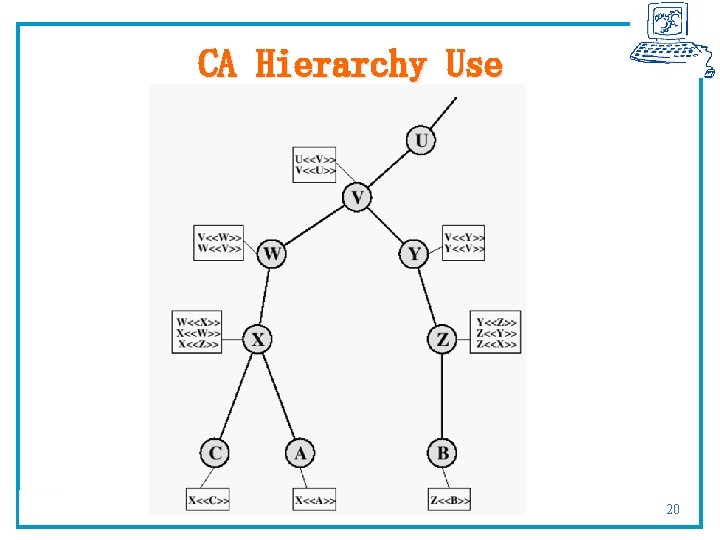
CA Hierarchy if both users share a common CA then they are assumed to know its public key otherwise CA's must form a hierarchy use certificates linking members of hierarchy to validate other CA's each CA has certificates for clients (forward) and parent (backward) each client trusts parents certificates enable verification of any certificate from one CA by users of all other CAs in hierarchy 浙江大学计算机学院 陈刚 19
Certificate Revocation certificates have a period of validity may need to revoke before expiry, eg: 1. user's private key is compromised 2. user is no longer certified by this CA 3. CA's certificate is compromised CA’s maintain list of revoked certificates the Certificate Revocation List (CRL) users should check certificates with CA’s CRL 浙江大学计算机学院 陈刚 21
Authentication Procedures X. 509 includes three alternative authentication procedures: One-Way Authentication Two-Way Authentication Three-Way Authentication all use public-key signatures 浙江大学计算机学院 陈刚 22
One-Way Authentication 浙江大学计算机学院 陈刚 23
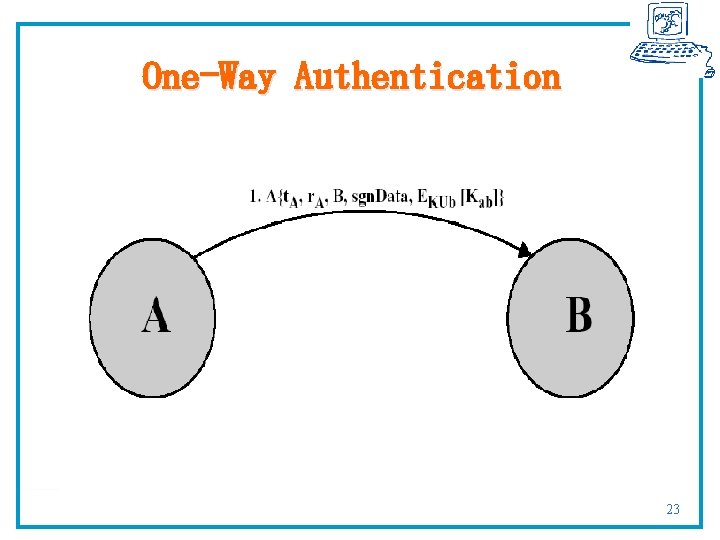
One-Way Authentication 1 message ( A->B) used to establish the identity of A and that message is from A message was intended for B integrity & originality of message must include timestamp, nonce, B's identity and is signed by A may include additional info for B eg session key 浙江大学计算机学院 陈刚 24
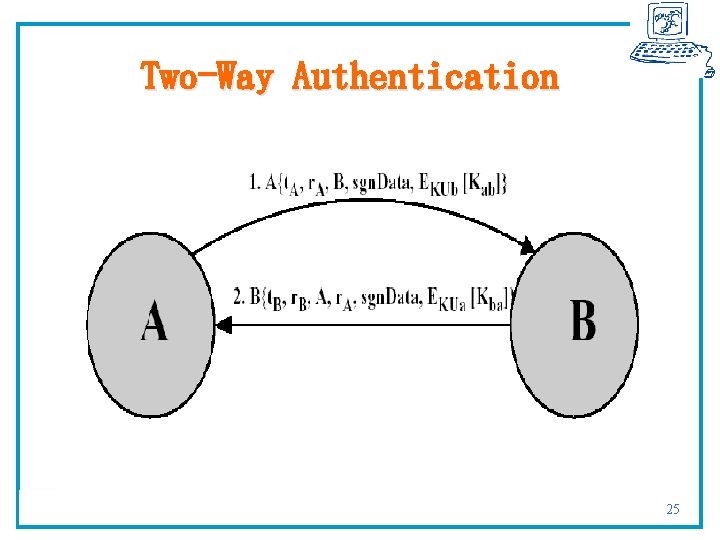
Two-Way Authentication 浙江大学计算机学院 陈刚 25
Two-Way Authentication 2 messages (A->B, B->A) which also establishes in addition: the identity of B and that reply is from B that reply is intended for A integrity & originality of reply includes original nonce from A, also timestamp and nonce from B may include additional info for A 浙江大学计算机学院 陈刚 26
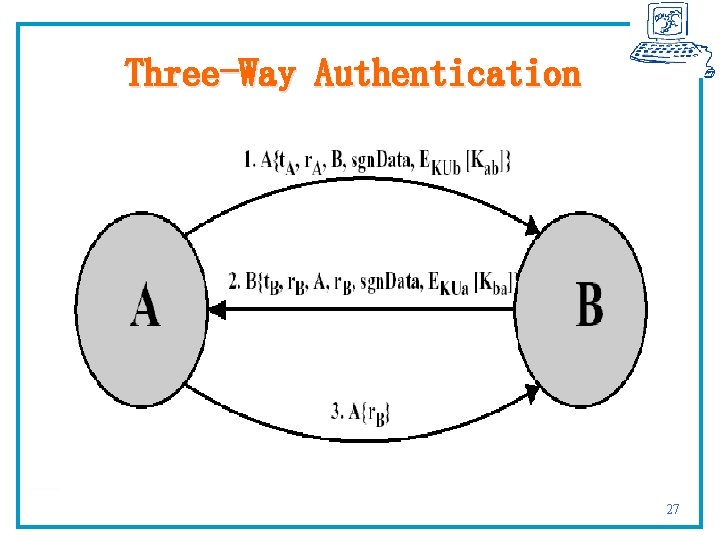
Three-Way Authentication 浙江大学计算机学院 陈刚 27
Three-Way Authentication 3 messages (A->B, B->A, A->B) which enables above authentication without synchronized clocks has reply from A back to B containing signed copy of nonce from B means that timestamps need not be checked or relied upon 浙江大学计算机学院 陈刚 28
- Slides: 28