
Digital Signatures for DNA Diptendu Kar Indrajit Ray
![Digital Signatures for DNA Diptendu Kar, Indrajit Ray [Computer Science] In collaboration with: Jenna](https://slidetodoc.com/presentation_image_h2/d63a1dd039e4ab5a11404c3589bdc387/image-1.jpg "Digital Signatures for DNA Diptendu Kar, Indrajit Ray [Computer Science] In collaboration with: Jenna")




- Slides: 49
Digital Signatures for DNA Diptendu Kar, Indrajit Ray [Computer Science] In collaboration with: Jenna Gallegos, Jean Peccoud [Chemical and Biological Engineering] Colorado State University
The aim of this project is to provide physical significance to digital signatures But first, a bit of background on biology
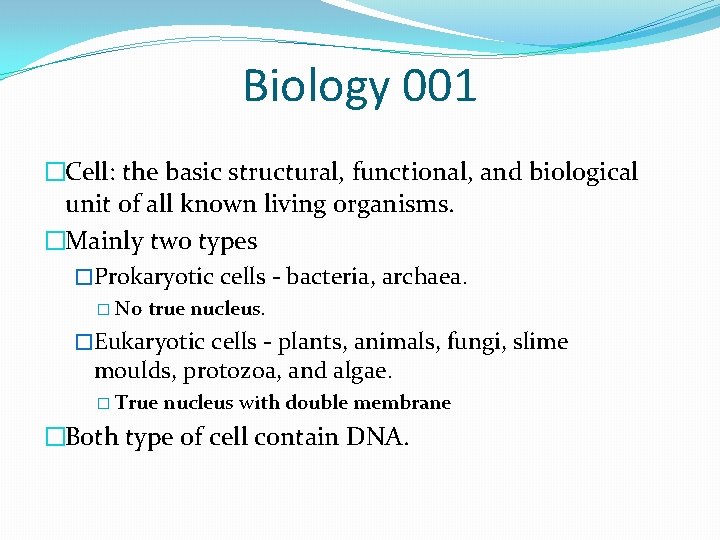
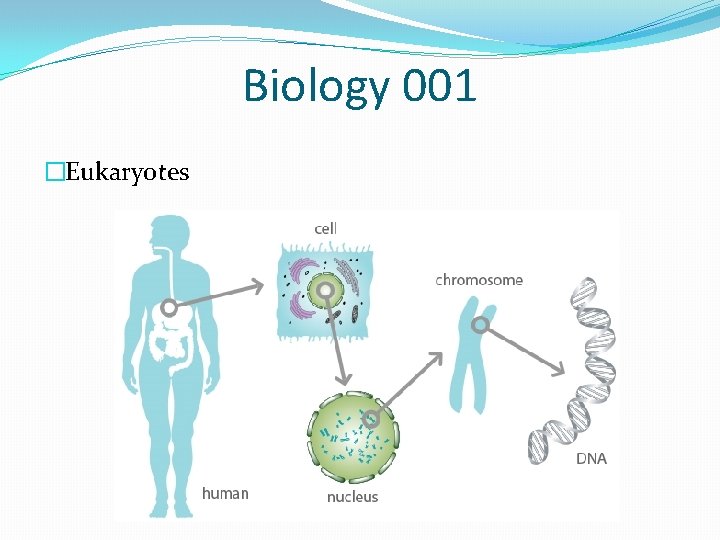
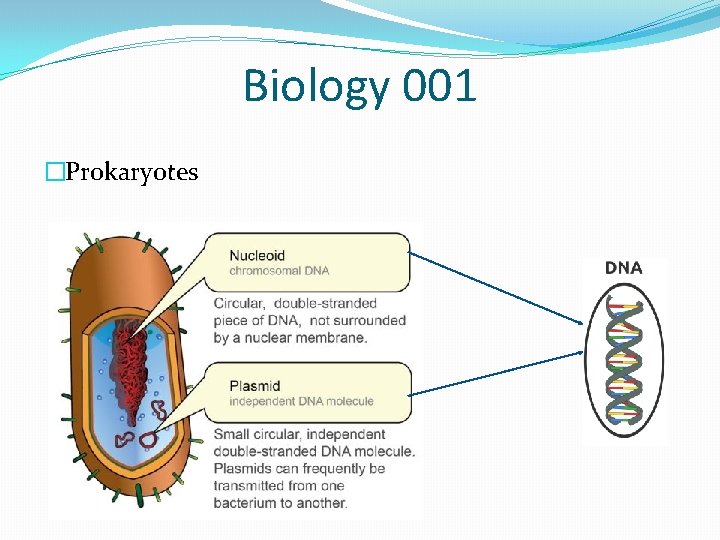
Biology 001 �Cell: the basic structural, functional, and biological unit of all known living organisms. �Mainly two types �Prokaryotic cells - bacteria, archaea. � No true nucleus. �Eukaryotic cells - plants, animals, fungi, slime moulds, protozoa, and algae. � True nucleus with double membrane �Both type of cell contain DNA.
Biology 001 �Eukaryotes
Biology 001 �Prokaryotes
Biology 001 �DNA, or deoxyribonucleic acid, is the hereditary material in humans and almost all other organisms. �Most DNA is located in the cell nucleus (where it is called nuclear DNA), but a small amount of DNA can also be found in the mitochondria (where it is called mitochondrial DNA). �The information in DNA is stored as a code made up of four chemical bases. � adenine (A), guanine (G), cytosine (C), and thymine (T). � Human DNA consists of about 3 billion bases, and more than 99 percent of those bases are the same in all people. �The order, or sequence, of these bases determines the information available for building and maintaining an organism.
Biology 001 �Our project utilizes DNA from plasmids. �Plasmid DNA gives the cell extra characteristics like antibiotic resistance. �Plasmid DNA is interesting : �Can isolate them in large quantities. �Can cut and splice them, adding whatever DNA we choose. (tweak with features) �Can put them back into bacteria, where they'll replicate along with the bacteria's own DNA. �Can isolate them again - getting billions of copies of whatever DNA we inserted into the plasmid! �Plasmid are limited to sizes of 2. 5 -20 kilo bases (kb), in general.
Done with background !
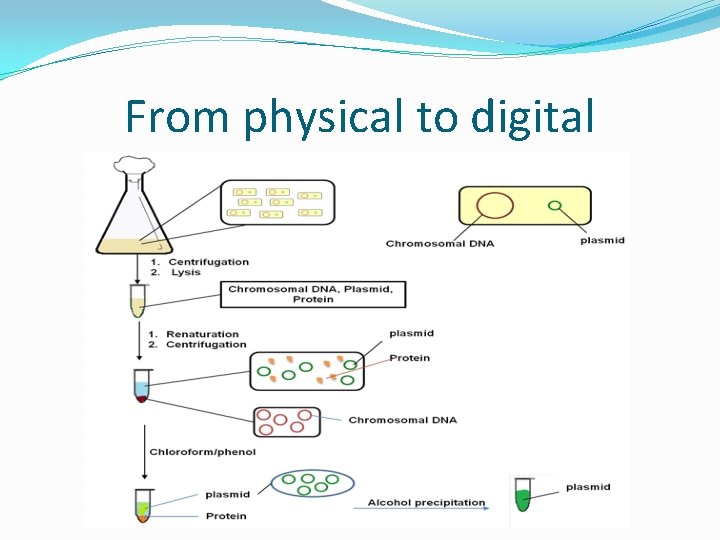
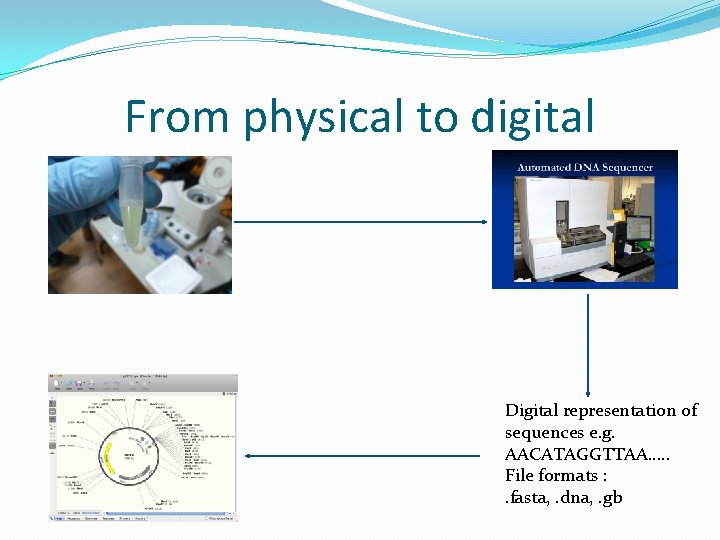
From physical to digital �DNA is a physical entity. How do we apply digital signatures to a physical entity. �DNA sequences are documented electronically as well. �Also, any digital representation of a DNA can be synthesized into a physical molecule.
From physical to digital
From physical to digital Digital representation of sequences e. g. AACATAGGTTAA…. . File formats : . fasta, . dna, . gb
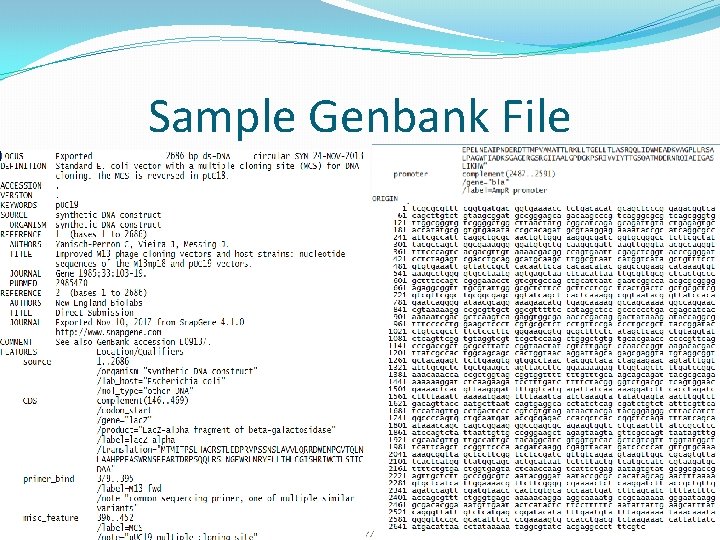
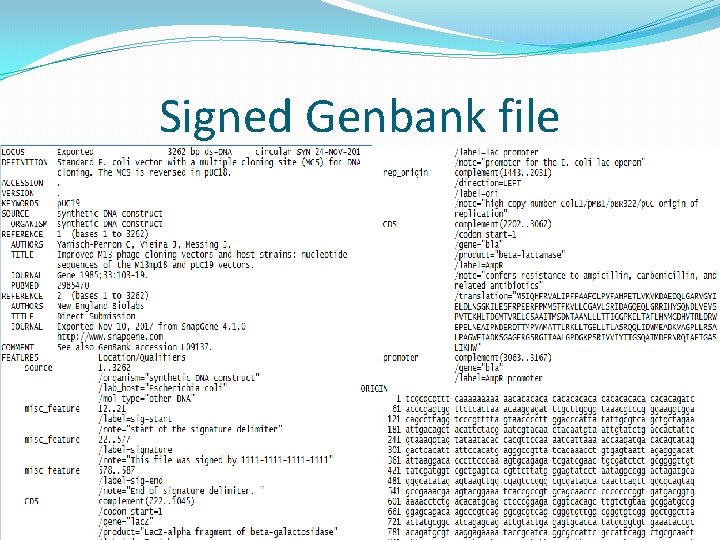
Sample Genbank File
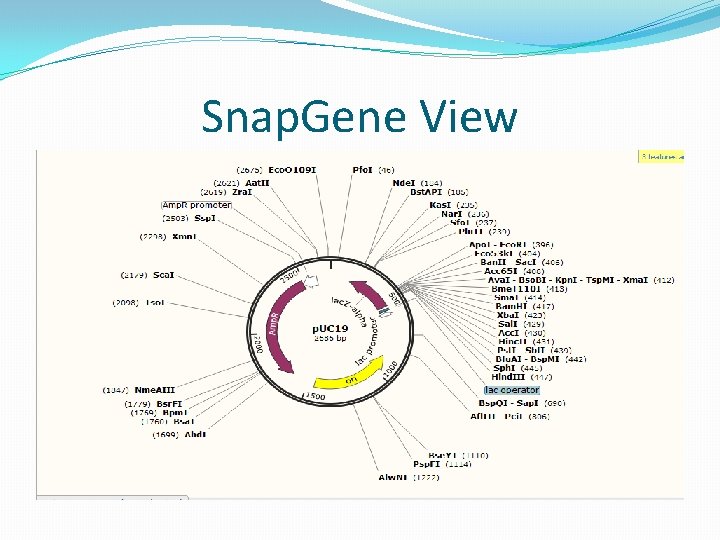
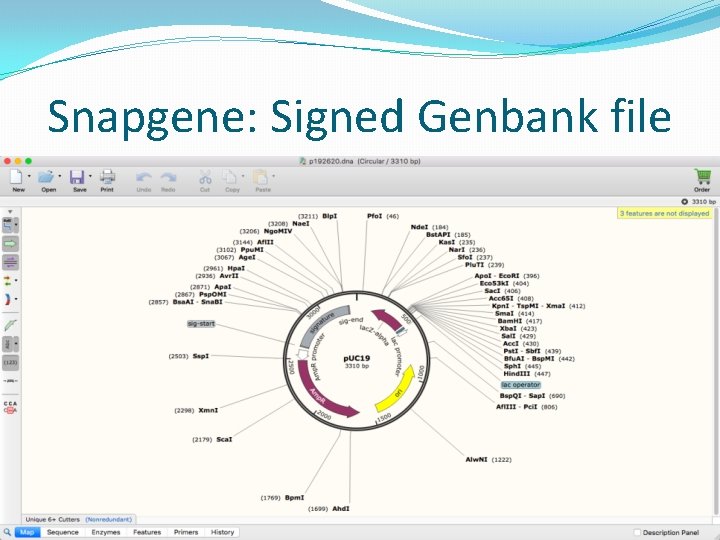
Snap. Gene View
Time to apply digital signature �Now that we have the digital DNA, we can apply digital signatures. �The message is the sequence – “ACAATGT…. . ” �We will be using Identity Based Signatures. �Not every lab/person have certificates. �The precise author who worked with the DNA can be determined. �For identity we use ORCID. �Open Researcher and Contributor ID. � 16 digit unique identifier – (0123 -4454 -9876 -0143)
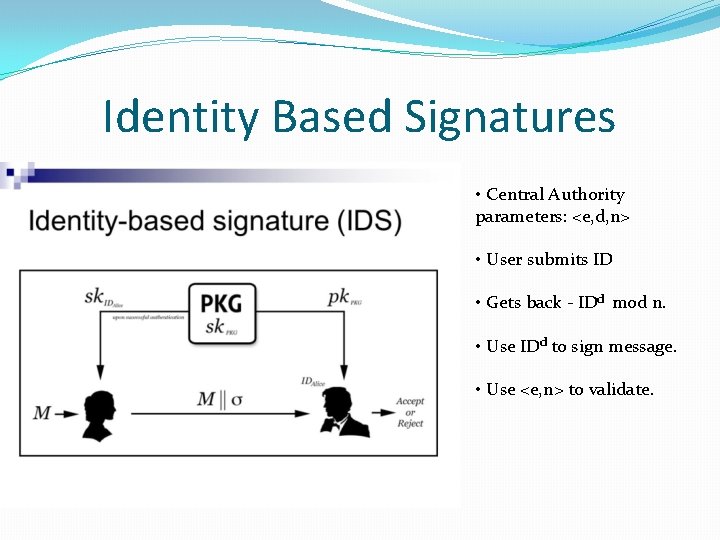
Identity Based Signatures �First introduced by Shamir in 1984. �No need to have individual secret keys. �A unique identifier such as email, ORCID etc. acts as a substitute. �A central authority has a public private key pair. �Use the identity to derive a private key. �Sign using derived private key tied to the identity. �Validate using the public key of the central authority.
Identity Based Signatures • Central Authority parameters: <e, d, n> • User submits ID • Gets back - IDd mod n. • Use IDd to sign message. • Use <e, n> to validate.
Simplified Shamir’s Scheme �Shamir’s scheme generates a signature of length 2 n for n bit security parameter. (n - 1024, sign - 2048) �We simplified it by removing the random. �Advantage - Signature length = 1024 bits = 512 base pairs. (cannot add large signatures) �Random is not essential in DNA sharing domain. �Same DNA molecule will not be shared twice with someone. (fair assumption)
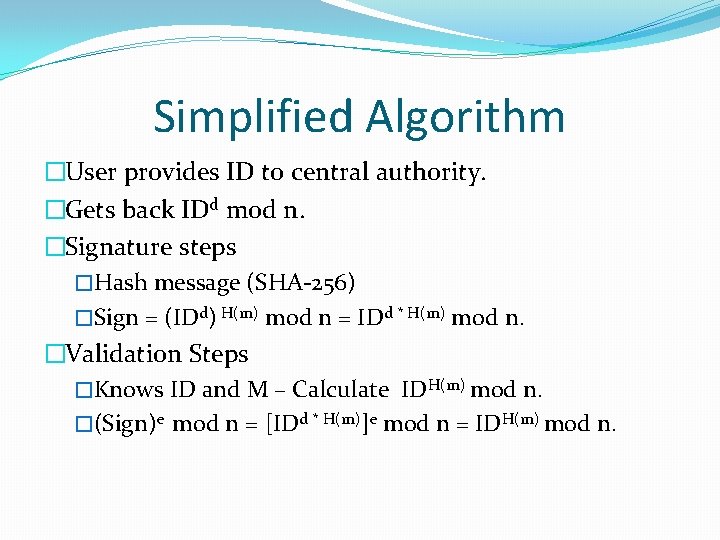
Simplified Algorithm �User provides ID to central authority. �Gets back IDd mod n. �Signature steps �Hash message (SHA-256) �Sign = (IDd) H(m) mod n = IDd * H(m) mod n. �Validation Steps �Knows ID and M – Calculate IDH(m) mod n. �(Sign)e mod n = [IDd * H(m)]e mod n = IDH(m) mod n.
Why not Bilinear Pairing? �Hard to implement from scratch. �There exists a library – JPBC (Java Pairing Based Cryptography) from Stanford. �Only one IBS scheme is implemented. �Kenneth G. Paterson and Jacob C. N. Schuldt �Signature Size – 384 bytes = 1536 base pairs (too large) �Issues with molecule stability and functionality.
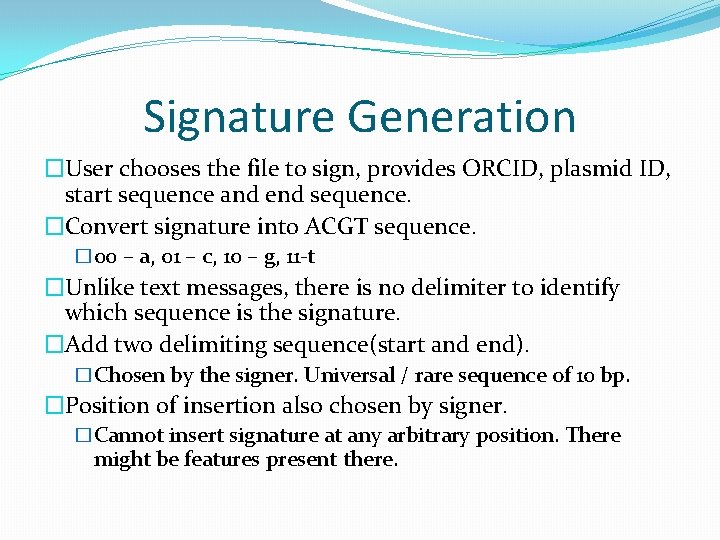
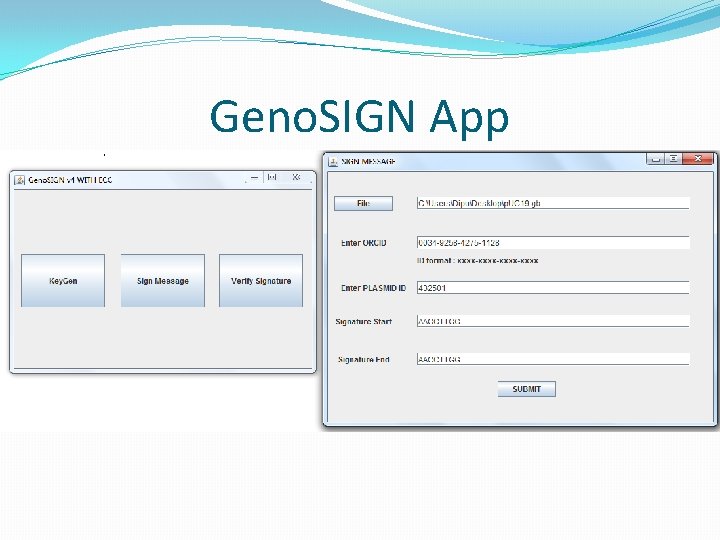
Signature Generation �User chooses the file to sign, provides ORCID, plasmid ID, start sequence and end sequence. �Convert signature into ACGT sequence. � 00 – a, 01 – c, 10 – g, 11 -t �Unlike text messages, there is no delimiter to identify which sequence is the signature. �Add two delimiting sequence(start and end). �Chosen by the signer. Universal / rare sequence of 10 bp. �Position of insertion also chosen by signer. �Cannot insert signature at any arbitrary position. There might be features present there.
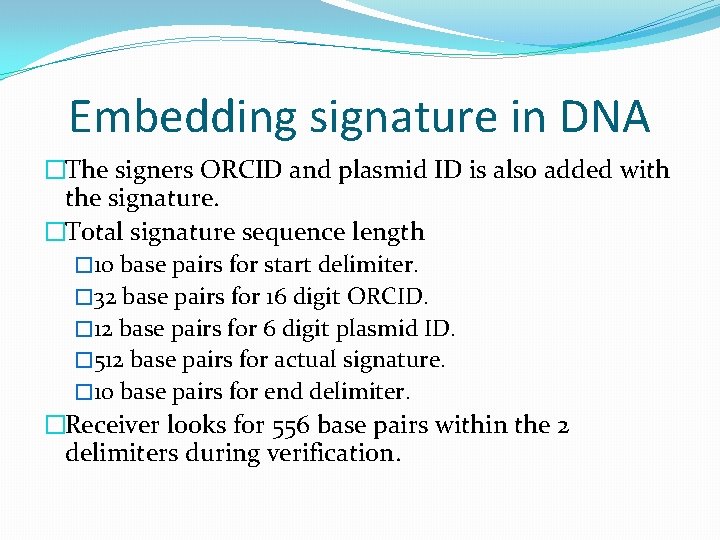
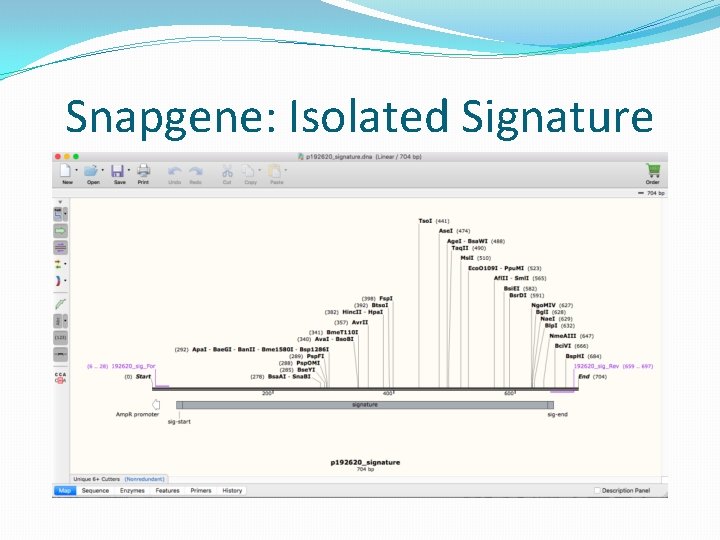
Embedding signature in DNA �The signers ORCID and plasmid ID is also added with the signature. �Total signature sequence length � 10 base pairs for start delimiter. � 32 base pairs for 16 digit ORCID. � 12 base pairs for 6 digit plasmid ID. � 512 base pairs for actual signature. � 10 base pairs for end delimiter. �Receiver looks for 556 base pairs within the 2 delimiters during verification.
Signed Genbank file
Snapgene: Signed Genbank file
Snapgene: Isolated Signature
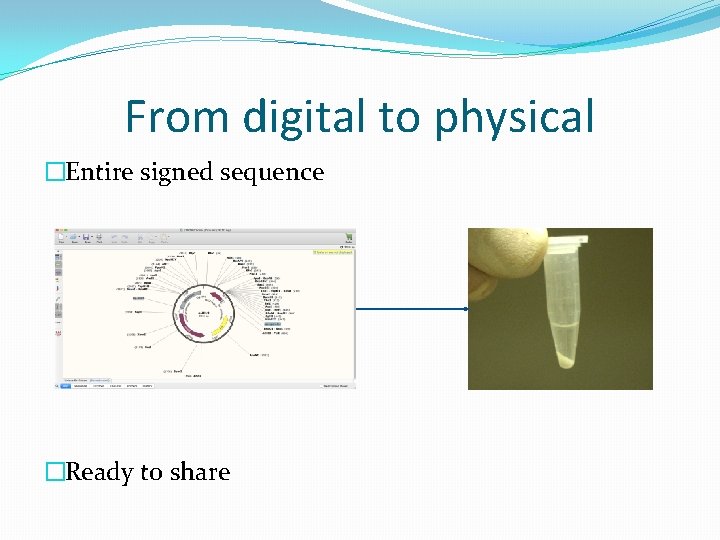
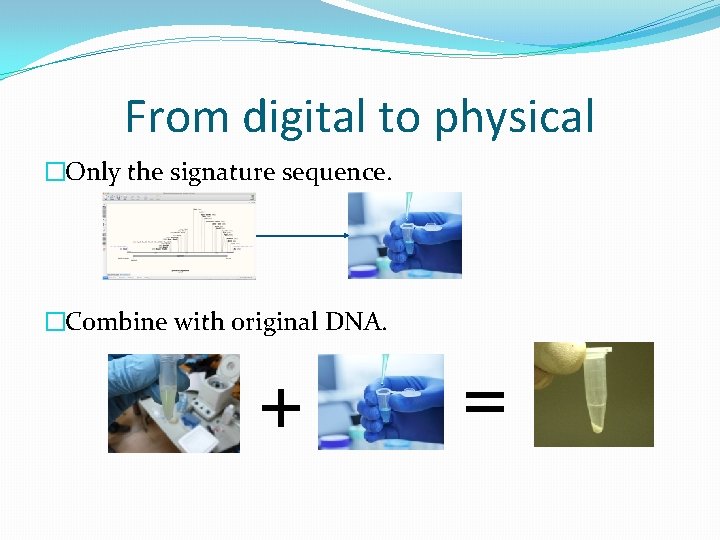
From digital to physical �Artificial DNA synthesis companies. �Gene universal – 0. 09 /bp �Twist Bioscience – 0. 07/bp �Send the entire signed sequence / just signature sequence. �Receive the physical DNA molecule.
From digital to physical �Entire signed sequence �Ready to share
From digital to physical �Only the signature sequence. �Combine with original DNA. + =
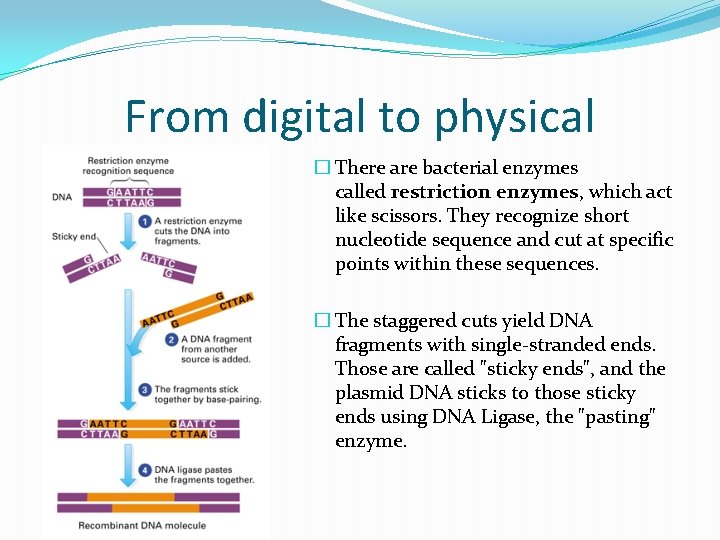
From digital to physical � There are bacterial enzymes called restriction enzymes, which act like scissors. They recognize short nucleotide sequence and cut at specific points within these sequences. � The staggered cuts yield DNA fragments with single-stranded ends. Those are called "sticky ends", and the plasmid DNA sticks to those sticky ends using DNA Ligase, the "pasting" enzyme.
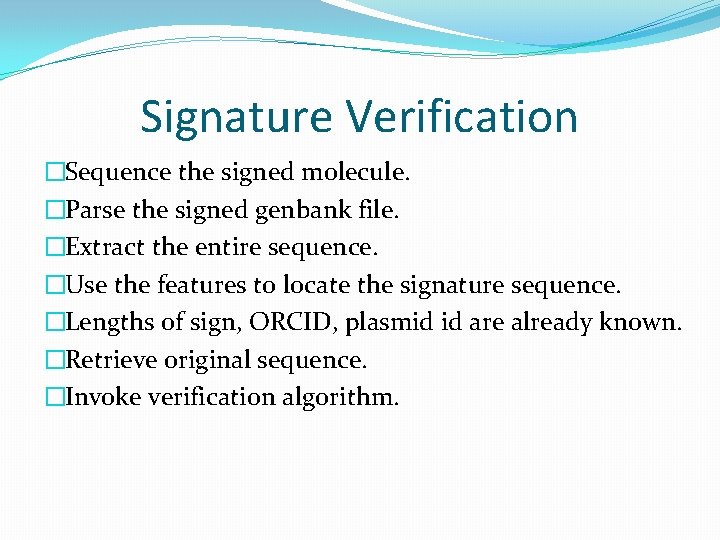
Signature Verification �Sequence the signed molecule. �Parse the signed genbank file. �Extract the entire sequence. �Use the features to locate the signature sequence. �Lengths of sign, ORCID, plasmid id are already known. �Retrieve original sequence. �Invoke verification algorithm.
That’s it? No. A bit more….
DNA Signature Problem �Digital signature ensures that any change in message or identity or the signature itself will result in failed verification. �Yes, that’s what we want ! �But DNA molecules mutate(change) quite often. �Now, the signature cannot be verified. �It’s a natural phenomenon beyond anyone’s control. �Receiver cannot verify, and its not signers fault.
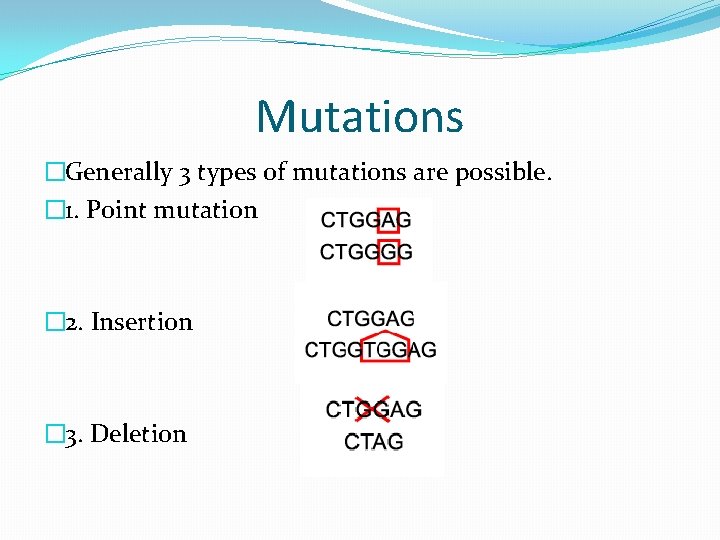
Mutations �Generally 3 types of mutations are possible. � 1. Point mutation � 2. Insertion � 3. Deletion
Error Correction Codes !
Error Correction Codes �Error correction codes (ECC) are widely used in digital storage media like cd/dvd, disks, distributed storage. �We can apply the same techniques here. �We are using Reed Solomon Codes. �Introduced by Irving S. Reed and Gustave Solomon in 1960. �Class of linear block code. Based on Galois Field Arithmetic. �Used in storage devices, Wireless or mobile communications, Satellite communications etc.
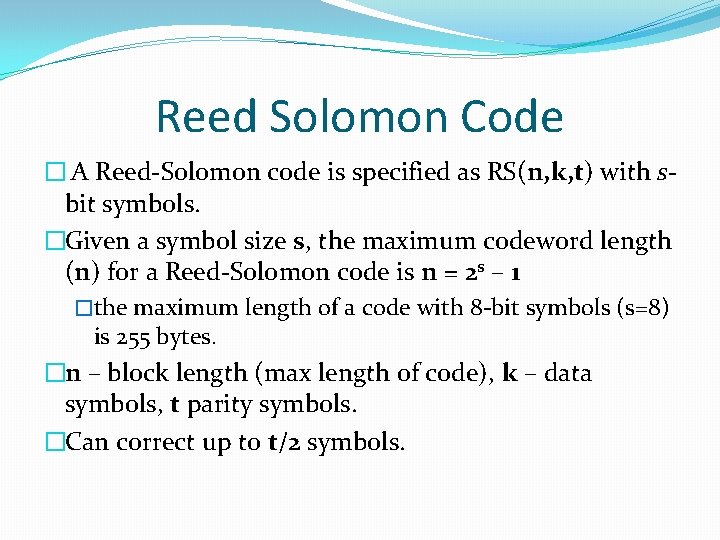
Reed Solomon Code � A Reed-Solomon code is specified as RS(n, k, t) with sbit symbols. �Given a symbol size s, the maximum codeword length (n) for a Reed-Solomon code is n = 2 s – 1 �the maximum length of a code with 8 -bit symbols (s=8) is 255 bytes. �n – block length (max length of code), k – data symbols, t parity symbols. �Can correct up to t/2 symbols.
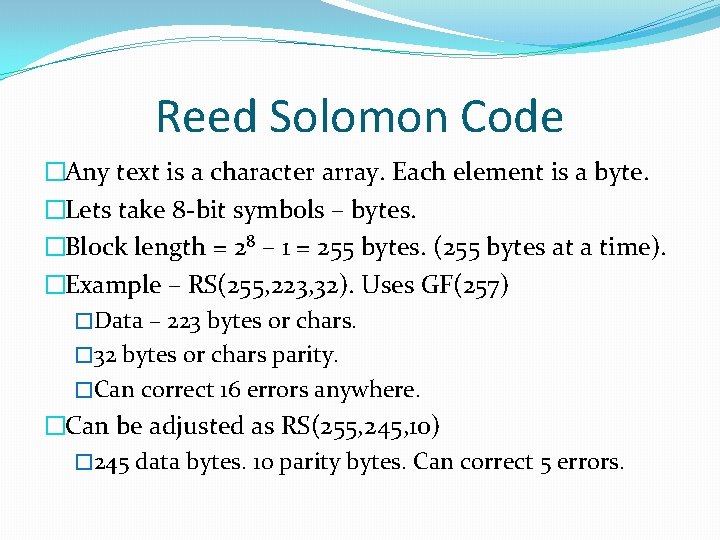
Reed Solomon Code �Any text is a character array. Each element is a byte. �Lets take 8 -bit symbols – bytes. �Block length = 28 – 1 = 255 bytes. (255 bytes at a time). �Example – RS(255, 223, 32). Uses GF(257) �Data – 223 bytes or chars. � 32 bytes or chars parity. �Can correct 16 errors anywhere. �Can be adjusted as RS(255, 245, 10) � 245 data bytes. 10 parity bytes. Can correct 5 errors.
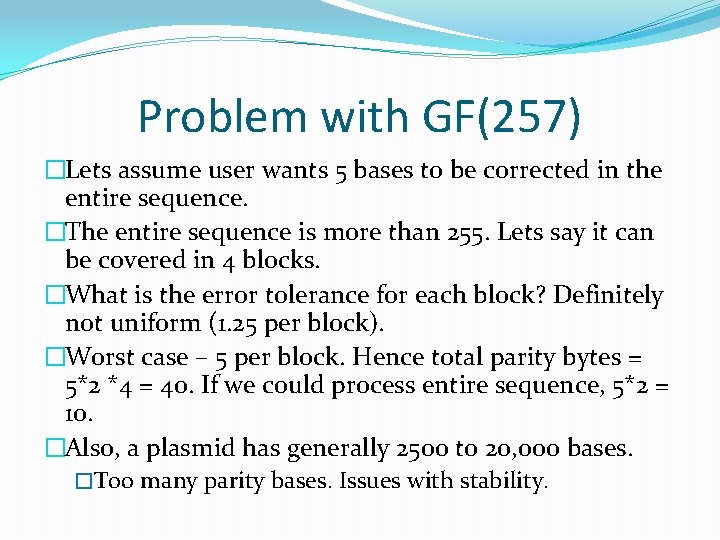
Problem with GF(257) �Lets assume user wants 5 bases to be corrected in the entire sequence. �The entire sequence is more than 255. Lets say it can be covered in 4 blocks. �What is the error tolerance for each block? Definitely not uniform (1. 25 per block). �Worst case – 5 per block. Hence total parity bytes = 5*2 *4 = 40. If we could process entire sequence, 5*2 = 10. �Also, a plasmid has generally 2500 to 20, 000 bases. �Too many parity bases. Issues with stability.
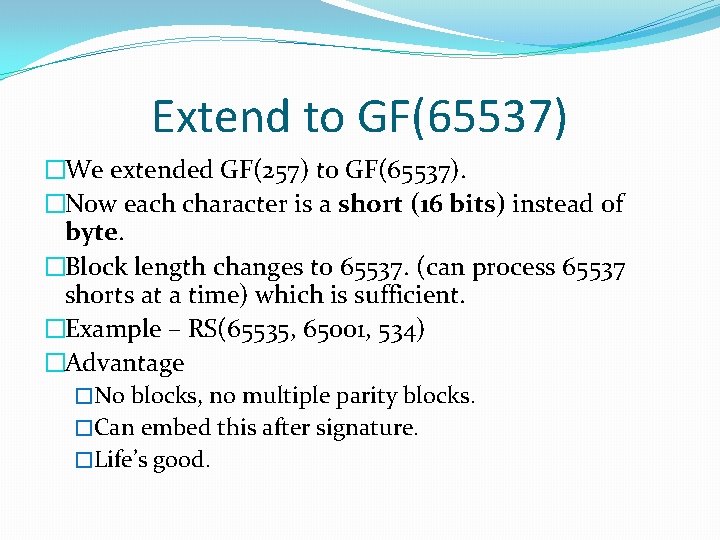
Extend to GF(65537) �We extended GF(257) to GF(65537). �Now each character is a short (16 bits) instead of byte. �Block length changes to 65537. (can process 65537 shorts at a time) which is sufficient. �Example – RS(65535, 65001, 534) �Advantage �No blocks, no multiple parity blocks. �Can embed this after signature. �Life’s good.
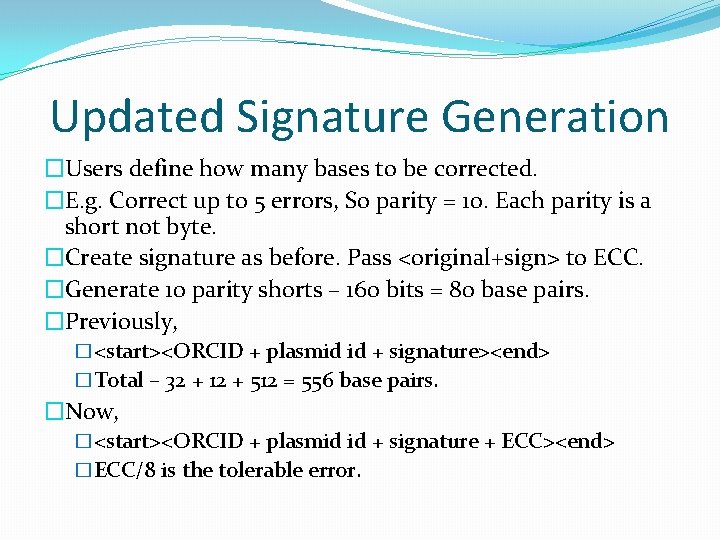
Updated Signature Generation �Users define how many bases to be corrected. �E. g. Correct up to 5 errors, So parity = 10. Each parity is a short not byte. �Create signature as before. Pass <original+sign> to ECC. �Generate 10 parity shorts – 160 bits = 80 base pairs. �Previously, �<start><ORCID + plasmid id + signature><end> �Total – 32 + 12 + 512 = 556 base pairs. �Now, �<start><ORCID + plasmid id + signature + ECC><end> �ECC/8 is the tolerable error.
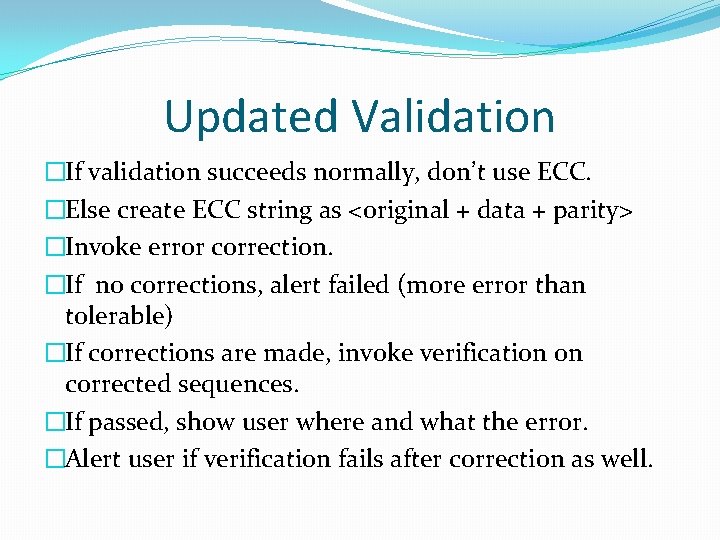
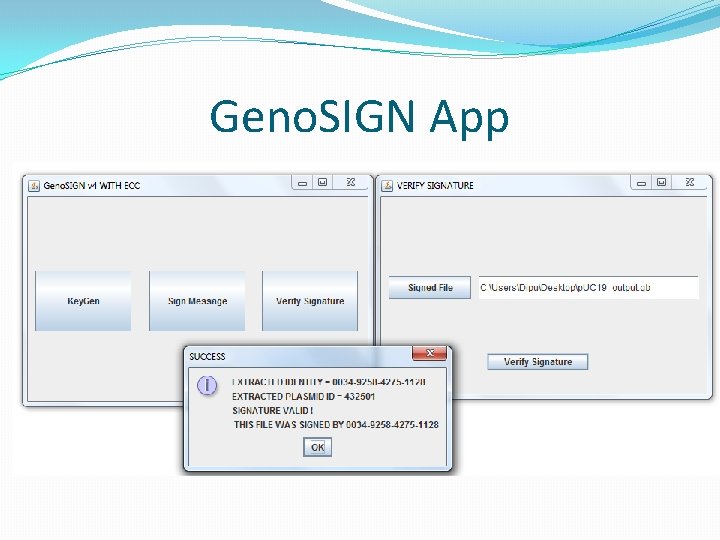
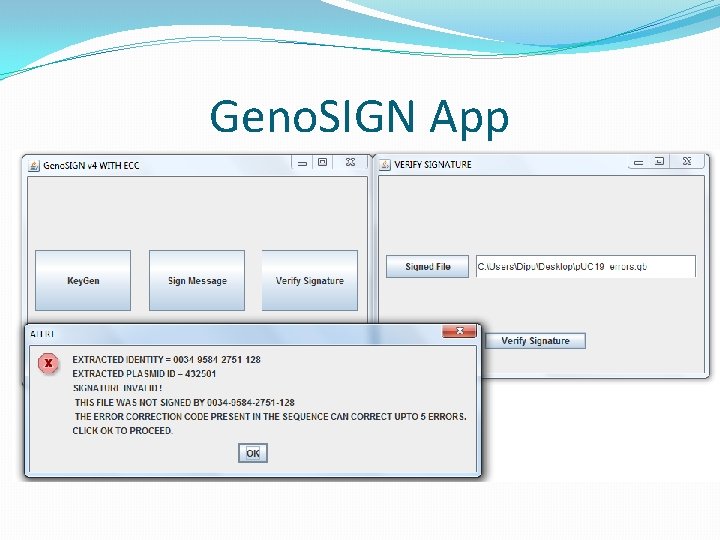
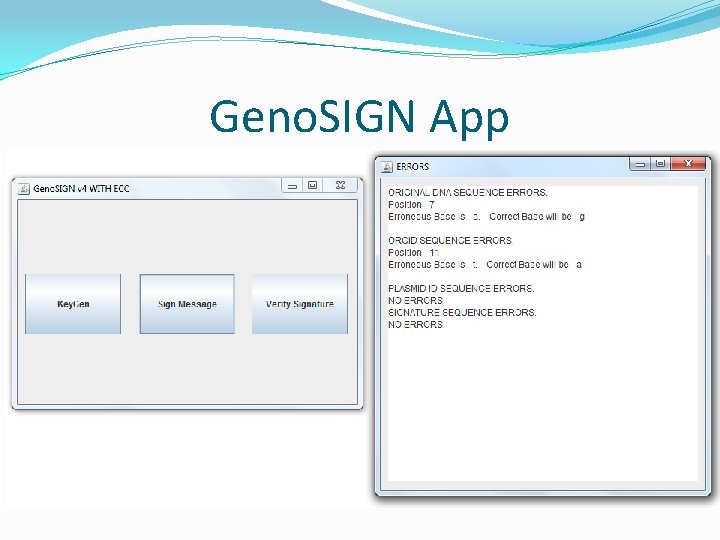
Updated Validation �If validation succeeds normally, don’t use ECC. �Else create ECC string as <original + data + parity> �Invoke error correction. �If no corrections, alert failed (more error than tolerable) �If corrections are made, invoke verification on corrected sequences. �If passed, show user where and what the error. �Alert user if verification fails after correction as well.
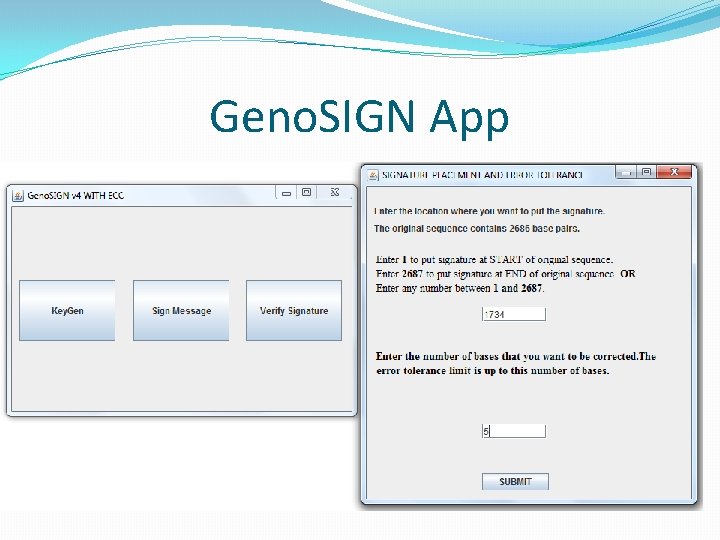
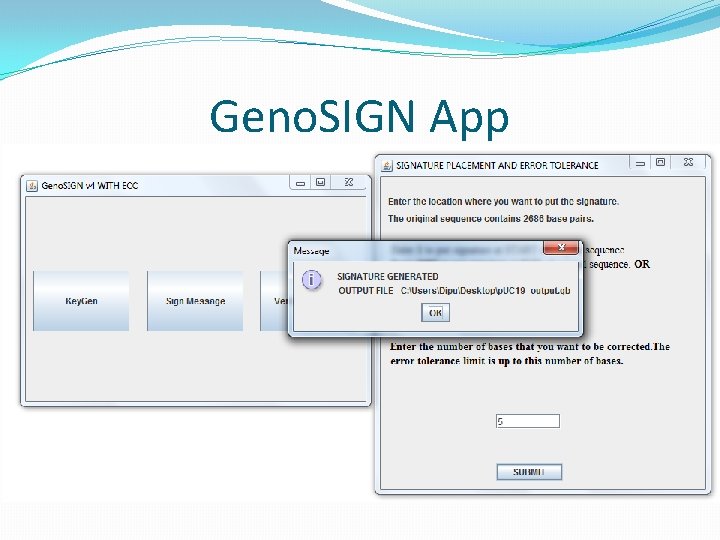
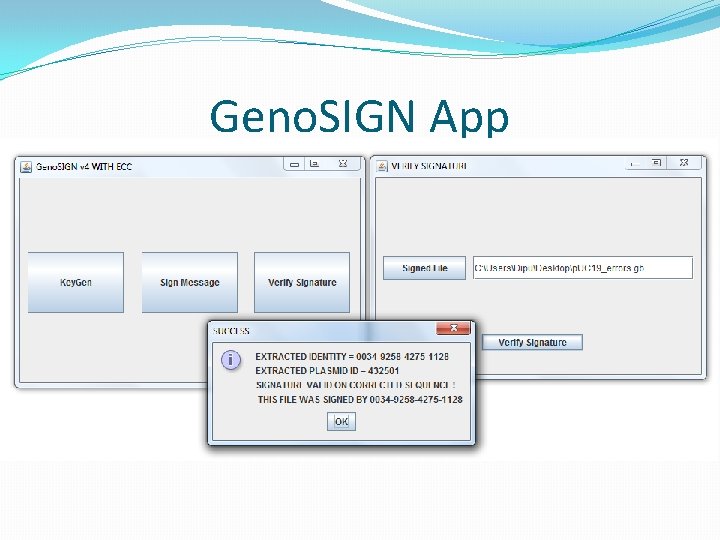
Geno. SIGN App
Geno. SIGN App
Geno. SIGN App
Geno. SIGN App
Geno. SIGN App
Geno. SIGN App
Geno. SIGN App
Future Work �Need to address insertion and deletion mutation. �Apply blockchain technology to DNA sharing. �decentralized database of transactions (who shared which DNA and which version) that everyone on the network can see. �Other problems…. (provided by our collaborators)
“Genetic code is a divine writing. ” Thank You ! Thoughts?