
Digital Signature Schemes Dr Ayad Ibrahim 2017 2018

Digital Signature Schemes Dr. Ayad Ibrahim, 2017 -2018
Outline � Introduction � Advantage of Digital signatures � Adversary Goal � RSA-signature � Attacks on RSA-signature � Hashed-RSA � Shnorr Signature � DSA algorithm
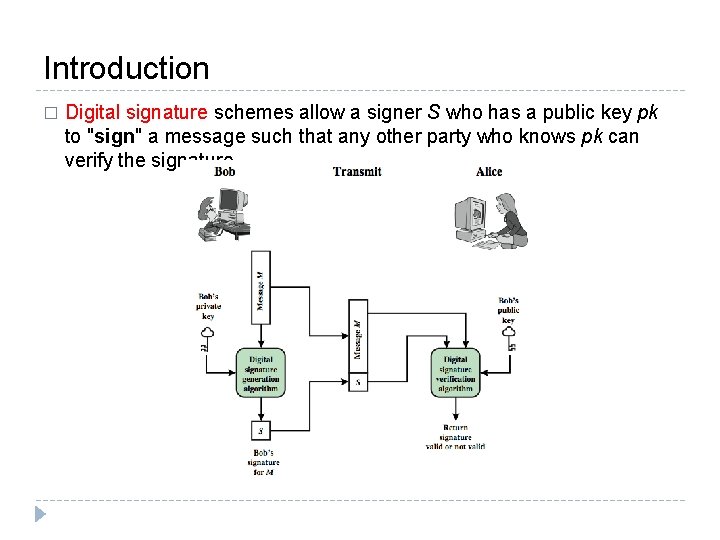
Introduction � Digital signature schemes allow a signer S who has a public key pk to "sign" a message such that any other party who knows pk can verify the signature.
Services of digital signature 1. 2. Authentication: verify that the message originated from S. Integrity: ensure message has not been modified in any way. � Signature schemes can be viewed as the public-key counterpart of message authentication codes.
Advantages of digital signature over MAC � The sender sign message once for all recipients. � Third party can verify the legitimate signature on m with respect to S's public key. � Non-repudiation: a valid signature on a message is enough to convince the judge that S indeed signed this message. � Message authentication codes have the advantage of being roughly 2 -3 orders of magnitude more efficient than digital signatures.
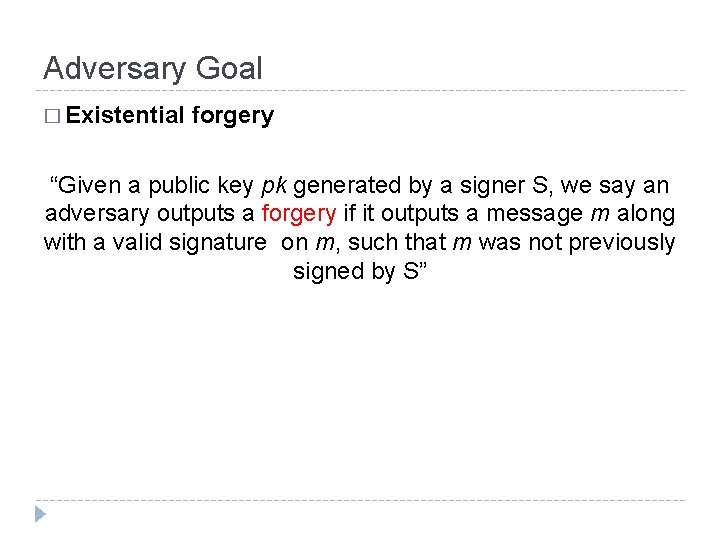
Adversary Goal � Existential forgery “Given a public key pk generated by a signer S, we say an adversary outputs a forgery if it outputs a message m along with a valid signature on m, such that m was not previously signed by S”

RSA Signatures
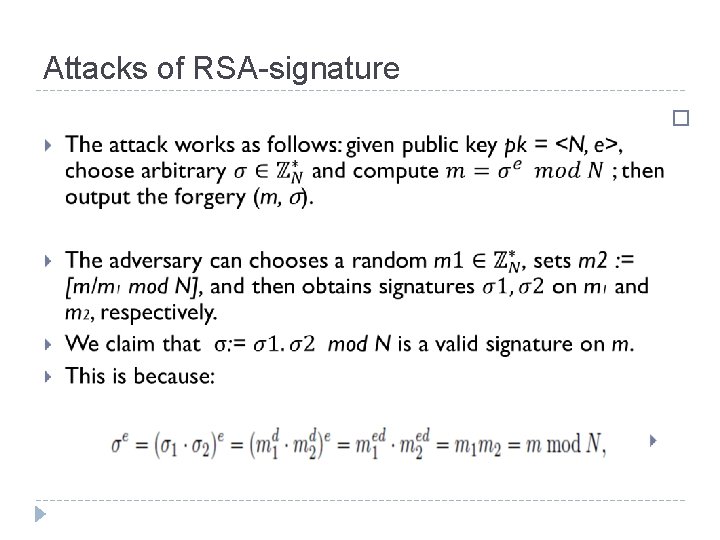
Attacks of RSA-signature �
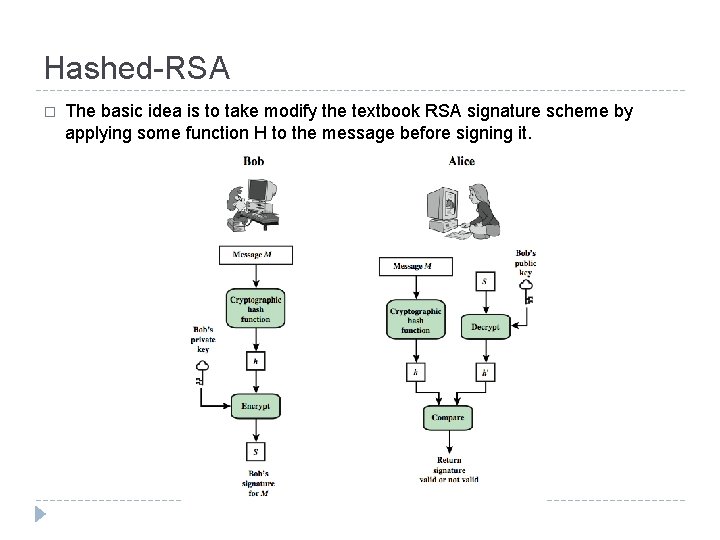
Hashed-RSA � The basic idea is to take modify the textbook RSA signature scheme by applying some function H to the message before signing it.
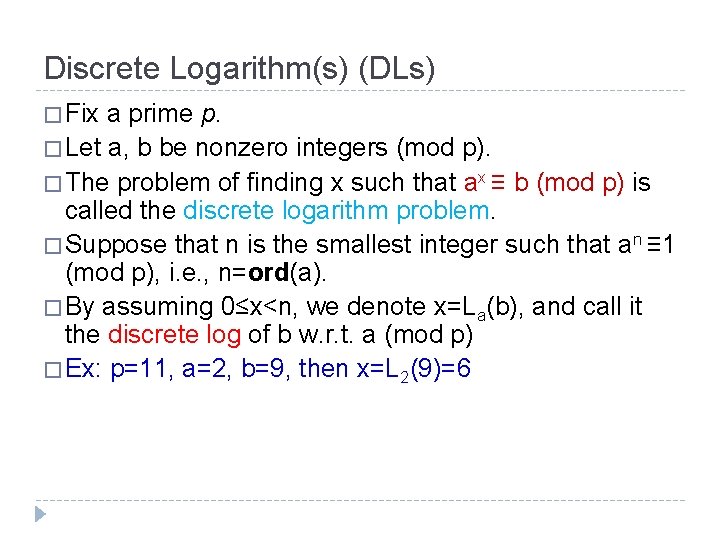
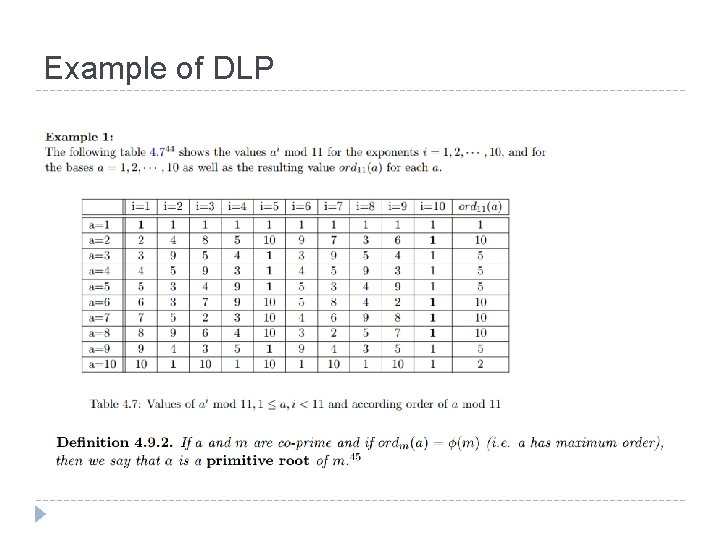
Discrete Logarithm(s) (DLs) � Fix a prime p. � Let a, b be nonzero integers (mod p). � The problem of finding x such that ax ≡ b (mod p) is called the discrete logarithm problem. � Suppose that n is the smallest integer such that an ≡ 1 (mod p), i. e. , n=ord(a). � By assuming 0≤x<n, we denote x=La(b), and call it the discrete log of b w. r. t. a (mod p) � Ex: p=11, a=2, b=9, then x=L 2(9)=6
Example of DLP
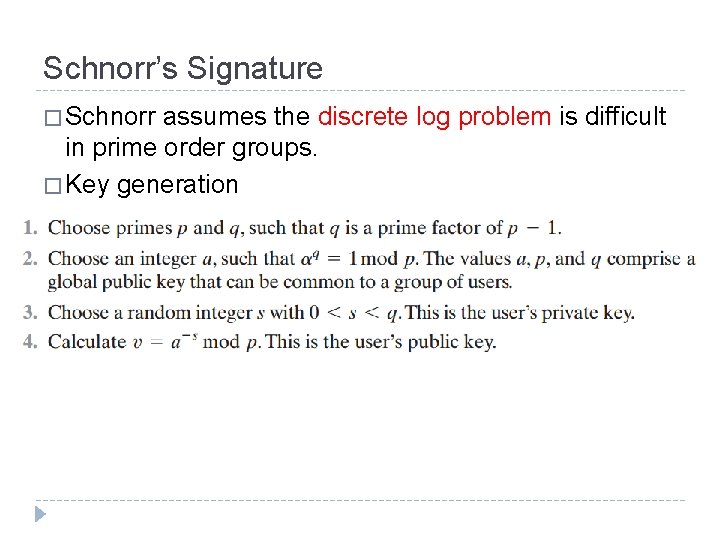
Schnorr’s Signature � Schnorr assumes the discrete log problem is difficult in prime order groups. � Key generation
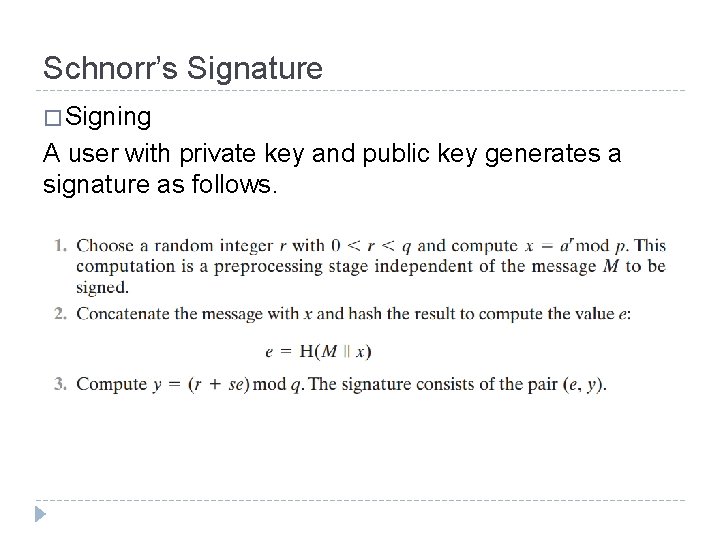
Schnorr’s Signature � Signing A user with private key and public key generates a signature as follows.
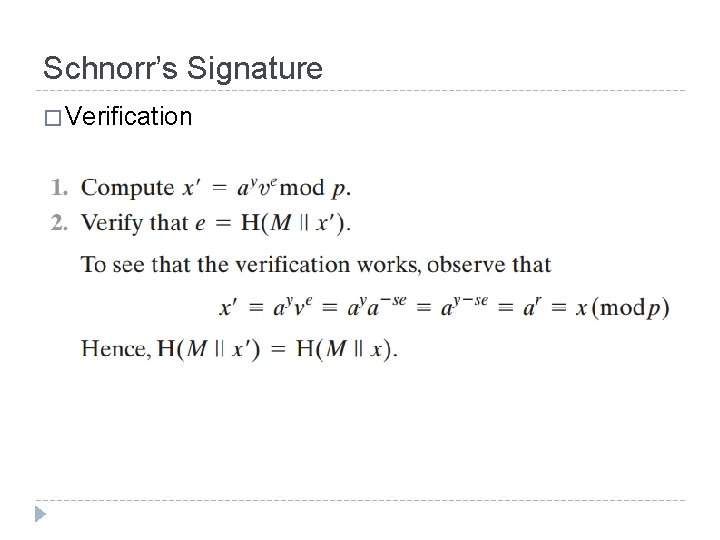
Schnorr’s Signature � Verification
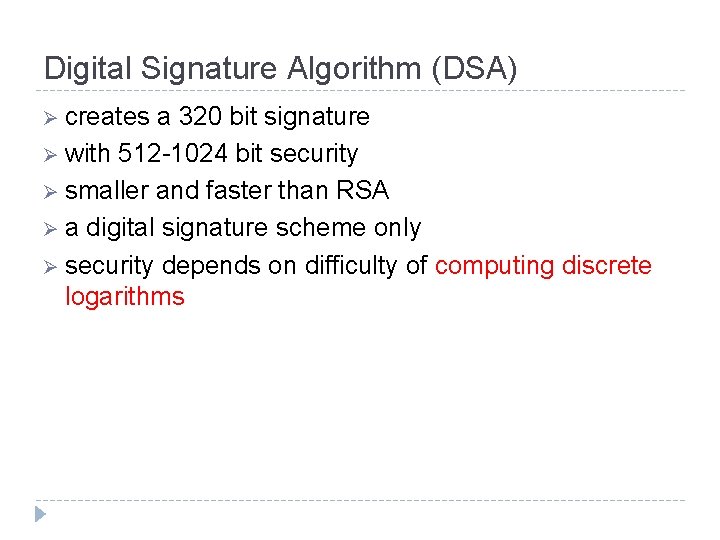
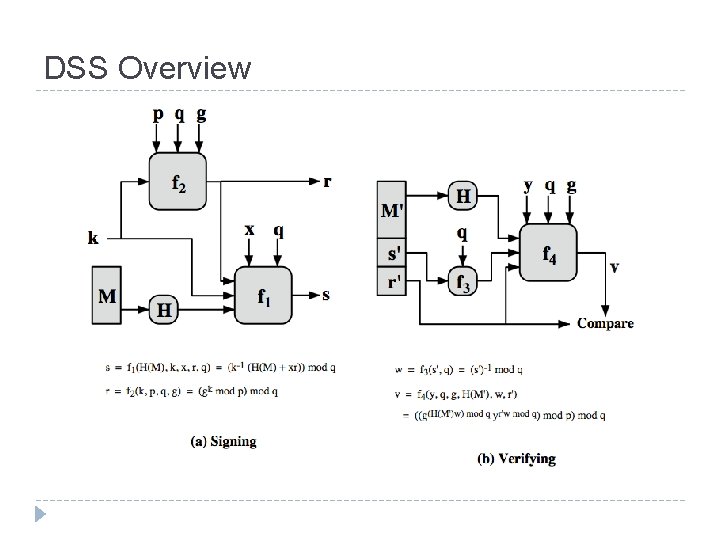
Digital Signature Algorithm (DSA) Ø creates a 320 bit signature Ø with 512 -1024 bit security Ø smaller and faster than RSA Ø a digital signature scheme only Ø security depends on difficulty of computing discrete logarithms
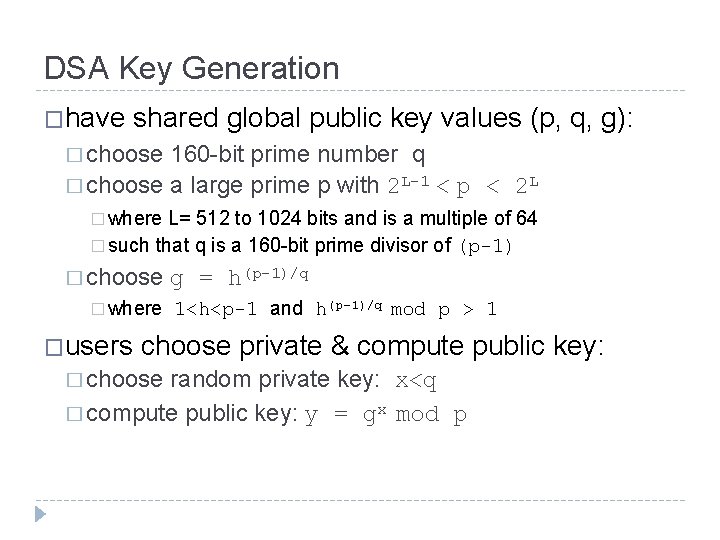
DSA Key Generation �have shared global public key values (p, q, g): � choose 160 -bit prime number q � choose a large prime p with 2 L-1 < p < 2 L � where L= 512 to 1024 bits and is a multiple of 64 � such that q is a 160 -bit prime divisor of (p-1) � choose � where �users g = h(p-1)/q 1<h<p-1 and h(p-1)/q mod p > 1 choose private & compute public key: � choose random private key: x<q � compute public key: y = gx mod p
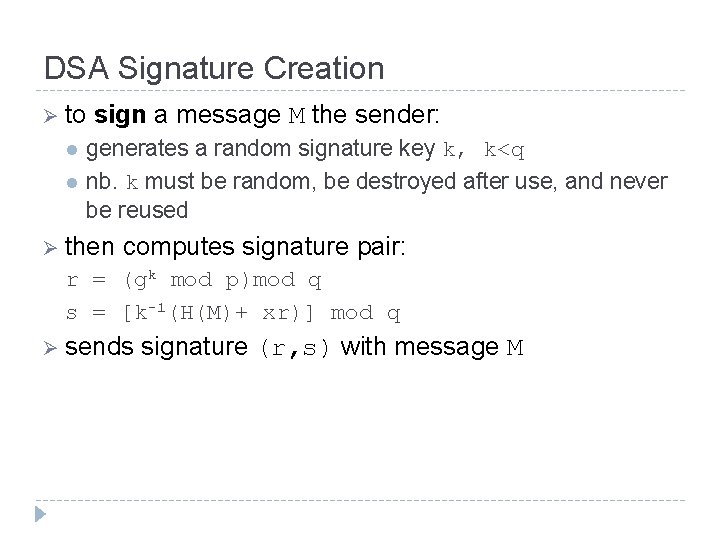
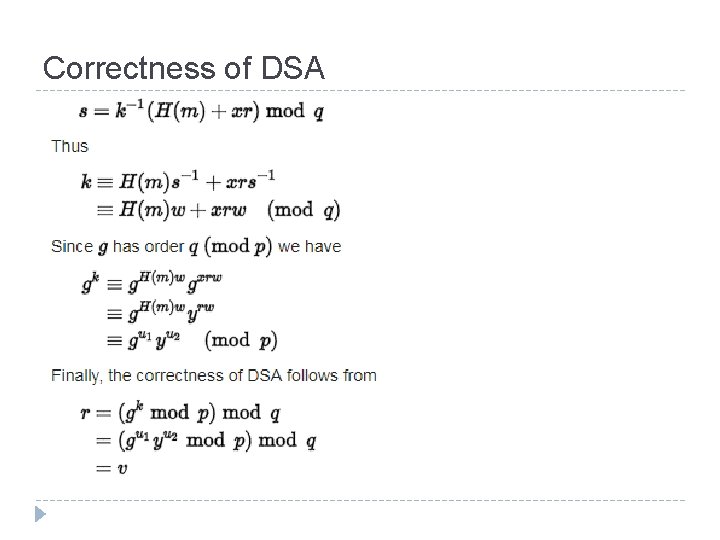
DSA Signature Creation Ø to l l sign a message M the sender: generates a random signature key k, k<q nb. k must be random, be destroyed after use, and never be reused Ø then computes signature pair: r = (gk mod p)mod q s = [k-1(H(M)+ xr)] mod q Ø sends signature (r, s) with message M
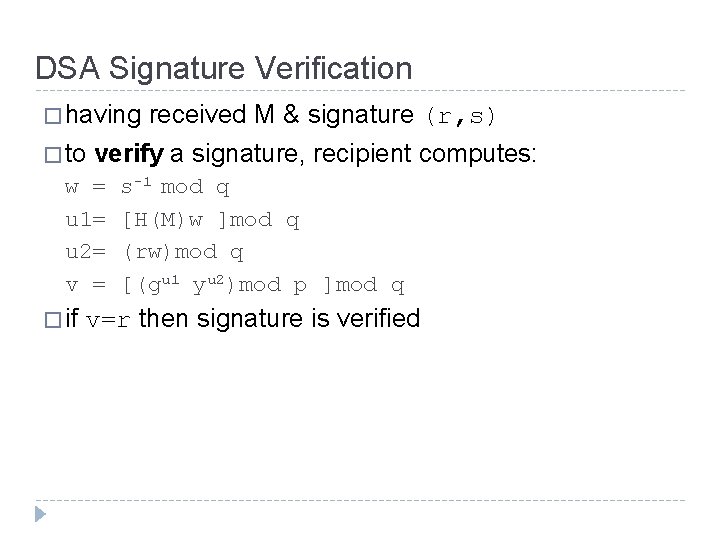
DSA Signature Verification � having � to verify a signature, recipient computes: w = u 1= u 2= v = � if received M & signature (r, s) s-1 mod q [H(M)w ]mod q (rw)mod q [(gu 1 yu 2)mod p ]mod q v=r then signature is verified
DSS Overview
Correctness of DSA

� Thanks for listening
- Slides: 21