
Digital Signals Data Communications Digital Signals In addition
- Slides: 19
Digital Signals Data Communications
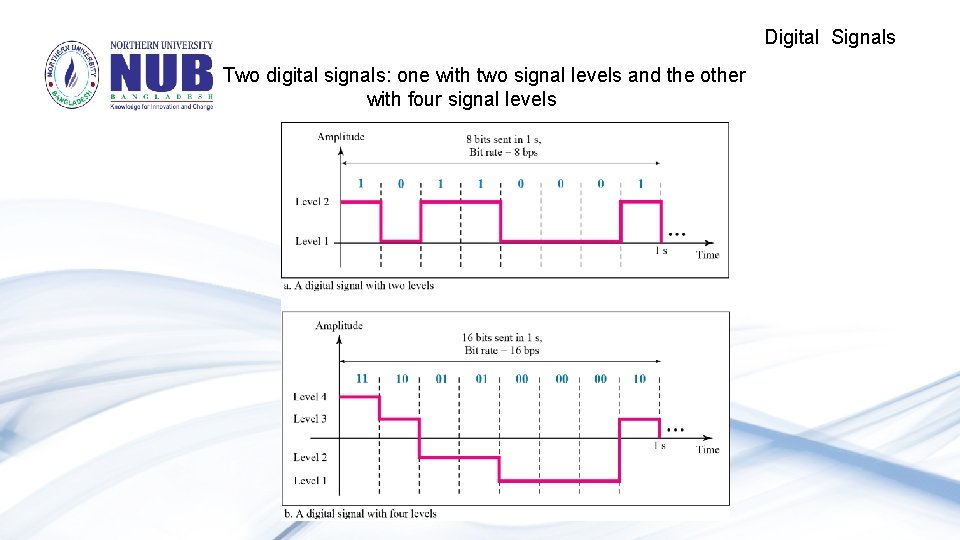
Digital Signals In addition to being represented by an analog signal, information can also be represented by a digital signal. For example, a 1 can be encoded as a positive voltage and a 0 as zero voltage. A digital signal can have more than two levels. In this case, we can send more than 1 bit for each level.
Digital Signals Two digital signals: one with two signal levels and the other with four signal levels
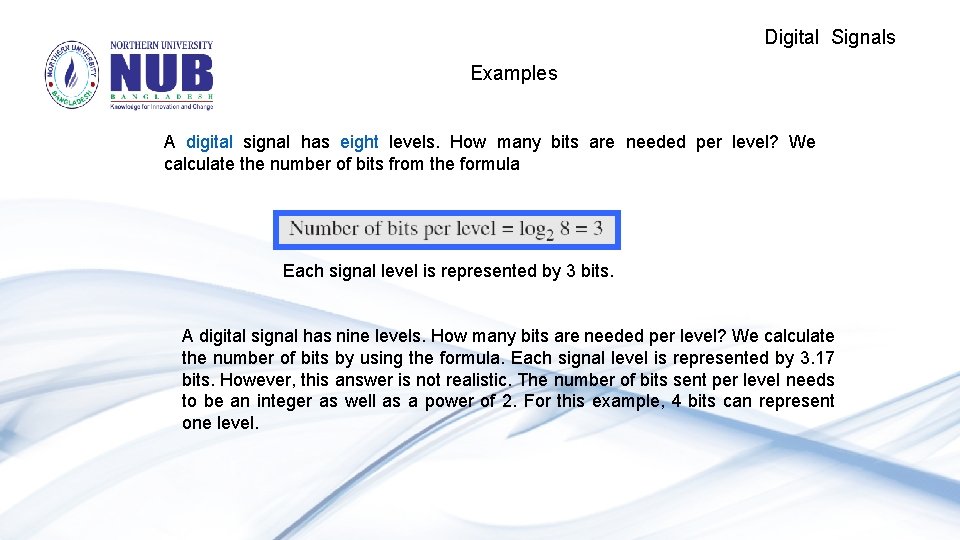
Digital Signals Examples A digital signal has eight levels. How many bits are needed per level? We calculate the number of bits from the formula Each signal level is represented by 3 bits. A digital signal has nine levels. How many bits are needed per level? We calculate the number of bits by using the formula. Each signal level is represented by 3. 17 bits. However, this answer is not realistic. The number of bits sent per level needs to be an integer as well as a power of 2. For this example, 4 bits can represent one level.
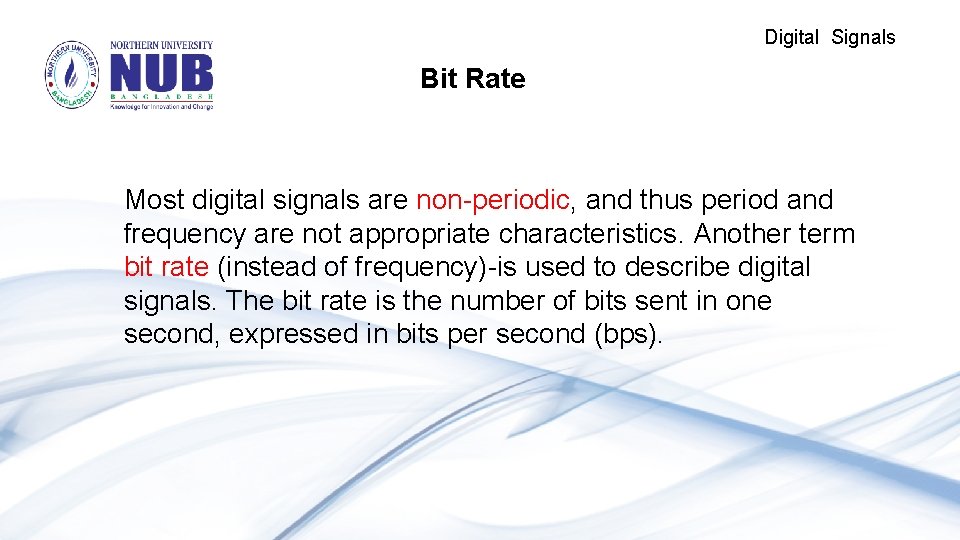
Digital Signals Bit Rate Most digital signals are non-periodic, and thus period and frequency are not appropriate characteristics. Another term bit rate (instead of frequency)-is used to describe digital signals. The bit rate is the number of bits sent in one second, expressed in bits per second (bps).
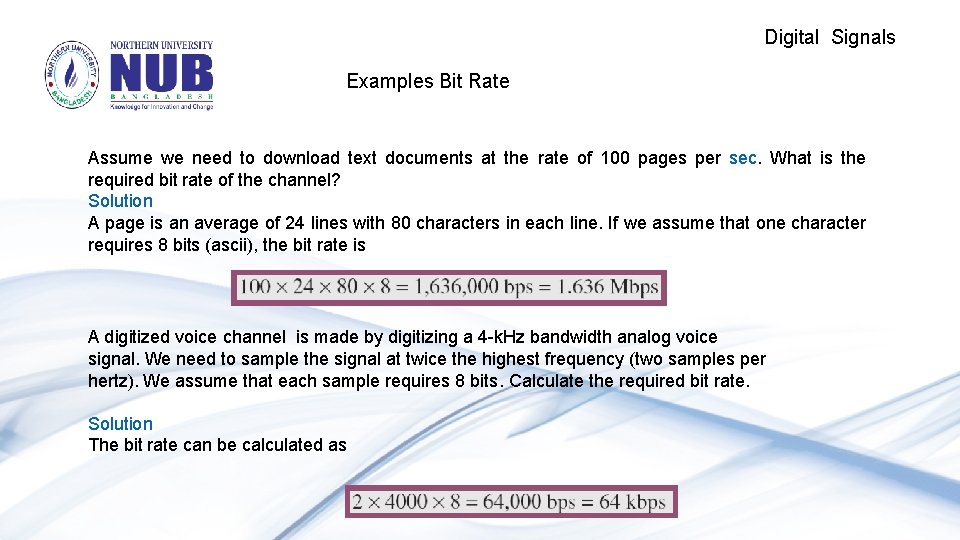
Digital Signals Examples Bit Rate Assume we need to download text documents at the rate of 100 pages per sec. What is the required bit rate of the channel? Solution A page is an average of 24 lines with 80 characters in each line. If we assume that one character requires 8 bits (ascii), the bit rate is A digitized voice channel is made by digitizing a 4 -k. Hz bandwidth analog voice signal. We need to sample the signal at twice the highest frequency (two samples per hertz). We assume that each sample requires 8 bits. Calculate the required bit rate. Solution The bit rate can be calculated as
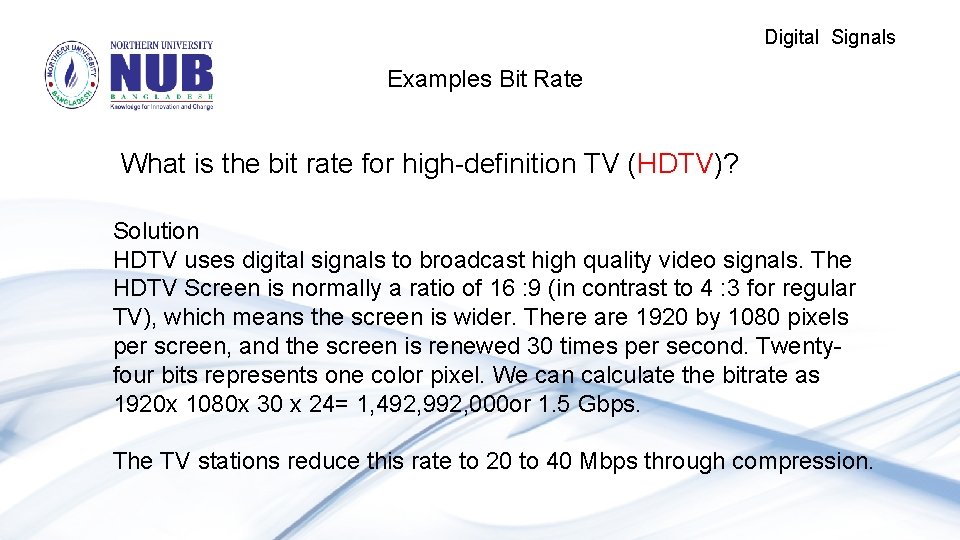
Digital Signals Examples Bit Rate What is the bit rate for high-definition TV (HDTV)? Solution HDTV uses digital signals to broadcast high quality video signals. The HDTV Screen is normally a ratio of 16 : 9 (in contrast to 4 : 3 for regular TV), which means the screen is wider. There are 1920 by 1080 pixels per screen, and the screen is renewed 30 times per second. Twentyfour bits represents one color pixel. We can calculate the bitrate as 1920 x 1080 x 30 x 24= 1, 492, 992, 000 or 1. 5 Gbps. The TV stations reduce this rate to 20 to 40 Mbps through compression.
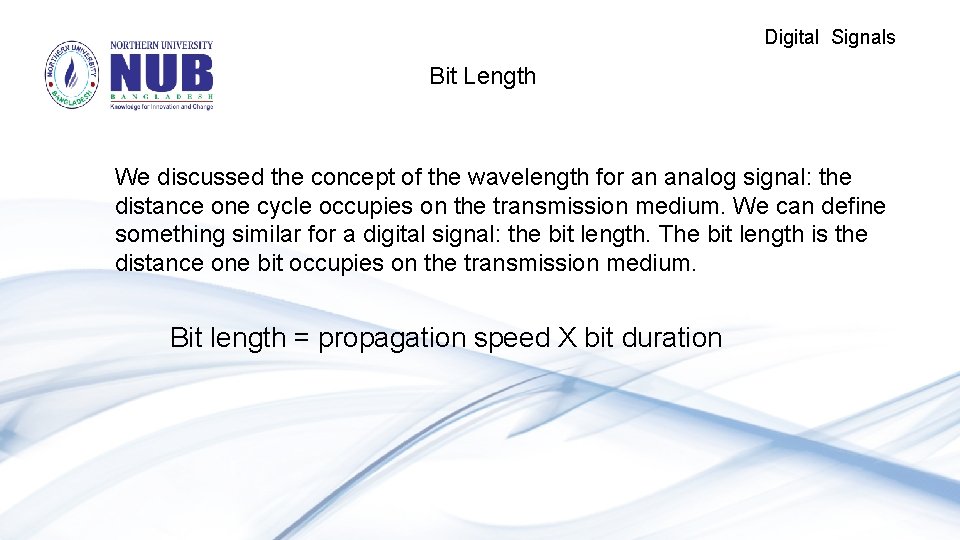
Digital Signals Bit Length We discussed the concept of the wavelength for an analog signal: the distance one cycle occupies on the transmission medium. We can define something similar for a digital signal: the bit length. The bit length is the distance one bit occupies on the transmission medium. Bit length = propagation speed X bit duration
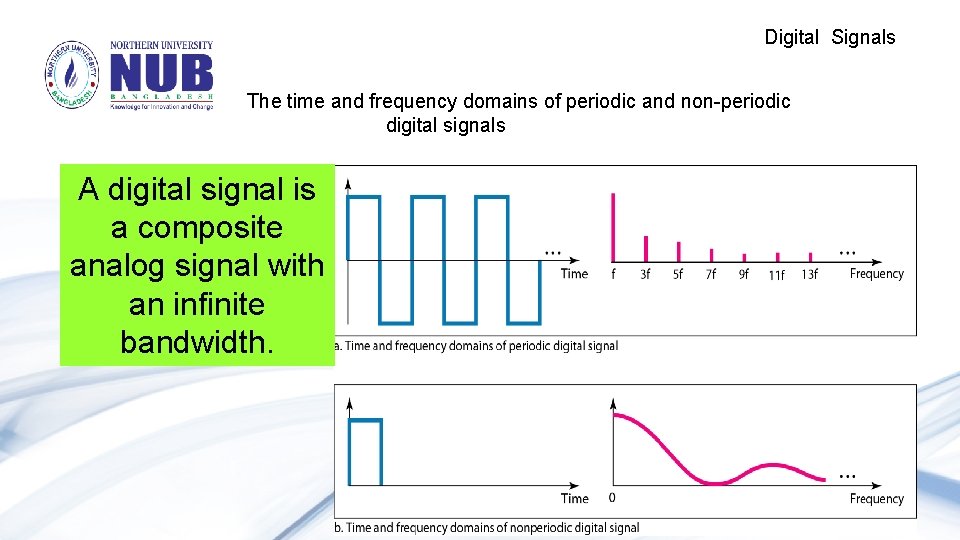
Digital Signals The time and frequency domains of periodic and non-periodic digital signals A digital signal is a composite analog signal with an infinite bandwidth.
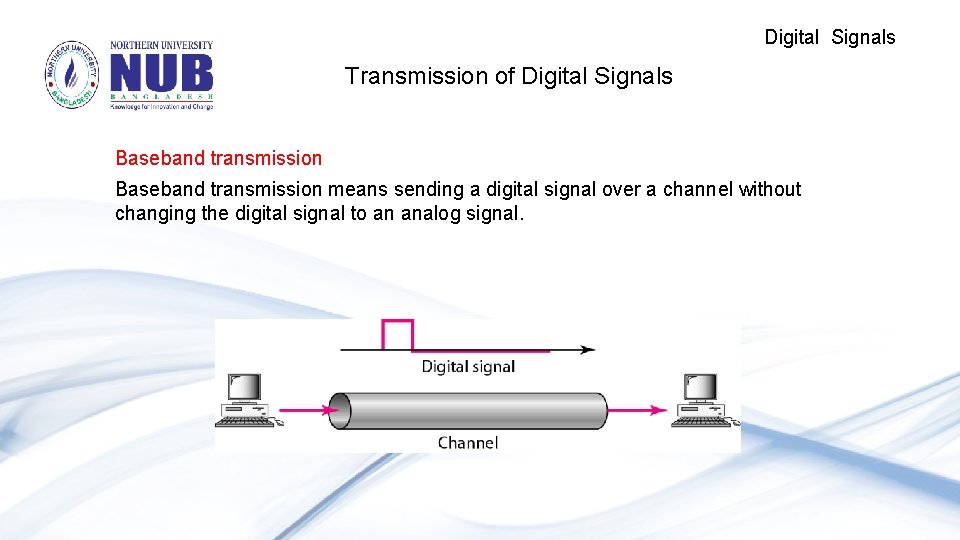
Digital Signals Transmission of Digital Signals Baseband transmission means sending a digital signal over a channel without changing the digital signal to an analog signal.
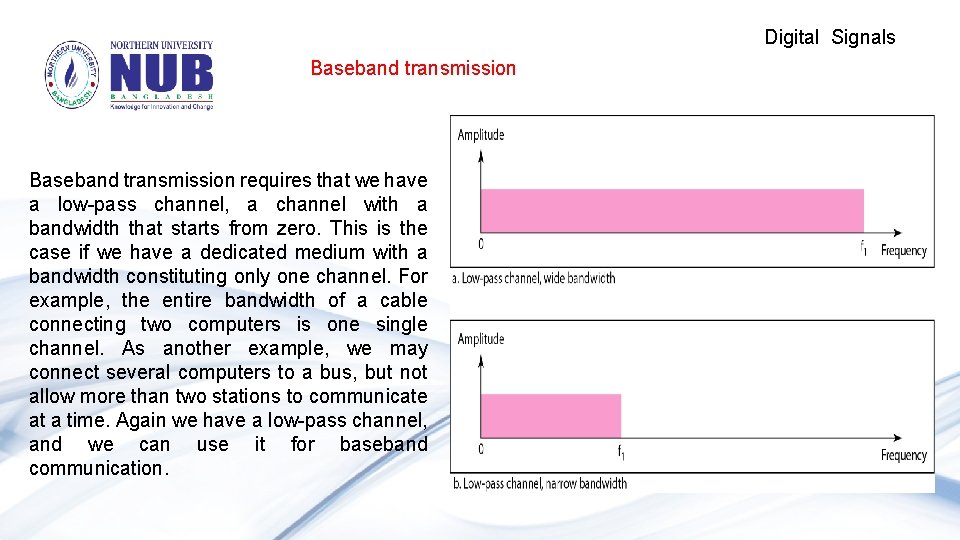
Digital Signals Baseband transmission requires that we have a low-pass channel, a channel with a bandwidth that starts from zero. This is the case if we have a dedicated medium with a bandwidth constituting only one channel. For example, the entire bandwidth of a cable connecting two computers is one single channel. As another example, we may connect several computers to a bus, but not allow more than two stations to communicate at a time. Again we have a low-pass channel, and we can use it for baseband communication.
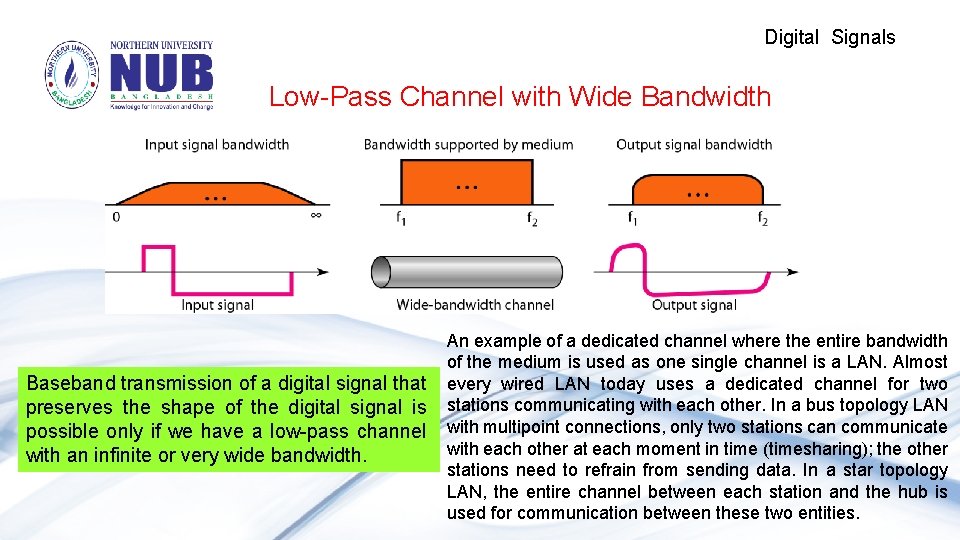
Digital Signals Low-Pass Channel with Wide Bandwidth Baseband transmission of a digital signal that preserves the shape of the digital signal is possible only if we have a low-pass channel with an infinite or very wide bandwidth. An example of a dedicated channel where the entire bandwidth of the medium is used as one single channel is a LAN. Almost every wired LAN today uses a dedicated channel for two stations communicating with each other. In a bus topology LAN with multipoint connections, only two stations can communicate with each other at each moment in time (timesharing); the other stations need to refrain from sending data. In a star topology LAN, the entire channel between each station and the hub is used for communication between these two entities.
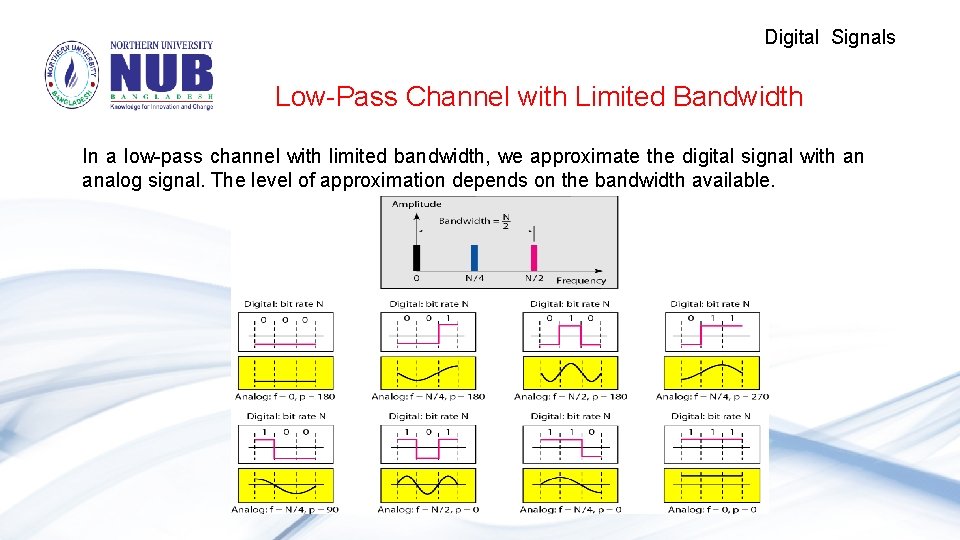
Digital Signals Low-Pass Channel with Limited Bandwidth In a low-pass channel with limited bandwidth, we approximate the digital signal with an analog signal. The level of approximation depends on the bandwidth available.
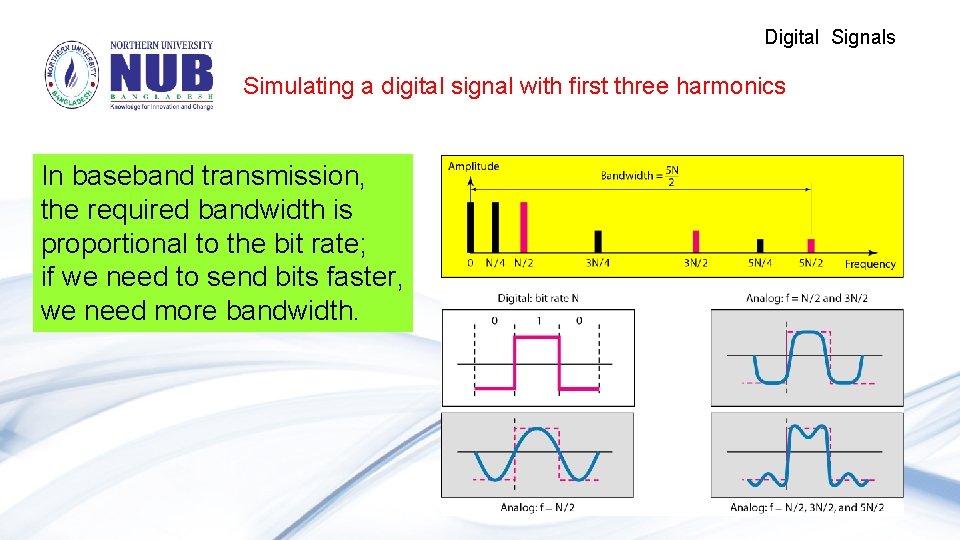
Digital Signals Simulating a digital signal with first three harmonics In baseband transmission, the required bandwidth is proportional to the bit rate; if we need to send bits faster, we need more bandwidth.
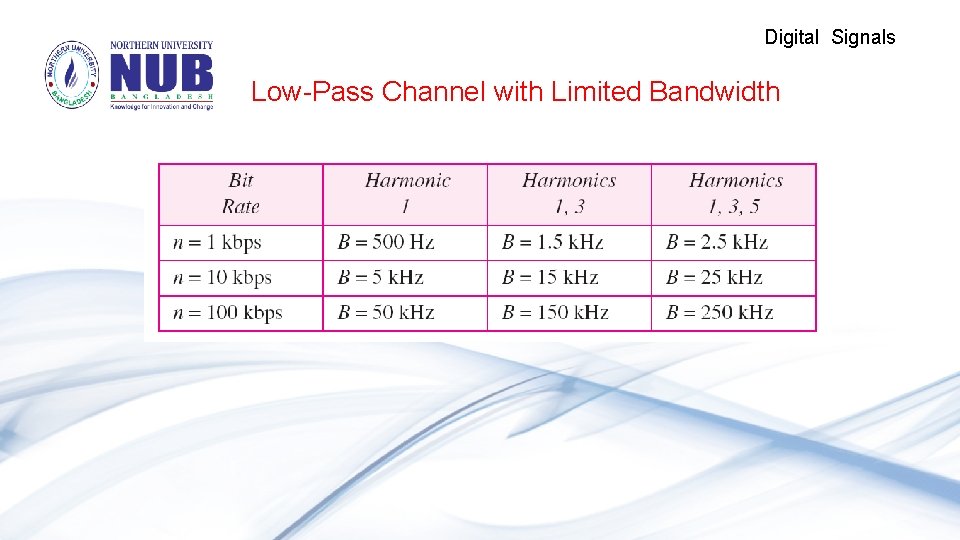
Digital Signals Low-Pass Channel with Limited Bandwidth
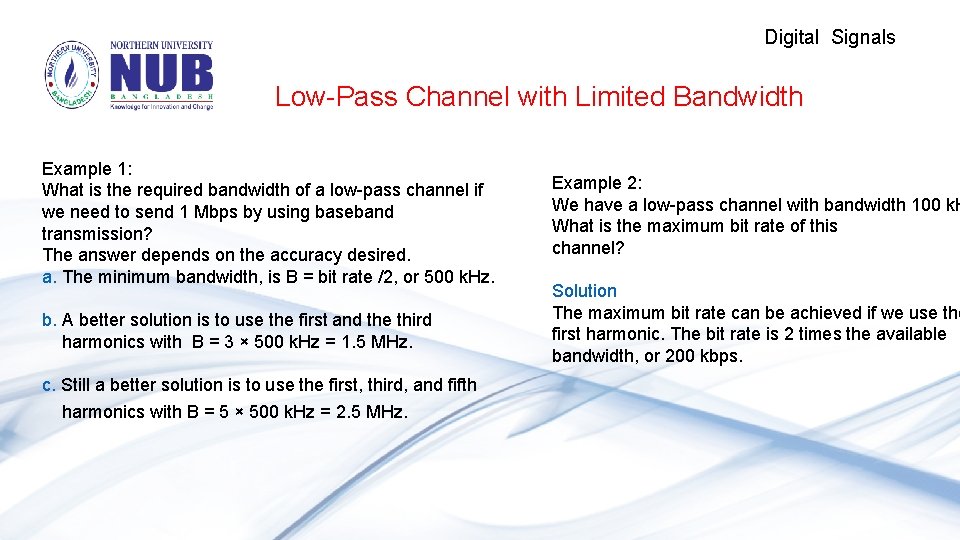
Digital Signals Low-Pass Channel with Limited Bandwidth Example 1: What is the required bandwidth of a low-pass channel if we need to send 1 Mbps by using baseband transmission? The answer depends on the accuracy desired. a. The minimum bandwidth, is B = bit rate /2, or 500 k. Hz. b. A better solution is to use the first and the third harmonics with B = 3 × 500 k. Hz = 1. 5 MHz. c. Still a better solution is to use the first, third, and fifth harmonics with B = 5 × 500 k. Hz = 2. 5 MHz. Example 2: We have a low-pass channel with bandwidth 100 k. H What is the maximum bit rate of this channel? Solution The maximum bit rate can be achieved if we use the first harmonic. The bit rate is 2 times the available bandwidth, or 200 kbps.
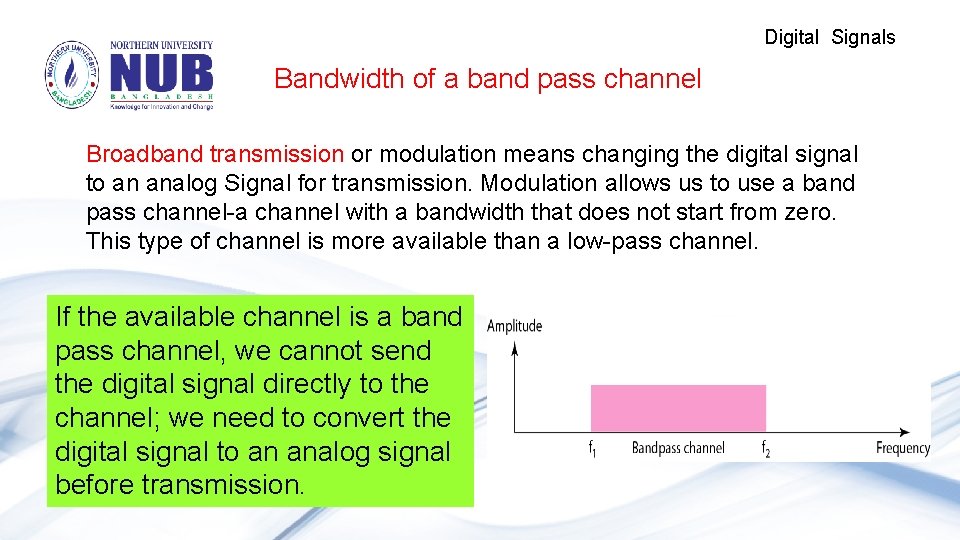
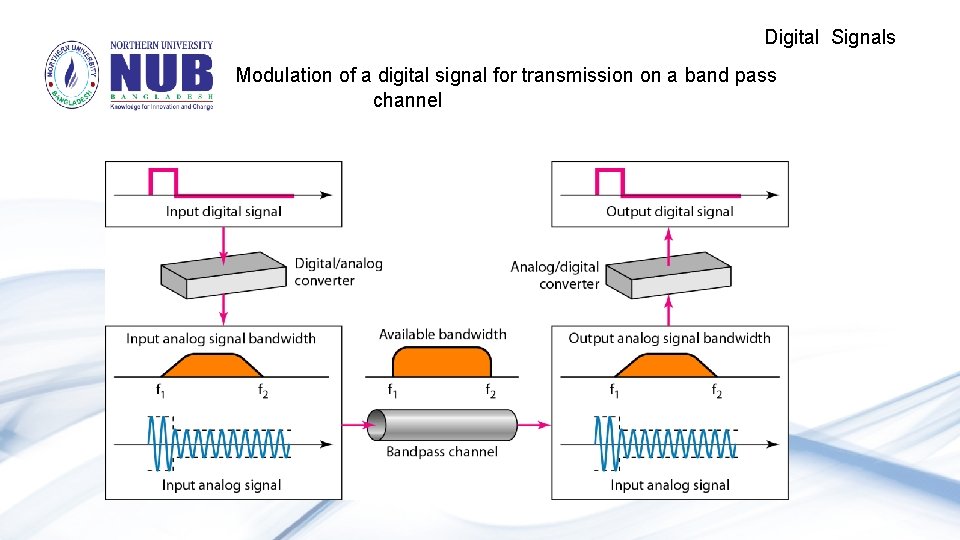
Digital Signals Bandwidth of a band pass channel Broadband transmission or modulation means changing the digital signal to an analog Signal for transmission. Modulation allows us to use a band pass channel-a channel with a bandwidth that does not start from zero. This type of channel is more available than a low-pass channel. If the available channel is a band pass channel, we cannot send the digital signal directly to the channel; we need to convert the digital signal to an analog signal before transmission.
Digital Signals Modulation of a digital signal for transmission on a band pass channel
Digital Signals Modulation of a digital signal for transmission on a band pass channel Example 1: An example of broadband transmission using modulation is the sending of computer data through a telephone subscriber line, the line connecting a resident to the central telephone office. These lines are designed to carry voice with a limited bandwidth. The channel is considered a bandpass channel. We convert the digital signal from the computer to an analog signal, and send the analog signal. We can install two converters to change the digital signal to analog and vice versa at the receiving end. Example 2: A second example is the digital cellular telephone. For better reception, digital cellular phones convert the analog voice signal to a digital signal. Although the bandwidth allocated to a company providing digital cellular phone service is very wide, we still cannot send the digital signal without conversion. The reason is that we only have a bandpass channel available between caller and callee. We need to convert the digitized voice to a composite analog signal before sending.