
Digital signal processors DSP 1 Content Digital signal
![Impulse response of digital filter The impulse response, often denoted h[k] or hk, is](https://slidetodoc.com/presentation_image_h2/8a2b07925eca00476417fdc56ff49530/image-21.jpg "Impulse response of digital filter The impulse response, often denoted h[k] or hk, is")
- Slides: 32
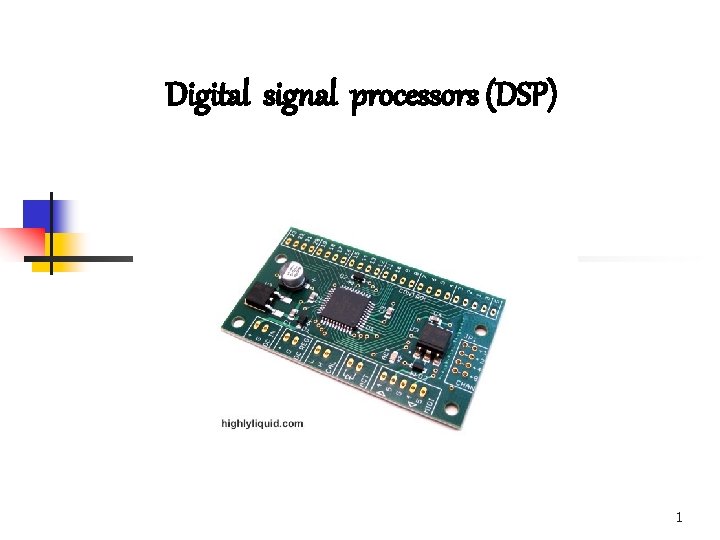
Digital signal processors (DSP) 1
Content Digital signal processing principles (4) DSP Manufacturers Architecture of DSP Digital filters design and implementation Other types of signal processing 2
Introduction to DSP The goal of DSP is usually to measure, filter and/or compress continuous real-world analog signals. The first step is usually to convert the signal from an analog to a digital form, by sampling it using an analog -to-digital converter (ADC), which turns the analog signal into a stream of numbers. However, often, the required output signal is another analog output signal, which requires a digital-to-analog converter (DAC). 3
Even if this process is more complex than analog processing and has a discrete value range, the application of computational power to digital signal processing allows for many advantages over analog processing in many applications, such as error detection and correction in transmission as well as data compression. 4
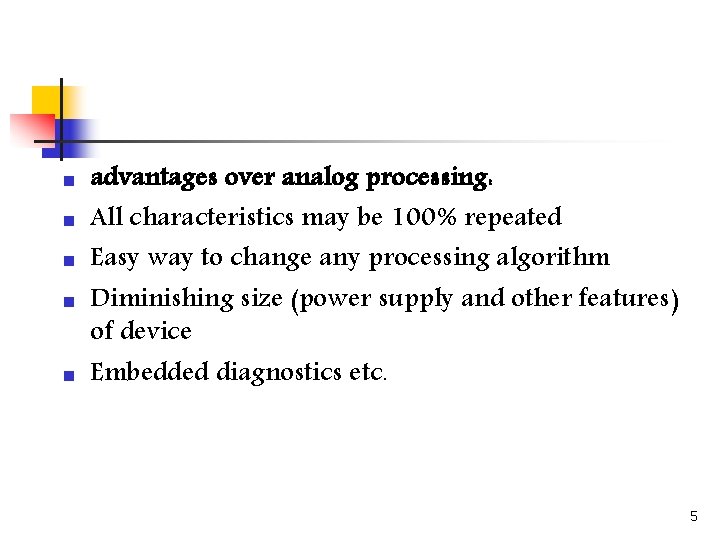
advantages over analog processing: All characteristics may be 100% repeated Easy way to change any processing algorithm Diminishing size (power supply and other features) of device Embedded diagnostics etc. 5
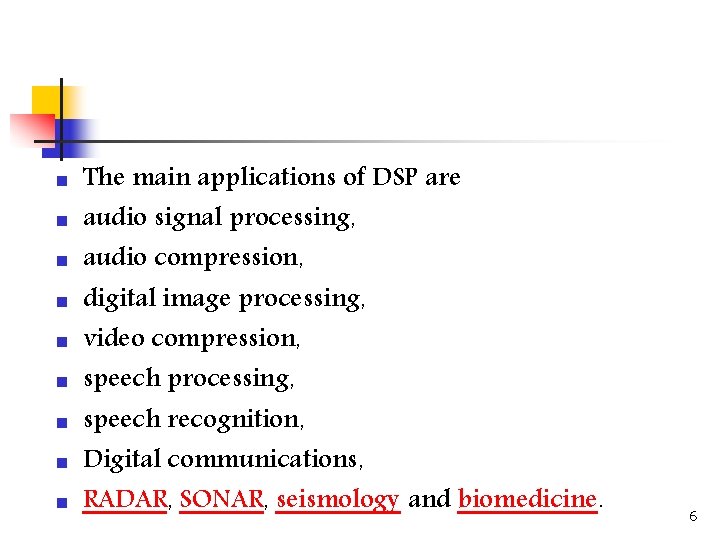
The main applications of DSP are audio signal processing, audio compression, digital image processing, video compression, speech processing, speech recognition, Digital communications, RADAR, SONAR, seismology and biomedicine. 6
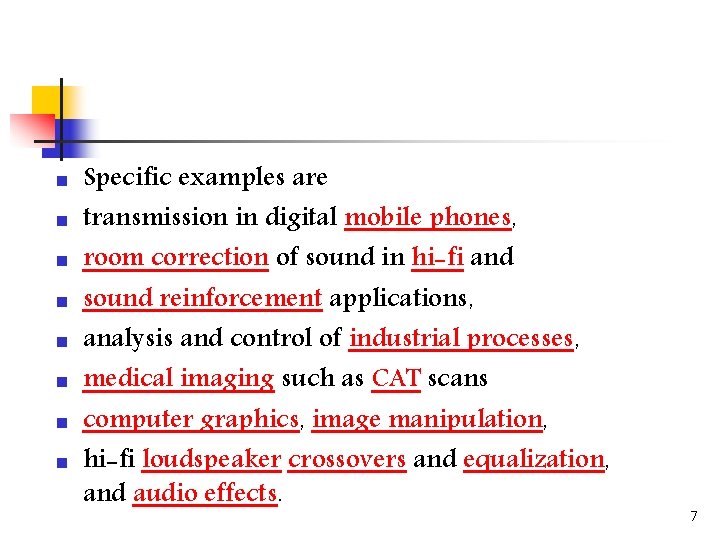
Specific examples are transmission in digital mobile phones, room correction of sound in hi-fi and sound reinforcement applications, analysis and control of industrial processes, medical imaging such as CAT scans computer graphics, image manipulation, hi-fi loudspeaker crossovers and equalization, and audio effects. 7
Main manufacturers Texas Instruments (TI) Analog Devices Motorola Other firms 8
Firms Which uses DSP of TI Xybernaut Kodak Nokia 3 Com e. Digital Sony. Ericsson Hewlett Packard Sony Palm 9
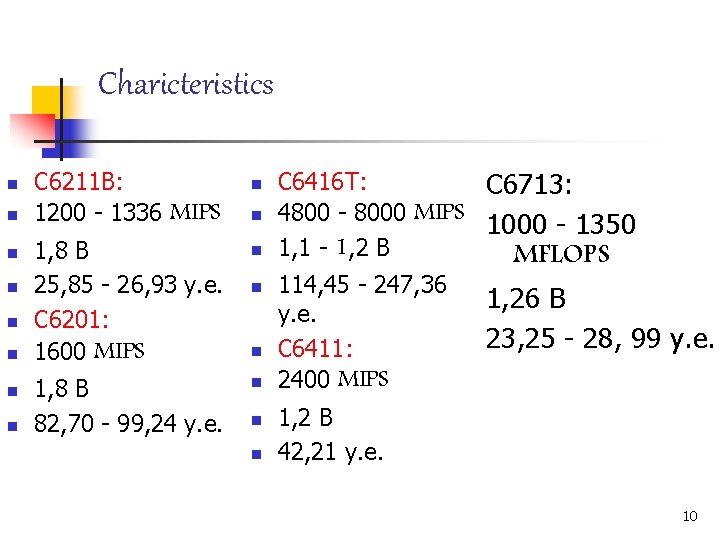
Charicteristics С 6211 В: 1200 - 1336 MIPS 1, 8 В 25, 85 - 26, 93 у. е. С 6201: 1600 MIPS 1, 8 В 82, 70 - 99, 24 у. е. С 6416 Т: С 6713: 4800 - 8000 MIPS 1000 - 1350 1, 1 - 1, 2 В MFLOPS 114, 45 - 247, 36 у. е. С 6411: 2400 MIPS 1, 26 В 23, 25 - 28, 99 у. е. 1, 2 В 42, 21 у. е. 10
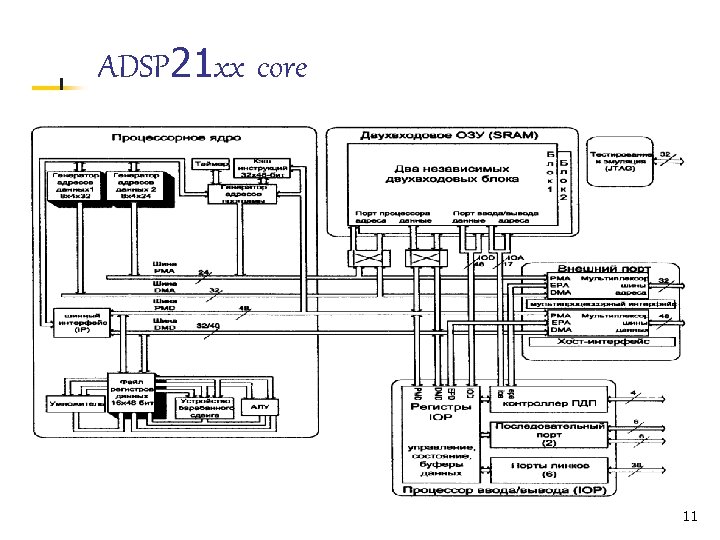
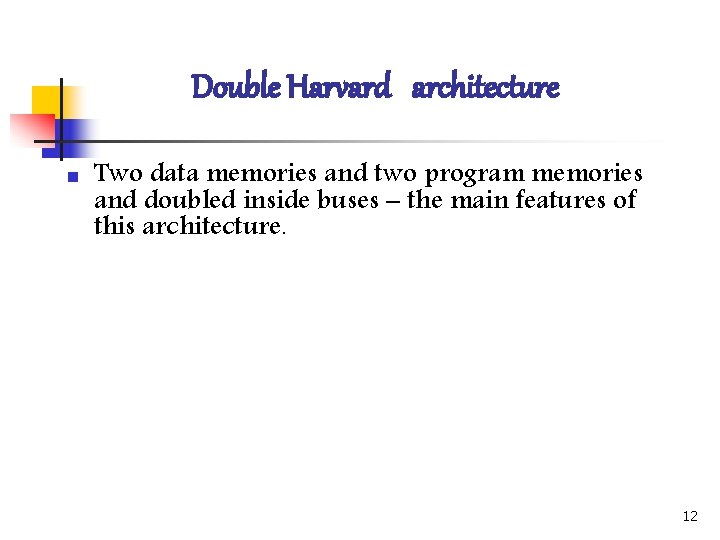
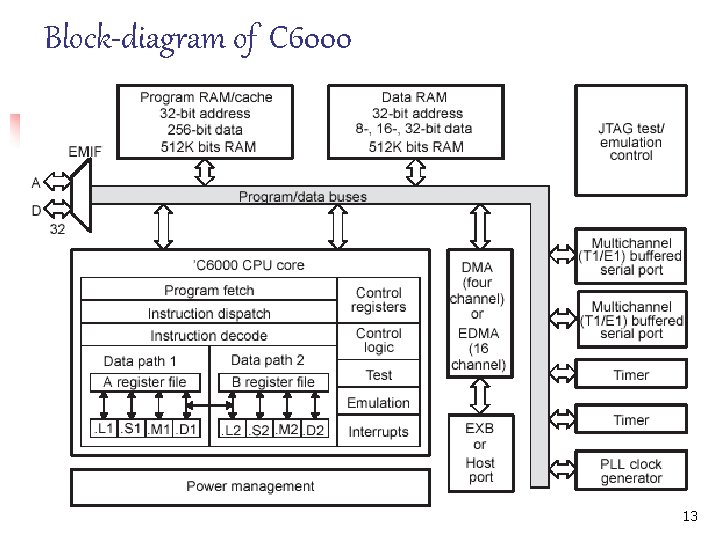
Double Harvard architecture Two data memories and two program memories and doubled inside buses – the main features of this architecture. 12
Block-diagram of C 6000 13
Introduction to signal processing There are two unequal types of signal processing Linear (digital filtering) Non-linear (all other methods) 14
Digital filtering The design of digital filters is a deceptively complex topic. Although filters are easily understood and calculated, the practical challenges of their design and implementation are significant and are the subject of much advanced research. There are two categories of digital filter: the recursive filter and the nonrecursive filter. These are often referred to as infinite impulse response (IIR) filters and finite impulse response (FIR) filters, respectively. 15
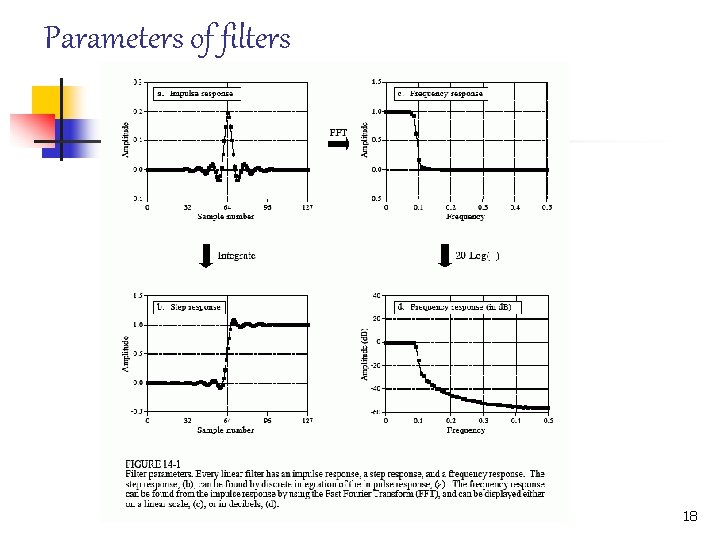
Digital filtering The impulse response is the output of a system when the input is an impulse. In this same manner, the step response is the output when the input is a step (also called an edge, and an edge response). Since the step is the integral of the impulse, the step response is the integral of the impulse response. This provides two ways to find the step response: (1) feed a step waveform into the filter and see what comes out, or (2) integrate the impulse response. 16
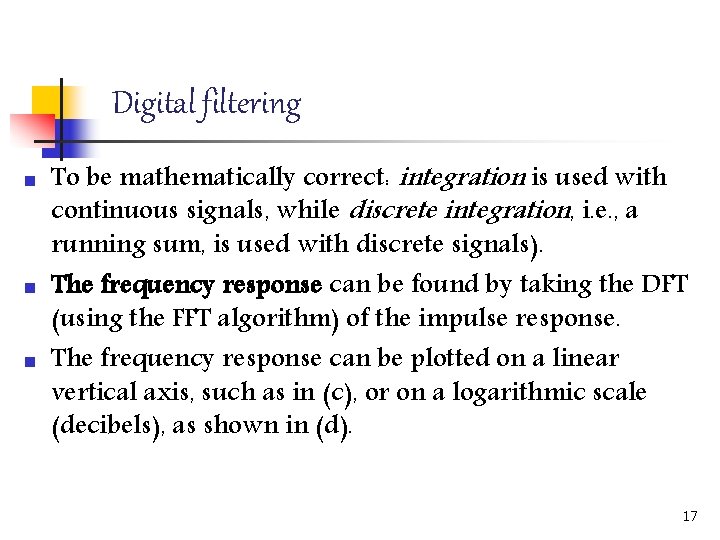
Digital filtering To be mathematically correct: integration is used with continuous signals, while discrete integration, i. e. , a running sum, is used with discrete signals). The frequency response can be found by taking the DFT (using the FFT algorithm) of the impulse response. The frequency response can be plotted on a linear vertical axis, such as in (c), or on a logarithmic scale (decibels), as shown in (d). 17
Parameters of filters 18
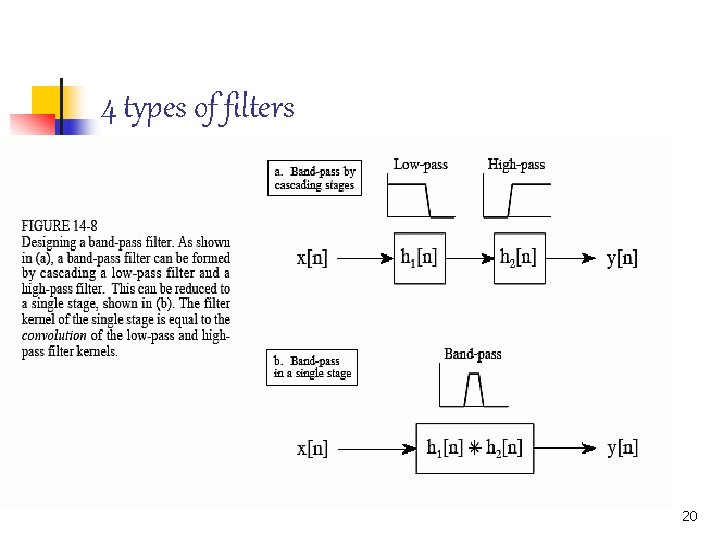
4 types of filters Figs. 14 -8 shows how low-pass and high-pass filter kernels can be combined to form band-pass and bandreject filters. In short, adding the filter kernels produces a bandreject filter, while convolving the filter kernels produces a band-pass filter. These are based on the way cascaded and parallel systems are be combined. 19
4 types of filters 20
Impulse response of digital filter The impulse response, often denoted h[k] or hk, is a measurement of how a filter will respond to the Kronecker delta function. The impulse response is a characterization of the filter's behaviour. Digital filters are typically considered in two categories: infinite impulse response (IIR) and finite impulse response (FIR). 21
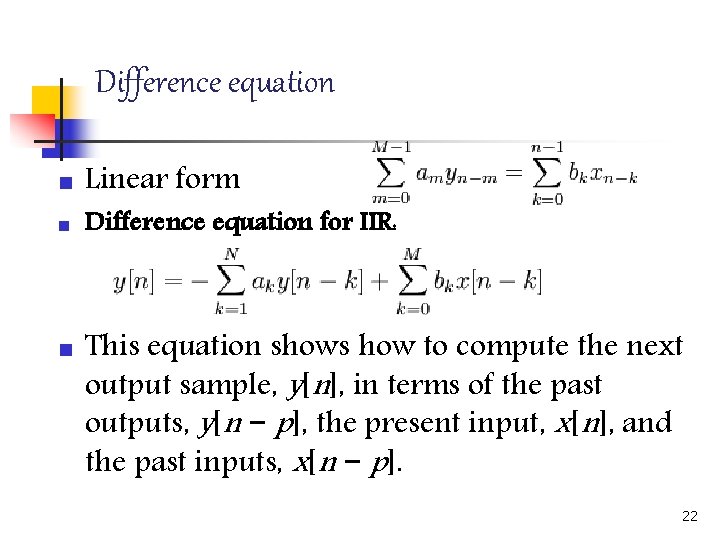
Difference equation Linear form Difference equation for IIR: This equation shows how to compute the next output sample, y[n], in terms of the past outputs, y[n − p], the present input, x[n], and the past inputs, x[n − p]. 22
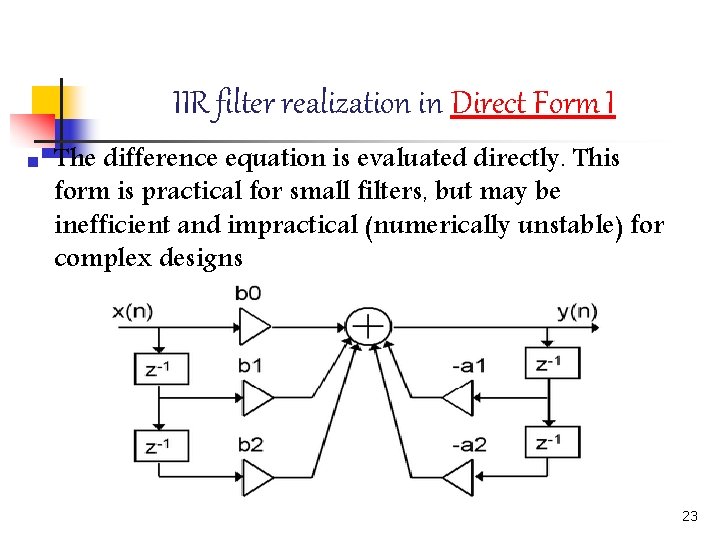
IIR filter realization in Direct Form I The difference equation is evaluated directly. This form is practical for small filters, but may be inefficient and impractical (numerically unstable) for complex designs 23
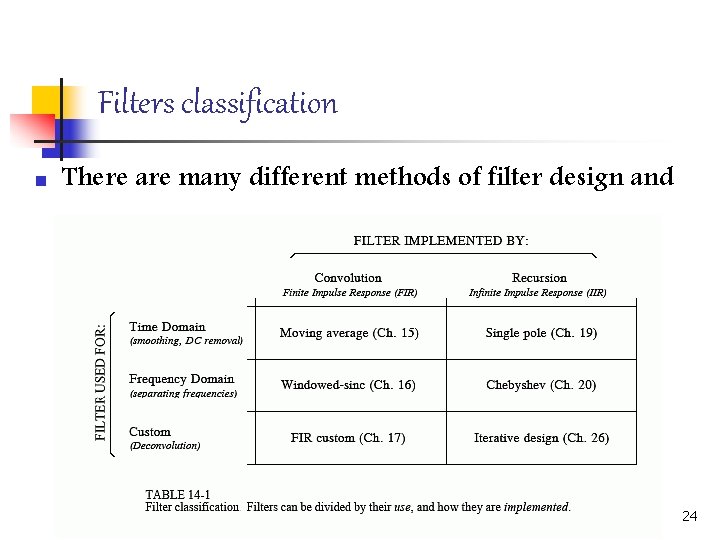
Filters classification There are many different methods of filter design and … 24
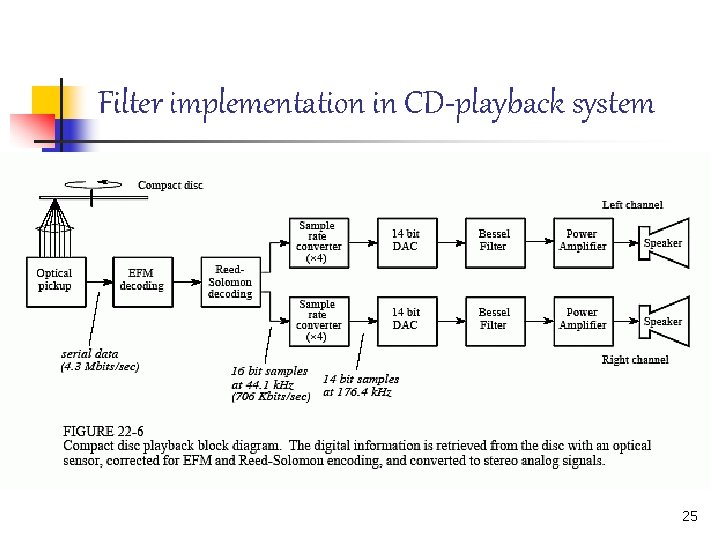
Filter implementation in CD-playback system 25
Nonlinear Signal Processing For some signal processing systems, nonlinearity is an essential component: classical examples for nonlinear systems are quantizers and pattern classifiers. For nonlinear dynamical systems (such as oscillators, filters etc. ), the conventional approach to their analysis and design has been linearization as seen e. g. in the field of adaptive filtering. 26
Nonlinear Signal Processing Modulation/Demodulation Adaptive and median filters Image Encoding and Compression Video Encoding and Compression Error proof coding 27
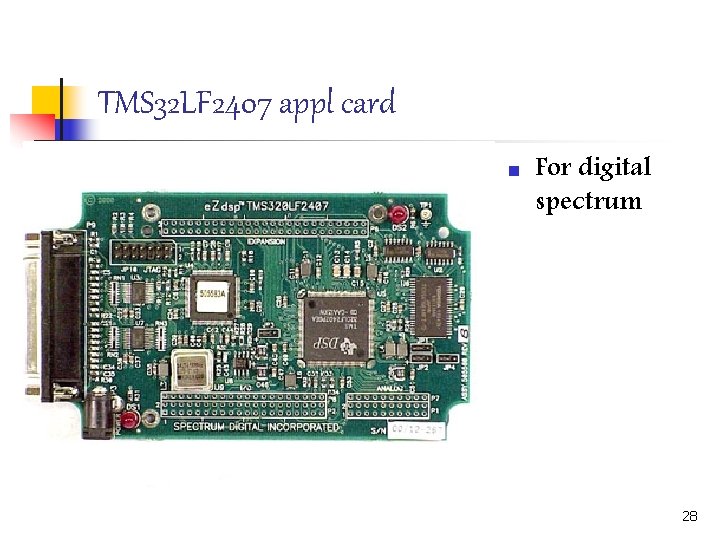
TMS 32 LF 2407 appl card For digital spectrum 28
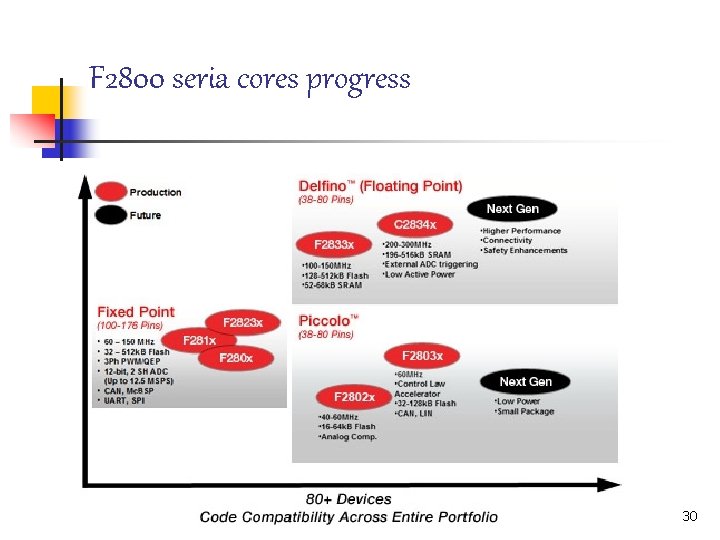
Next series C 2000, C 3000, C 4000, C 5000, C 6000 TMS 320 C 2000 series consists of 2 families: C 240 x, an older 16 -bit line that is no longer recommended for new development and the C 28 xx 32 -bit line. The newer C 28 xx family consists of a Delfino high-performance floating point line and a low-cost Piccolo line. The C 2000 series is notable for its high performance set of on-chip control peripherals including PWM, ADC, quadrature encoder modules, and capture modules. The series also contains support for I 2 C, SPI, serial (SCI), CAN, watchdog, Mc. BSP, external memory interface and GPIO. 29
F 2800 seria cores progress 30
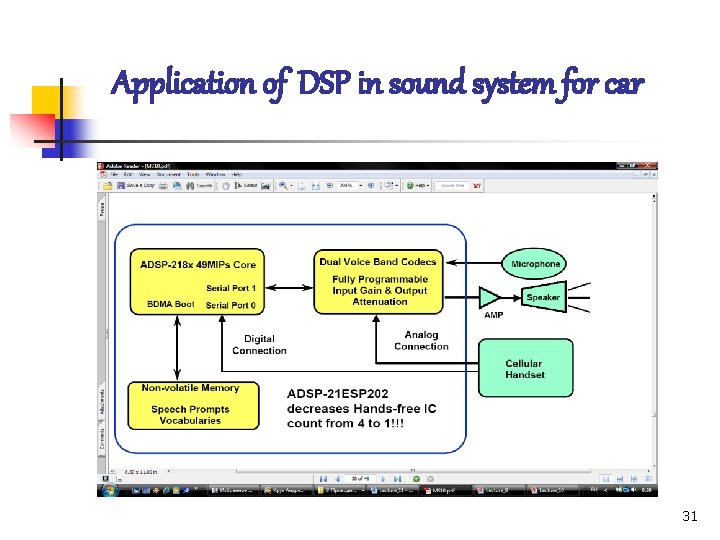
Application of DSP in sound system for car 31
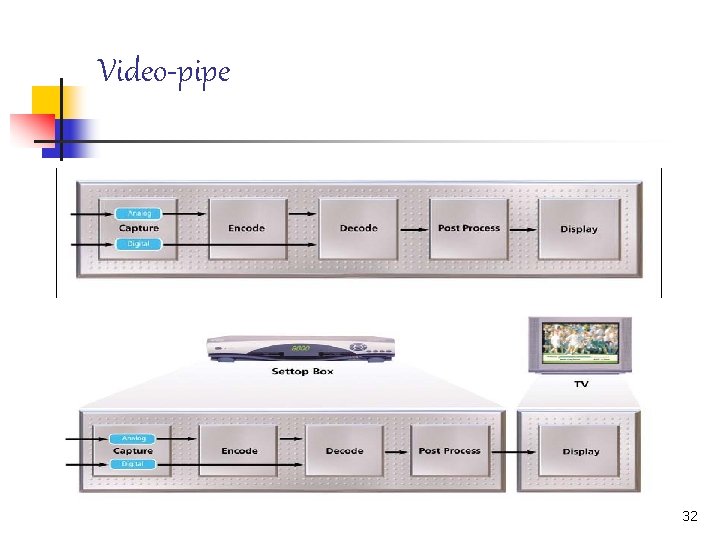
Video-pipe 32