
Digital Signal Processing compression linear and nonlinear terminology
- Slides: 46
Digital Signal Processing, compression, linear and nonlinear: terminology, measurement and issues. Richard Baker University of Manchester
Outline • • • A few common misconceptions What is signal processing? Advantages of going digital Analogue to digital conversion Compression – why and how? Measurement issues
Common Misconceptions • “Only digital hearing aids are signal processing aids” • “Digital is better than Analogue” • “Wide dynamic range compression (WDRC) = digital” • “Nonlinear = digital” • “Programmable hearing aids are the same as DSP hearing aids” • “Digital hearing aids cut out background noise”
What is signal processing? • Signal processing is exactly what it says, it may be: – Amplifying – Filtering – Peak-clipping – Compression: output limiting, WDRC, etc – Frequency shifting –… – etc.
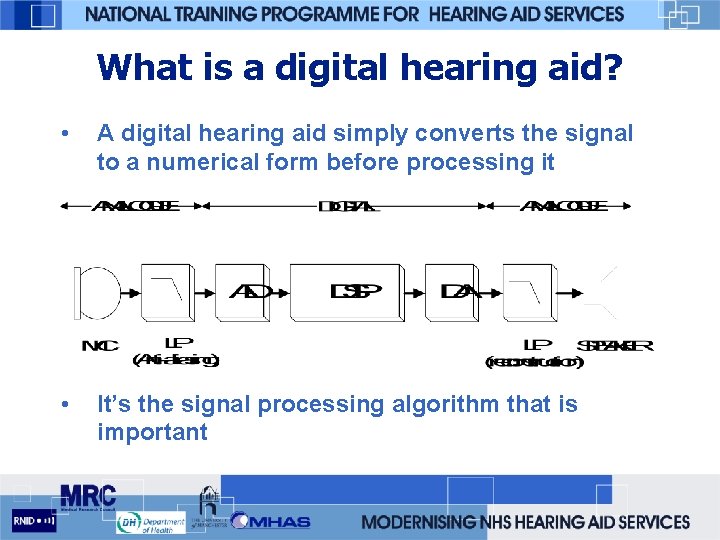
What is a digital hearing aid? • A digital hearing aid simply converts the signal to a numerical form before processing it • It’s the signal processing algorithm that is important
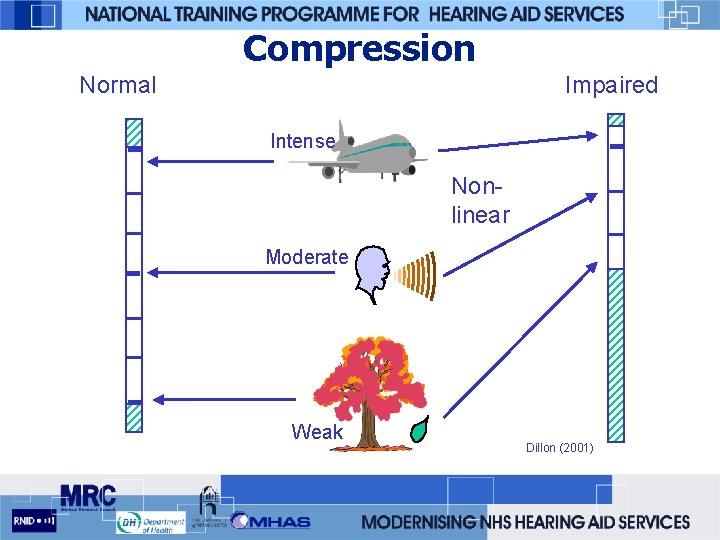
What is compression? • Compression: – the range of input sound intensities is “squashed” into a smaller range of output intensities – e. g. a range of input intensities from 0 to 100 d. B SPL may be compressed into an output range of 50 to 100 d. B SPL – The output “dynamic range” is reduced compared to that of the input
Why do we need compression? • Sensorineural hearing loss most often results from damage to outer hair cells in the cochlear • This results in: – Loss of sensitivity at low sound intensities – Abnormally rapid growth of loudness (recruitment) – Loss of frequency selectivity (Hearing aids can’t do much about this one at the moment)
Loudness Growth • Typically, sensorineural loss results in recruitment: – Low intensity sounds are inaudible – Moderate intensity sounds are heard as very quiet – High intensity sounds are perceived as similar in loudness to that normal hearing listener • Implications for hearing aids – High gain for low intensity input – Low gain for high intensity input – i. e. reduced dynamic range at output compared to input
Compression Normal Impaired Intense Nonlinear Moderate Weak Dillon (2001)
Hearing aid goals • Audibility - be able to hear important sounds e. g. speech • Comfort - sounds comfortably loud • Safety - sounds prevented from being too loud • Intelligibility - maximise the intelligibility of speech sounds • Quality - maximise the perceived quality of the sounds (e. g. little distortion) • Consistency - same performance regardless of listing conditions • . . . • The same aims apply to both linear and nonlinear aids
Linear versus nonlinear • Linear - gain is constant irrespective of input level (if we ignore very high levels) • Nonlinear - gain changes as input level changes (may be compression or expansion) • Remember, when talking in d. B terms: Output level = Input level + gain
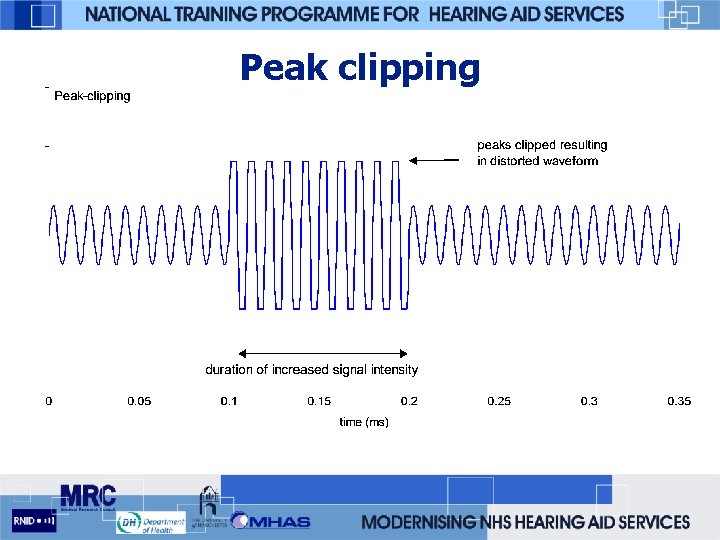
Linear hearing aids • Amplify all sounds by the same amount • Problem – louder sounds become too loud to be comfortable • Solution – use some type of limiting to prevent this • e. g. clip the peaks off the waveform when it goes too loud - peak clipping – causes distortion
Peak clipping
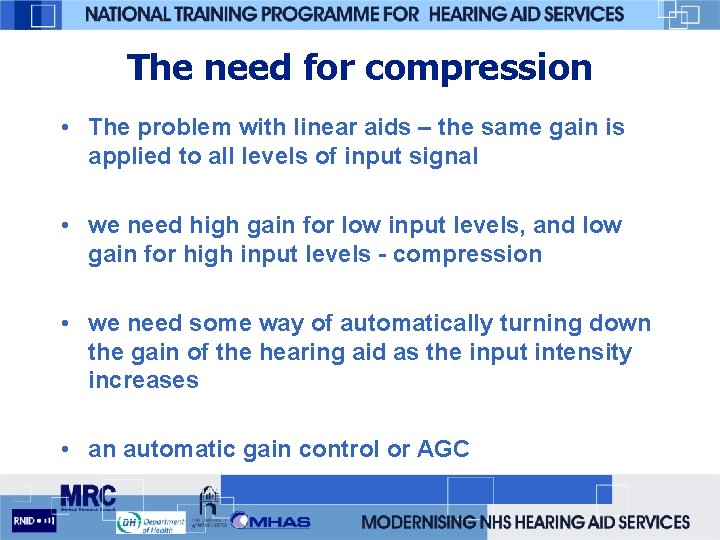
The need for compression • The problem with linear aids – the same gain is applied to all levels of input signal • we need high gain for low input levels, and low gain for high input levels - compression • we need some way of automatically turning down the gain of the hearing aid as the input intensity increases • an automatic gain control or AGC
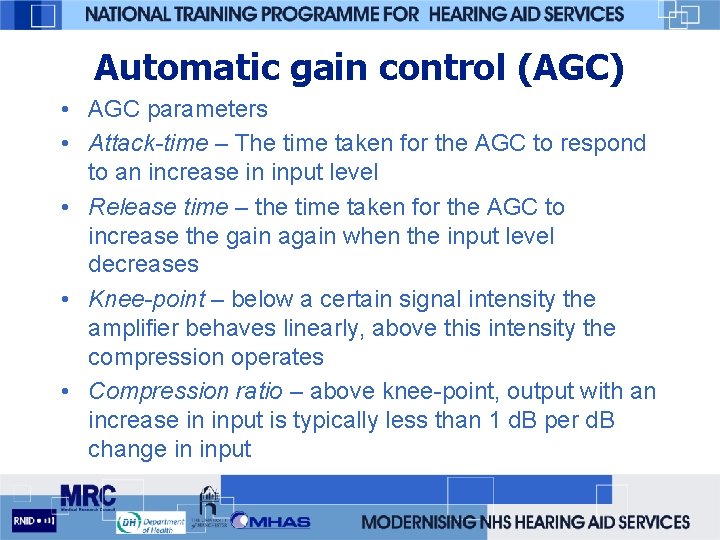
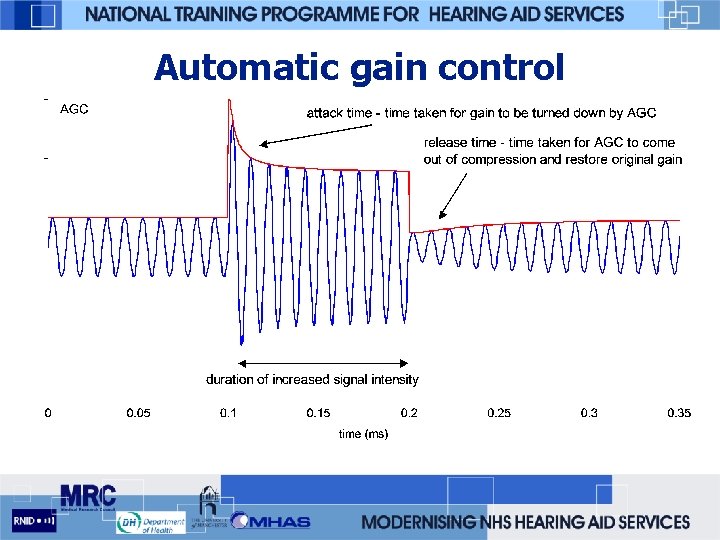
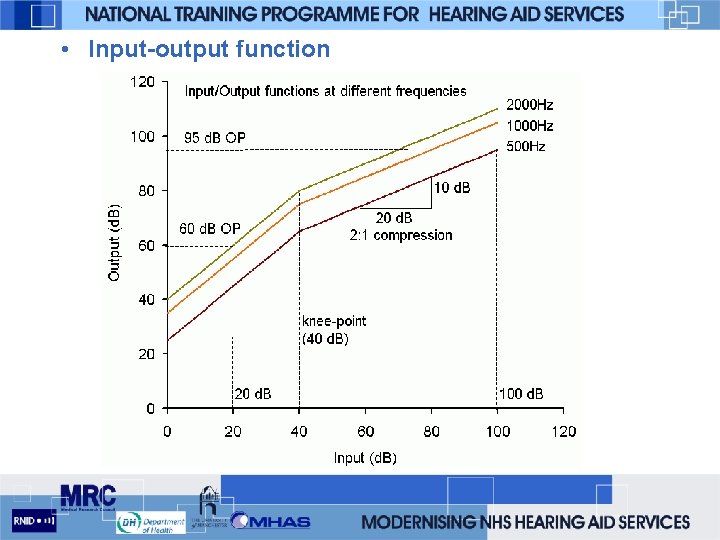
Automatic gain control (AGC) • AGC parameters • Attack-time – The time taken for the AGC to respond to an increase in input level • Release time – the time taken for the AGC to increase the gain again when the input level decreases • Knee-point – below a certain signal intensity the amplifier behaves linearly, above this intensity the compression operates • Compression ratio – above knee-point, output with an increase in input is typically less than 1 d. B per d. B change in input
Automatic gain control
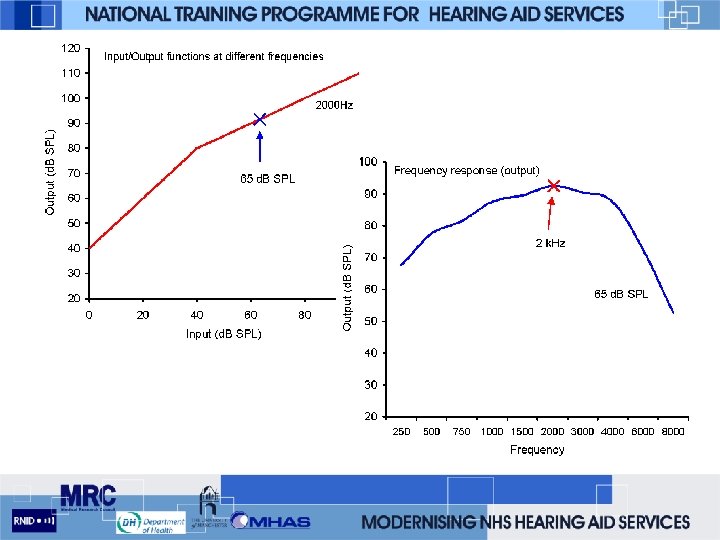
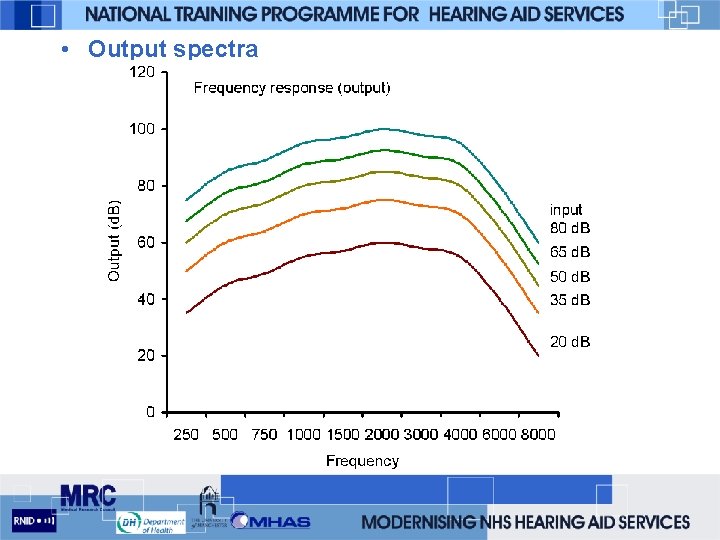
I/O functions, output spectra & transfer functions etc. • I/O functions - output vs input – at one frequency • Output spectra - output across frequency – at one input level • input/gain function - gain vs input – at one frequency • Transfer function - output/input (i. e. gain) across frequency – at one input level • All ways of plotting different aspects of hearing aid function
• Input-output function
• Output spectra
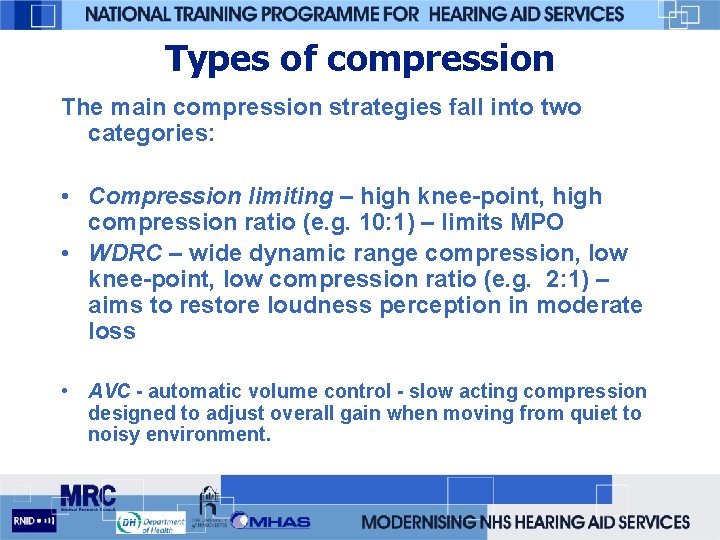
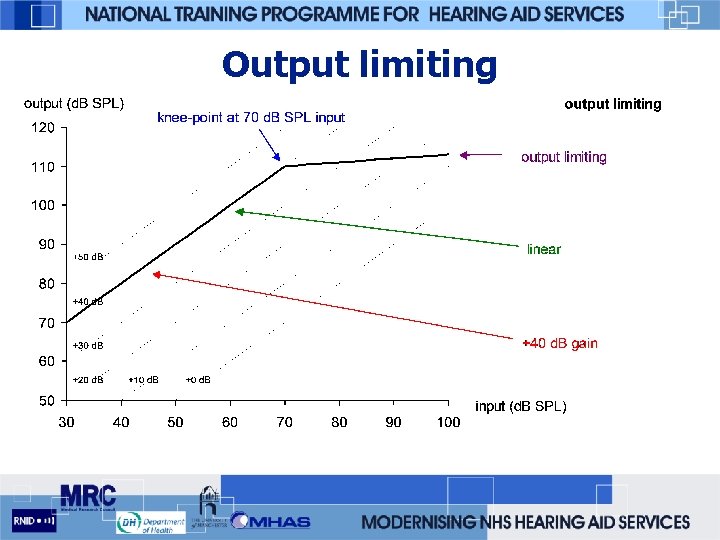
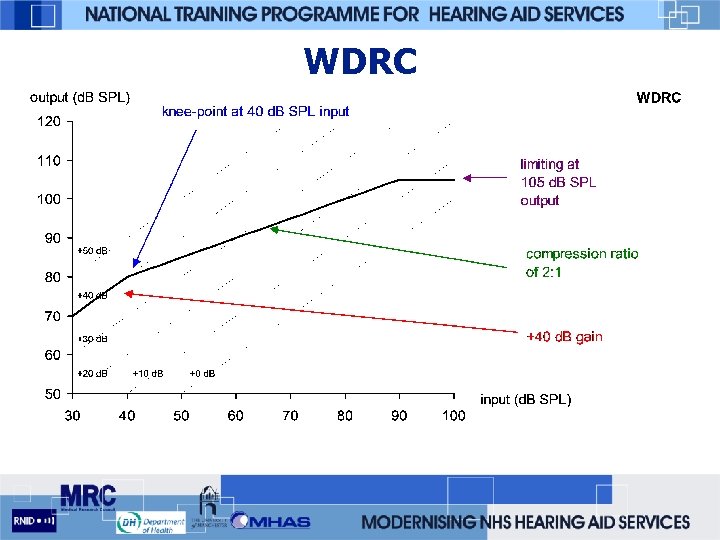
Types of compression The main compression strategies fall into two categories: • Compression limiting – high knee-point, high compression ratio (e. g. 10: 1) – limits MPO • WDRC – wide dynamic range compression, low knee-point, low compression ratio (e. g. 2: 1) – aims to restore loudness perception in moderate loss • AVC - automatic volume control - slow acting compression designed to adjust overall gain when moving from quiet to noisy environment.
Output limiting
WDRC
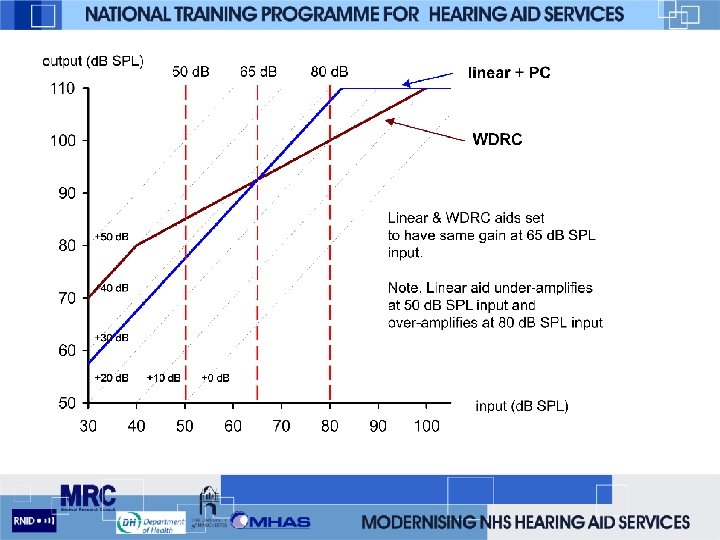
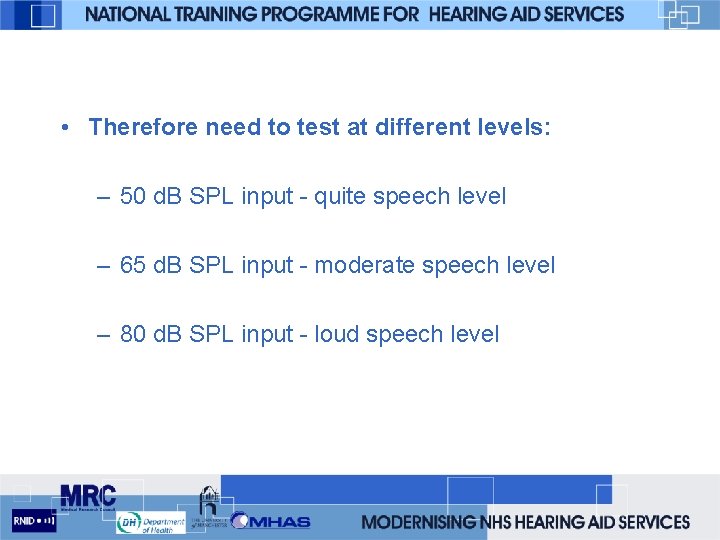
• Therefore need to test at different levels: – 50 d. B SPL input - quite speech level – 65 d. B SPL input - moderate speech level – 80 d. B SPL input - loud speech level
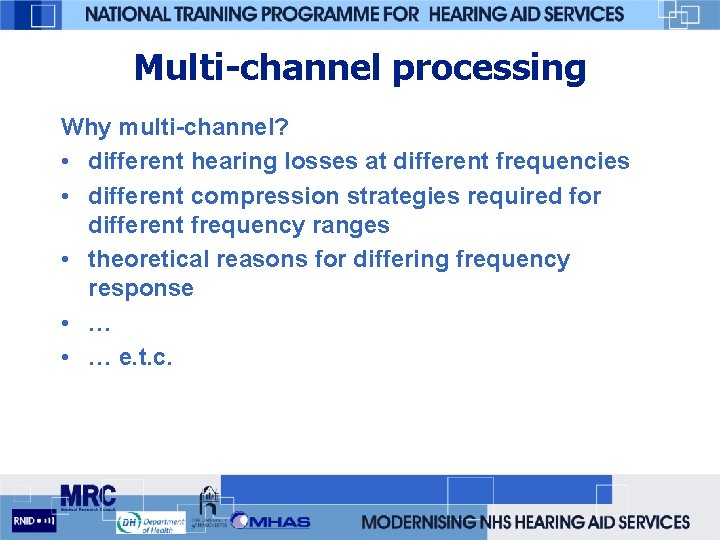
Multi-channel processing Why multi-channel? • different hearing losses at different frequencies • different compression strategies required for different frequency ranges • theoretical reasons for differing frequency response • … e. t. c.
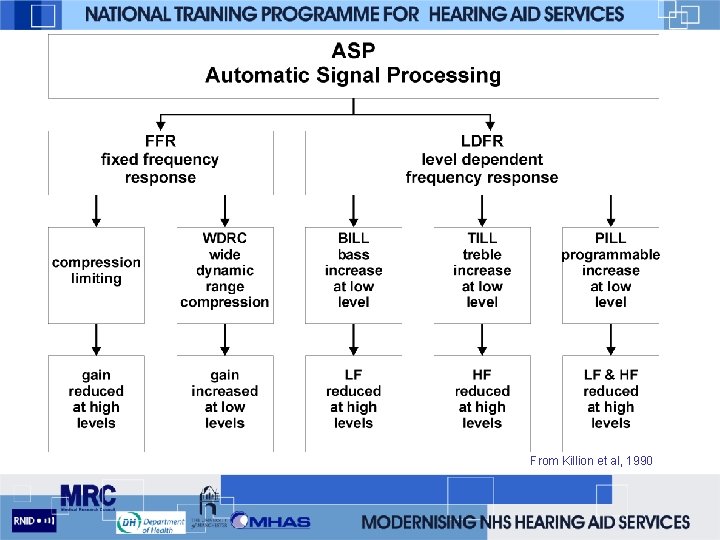
From Killion et al, 1990
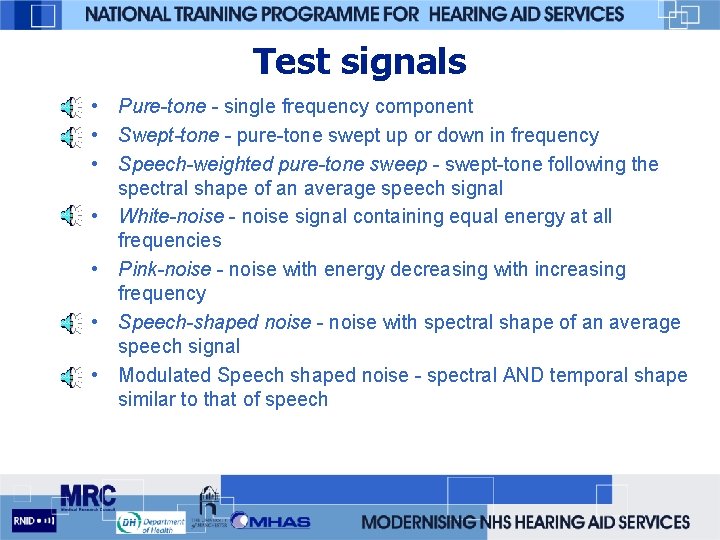
Test signals • Pure-tone - single frequency component • Swept-tone - pure-tone swept up or down in frequency • Speech-weighted pure-tone sweep - swept-tone following the spectral shape of an average speech signal • White-noise - noise signal containing equal energy at all frequencies • Pink-noise - noise with energy decreasing with increasing frequency • Speech-shaped noise - noise with spectral shape of an average speech signal • Modulated Speech shaped noise - spectral AND temporal shape similar to that of speech
Test signals • Test signals can be either: – Continuous - long(ish) duration with approximately constant amplitude – Fluctuating - varying up and down in amplitude (usually designed to mimic temporal fluctuations in natural speech) • Least natural: • Most natural: continuous pure-tone fluctuating speech shaped noise
Which signal to use? • With a linear aid pure-tone test signals should produce the same results as noise signals • With non-linear aids, the aid can respond very differently to different signals
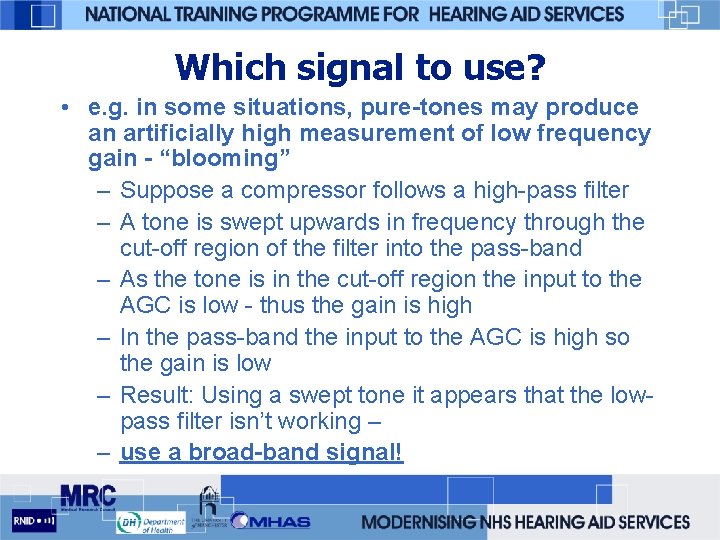
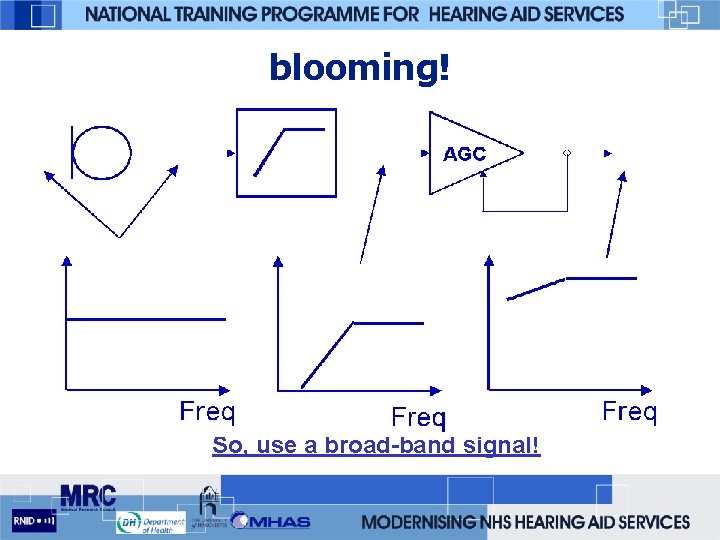
Which signal to use? • e. g. in some situations, pure-tones may produce an artificially high measurement of low frequency gain - “blooming” – Suppose a compressor follows a high-pass filter – A tone is swept upwards in frequency through the cut-off region of the filter into the pass-band – As the tone is in the cut-off region the input to the AGC is low - thus the gain is high – In the pass-band the input to the AGC is high so the gain is low – Result: Using a swept tone it appears that the lowpass filter isn’t working – – use a broad-band signal!
blooming! So, use a broad-band signal!
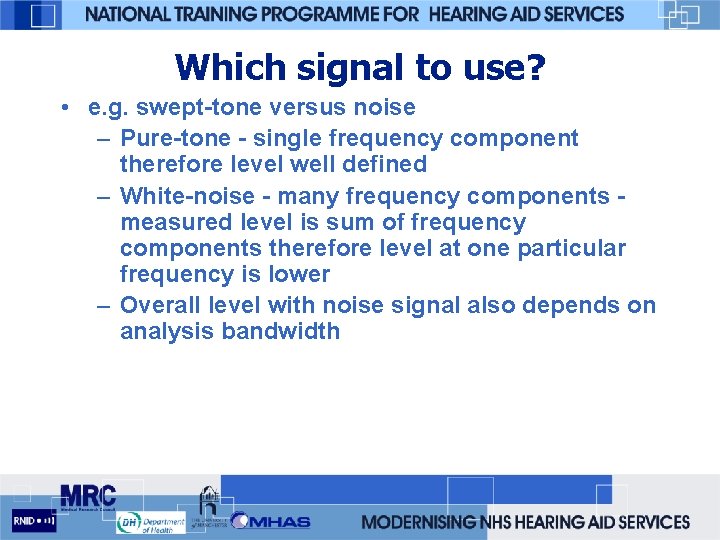
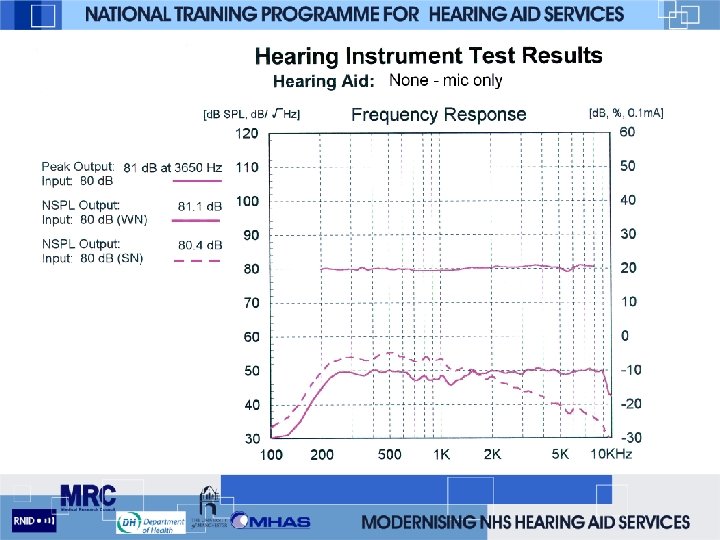
Which signal to use? • e. g. swept-tone versus noise – Pure-tone - single frequency component therefore level well defined – White-noise - many frequency components measured level is sum of frequency components therefore level at one particular frequency is lower – Overall level with noise signal also depends on analysis bandwidth
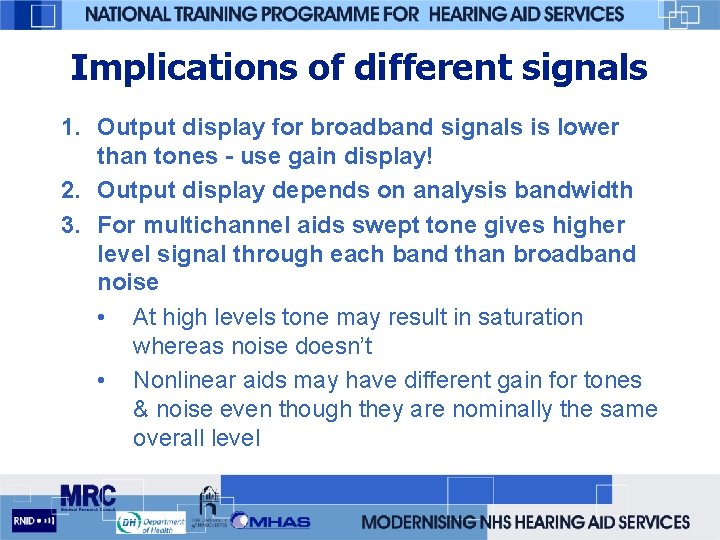
Implications of different signals 1. Output display for broadband signals is lower than tones - use gain display! 2. Output display depends on analysis bandwidth 3. For multichannel aids swept tone gives higher level signal through each band than broadband noise • At high levels tone may result in saturation whereas noise doesn’t • Nonlinear aids may have different gain for tones & noise even though they are nominally the same overall level
“extras” • As well as different signal processing strategies modern hearing aids are available with many “extras” designed to improve their performance • These also have implications for how the aids are tested and the signals used…
“extras” • Noise suppression/cancellation – Algorithms attempt to “detect presence of speech” and turn down the gain if no speech is present – Note • Need to use realistic speech like signal to perform measurements – continuous noise will be suppressed, so need to have speechshaped noise with fluctuating envelope (is such a signal available? ) • Turn the noise reduction feature off
“extras” • Multi-program/memory aids – Can allow 2 or more different processing algorithms to be used – E. g. a second setting with extra gain for bouts of OME – Note • Need to know what each of the memories are supposed to do in order to test aid
“extras” • Directional/Multi-Microphone technology – Aims to improve signal-noise ratio by “picking out” sounds from the front, and reducing those from other direction – Note • Need to be careful how aid is positioned in a test box to get accurate measurements • Turn the directional microphone off!
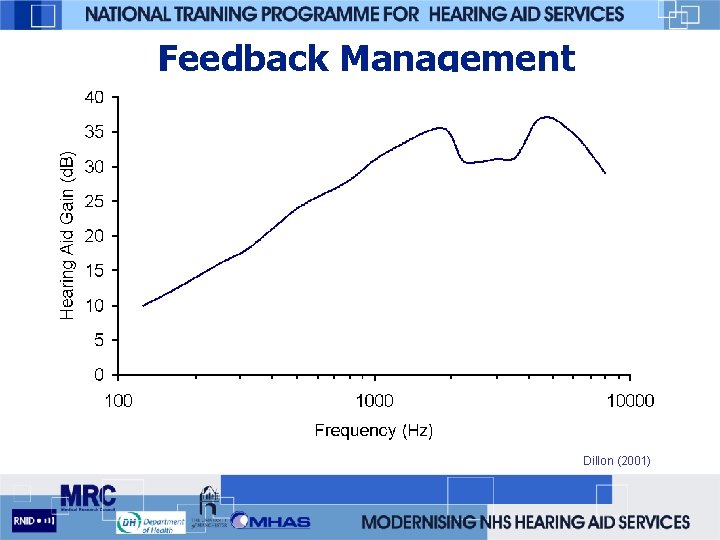
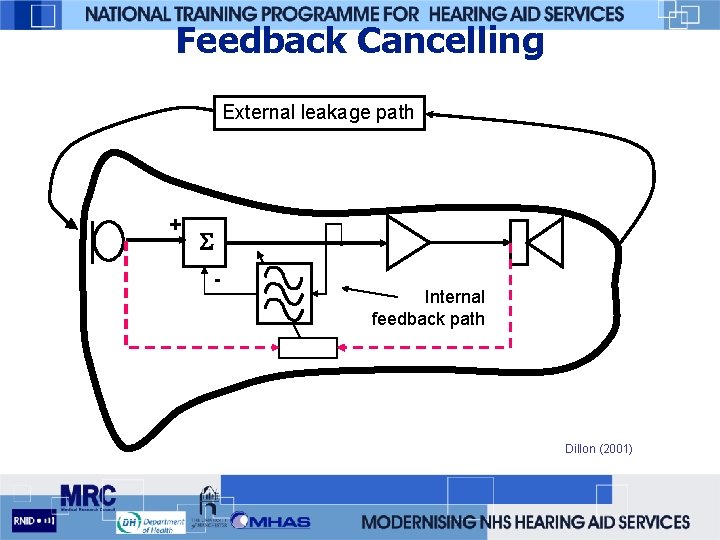
“extras” • Feedback management/cancellation – Notch-filters or complex feedback cancellation algorithms have been developed that can reduce feedback and allow 10 -20 d. B extra gain. – This can allow additional gain, use of vents where they are normally not possible etc. – Note: awareness of notch-filters is necessary & the feed-back suppression needs to be turned off for measurement purposes (is this possible for every situation? )
Feedback Management Dillon (2001)
Feedback Cancelling External leakage path + - Internal feedback path Dillon (2001)
Implications • conceptual complexity - difficult to understand what the aid is doing • complexity & adjustability - many different parameters to adjust to set up the aid • lack of user adjustability - some nonlinear aids have no volume control - WDRC, in theory, should do away for the need for it • test signal - need to chose the right test signal • lack of defined standards - no clearly defined standards for measuring nonlinear aids
Ideal vs reality for testing aids • Ideal situation: – full test-box & programming facility, ability to turn off “extras”, modulated speech-shaped noise as test signal • Likely situation for some (eg outreach or other services? ): – “old” test-box, no programming facility, can’t turn off “extras”, only continuous pure-tone or swept pure-tone available
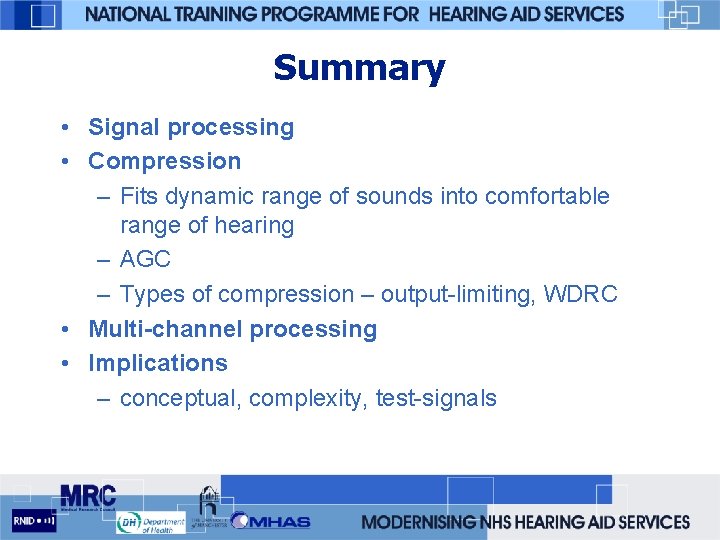
Summary • Signal processing • Compression – Fits dynamic range of sounds into comfortable range of hearing – AGC – Types of compression – output-limiting, WDRC • Multi-channel processing • Implications – conceptual, complexity, test-signals
• • References – Dillon, H. (2001) Hearing Aids, Thieme – Sandlin, R. E. (2000) Hearing Aid Amplification, Singular – Vonlanthen, A. (2000) Hearing Instrument Technonogy, Singular – Venema, T. (1998) Compression for Clinicians, Singular – Killion, M. C. , Staab, W. & Preeves, D. (1990) Classifying automatic signal processors. Hearing Instruments, 41(8), 24 -26 – Seewald, R. C (2001), A Sound Foundation Through Early Amplification 2000, Phonak AG, ISBN: 3 -9522009 -0 -5 – Seewald, R. C. & Gravel, J. C. (2002), A Sound Foundation Through Early Amplification 2001, Phonak AG, ISBN: 3 -9522009 -1 -3 Standards – BS EN 61669: 2001 Electroacoustics – Equipment for the measurement of real-ear acoustical characteristics of hearing aids – BS ISO 12124: 2001 Acoustics – Procedures for the measurement of realear acoustical characteristics of hearing aids