
Digital Signal Image Processing Lecture7 Dr Muhammad Arif

- Slides: 33
Digital Signal & Image Processing Lecture-7 Dr Muhammad Arif m. arif@faculty. muet. edu. pk https: //sites. google. com/site/mdotarif/teaching/dsip
Overview • • • Realization of Digital Systems Direct-form I Realization Direct-form II Realization Cascade or Series Realization Parallel Realization
Realization of Digital Systems • A realization is a hardware or software configuration that implements the system. • Digital filters described by the transfer function �� (�� ) may be generally realized into the following forms: Ø Direct-form II ØCascade or Series Ø Parallel • There are other forms of realizations such as lattice, however in this course we will only study above mentioned realizations. 3
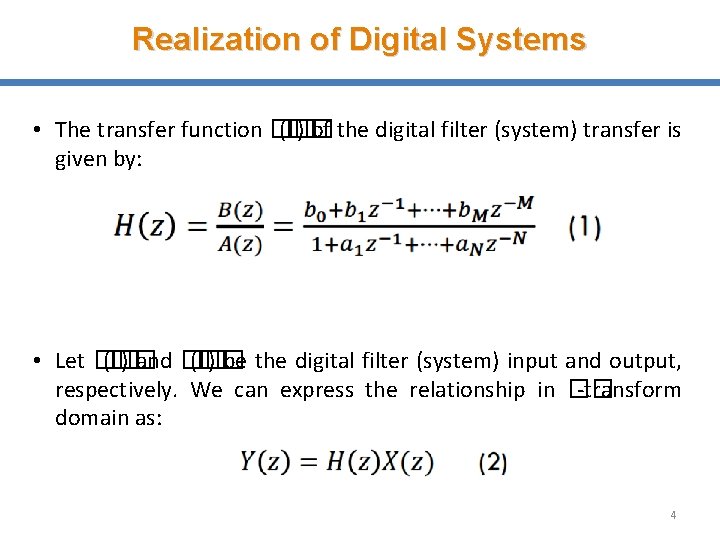
Realization of Digital Systems • The transfer function �� (�� ) of the digital filter (system) transfer is given by: • Let �� (�� ) and �� (�� ) be the digital filter (system) input and output, respectively. We can express the relationship in �� -transform domain as: 4
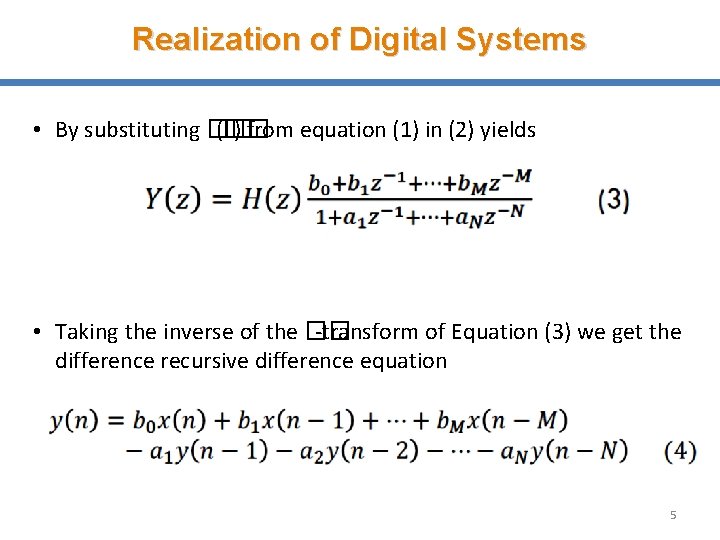
Realization of Digital Systems • By substituting �� (�� ) from equation (1) in (2) yields • Taking the inverse of the �� -transform of Equation (3) we get the difference recursive difference equation 5
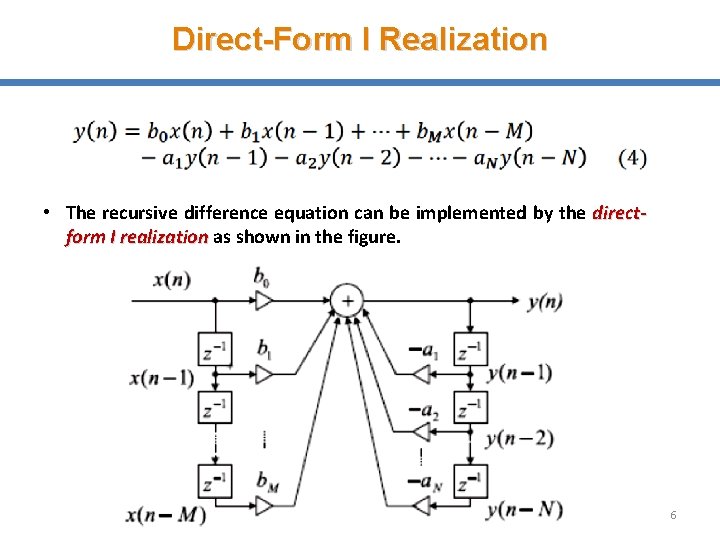
Direct-Form I Realization • The recursive difference equation can be implemented by the directform I realization as shown in the figure. 6
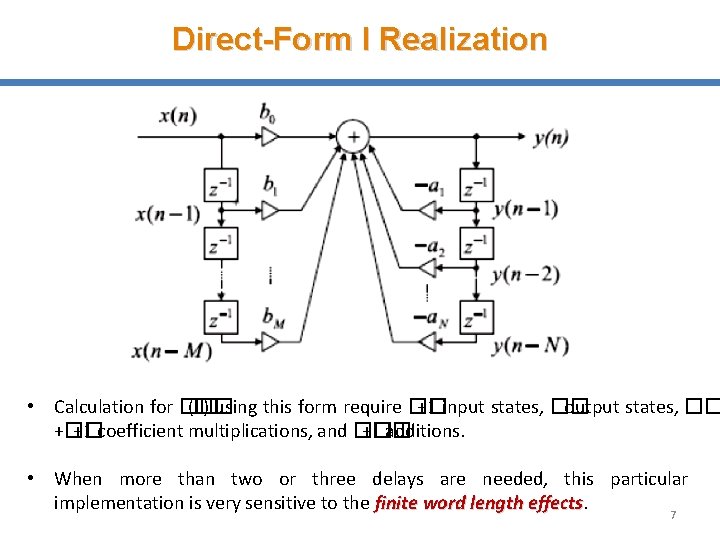
Direct-Form I Realization • Calculation for �� (�� ) using this form require �� +1 input states, �� output states, �� +1 coefficient multiplications, and �� +�� additions. • When more than two or three delays are needed, this particular implementation is very sensitive to the finite word length effects 7
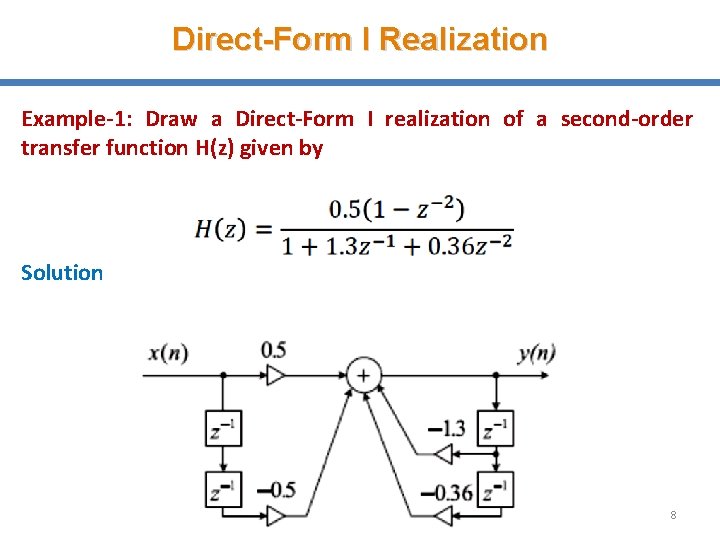
Direct-Form I Realization Example-1: Draw a Direct-Form I realization of a second-order transfer function H(z) given by Solution 8
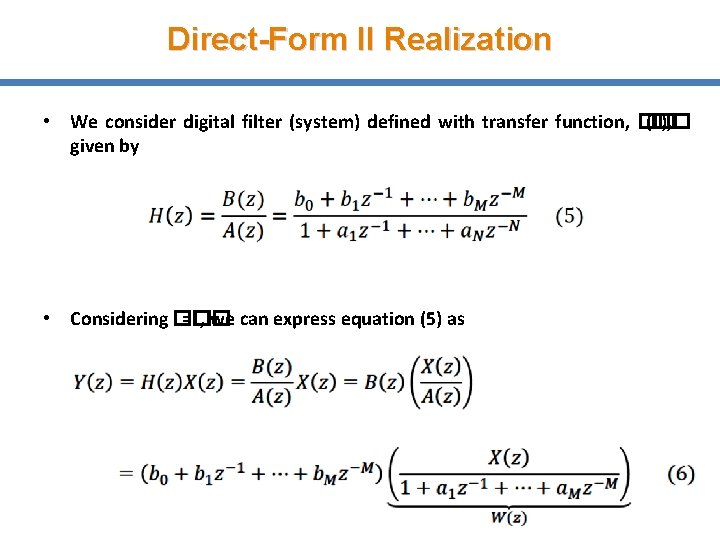
Direct-Form II Realization • We consider digital filter (system) defined with transfer function, �� (�� ), given by • Considering �� =�� , we can express equation (5) as 9
Direct-Form II Realization 10
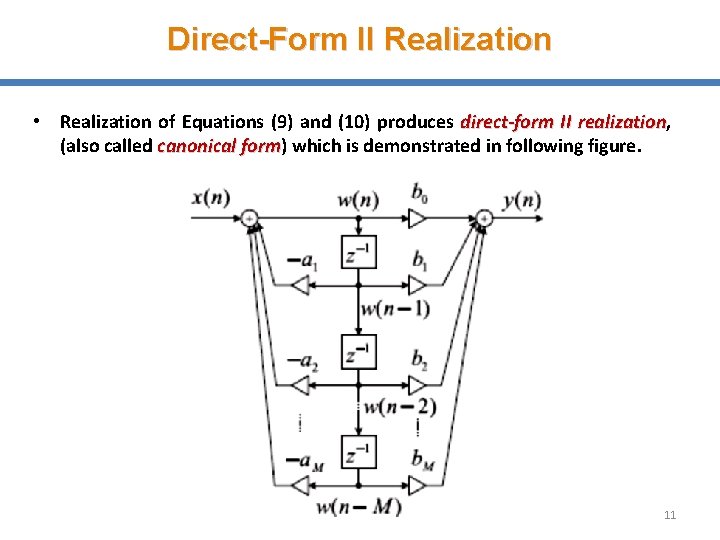
Direct-Form II Realization • Realization of Equations (9) and (10) produces direct-form II realization, realization (also called canonical form) form which is demonstrated in following figure. 11
Direct-Form II Realization • Much less storage is needed if a direct form II realization is used. • This realization requires the use of an intermediate signal �� (�� ) that records salient information about the history of the filter in place of past inputs and past outputs. • Instead of �� past outputs and �� past inputs, only max(�� , �� ) samples of the intermediate signal need to be remembered to produce the new filter outputs. • Calculation for �� (�� ) using this implementation require max(�� , �� )+1 intermediate states, �� +1 coefficient multiplications, and �� +�� additions. 12
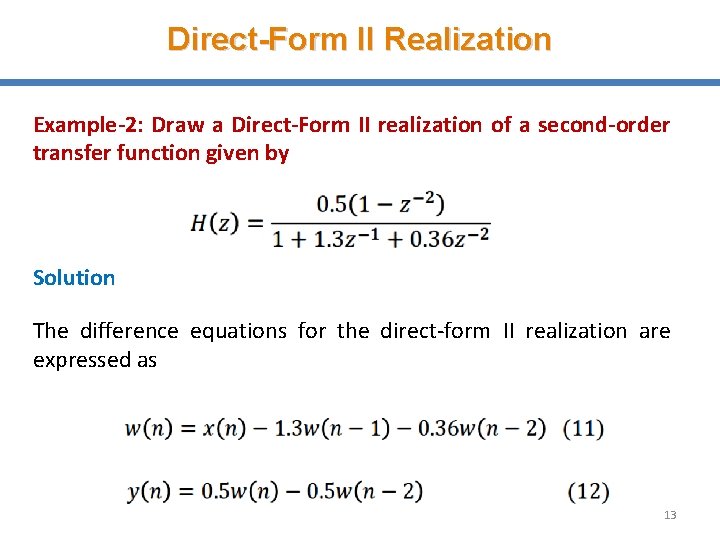
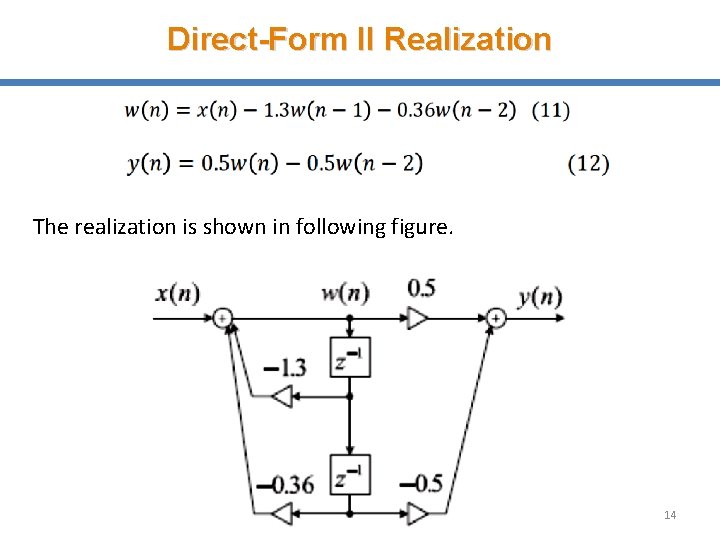
Direct-Form II Realization Example-2: Draw a Direct-Form II realization of a second-order transfer function given by Solution The difference equations for the direct-form II realization are expressed as 13
Direct-Form II Realization The realization is shown in following figure. 14
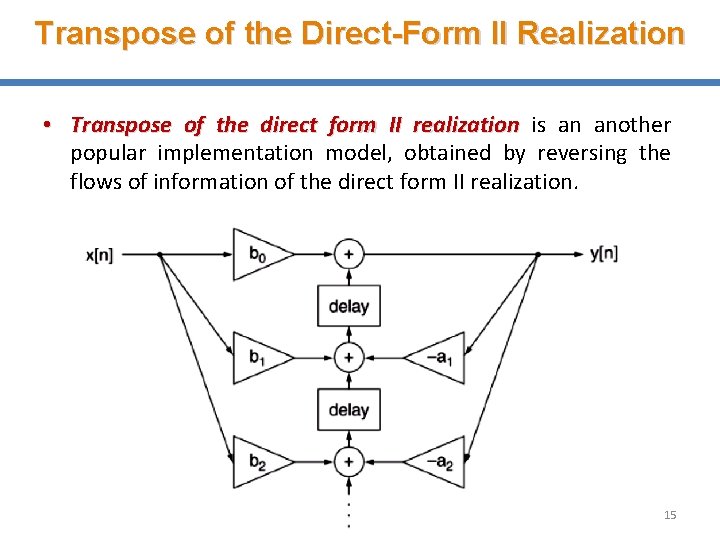
Transpose of the Direct-Form II Realization • Transpose of the direct form II realization is an another popular implementation model, obtained by reversing the flows of information of the direct form II realization. 15
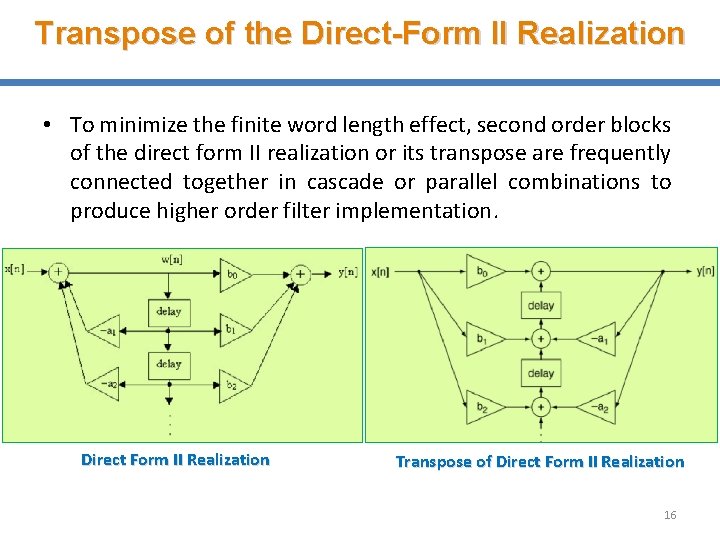
Transpose of the Direct-Form II Realization • To minimize the finite word length effect, second order blocks of the direct form II realization or its transpose are frequently connected together in cascade or parallel combinations to produce higher order filter implementation. Direct Form II Realization Transpose of Direct Form II Realization 16
Cascade (Series) Realization 17
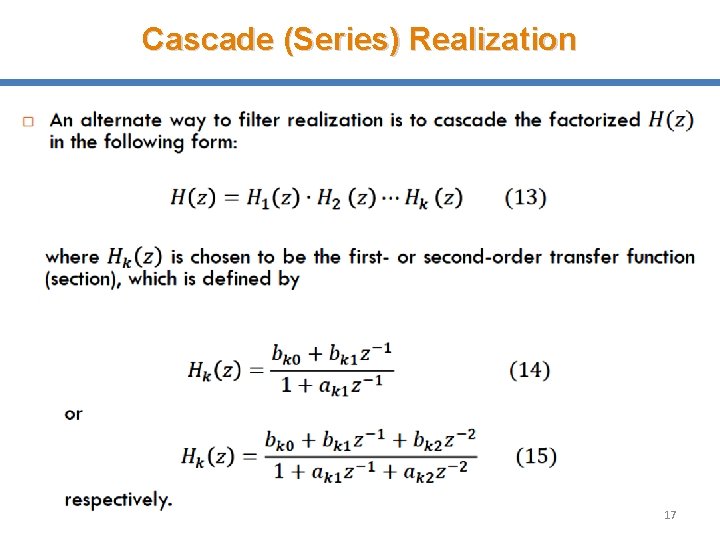
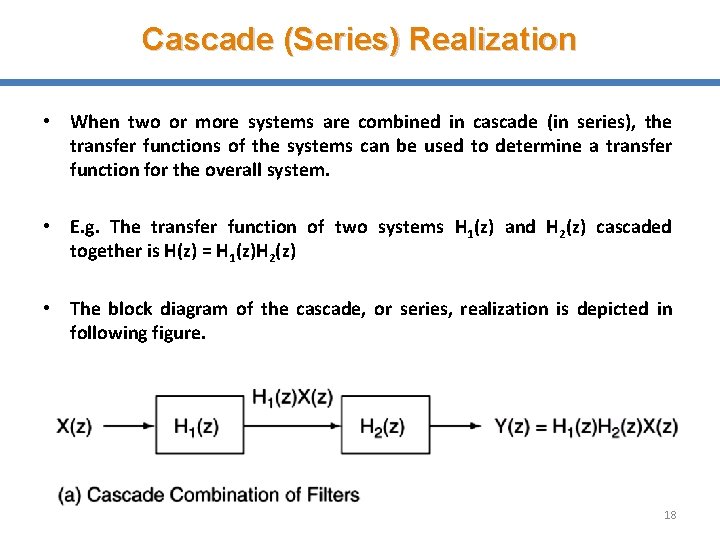
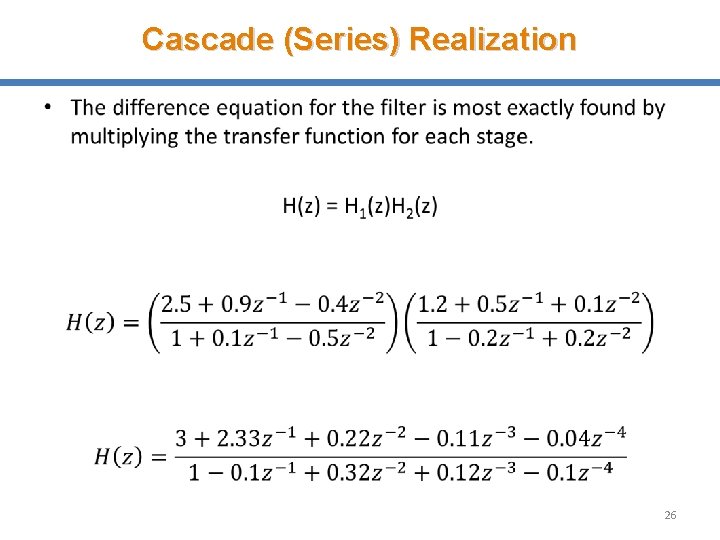
Cascade (Series) Realization • When two or more systems are combined in cascade (in series), the transfer functions of the systems can be used to determine a transfer function for the overall system. • E. g. The transfer function of two systems H 1(z) and H 2(z) cascaded together is H(z) = H 1(z)H 2(z) • The block diagram of the cascade, or series, realization is depicted in following figure. 18
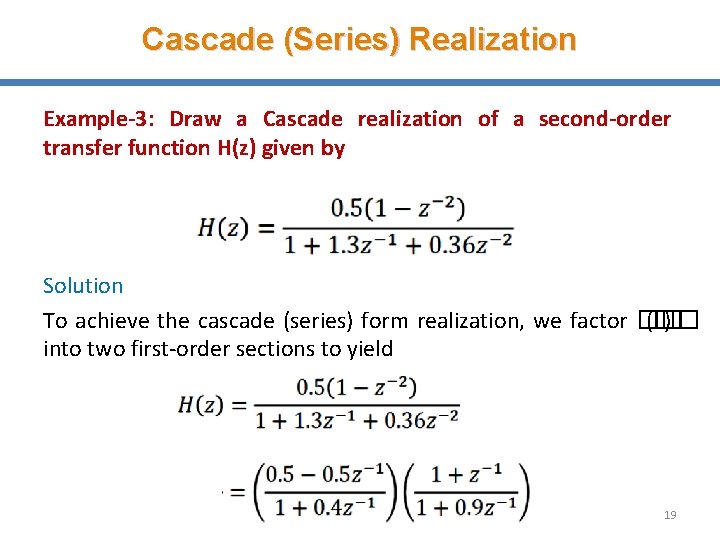
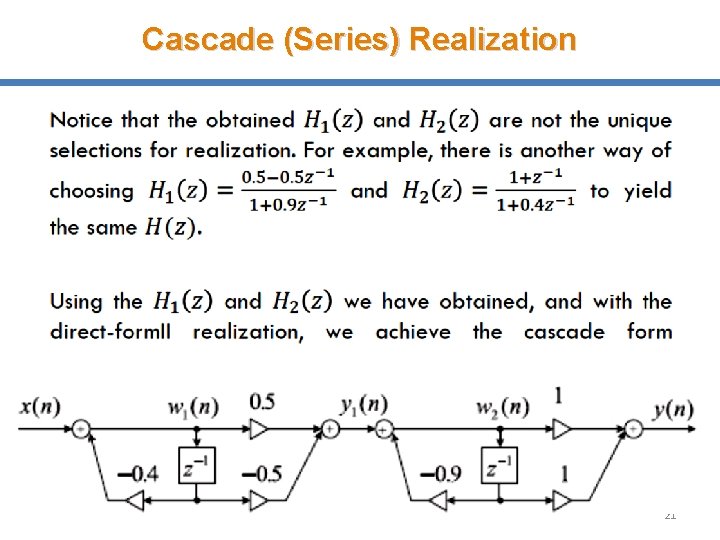
Cascade (Series) Realization Example-3: Draw a Cascade realization of a second-order transfer function H(z) given by Solution To achieve the cascade (series) form realization, we factor �� (�� ) into two first-order sections to yield 19
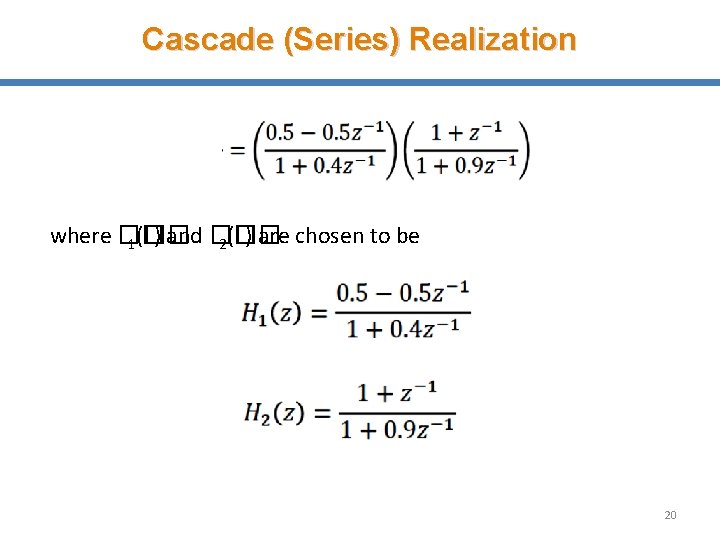
Cascade (Series) Realization where �� ) and �� ) are chosen to be 1(�� 20
Cascade (Series) Realization 21
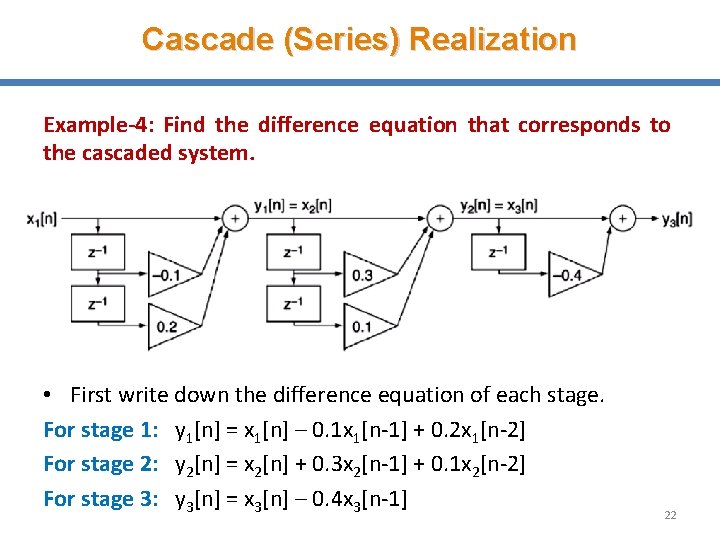
Cascade (Series) Realization Example-4: Find the difference equation that corresponds to the cascaded system. • First write down the difference equation of each stage. For stage 1: y 1[n] = x 1[n] – 0. 1 x 1[n-1] + 0. 2 x 1[n-2] For stage 2: y 2[n] = x 2[n] + 0. 3 x 2[n-1] + 0. 1 x 2[n-2] For stage 3: y 3[n] = x 3[n] – 0. 4 x 3[n-1] 22
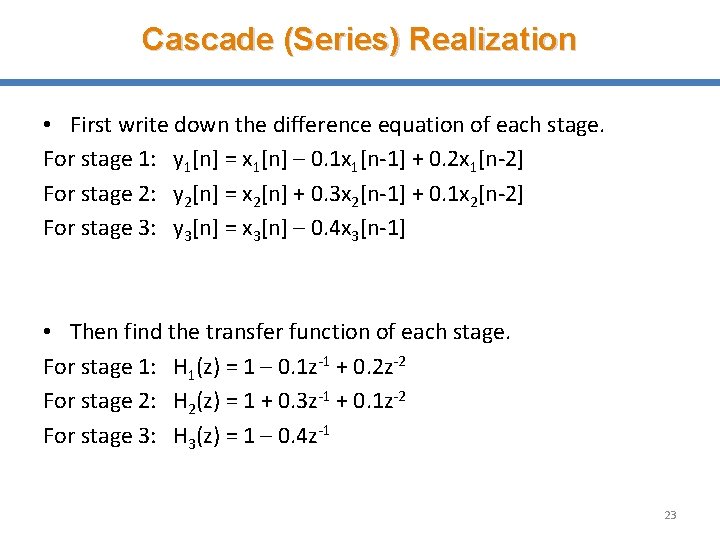
Cascade (Series) Realization • First write down the difference equation of each stage. For stage 1: y 1[n] = x 1[n] – 0. 1 x 1[n-1] + 0. 2 x 1[n-2] For stage 2: y 2[n] = x 2[n] + 0. 3 x 2[n-1] + 0. 1 x 2[n-2] For stage 3: y 3[n] = x 3[n] – 0. 4 x 3[n-1] • Then find the transfer function of each stage. For stage 1: H 1(z) = 1 – 0. 1 z-1 + 0. 2 z-2 For stage 2: H 2(z) = 1 + 0. 3 z-1 + 0. 1 z-2 For stage 3: H 3(z) = 1 – 0. 4 z-1 23
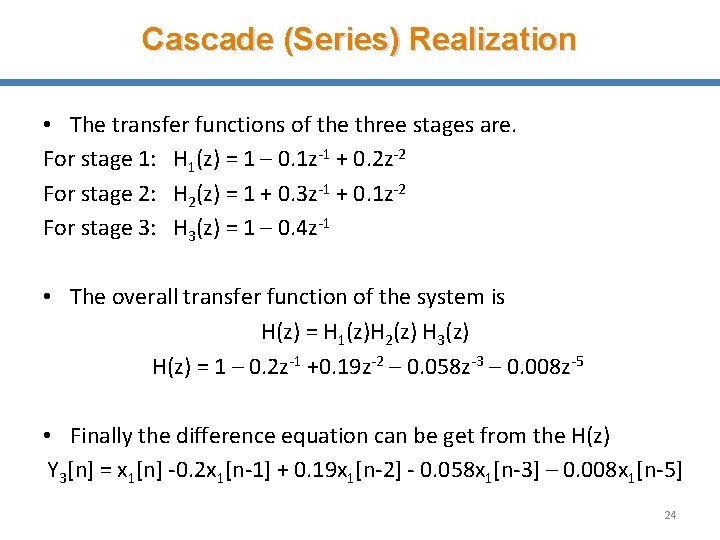
Cascade (Series) Realization • The transfer functions of the three stages are. For stage 1: H 1(z) = 1 – 0. 1 z-1 + 0. 2 z-2 For stage 2: H 2(z) = 1 + 0. 3 z-1 + 0. 1 z-2 For stage 3: H 3(z) = 1 – 0. 4 z-1 • The overall transfer function of the system is H(z) = H 1(z)H 2(z) H 3(z) H(z) = 1 – 0. 2 z-1 +0. 19 z-2 – 0. 058 z-3 – 0. 008 z-5 • Finally the difference equation can be get from the H(z) Y 3[n] = x 1[n] -0. 2 x 1[n-1] + 0. 19 x 1[n-2] - 0. 058 x 1[n-3] – 0. 008 x 1[n-5] 24
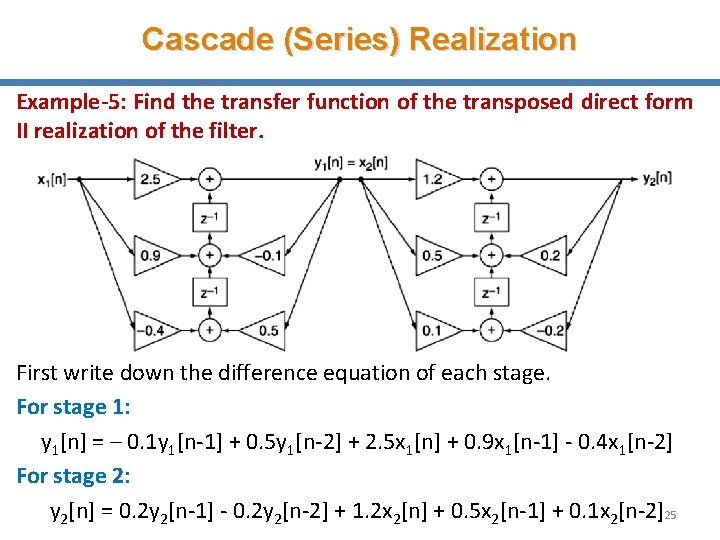
Cascade (Series) Realization Example-5: Find the transfer function of the transposed direct form II realization of the filter. First write down the difference equation of each stage. For stage 1: y 1[n] = – 0. 1 y 1[n-1] + 0. 5 y 1[n-2] + 2. 5 x 1[n] + 0. 9 x 1[n-1] - 0. 4 x 1[n-2] For stage 2: y 2[n] = 0. 2 y 2[n-1] - 0. 2 y 2[n-2] + 1. 2 x 2[n] + 0. 5 x 2[n-1] + 0. 1 x 2[n-2]25
Cascade (Series) Realization • 26
Parallel Realization 27
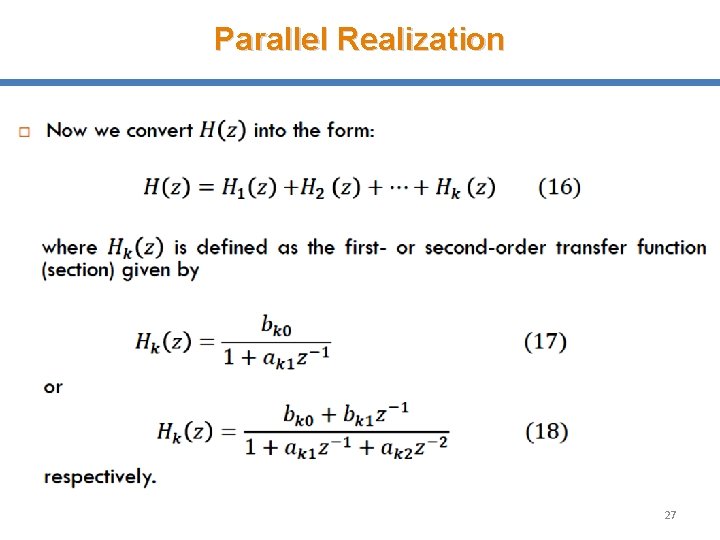
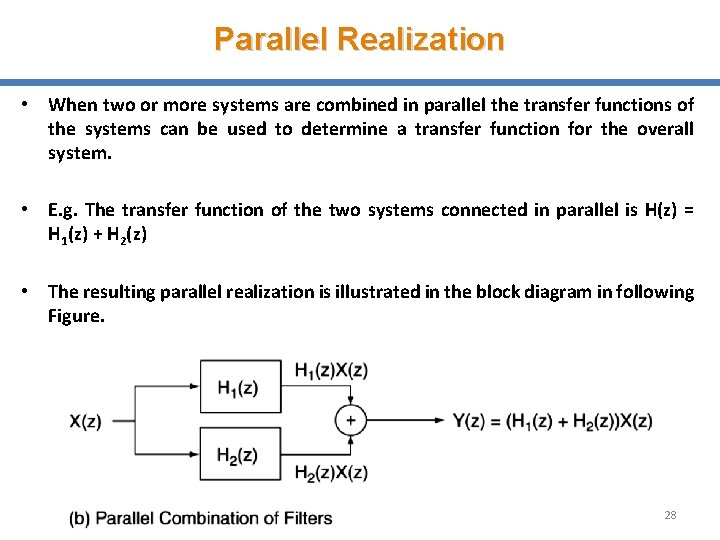
Parallel Realization • When two or more systems are combined in parallel the transfer functions of the systems can be used to determine a transfer function for the overall system. • E. g. The transfer function of the two systems connected in parallel is H(z) = H 1(z) + H 2(z) • The resulting parallel realization is illustrated in the block diagram in following Figure. 28
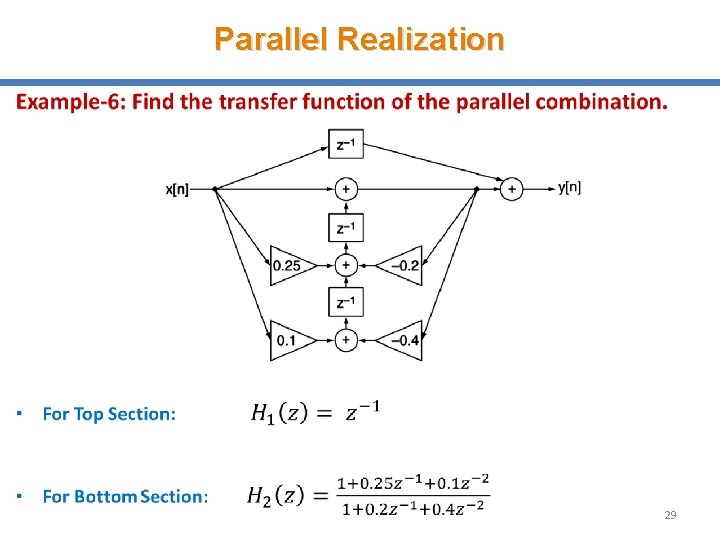
Parallel Realization • 29
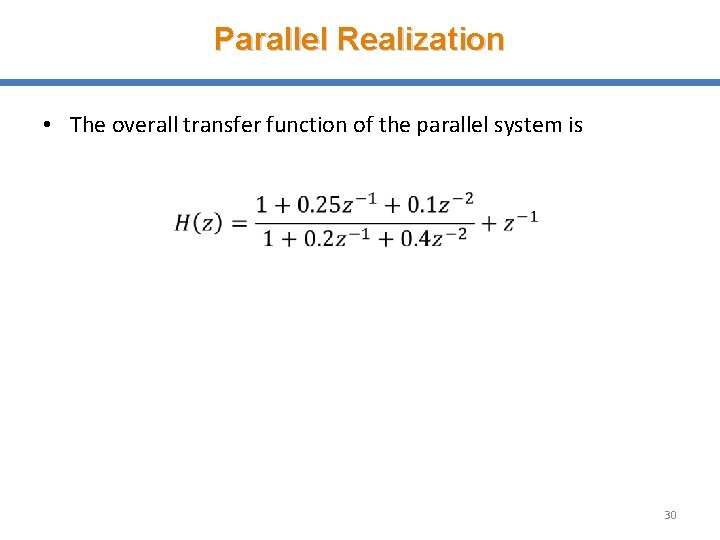
Parallel Realization • The overall transfer function of the parallel system is 30
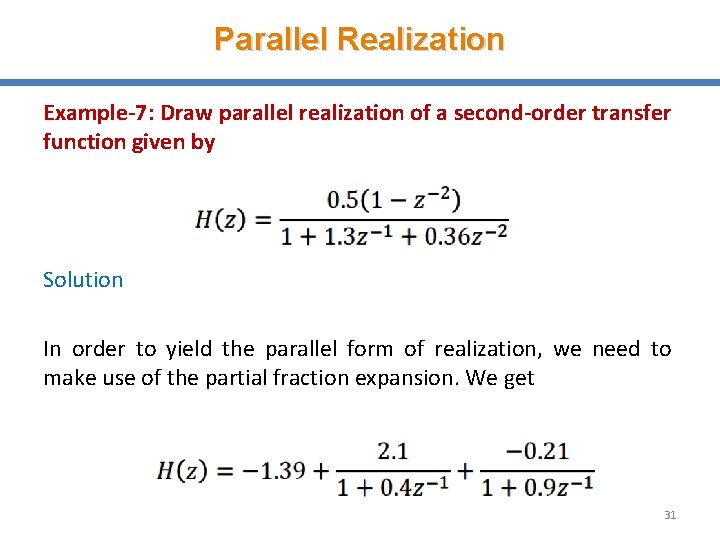
Parallel Realization Example-7: Draw parallel realization of a second-order transfer function given by Solution In order to yield the parallel form of realization, we need to make use of the partial fraction expansion. We get 31
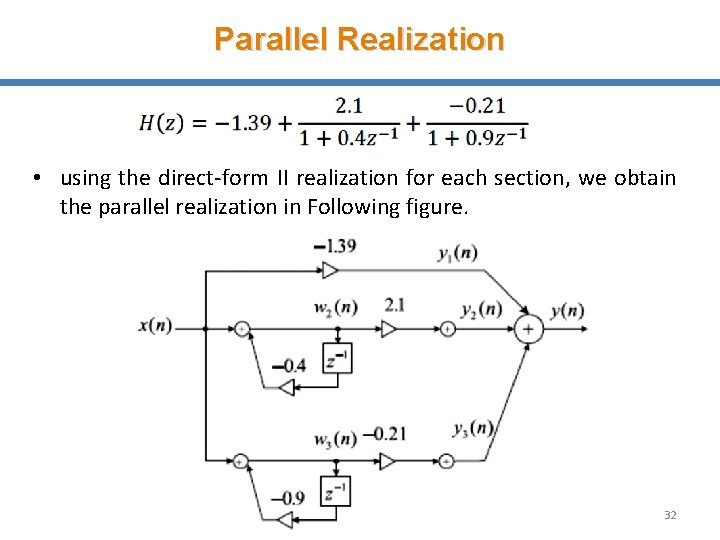
Parallel Realization • using the direct-form II realization for each section, we obtain the parallel realization in Following figure. 32
Realization of Digital Systems • In practice, the second-order filter module with the directform I or direct-form II realization is used. • The high-order filter can be factored in the cascade form with the first- or second-order sections. • In cases where the first order-filter is required, we can still modify the second-order filter module by setting the corresponding filter coefficients to be zero. 33