
DIGITAL SEMIOTICS Roberta Iadevaia INDEX INTRODUCTION What is
DIGITAL SEMIOTICS Roberta Iadevaia
INDEX INTRODUCTION • What is Semiotics and what is it for • Different notions of sign: Ferdinand de Saussure's Structural Semiotics Charles Peirce's Unlimited Semiosis Umberto Eco's Interpretive Semiotics Jean-Marie Klinkenberg's Cognitive Semiotics
INDEX EXAMPLES Concrete Poetry Eugen Gomringer: Schweigen • Animated Poetry Bp. Nichol: First Screening • • Codeworks Videoclip Grandaddy: Jed's Other Poem (Beautiful Ground) •
INDEX PLAN OF THE CONTENT • Jacques Fontanille's Generative Path of The Expression (level of practices) • Algirdas Julien Greimas's Semiotic Square • Algirdas Julien Greimas's Actantial Model • • Alexander Galloway's Regimes of Signification of The Interfaces Alexandra Saemmer's Interfacial Media Figures
INTRODUCTION WHAT IS SEMIOTICS? • • Semiotics is the discipline that studies signs and the way they make sense (signification) Thus semiotics is the study of sign process (semiosis) WHAT IS IT FOR? • To analyze content, form and expression of every product composed of signs (books, films, web interfaces, works of electronic literature. . . )
DIFFERENT NOTIONS OF SIGN IN GENERAL • • The sign is “something that refers to something else, to someone in some way” * The sign is a discrete unit of meaning: a system composed of different elements *M. Danesi, P. Perron, Analyzing Cultures: An Introduction and Handbook, Indiana University Press, Bloomington 1999
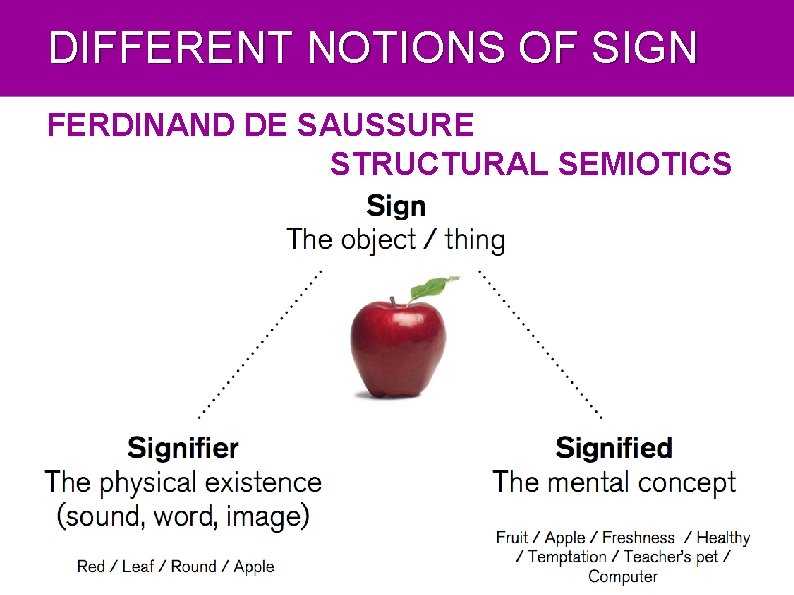
DIFFERENT NOTIONS OF SIGN FERDINAND DE SAUSSURE STRUCTURAL SEMIOTICS
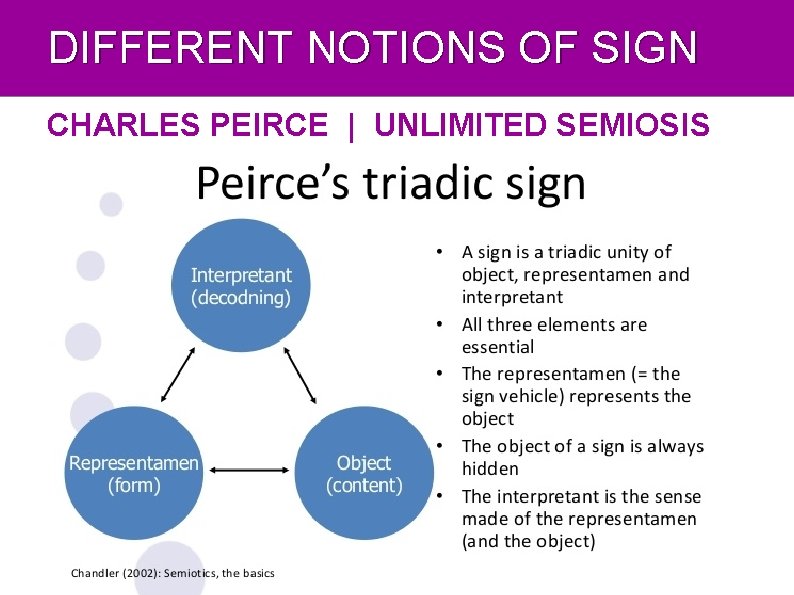
DIFFERENT NOTIONS OF SIGN CHARLES PEIRCE | UNLIMITED SEMIOSIS
DIFFERENT NOTIONS OF SIGN UMBERTO ECO | INTERPRETIVE SEMIOTICS • • Interpretive Semiotics questions ontological Structuralism The construction of the meaning is played within the dialectical process activating between the rhetorical-textual structures and the reader's interpretation strategies (“principle of interpretative cooperation” >> Lector in fabula)
DIFFERENT NOTIONS OF SIGN A CLARIFICATION. THE NOTION OF “TEXT” IN SEMIOTICS • • TEXT >> any semiotic object with a particular structure aiming to obtain a particular series of communicative purposes Text can consist of different media forms (visual text, audiovisual text. . . )
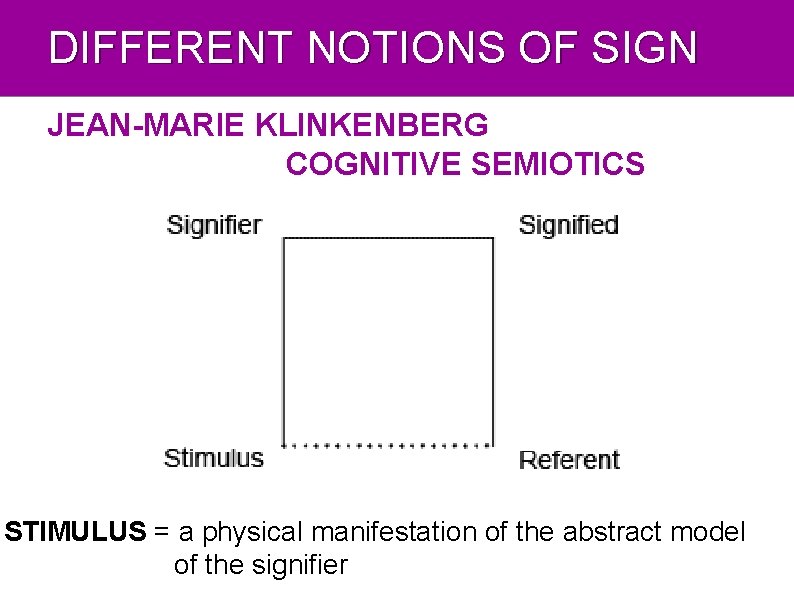
DIFFERENT NOTIONS OF SIGN JEAN-MARIE KLINKENBERG COGNITIVE SEMIOTICS STIMULUS = a physical manifestation of the abstract model of the signifier
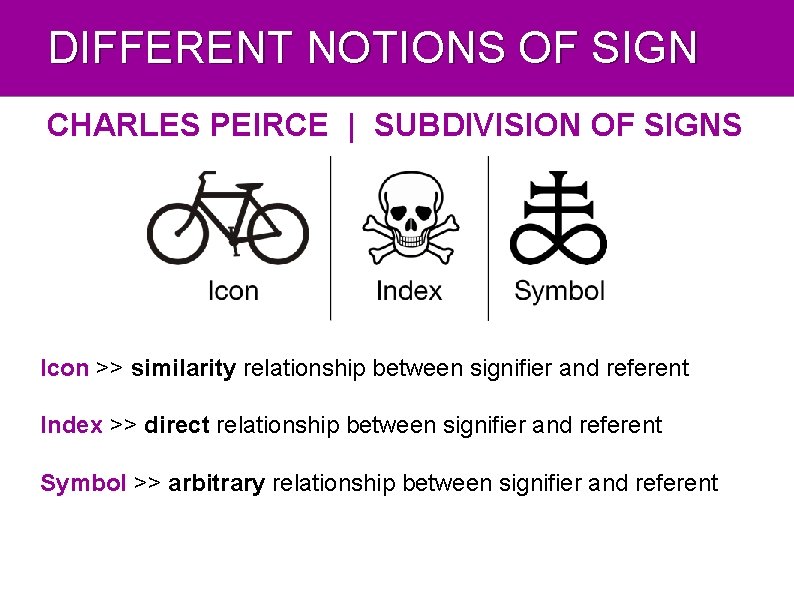
DIFFERENT NOTIONS OF SIGN CHARLES PEIRCE | SUBDIVISION OF SIGNS Icon >> similarity relationship between signifier and referent Index >> direct relationship between signifier and referent Symbol >> arbitrary relationship between signifier and referent
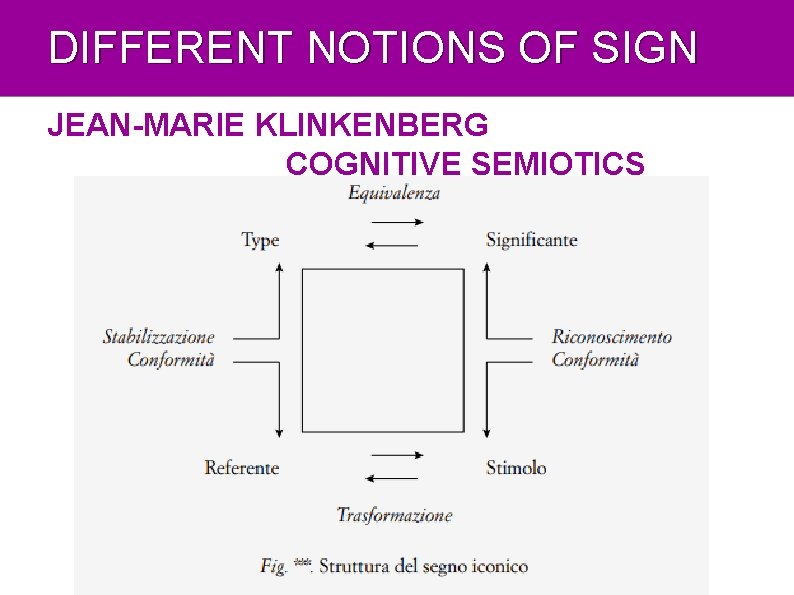
DIFFERENT NOTIONS OF SIGN JEAN-MARIE KLINKENBERG COGNITIVE SEMIOTICS
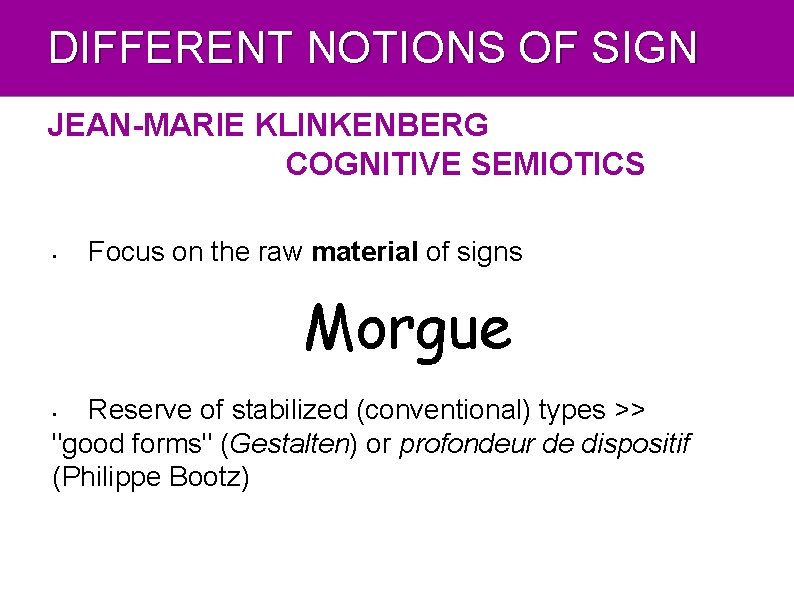
DIFFERENT NOTIONS OF SIGN JEAN-MARIE KLINKENBERG COGNITIVE SEMIOTICS • Focus on the raw material of signs Morgue Reserve of stabilized (conventional) types >> "good forms" (Gestalten) or profondeur de dispositif (Philippe Bootz) •
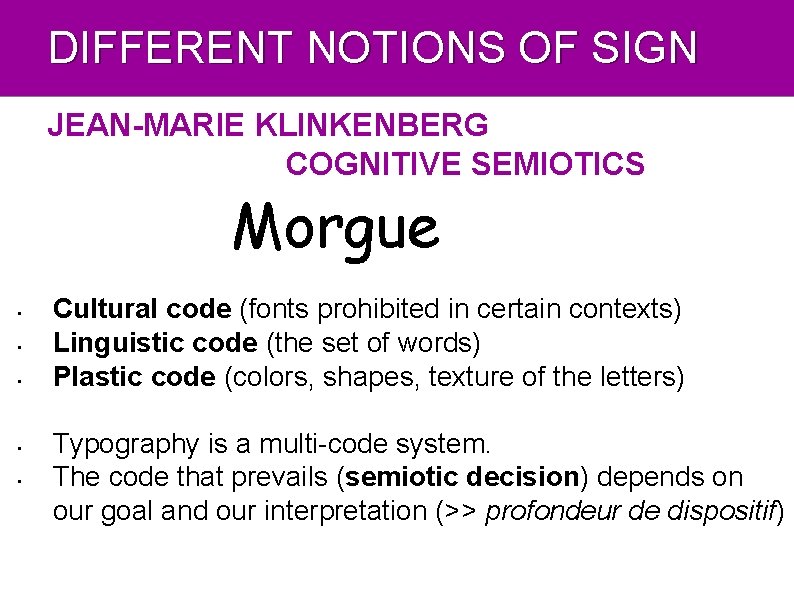
DIFFERENT NOTIONS OF SIGN JEAN-MARIE KLINKENBERG COGNITIVE SEMIOTICS Morgue • • • Cultural code (fonts prohibited in certain contexts) Linguistic code (the set of words) Plastic code (colors, shapes, texture of the letters) Typography is a multi-code system. The code that prevails (semiotic decision) depends on our goal and our interpretation (>> profondeur de dispositif)
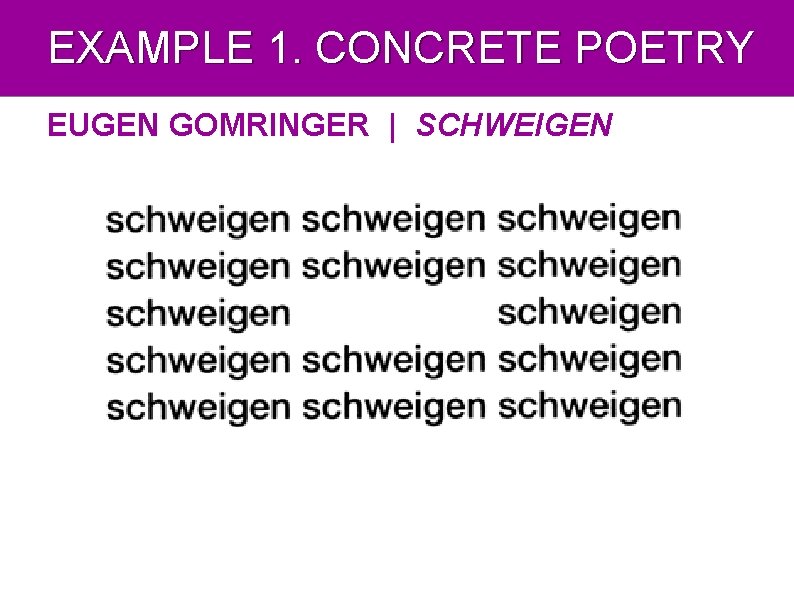
EXAMPLE 1. CONCRETE POETRY EUGEN GOMRINGER | SCHWEIGEN
EXAMPLE 1. CONCRETE POETRY EUGEN GOMRINGER | SCHWEIGEN • • All semiotic codes possess: a grammar (the association rules of the signifier's system) All grammars are constituted by a vocabulary (the set of elements present in the code), and a syntax (the rules for the association of these elements) Vocabulary >> paradigmatic axis Syntax >> syntagmatic axis
EXAMPLE 1. CONCRETE POETRY EUGEN GOMRINGER | SCHWEIGEN Gomringer's definition of constellation Our languages are on the road to formal simplification, abbreviated, restricted forms of language are emerging. The content of a sentence is often conveyed in a single word. Longer statements are often represented by small groups of letters. Moreover, there is a tendency among languages for the many to be replaced by a few which are generally valid. Does this restricted and simplified use of language and writing mean the end of poetry? Certainly not. Restriction in the best sense-concentration and simplificationis the very essence of poetry. The constellation is the simplest possible kind of configuration in poetry, which has for its basic unit the word, it encloses a group of words as if it were drawing stars together to form a cluster. Eugen Gomringer, “From Line to Constellation” (1954) from Concrete Poetry: A World View, Indiana University Press, 1968
EXAMPLE 1. CONCRETE POETRY EUGEN GOMRINGER | SCHWEIGEN So, in Concrete Poetry. . . • • • the basic unit remains the word (linguistic code), but the grammar is not based on syntactic rules, but on plastic ones >> Linguistic vocabulary && plastic syntax
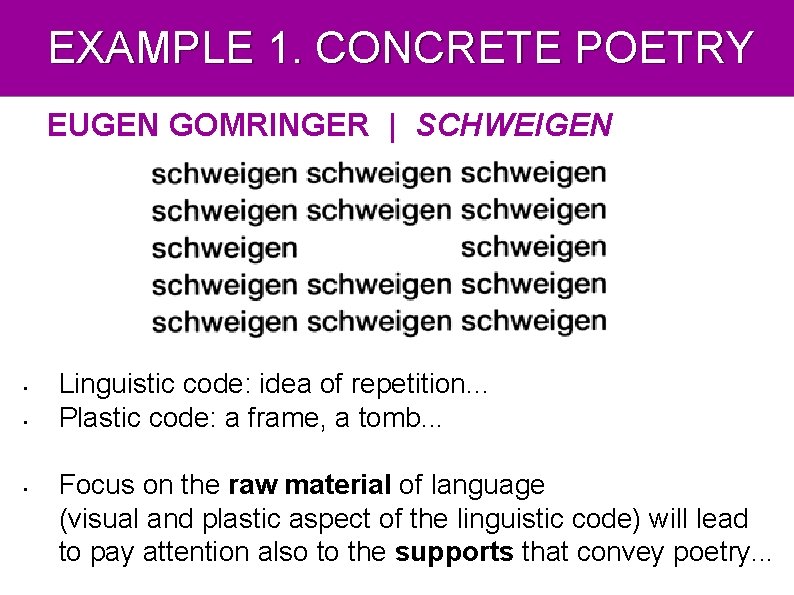
EXAMPLE 1. CONCRETE POETRY EUGEN GOMRINGER | SCHWEIGEN • • • Linguistic code: idea of repetition. . . Plastic code: a frame, a tomb. . . Focus on the raw material of language (visual and plastic aspect of the linguistic code) will lead to pay attention also to the supports that convey poetry. . .
EXAMPLE 2. ANIMATED POETRY BARRIE PHILIPP NICHOL (bp. Nichol) FIRST SCREENING (1984) • • The first digital anthology of poems Made on Apple IIe Programmed work (Apple BASIC) As the result depends on the technical execution context, it will not always be identical (lability) Autor of programmed work is a meta-author and is in the same situation as the reader Intentio auctoris is problematized Lability is reproductive >> meta-reading
EXAMPLE 2. ANIMATED POETRY BARRIE PHILIPP NICHOL (bp. Nichol) FIRST SCREENING (1984)
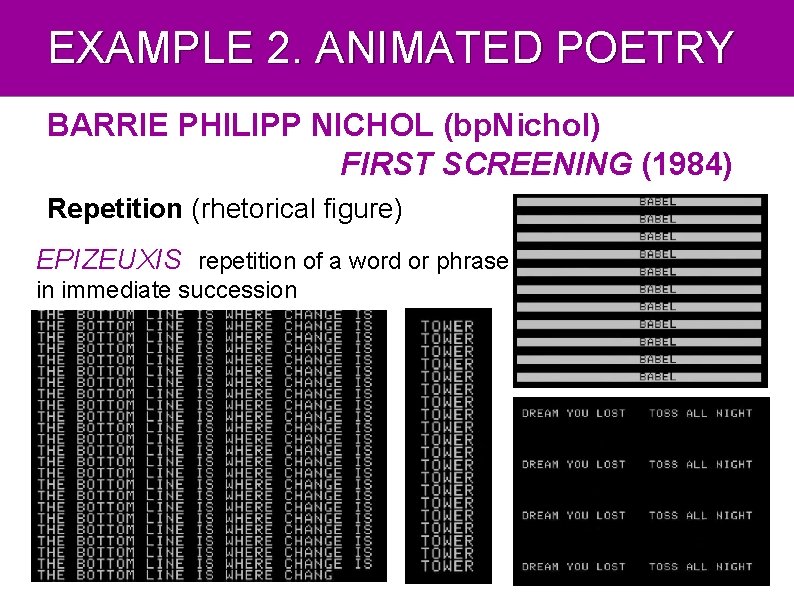
EXAMPLE 2. ANIMATED POETRY BARRIE PHILIPP NICHOL (bp. Nichol) FIRST SCREENING (1984) Repetition (rhetorical figure) EPIZEUXIS repetition of a word or phrase in immediate succession
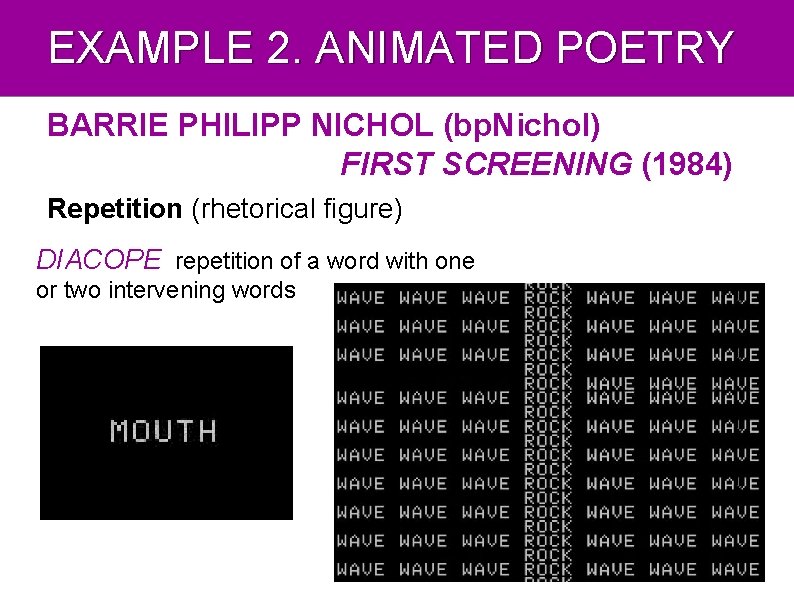
EXAMPLE 2. ANIMATED POETRY BARRIE PHILIPP NICHOL (bp. Nichol) FIRST SCREENING (1984) Repetition (rhetorical figure) DIACOPE repetition of a word with one or two intervening words
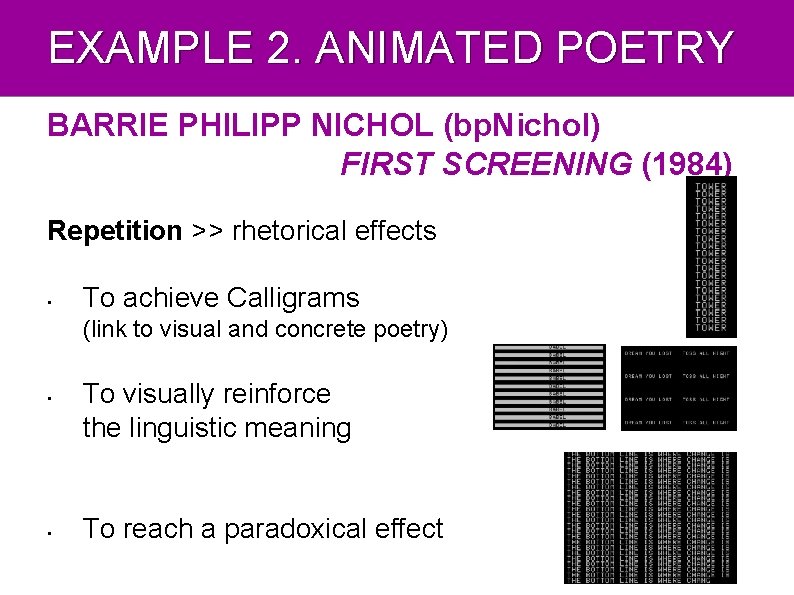
EXAMPLE 2. ANIMATED POETRY BARRIE PHILIPP NICHOL (bp. Nichol) FIRST SCREENING (1984) Repetition >> rhetorical effects • To achieve Calligrams (link to visual and concrete poetry) • • To visually reinforce the linguistic meaning To reach a paradoxical effect
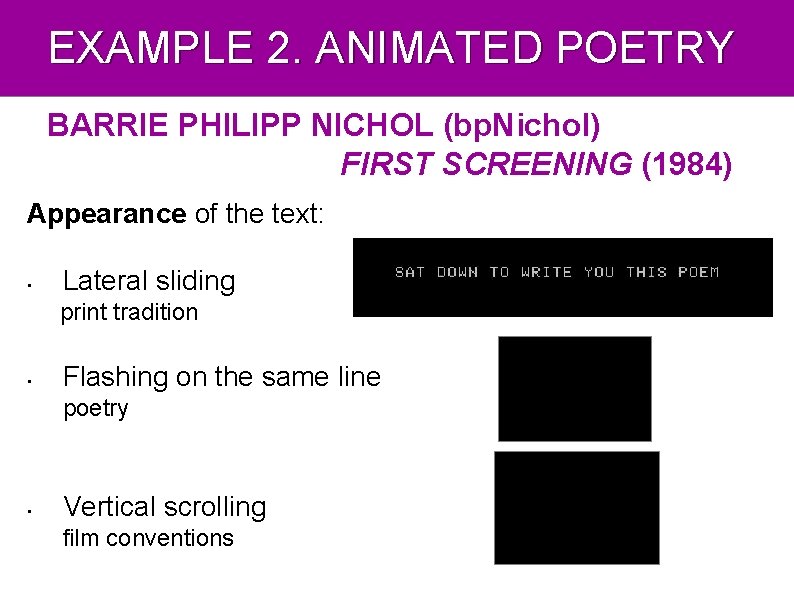
EXAMPLE 2. ANIMATED POETRY BARRIE PHILIPP NICHOL (bp. Nichol) FIRST SCREENING (1984) Appearance of the text: • Lateral sliding print tradition • Flashing on the same line poetry • Vertical scrolling film conventions
EXAMPLE 2. ANIMATED POETRY BARRIE PHILIPP NICHOL (bp. Nichol) FIRST SCREENING (1984) Appearance of the text: focus on permutation • • Syntactic animation: the syntactic function of the same word changes due to the movement of the word Animation works simultaneously with chrono-syntax (the syntactic function of words is given by their order of appearance, as in the oral discourse) and topo-syntax (the syntactic function is determined by the position of words in space, as in the written text)
EXAMPLE 2. ANIMATED POETRY BARRIE PHILIPP NICHOL (bp. Nichol) FIRST SCREENING (1984) Appearance of the text • The movement assumes the syntactic function traditionally carried out by the verb, that is, it makes the words perform an action
EXAMPLE 2. ANIMATED POETRY BARRIE PHILIPP NICHOL (bp. Nichol) FIRST SCREENING (1984) Appearance of the text • • Text has become performative (it does what it says) Space has become choreographic (words are free to move and perform, like dancers or actors)
EXAMPLE 2. ANIMATED POETRY BARRIE PHILIPP NICHOL (bp. Nichol) FIRST SCREENING (1984) Appearance of the text • • Linguistic signs have also visual and plastic values Intermedia* : continuous and ambiguous circulation between different semiotic systems
EXAMPLE 2. ANIMATED POETRY BARRIE PHILIPP NICHOL (bp. Nichol) FIRST SCREENING (1984) Appearance of the text
EXAMPLE 2. ANIMATED POETRY BARRIE PHILIPP NICHOL (bp. Nichol) FIRST SCREENING (1984) Appearance of the text • Physical behavior of the device is projected on the linguistic meaning >> material metaphors *
EXAMPLE 2. ANIMATED POETRY BARRIE PHILIPP NICHOL (bp. Nichol) FIRST SCREENING (1984) Appearance of the text • • Technotext * : any literary work that interrogates the inscription technology that produces it First Screening is a technotext both because it reflects on the differences with print, and because it plays with the opacity of the electronic medium * N. Katherine Hayles, Writing Machines, 2002
EXAMPLE 2. ANIMATED POETRY JACQUES FONTANILLE THE GENERATIVE PATH OF THE EXPRESSION
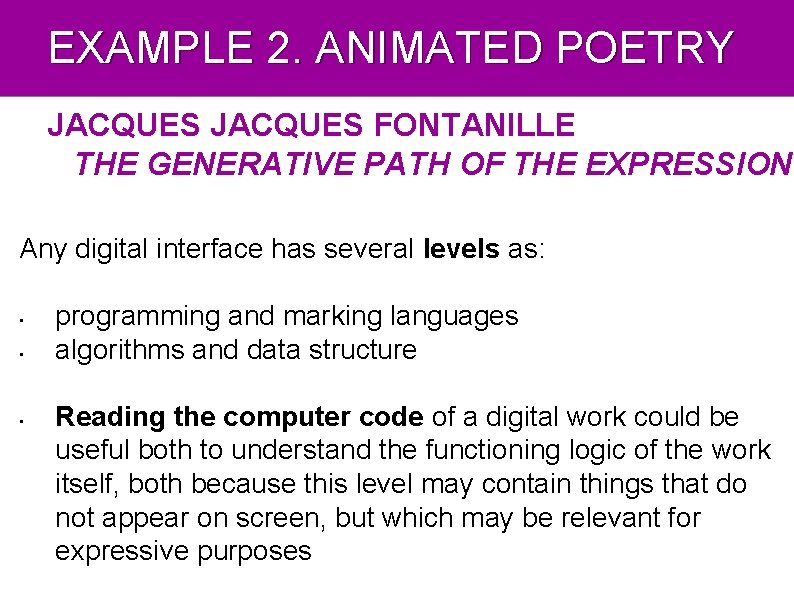
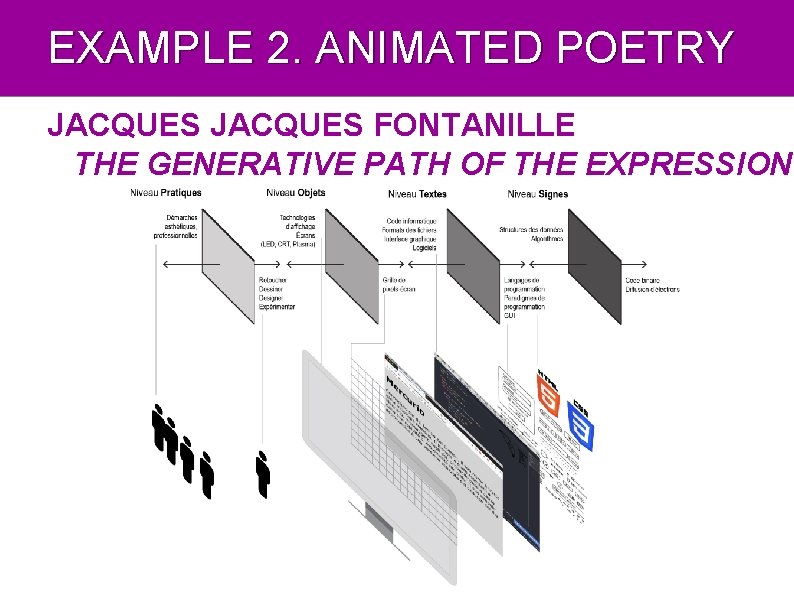
EXAMPLE 2. ANIMATED POETRY JACQUES FONTANILLE THE GENERATIVE PATH OF THE EXPRESSION Any digital interface has several levels as: • • • programming and marking languages algorithms and data structure Reading the computer code of a digital work could be useful both to understand the functioning logic of the work itself, both because this level may contain things that do not appear on screen, but which may be relevant for expressive purposes
EXAMPLE 2. ANIMATED POETRY BARRIE PHILIPP NICHOL (bp. Nichol) FIRST SCREENING (1984)
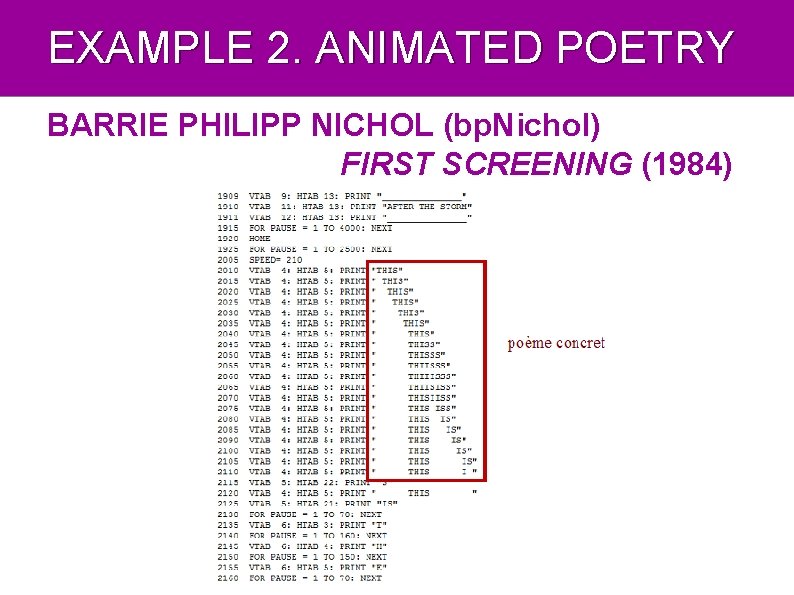
EXAMPLE 2. ANIMATED POETRY BARRIE PHILIPP NICHOL (bp. Nichol) FIRST SCREENING (1984) • • Computer code can possess an aesthetic dimension (it is a language) Codework * : a work that uses computer code not only for functional reasons, but also for aesthetic and rhetoric purposes * Alan Sondheim, 2001
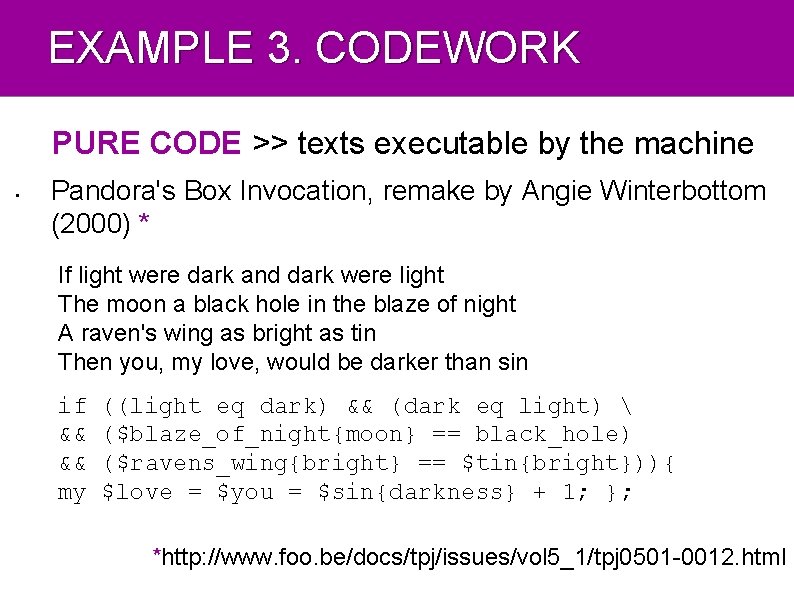
EXAMPLE 3. CODEWORK PURE CODE >> texts executable by the machine • Pandora's Box Invocation, remake by Angie Winterbottom (2000) * If light were dark and dark were light The moon a black hole in the blaze of night A raven's wing as bright as tin Then you, my love, would be darker than sin if && && my ((light eq dark) && (dark eq light) ($blaze_of_night{moon} == black_hole) ($ravens_wing{bright} == $tin{bright})){ $love = $you = $sin{darkness} + 1; }; *http: //www. foo. be/docs/tpj/issues/vol 5_1/tpj 0501 -0012. html
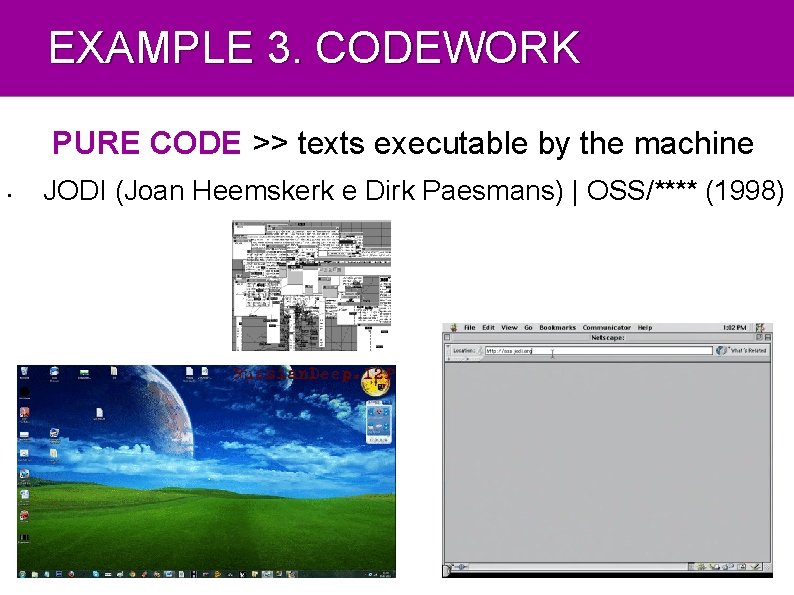
EXAMPLE 3. CODEWORK PURE CODE >> texts executable by the machine • JODI (Joan Heemskerk e Dirk Paesmans) | OSS/**** (1998)
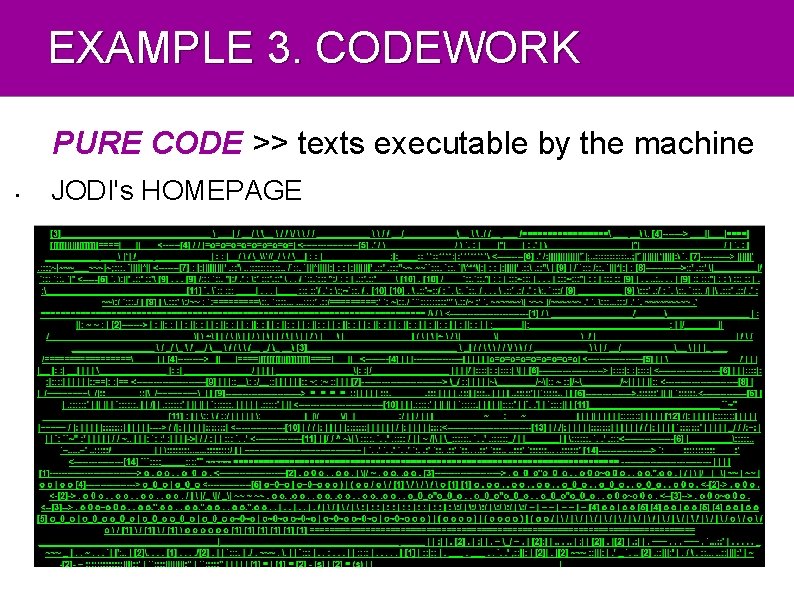
EXAMPLE 3. CODEWORK PURE CODE >> texts executable by the machine • JODI's HOMEPAGE
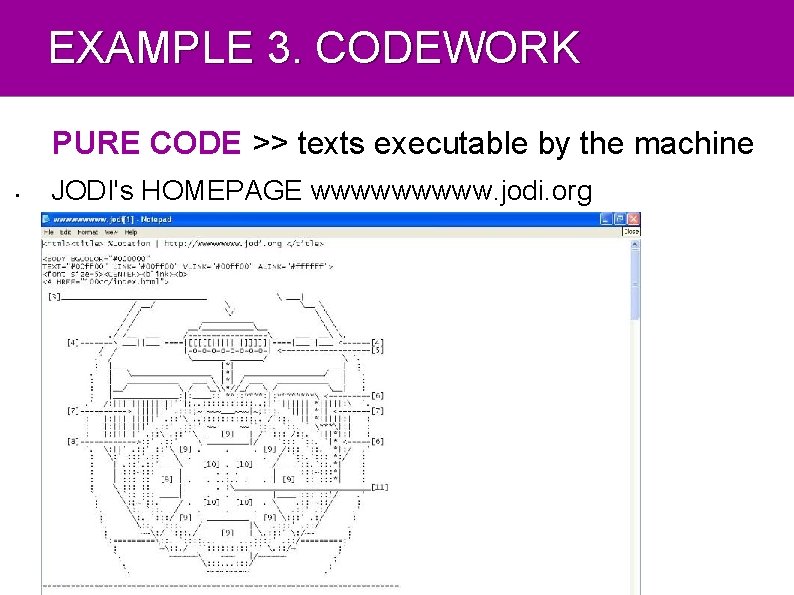
EXAMPLE 3. CODEWORK PURE CODE >> texts executable by the machine • JODI's HOMEPAGE wwwww. jodi. org
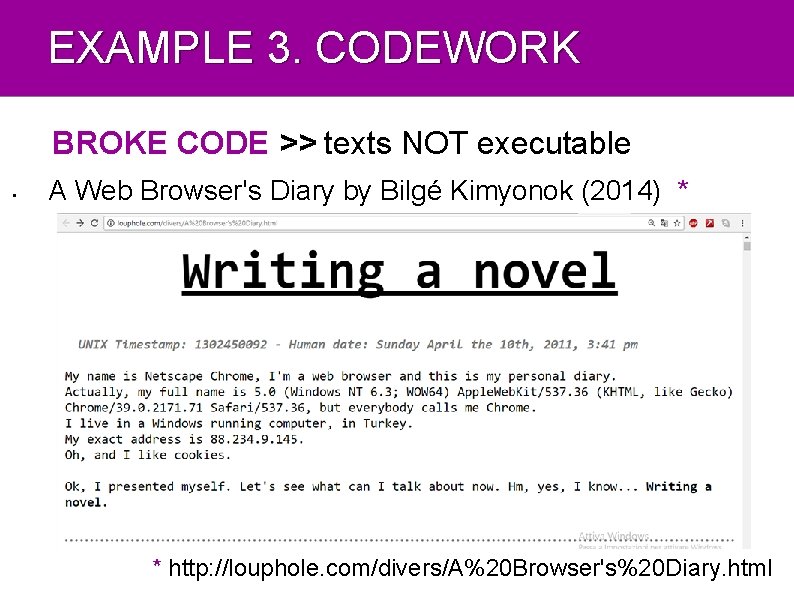
EXAMPLE 3. CODEWORK BROKE CODE >> texts NOT executable • A Web Browser's Diary by Bilgé Kimyonok (2014) * * http: //louphole. com/divers/A%20 Browser's%20 Diary. html
EXAMPLE 3. CODEWORK • • • Computer code as a literary/artistic medium An image is just as much a result of the various codes that interpret it, as it is the result of authorial intention or audience perception * Experimental dysfunctionality >> A systematic and programmatic artistic research focused on the anomalies of computational systems aimed at critically reflect on new media ** * Brett Stalbaum (1998) ** Marie-Laure Ryan (2010)
EXAMPLE 4. VIDEOCLIP GRANDADDY | JED'S OTHER POEM (BEAUTIFUL GROUND) (2000)
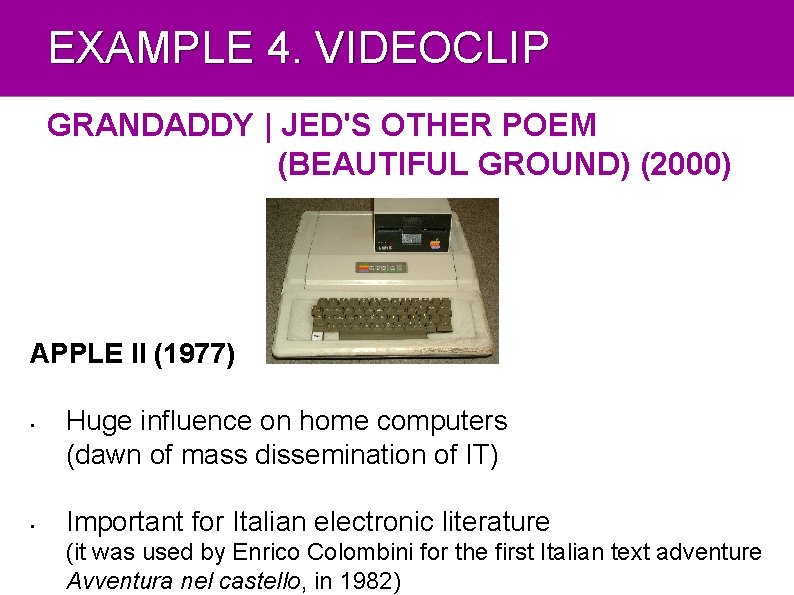
EXAMPLE 4. VIDEOCLIP GRANDADDY | JED'S OTHER POEM (BEAUTIFUL GROUND) (2000) APPLE II (1977) • • Huge influence on home computers (dawn of mass dissemination of IT) Important for Italian electronic literature (it was used by Enrico Colombini for the first Italian text adventure Avventura nel castello, in 1982)
EXAMPLE 4. VIDEOCLIP GRANDADDY | JED'S OTHER POEM (BEAUTIFUL GROUND) (2000) About the format • • • It is a videoclip and not a programmed work because: music starts before the execution of the program (when the word “run” appears) there are not progressive non-synchronizations between code and audiovisual output
EXAMPLE 4. VIDEOCLIP GRANDADDY | JED'S OTHER POEM (BEAUTIFUL GROUND) (2000) About the computer code • It is referred as an actor (anthropomorphism )
EXAMPLE 4. VIDEOCLIP GRANDADDY | JED'S OTHER POEM (BEAUTIFUL GROUND) (2000) About the computer code • Mise en abyime of computer science in videoclip: the video represents the context in which the fruition of digital works take place (screen, device, reader's place)
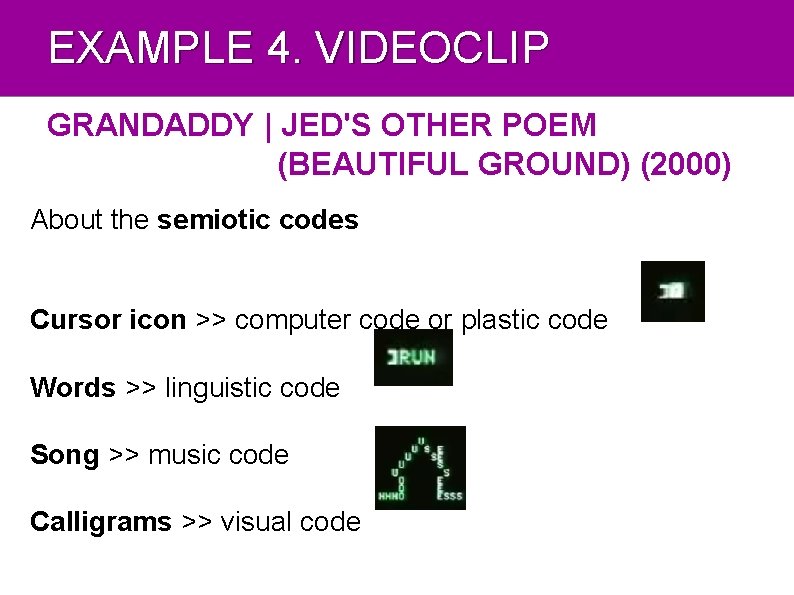
EXAMPLE 4. VIDEOCLIP GRANDADDY | JED'S OTHER POEM (BEAUTIFUL GROUND) (2000) About the semiotic codes Cursor icon >> computer code or plastic code Words >> linguistic code Song >> music code Calligrams >> visual code
EXAMPLE 4. VIDEOCLIP GRANDADDY | JED'S OTHER POEM (BEAUTIFUL GROUND) (2000) About the semiotic codes Animations >> temporal semiotics Computer code >> computer code Closing credits, editing >> video/movie code Apple II >> cultural code
EXAMPLE 4. VIDEOCLIP GRANDADDY | JED'S OTHER POEM (BEAUTIFUL GROUND) (2000) About the semiotic effects generated by animation • Intermittent cursor >> waiting for an action
EXAMPLE 4. VIDEOCLIP GRANDADDY | JED'S OTHER POEM About the semiotic effects generated by animation
EXAMPLE 4. VIDEOCLIP GRANDADDY | JED'S OTHER POEM (BEAUTIFUL GROUND) (2000) About the semiotic effects generated by animation • Psychological effect due to the association of the linguistic meaning to the movement
EXAMPLE 4. VIDEOCLIP GRANDADDY | JED'S OTHER POEM (BEAUTIFUL GROUND) (2000) About the semiotic effects generated by animation • Writing space: from typographic (linear) to choreographic
EXAMPLE 4. VIDEOCLIP GRANDADDY | JED'S OTHER POEM (BEAUTIFUL GROUND) (2000) About the semiotic effects generated by animation
EXAMPLE 4. VIDEOCLIP GRANDADDY | JED'S OTHER POEM (BEAUTIFUL GROUND) (2000) About the semiotic effects generated by animation
EXAMPLE 4. VIDEOCLIP GRANDADDY | JED'S OTHER POEM (BEAUTIFUL GROUND) (2000) About the semiotic effects generated by animation
EXAMPLE 4. VIDEOCLIP GRANDADDY | JED'S OTHER POEM (BEAUTIFUL GROUND) (2000) About the semiotic effects generated by animation • • Singing >> the linguistic and computer code are predominant Music >> choreography, plastic and figurative codes prevail
EXAMPLE 4. VIDEOCLIP GRANDADDY | JED'S OTHER POEM (BEAUTIFUL GROUND) (2000) About the semiotic effects generated by animation Videoclip is multimedia and intermedia: • multimedia because there are more media at the same time (written, visual and sound); • intermedia because some elements (like the cursor) move from one code to another
EXAMPLE 4. VIDEOCLIP GRANDADDY | JED'S OTHER POEM (BEAUTIFUL GROUND) (2000) About the semiotic effects generated by animation • • • Cognitive surplus Reading the most recent things leads to forgetting the previous ones On-screen reading requires new strategies
EXAMPLE 4. VIDEOCLIP GRANDADDY | JED'S OTHER POEM (BEAUTIFUL GROUND) (2000) About the differences between programmed works and video works • • • In the video works the reader can not control the speed, nor the order of reproduction, nor can he know the total length of the work In a digital environment, authors and readers must renounce total control of the work and embrace an aesthetic of the flow Everything in the digital space is a Transitoire Observable * * Philippe Bootz, 2003
THE PLAN OF CONTENT Interfaces can be broken down into a series of levels (practices, objects, texts and signs) • Identify the practices, by asking: 1. What the interface allows to do or not do (level of practices and texts) 2. Which vocabulary it uses to address users (level of practices) 3. What kind of signs we see on screen, eg images, video, texts (level of objects) 4. How these signs are organized in time and space (level of objects) 5. How interactivity develops (level of objects)
THE PLAN OF CONTENT • Identify what values are evoked by these practices: 1. How are these values translated into interfaces (for example, are they represented through objects or computer code)? 2. What kind of values are they? Useful tools >> the semiotic square, the actantial model and the signification regimes of interfaces
THE PLAN OF CONTENT ALGIRDAS JULIEN GREIMAS • The focus returns to the internal structures of the text • Everything is narration (film, advertising, books, videogames, paintings, arrangement of objects in a museum. . . ) • • A stratified model of text >> the basic or deep structures (analytical and abstract elements) generate the surface structures (more concrete elements) Sense is generated from the simple, abstract and deep oppositions contained in the basic structure
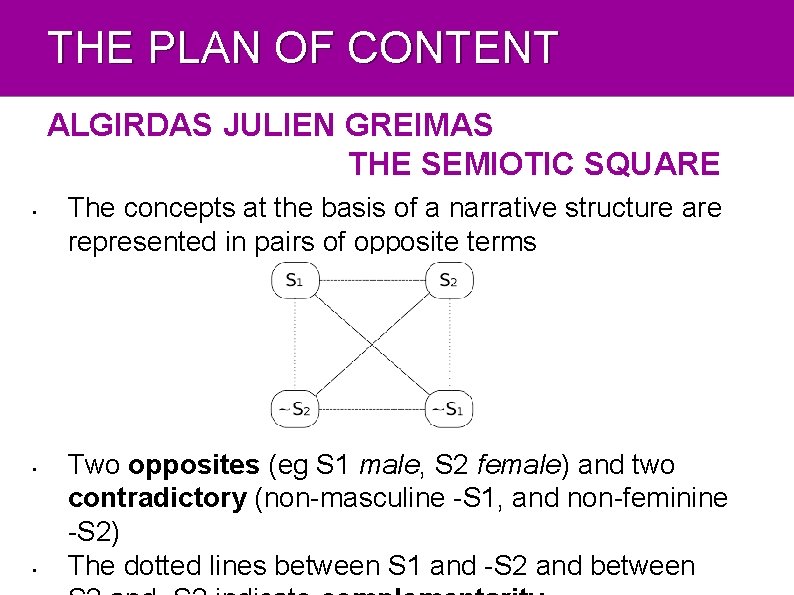
THE PLAN OF CONTENT ALGIRDAS JULIEN GREIMAS THE SEMIOTIC SQUARE • • • The concepts at the basis of a narrative structure are represented in pairs of opposite terms Two opposites (eg S 1 male, S 2 female) and two contradictory (non-masculine -S 1, and non-feminine -S 2) The dotted lines between S 1 and -S 2 and between
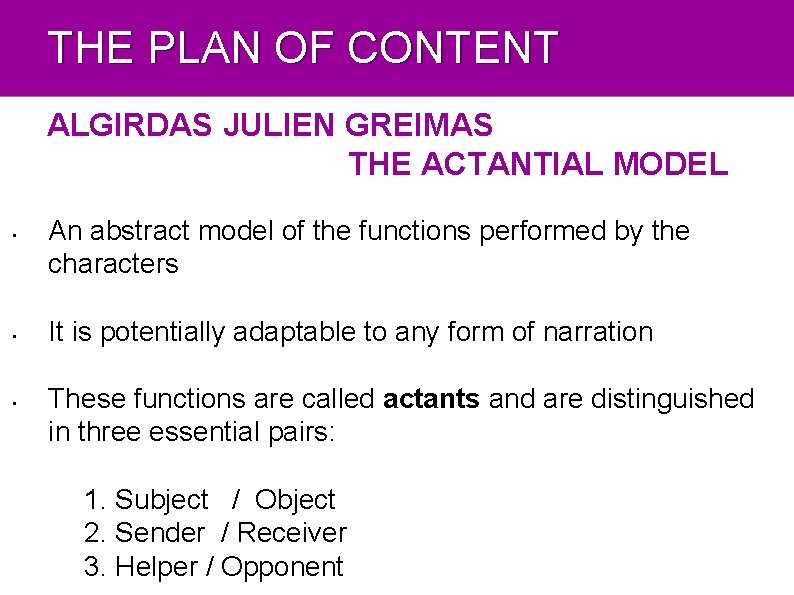
THE PLAN OF CONTENT ALGIRDAS JULIEN GREIMAS THE ACTANTIAL MODEL • • • An abstract model of the functions performed by the characters It is potentially adaptable to any form of narration These functions are called actants and are distinguished in three essential pairs: 1. Subject / Object 2. Sender / Receiver 3. Helper / Opponent
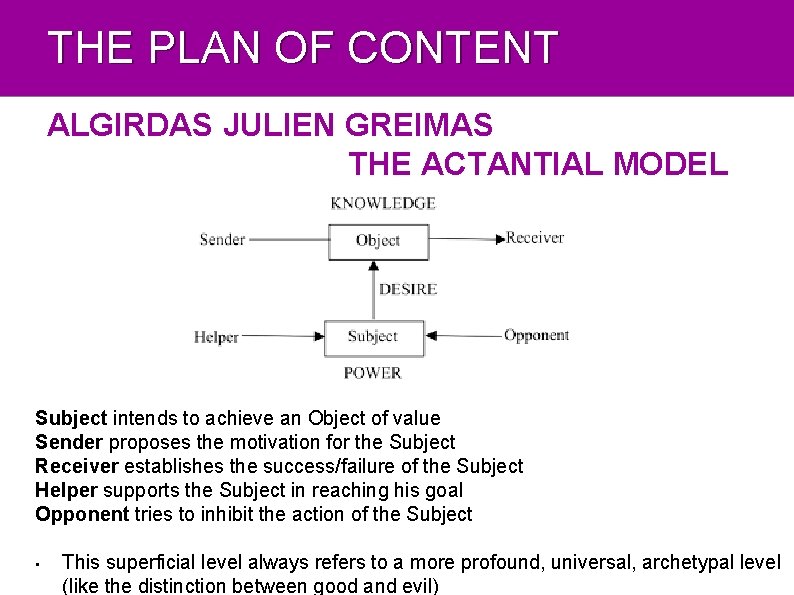
THE PLAN OF CONTENT ALGIRDAS JULIEN GREIMAS THE ACTANTIAL MODEL Subject intends to achieve an Object of value Sender proposes the motivation for the Subject Receiver establishes the success/failure of the Subject Helper supports the Subject in reaching his goal Opponent tries to inhibit the action of the Subject • This superficial level always refers to a more profound, universal, archetypal level (like the distinction between good and evil)
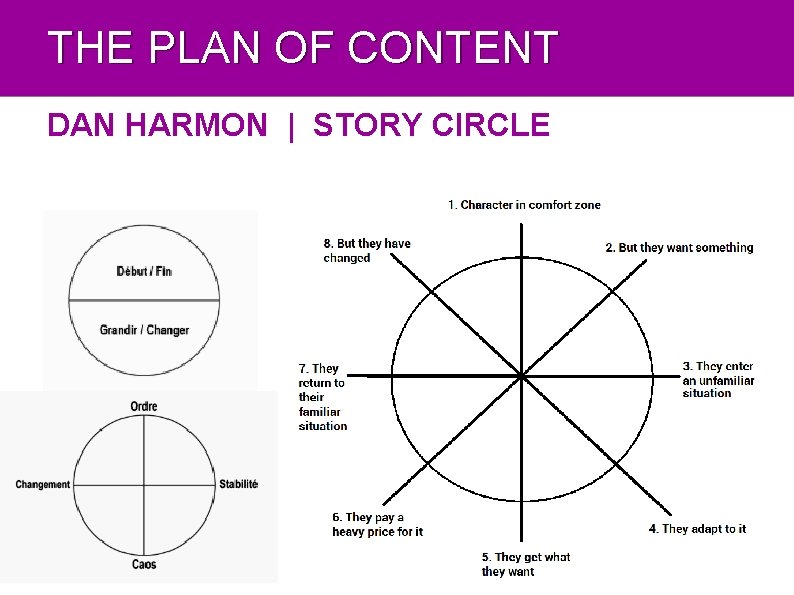
THE PLAN OF CONTENT DAN HARMON | STORY CIRCLE
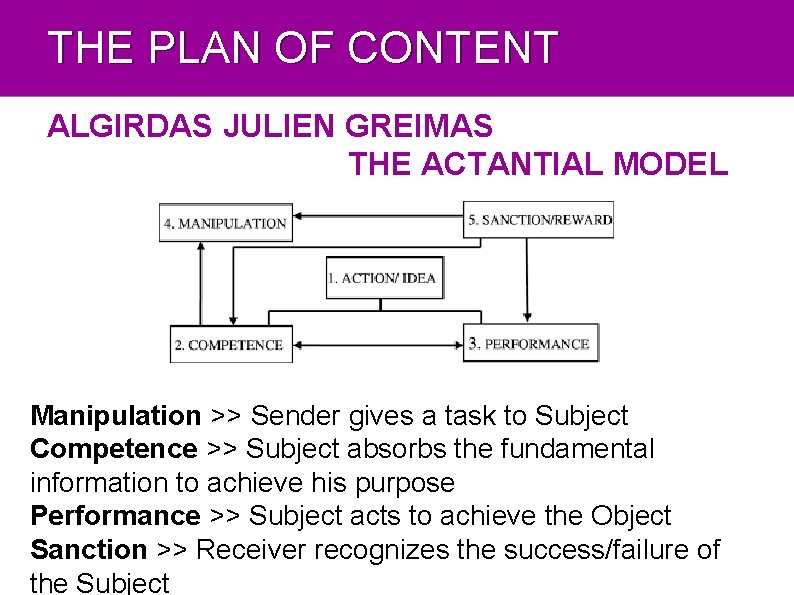
THE PLAN OF CONTENT ALGIRDAS JULIEN GREIMAS THE ACTANTIAL MODEL Manipulation >> Sender gives a task to Subject Competence >> Subject absorbs the fundamental information to achieve his purpose Performance >> Subject acts to achieve the Object Sanction >> Receiver recognizes the success/failure of the Subject
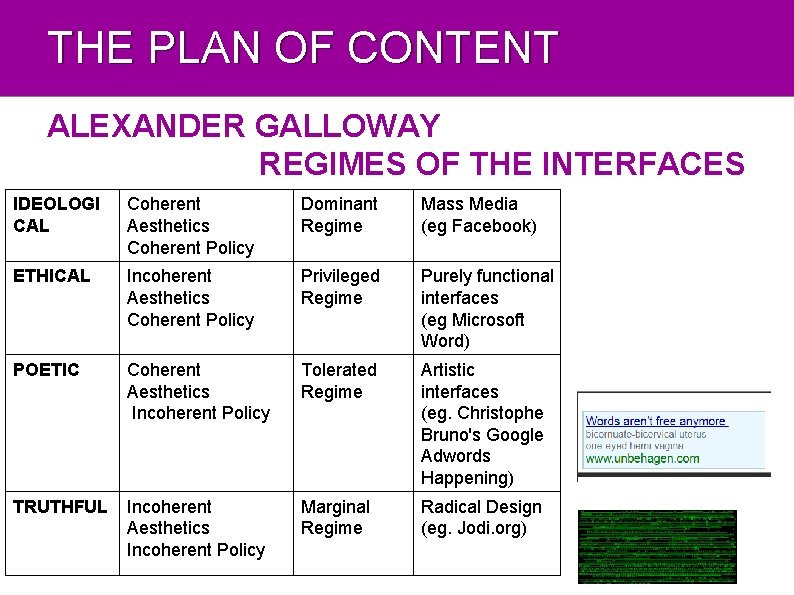
THE PLAN OF CONTENT ALEXANDER GALLOWAY REGIMES OF THE INTERFACES IDEOLOGI CAL Coherent Aesthetics Coherent Policy Dominant Regime Mass Media (eg Facebook) ETHICAL Incoherent Aesthetics Coherent Policy Privileged Regime Purely functional interfaces (eg Microsoft Word) POETIC Coherent Aesthetics Incoherent Policy Tolerated Regime Artistic interfaces (eg. Christophe Bruno's Google Adwords Happening) TRUTHFUL Incoherent Aesthetics Incoherent Policy Marginal Regime Radical Design (eg. Jodi. org)
THE PLAN OF CONTENT RECAP. . . • • We can analyze any narrative system by identifying its different codes (plastic, visual, linguistic. . . ) Grouping the codes and attributing certain values to them based on oppositions Associate an actant with each of the elements Identify the regime used, asking ourselves why that regime was chosen, how society and the world are represented by that regime or if there is a change from
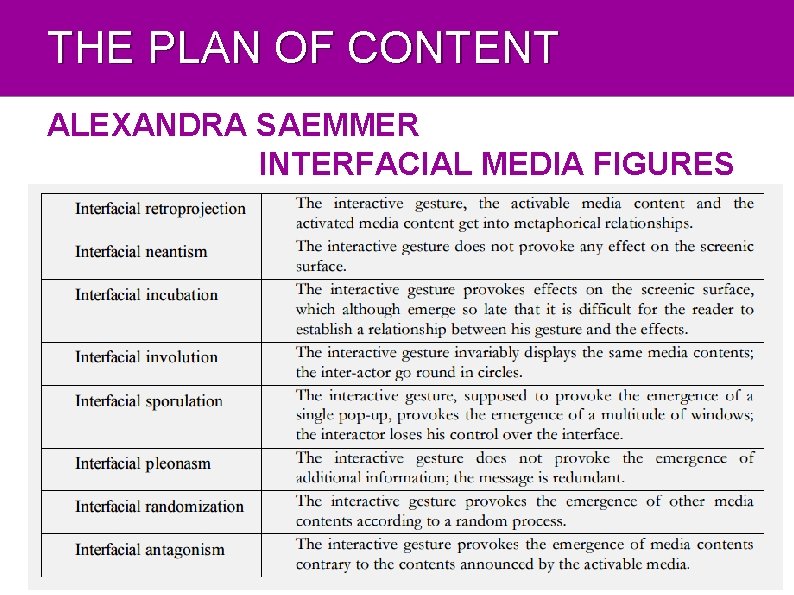
THE PLAN OF CONTENT ALEXANDRA SAEMMER INTERFACIAL MEDIA FIGURES • Eight figures of speech that can be obtained from the relationship between the user's gesture, the activatable content and the activated content
THE PLAN OF CONTENT ALEXANDRA SAEMMER INTERFACIAL MEDIA FIGURES
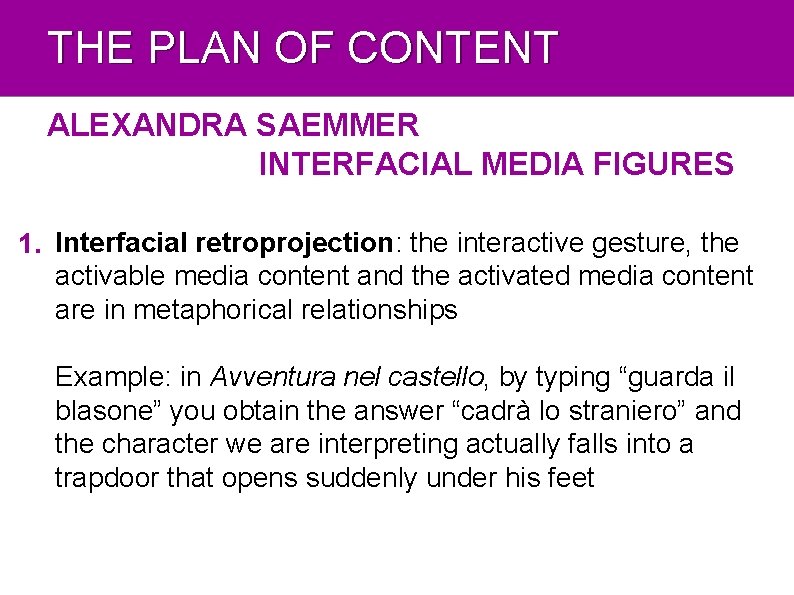
THE PLAN OF CONTENT ALEXANDRA SAEMMER INTERFACIAL MEDIA FIGURES 1. Interfacial retroprojection: the interactive gesture, the activable media content and the activated media content are in metaphorical relationships Example: in Avventura nel castello, by typing “guarda il blasone” you obtain the answer “cadrà lo straniero” and the character we are interpreting actually falls into a trapdoor that opens suddenly under his feet
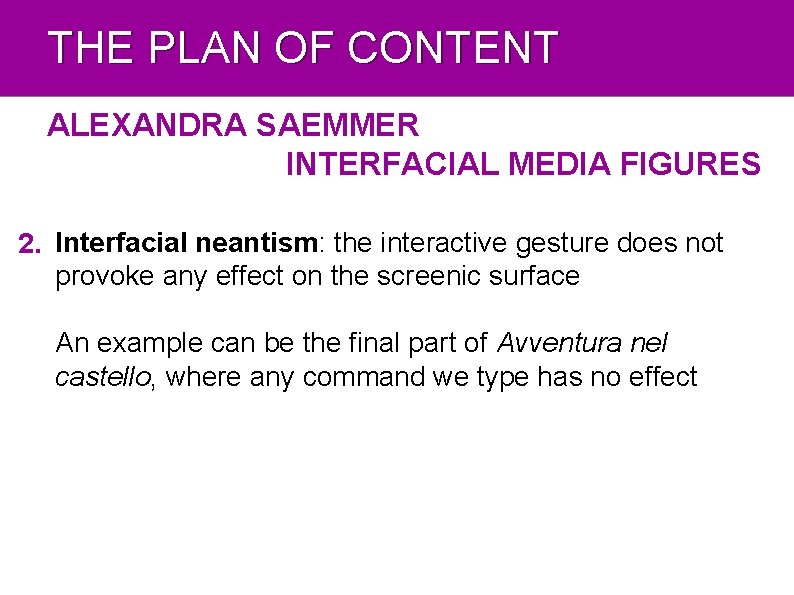
THE PLAN OF CONTENT ALEXANDRA SAEMMER INTERFACIAL MEDIA FIGURES 2. Interfacial neantism: the interactive gesture does not provoke any effect on the screenic surface An example can be the final part of Avventura nel castello, where any command we type has no effect
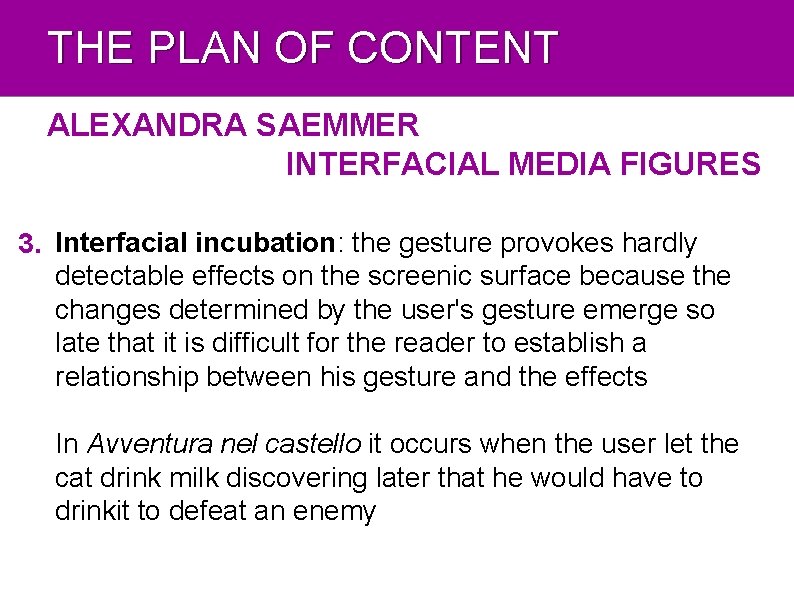
THE PLAN OF CONTENT ALEXANDRA SAEMMER INTERFACIAL MEDIA FIGURES 3. Interfacial incubation: the gesture provokes hardly detectable effects on the screenic surface because the changes determined by the user's gesture emerge so late that it is difficult for the reader to establish a relationship between his gesture and the effects In Avventura nel castello it occurs when the user let the cat drink milk discovering later that he would have to drinkit to defeat an enemy
THE PLAN OF CONTENT ALEXANDRA SAEMMER INTERFACIAL MEDIA FIGURES 4. Interfacial involution: the interactive gesture invariably displays the same media contents, and then the gesture invariably follows the same effects In Avventura nel castello it occurs when the user keeps bumping into the mirrors, receiving the same answers, until he discovers that a mirror is actually a revolving wall
THE PLAN OF CONTENT ALEXANDRA SAEMMER INTERFACIAL MEDIA FIGURES 5. Interfacial sporulation: the interactive gesture causes unexpected effects that make the reader lose control In Avventura nel castello it occurs when the users types the wrong formula “idiota”, causing a glitch screen
THE PLAN OF CONTENT ALEXANDRA SAEMMER INTERFACIAL MEDIA FIGURES 6. Interfacial pleonasm: the interactive gesture causes redundant messages For example in Avventura nel castello, if the user types “guarda nano”, the parser replies “è piuttosto piccolo”
THE PLAN OF CONTENT ALEXANDRA SAEMMER INTERFACIAL MEDIA FIGURES 7. Interfacial randomization: the interactive gesture provokes the emergence of other media contents according to a random process For example, it can occur in automatic text generators
THE PLAN OF CONTENT ALEXANDRA SAEMMER INTERFACIAL MEDIA FIGURES 8. Interfacial antagonism: the interactive gesture provokes the emergence of media contents contrary to the contents announced by the activable media A typical example are pop-up ads that open by clicking on a streaming video
DIGITAL SEMIOTICS Roberta Iadevaia roberta. iadevaia@studenti. iulm. it
- Slides: 82