
Digital Resources Web Pages and Wikis Introduction Types
Digital Resources: Web Pages and Wikis Introduction Types of Web pages Evaluating Web pages Talk About It Your Turn Tech Tools in this presentation • Wikia • Way. Back. Machine • easy. Whois
Introduction Finding the right ring tone for each of your friends requires following a set of steps. You listen to tones on different Web sites. You use criteria to evaluate each ring tone. Finally, you choose the tones you want. Thumbplay is a registered trademark and the Thumbplay logo is a trademark of Thumbplay, Inc. All rights reserved.
Introduction You will follow a similar process to locate digital resources for your research project. You read, view, and listen to sources on many Web sites. You evaluate each source for accuracy and credibility. Finally, you choose the best resources for your project.
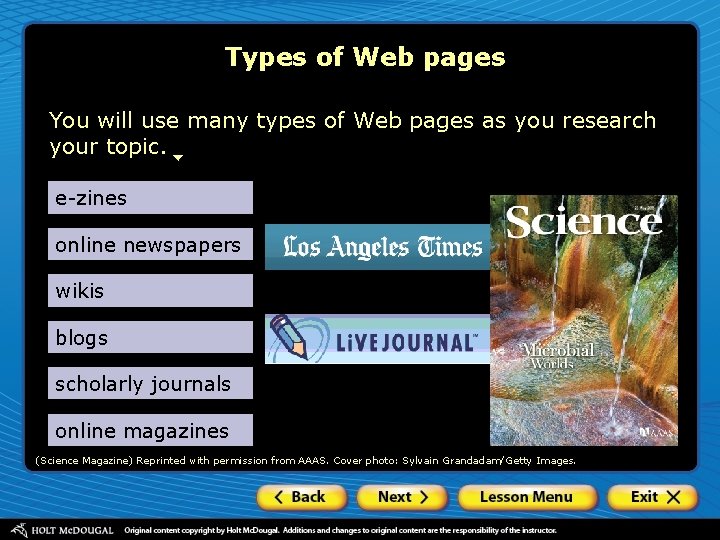
Types of Web pages You will use many types of Web pages as you research your topic. e-zines online newspapers wikis blogs scholarly journals online magazines (Science Magazine) Reprinted with permission from AAAS. Cover photo: Sylvain Grandadam/Getty Images.
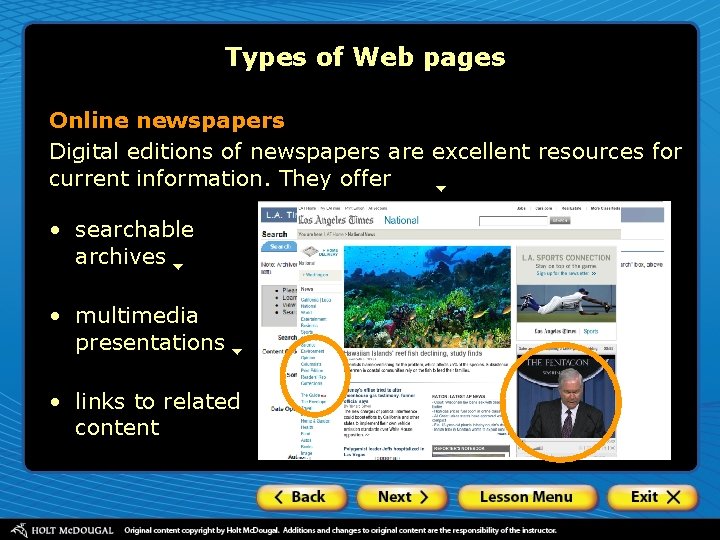
Types of Web pages Online newspapers Digital editions of newspapers are excellent resources for current information. They offer • searchable archives • multimedia presentations • links to related content
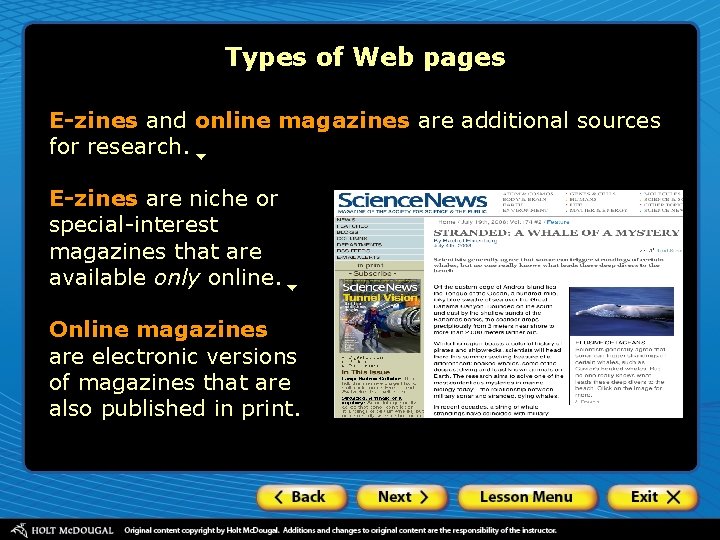
Types of Web pages E-zines and online magazines are additional sources for research. E-zines are niche or special-interest magazines that are available only online. Online magazines are electronic versions of magazines that are also published in print.
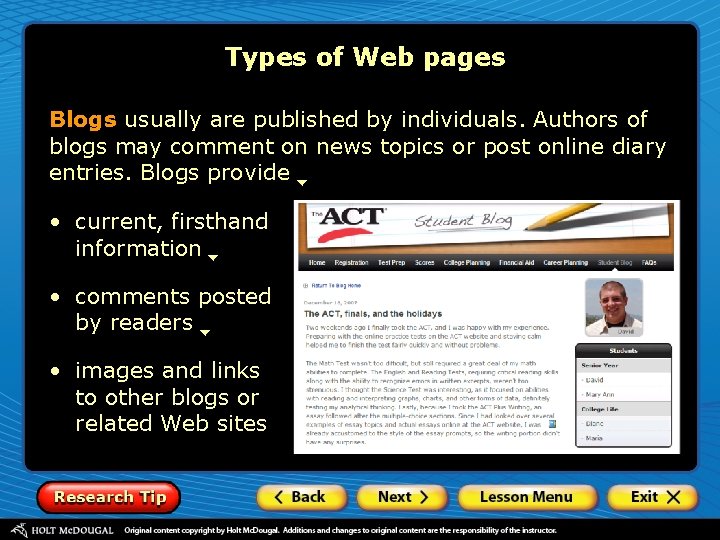
Types of Web pages Blogs usually are published by individuals. Authors of blogs may comment on news topics or post online diary entries. Blogs provide • current, firsthand information • comments posted by readers • images and links to other blogs or related Web sites
Types of Web pages Online scholarly journals can be good research sources. Unlike e-zines or online magazines, online scholarly journals provide in-depth, academic information on specific topics. There a number of Web sites you can use to search for scholarly journals.
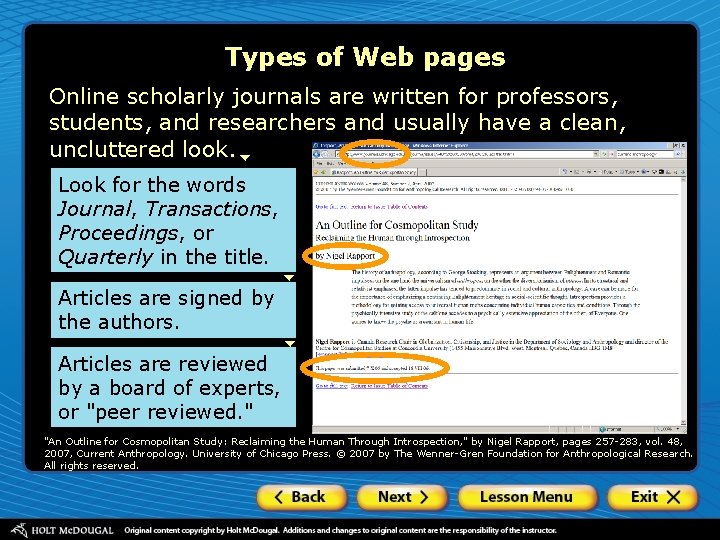
Types of Web pages Online scholarly journals are written for professors, students, and researchers and usually have a clean, uncluttered look. Look for the words Journal, Transactions, Proceedings, or Quarterly in the title. Articles are signed by the authors. Articles are reviewed by a board of experts, or "peer reviewed. " "An Outline for Cosmopolitan Study: Reclaiming the Human Through Introspection, " by Nigel Rapport, pages 257 -283, vol. 48, 2007, Current Anthropology. University of Chicago Press. © 2007 by The Wenner-Gren Foundation for Anthropological Research. All rights reserved.
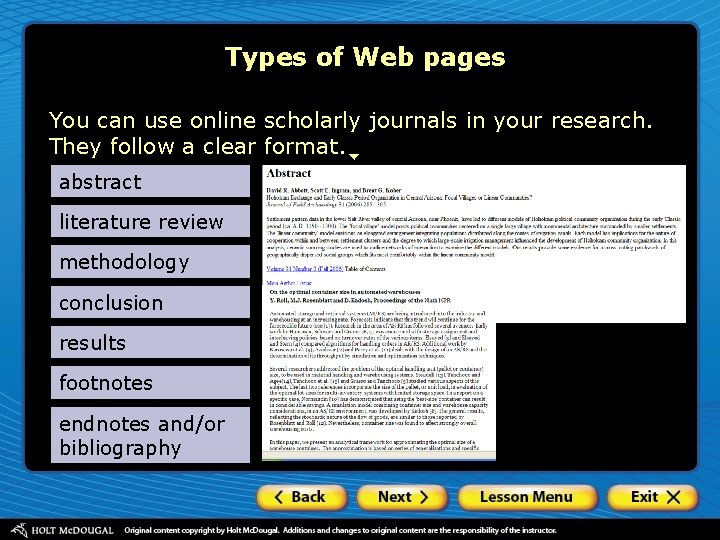
Types of Web pages You can use online scholarly journals in your research. They follow a clear format. abstract literature review methodology conclusion results footnotes endnotes and/or bibliography
Types of Web pages Wikis can be excellent sources of information. Because wikis are collaborative and can be updated frequently, they can give more varied and up-to-date information on a topic than even the most recent journals. As with all information, check the information you obtain from a wiki against other sources.
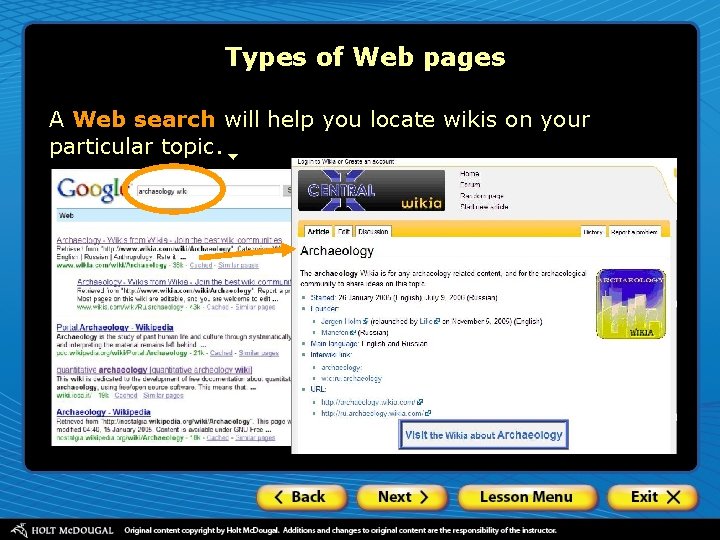
Types of Web pages A Web search will help you locate wikis on your particular topic.
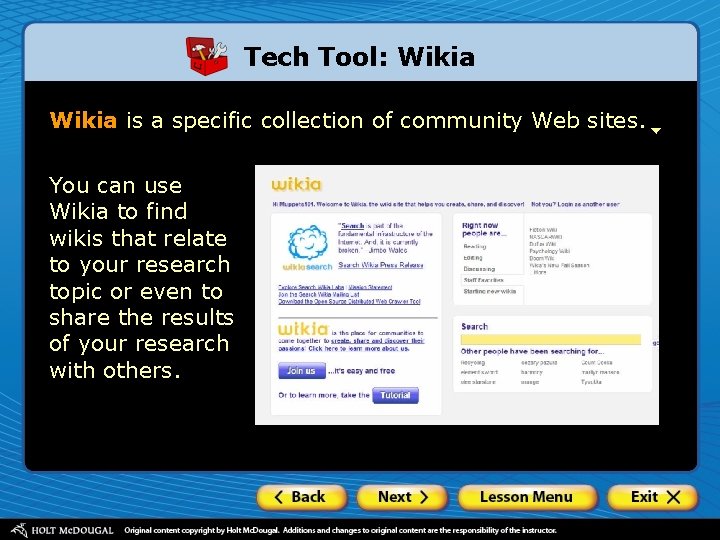
Tech Tool: Wikia is a specific collection of community Web sites. You can use Wikia to find wikis that relate to your research topic or even to share the results of your research with others.
Evaluating Web pages With so many great research resources available, you have to evaluate the quality of online sources. Evaluate Web content for clarity stability objectivity coverage Following are strategies for deciding whether you should use a Web page as a research source.
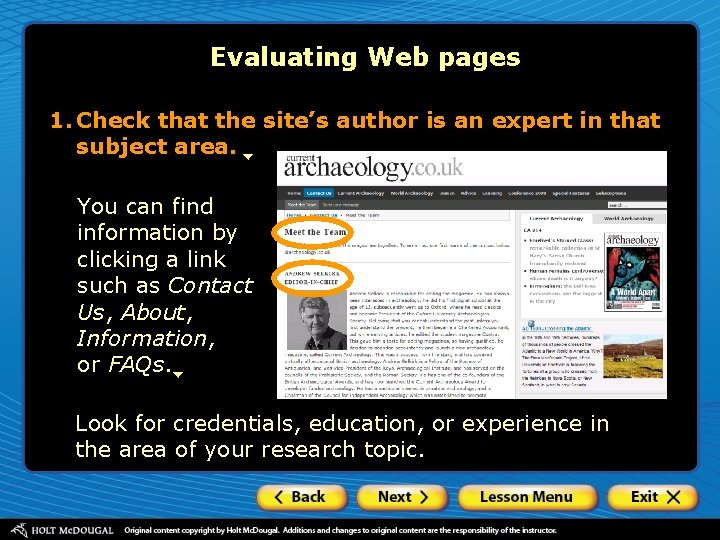
Evaluating Web pages 1. Check that the site’s author is an expert in that subject area. You can find information by clicking a link such as Contact Us, About, Information, or FAQs. Look for credentials, education, or experience in the area of your research topic.
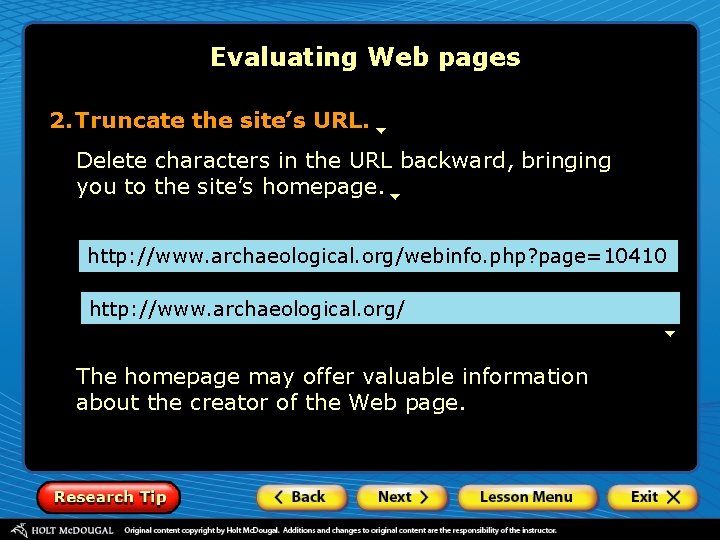
Evaluating Web pages 2. Truncate the site’s URL. Delete characters in the URL backward, bringing you to the site’s homepage. http: //www. archaeological. org/webinfo. php? page=10410 http: //www. archaeological. org/ The homepage may offer valuable information about the creator of the Web page.
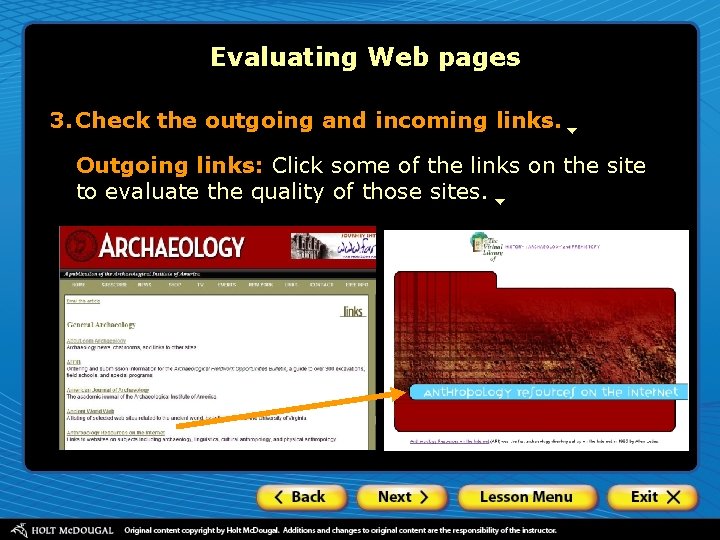
Evaluating Web pages 3. Check the outgoing and incoming links. Outgoing links: Click some of the links on the site to evaluate the quality of those sites.
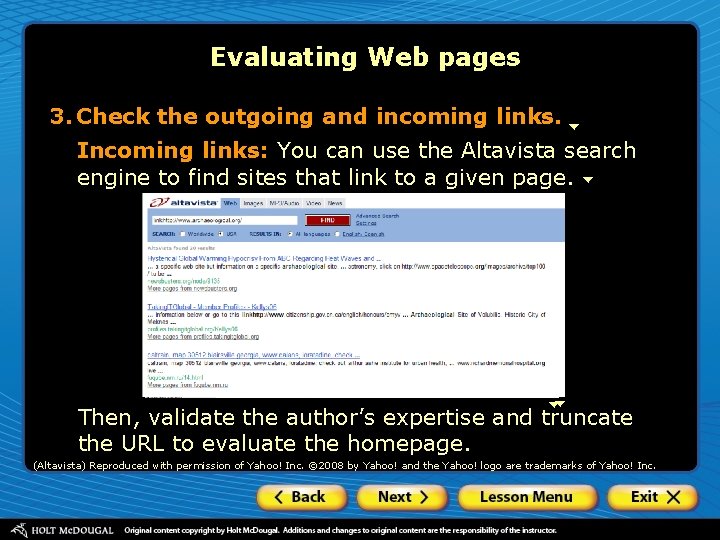
Evaluating Web pages 3. Check the outgoing and incoming links. Incoming links: You can use the Altavista search engine to find sites that link to a given page. Then, validate the author’s expertise and truncate the URL to evaluate the homepage. (Altavista) Reproduced with permission of Yahoo! Inc. © 2008 by Yahoo! and the Yahoo! logo are trademarks of Yahoo! Inc.
Evaluating Web pages 4. Use the Way. Back. Machine to see how the site has evolved since its inception. The Way. Back. Machine is a tool that allows a user to go back and see older versions of Web sites. It’s an archive of the Internet. You can use the Way. Back. Machine to: find an older version of a Web site if you return to the site and see that its content has been updated locate information from a specific day or time period
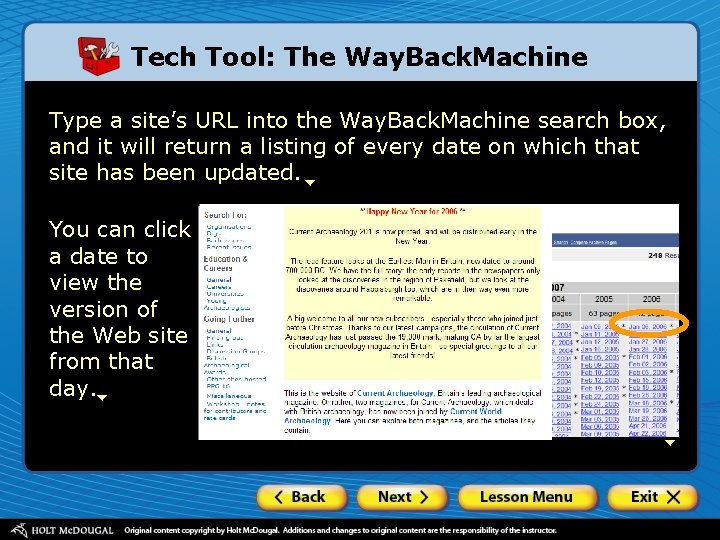
Tech Tool: The Way. Back. Machine Type a site’s URL into the Way. Back. Machine search box, and it will return a listing of every date on which that site has been updated. You can click a date to view the version of the Web site from that day.
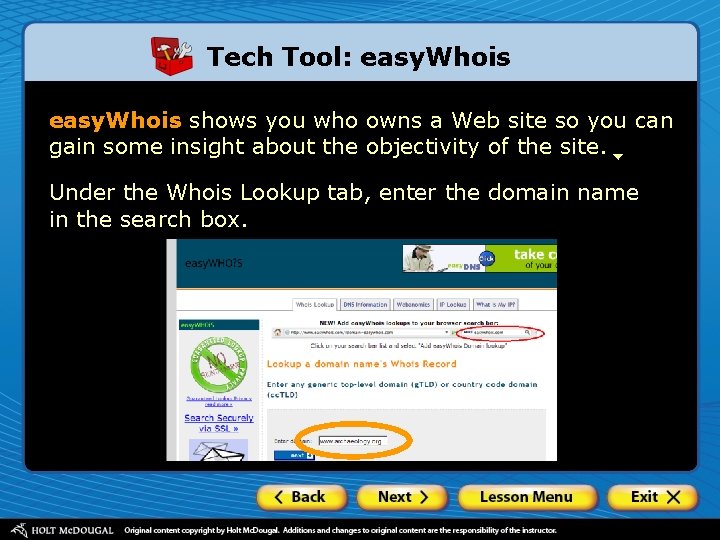
Tech Tool: easy. Whois shows you who owns a Web site so you can gain some insight about the objectivity of the site. Under the Whois Lookup tab, enter the domain name in the search box.
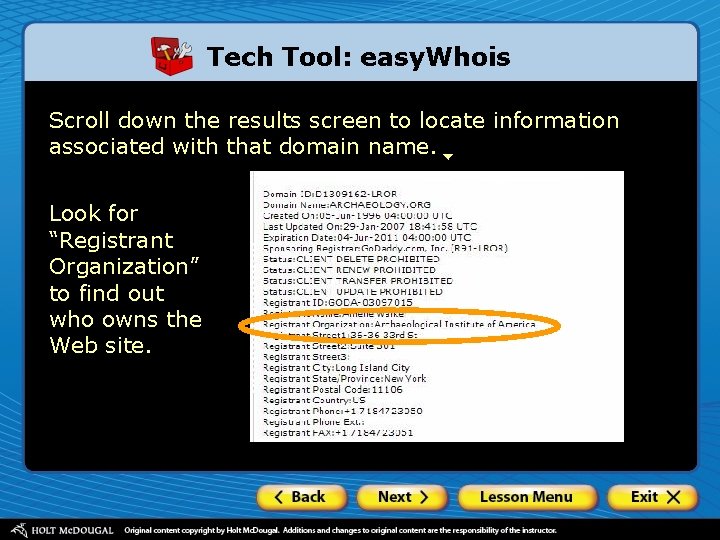
Tech Tool: easy. Whois Scroll down the results screen to locate information associated with that domain name. Look for “Registrant Organization” to find out who owns the Web site.
Talk About It Discuss these questions with your classmates. 1. Why should you use several sources to confirm information you find online? 2. After what you have learned in this lesson, how will you change the process you use to select online sources? 3. How might using online scholarly journals enrich your research? 4. Have you used a wiki or blog as a research source? What was your experience?
Your Turn Choose a familiar research topic and complete the activities below. 1. Find three types of online sources (scholarly journal article, Web site, e-zine article, and so on) about your topic. 2. Use the strategies presented in this lesson to evaluate each source: check an author’s expertise, truncate a Web site’s URL, check links, and so on. 3. Use the Way. Back. Machine to view a previous version of one of these sources. Write a brief explanation of changes made to the site.

The End
- Slides: 25