
Digital Representation of Audio Information Kevin D Donohue
- Slides: 22
Digital Representation of Audio Information Kevin D. Donohue Electrical Engineering University of Kentucky
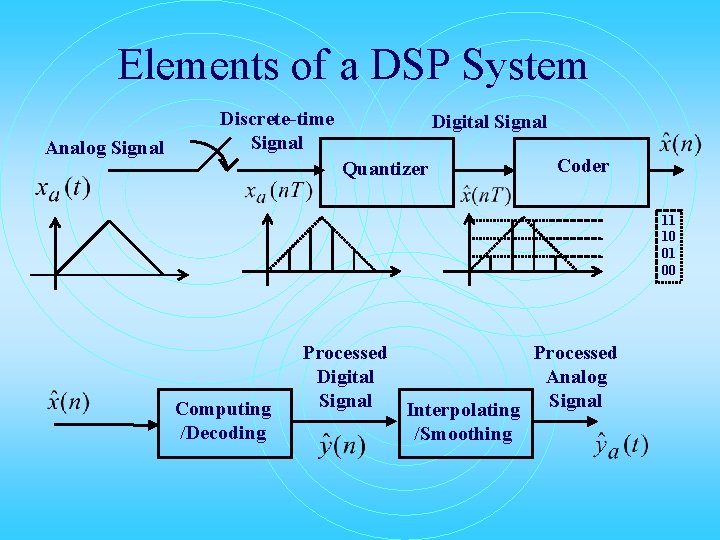
Elements of a DSP System Analog Signal Discrete-time Signal Digital Signal Quantizer Coder 11 10 01 00 Computing /Decoding Processed Digital Analog Signal Interpolating Signal /Smoothing
Critical Audio Issues Trade-off between resources to store/transmit and quality of audio information ØSampling rate ØQuantization level ØCompression techniques
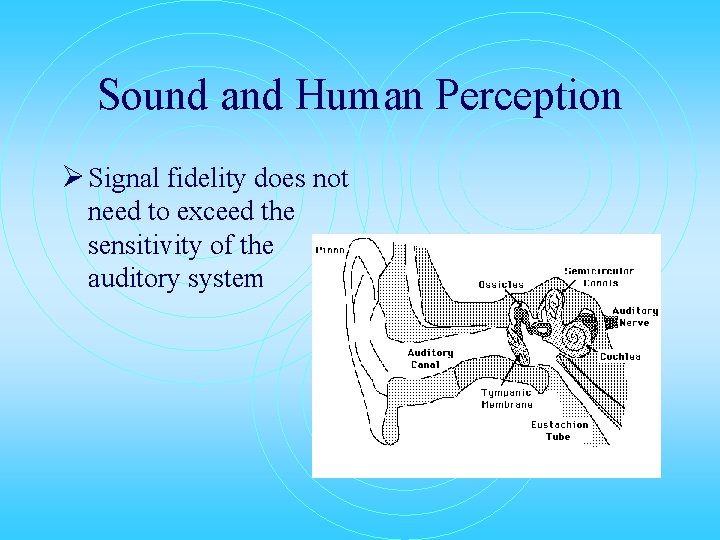
Sound and Human Perception Ø Signal fidelity does not need to exceed the sensitivity of the auditory system
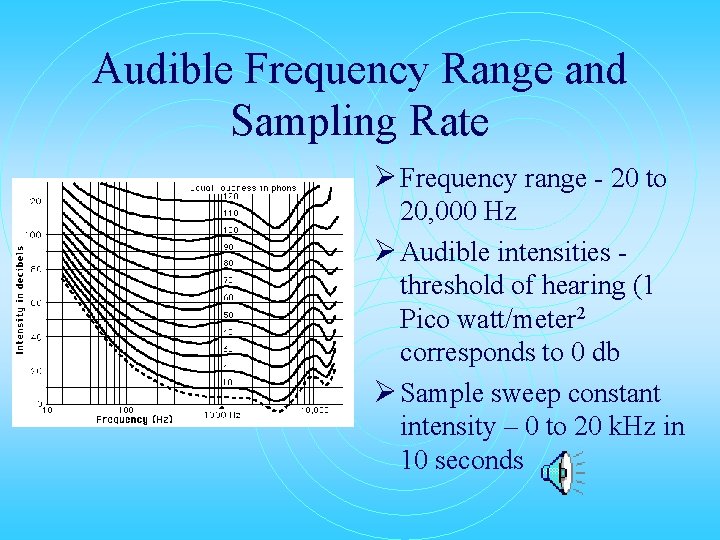
Audible Frequency Range and Sampling Rate Ø Frequency range - 20 to 20, 000 Hz Ø Audible intensities - threshold of hearing (1 Pico watt/meter 2 corresponds to 0 db Ø Sample sweep constant intensity – 0 to 20 k. Hz in 10 seconds
Sampling Requirement Ø A bandlimited signal can be completely reconstructed from a set of discrete samples by low-pass filtering (or interpolating) a sequence of its samples, if the original signal was sampled at a rate greater than twice its highest frequency. Ø Aliasing errors occur when original signal contains frequencies greater than or equal to half the sampling rate. Ø Signal energy beyond 20 k. Hz is not audible, sampling rates beyond 40 k. Hz should capture almost all audible detail (no perceived quality loss).
Sampling Standards Ø CD quality samples at 44. 1 k. Hz Ø DVD quality samples at 48 k. Hz Ø Telephone quality 8 k. Hz.
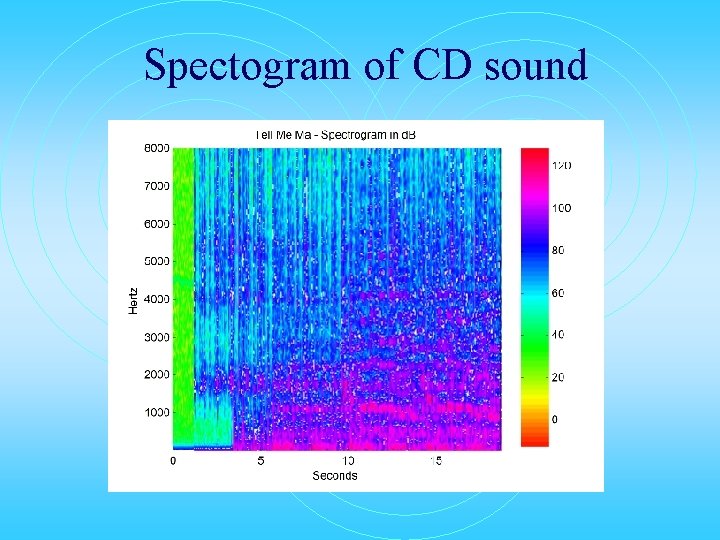
Spectogram of CD sound
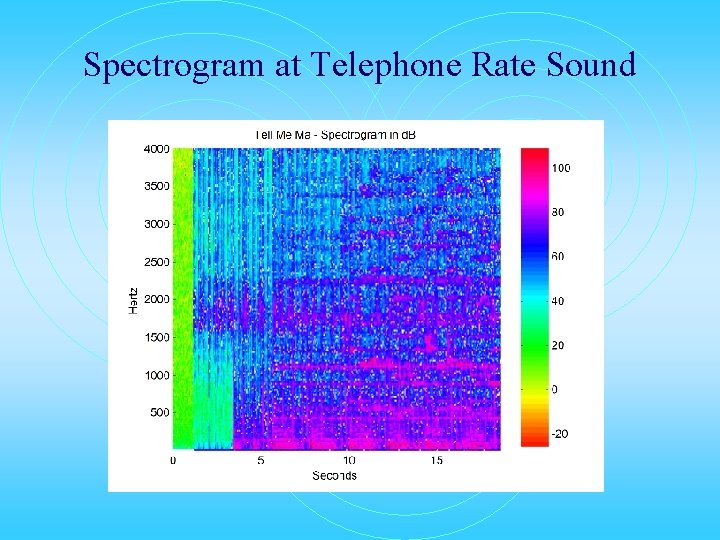
Spectrogram at Telephone Rate Sound
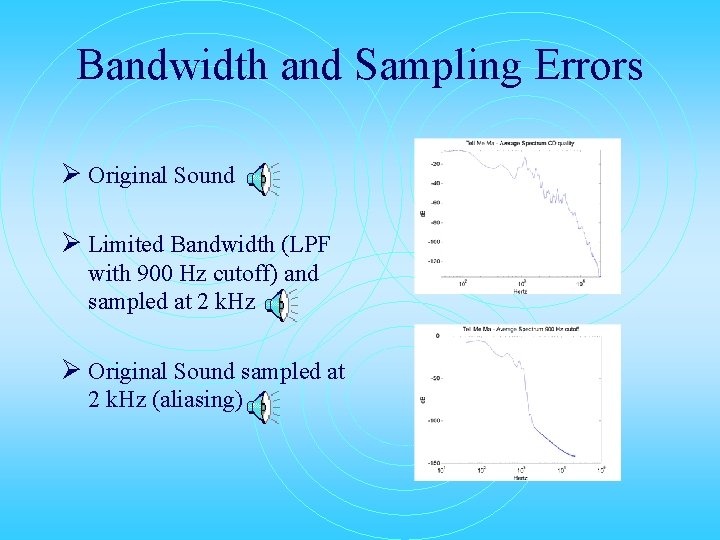
Bandwidth and Sampling Errors Ø Original Sound Ø Limited Bandwidth (LPF with 900 Hz cutoff) and sampled at 2 k. Hz Ø Original Sound sampled at 2 k. Hz (aliasing)
Dynamic Range and Audible Sound ØIntensity changes less than 1 d. B in intensity typically are not perceived by the human auditory system. Ø 25 tones at 1 k. Hz, decreasing in 3 d. B increments ØThe human ear can detect sounds from 1 x 10 -12 to 10 watts / meter 2 (130 d. B dynamic range)
Quantization Levels and Dynamic Range Ø An N bit word can represent 2 N levels Ø For audio signal an N bit word corresponds to: Nx 20 x. Log 10(2) d. B dynamic range Ø 16 bits achieve a dynamic range of about 96 d. B. For every bit added, about 6 db is added to the dynamic range.
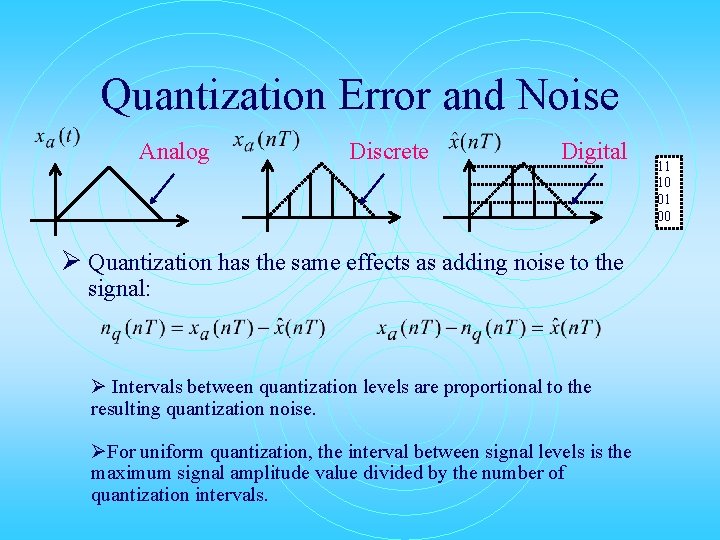
Quantization Error and Noise Analog Discrete Digital Ø Quantization has the same effects as adding noise to the signal: Ø Intervals between quantization levels are proportional to the resulting quantization noise. ØFor uniform quantization, the interval between signal levels is the maximum signal amplitude value divided by the number of quantization intervals. 11 10 01 00
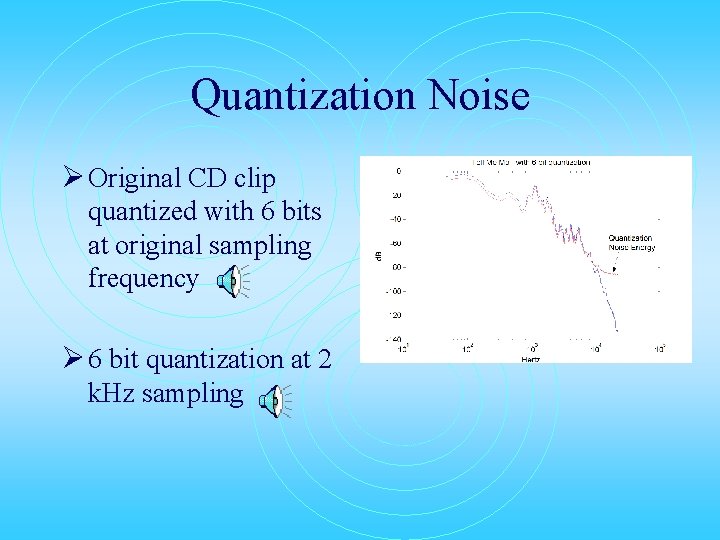
Quantization Noise Ø Original CD clip quantized with 6 bits at original sampling frequency Ø 6 bit quantization at 2 k. Hz sampling
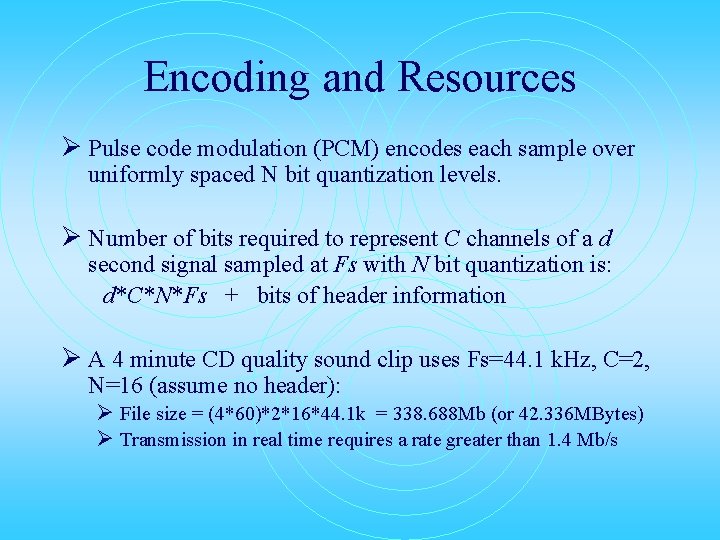
Encoding and Resources Ø Pulse code modulation (PCM) encodes each sample over uniformly spaced N bit quantization levels. Ø Number of bits required to represent C channels of a d second signal sampled at Fs with N bit quantization is: d*C*N*Fs + bits of header information Ø A 4 minute CD quality sound clip uses Fs=44. 1 k. Hz, C=2, N=16 (assume no header): Ø File size = (4*60)*2*16*44. 1 k = 338. 688 Mb (or 42. 336 MBytes) Ø Transmission in real time requires a rate greater than 1. 4 Mb/s
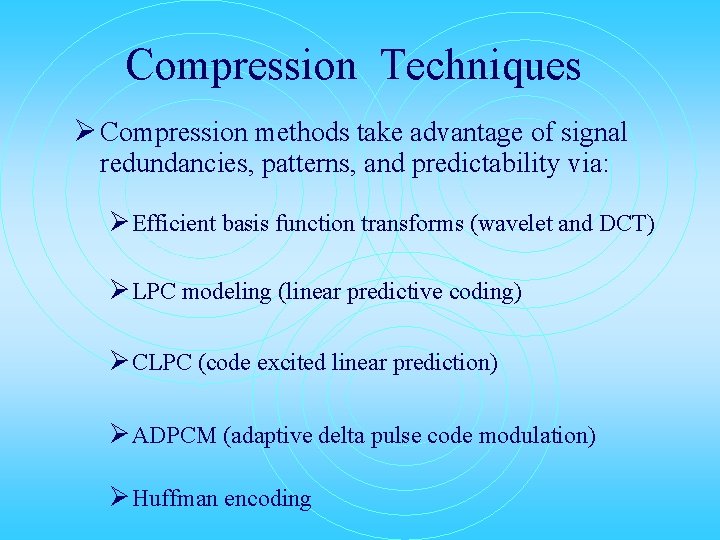
Compression Techniques Ø Compression methods take advantage of signal redundancies, patterns, and predictability via: Ø Efficient basis function transforms (wavelet and DCT) Ø LPC modeling (linear predictive coding) Ø CLPC (code excited linear prediction) Ø ADPCM (adaptive delta pulse code modulation) Ø Huffman encoding
File Formats • Critical parameters for data encoding describe how samples are stored in the file ã signed or unsigned ã bits per sample ã byte order ã number of channels and interleaving ã compression parameters
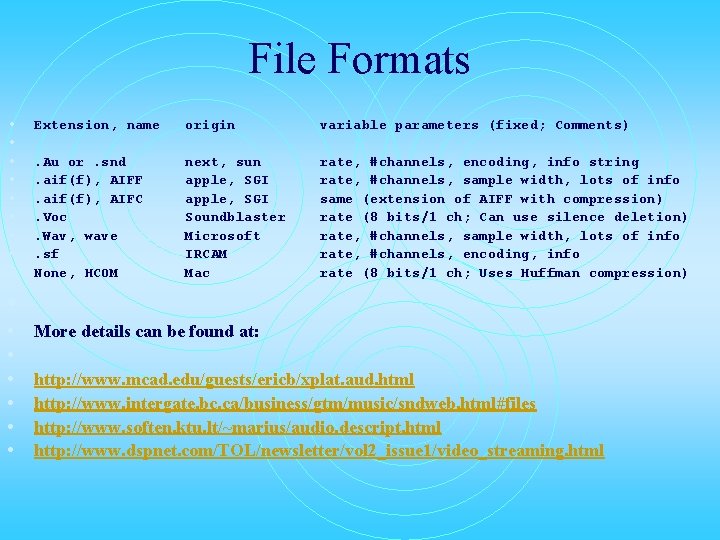
File Formats • • • Extension, name origin variable parameters (fixed; Comments) . Au or. snd next, sun rate, #channels, encoding, info string. aif(f), AIFF apple, SGI rate, #channels, sample width, lots of info. aif(f), AIFC apple, SGI same (extension of AIFF with compression). Voc Soundblaster rate (8 bits/1 ch; Can use silence deletion). Wav, wave Microsoft rate, #channels, sample width, lots of info. sf IRCAM rate, #channels, encoding, info None, HCOM Mac rate (8 bits/1 ch; Uses Huffman compression) • • • • More details can be found at: http: //www. mcad. edu/guests/ericb/xplat. aud. html http: //www. intergate. bc. ca/business/gtm/music/sndweb. html#files http: //www. soften. ktu. lt/~marius/audio. descript. html http: //www. dspnet. com/TOL/newsletter/vol 2_issue 1/video_streaming. html
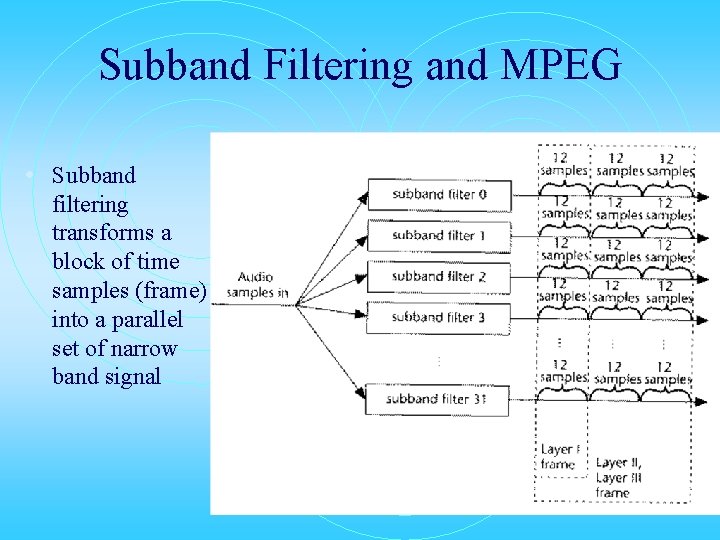
Subband Filtering and MPEG • Subband filtering transforms a block of time samples (frame) into a parallel set of narrow band signal
MPEG Layers â MPEG defines 3 layers for audio. Basic model is same, but codec complexity increases with each layer. â Divides data into frames, each of them contains 384 samples, 12 samples from each of the 32 filtered subbands. â Layer 1: DCT type filter with one frame and equal frequency spread per band. Psychoacoustic model only uses frequency masking (4: 1). â Layer 2: use three frames in filter (before, current, next, a total of 1152 samples). This models some temporal masking (6: 1). â Layer 3: better critical band filter is used (non-equal frequencies), psychoacoustic model includes temporal masking effects, takes into account stereo redundancy, and uses Huffman coder (12: 1).
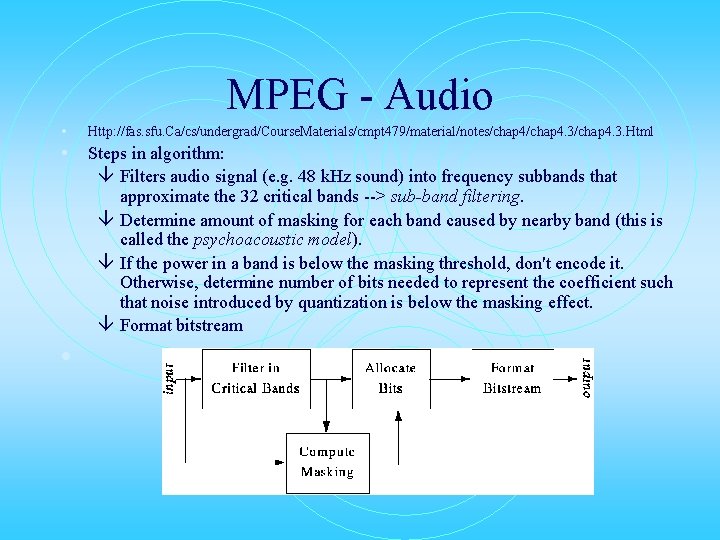
MPEG - Audio • Http: //fas. sfu. Ca/cs/undergrad/Course. Materials/cmpt 479/material/notes/chap 4. 3/chap 4. 3. Html • Steps in algorithm: â Filters audio signal (e. g. 48 k. Hz sound) into frequency subbands that approximate the 32 critical bands --> sub-band filtering. â Determine amount of masking for each band caused by nearby band (this is called the psychoacoustic model). â If the power in a band is below the masking threshold, don't encode it. Otherwise, determine number of bits needed to represent the coefficient such that noise introduced by quantization is below the masking effect. â Format bitstream •
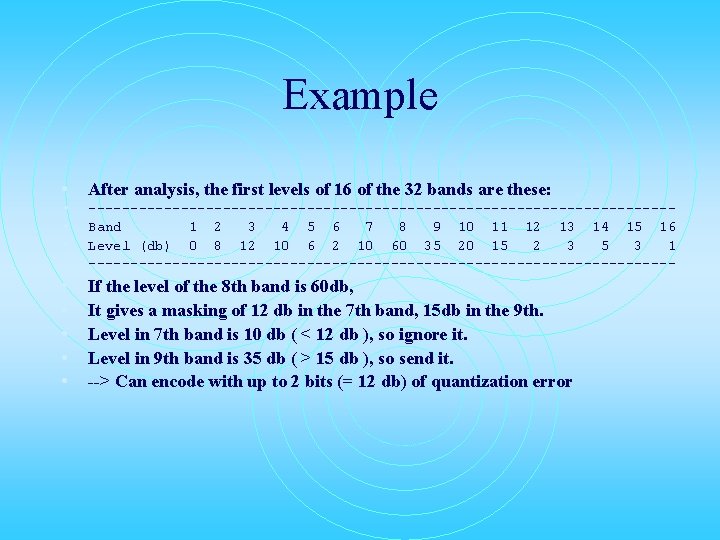
Example • After analysis, the first levels of 16 of the 32 bands are these: • • -----------------------------------Band 1 2 3 4 5 6 7 8 9 10 11 12 13 14 15 16 Level (db) 0 8 12 10 60 35 20 15 2 3 5 3 1 ----------------------------------- • • • If the level of the 8 th band is 60 db, It gives a masking of 12 db in the 7 th band, 15 db in the 9 th. Level in 7 th band is 10 db ( < 12 db ), so ignore it. Level in 9 th band is 35 db ( > 15 db ), so send it. --> Can encode with up to 2 bits (= 12 db) of quantization error