
Digital Preservation Storage Infrastructures for Texas State University









- Slides: 31
Digital Preservation Storage Infrastructures for Texas State University Libraries Ray Uzwyshyn, Director Collections and Digital Services On Behalf of Alkek Library Digital Preservation Working Group January 2020
What is Library Digital Preservation Storage? • Simply put, Very long-term Digital Storage. • The University Libraries, The Wittliff Collections and University Archives increasingly collect and gather digital information, media and data. • This data requires longer term digital storage in line with Research library national standards (ISO standards: 16363, 16919, 14721) and longer-term new millenia archival perspectives
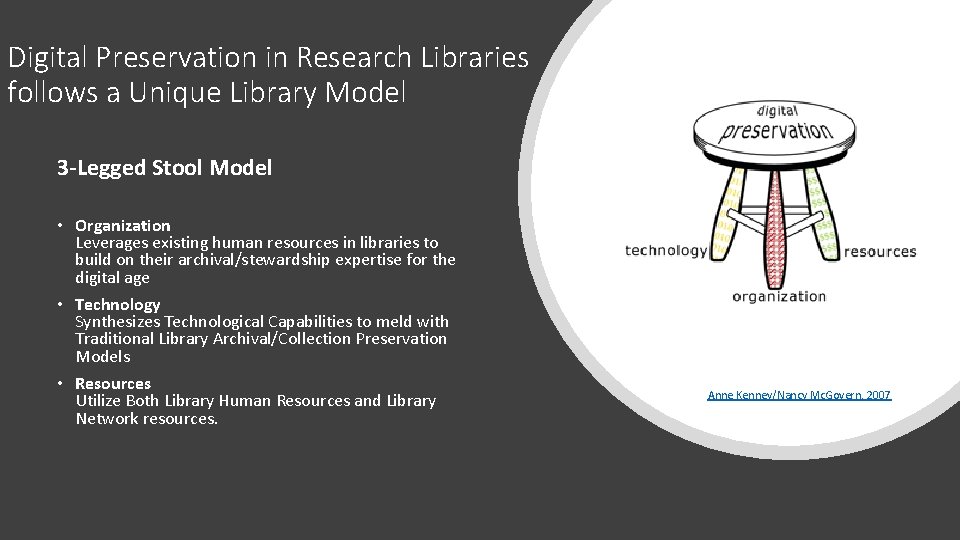
Digital Preservation in Research Libraries follows a Unique Library Model 3 -Legged Stool Model • Organization Leverages existing human resources in libraries to build on their archival/stewardship expertise for the digital age • Technology Synthesizes Technological Capabilities to meld with Traditional Library Archival/Collection Preservation Models • Resources Utilize Both Library Human Resources and Library Network resources. Anne Kenney/Nancy Mc. Govern, 2007
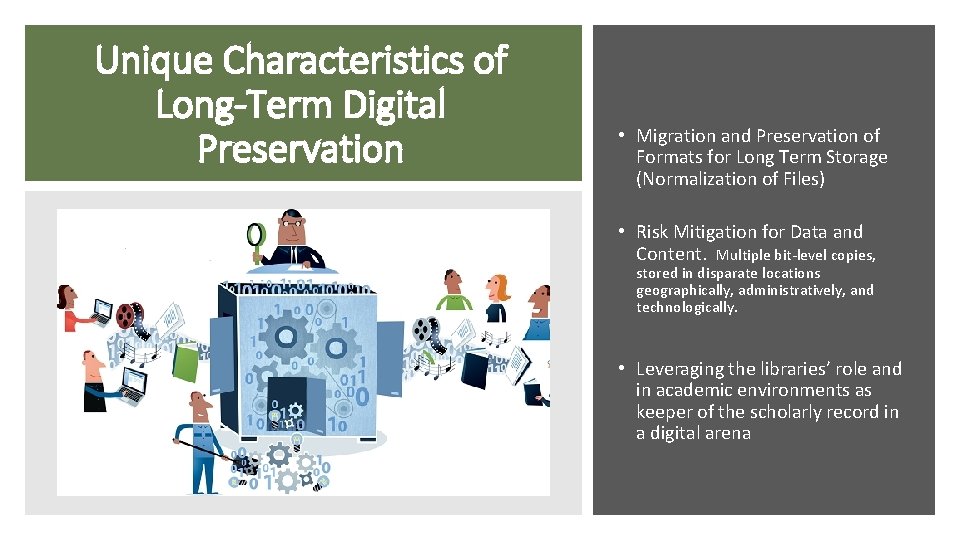
Unique Characteristics of Long-Term Digital Preservation • Migration and Preservation of Formats for Long Term Storage (Normalization of Files) • Risk Mitigation for Data and Content. Multiple bit-level copies, stored in disparate locations geographically, administratively, and technologically. • Leveraging the libraries’ role and in academic environments as keeper of the scholarly record in a digital arena
Texas State University Libraries Digital Preservation Working Group Background & History • Formed 2015 and consists of members of Libraries’ Digital and Web Services (Digitalization Lab, Institutional Repositories) University Archives, Wittliff Collections, Library General Collections • Group began by investigating and then authoring the Libraries’ first Digital Preservation Policy Document (August 2016), benchmark minimums for preservation Masters etc. • Created Dedicated Local Server Space for Preservation Files and Use Files with TR • Opened and Developed an ongoing relationship with Windows Team (Todd)
2016 -2018 New Digital Preservation Tools, Platforms and Resources Became Available • Archivematica: Middleware standard for Digital Preservation Metadata and Integrity • Archivematica bundles micro-services for normalizing files, managing metadata and verifying file types, bit-level integrity (checksums) etc. • Arch • Texas State Began R&D with Archivematica on Linux Ubuntu and first deployed production level instance on a new Archivematica Linux Red Hat platform • University Archives and Wittliff Collections began experimenting with, learning and utilizing Software • All various areas gained expertise in Metadata, middleware workflow process (Archivematica) to create AIP’s (Archival Information Packages) to safely store, archive and retrieve files and metadata for later use
Digital Preservation Group Conducted Initial Digital Storage Needs Estimate (2016) • Conclusions: 10 -12 TB/year for all access files needed (Not permanent Digital Storage, requiring now 60 -70 TB) • University Archives: • • • Thesis project: 500 GB per year Yearbook/Football negatives: 235 GB per year San Marcos Daily Record Negatives 1500 GB per year Audio digitization: 500 GB per year. Misc imaging: 500 GB per year • Wittliff Collections: • • • Unique digitization projects. Lonesome Dove Dailies (20 TB), Powers (10 TB) , Broyles (300 GB). Jerry Jeff Walker 2# reel tapes. O’Connor Collection/New Major Donation example (2 TB). Austin Film Festival: 1. 5 TB per year, (2+ years). Misc imaging: 2 TB per year Audio digitization: Wittliff: 200 GB / year • General Collections: • Streaming media archive: 2 TB per year, General Collections (Covered by LOCKSS, PORTICO Memberships)
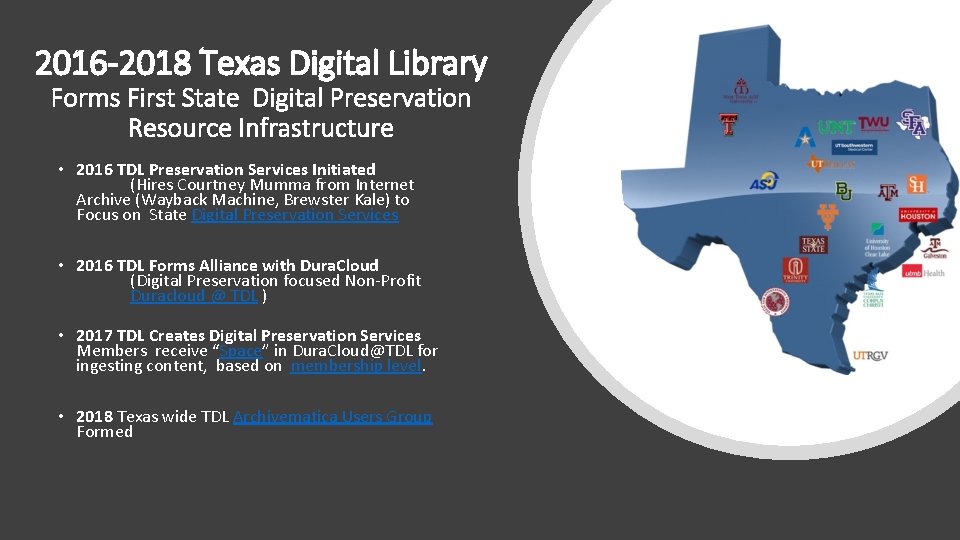
2016 -2018 Texas Digital Library Forms First State Digital Preservation Resource Infrastructure • 2016 TDL Preservation Services Initiated (Hires Courtney Mumma from Internet Archive (Wayback Machine, Brewster Kale) to Focus on State Digital Preservation Services • 2016 TDL Forms Alliance with Dura. Cloud (Digital Preservation focused Non-Profit Duracloud @ TDL ) • 2017 TDL Creates Digital Preservation Services Members receive “Space” in Dura. Cloud@TDL for ingesting content, based on membership level. • 2018 Texas wide TDL Archivematica Users Group Formed
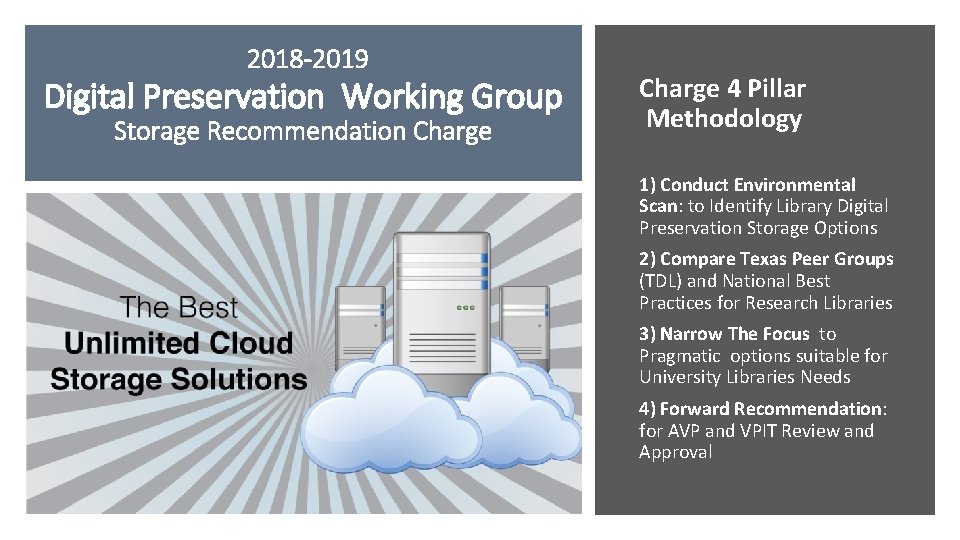
2018 -2019 Digital Preservation Working Group Storage Recommendation Charge 4 Pillar Methodology 1) Conduct Environmental Scan: to Identify Library Digital Preservation Storage Options 2) Compare Texas Peer Groups (TDL) and National Best Practices for Research Libraries 3) Narrow The Focus to Pragmatic options suitable for University Libraries Needs 4) Forward Recommendation: for AVP and VPIT Review and Approval
• Investigation begins into various Historic, Library Centered, University and Commercial Solutions 2019 Digital Preservation Storage Focus • Continued growing recognition of permanent digital preservation storage needs for libraries • Growing recognition that resource possibilities are maturing and widely available both commercially and in the library space • Possible solutions overviewed ranged from new to historical models to In-House and Outsourcing possibilities
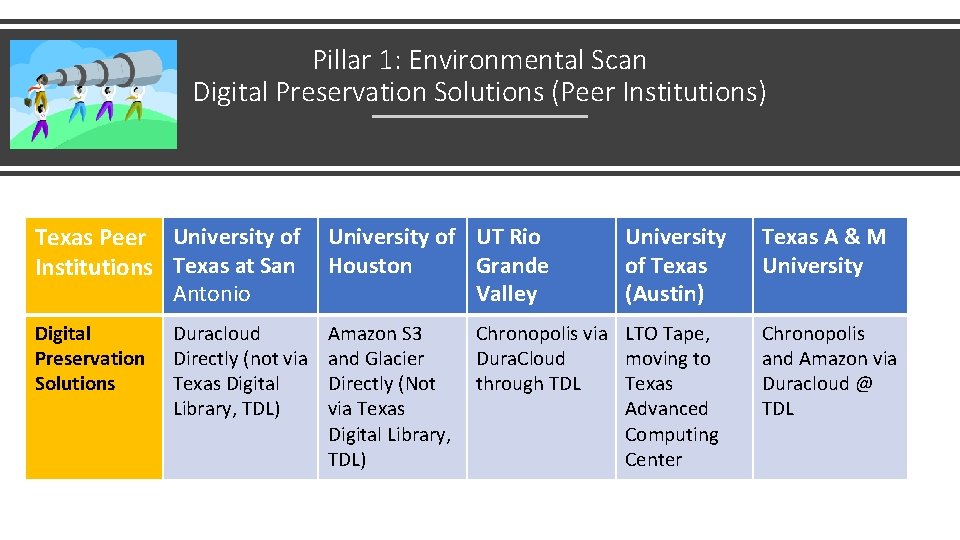
Pillar 1: Environmental Scan Digital Preservation Solutions (Peer Institutions) Texas Peer University of Institutions Texas at San Antonio University of UT Rio Houston Grande Valley Digital Preservation Solutions Amazon S 3 and Glacier Directly (Not via Texas Digital Library, TDL) Duracloud Directly (not via Texas Digital Library, TDL) University of Texas (Austin) Chronopolis via LTO Tape, Dura. Cloud moving to through TDL Texas Advanced Computing Center Texas A & M University Chronopolis and Amazon via Duracloud @ TDL
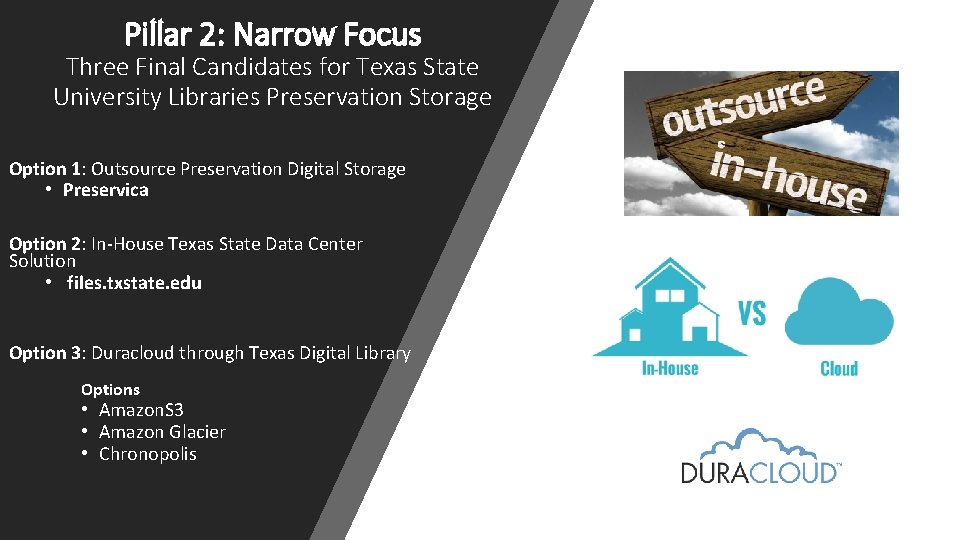
Pillar 2: Narrow Focus Three Final Candidates for Texas State University Libraries Preservation Storage Option 1: Outsource Preservation Digital Storage • Preservica Option 2: In-House Texas State Data Center Solution • files. txstate. edu Option 3: Duracloud through Texas Digital Library Options • Amazon. S 3 • Amazon Glacier • Chronopolis
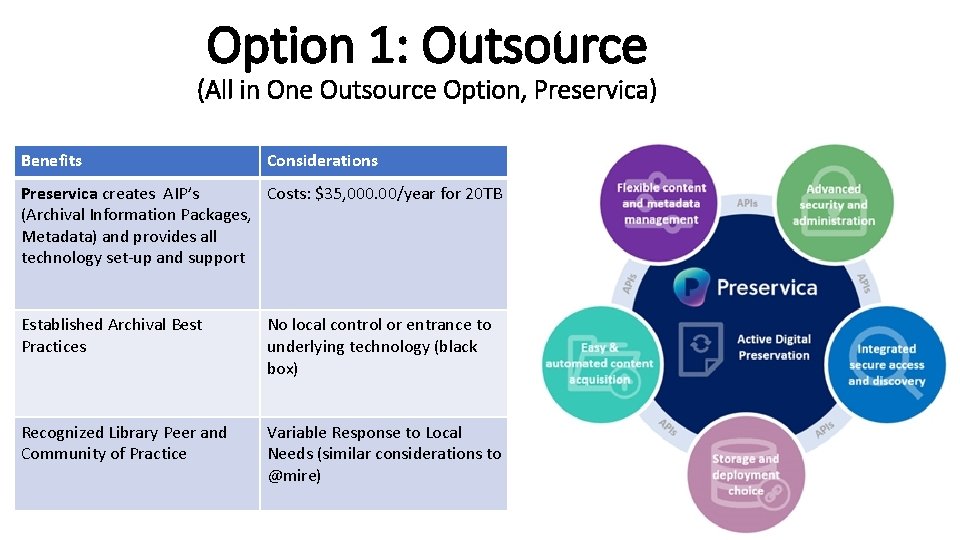
Option 1: Outsource (All in One Outsource Option, Preservica) Benefits Considerations Preservica creates AIP’s Costs: $35, 000. 00/year for 20 TB (Archival Information Packages, Metadata) and provides all technology set-up and support Established Archival Best Practices No local control or entrance to underlying technology (black box) Recognized Library Peer and Community of Practice Variable Response to Local Needs (similar considerations to @mire)
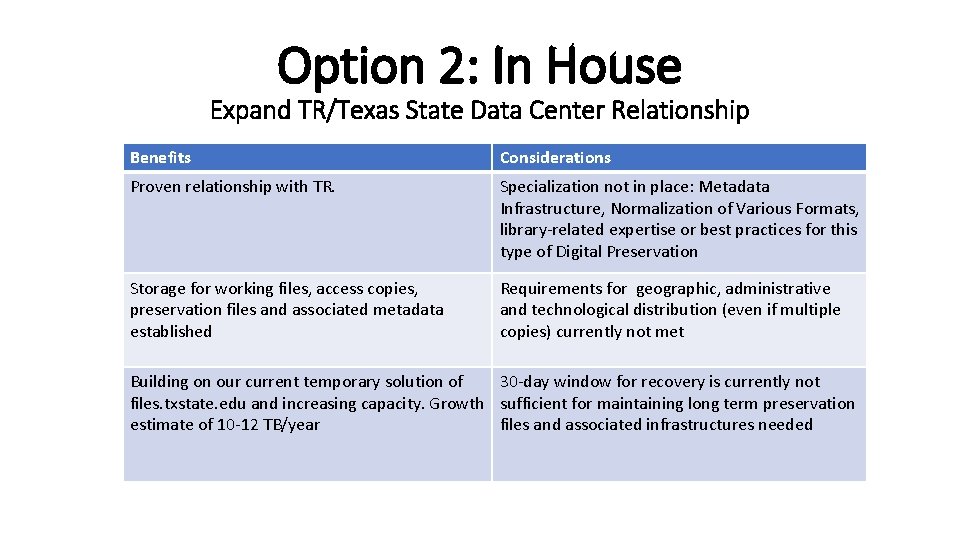
Option 2: In House Expand TR/Texas State Data Center Relationship Benefits Considerations Proven relationship with TR. Specialization not in place: Metadata Infrastructure, Normalization of Various Formats, library-related expertise or best practices for this type of Digital Preservation Storage for working files, access copies, preservation files and associated metadata established Requirements for geographic, administrative and technological distribution (even if multiple copies) currently not met Building on our current temporary solution of 30 -day window for recovery is currently not files. txstate. edu and increasing capacity. Growth sufficient for maintaining long term preservation estimate of 10 -12 TB/year files and associated infrastructures needed
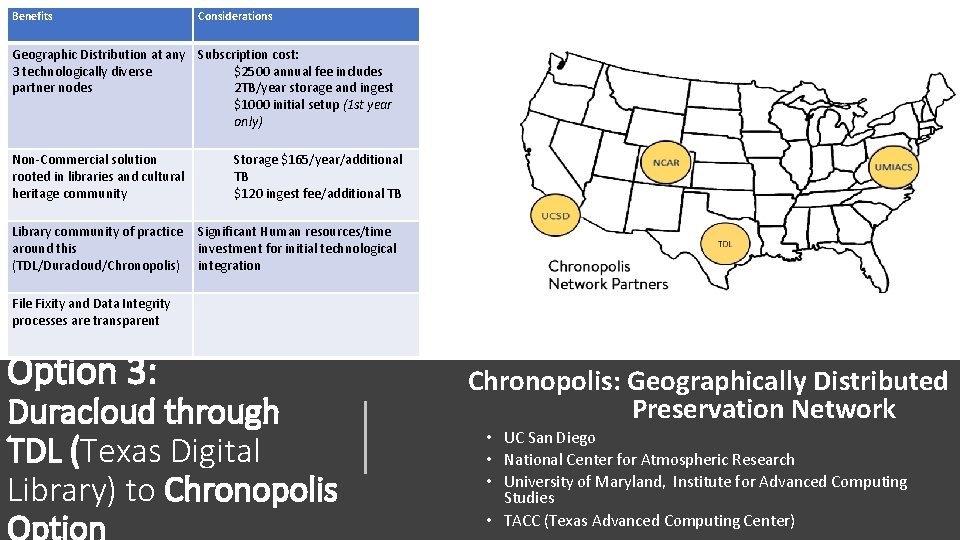
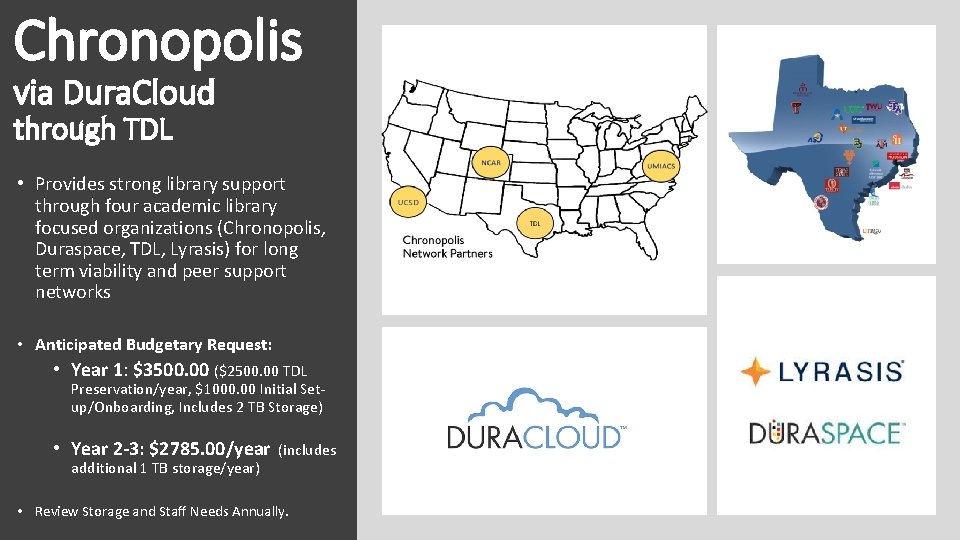
Benefits Considerations Geographic Distribution at any Subscription cost: 3 technologically diverse $2500 annual fee includes partner nodes 2 TB/year storage and ingest $1000 initial setup (1 st year only) Non-Commercial solution rooted in libraries and cultural heritage community Library community of practice around this (TDL/Duracloud/Chronopolis) Storage $165/year/additional TB $120 ingest fee/additional TB Significant Human resources/time investment for initial technological integration File Fixity and Data Integrity processes are transparent Option 3: Duracloud through TDL (Texas Digital Library) to Chronopolis Option Chronopolis: Geographically Distributed Preservation Network • UC San Diego • National Center for Atmospheric Research • University of Maryland, Institute for Advanced Computing Studies • TACC (Texas Advanced Computing Center)
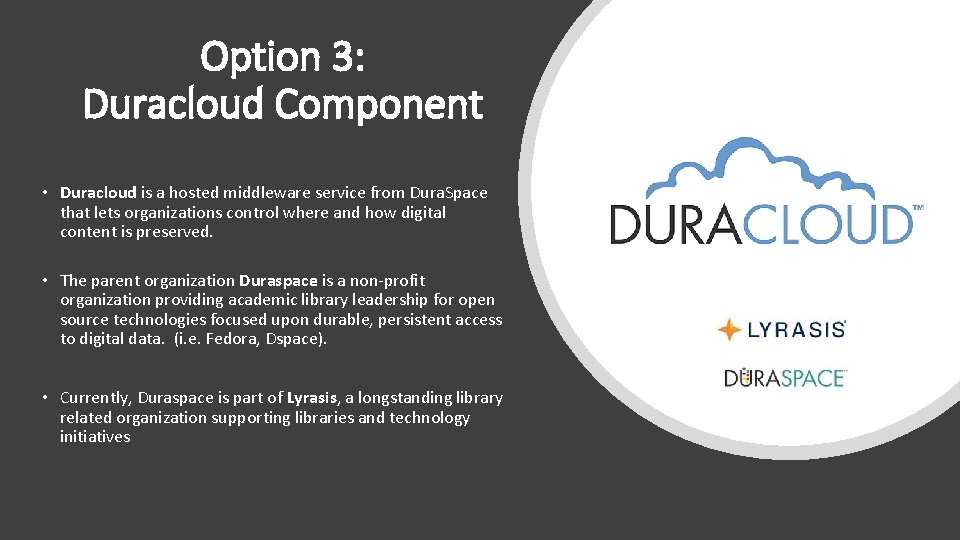
Option 3: Duracloud Component • Duracloud is a hosted middleware service from Dura. Space that lets organizations control where and how digital content is preserved. • The parent organization Duraspace is a non-profit organization providing academic library leadership for open source technologies focused upon durable, persistent access to digital data. (i. e. Fedora, Dspace). • Currently, Duraspace is part of Lyrasis, a longstanding library related organization supporting libraries and technology initiatives
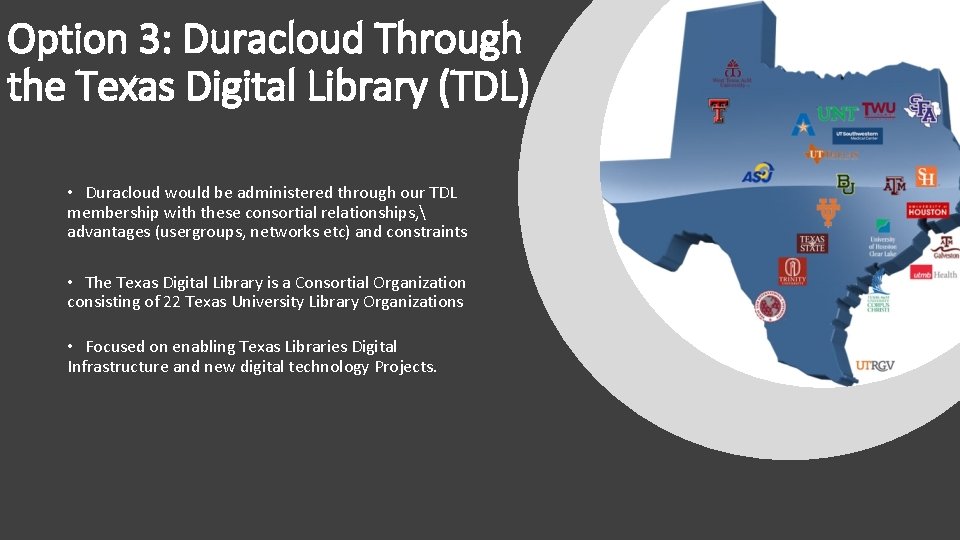
Option 3: Duracloud Through the Texas Digital Library (TDL) • Duracloud would be administered through our TDL membership with these consortial relationships, advantages (usergroups, networks etc) and constraints • The Texas Digital Library is a Consortial Organization consisting of 22 Texas University Library Organizations • Focused on enabling Texas Libraries Digital Infrastructure and new digital technology Projects.
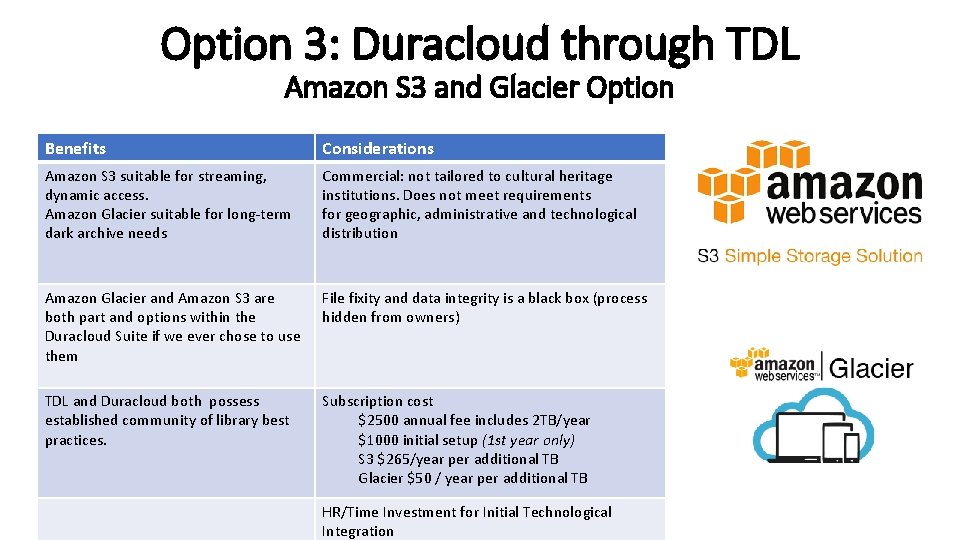
Option 3: Duracloud through TDL Amazon S 3 and Glacier Option Benefits Considerations Amazon S 3 suitable for streaming, dynamic access. Amazon Glacier suitable for long-term dark archive needs Commercial: not tailored to cultural heritage institutions. Does not meet requirements for geographic, administrative and technological distribution Amazon Glacier and Amazon S 3 are both part and options within the Duracloud Suite if we ever chose to use them File fixity and data integrity is a black box (process hidden from owners) TDL and Duracloud both possess established community of library best practices. Subscription cost $2500 annual fee includes 2 TB/year $1000 initial setup (1 st year only) S 3 $265/year per additional TB Glacier $50 / year per additional TB HR/Time Investment for Initial Technological Integration
Digital Preservation Storage Working Group Final Recommendation
Chronopolis via Dura. Cloud through TDL • Provides strong library support through four academic library focused organizations (Chronopolis, Duraspace, TDL, Lyrasis) for long term viability and peer support networks • Anticipated Budgetary Request: • Year 1: $3500. 00 ($2500. 00 TDL Preservation/year, $1000. 00 Initial Setup/Onboarding, Includes 2 TB Storage) • Year 2 -3: $2785. 00/year additional 1 TB storage/year) (includes • Review Storage and Staff Needs Annually.
Deeper Rationale For Long Term Digital Preservation Storage Infrastructure • New Level of Service Expected by Donors, Researchers, Faculty and students. • Present Area of Focus for Research Libraries • Connects Library with many State and National Library Technology Organizations focused on these Issues (TDL, Texas Digital Library, CNI, Coalition of Network Information, JISC, LITA Library Information Technology Association, Chronopolis, Duraspace) • Places Texas State Libraries in Line with institutions we have joined and are aspiring towards (GWLA, Greater Western Library Association and ARL, Association of Research Libraries)
Questions?