
Digital Photography By Ilana Logvinsky Camera Angles Most
Digital Photography By : Ilana Logvinsky
Camera Angles
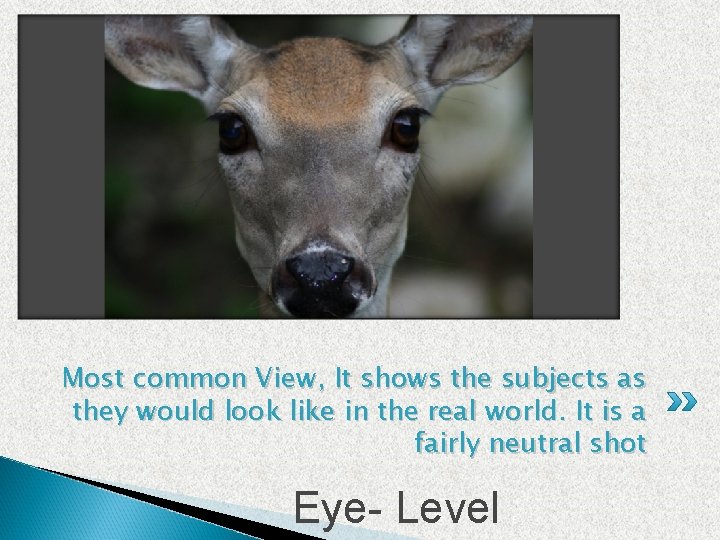
Most common View, It shows the subjects as they would look like in the real world. It is a fairly neutral shot Eye- Level E
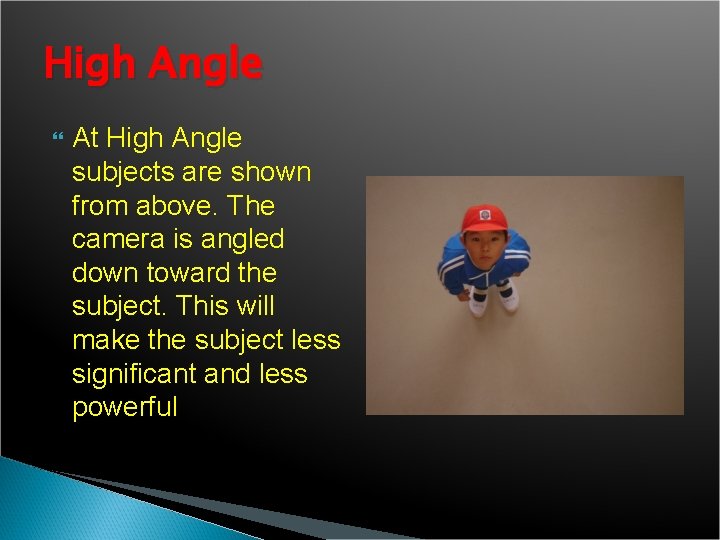
High Angle At High Angle subjects are shown from above. The camera is angled down toward the subject. This will make the subject less significant and less powerful
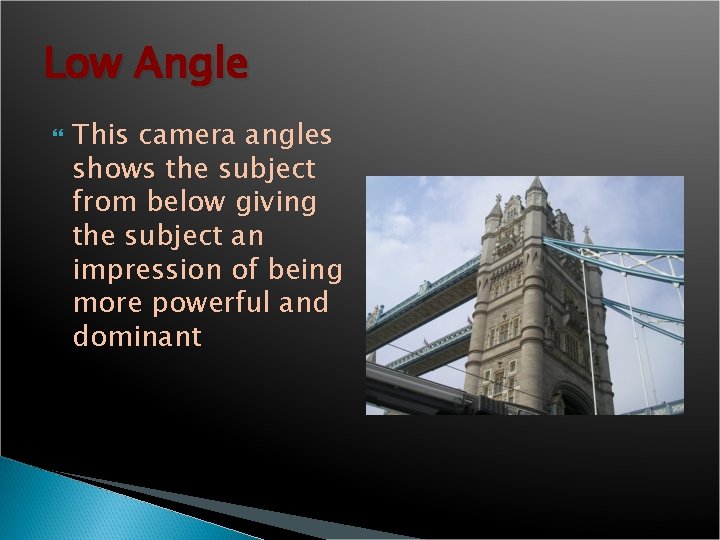
Low Angle This camera angles shows the subject from below giving the subject an impression of being more powerful and dominant

Bird’s Eye The camera angle is shot from above. It is an unnatural point of view which can be used for dramatic effect or for showing a different spatial perspective.
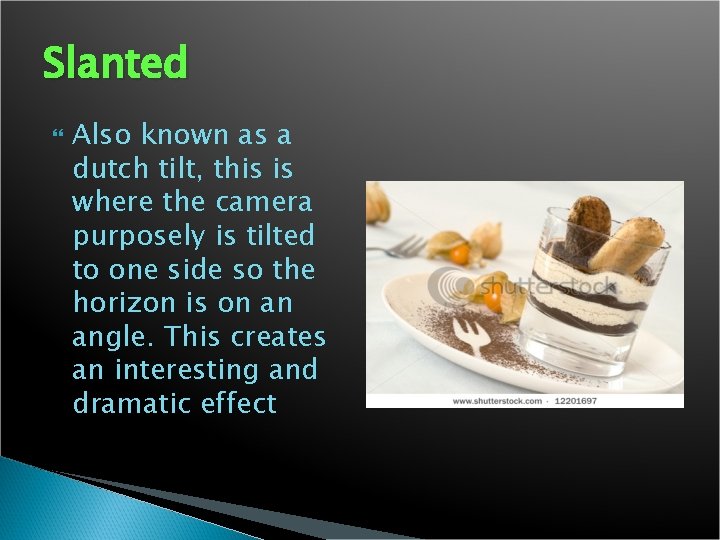
Slanted Also known as a dutch tilt, this is where the camera purposely is tilted to one side so the horizon is on an angle. This creates an interesting and dramatic effect
Camera Shots
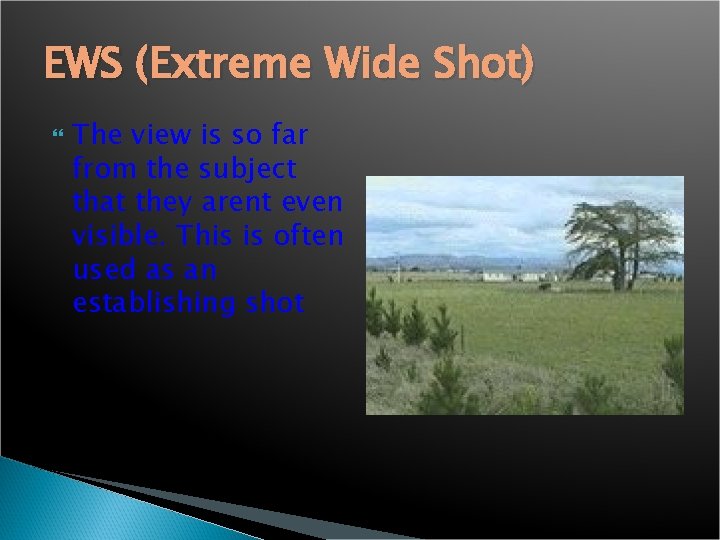
EWS (Extreme Wide Shot) The view is so far from the subject that they arent even visible. This is often used as an establishing shot
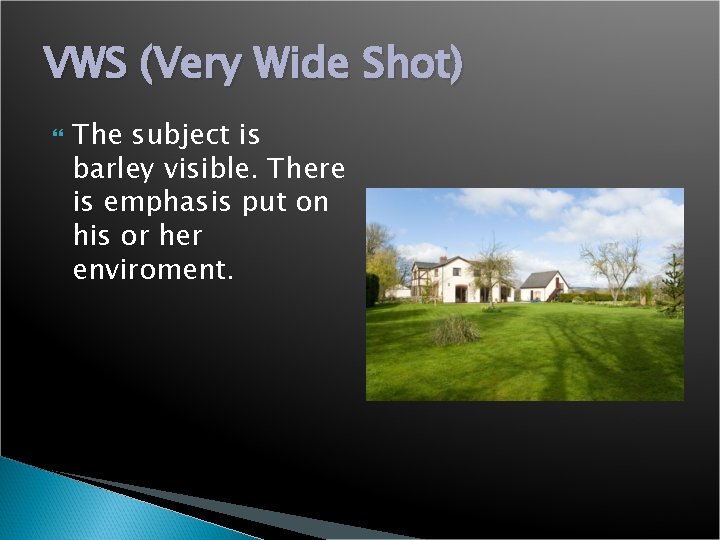
VWS (Very Wide Shot) The subject is barley visible. There is emphasis put on his or her enviroment.
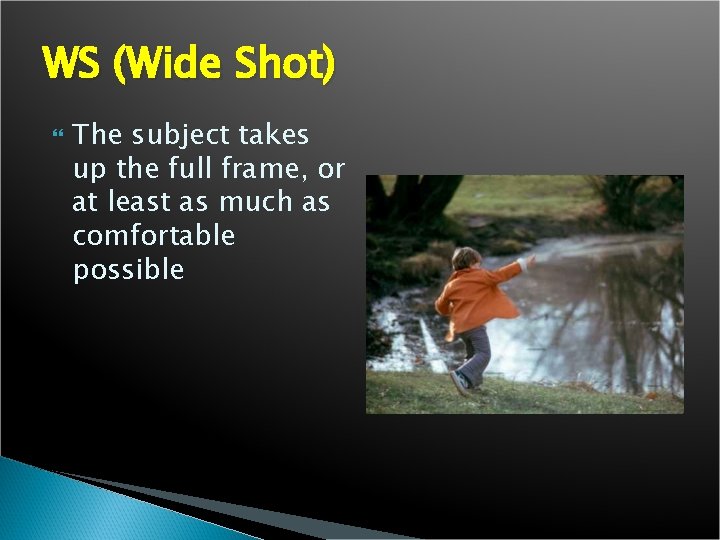
WS (Wide Shot) The subject takes up the full frame, or at least as much as comfortable possible
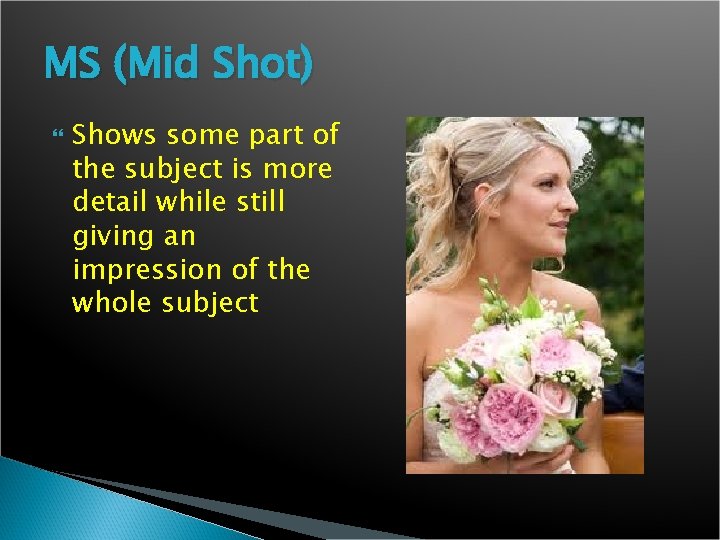
MS (Mid Shot) Shows some part of the subject is more detail while still giving an impression of the whole subject
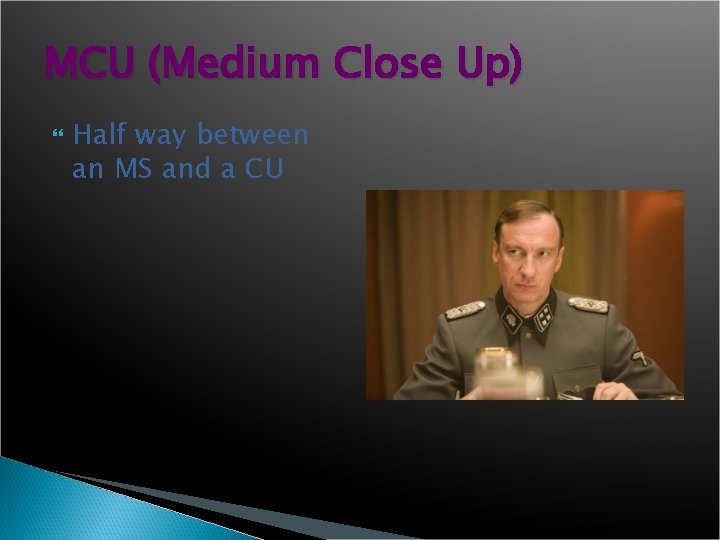
MCU (Medium Close Up) Half way between an MS and a CU
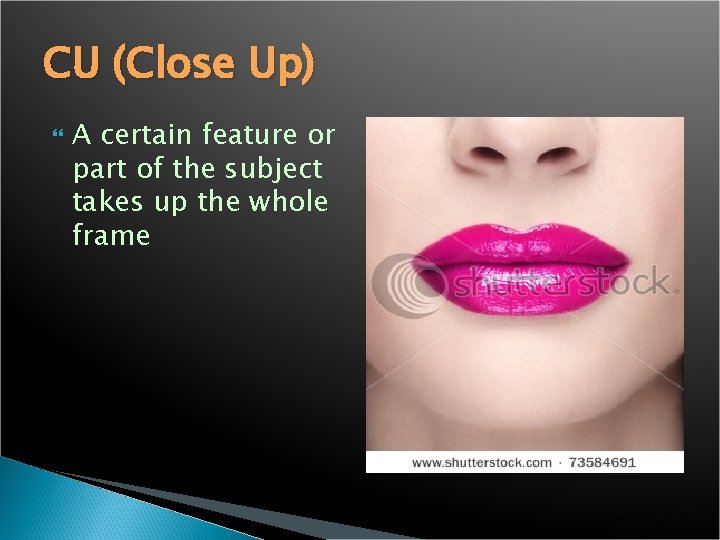
CU (Close Up) A certain feature or part of the subject takes up the whole frame
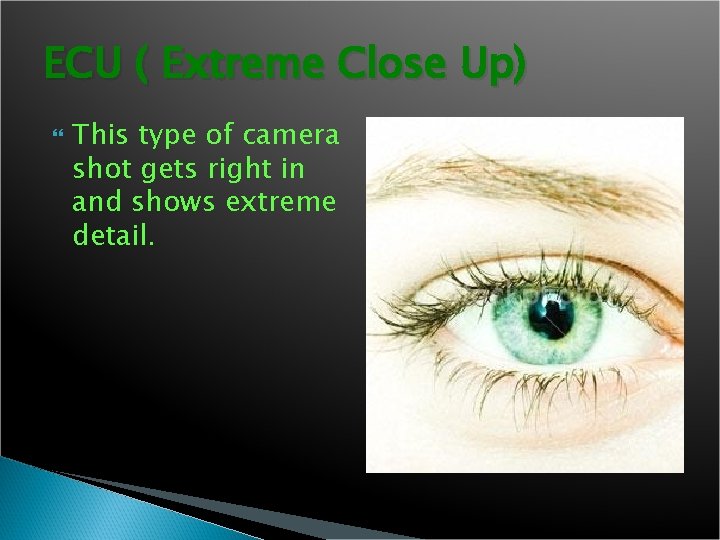
ECU ( Extreme Close Up) This type of camera shot gets right in and shows extreme detail.
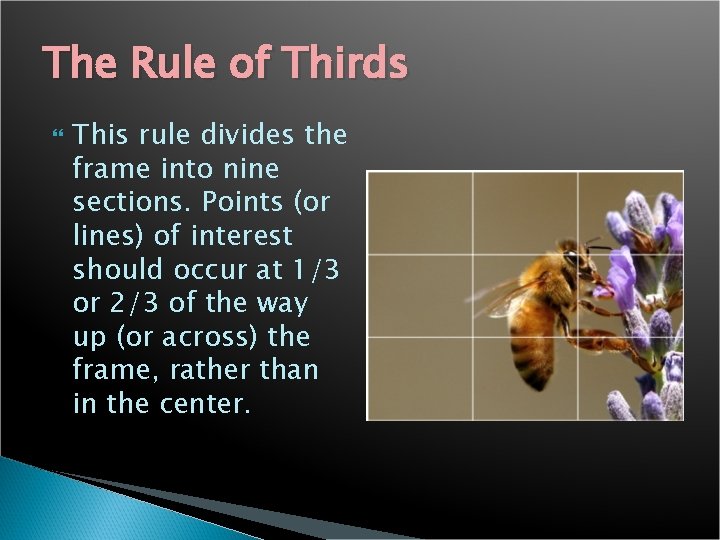
The Rule of Thirds This rule divides the frame into nine sections. Points (or lines) of interest should occur at 1/3 or 2/3 of the way up (or across) the frame, rather than in the center.
Types of Photography
Amateur Any type of photography practiced by nonprofessionals. I like this type of photography because I am not a professional and I like to take pictures of random objects.
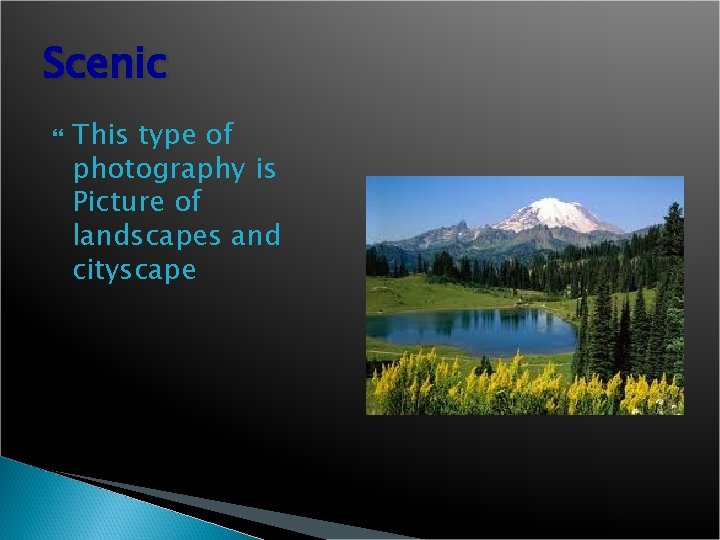
Scenic This type of photography is Picture of landscapes and cityscape
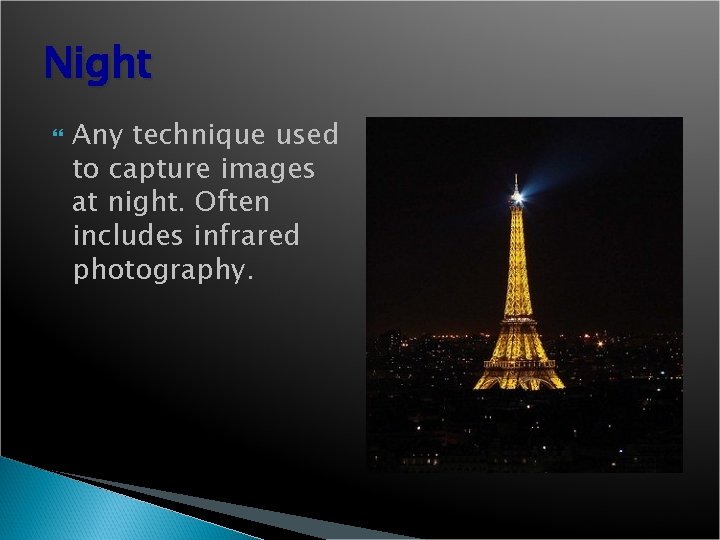
Night Any technique used to capture images at night. Often includes infrared photography.
Body: A light-tight compartment to house the recording medium (film or CCD). Lens: A transparent element to focus light rays onto the recording medium. Aperture: A method of controlling how much light reaches the recording medium. Shutter: A method of controlling how long the recording medium is exposed to the incoming light. Viewfinder: A way to see the image that is to be captured. Transport: In film cameras, a method of moving the film and holding it in the correct position. 6 Components of the Camera
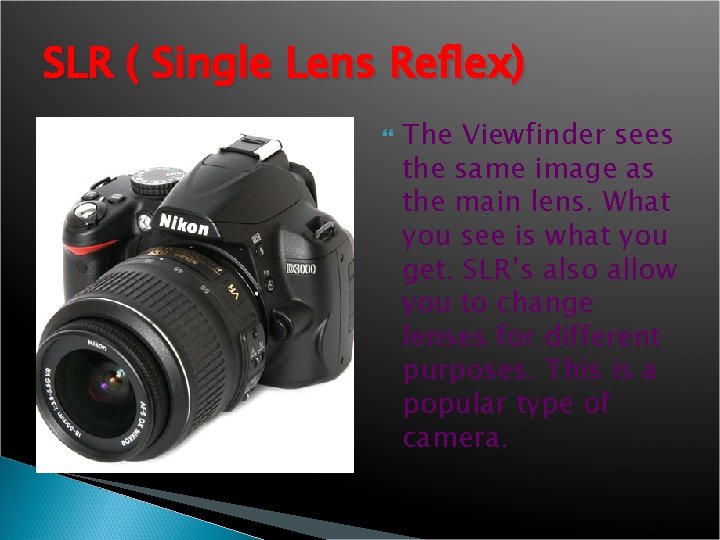
SLR ( Single Lens Reflex) The Viewfinder sees the same image as the main lens. What you see is what you get. SLR’s also allow you to change lenses for different purposes. This is a popular type of camera.
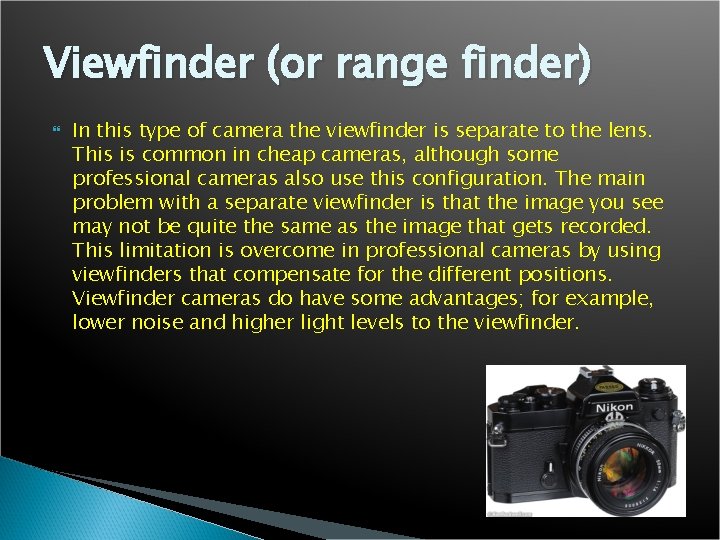
Viewfinder (or range finder) In this type of camera the viewfinder is separate to the lens. This is common in cheap cameras, although some professional cameras also use this configuration. The main problem with a separate viewfinder is that the image you see may not be quite the same as the image that gets recorded. This limitation is overcome in professional cameras by using viewfinders that compensate for the different positions. Viewfinder cameras do have some advantages; for example, lower noise and higher light levels to the viewfinder.
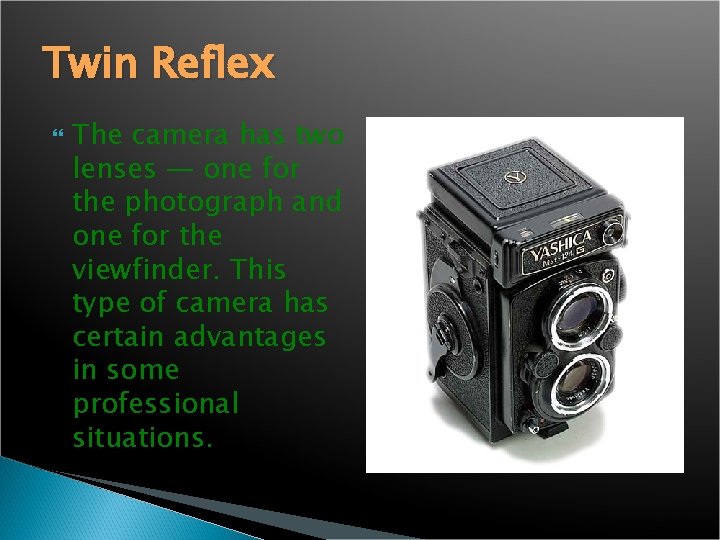
Twin Reflex The camera has two lenses — one for the photograph and one for the viewfinder. This type of camera has certain advantages in some professional situations.
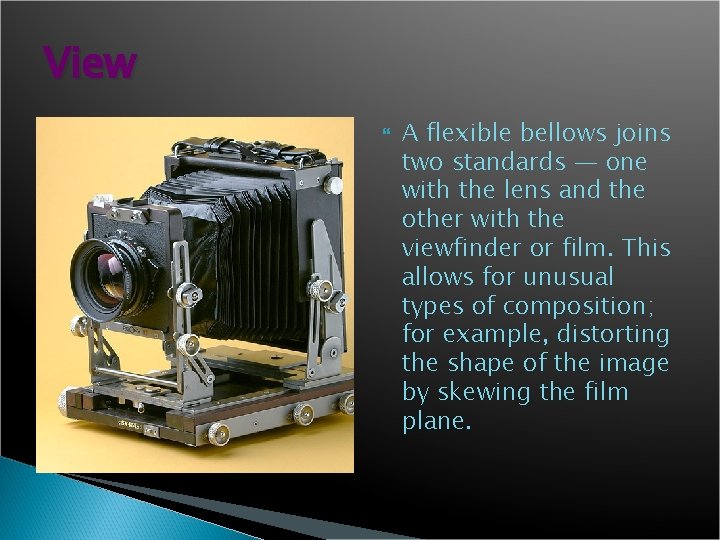
View A flexible bellows joins two standards — one with the lens and the other with the viewfinder or film. This allows for unusual types of composition; for example, distorting the shape of the image by skewing the film plane.
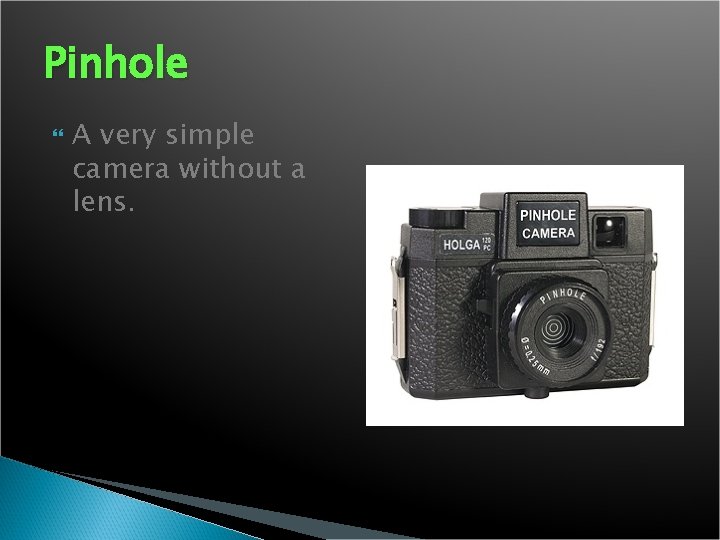
Pinhole A very simple camera without a lens.
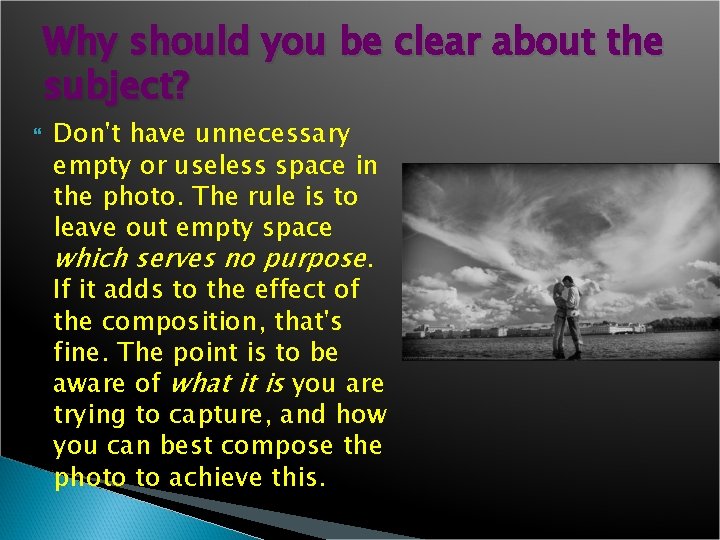
Why should you be clear about the subject? Don't have unnecessary empty or useless space in the photo. The rule is to leave out empty space which serves no purpose. If it adds to the effect of the composition, that's fine. The point is to be aware of what it is you are trying to capture, and how you can best compose the photo to achieve this.
Why do you compose the entire frame, not just the subject? While concentrating on the subject of the photo, it's easy to overlook other parts of the composition. Some objects don't look good if you can't see the whole thing, or at least a certain amount of it. Partial objects can be awkward or even confusing.
Why use different camera angles? One of the most common ways to add dramatic effect to a photograph is to use an interesting or unusual camera angle. When the subject is a person, different angles can have a strong influence on how they are perceived.
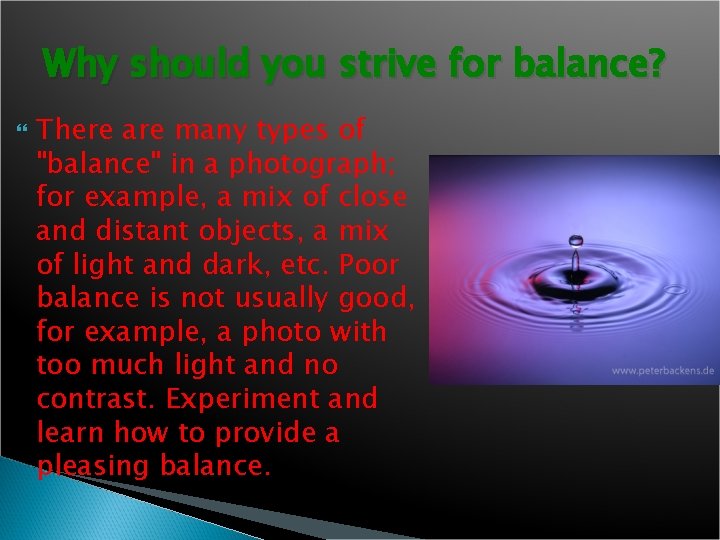
Why should you strive for balance? There are many types of "balance" in a photograph; for example, a mix of close and distant objects, a mix of light and dark, etc. Poor balance is not usually good, for example, a photo with too much light and no contrast. Experiment and learn how to provide a pleasing balance.
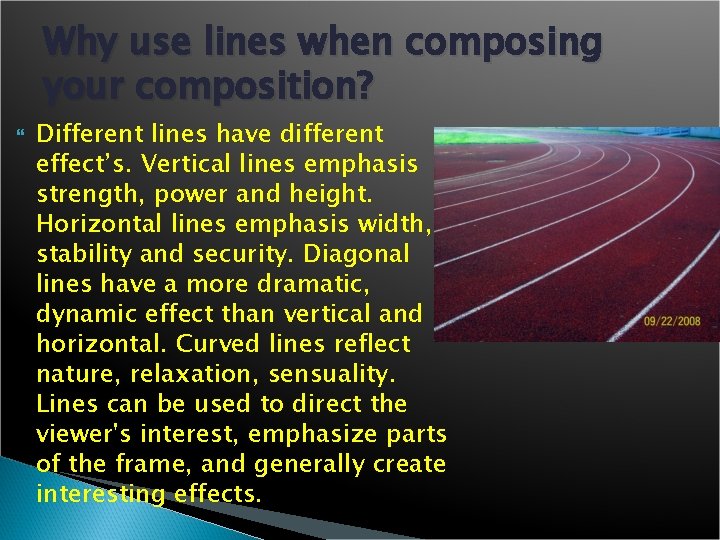
Why use lines when composing your composition? Different lines have different effect’s. Vertical lines emphasis strength, power and height. Horizontal lines emphasis width, stability and security. Diagonal lines have a more dramatic, dynamic effect than vertical and horizontal. Curved lines reflect nature, relaxation, sensuality. Lines can be used to direct the viewer's interest, emphasize parts of the frame, and generally create interesting effects.
- Slides: 31