
Digital Multimeter Introduction Choosing the right meter Category
- Slides: 5
Digital Multimeter Introduction • Choosing the right meter Category • Category ratings are designed to protect users from transient overvoltage conditions (intermittent voltage spikes caused by electrical equipment surges during starting, capacitors, inductive circuits, and lightning strikes) • It is these unintended and intermittent transient voltage spikes that can be dangerous to users with too low of meter category rating
Digital Multimeter Introduction • Choosing the right meter Category 1. With the likely hood of working in multiple different category environments always choose a meter that will be safe for working on the HIGHEST category that could potentially be accessed 2. Choose a Steady State Voltage rating that meets the maximum voltage you will encounter 3. ALWAYS choose the Category FIRST and then a steady state voltage value − A CAT III– 600 V meter will provide far superior transient voltage protection than CAT II– 1000 V meter
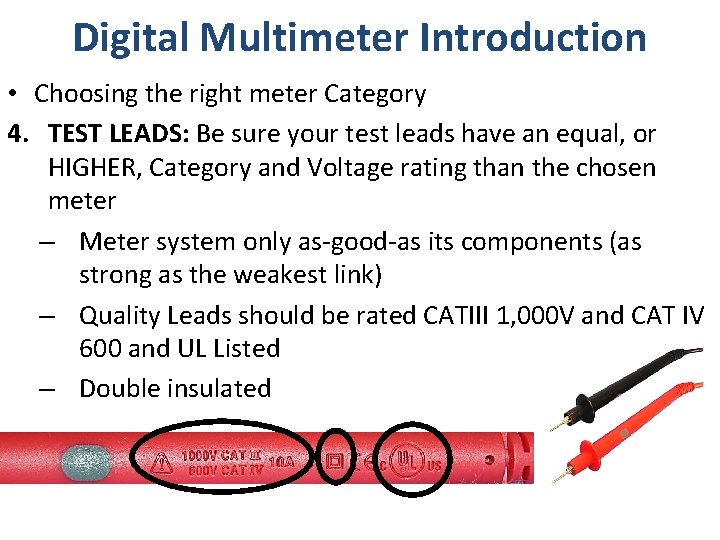
Digital Multimeter Introduction • Choosing the right meter Category 4. TEST LEADS: Be sure your test leads have an equal, or HIGHER, Category and Voltage rating than the chosen meter – Meter system only as-good-as its components (as strong as the weakest link) – Quality Leads should be rated CATIII 1, 000 V and CAT IV 600 and UL Listed – Double insulated
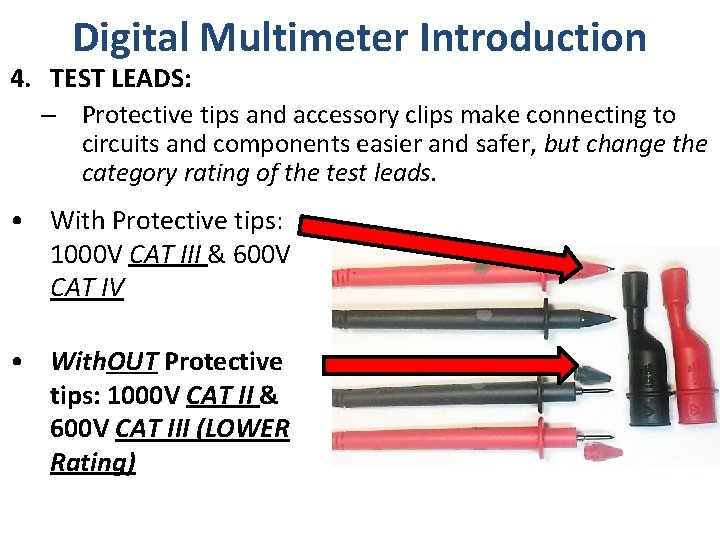
Digital Multimeter Introduction 4. TEST LEADS: – Protective tips and accessory clips make connecting to circuits and components easier and safer, but change the category rating of the test leads. • With Protective tips: 1000 V CAT III & 600 V CAT IV • With. OUT Protective tips: 1000 V CAT II & 600 V CAT III (LOWER Rating)
Review for Understanding 1. What are the two types of signals commonly converted and displayed on a DMM? 2. True of False: DMMs can measure a wide range of signals with accuracy. 3. How many ohms is 92. 2 kΩ 4. Explain the 4 basic operations DMMs help us to perform. 5. Define High Impedance. Why is it important when testing electronic circuits?