
Digital Medieval Studies An Introduction Overview Be aware
Digital Medieval Studies An Introduction
Overview • Be aware of DH research possibilities • Be able to define key DH terms and methodologies • Be familiar with a range of DH projects • Know some ways to get started
What Is Digital Humanities? DH = “Humanities research with computer technologies”

• DH centres in major universities worldwide. Stats & infographic: Melissa Terras, “Quantifying the Digital Humanities, ” UCL Centre for Digital Humanities, 2011.
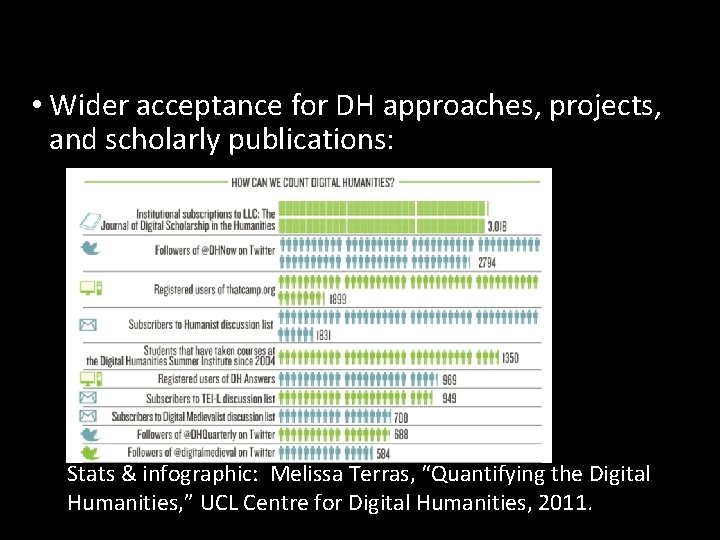
• Wider acceptance for DH approaches, projects, and scholarly publications: Stats & infographic: Melissa Terras, “Quantifying the Digital Humanities, ” UCL Centre for Digital Humanities, 2011.
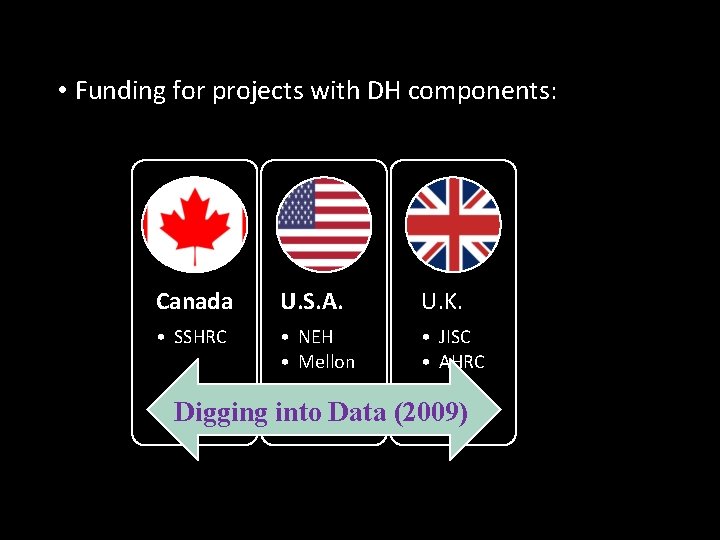
• Funding for projects with DH components: Canada U. S. A. U. K. • SSHRC • NEH • Mellon • JISC • AHRC Digging into Data (2009)
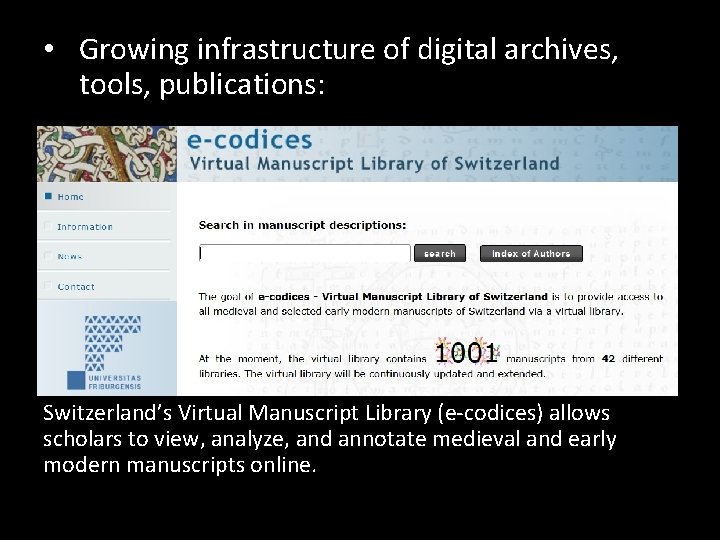
• Growing infrastructure of digital archives, tools, publications: Switzerland’s Virtual Manuscript Library (e-codices) allows scholars to view, analyze, and annotate medieval and early modern manuscripts online.
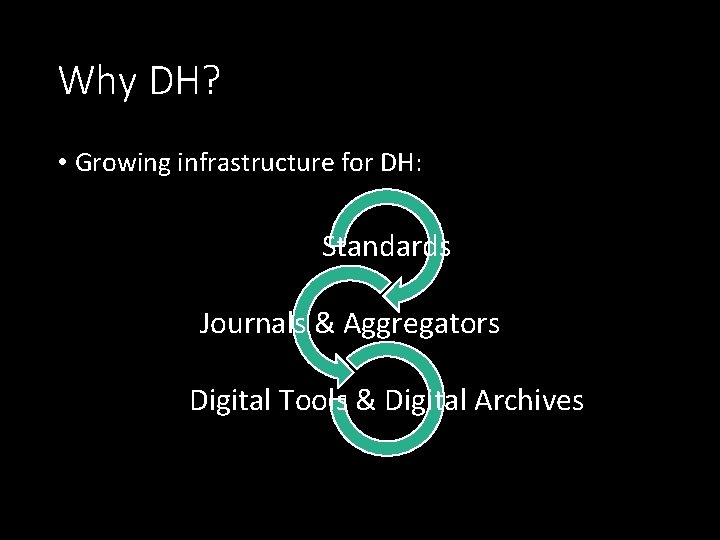
Why DH? • Growing infrastructure for DH: Standards Journals & Aggregators Digital Tools & Digital Archives
Why DH? Jobs + Tools + Infrastructure = Opportunity.
Digital Humanities: A Brief History
Digital Humanities: A Brief History • “Digital Humanities” is no newfangled discipline. • Medievalists at U of T were “doing DH” in the 1970 s. Medieval corpora first went digital in the 1950 s.
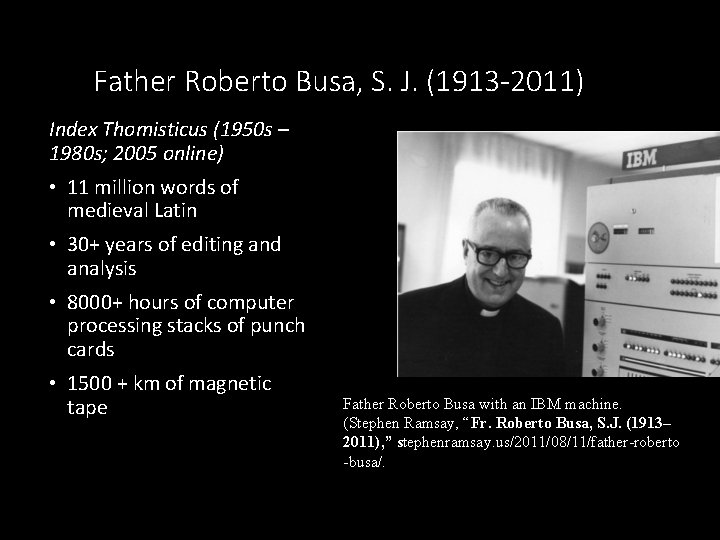
Father Roberto Busa, S. J. (1913 -2011) Index Thomisticus (1950 s – 1980 s; 2005 online) • 11 million words of medieval Latin • 30+ years of editing and analysis • 8000+ hours of computer processing stacks of punch cards • 1500 + km of magnetic tape Father Roberto Busa with an IBM machine. (Stephen Ramsay, “Fr. Roberto Busa, S. J. (1913– 2011), ” stephenramsay. us/2011/08/11/father-roberto -busa/.
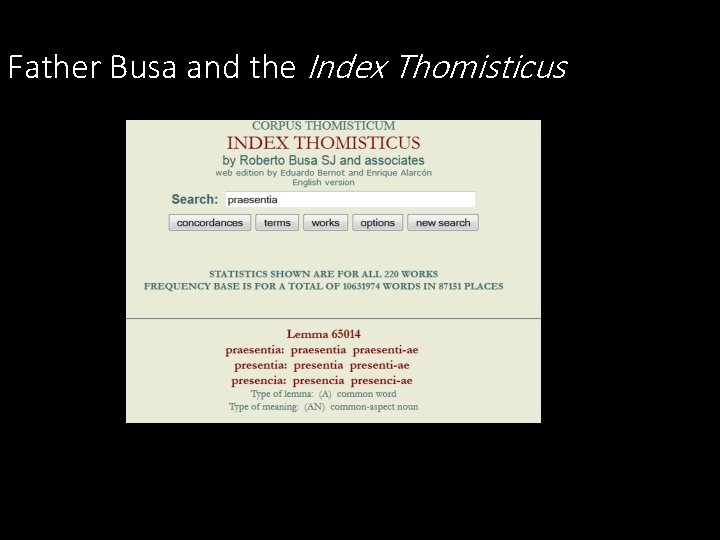
Father Busa and the Index Thomisticus
Father Busa and the Index Thomisticus “The use of computers in the humanities […] can help us to be more humanistic than before. ” (Busa, Roberto. “Foreword: Perspectives on the Digital Humanities. ” In A Companion to Digital Humanities. )
DH History • 1949 to early 1980 s: • focus on textual data: electronic texts, concordances, stylometrics • Major U of T DH projects: DOE (1970), DEEDS (1975)
DH History • 1980 s to 1990 s • Rise of personal computers • Listservs, text analysis programs • TEI P 1: Guidelines for Electronic Text Encoding and Interchange (conversation starts 1987, guidelines first published 1994) • At U of T: RPO, an electronic anthology of English poetry for general readers (1994)
DH History • Late 1990 s to present day: • Rise of personal computing & the internet • An explosive variety of DH activities (digital editions, digital archives, GIS mapping, visualizations, blogs, listservs, online journals…) • At U of T: DOE Corpus online; LEME; REED’s Patrons and Performances and prototype digital edition • Transition from “computing in the humanities” to “digital humanities”
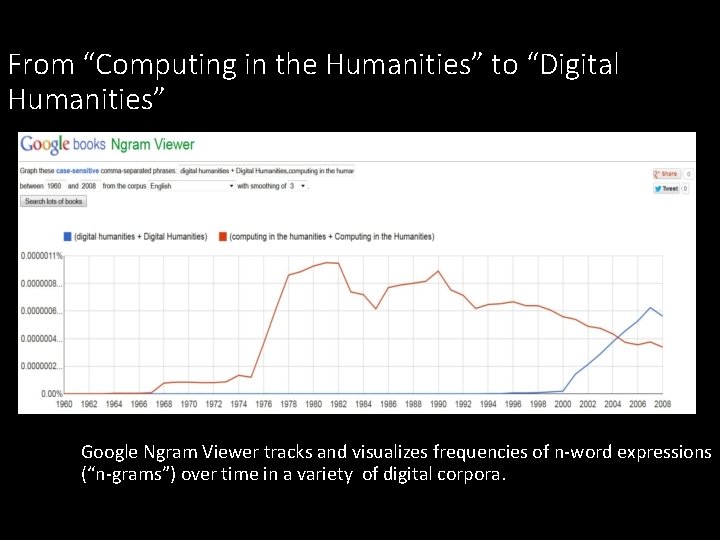
From “Computing in the Humanities” to “Digital Humanities” Google Ngram Viewer tracks and visualizes frequencies of n-word expressions (“n-grams”) over time in a variety of digital corpora.
DH Now • Textual encoding and analysis • Digital editions and archives • Dictionaries • GIS Mapping • Scholarly blogs & journals • Visualization tools
Textual Encoding and Analysis • TEI P 5: Text Encoding Initiative • A standard for marking up texts to describe their content (intellectual content, physical description) • Enables computational uses of texts: text interchange, interoperability, querying, etc. • TEI P 5 Chapter 10: manuscripts • To learn more: teibyexample. org
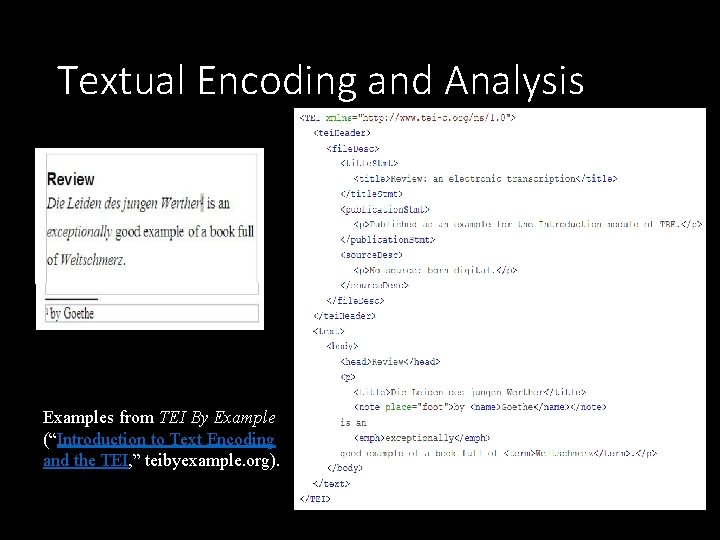
Textual Encoding and Analysis Examples from TEI By Example (“Introduction to Text Encoding and the TEI, ” teibyexample. org).
Digital Editions of Medieval Texts and Manuscripts • A printed edition of a medieval text often distances you from the manuscript itself. Editors make choices about the text: Is it a diplomatic edition, “warts and all”? Or a reading edition, presenting a far more manicured text? Plus, what about illuminations? What about marginalia? What about multiple witnesses (different mss. of the same text) kept in different libraries around the world? • A digital edition lets you do cross-manuscript comparisons. You can view the text in multiple modes (e. g. transcription, translation, facsimile, even recorded performance!), across multiple variants or manuscripts, with far greater flexibility than printed facsimiles allow.
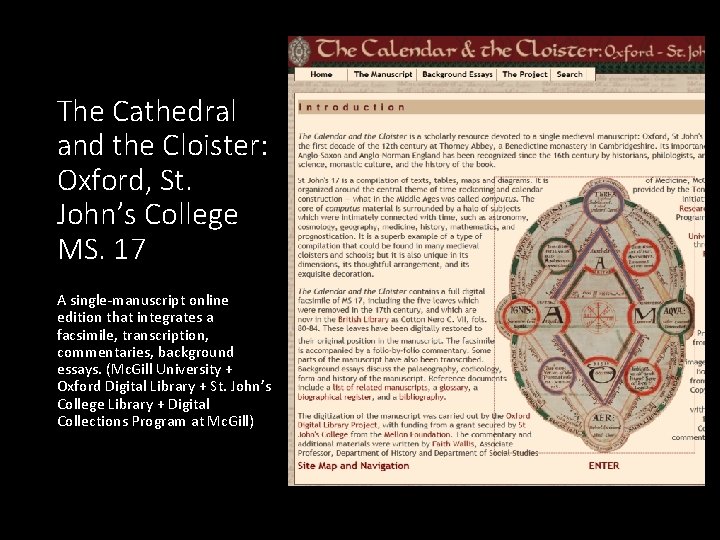
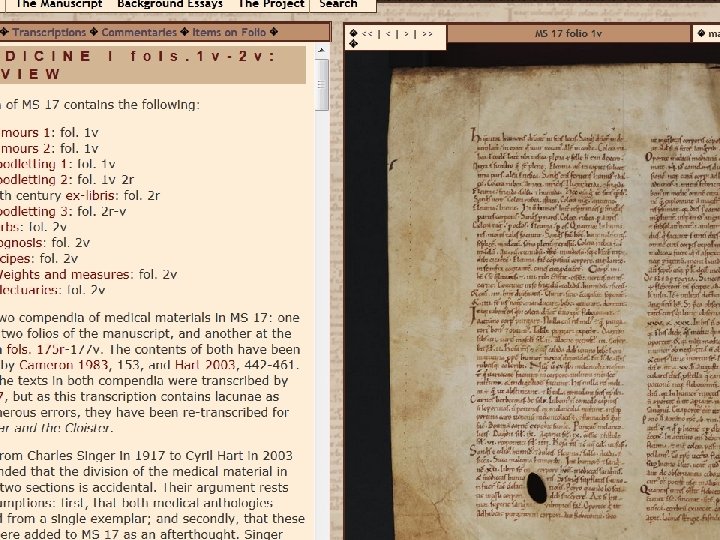
The Cathedral and the Cloister: Oxford, St. John’s College MS. 17 A single-manuscript online edition that integrates a facsimile, transcription, commentaries, background essays. (Mc. Gill University + Oxford Digital Library + St. John’s College Library + Digital Collections Program at Mc. Gill)
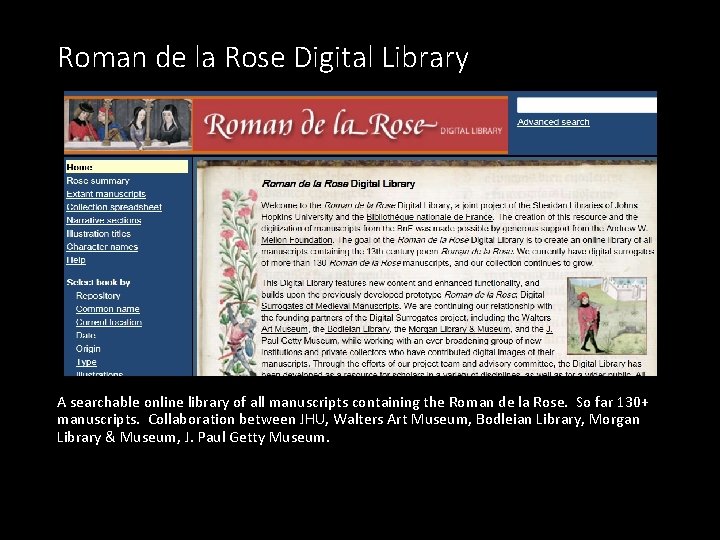
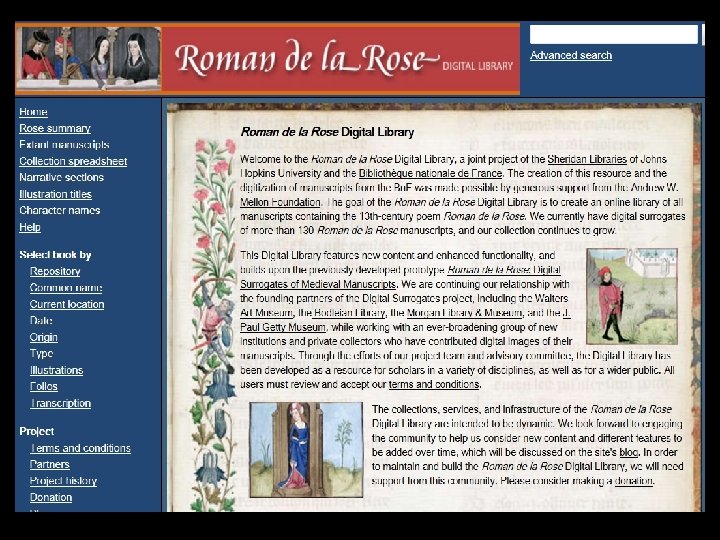
Roman de la Rose Digital Library A searchable online library of all manuscripts containing the Roman de la Rose. So far 130+ manuscripts. Collaboration between JHU, Walters Art Museum, Bodleian Library, Morgan Library & Museum, J. Paul Getty Museum.
Digitization of Manuscripts
Roman de la Rose • Two features to highlight: • You can search, view, bookmark, and annotate manuscripts. • You can browse Rose manuscripts by an index of narrative episodes and view the same narrative section across several manuscripts.
Dictionary of Old English
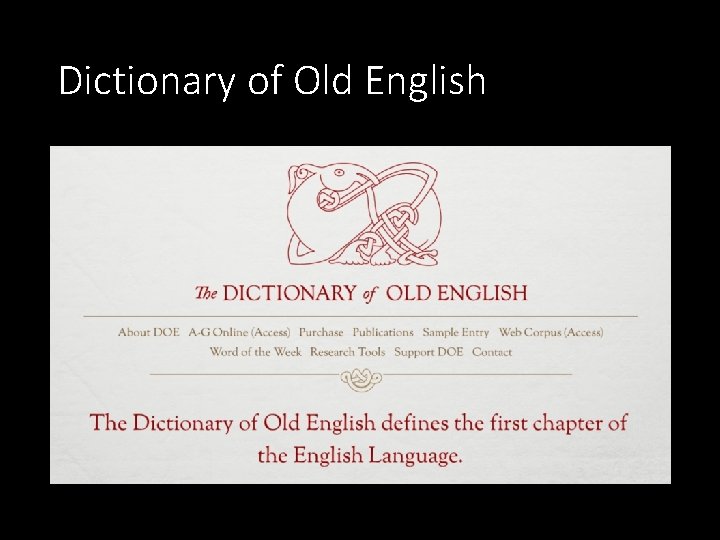
Dictionary of Old English • Compared to print dictionaries, electronic dictionaries allow richer data and more interesting context • Dictionary of Old English: founded 1970, borndigital. • Interoperable with MED and OED: Through DOE, users can view a word’s entire documented history • Multimedia: manuscript snippets of cruxes or contested passages.

Scholarly blogs; more broadly, social media communities
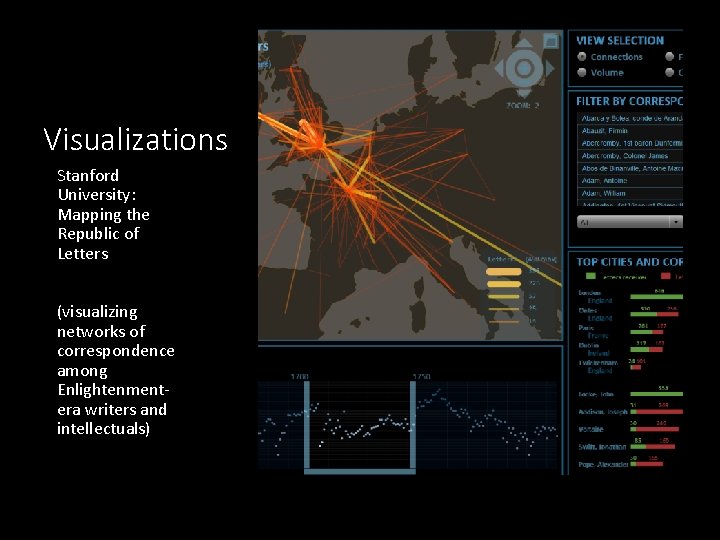
Visualizations Stanford University: Mapping the Republic of Letters (visualizing networks of correspondence among Enlightenmentera writers and intellectuals)
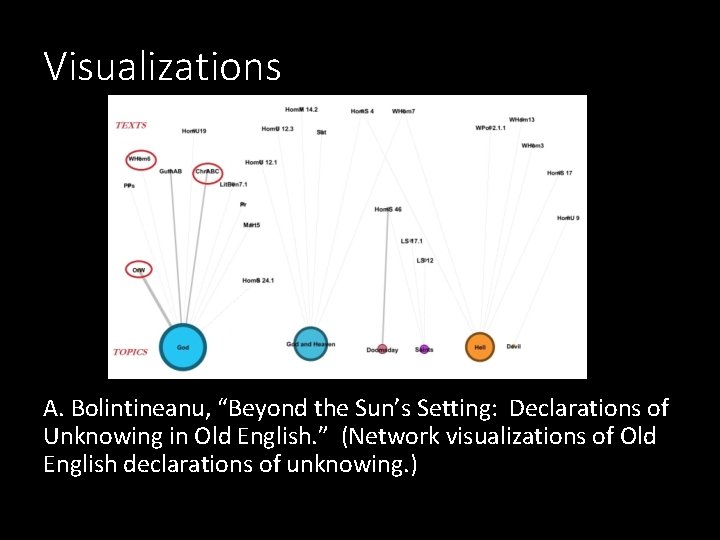
Visualizations A. Bolintineanu, “Beyond the Sun’s Setting: Declarations of Unknowing in Old English. ” (Network visualizations of Old English declarations of unknowing. )

(GIS) Mapping • GIS = Geographical Information System (from Google Maps to urban planning software) • Mapping visualizes an issue’s spatial dimension: • spatial distribution of population density, income, social class • the trajectory of an acting company • the progress of epidemic disease • regional changes in pronunciation or dialect • settings of a novel

Mapping Medieval Chester • Goal: making a digital map of medieval Chester by combining postmedieval maps with archaeological and historical evidence • Digital advantage: interactive, layered, & transparent
The Paradise Project “Beyonde the iles of the lond of Prester John and his lordship of wyldernesse, to goo right est men shall nat fynde but hylles, great roches, and other myrke londe where no man may see on day ne on nyght, as men of the countré say. And this wyldernes and myrke londe lasteth to Paradyse Terrestre where Adam and Eve were sette, but they were there but a lytell whyle. And that is towarde the est at begynnynge of the erthe […] Of Paradyse can I nat speke propirly for I have nat be there. ” (The Book of John Mandeville. )
Where is Paradise in Middle English? • In the uttermost East of the world • Accessible through a hole in the ground, in Ireland • Just past Hell and Purgatory • Just beyond Ireland • In Faerie • In sleep • An interrupted breath away

The Paradise Project • Examine representations of Paradise in Middle English • Build a virtual space that mimics the spatial poetics of medieval marvellous spaces • • Space defined by narrative, not vice versa Permeable boundaries Flexible spaces in many more than two dimensions Spatial indeterminacy
What is Project Paradise? • A comparison between two medieval “texts”—map and travel narrative: the Hereford mappa mundi and the Book of John Mandeville • A conversation between two imaginary geographies
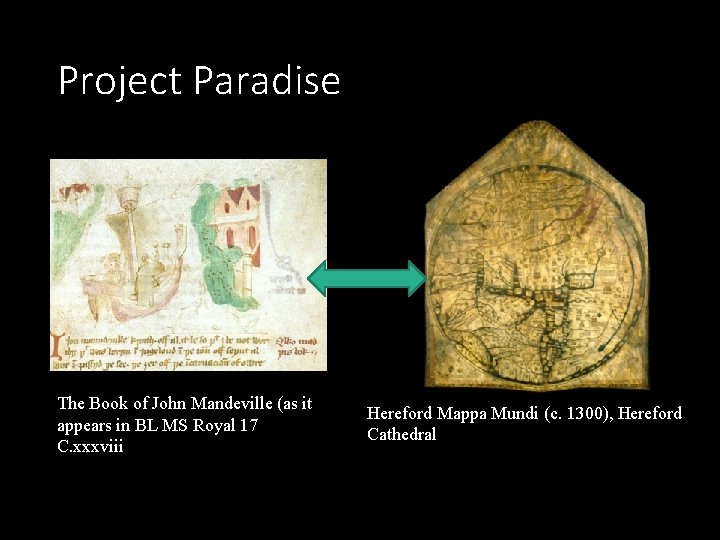
Project Paradise The Book of John Mandeville (as it appears in BL MS Royal 17 C. xxxviii Hereford Mappa Mundi (c. 1300), Hereford Cathedral
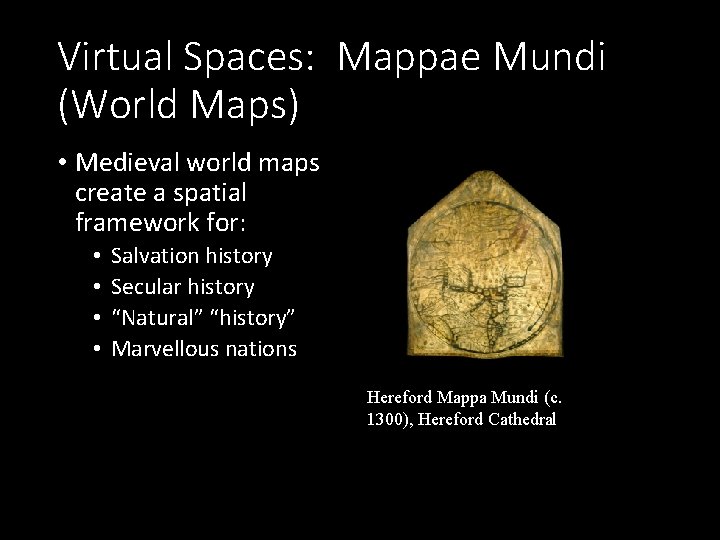
Virtual Spaces: Mappae Mundi (World Maps) • Medieval world maps create a spatial framework for: • • Salvation history Secular history “Natural” “history” Marvellous nations Hereford Mappa Mundi (c. 1300), Hereford Cathedral
Virtual Spaces: Geotemporal Digital Exhibits • Scholars’ Lab, University of Virginia Library • Intersection of archives, artifacts, timelines, and maps • Tell stories by plotting documents on maps and underpinning your visual exhibit with a narrative
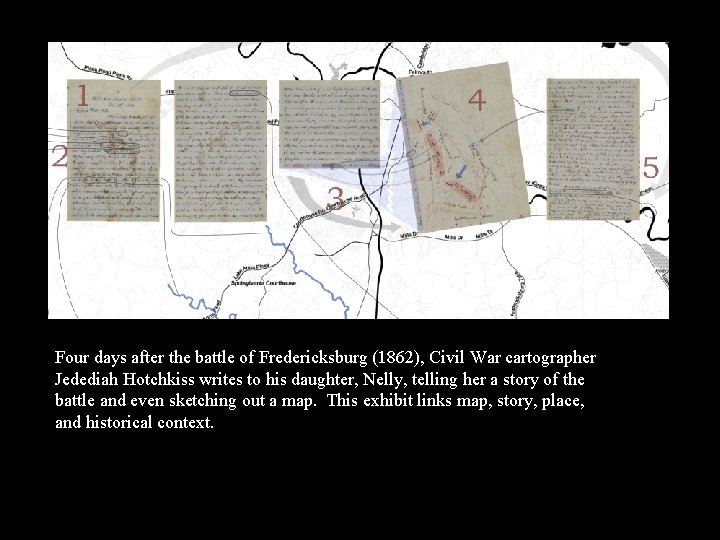
Four days after the battle of Fredericksburg (1862), Civil War cartographer Jedediah Hotchkiss writes to his daughter, Nelly, telling her a story of the battle and even sketching out a map. This exhibit links map, story, place, and historical context.
Project Paradise in Neatline: demo
Hereford vs. Mandeville • Hereford: Paradise is an enclosed space in the uttermost East of the world • Mandeville: Paradise is both inaccessible to the world and inextricably linked to the world: scattered, broken fragments infiltrating the world’s geography and history
From “Computing in the Humanities” to “Digital Humanities” Discussion: • Why “Digital Humanities” but not “Digital Sciences”? • Drawbacks of DH? Advantages of DH? • What can DH bring to Medieval Studies? What can Medieval Studies bring to DH?

“Quiz”

How to Get Started • Start reading and thinking. • Lisa Spiro, “Getting Started in the Digital Humanities, ” http: //digitalscholarship. wordpress. com/2011/10/14/gettingstarted-in-the-digital-humanities/ • (a FABULOUS intro to DH) • Blogs & social media, esp. In the Middle (http: //inthemedievalmiddle. com) • Digital Medievalist Journal (http: //www. digitalmedievalist. org/journal/) • Digital Philology: A Journal of Medieval Cultures • (http: //www. press. jhu. edu/journals/digital_philology/) • For more resources, see digitalmedievalstudies. wordpress. com.

How to Get Started • Start playing with tools and ideas: • An overview of basic DH approaches: Stanford’s Tooling Up for Digital Humanities • A sampling of DH projects and the tools used to create them: Miriam Posner, How did they make that? • An exhaustive tool directory, organized by task: Bamboo DIRT

Learning Goals • Be aware of DH history and research possibilities • Be able to define key DH terms and methodologies (TEI, visualizations, mapping…) • Be familiar with a range of DH projects and initiatives (e-codices, Digging into Data, Roman de la Rose) • Have a series of starting points at your fingertips
- Slides: 49