
Digital Media Primer YueLing Wong Copyright c2013 by
"Digital Media Primer" Yue-Ling Wong, Copyright (c)2013 by Pearson Education, Inc. All rights reserved. 1
Chapter 1 Background Part 1 Analog vs. Digital, Digitization 2
Chapter 1 Background ANALOG VS. DIGITAL REPRESENTATIONS 3
In this lecture, you will find answers to these questions • Computers store and transmit information using digital data. What exactly is digital data? • Is there anything not digital? • Why do we bother to learn about anything not digital in a digital media course? • What does digitizing mean? 4
Analog Information Examples: • time • weight • temperature • line length • width and length of a sheet of paper 5
Analog Information More examples: • sound loudness • light brightness • color saturation and hue 6
Analog Information • Continuous information • An infinite number of divisions exist between any two measurements 7
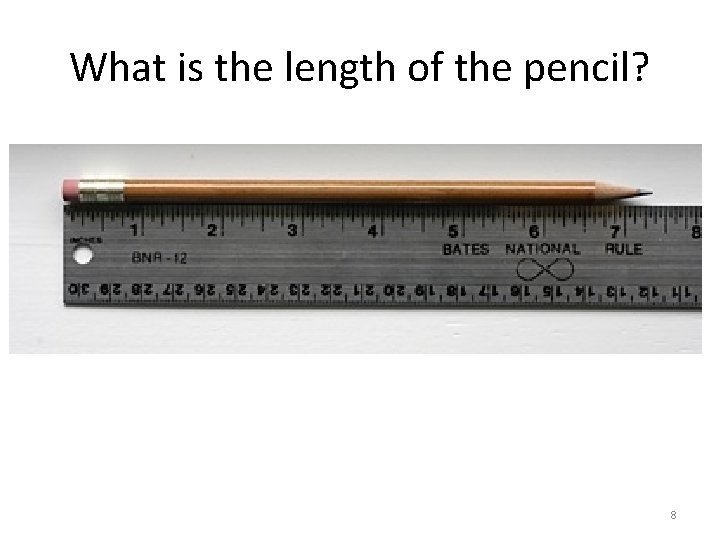
What is the length of the pencil? 8
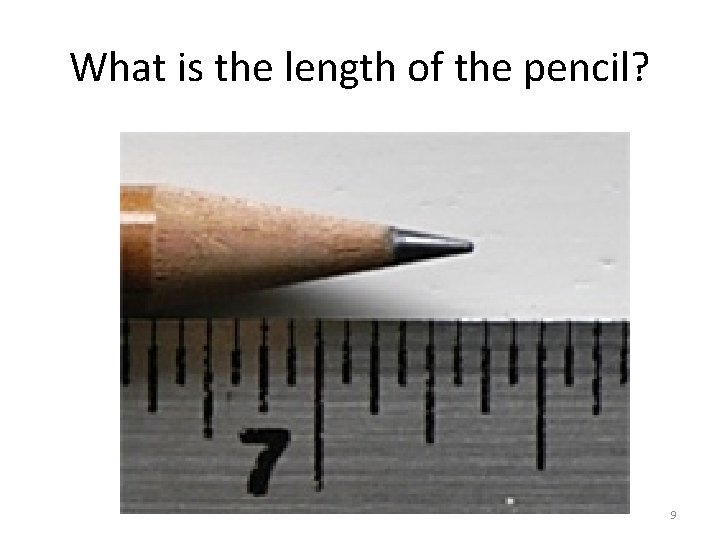
What is the length of the pencil? 9
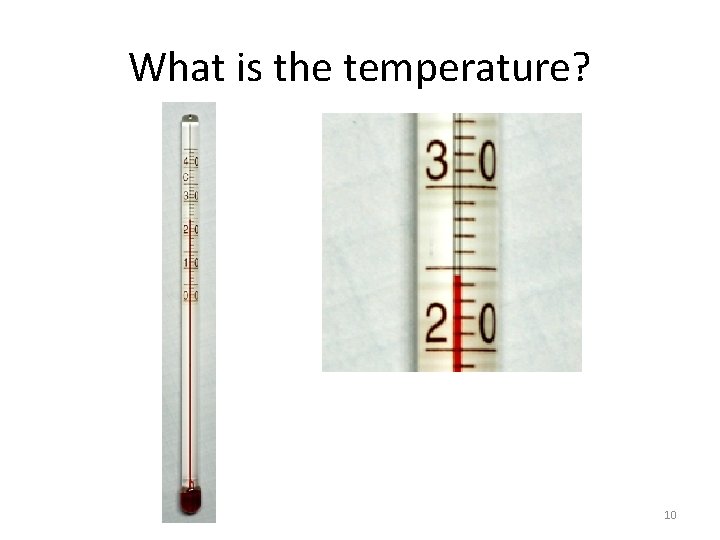
What is the temperature? 10
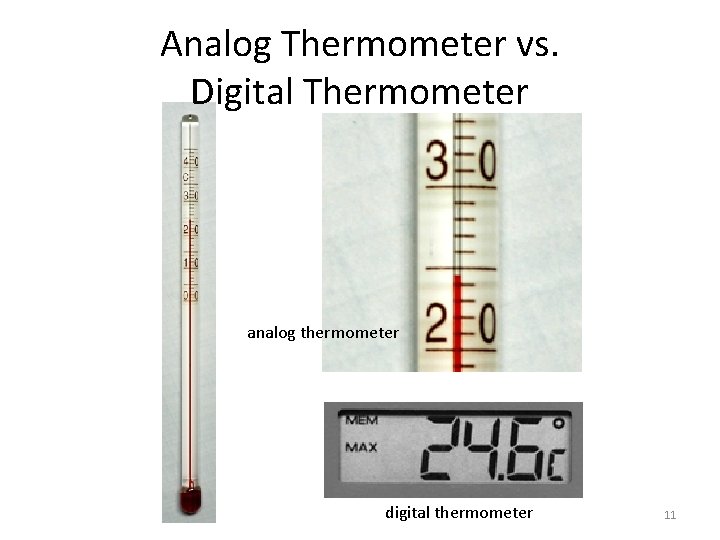
Analog Thermometer vs. Digital Thermometer analog thermometer digital thermometer 11
Analog Scales vs. Digital Scales 12
What are the characteristics of digital readings? 13
Analog vs. Digital • Analog information – continuous – made up of infinite number of data points • Digital data – discrete 14
Discrete Data Examples: • number of persons There is no in-between one person and two persons. • choices in multiple-choice questions There is no in-between choice A and choice B. 15
Analog vs. Digital Therometers and Scales • What are the limitations of these analog and digital devices? • What are the advantages of these analog and digital devices? 16
Analog vs. Digital • Sight and sound we peceive in our natural world are analog information--continuous and infinite number of points between any two points. • Computers handle discrete digital data. In addition, the amount of data has to be finite. • Sight and sound must be converted into finite discrete digital data in order for the computer to handle. 17
Before we talk about the conversion process, let's look at a scenario: Monitoring a puppy's weight in his first year 18
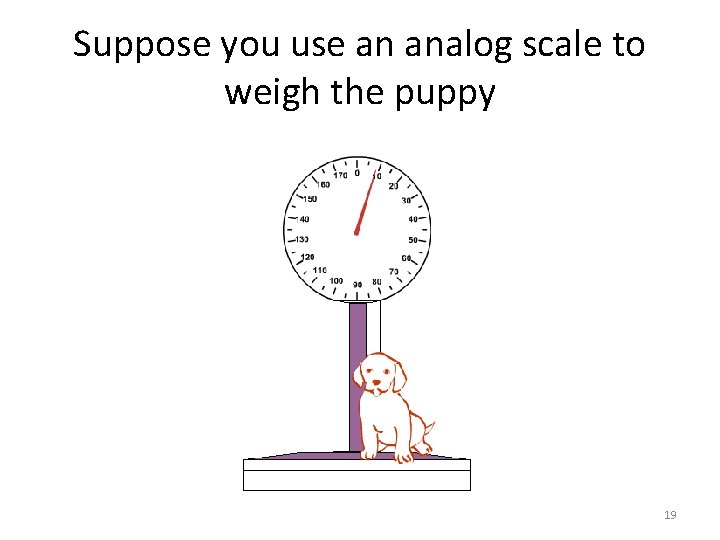
Suppose you use an analog scale to weigh the puppy 19
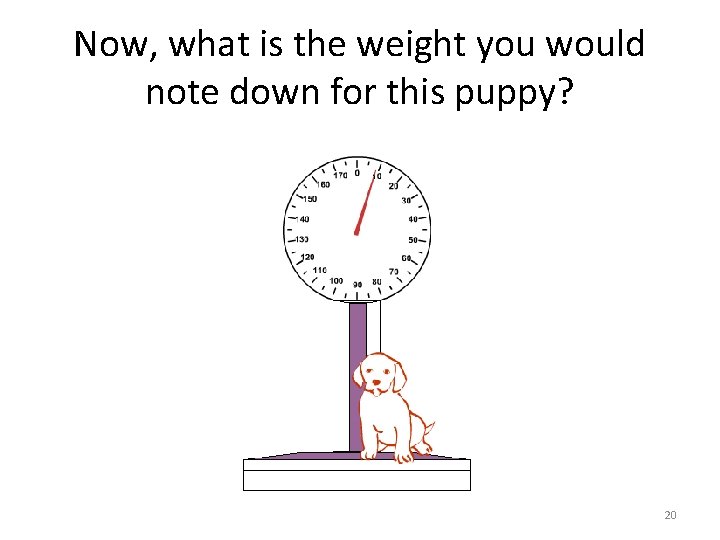
Now, what is the weight you would note down for this puppy? 20
See the problem in picking a number to represent an analog measurement? 21
Number of Decimal Places • In recording the weight, you must decide the number of decimal places to use. • This determines the precision or exactness of the measurement. • How many will give an exact measurement? How many is enough? How many is too many? 22
Using More Decimal Places • Pros : – increase the precision in general (But how many is meaningful? ) – Will allow finer distinction between values (will explain in the next slide) • Cons: – Require more paper and paperwork. – Take longer to read through and interpret the numbers. 23
Distinction Between Values With one decimal place: – You can have 10 different values between say 2 and 3: 2. 1, 2. 2, . . . 3. 0 • You can distinct between 2. 5 and 2. 8. • But 2. 5 and 2. 8 would have been rounded to the same value of 3 the values do not allow decimal places. 24
Distinction Between Values Suppose the allowable weight read outs are these 10 levels: 0, 5, 10, 15, 20, 25, 30, 35, 40, 45 Then, 2 pounds: rounded to 0 pound 3 pounds: rounded to 5 pounds The difference between 2 and 3 pounds is 1 pound. But now, it become 5 pounds if we use these levels. 25
Now, how often would you weigh the puppy to produce a "good" monitoring of his weight over his first year? A. B. C. D. E. F. G. H. once a year once a month every two weeks every week every day every hour every minute every second 26
What are your considerations in deciding how often to weigh the puppy? 27
Considerations • What happens if you weigh the puppy not often enough? • What happens if you weigh the puppy too often? • Is there one right answer? • Will you use the same weighing schedule to monitor the weight of an adult dog? 28
Back to the Computer DIGITIZATION: SAMPLING AND QUANTIZATION 29
Digitization • To convert analog information into digital data that computers can handle • 2 -step process: 1. sampling 2. quantization 30
Sampling • Analogous to weighing and recording the puppy's weight • During the sampling step, you need to set a sampling rate. • Sampling rate: how often you take a data 31
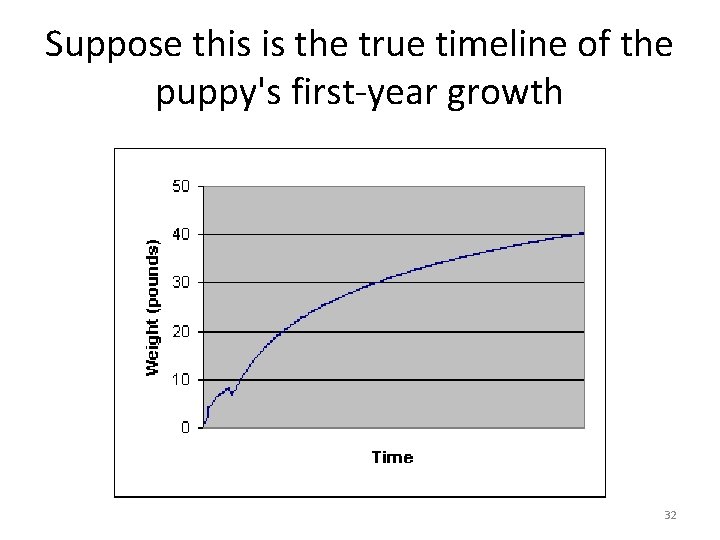
Suppose this is the true timeline of the puppy's first-year growth 32
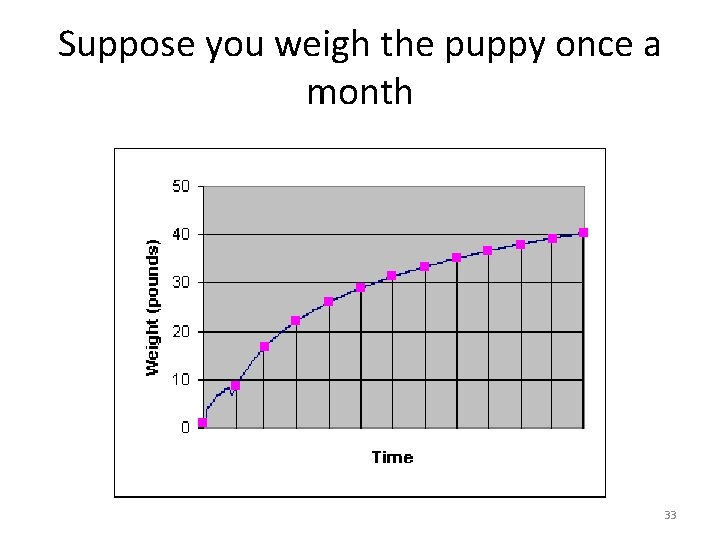
Suppose you weigh the puppy once a month 33
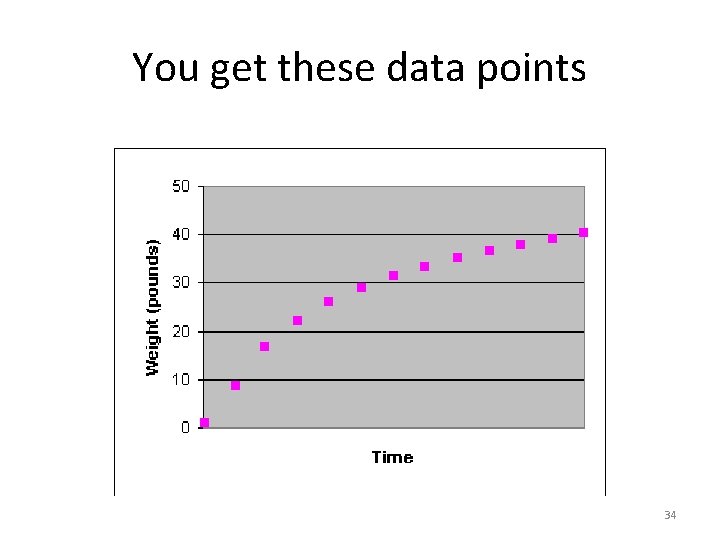
You get these data points 34
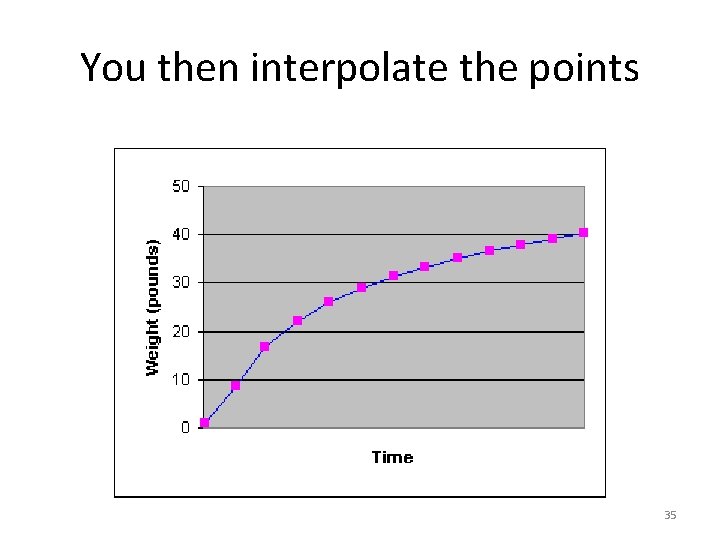
You then interpolate the points 35
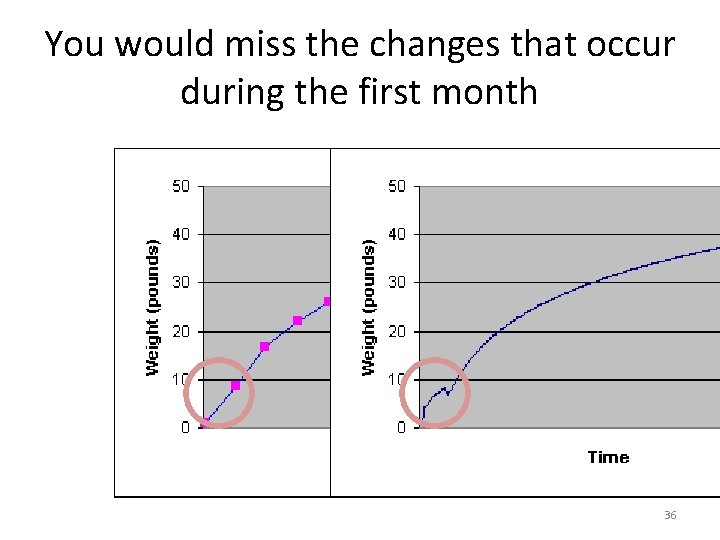
You would miss the changes that occur during the first month 36
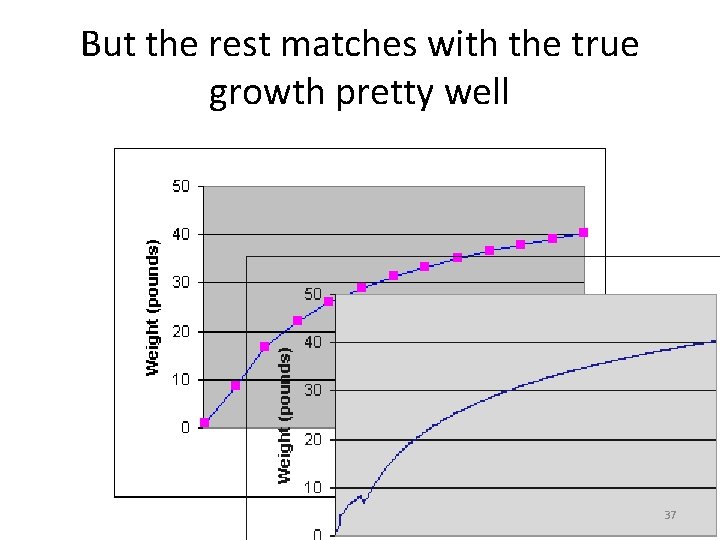
But the rest matches with the true growth pretty well 37
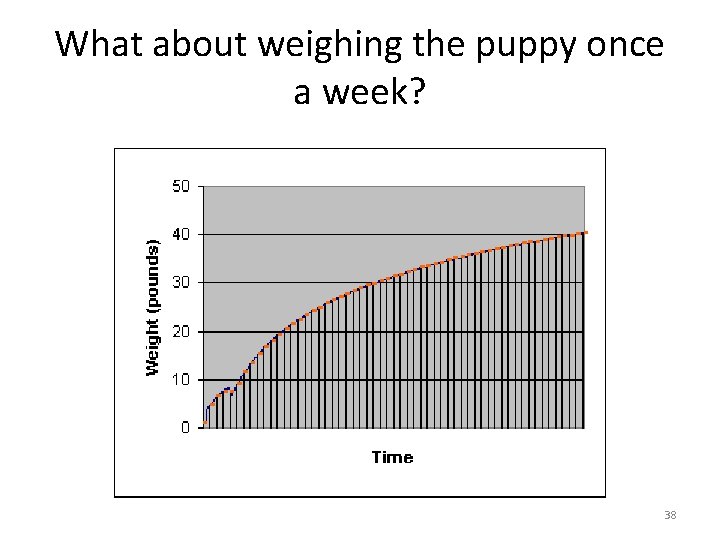
What about weighing the puppy once a week? 38
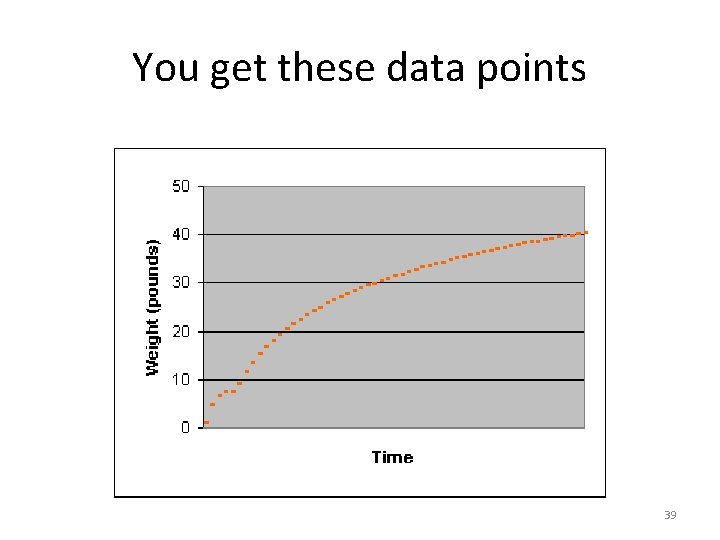
You get these data points 39
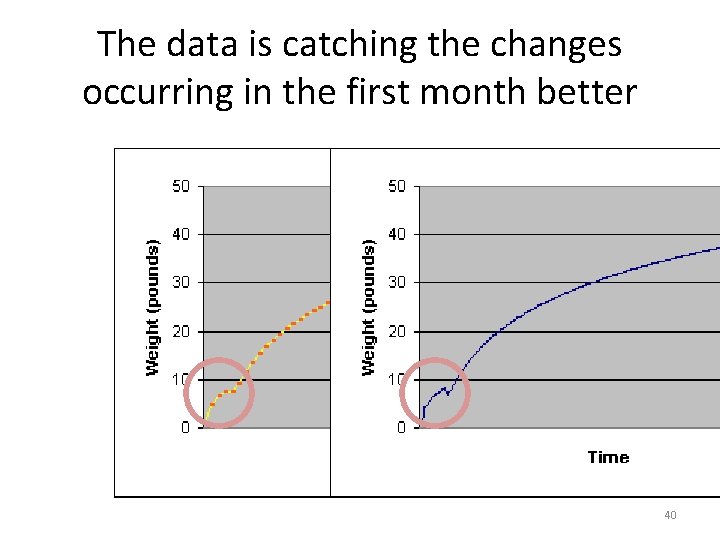
The data is catching the changes occurring in the first month better 40
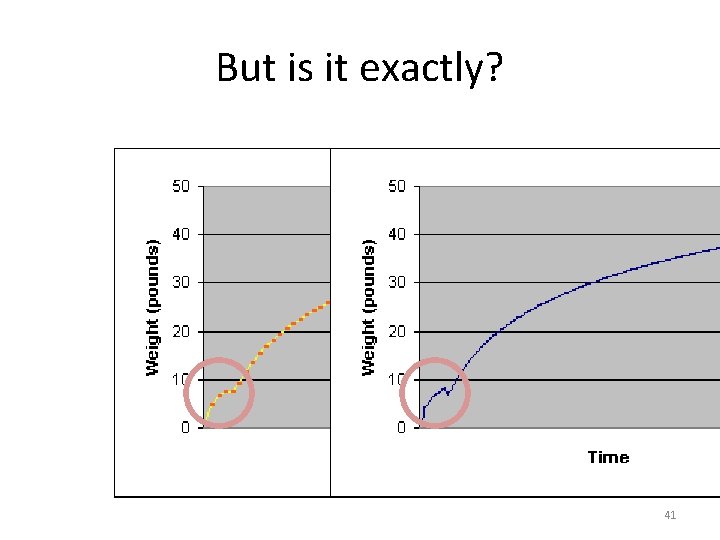
But is it exactly? 41
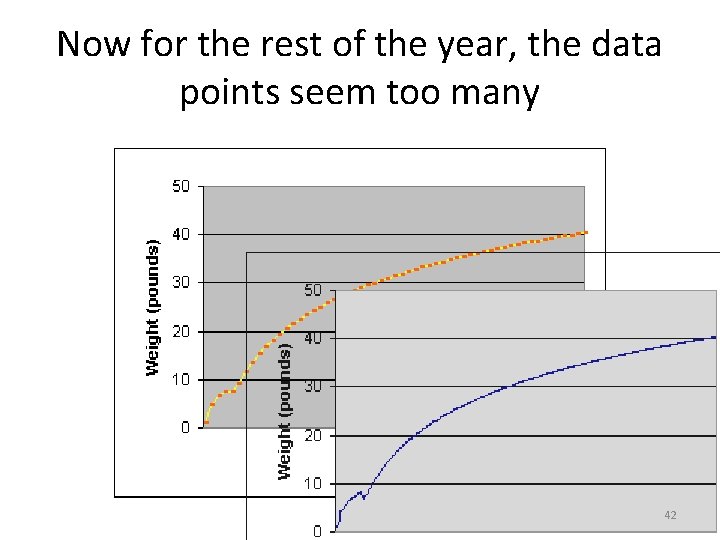
Now for the rest of the year, the data points seem too many 42
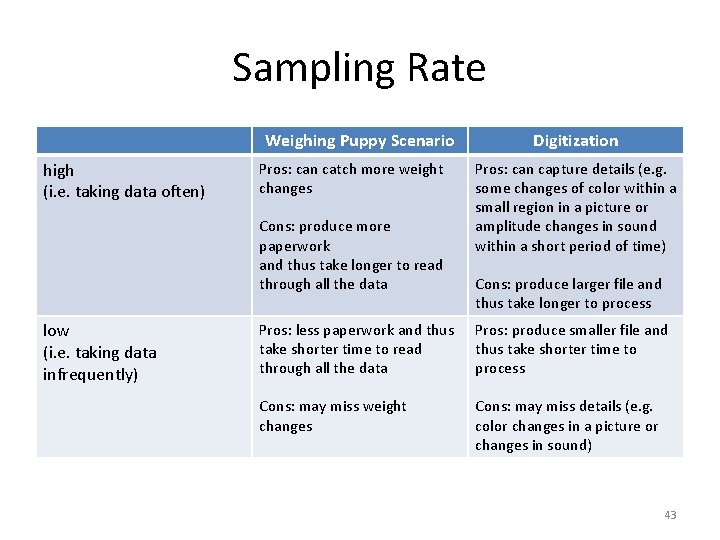
Sampling Rate Weighing Puppy Scenario high (i. e. taking data often) Pros: can catch more weight changes Cons: produce more paperwork and thus take longer to read through all the data low (i. e. taking data infrequently) Digitization Pros: can capture details (e. g. some changes of color within a small region in a picture or amplitude changes in sound within a short period of time) Cons: produce larger file and thus take longer to process Pros: less paperwork and thus take shorter time to read through all the data Pros: produce smaller file and thus take shorter time to process Cons: may miss weight changes Cons: may miss details (e. g. color changes in a picture or changes in sound) 43
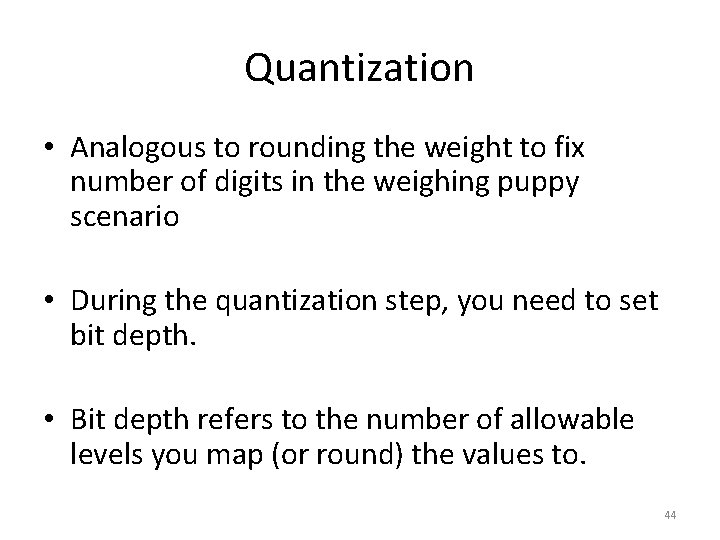
Quantization • Analogous to rounding the weight to fix number of digits in the weighing puppy scenario • During the quantization step, you need to set bit depth. • Bit depth refers to the number of allowable levels you map (or round) the values to. 44
Example: 10 levels of weight For 10 discrete levels, you may have the 10 allowable values as • 2. 0, 2. 1, 2. 2, 2. 3, 2. 4, 2. 5, 2. 6, 2. 7, 2. 8, and 2. 9 • 0, 5, 10, 15, 20, 25, 30, 35, 40, 45 • 2, 4, 6, 8, 10, 12, 14, 16, 18, 20 • 1, 2, 3, 4, 5, 6, 7, 8, 9, 10 • . . . and so forth 45
Suppose you choose 2. 0, 2. 1, . . . , 2. 9 For 2. 0, 2. 1, 2. 2, 2. 3, 2. 4, 2. 5, 2. 6, 2. 7, 2. 8, 2. 9 • Any weight data below 2. 0 will be recorded as 2. 0. • Any weight data higher than 2. 9 will be capped at 2. 9. • It works well if the puppy's weight falls in this range. But it does not seem to be the case. 46
Suppose you choose 0, 5, . . . , 45 For 0, 5, 10, 15, 20, 25, 30, 35, 40, 45 • A weight of 2 pounds would be rounded to 0 and a weight of 3 pounds to 5. • Cons: For example, the difference between 2 and 3 pounds is altered after they are mapped to the allowable value on this 10 -level scale. The difference becomes 5 pounds not 1 pound. • Pros: Wider range. • Again, it works well if the puppy's weight falls in this range. 47
Well, what if we choose this: 2. 0, 2. 1, 2. 2, . . . , 44. 8, 44. 9, 45. 0 48
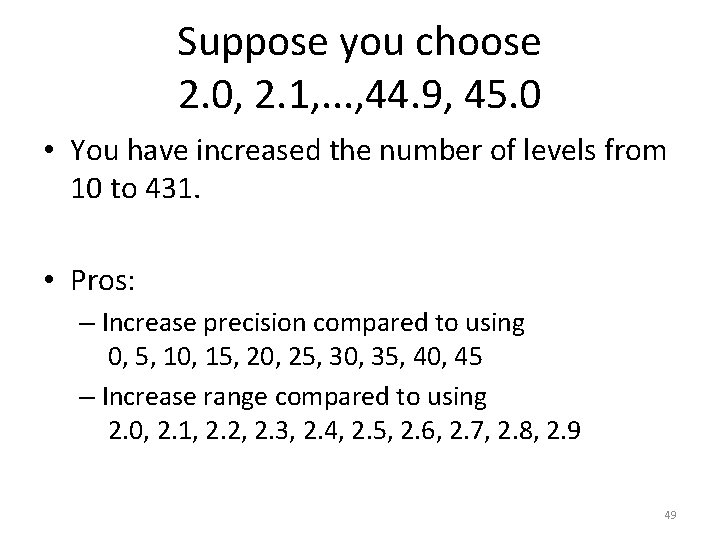
Suppose you choose 2. 0, 2. 1, . . . , 44. 9, 45. 0 • You have increased the number of levels from 10 to 431. • Pros: – Increase precision compared to using 0, 5, 10, 15, 20, 25, 30, 35, 40, 45 – Increase range compared to using 2. 0, 2. 1, 2. 2, 2. 3, 2. 4, 2. 5, 2. 6, 2. 7, 2. 8, 2. 9 49
Increase Number of Allowable Levels • There does not seem to be any cons in the weighing puppy scenario. • However, for digitization, increasing the number of allowable levels (i. e. increasing bit depth) will increase the file size. 50
Sampling and Quantization Digitizing media involves sampling and quantization regardless of the type of media: – images – video – audio 51
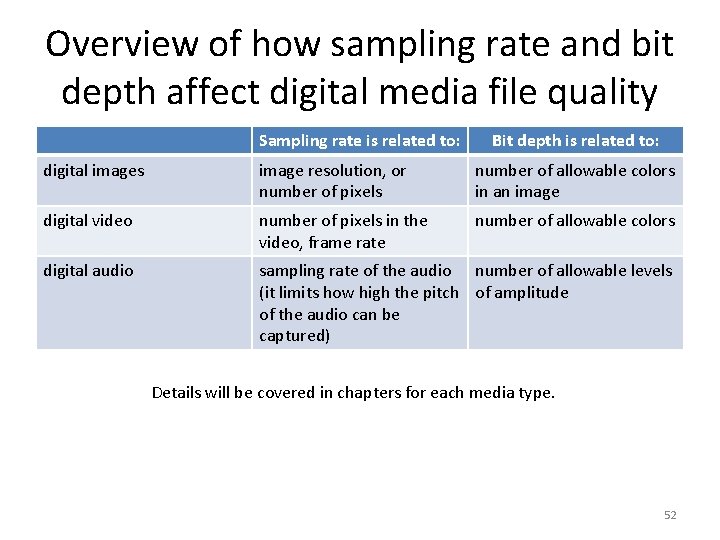
Overview of how sampling rate and bit depth affect digital media file quality Sampling rate is related to: Bit depth is related to: digital images image resolution, or number of pixels number of allowable colors in an image digital video number of pixels in the video, frame rate number of allowable colors digital audio sampling rate of the audio number of allowable levels (it limits how high the pitch of amplitude of the audio can be captured) Details will be covered in chapters for each media type. 52
Review Questions Note to instructor: Depending on your preference, you may want to go over the review questions at the end of this lecture as an instant review or at the beginning of next lecture to refresh students' memory of this lecture. 53
Review Question Digital data is _____ and analog information is _____. A. continuous; discrete B. discrete; continuous 54
Review Question Digitization means converting _____ into _____. 55
Review Question Converting from analog to digital involves a twostep process: _____ and _____. 56
Review Question When analog information is converted to digital data, two properties affect the exactness of the digital representation, one from sampling and one from quantizing. Which of the following is a result of quantization? A. sampling rate B. bit depth 57
Review Question Which of the following refers to the number of allowable levels of digitized data? A. sampling rate B. bit depth 58
Review Question Which of the following can reduce file size of digital media? (More than one choice) A. decrease sampling rate B. increase sampling rate C. decrease bit depth D. increase big depth 59
- Slides: 59