
Digital Lesson Law of Sines An oblique triangle
Digital Lesson Law of Sines
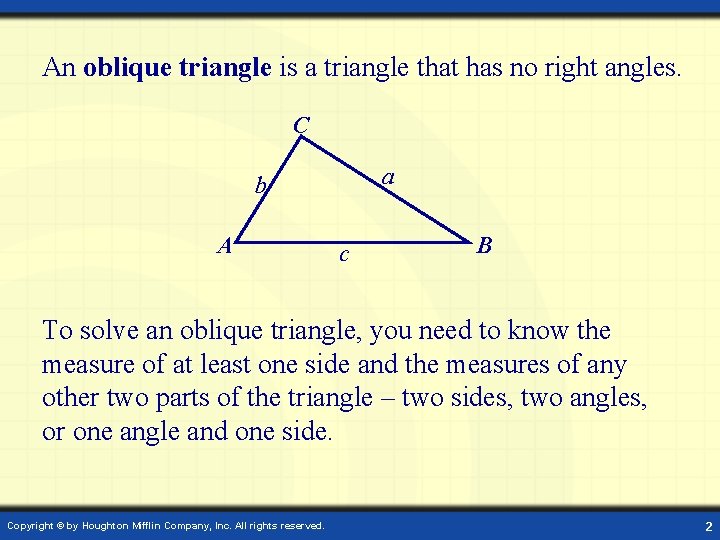
An oblique triangle is a triangle that has no right angles. C a b A c B To solve an oblique triangle, you need to know the measure of at least one side and the measures of any other two parts of the triangle – two sides, two angles, or one angle and one side. Copyright © by Houghton Mifflin Company, Inc. All rights reserved. 2
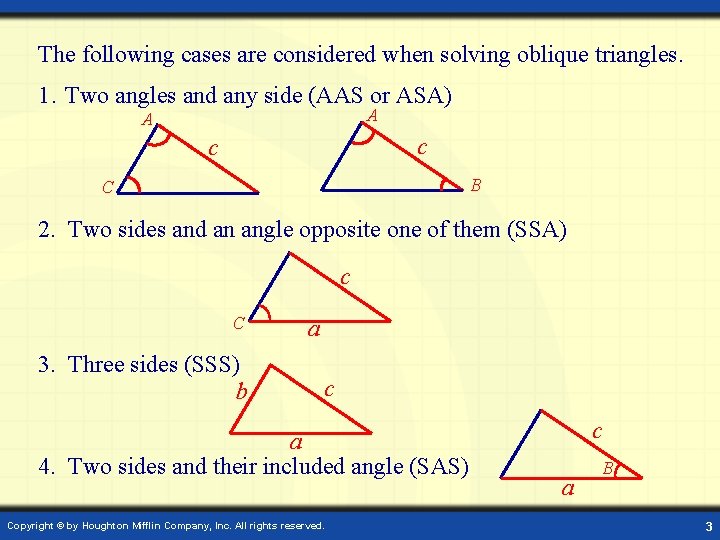
The following cases are considered when solving oblique triangles. 1. Two angles and any side (AAS or ASA) A A c c B C 2. Two sides and an angle opposite one of them (SSA) c C 3. Three sides (SSS) b a c a 4. Two sides and their included angle (SAS) Copyright © by Houghton Mifflin Company, Inc. All rights reserved. c a B 3
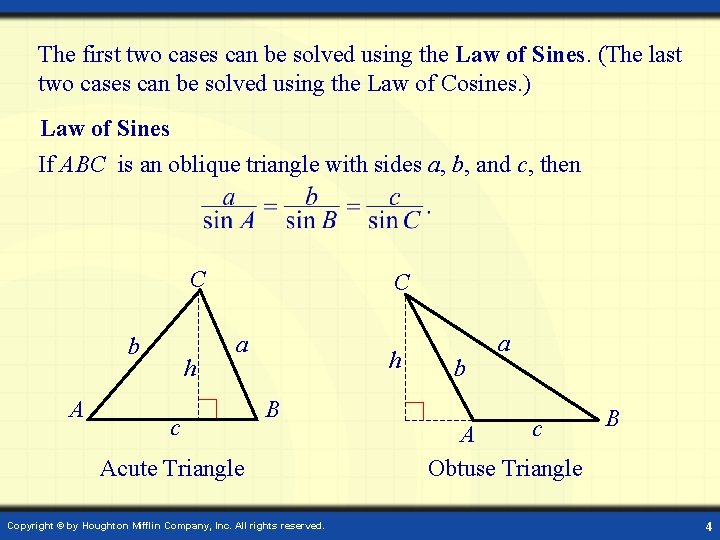
The first two cases can be solved using the Law of Sines. (The last two cases can be solved using the Law of Cosines. ) Law of Sines If ABC is an oblique triangle with sides a, b, and c, then C b A h C a c h B Acute Triangle Copyright © by Houghton Mifflin Company, Inc. All rights reserved. b a c A Obtuse Triangle B 4
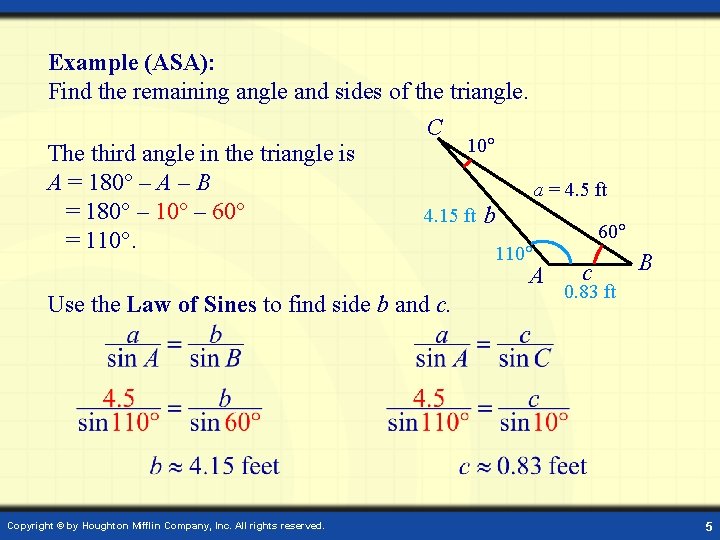
Example (ASA): Find the remaining angle and sides of the triangle. The third angle in the triangle is A = 180 – A – B = 180 – 10 – 60 = 110. C 10 a = 4. 5 ft 4. 15 ft b 110 A Use the Law of Sines to find side b and c. Copyright © by Houghton Mifflin Company, Inc. All rights reserved. 60 c B 0. 83 ft 5
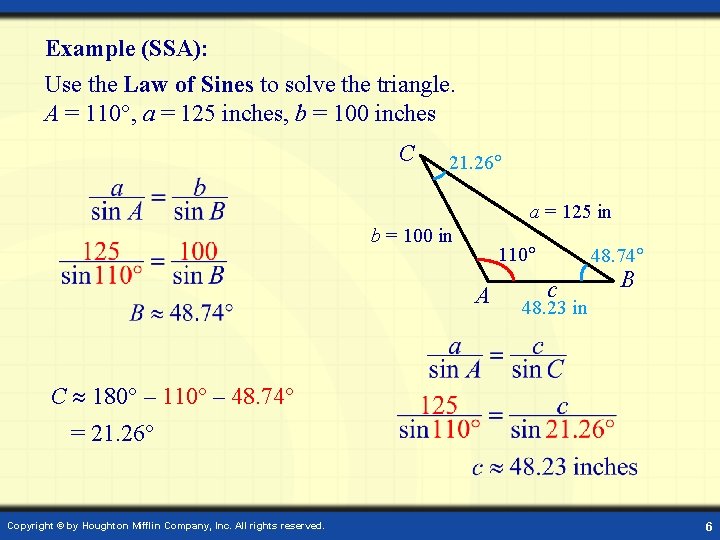
Example (SSA): Use the Law of Sines to solve the triangle. A = 110 , a = 125 inches, b = 100 inches C 21. 26 a = 125 in b = 100 in 110 A 48. 74 c B 48. 23 in C 180 – 110 – 48. 74 = 21. 26 Copyright © by Houghton Mifflin Company, Inc. All rights reserved. 6
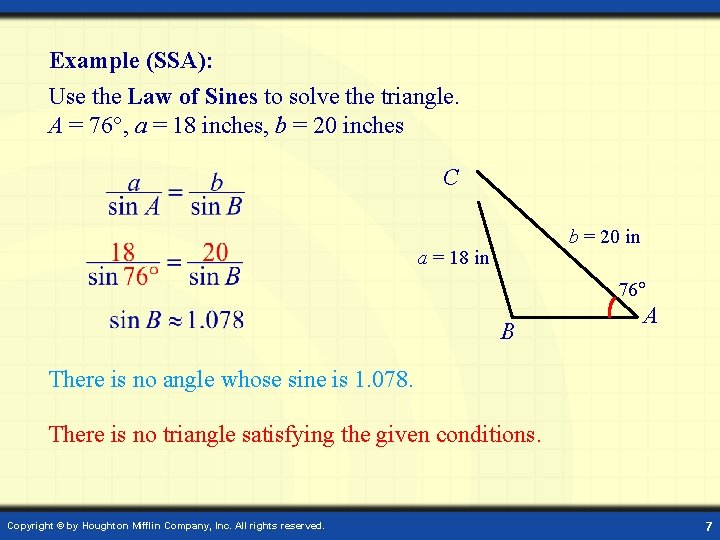
Example (SSA): Use the Law of Sines to solve the triangle. A = 76 , a = 18 inches, b = 20 inches C b = 20 in a = 18 in 76 B A There is no angle whose sine is 1. 078. There is no triangle satisfying the given conditions. Copyright © by Houghton Mifflin Company, Inc. All rights reserved. 7
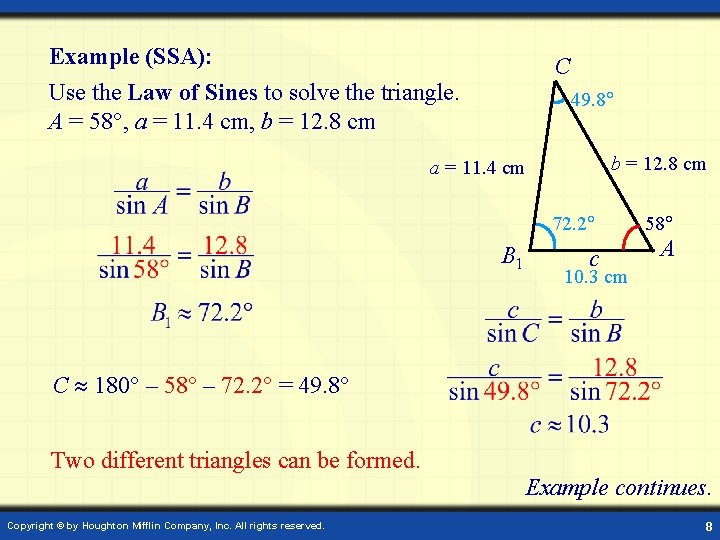
Example (SSA): Use the Law of Sines to solve the triangle. A = 58 , a = 11. 4 cm, b = 12. 8 cm C 49. 8 b = 12. 8 cm a = 11. 4 cm B 1 72. 2 58 c A 10. 3 cm C 180 – 58 – 72. 2 = 49. 8 Two different triangles can be formed. Example continues. Copyright © by Houghton Mifflin Company, Inc. All rights reserved. 8
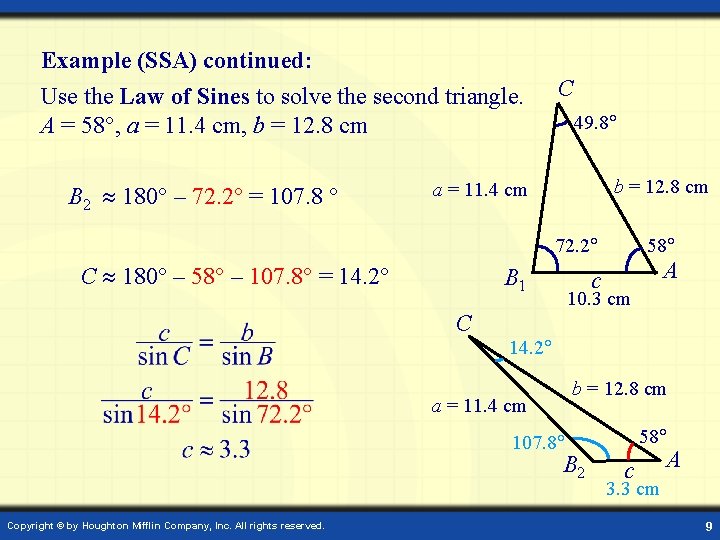
Example (SSA) continued: Use the Law of Sines to solve the second triangle. A = 58 , a = 11. 4 cm, b = 12. 8 cm B 2 180 – 72. 2 = 107. 8 C 49. 8 b = 12. 8 cm a = 11. 4 cm C 180 – 58 – 107. 8 = 14. 2 72. 2 58 c A B 1 10. 3 cm C 14. 2 b = 12. 8 cm a = 11. 4 cm 58 107. 8 B 2 Copyright © by Houghton Mifflin Company, Inc. All rights reserved. c A 3. 3 cm 9
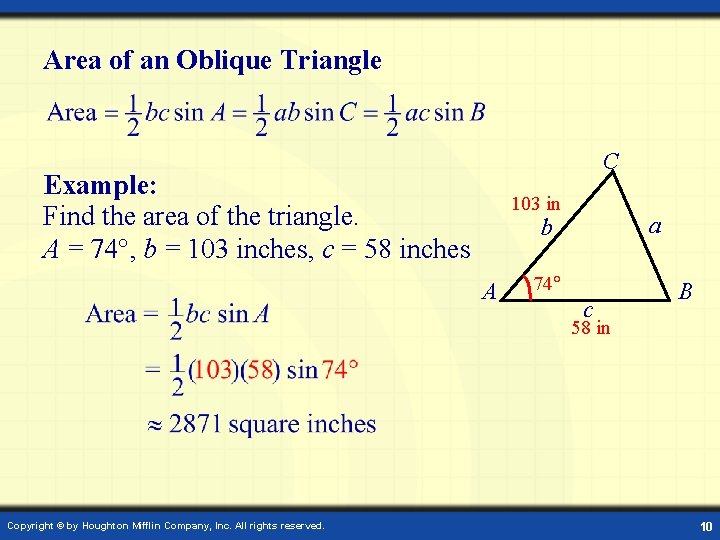
Area of an Oblique Triangle C Example: Find the area of the triangle. A = 74 , b = 103 inches, c = 58 inches 103 in a b A 74 c B 58 in Copyright © by Houghton Mifflin Company, Inc. All rights reserved. 10
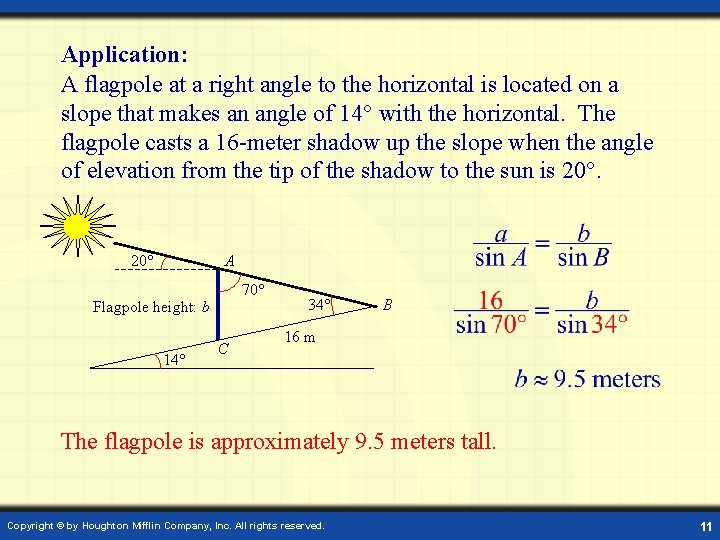
Application: A flagpole at a right angle to the horizontal is located on a slope that makes an angle of 14 with the horizontal. The flagpole casts a 16 -meter shadow up the slope when the angle of elevation from the tip of the shadow to the sun is 20. A 20 70 Flagpole height: b 14 C 34 B 16 m The flagpole is approximately 9. 5 meters tall. Copyright © by Houghton Mifflin Company, Inc. All rights reserved. 11
- Slides: 11