
Digital Image Processing monsoon 2003 FINAL PROJECT REPORT

- Slides: 23
Digital Image Processing - (monsoon 2003) FINAL PROJECT REPORT FINGERPRINT MATCHING Project Members Sanyam Sharma - 200101072 Sunil Mohan Ranta - 200101083 Group No. - 15
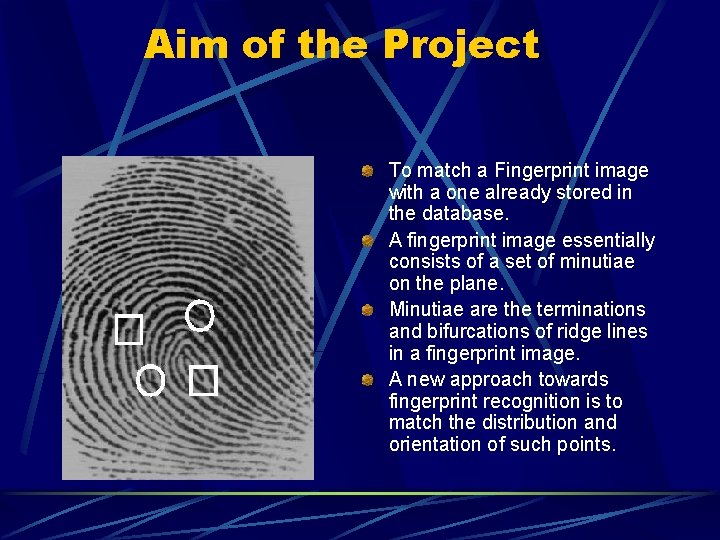
Aim of the Project To match a Fingerprint image with a one already stored in the database. A fingerprint image essentially consists of a set of minutiae on the plane. Minutiae are the terminations and bifurcations of ridge lines in a fingerprint image. A new approach towards fingerprint recognition is to match the distribution and orientation of such points.
Motivation behind it…… § Finger-print recognition is used in various systems for Verification, Identification etc. § Recognizing manually can be very time consuming and costly. § There are systems already in use which use similar technology and a lot of research is going on to improve the technique.
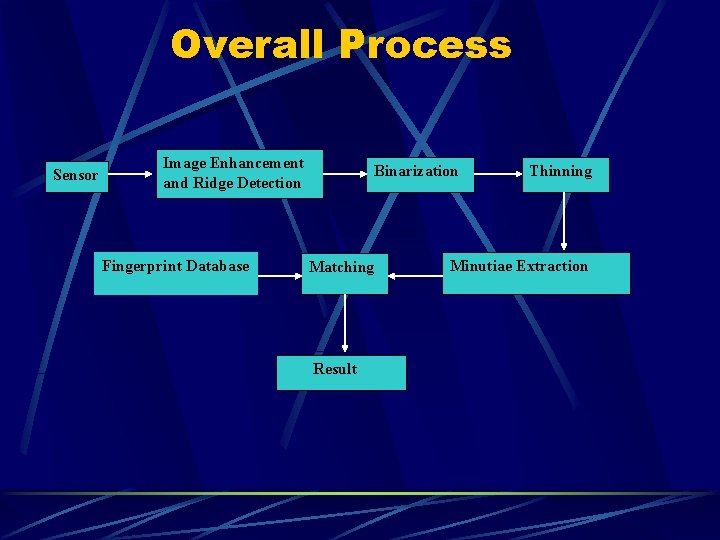
Algorithm (i) (iii) (iv) (vi) This particular method of fingerprint matching consists mainly of six stages …. Image Enhancement, Ridge extraction Binarization Thinning Minutiae extraction Post processing.
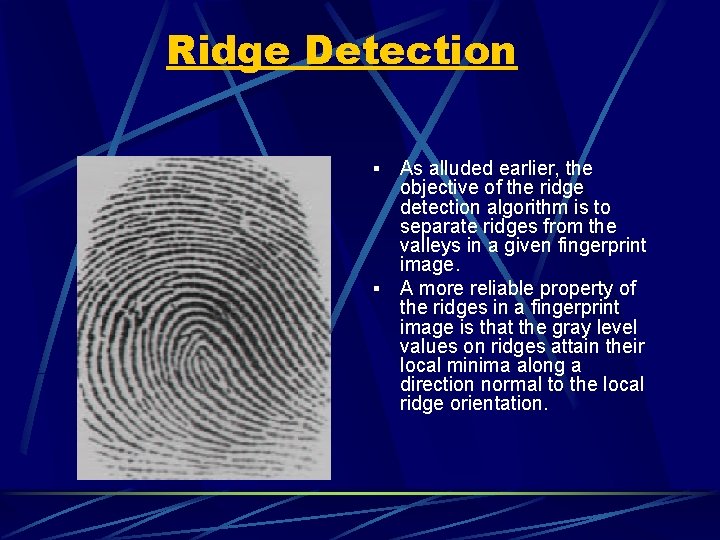
Ridge Detection As alluded earlier, the objective of the ridge detection algorithm is to separate ridges from the valleys in a given fingerprint image. § A more reliable property of the ridges in a fingerprint image is that the gray level values on ridges attain their local minima along a direction normal to the local ridge orientation. §
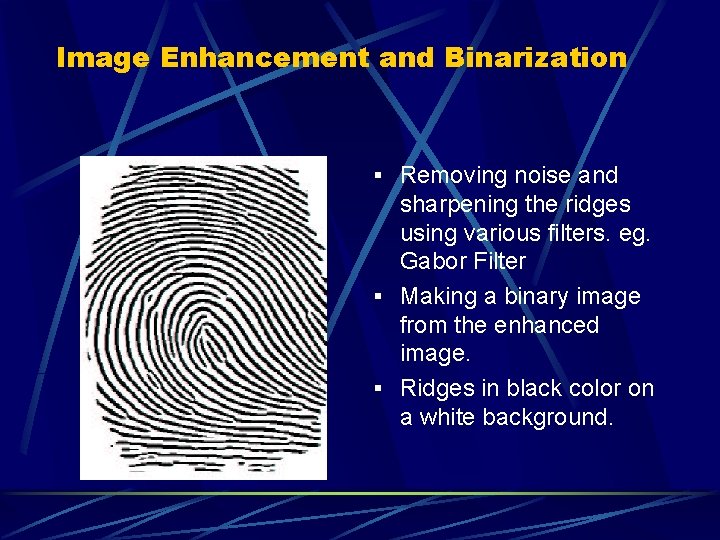
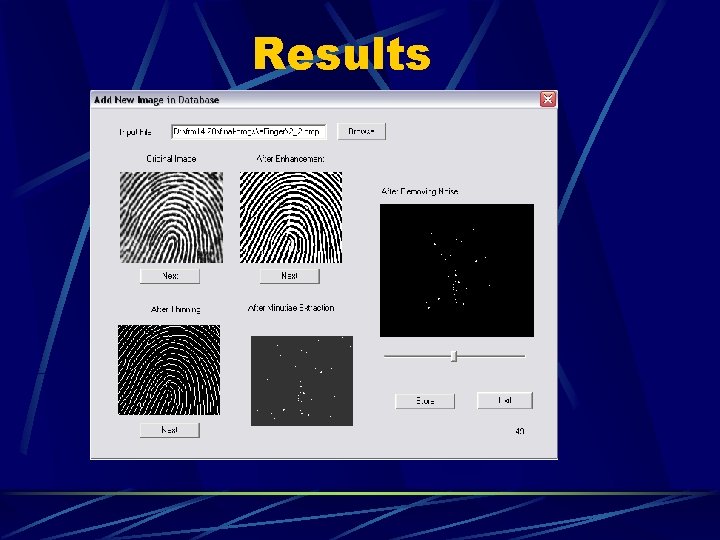
Image Enhancement and Binarization § Removing noise and sharpening the ridges using various filters. eg. Gabor Filter § Making a binary image from the enhanced image. § Ridges in black color on a white background.
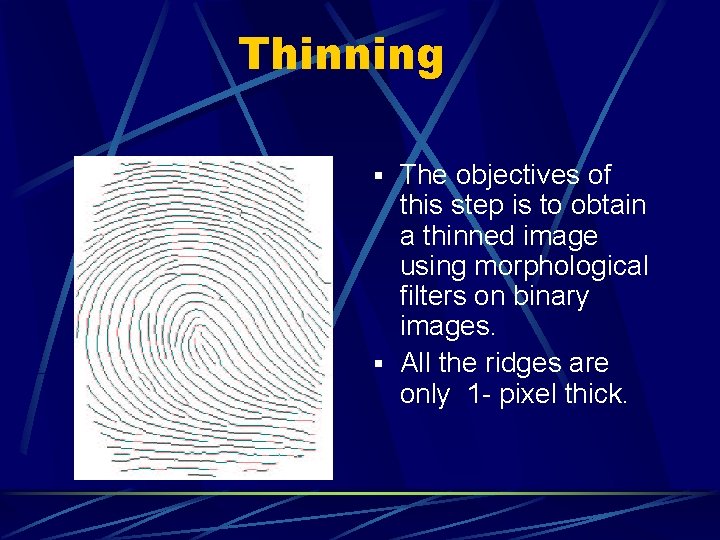
Thinning § The objectives of this step is to obtain a thinned image using morphological filters on binary images. § All the ridges are only 1 - pixel thick.
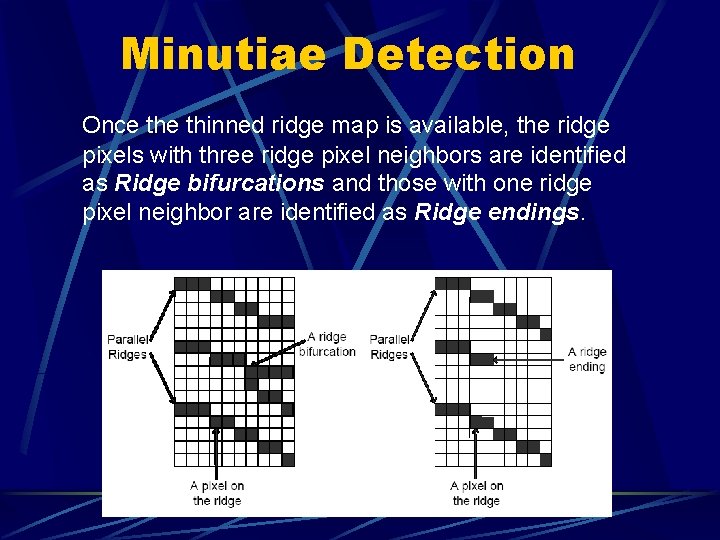
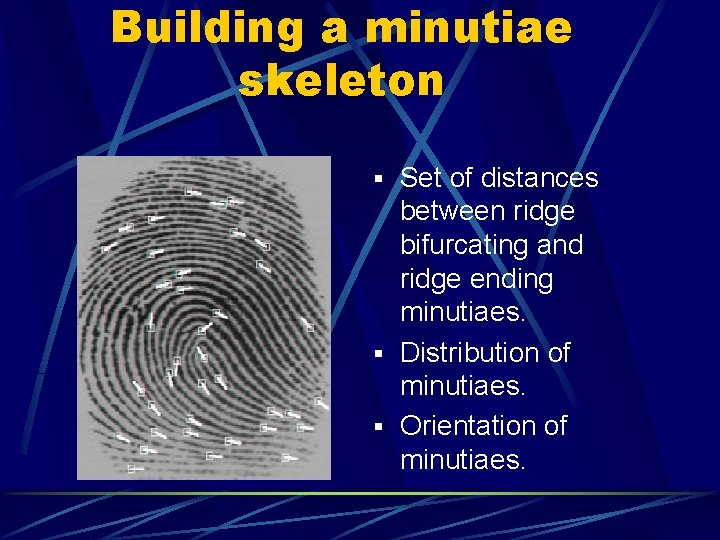
Minutiae Detection Once thinned ridge map is available, the ridge pixels with three ridge pixel neighbors are identified as Ridge bifurcations and those with one ridge pixel neighbor are identified as Ridge endings.
Building a minutiae skeleton § Set of distances between ridge bifurcating and ridge ending minutiaes. § Distribution of minutiaes. § Orientation of minutiaes.
Matching the details … § Comparing the obtained skeleton and minutiae score with the other image. § There can be many ways to match the details obtained. § One approach can be using a skeleton structure of minutiae points.
Overall Process Sensor Image Enhancement and Ridge Detection Fingerprint Database Binarization Matching Result Thinning Minutiae Extraction
Applications … § Fingerprint Matching. Identifiers. § Fingerprint Verification. Secure access, digital signatures etc.
Results
After Enhancement § We have achieved Appreciable enhancement using Gabor filters. § Features handled - ridge enhancement § Binarization of image using threshold values.
Thinning § Reducing width of ridges to a ‘single’ pixel. § Algorithm used Morphological thinning.
Minutiae Detection § Next step is to detect Minutiae in the image. § We have achieved quite efficient resultsin detecting all the minutiae points. § Removal of False minutiae points.
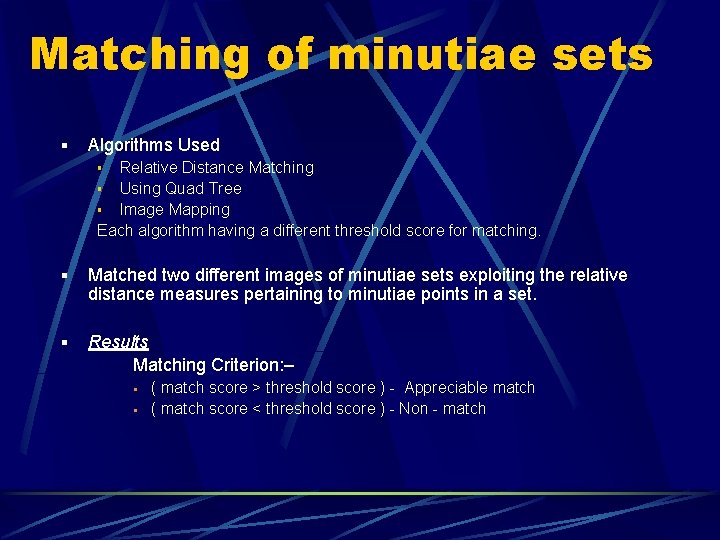
Matching of minutiae sets § Algorithms Used Relative Distance Matching § Using Quad Tree § Image Mapping Each algorithm having a different threshold score for matching. § § Matched two different images of minutiae sets exploiting the relative distance measures pertaining to minutiae points in a set. § Results Matching Criterion: – § § ( match score > threshold score ) - Appreciable match ( match score < threshold score ) - Non - match
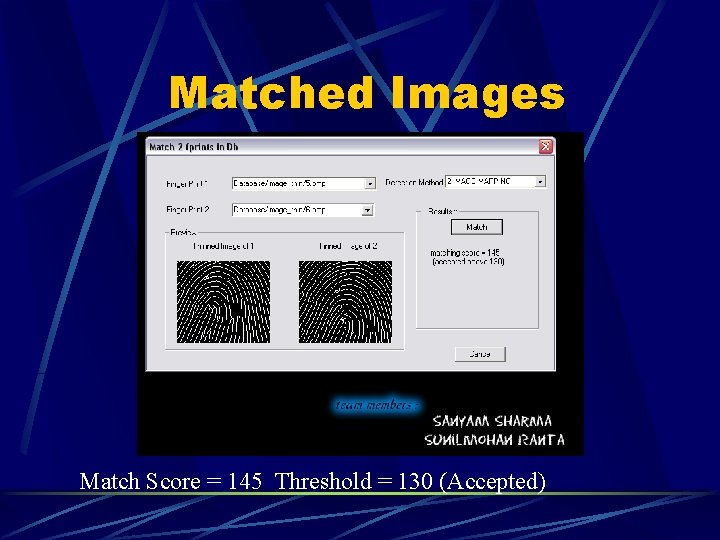
Matched Images Match Score = 145 Threshold = 130 (Accepted)
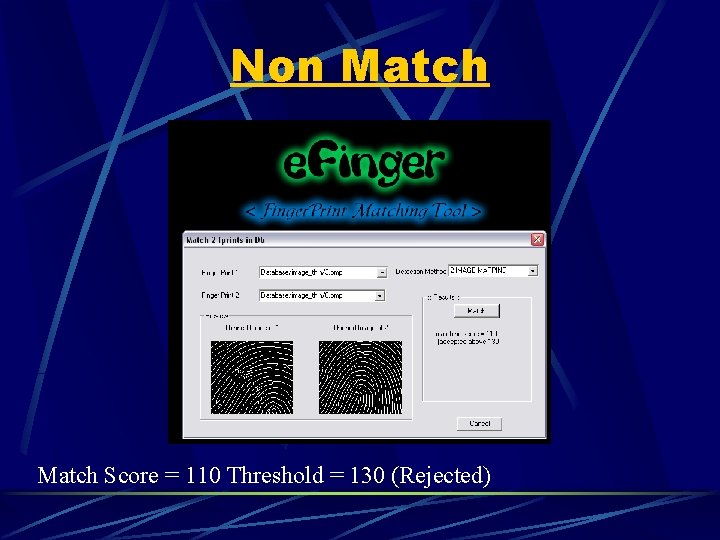
Non Match Score = 110 Threshold = 130 (Rejected)
Constraints § Rotation Variant. § Quality of images should be good. Difficulties … High efficiency needed as the fields of application are related to security.
Future Work § Matching algorithms can be improved. By exploiting § minutiae orientation details. § differentiating bifurcating and ending minutiae’s. § considering average ridge thickness etc.
Workbed Platform – Windows Tools – Microsoft Visual c++ , Matlab and Matlab addin for MS VC++. Image Input - Scanner References … § [1] A. K. Jain, L. Hong, S. Pankanti, R. Bolle, “An identity authentication system using fingerprints”, Proceedings of the IEEE, 85(9)(1997) 1365 -1388. § [2] A. K. Jain, A. Ross, S. Prabhakar, “Fingerprint matching using Minutiae and Features”. Texture § [3] P. Bhowmick, A. Bishnu, B. B. Bhattacharya , M. K. Kundu, C. A. Murthy, T. “Determination of Minutiae Scores for Fingerprint Image Applications”. Acharya, § [4] Dario Maio and Davide Maltoni “Direct Gray-Scale Minutiae Detection In Fingerprints”.
Thx