
DIGITAL IMAGE PROCESSING Lecture 3 Scalespace Colors Tammy
- Slides: 62
DIGITAL IMAGE PROCESSING Lecture 3 Scale-space, Colors Tammy Riklin Raviv Electrical and Computer Engineering Ben-Gurion University of the Negev
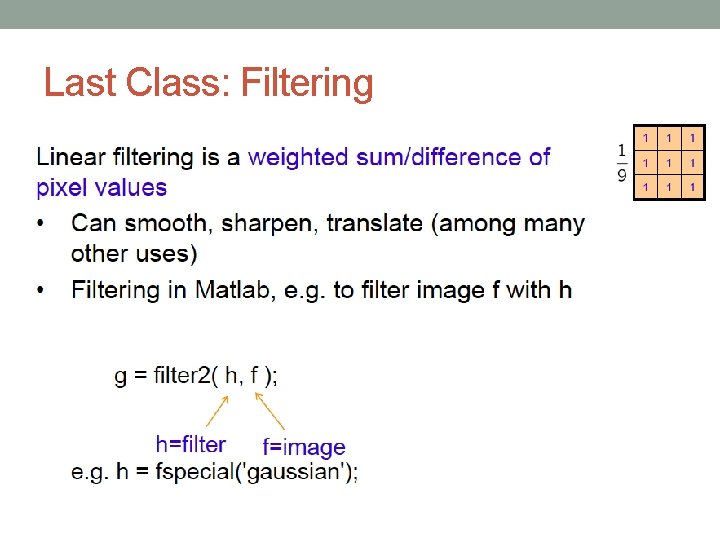
Last Class: Filtering
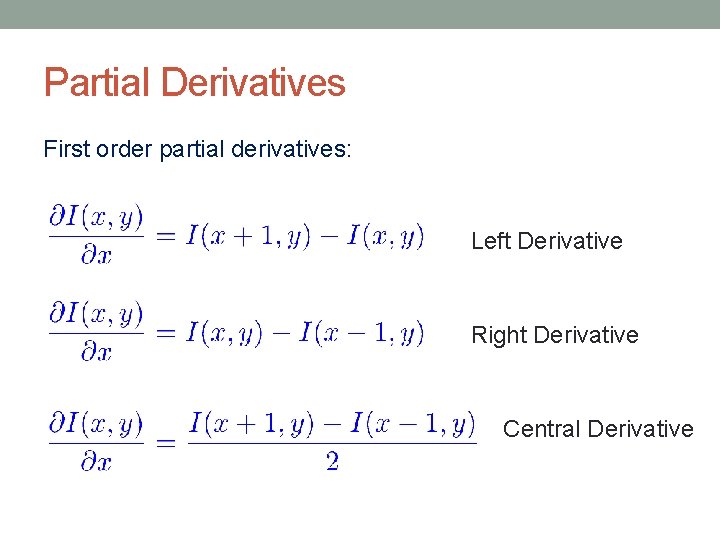
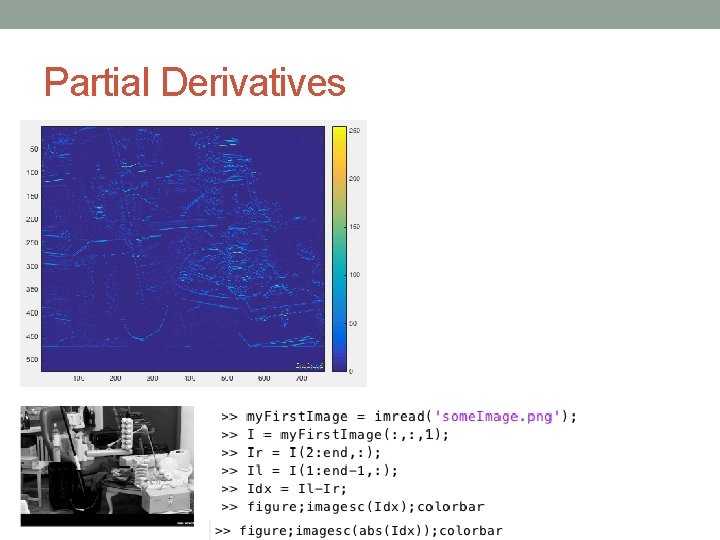
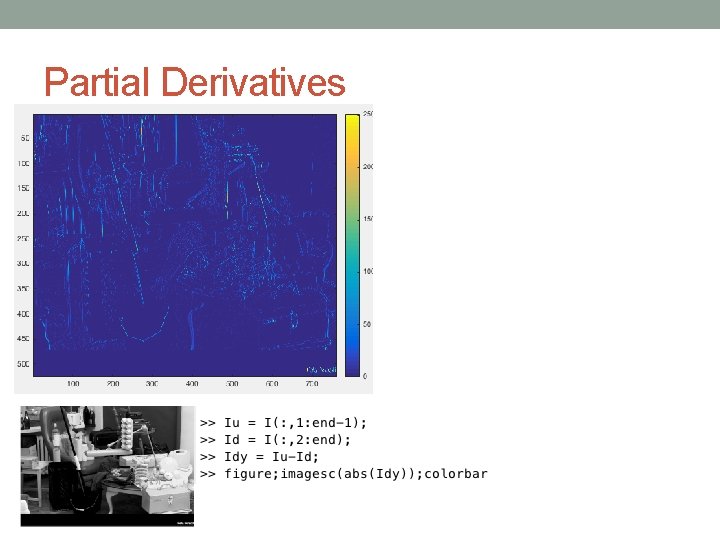
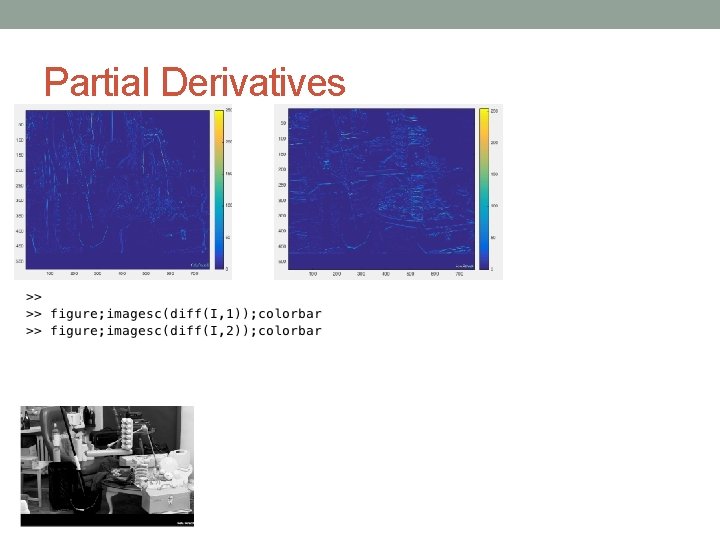
Partial Derivatives First order partial derivatives: Left Derivative Right Derivative Central Derivative
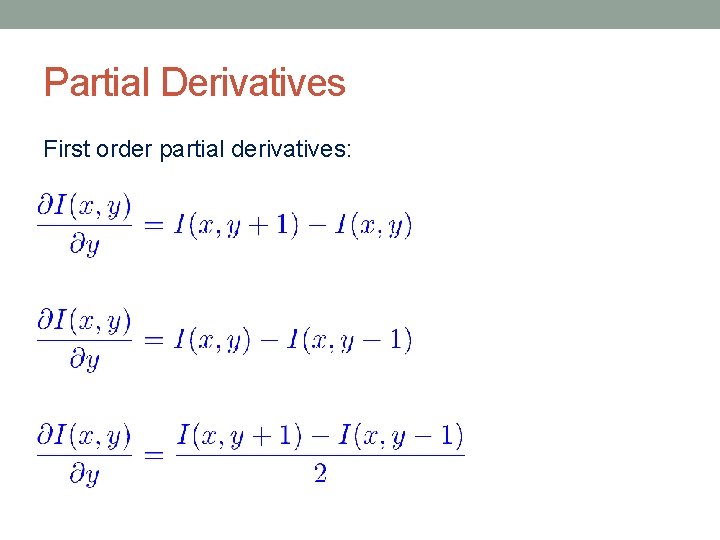
Partial Derivatives First order partial derivatives:
Partial Derivatives
Partial Derivatives
Partial Derivatives
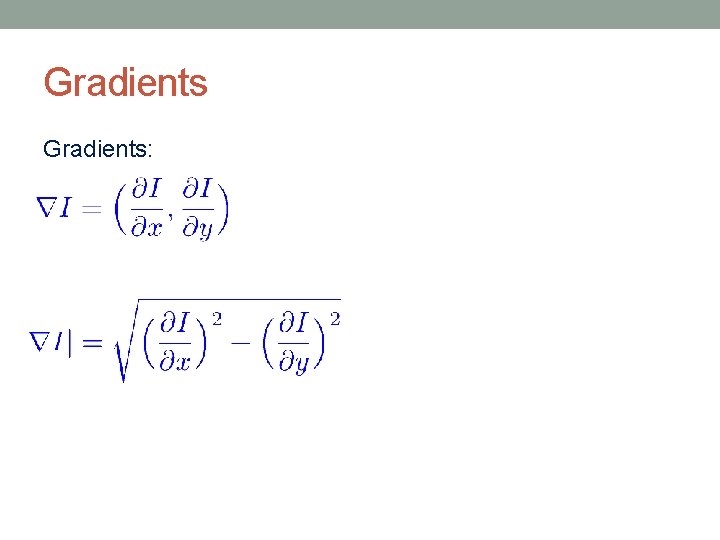
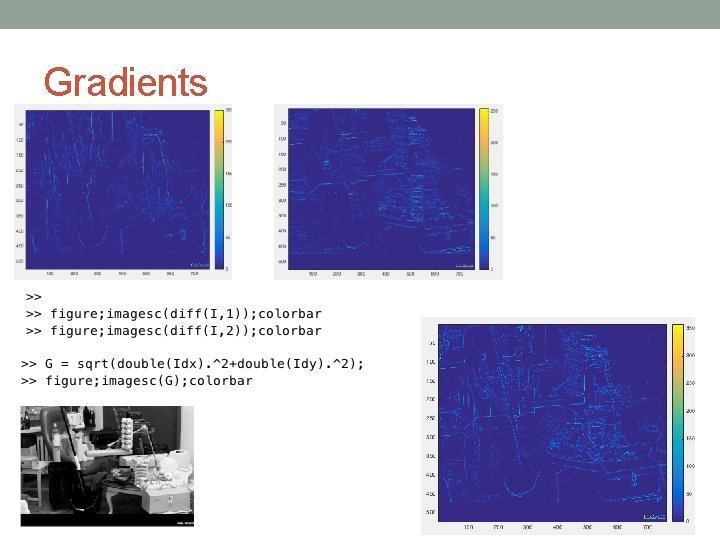
Gradients:
Gradients
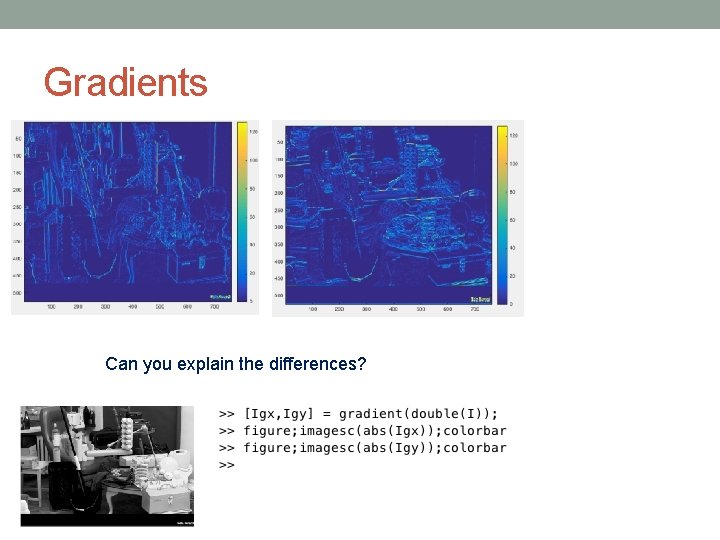
Gradients Can you explain the differences?
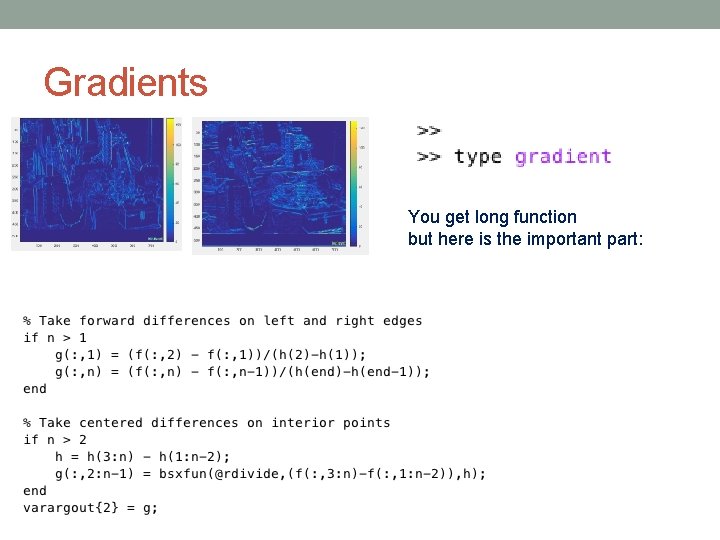
Gradients You get long function but here is the important part:
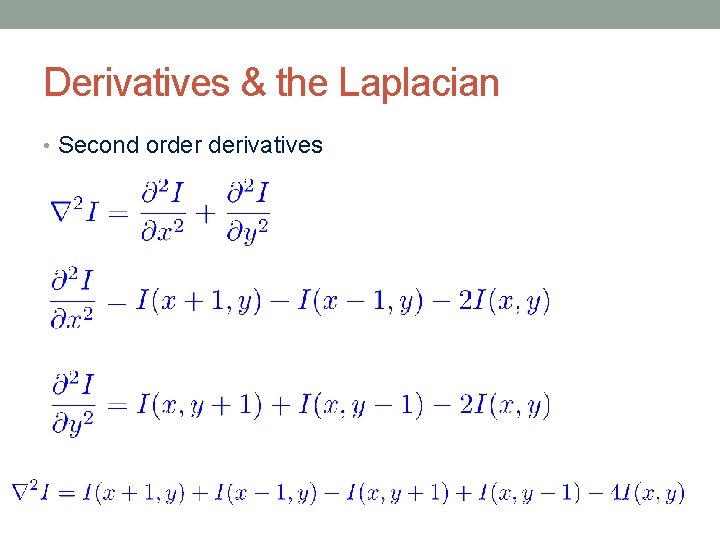
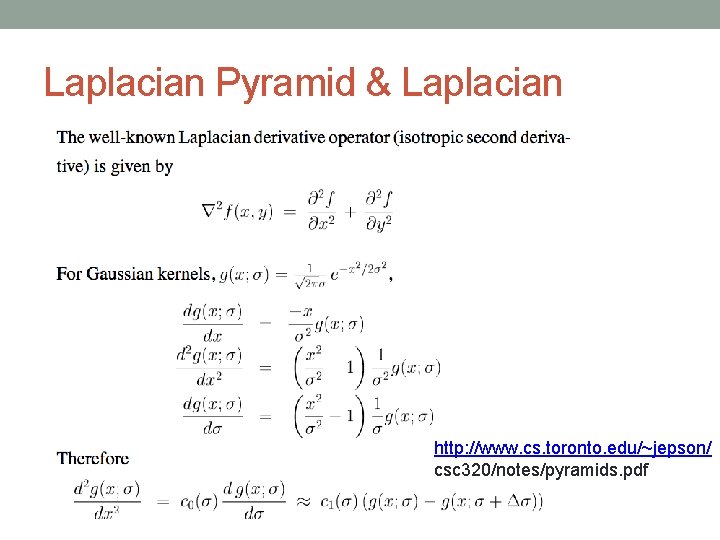
Derivatives & the Laplacian • Second order derivatives
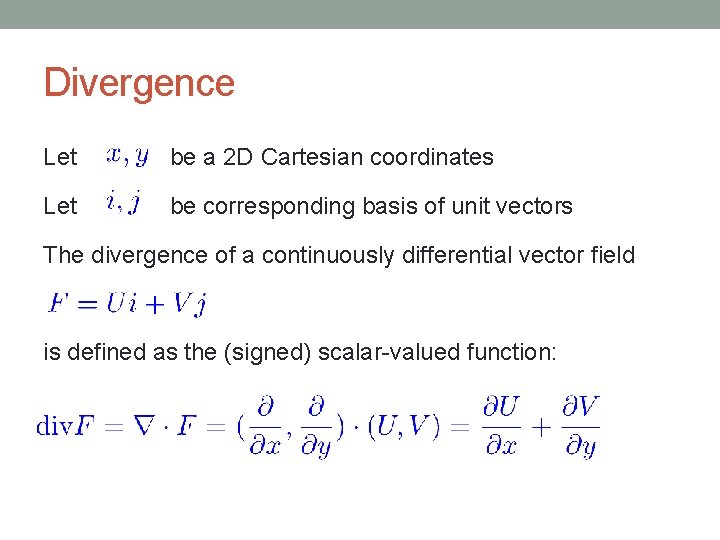
Divergence Let be a 2 D Cartesian coordinates Let be corresponding basis of unit vectors The divergence of a continuously differential vector field is defined as the (signed) scalar-valued function:
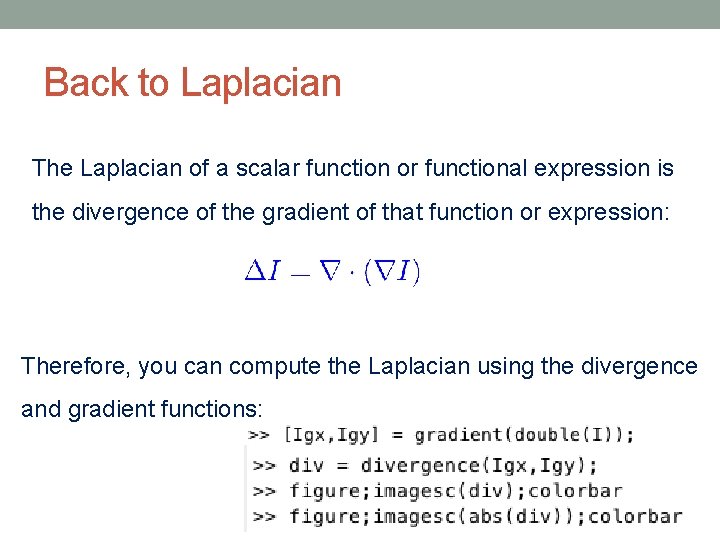
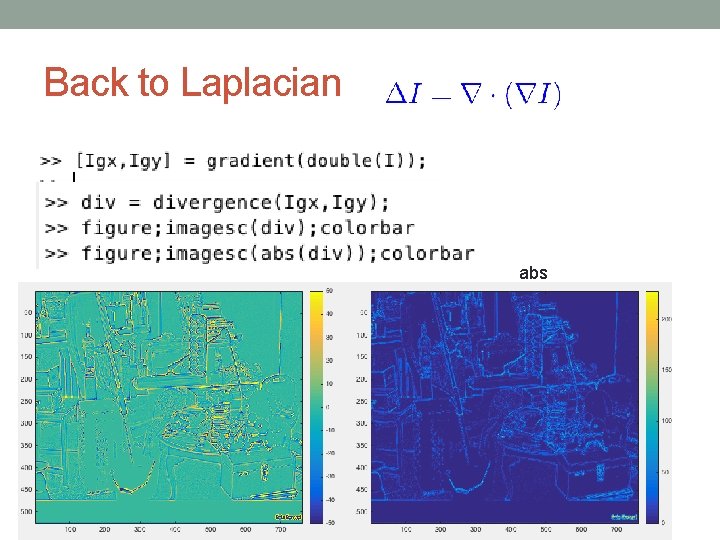
Back to Laplacian The Laplacian of a scalar function or functional expression is the divergence of the gradient of that function or expression: Therefore, you can compute the Laplacian using the divergence and gradient functions:
Back to Laplacian abs
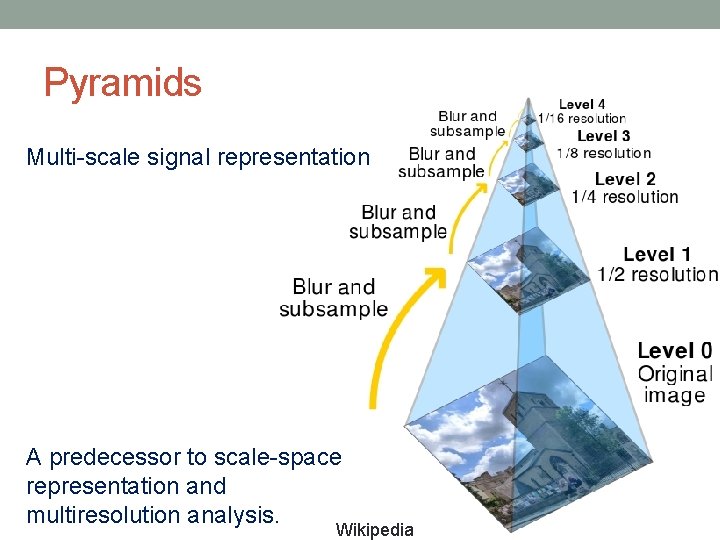
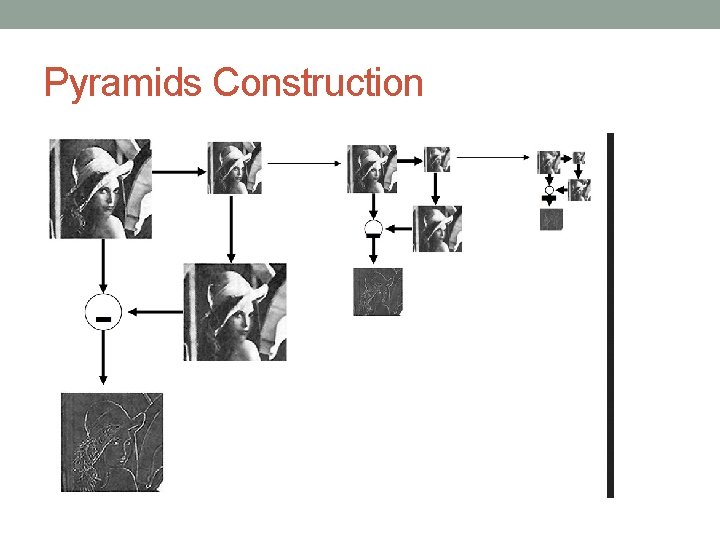
Pyramids Multi-scale signal representation A predecessor to scale-space representation and multiresolution analysis. Wikipedia
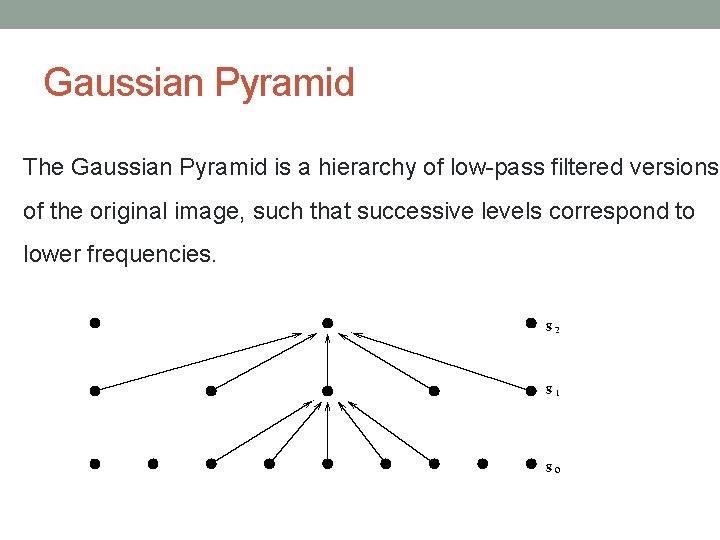
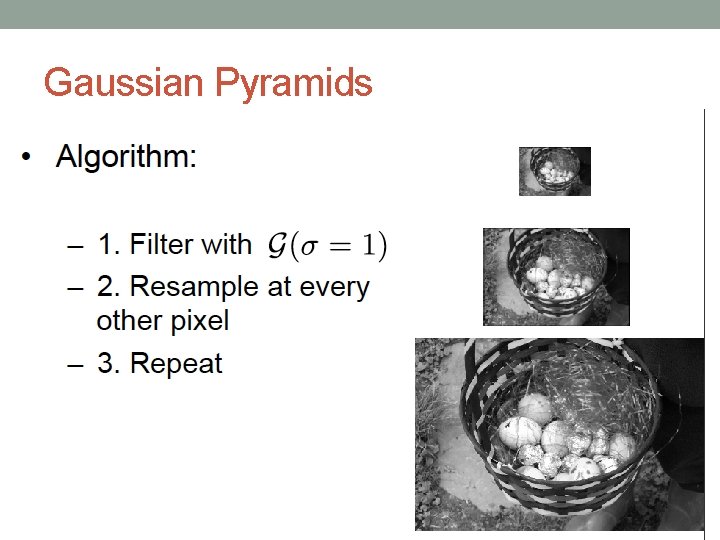
Gaussian Pyramid The Gaussian Pyramid is a hierarchy of low-pass filtered versions of the original image, such that successive levels correspond to lower frequencies.
Gaussian Pyramids
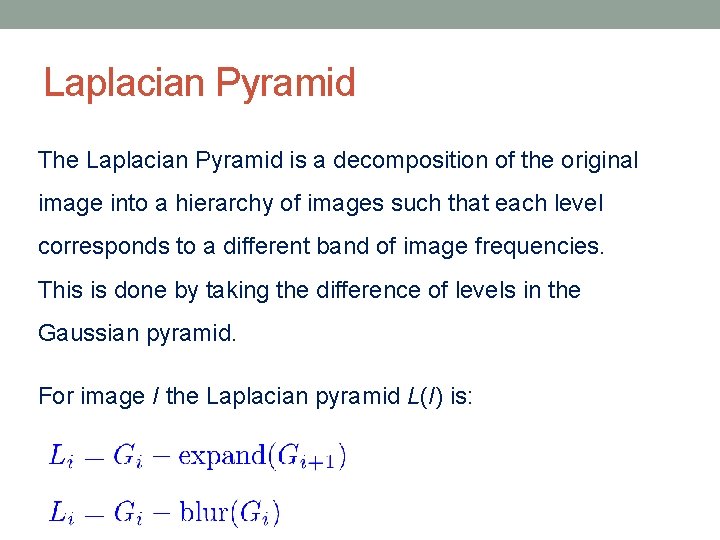
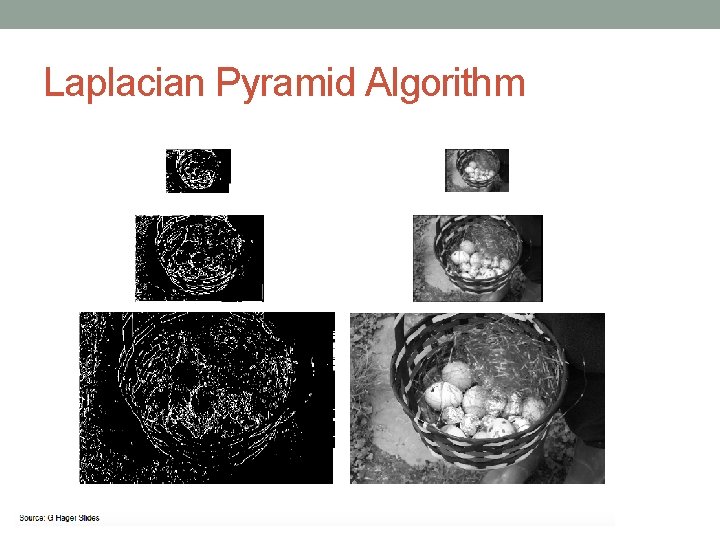
Laplacian Pyramid The Laplacian Pyramid is a decomposition of the original image into a hierarchy of images such that each level corresponds to a different band of image frequencies. This is done by taking the difference of levels in the Gaussian pyramid. For image I the Laplacian pyramid L(I) is:
Laplacian Pyramid Algorithm
Pyramids Construction
Laplacian Pyramid & Laplacian http: //www. cs. toronto. edu/~jepson/ csc 320/notes/pyramids. pdf
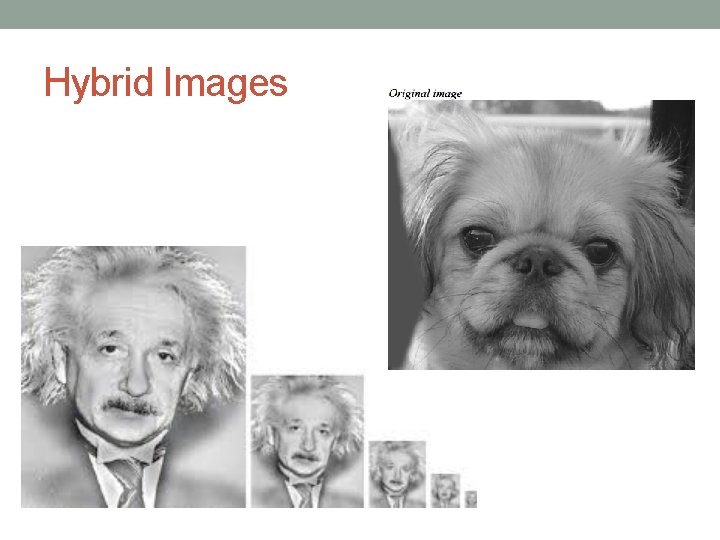
Hybrid Images
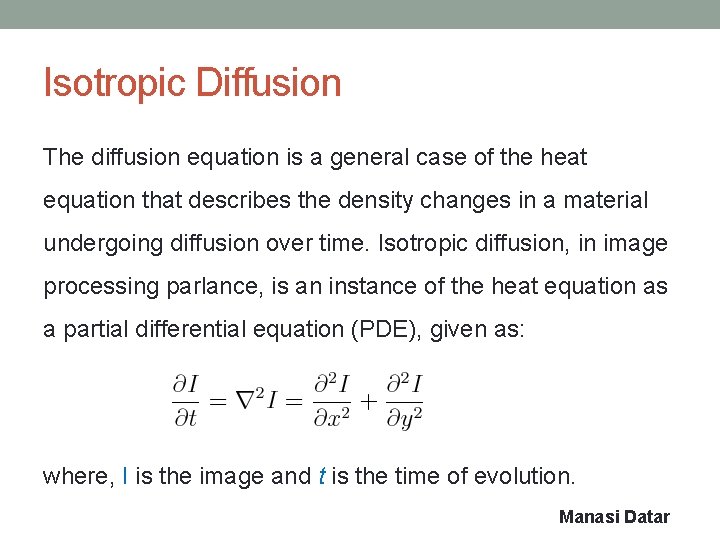
Isotropic Diffusion The diffusion equation is a general case of the heat equation that describes the density changes in a material undergoing diffusion over time. Isotropic diffusion, in image processing parlance, is an instance of the heat equation as a partial differential equation (PDE), given as: where, I is the image and t is the time of evolution. Manasi Datar
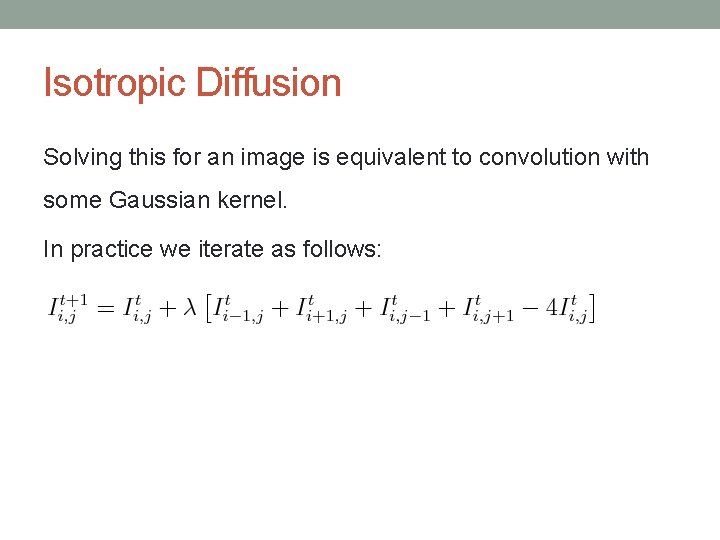
Isotropic Diffusion Solving this for an image is equivalent to convolution with some Gaussian kernel. In practice we iterate as follows:
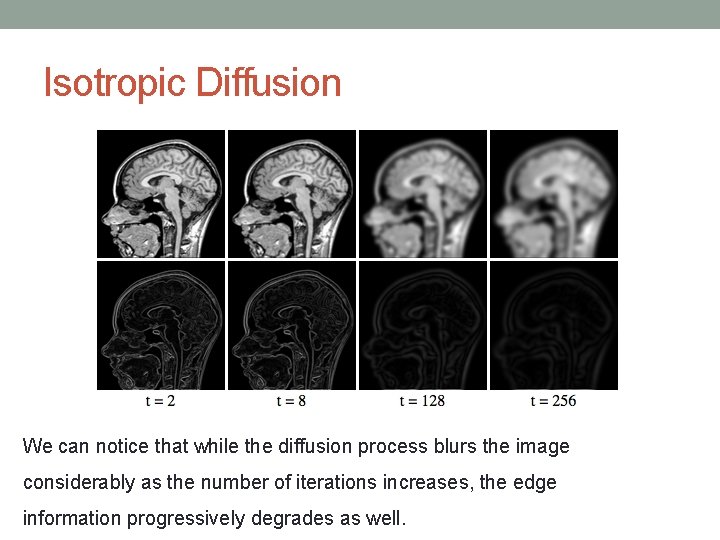
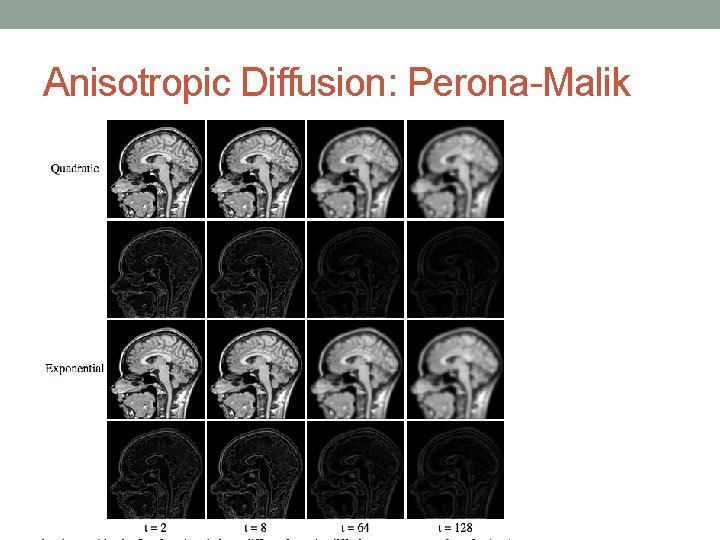
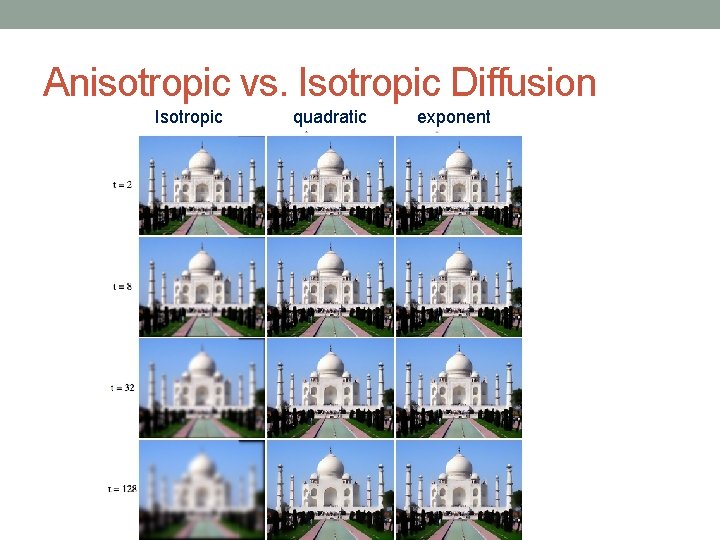
Isotropic Diffusion We can notice that while the diffusion process blurs the image considerably as the number of iterations increases, the edge information progressively degrades as well.
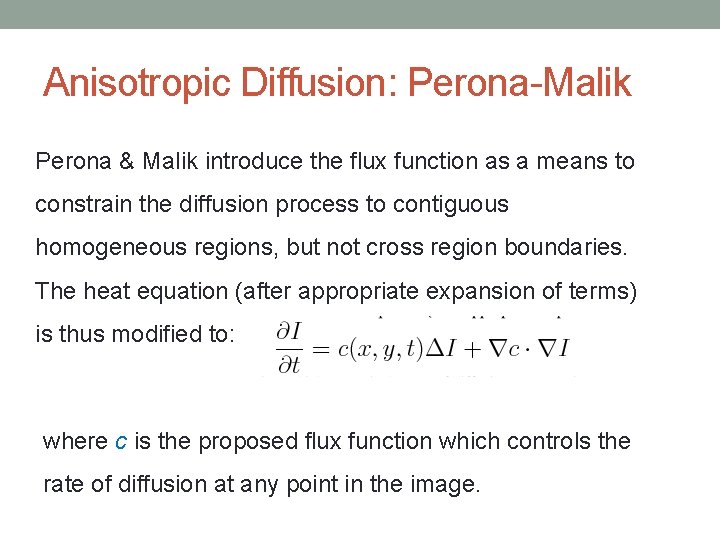
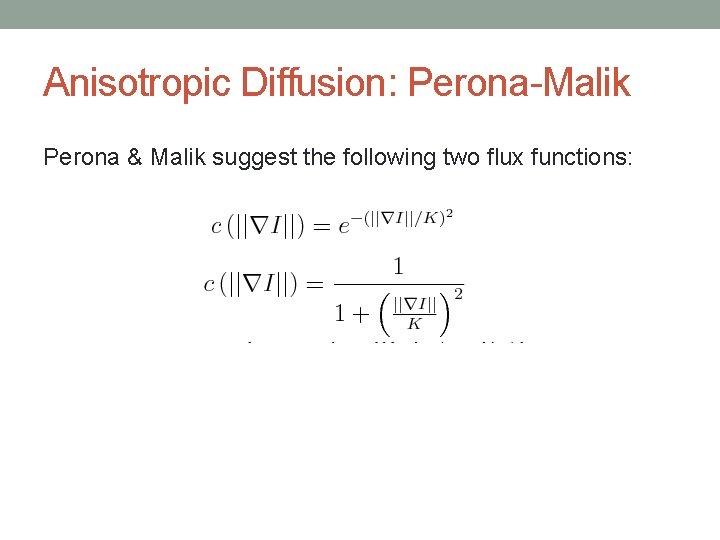
Anisotropic Diffusion: Perona-Malik Perona & Malik introduce the flux function as a means to constrain the diffusion process to contiguous homogeneous regions, but not cross region boundaries. The heat equation (after appropriate expansion of terms) is thus modified to: where c is the proposed flux function which controls the rate of diffusion at any point in the image.
Anisotropic Diffusion: Perona-Malik A choice of c such that it follows the gradient magnitude at the point enables us to restrain the diffusion process as we approach region boundaries. As we approach edges in the image, the flux function may trigger inverse diffusion and actually enhance the edges.
Anisotropic Diffusion: Perona-Malik Perona & Malik suggest the following two flux functions:
Anisotropic Diffusion: Perona-Malik The flux functions offer a trade-off between edgepreservation and blurring (smoothing) homogeneous regions. Both the functions are governed by the free parameter κ which determines the edge-strength to consider as a valid region boundary. Intuitively, a large value of κ will lead back into an isotropic-like solution. We will experiment with both the flux functions in this report.
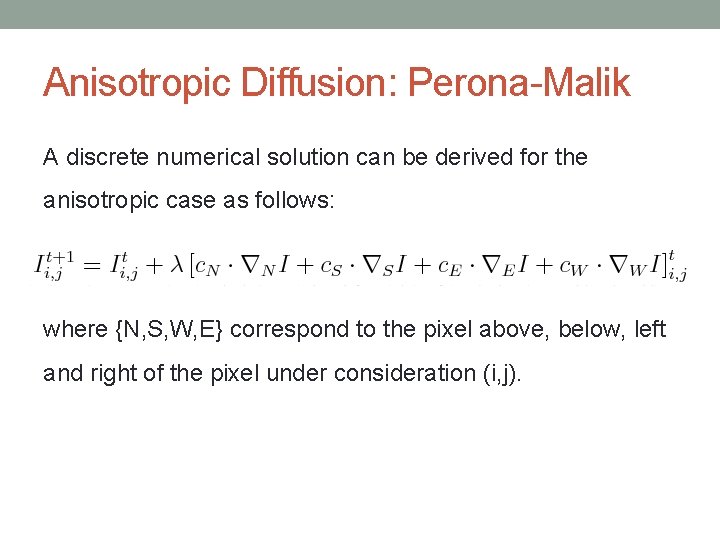
Anisotropic Diffusion: Perona-Malik A discrete numerical solution can be derived for the anisotropic case as follows: where {N, S, W, E} correspond to the pixel above, below, left and right of the pixel under consideration (i, j).
Anisotropic Diffusion: Perona-Malik
Anisotropic vs. Isotropic Diffusion Isotropic quadratic exponent
Bonus Question: Image Enhancement • Take an image (any image, but preferably one’s that needs enhancement) and enhance it. • Use what learned in this class to do so • Plot the “before” and “after” • Plot its derivatives before and after • Matlab code is needed • 3 Best works in class get 1 bonus point
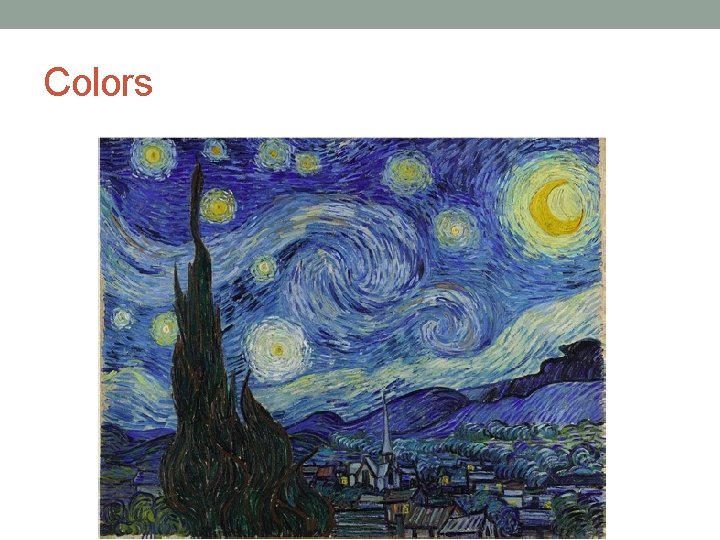
Colors
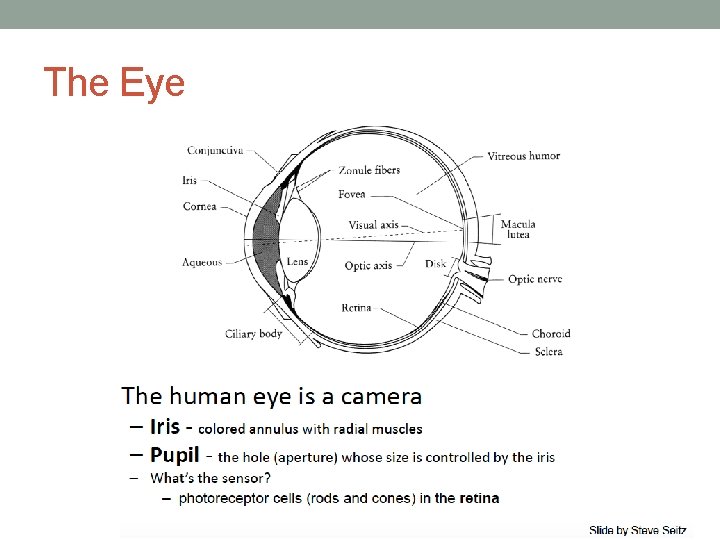
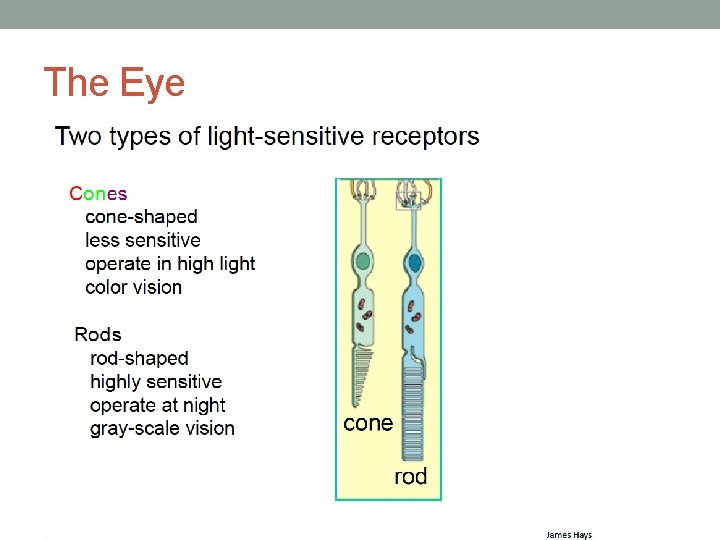
The Eye
The Eye
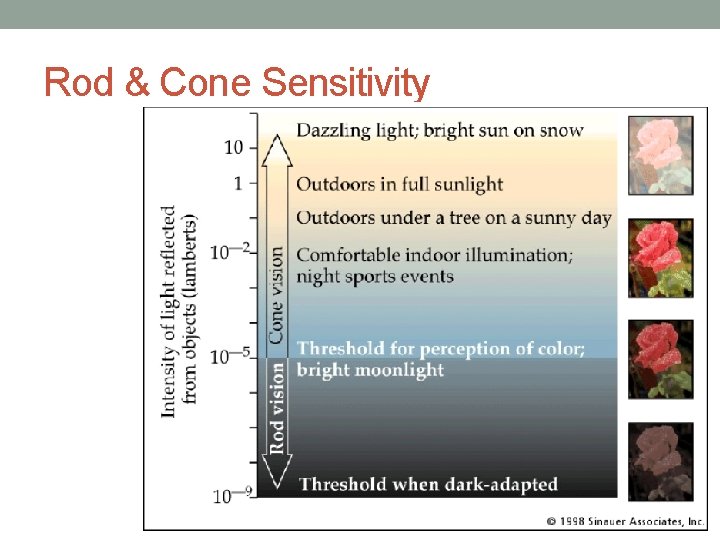
Rod & Cone Sensitivity
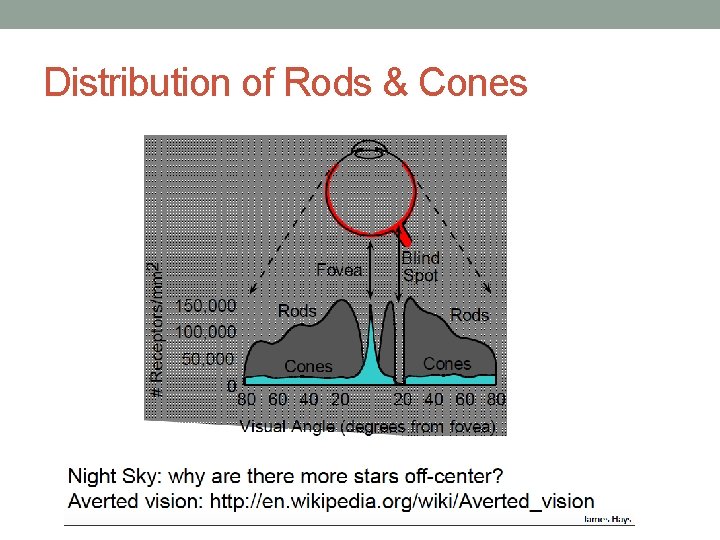
Distribution of Rods & Cones
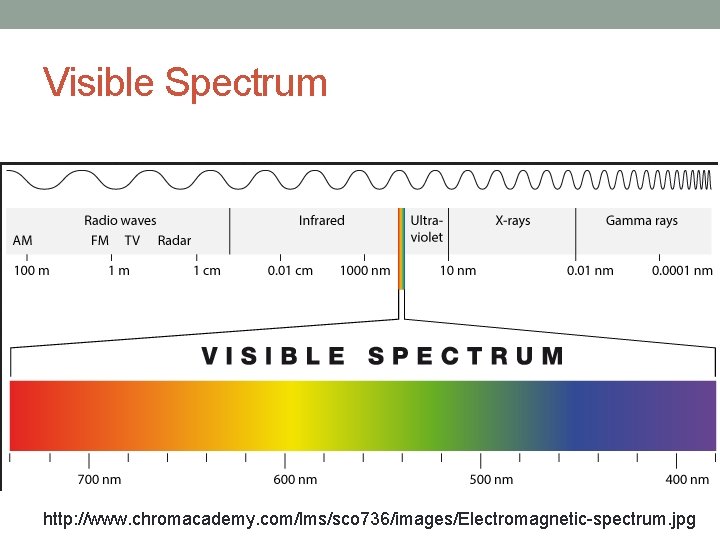
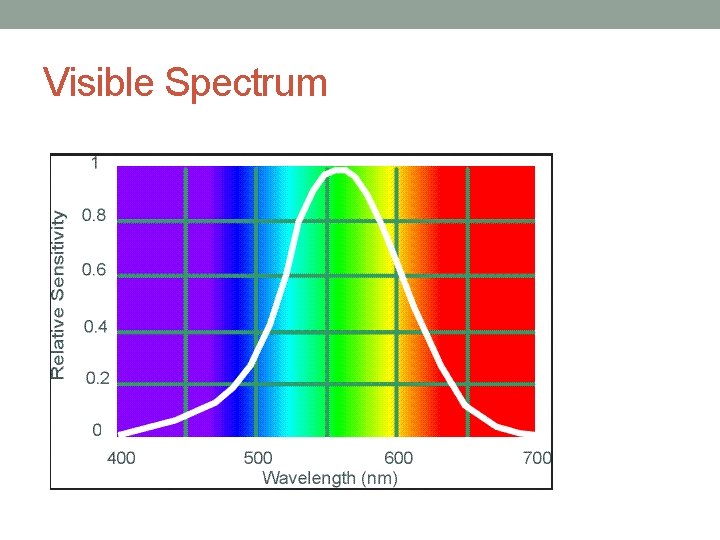
Visible Spectrum http: //www. chromacademy. com/lms/sco 736/images/Electromagnetic-spectrum. jpg
Visible Spectrum
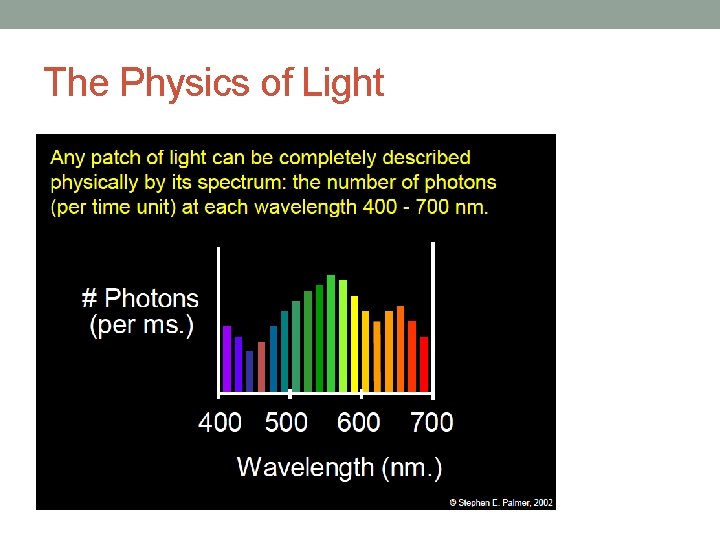
The Physics of Light
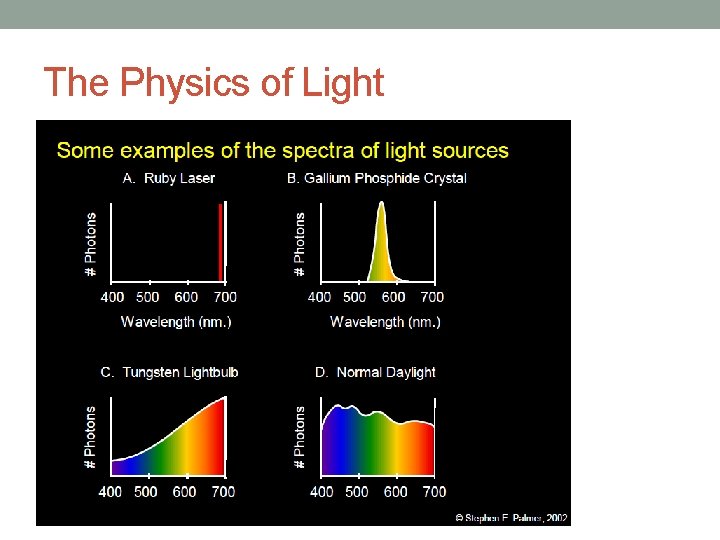
The Physics of Light
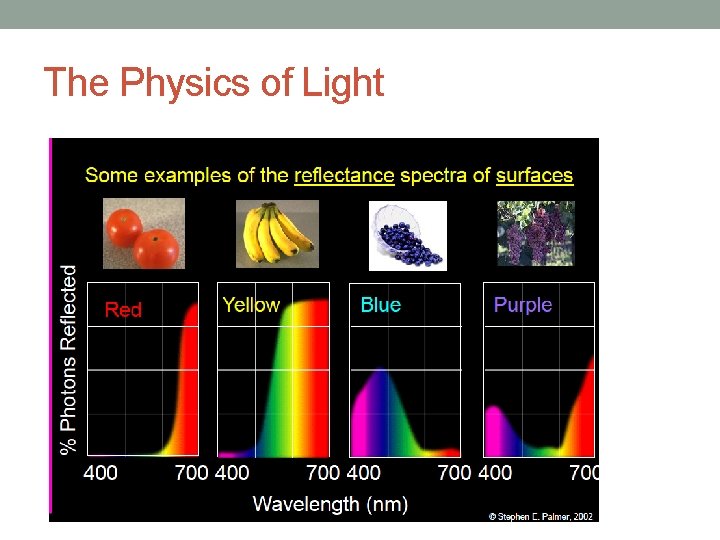
The Physics of Light
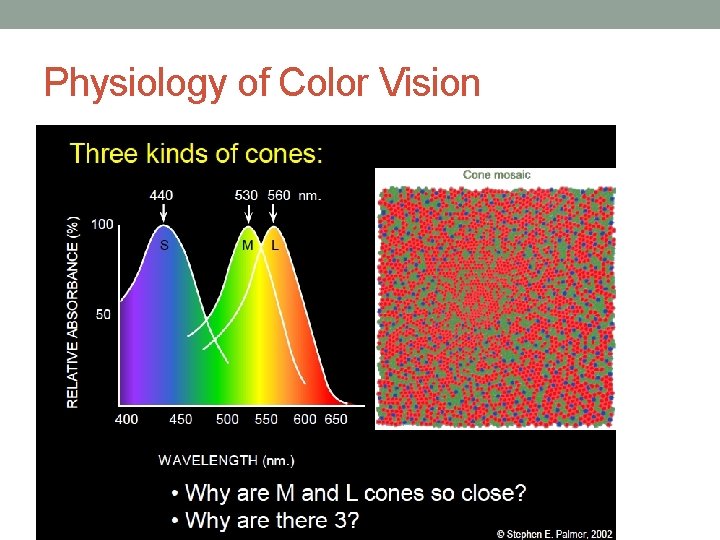
Physiology of Color Vision
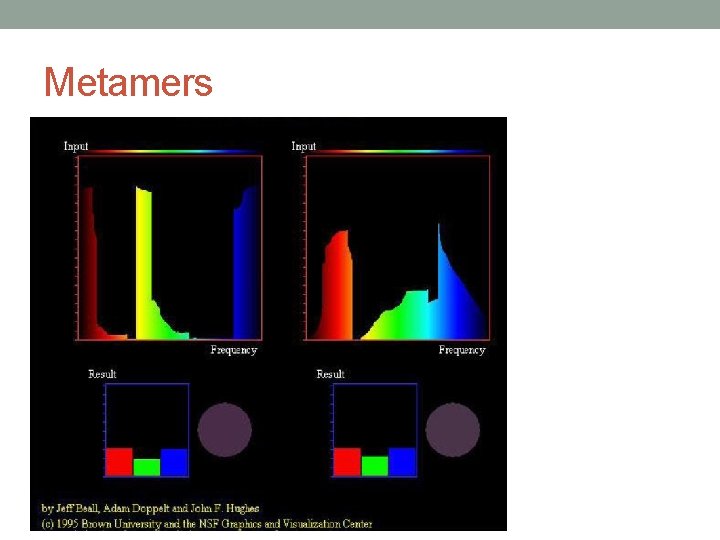
Metamers
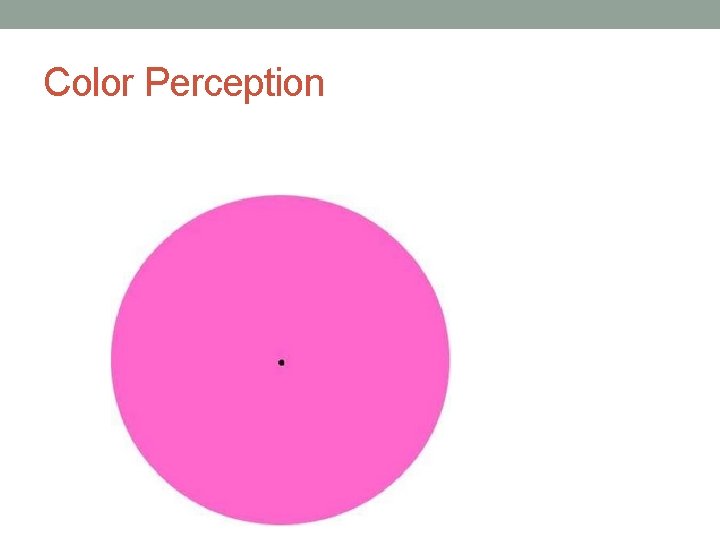
Color Perception
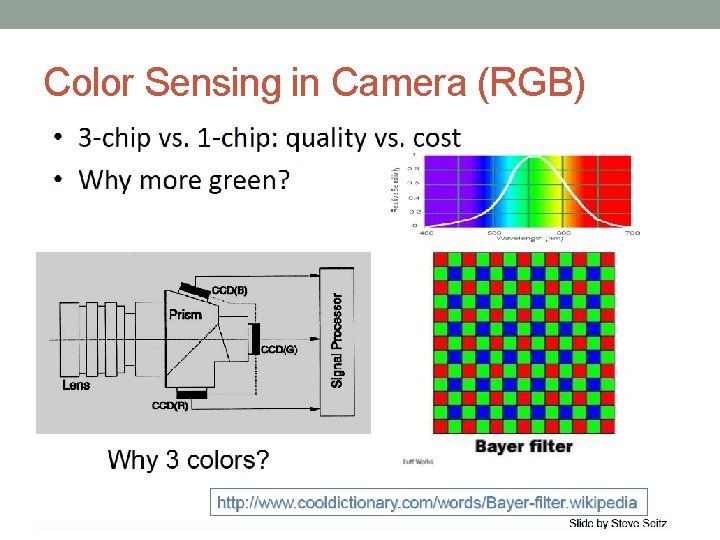
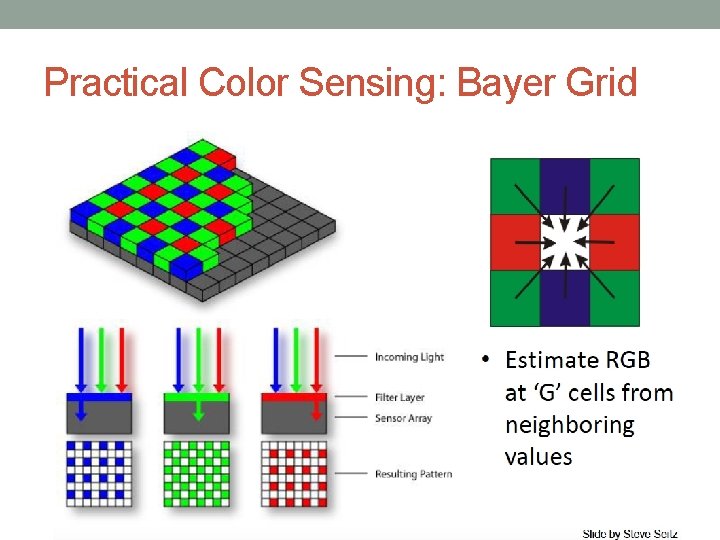
Color Sensing in Camera (RGB)
Practical Color Sensing: Bayer Grid
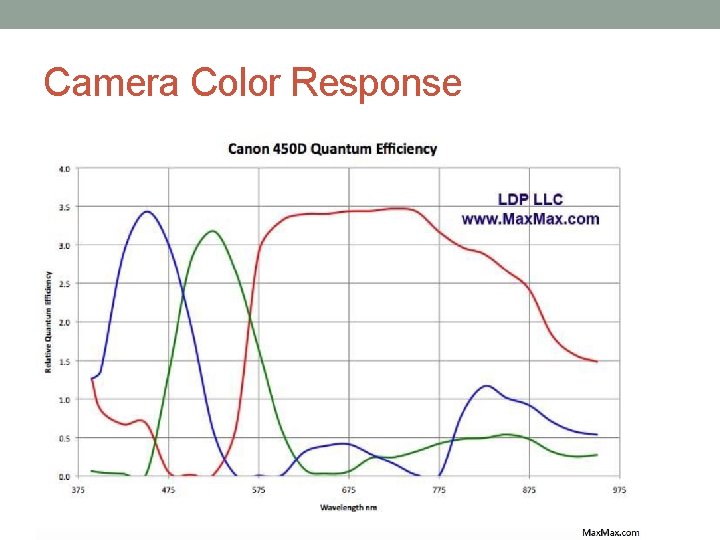
Camera Color Response
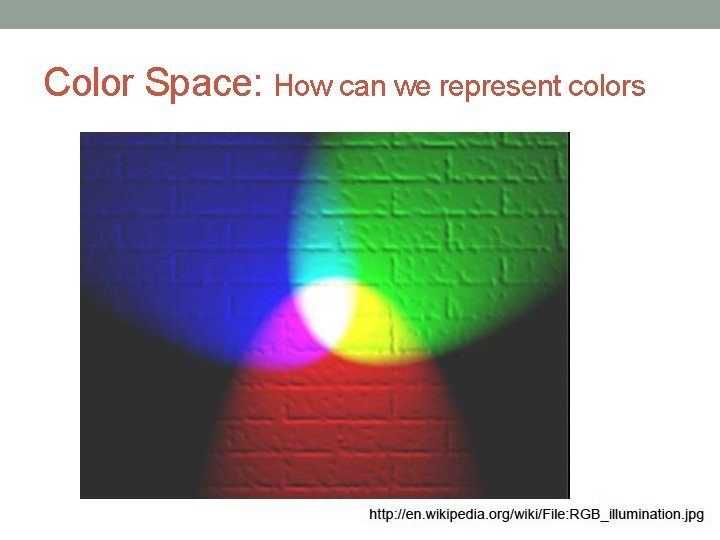
Color Space: How can we represent colors
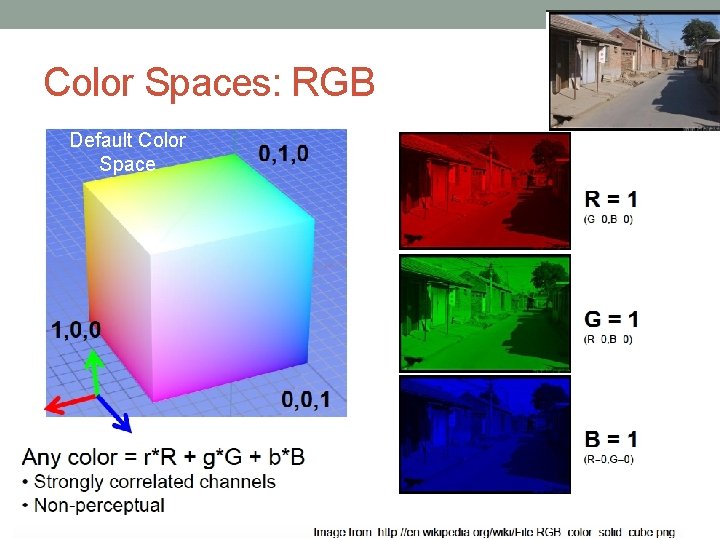
Color Spaces: RGB Default Color Space
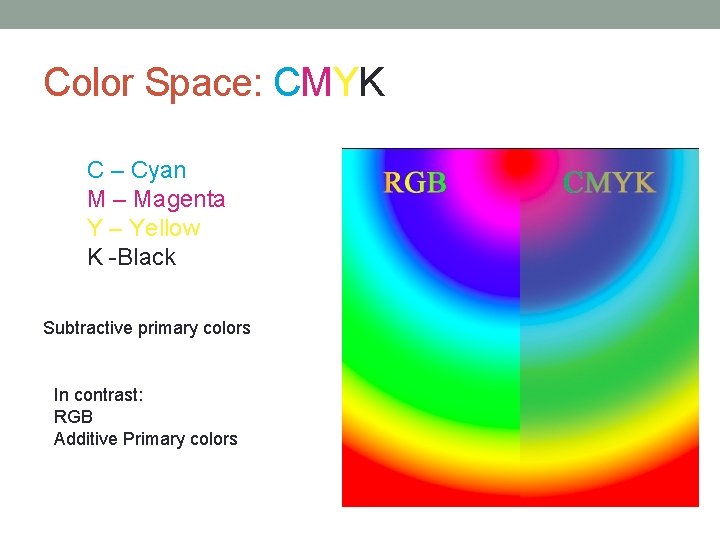
Color Space: CMYK C – Cyan M – Magenta Y – Yellow K -Black Subtractive primary colors In contrast: RGB Additive Primary colors
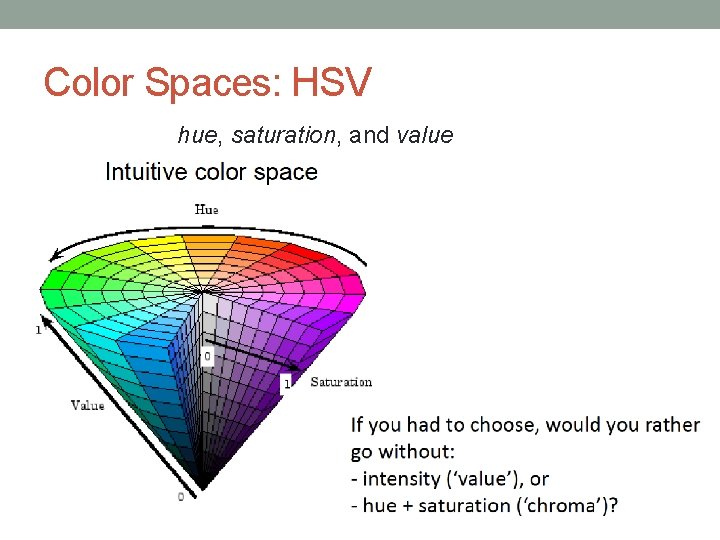
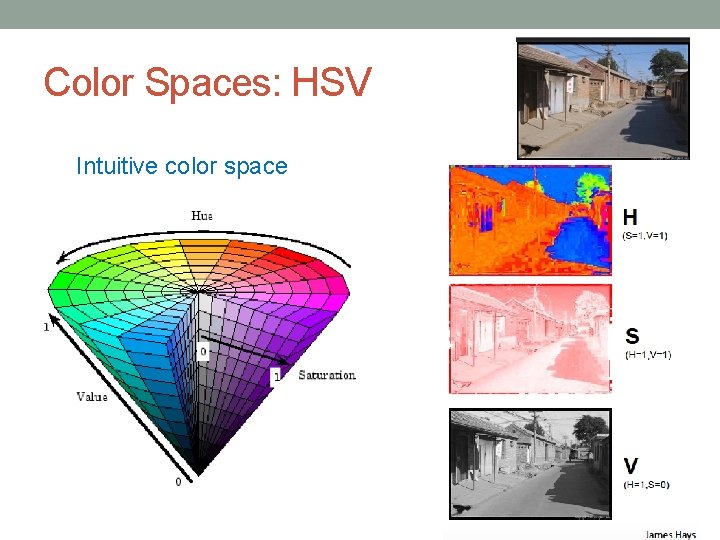
Color Spaces: HSV hue, saturation, and value
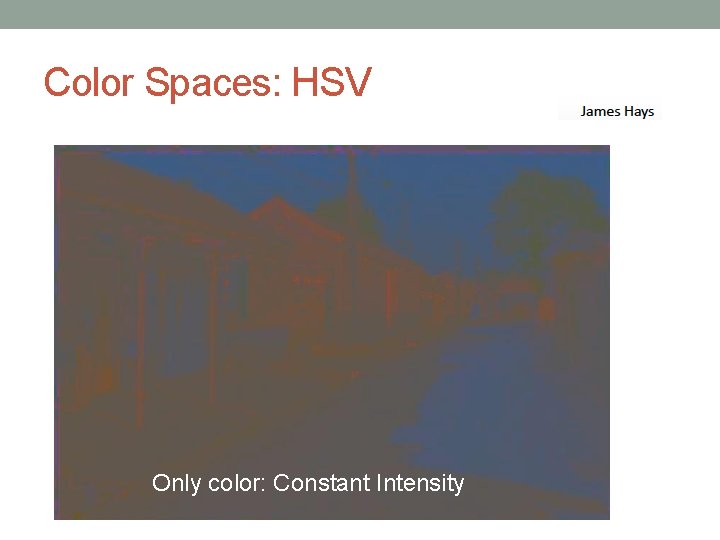
Color Spaces: HSV Only color: Constant Intensity
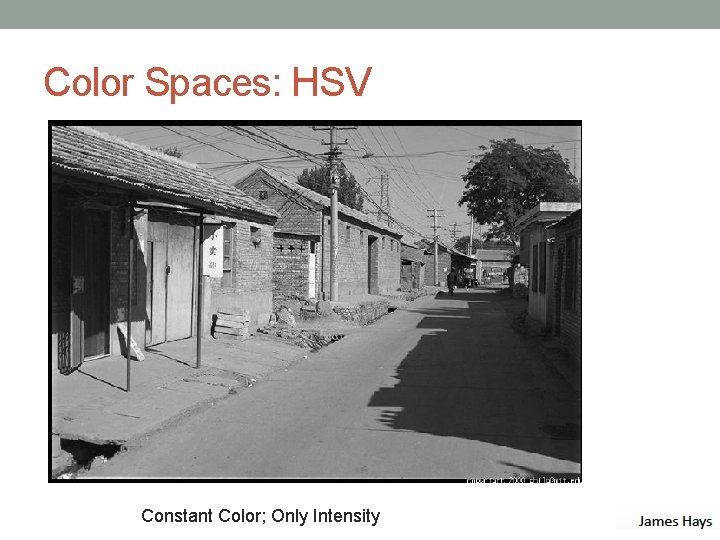
Color Spaces: HSV Only color: Constant Intensity Constant Color; Only Intensity
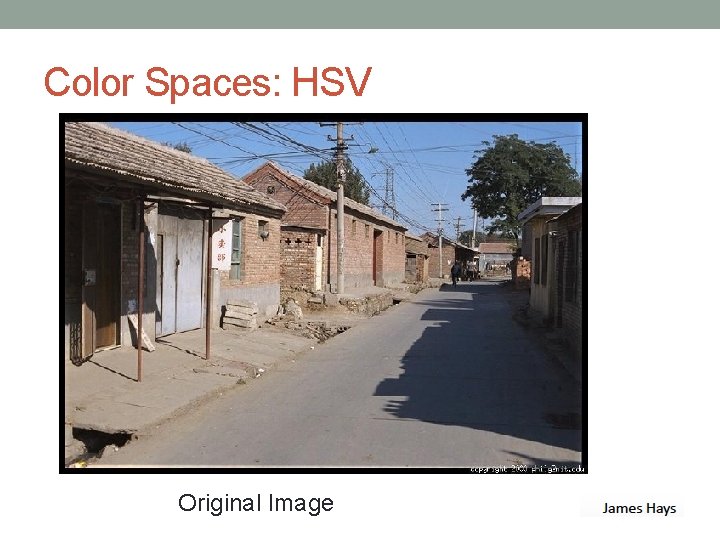
Color Spaces: HSV Only color: Constant Intensity Original Image
Color Spaces: HSV Intuitive color space Only color: Constant Intensity
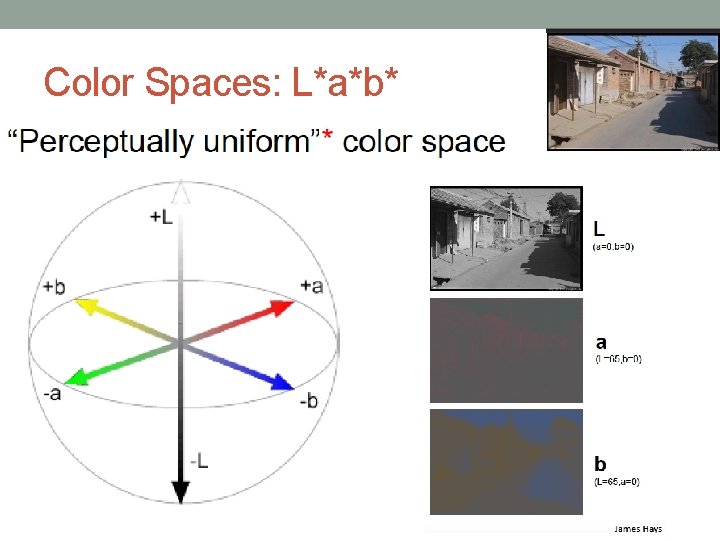
Color Spaces: L*a*b* Only color: Constant Intensity
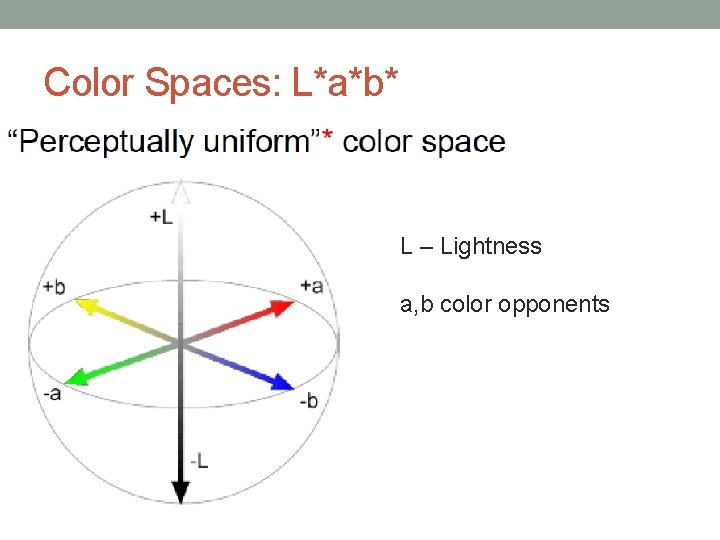
Color Spaces: L*a*b* L – Lightness a, b color opponents Only color: Constant Intensity
Next class Frequency