
Digital Image Processing Image Enhancement Filtering in the
- Slides: 59
Digital Image Processing Image Enhancement: Filtering in the Frequency Domain
2 of 54 Contents In this lecture we will look at image enhancement in the frequency domain – Jean Baptiste Joseph Fourier – The Fourier series & the Fourier transform – Image Processing in the frequency domain • Image smoothing • Image sharpening – Fast Fourier Transform
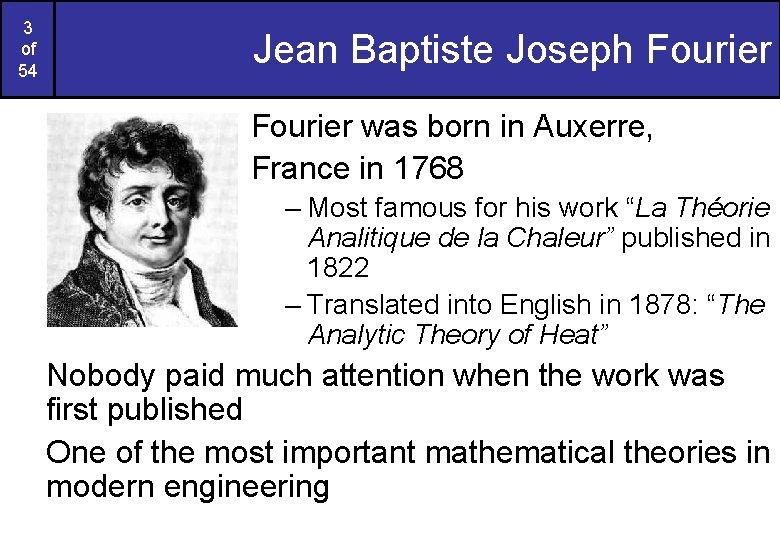
3 of 54 Jean Baptiste Joseph Fourier was born in Auxerre, France in 1768 – Most famous for his work “La Théorie Analitique de la Chaleur” published in 1822 – Translated into English in 1878: “The Analytic Theory of Heat” Nobody paid much attention when the work was first published One of the most important mathematical theories in modern engineering
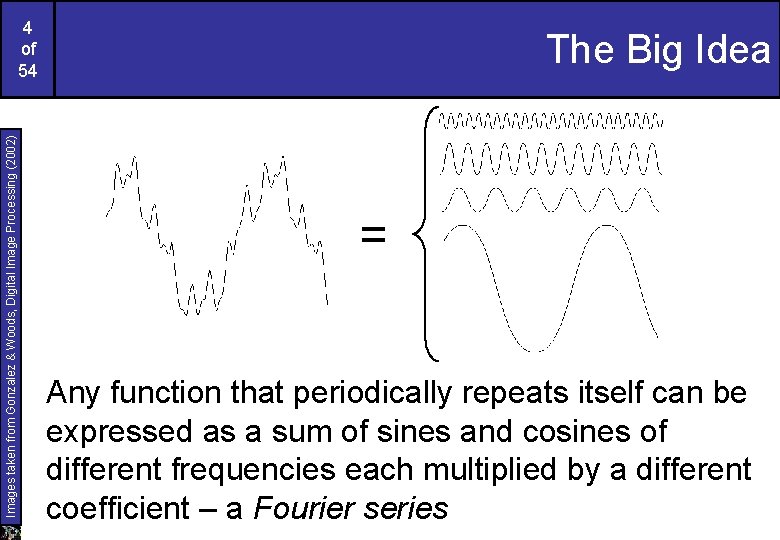
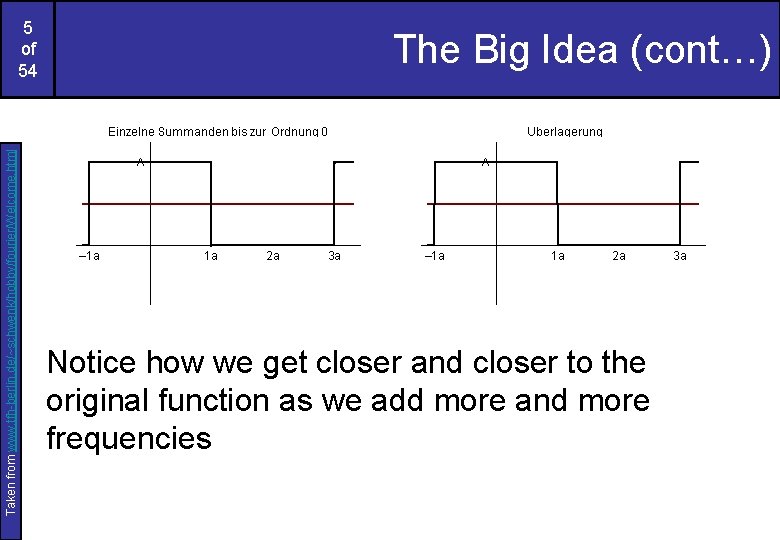
Images taken from Gonzalez & Woods, Digital Image Processing (2002) 4 of 54 The Big Idea = Any function that periodically repeats itself can be expressed as a sum of sines and cosines of different frequencies each multiplied by a different coefficient – a Fourier series
Taken from www. tfh-berlin. de/~schwenk/hobby/fourier/Welcome. html 5 of 54 The Big Idea (cont…) Notice how we get closer and closer to the original function as we add more and more frequencies
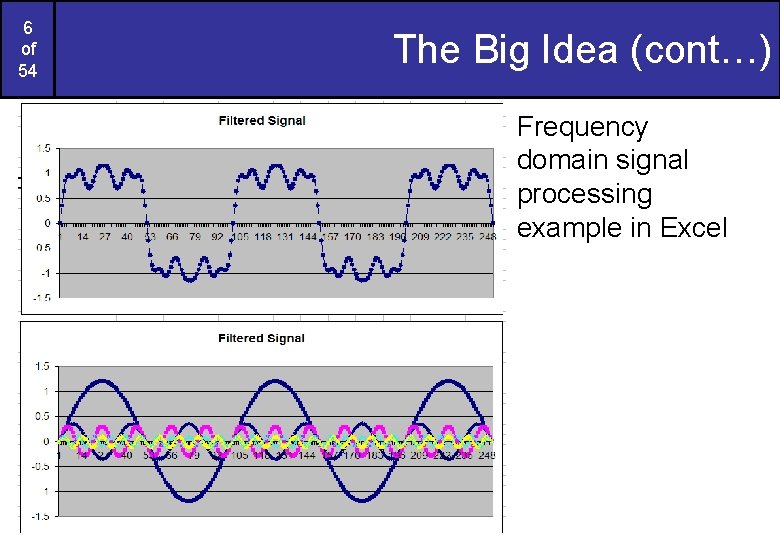
6 of 54 The Big Idea (cont…) Frequency domain signal processing example in Excel
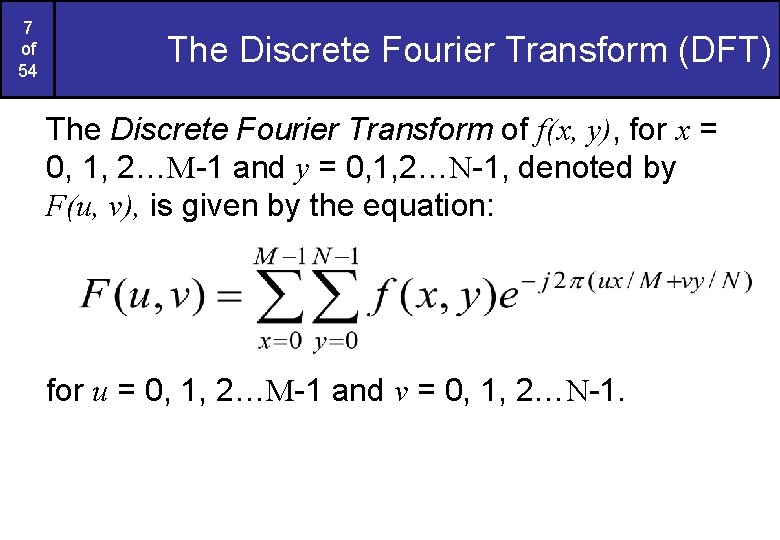
7 of 54 The Discrete Fourier Transform (DFT) The Discrete Fourier Transform of f(x, y), for x = 0, 1, 2…M-1 and y = 0, 1, 2…N-1, denoted by F(u, v), is given by the equation: for u = 0, 1, 2…M-1 and v = 0, 1, 2…N-1.
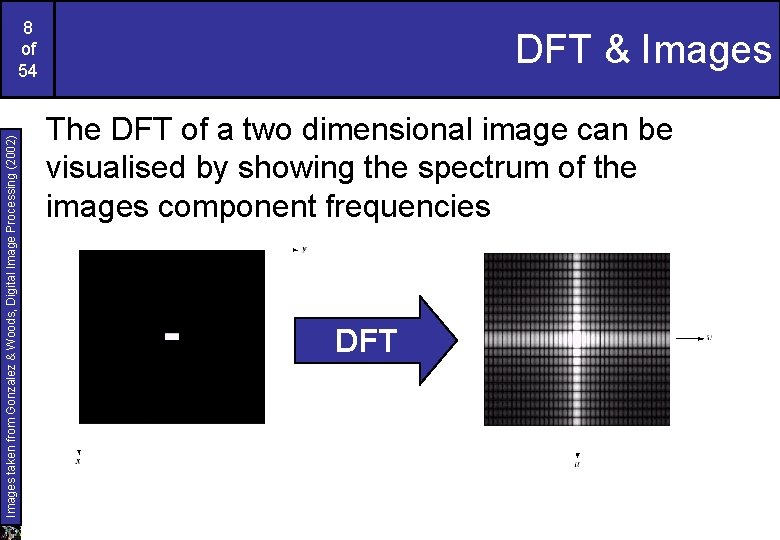
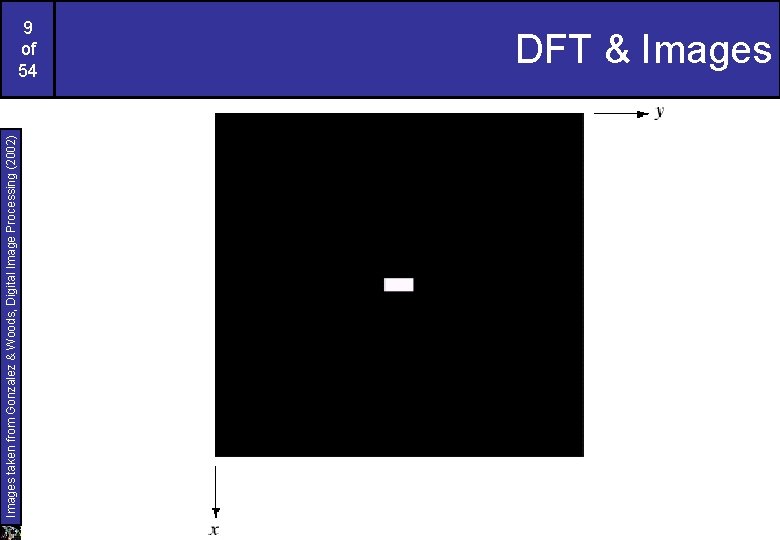
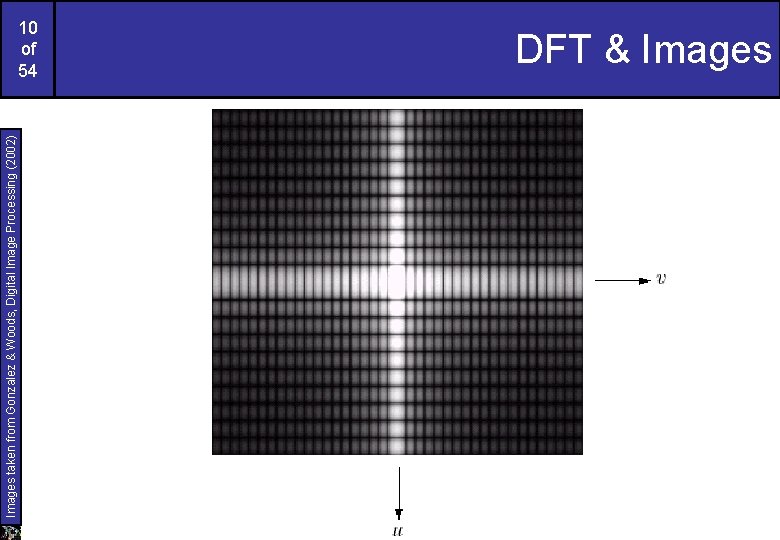
Images taken from Gonzalez & Woods, Digital Image Processing (2002) 8 of 54 DFT & Images The DFT of a two dimensional image can be visualised by showing the spectrum of the images component frequencies DFT
Images taken from Gonzalez & Woods, Digital Image Processing (2002) 9 of 54 DFT & Images
Images taken from Gonzalez & Woods, Digital Image Processing (2002) 10 of 54 DFT & Images
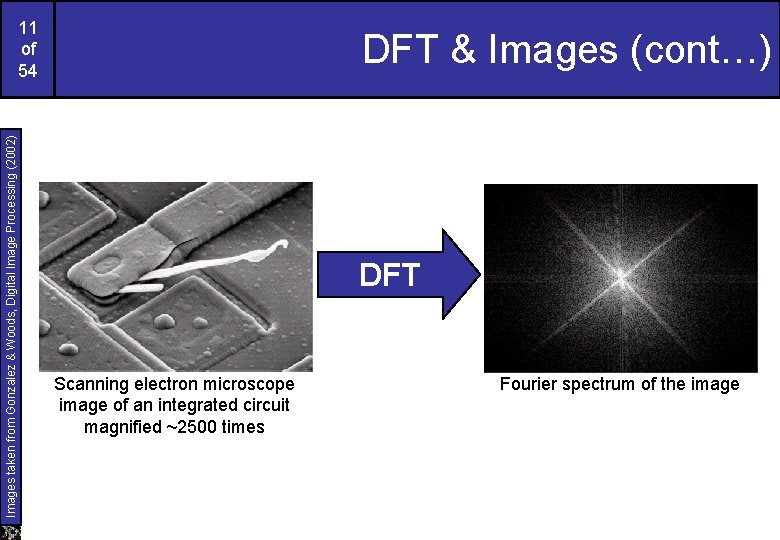
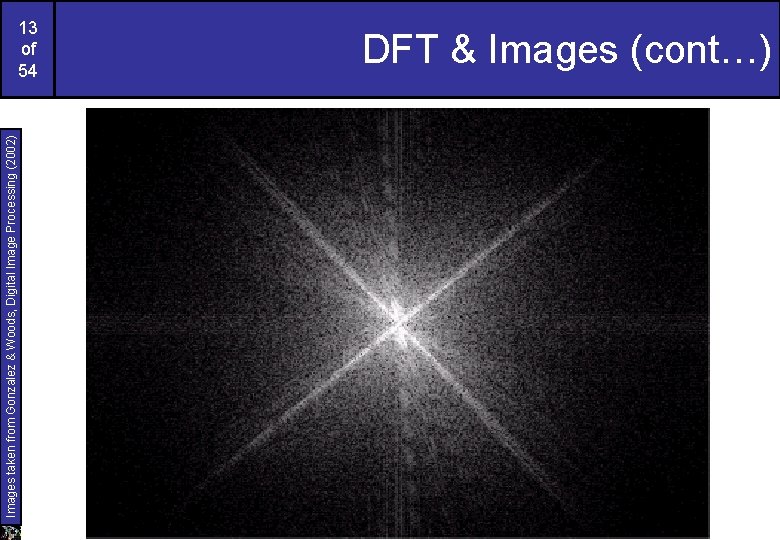
Images taken from Gonzalez & Woods, Digital Image Processing (2002) 11 of 54 DFT & Images (cont…) DFT Scanning electron microscope image of an integrated circuit magnified ~2500 times Fourier spectrum of the image
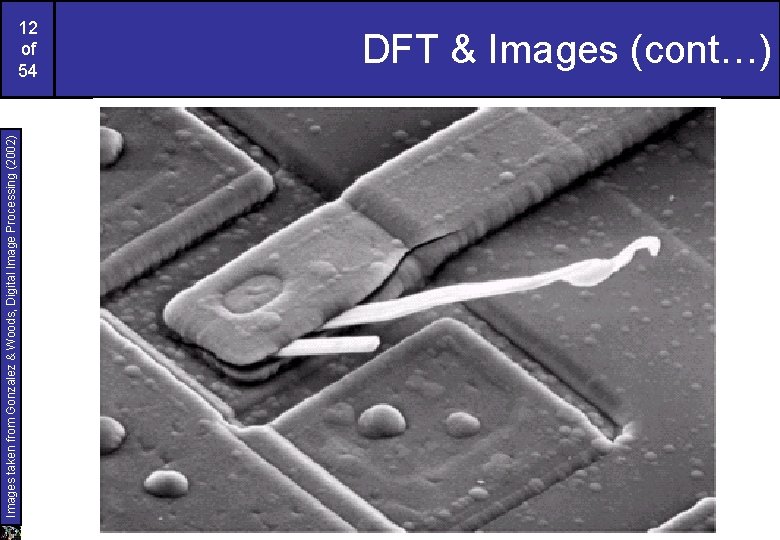
Images taken from Gonzalez & Woods, Digital Image Processing (2002) 12 of 54 DFT & Images (cont…)
Images taken from Gonzalez & Woods, Digital Image Processing (2002) 13 of 54 DFT & Images (cont…)
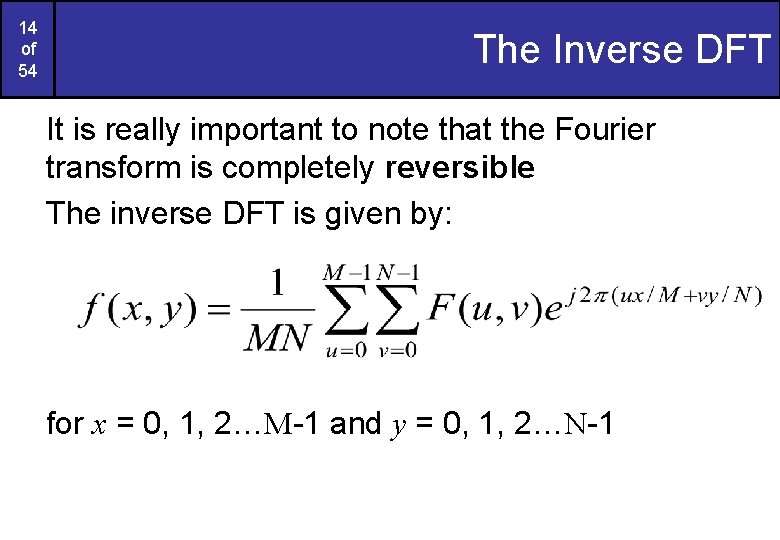
14 of 54 The Inverse DFT It is really important to note that the Fourier transform is completely reversible The inverse DFT is given by: for x = 0, 1, 2…M-1 and y = 0, 1, 2…N-1
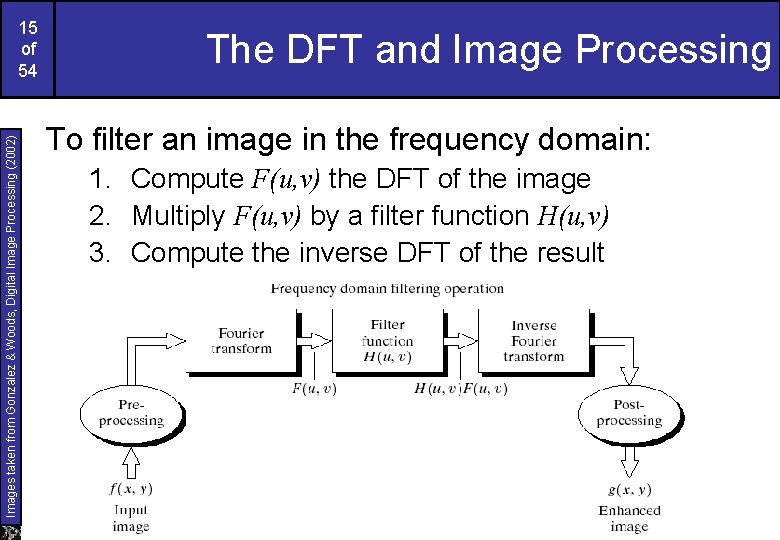
Images taken from Gonzalez & Woods, Digital Image Processing (2002) 15 of 54 The DFT and Image Processing To filter an image in the frequency domain: 1. Compute F(u, v) the DFT of the image 2. Multiply F(u, v) by a filter function H(u, v) 3. Compute the inverse DFT of the result
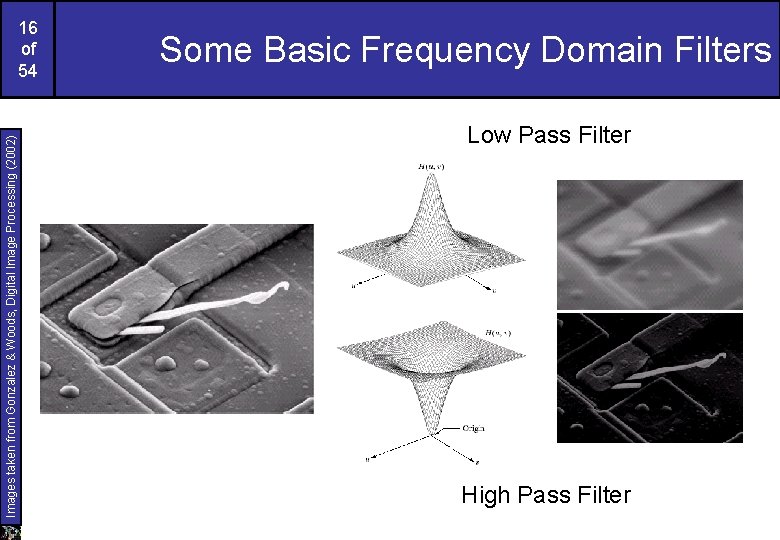
Images taken from Gonzalez & Woods, Digital Image Processing (2002) 16 of 54 Some Basic Frequency Domain Filters Low Pass Filter High Pass Filter
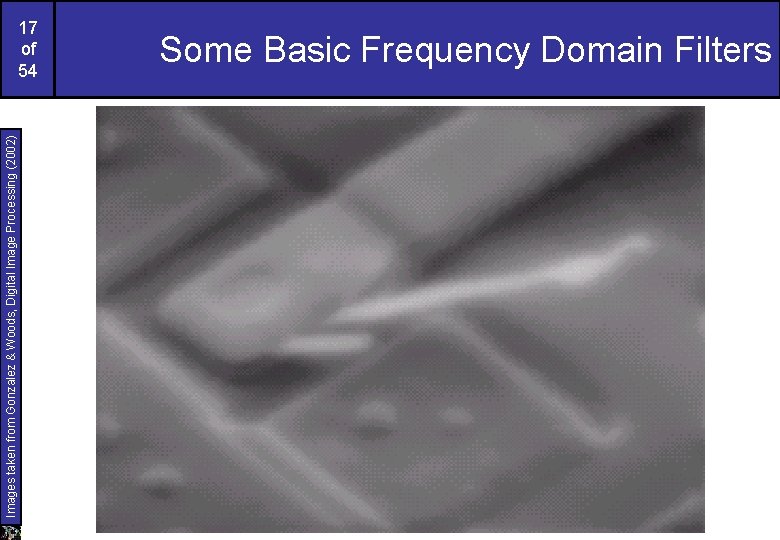
Images taken from Gonzalez & Woods, Digital Image Processing (2002) 17 of 54 Some Basic Frequency Domain Filters
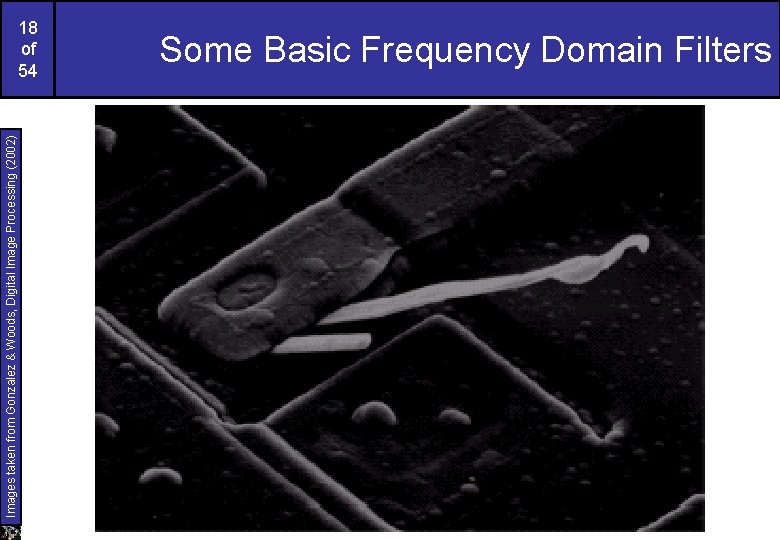
Images taken from Gonzalez & Woods, Digital Image Processing (2002) 18 of 54 Some Basic Frequency Domain Filters
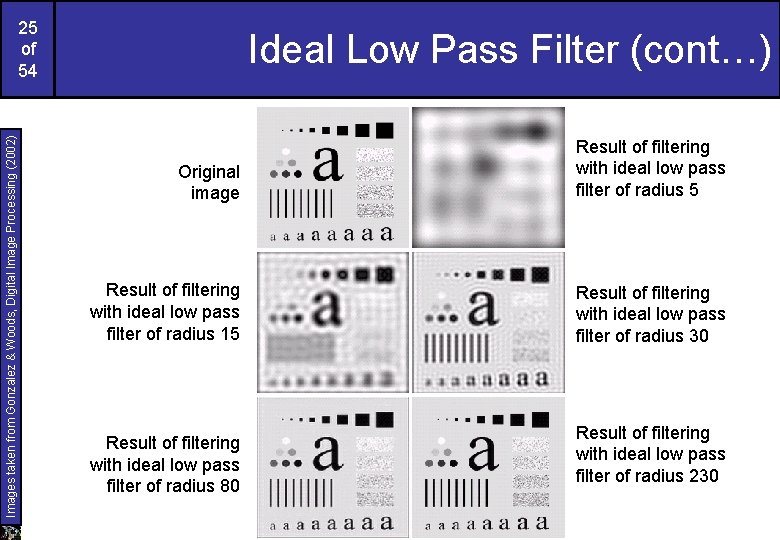
19 of 54 Smoothing Frequency Domain Filters Smoothing is achieved in the frequency domain by dropping out the high frequency components The basic model for filtering is: G(u, v) = H(u, v)F(u, v) where F(u, v) is the Fourier transform of the image being filtered and H(u, v) is the filter transform function Low pass filters – only pass the low frequencies, drop the high ones
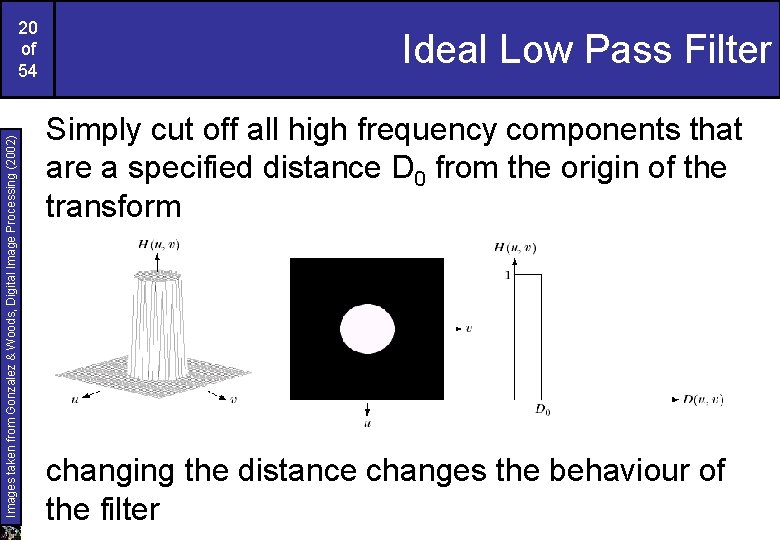
Images taken from Gonzalez & Woods, Digital Image Processing (2002) 20 of 54 Ideal Low Pass Filter Simply cut off all high frequency components that are a specified distance D 0 from the origin of the transform changing the distance changes the behaviour of the filter
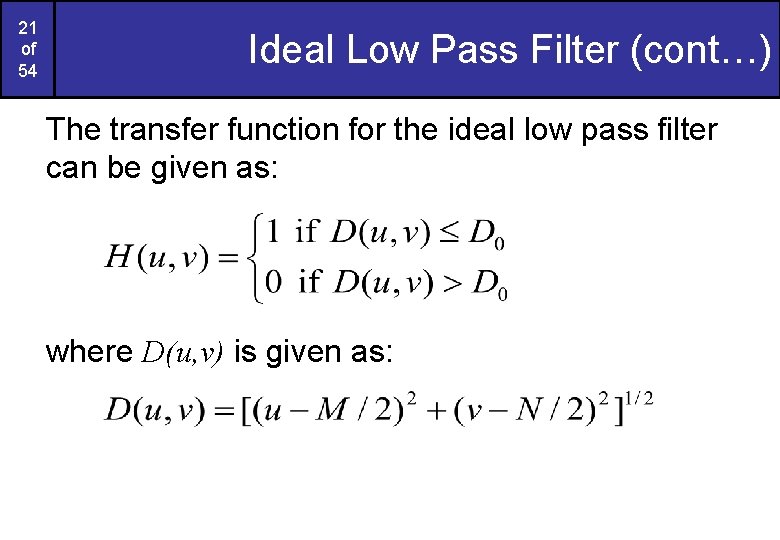
21 of 54 Ideal Low Pass Filter (cont…) The transfer function for the ideal low pass filter can be given as: where D(u, v) is given as:
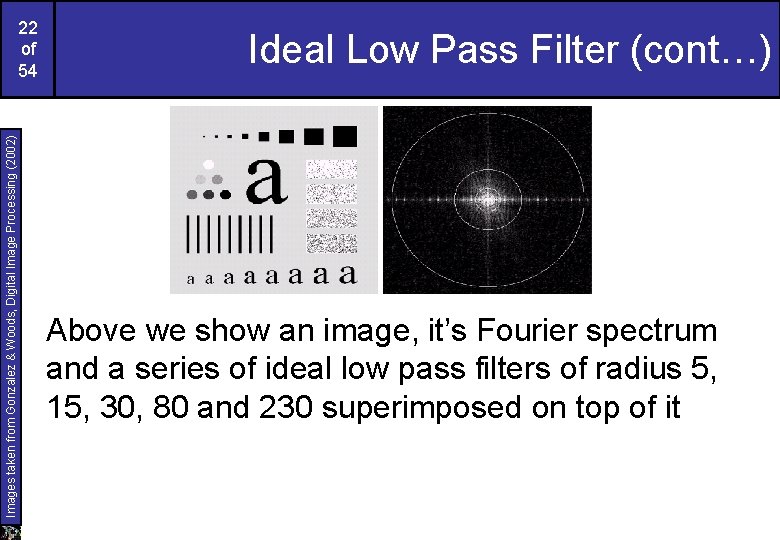
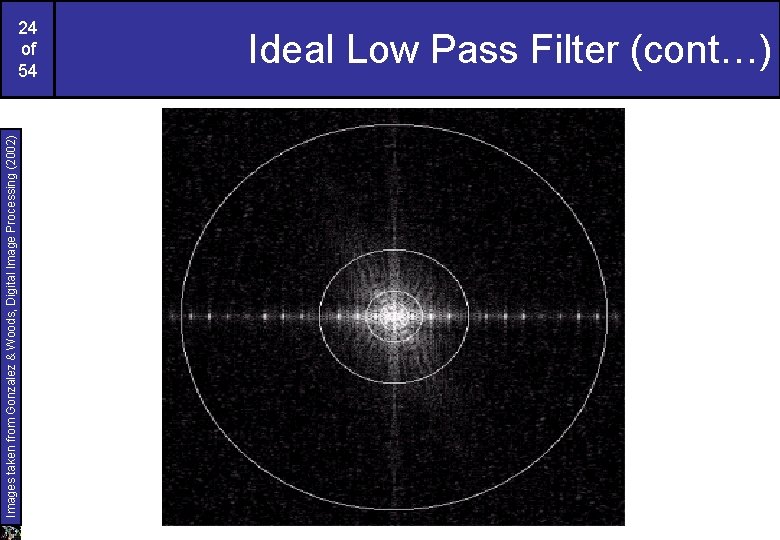
Images taken from Gonzalez & Woods, Digital Image Processing (2002) 22 of 54 Ideal Low Pass Filter (cont…) Above we show an image, it’s Fourier spectrum and a series of ideal low pass filters of radius 5, 15, 30, 80 and 230 superimposed on top of it
Images taken from Gonzalez & Woods, Digital Image Processing (2002) 23 of 54 Ideal Low Pass Filter (cont…)
Images taken from Gonzalez & Woods, Digital Image Processing (2002) 24 of 54 Ideal Low Pass Filter (cont…)
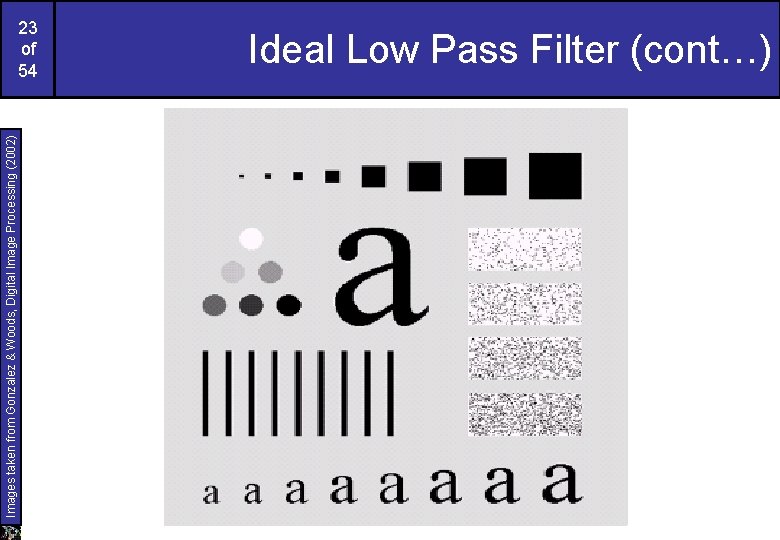
Images taken from Gonzalez & Woods, Digital Image Processing (2002) 25 of 54 Ideal Low Pass Filter (cont…) Original image Result of filtering with ideal low pass filter of radius 5 Result of filtering with ideal low pass filter of radius 15 Result of filtering with ideal low pass filter of radius 30 Result of filtering with ideal low pass filter of radius 80 Result of filtering with ideal low pass filter of radius 230
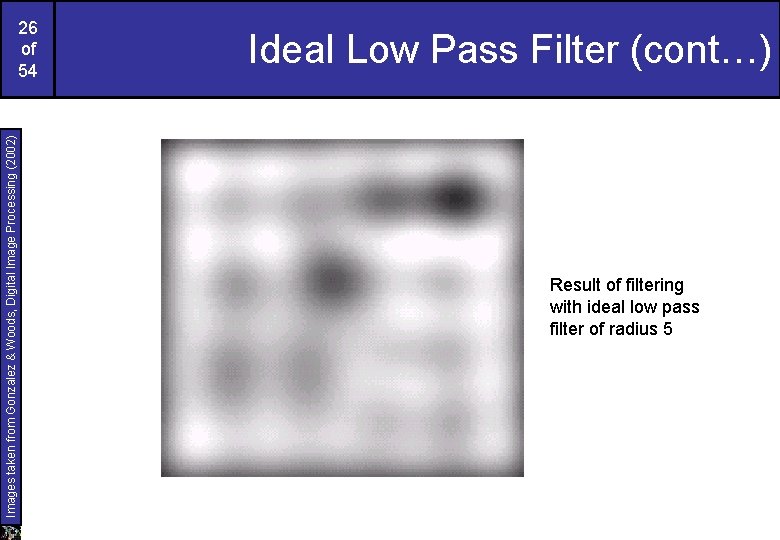
Images taken from Gonzalez & Woods, Digital Image Processing (2002) 26 of 54 Ideal Low Pass Filter (cont…) Result of filtering with ideal low pass filter of radius 5
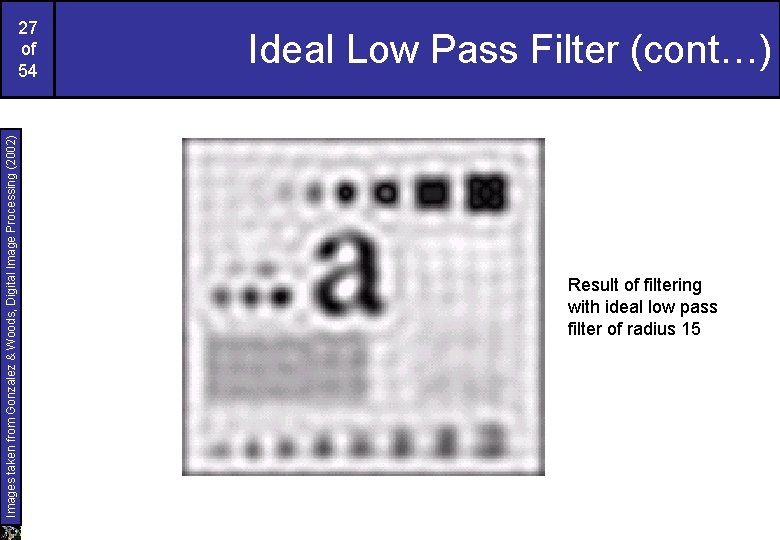
Images taken from Gonzalez & Woods, Digital Image Processing (2002) 27 of 54 Ideal Low Pass Filter (cont…) Result of filtering with ideal low pass filter of radius 15
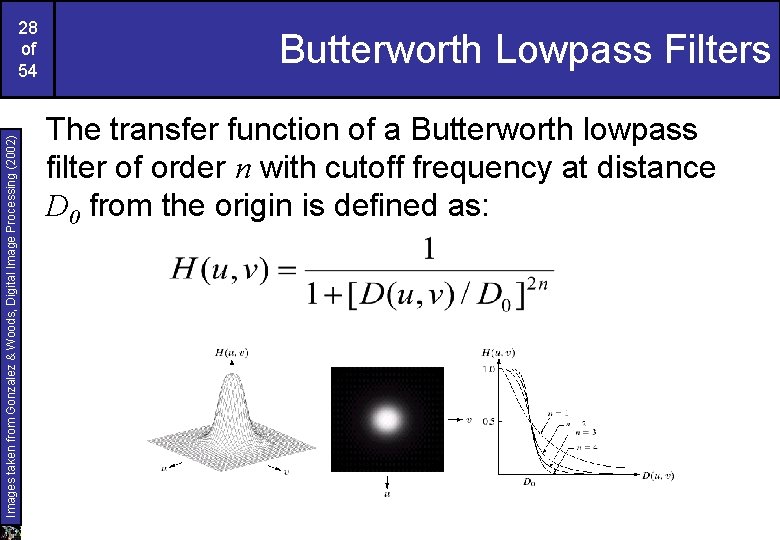
Images taken from Gonzalez & Woods, Digital Image Processing (2002) 28 of 54 Butterworth Lowpass Filters The transfer function of a Butterworth lowpass filter of order n with cutoff frequency at distance D 0 from the origin is defined as:
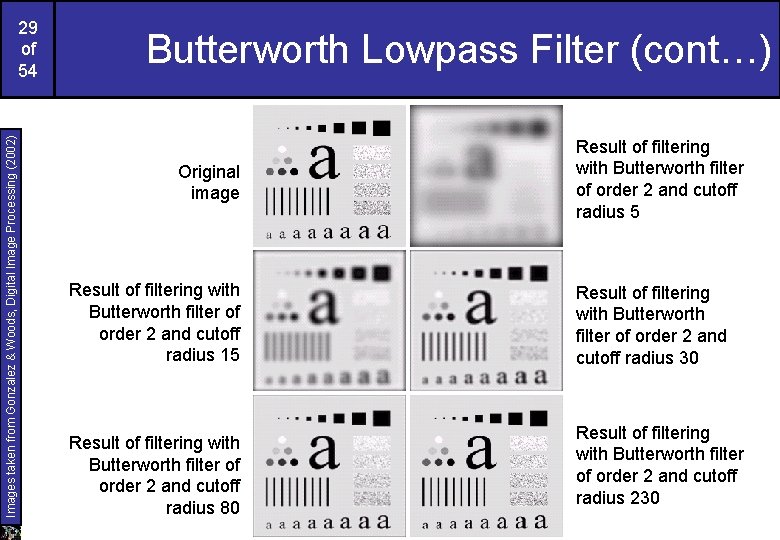
Images taken from Gonzalez & Woods, Digital Image Processing (2002) 29 of 54 Butterworth Lowpass Filter (cont…) Original image Result of filtering with Butterworth filter of order 2 and cutoff radius 15 Result of filtering with Butterworth filter of order 2 and cutoff radius 80 Result of filtering with Butterworth filter of order 2 and cutoff radius 5 Result of filtering with Butterworth filter of order 2 and cutoff radius 30 Result of filtering with Butterworth filter of order 2 and cutoff radius 230
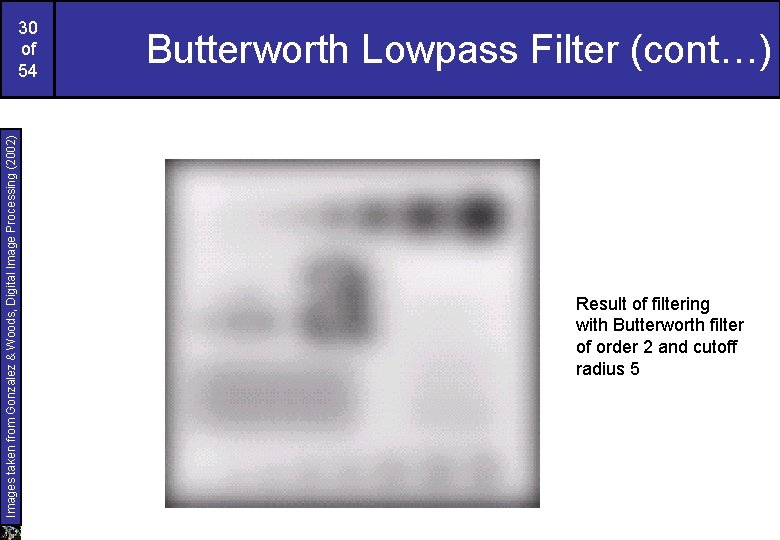
Images taken from Gonzalez & Woods, Digital Image Processing (2002) 30 of 54 Butterworth Lowpass Filter (cont…) Original image Result of filtering with Butterworth filter of order 2 and cutoff radius 5
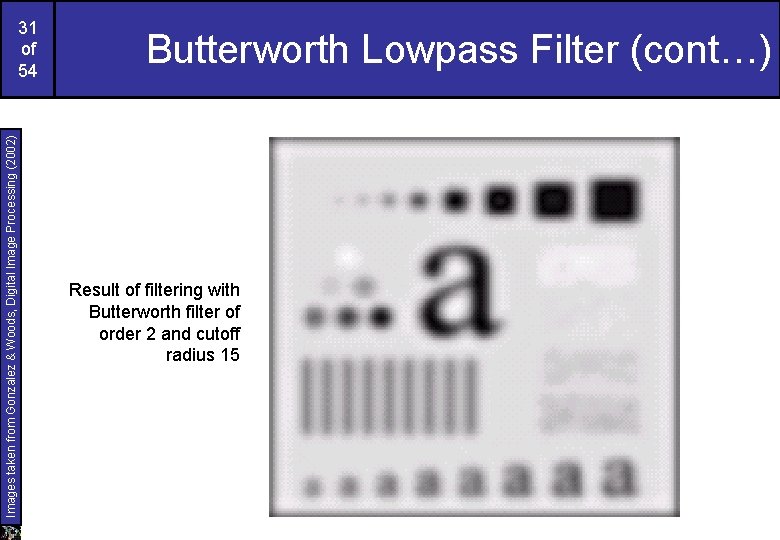
Images taken from Gonzalez & Woods, Digital Image Processing (2002) 31 of 54 Butterworth Lowpass Filter (cont…) Result of filtering with Butterworth filter of order 2 and cutoff radius 15
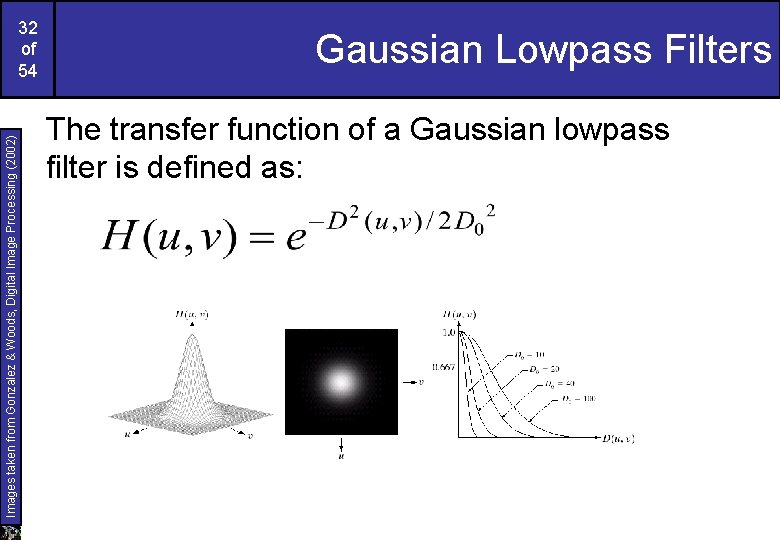
Images taken from Gonzalez & Woods, Digital Image Processing (2002) 32 of 54 Gaussian Lowpass Filters The transfer function of a Gaussian lowpass filter is defined as:
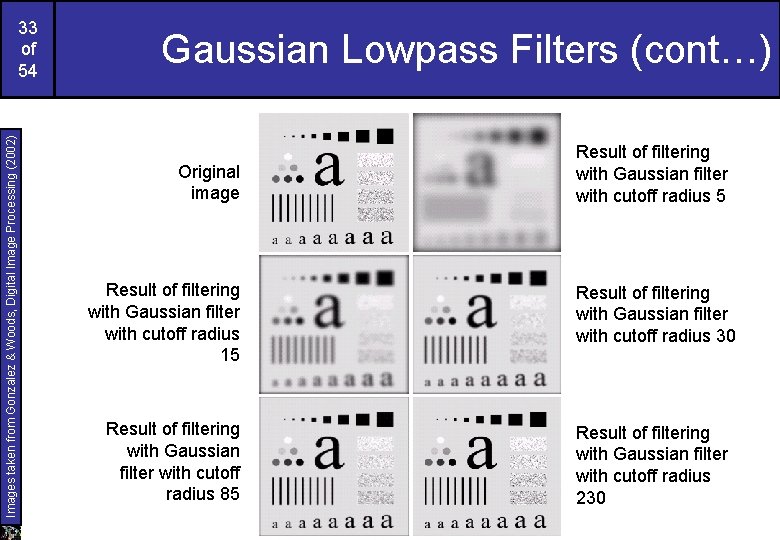
Images taken from Gonzalez & Woods, Digital Image Processing (2002) 33 of 54 Gaussian Lowpass Filters (cont…) Original image Result of filtering with Gaussian filter with cutoff radius 15 Result of filtering with Gaussian filter with cutoff radius 85 Result of filtering with Gaussian filter with cutoff radius 30 Result of filtering with Gaussian filter with cutoff radius 230
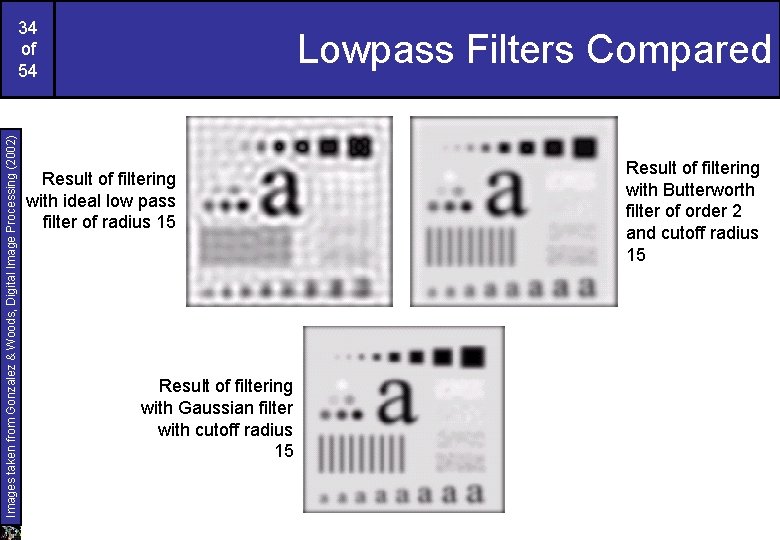
Images taken from Gonzalez & Woods, Digital Image Processing (2002) 34 of 54 Lowpass Filters Compared Result of filtering with ideal low pass filter of radius 15 Result of filtering with Gaussian filter with cutoff radius 15 Result of filtering with Butterworth filter of order 2 and cutoff radius 15
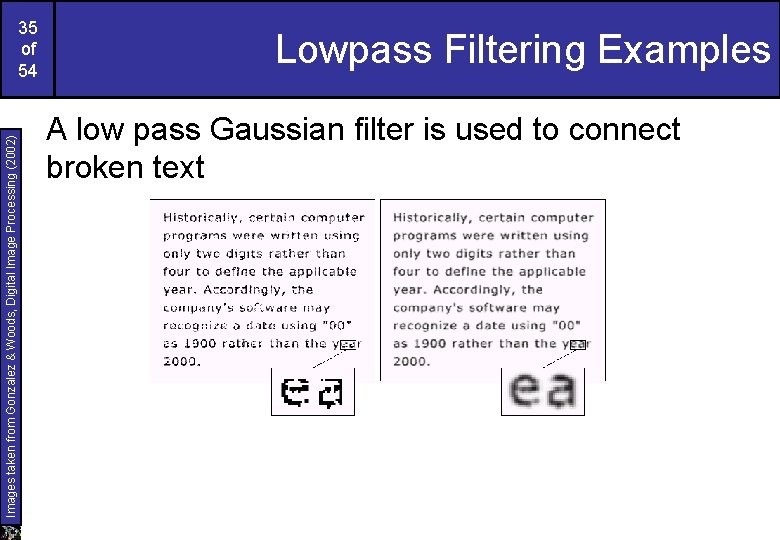
Images taken from Gonzalez & Woods, Digital Image Processing (2002) 35 of 54 Lowpass Filtering Examples A low pass Gaussian filter is used to connect broken text
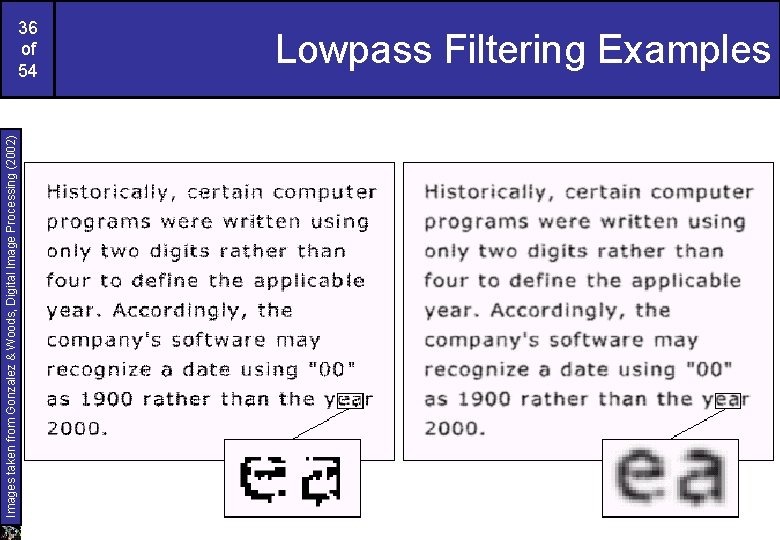
Images taken from Gonzalez & Woods, Digital Image Processing (2002) 36 of 54 Lowpass Filtering Examples
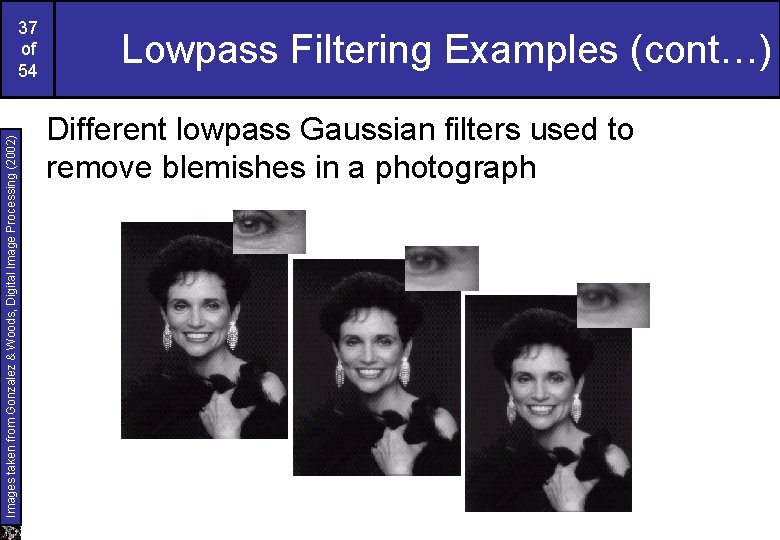
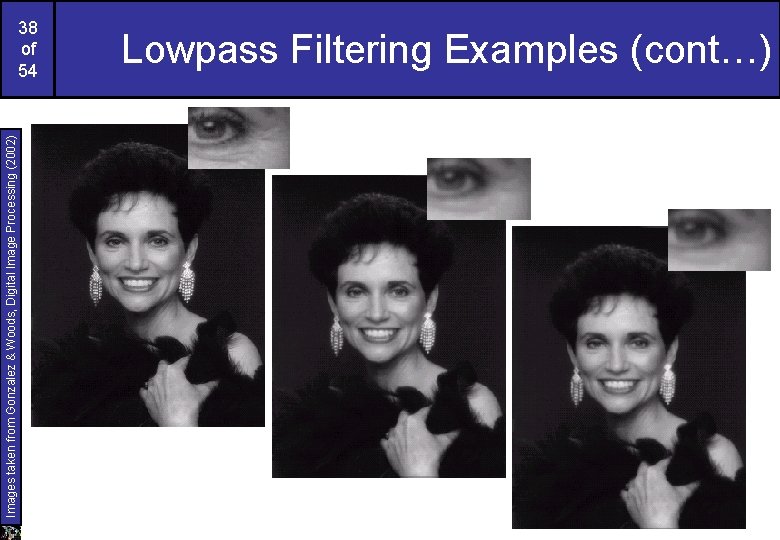
Images taken from Gonzalez & Woods, Digital Image Processing (2002) 37 of 54 Lowpass Filtering Examples (cont…) Different lowpass Gaussian filters used to remove blemishes in a photograph
Images taken from Gonzalez & Woods, Digital Image Processing (2002) 38 of 54 Lowpass Filtering Examples (cont…)
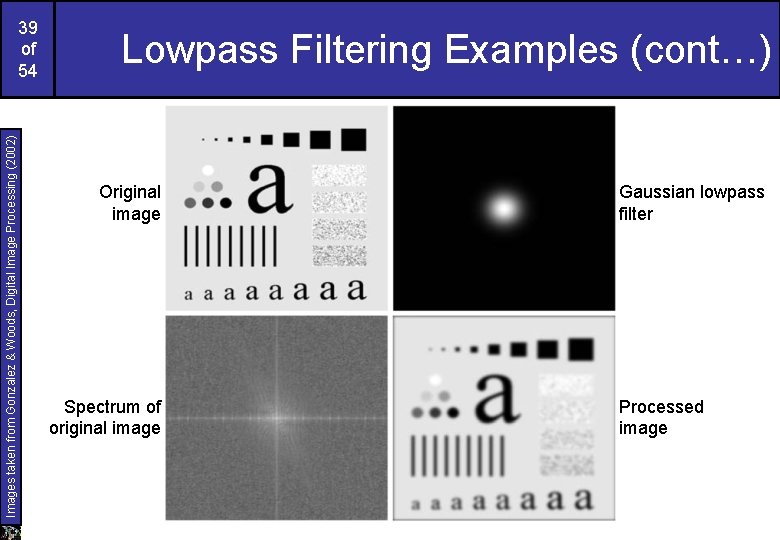
Images taken from Gonzalez & Woods, Digital Image Processing (2002) 39 of 54 Lowpass Filtering Examples (cont…) Original image Spectrum of original image Gaussian lowpass filter Processed image
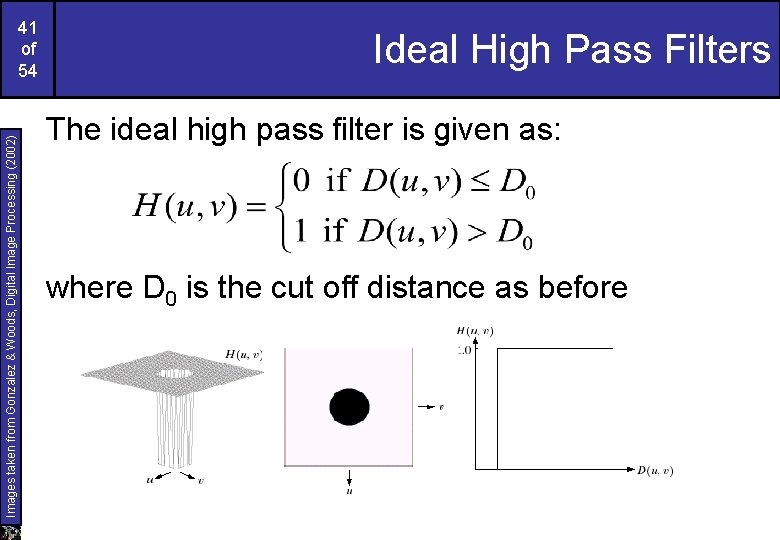
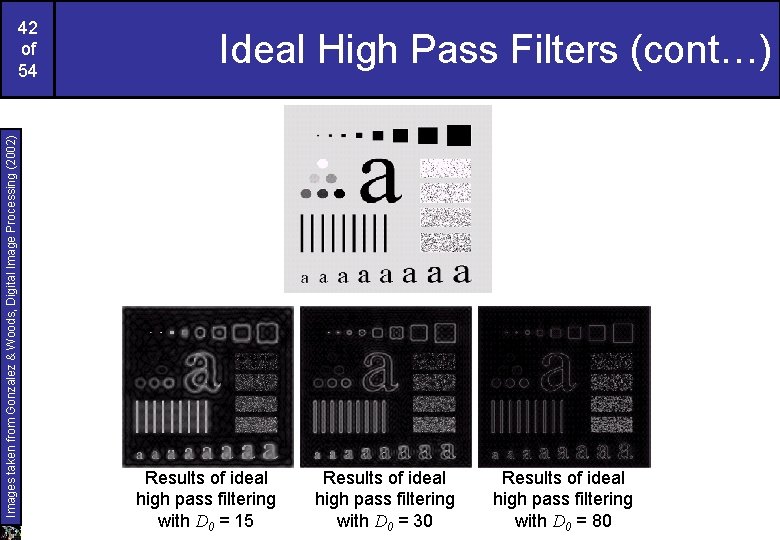
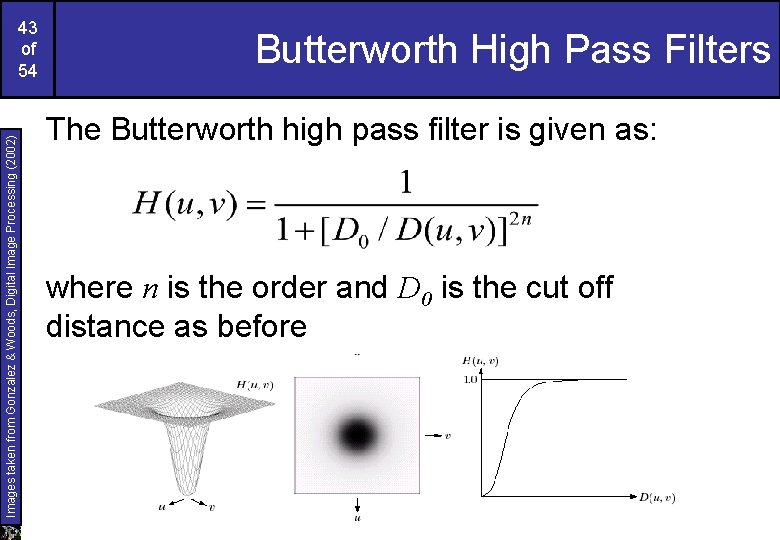
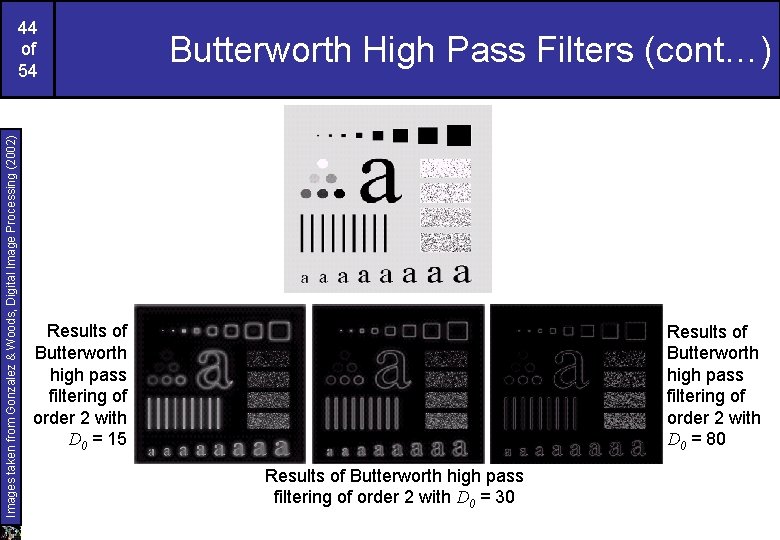
40 of 54 Sharpening in the Frequency Domain Edges and fine detail in images are associated with high frequency components High pass filters – only pass the high frequencies, drop the low ones High pass frequencies are precisely the reverse of low pass filters, so: Hhp(u, v) = 1 – Hlp(u, v)
Images taken from Gonzalez & Woods, Digital Image Processing (2002) 41 of 54 Ideal High Pass Filters The ideal high pass filter is given as: where D 0 is the cut off distance as before
Images taken from Gonzalez & Woods, Digital Image Processing (2002) 42 of 54 Ideal High Pass Filters (cont…) Results of ideal high pass filtering with D 0 = 15 Results of ideal high pass filtering with D 0 = 30 Results of ideal high pass filtering with D 0 = 80
Images taken from Gonzalez & Woods, Digital Image Processing (2002) 43 of 54 Butterworth High Pass Filters The Butterworth high pass filter is given as: where n is the order and D 0 is the cut off distance as before
Images taken from Gonzalez & Woods, Digital Image Processing (2002) 44 of 54 Butterworth High Pass Filters (cont…) Results of Butterworth high pass filtering of order 2 with D 0 = 15 Results of Butterworth high pass filtering of order 2 with D 0 = 80 Results of Butterworth high pass filtering of order 2 with D 0 = 30
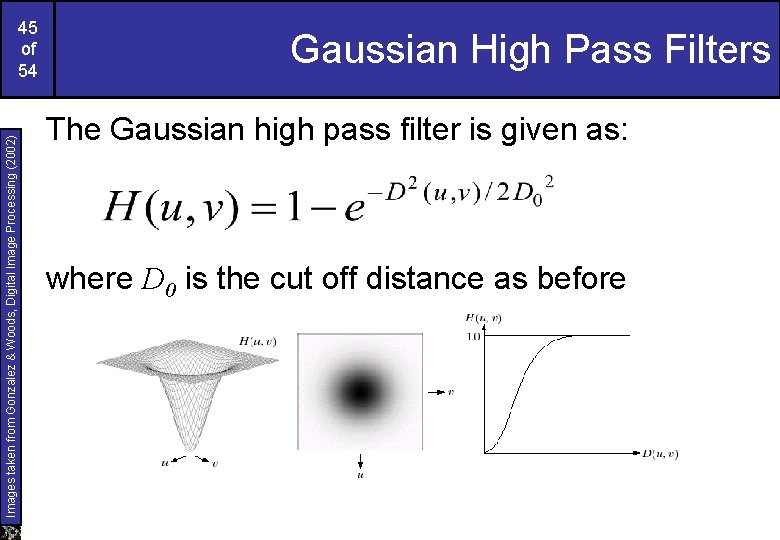
Images taken from Gonzalez & Woods, Digital Image Processing (2002) 45 of 54 Gaussian High Pass Filters The Gaussian high pass filter is given as: where D 0 is the cut off distance as before
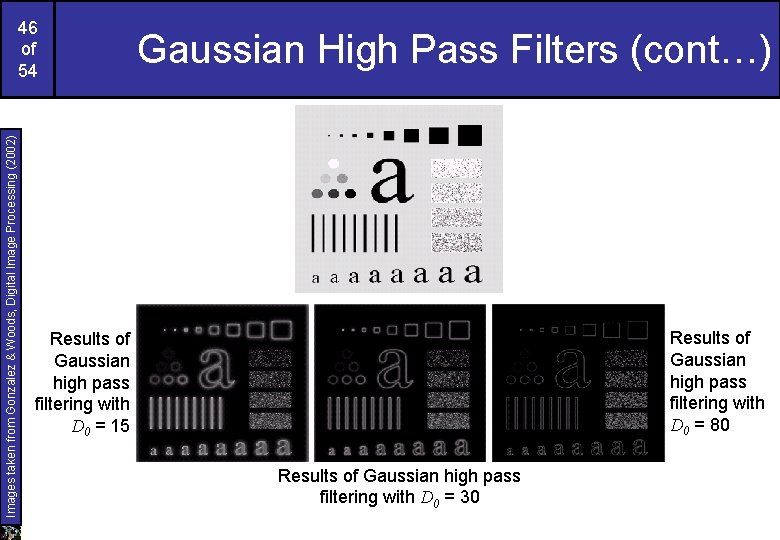
Images taken from Gonzalez & Woods, Digital Image Processing (2002) 46 of 54 Gaussian High Pass Filters (cont…) Results of Gaussian high pass filtering with D 0 = 80 Results of Gaussian high pass filtering with D 0 = 15 Results of Gaussian high pass filtering with D 0 = 30
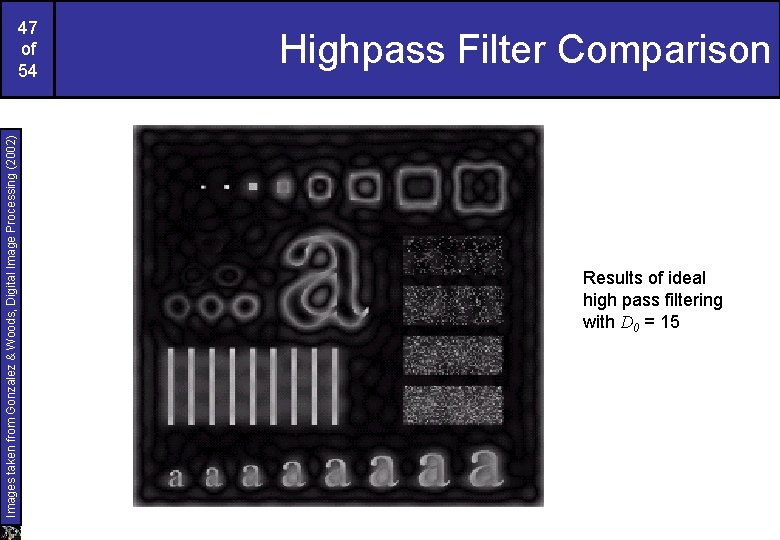
Images taken from Gonzalez & Woods, Digital Image Processing (2002) 47 of 54 Highpass Filter Comparison Results of ideal high pass filtering with D 0 = 15
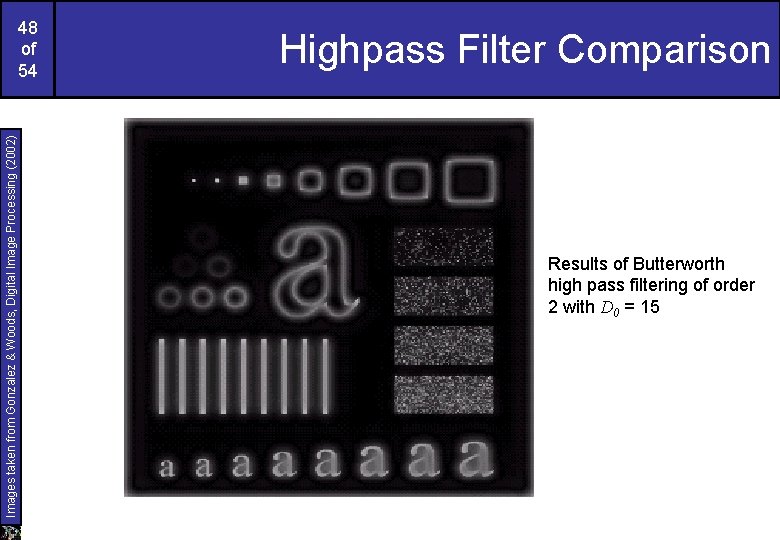
Images taken from Gonzalez & Woods, Digital Image Processing (2002) 48 of 54 Highpass Filter Comparison Results of Butterworth high pass filtering of order 2 with D 0 = 15
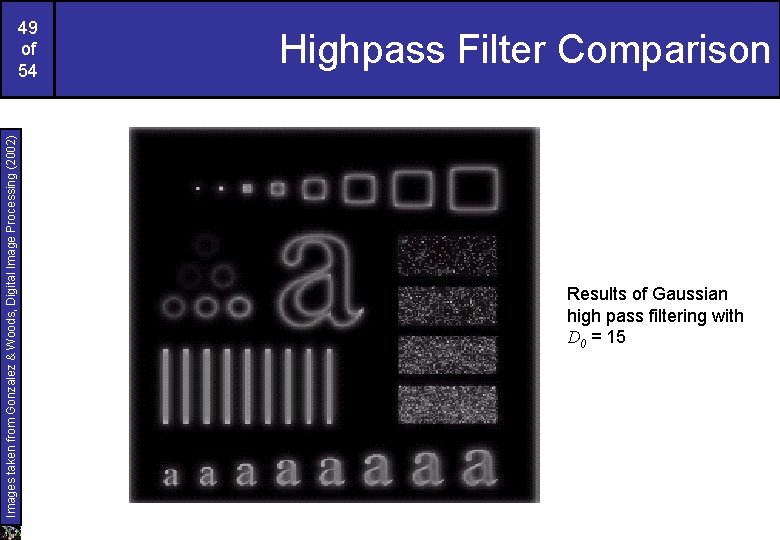
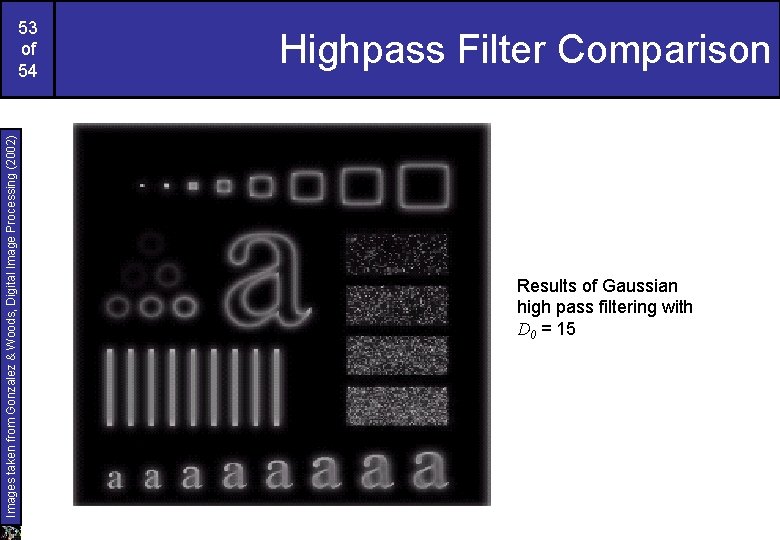
Images taken from Gonzalez & Woods, Digital Image Processing (2002) 49 of 54 Highpass Filter Comparison Results of Gaussian high pass filtering with D 0 = 15
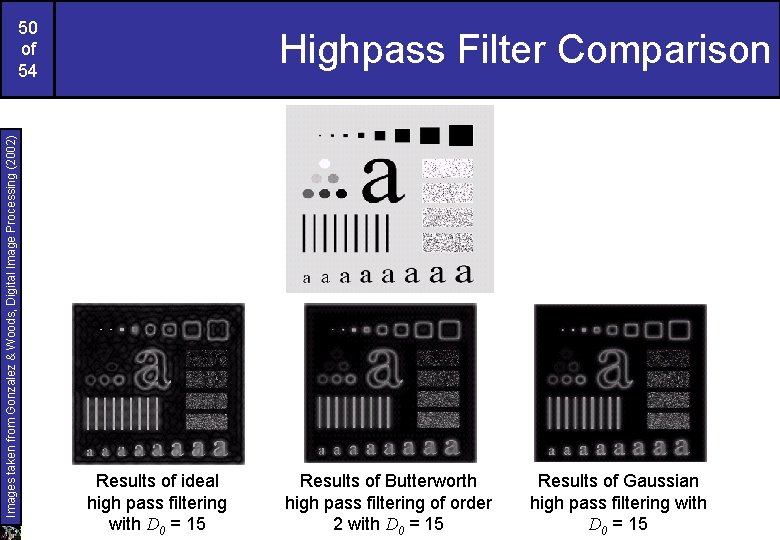
Images taken from Gonzalez & Woods, Digital Image Processing (2002) 50 of 54 Highpass Filter Comparison Results of ideal high pass filtering with D 0 = 15 Results of Butterworth high pass filtering of order 2 with D 0 = 15 Results of Gaussian high pass filtering with D 0 = 15
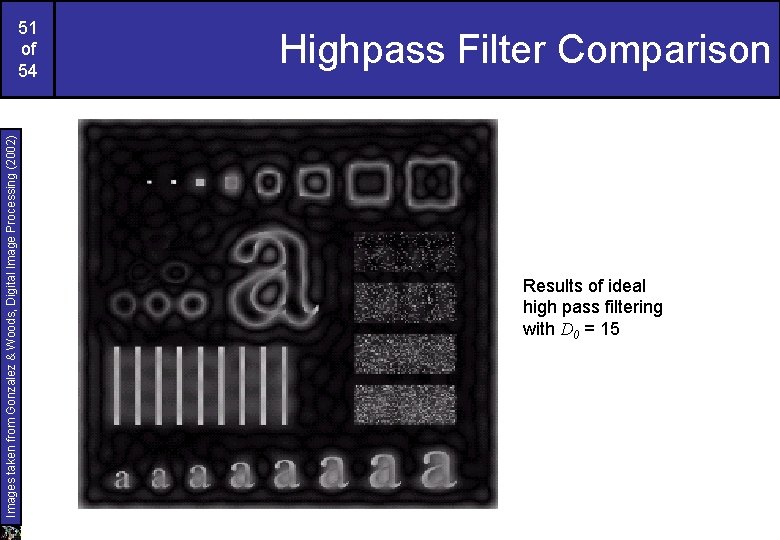
Images taken from Gonzalez & Woods, Digital Image Processing (2002) 51 of 54 Highpass Filter Comparison Results of ideal high pass filtering with D 0 = 15
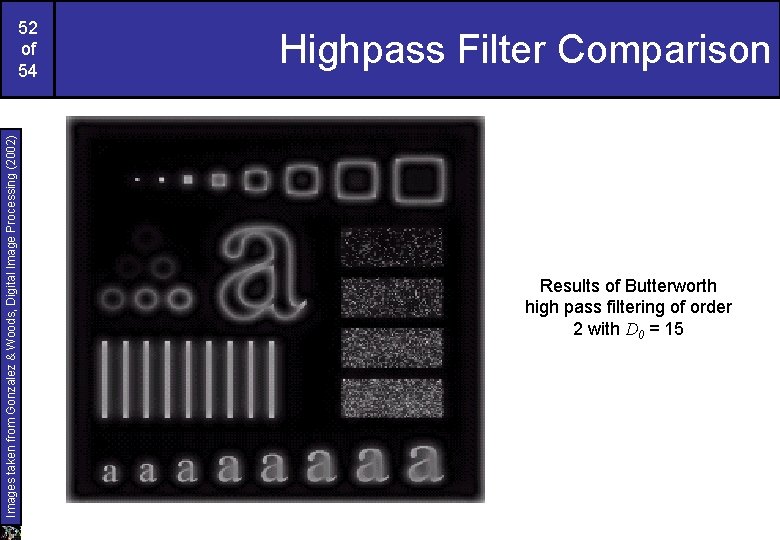
Images taken from Gonzalez & Woods, Digital Image Processing (2002) 52 of 54 Highpass Filter Comparison Results of Butterworth high pass filtering of order 2 with D 0 = 15
Images taken from Gonzalez & Woods, Digital Image Processing (2002) 53 of 54 Highpass Filter Comparison Results of Gaussian high pass filtering with D 0 = 15
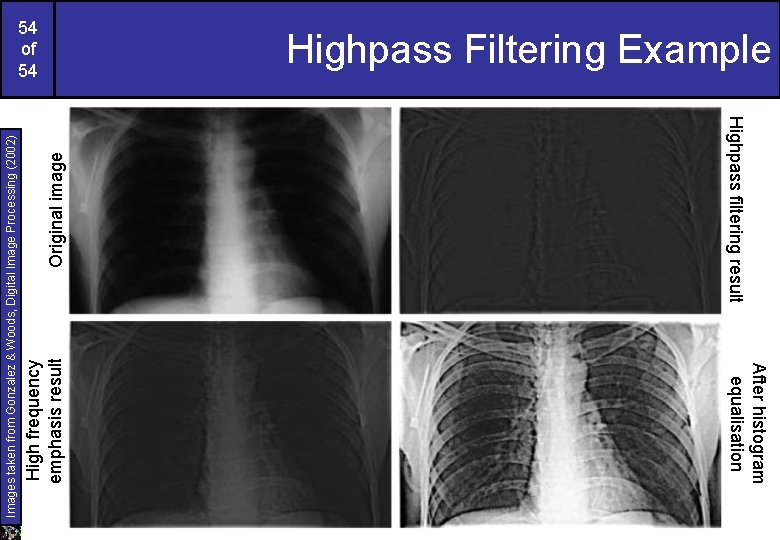
Original image Highpass filtering result After histogram equalisation High frequency emphasis result Images taken from Gonzalez & Woods, Digital Image Processing (2002) 54 of 54 Highpass Filtering Example
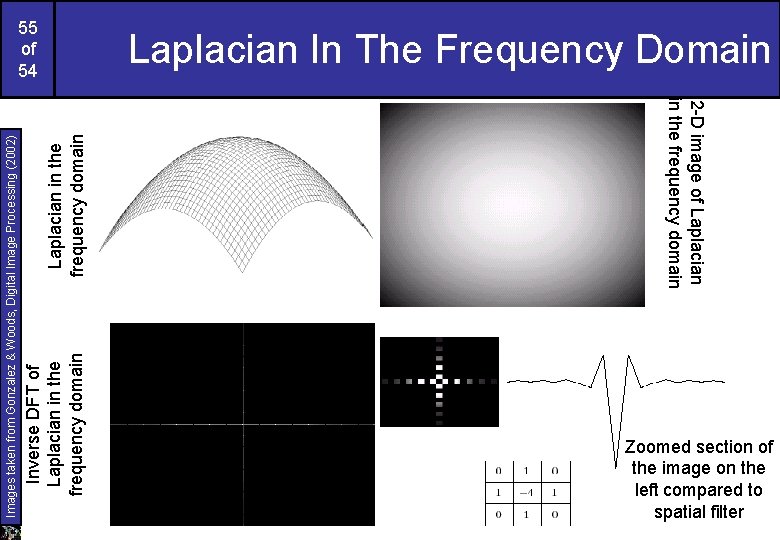
Laplacian in the frequency domain 2 -D image of Laplacian in the frequency domain Inverse DFT of Laplacian in the frequency domain Images taken from Gonzalez & Woods, Digital Image Processing (2002) 55 of 54 Laplacian In The Frequency Domain Zoomed section of the image on the left compared to spatial filter
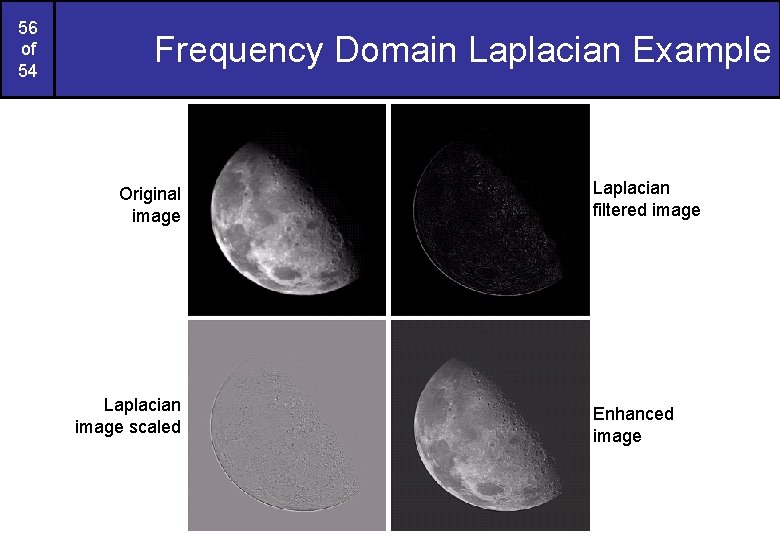
56 of 54 Frequency Domain Laplacian Example Original image Laplacian image scaled Laplacian filtered image Enhanced image
57 of 54 Fast Fourier Transform The reason that Fourier based techniques have become so popular is the development of the Fast Fourier Transform (FFT) algorithm Allows the Fourier transform to be carried out in a reasonable amount of time Reduces the amount of time required to perform a Fourier transform by a factor of 100 – 600 times!
58 of 54 Frequency Domain Filtering & Spatial Domain Filtering Similar jobs can be done in the spatial and frequency domains Filtering in the spatial domain can be easier to understand Filtering in the frequency domain can be much faster – especially for large images
59 of 54 Summary In this lecture we examined image enhancement in the frequency domain – The Fourier series & the Fourier transform – Image Processing in the frequency domain • Image smoothing • Image sharpening – Fast Fourier Transform Next time we will begin to examine image restoration using the spatial and frequency based techniques we have been looking at