
Digital Image Processing 2 nd ed www imageprocessingbook
Digital Image Processing, 2 nd ed. www. imageprocessingbook. com Chapter 4 Image Enhancement in the Frequency Domain © 2002 R. C. Gonzalez & R. E. Woods
Digital Image Processing, 2 nd ed. www. imageprocessingbook. com Background • Any function that periodically repeats itself can be expressed as the sum of sines and/or cosines of different frequencies, each multiplied by a different coefficient (Fourier series). • Even functions that are not periodic (but whose area under the curve is finite) can be expressed as the integral of sines and/or cosines multiplied by a weighting function (Fourier transform). © 2002 R. C. Gonzalez & R. E. Woods
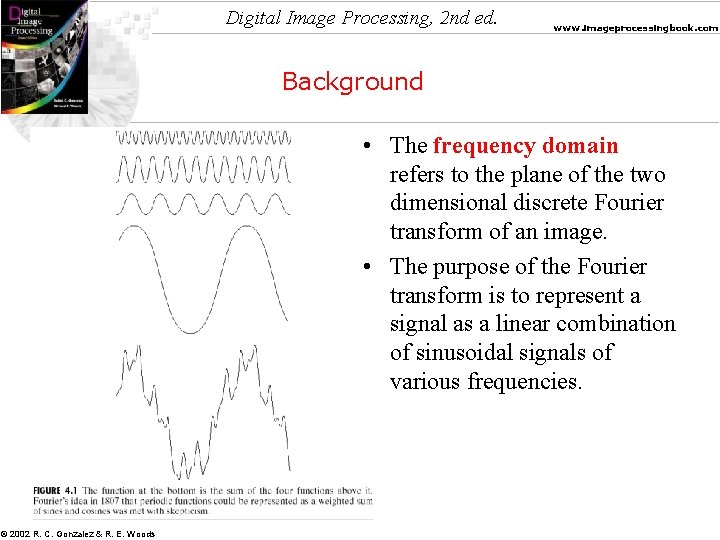
Digital Image Processing, 2 nd ed. www. imageprocessingbook. com Background • The frequency domain refers to the plane of the two dimensional discrete Fourier transform of an image. • The purpose of the Fourier transform is to represent a signal as a linear combination of sinusoidal signals of various frequencies. © 2002 R. C. Gonzalez & R. E. Woods
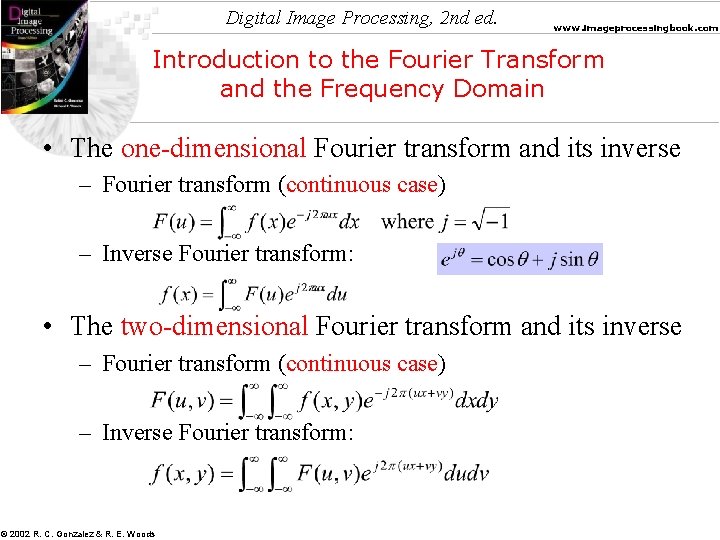
Digital Image Processing, 2 nd ed. www. imageprocessingbook. com Introduction to the Fourier Transform and the Frequency Domain • The one-dimensional Fourier transform and its inverse – Fourier transform (continuous case) – Inverse Fourier transform: • The two-dimensional Fourier transform and its inverse – Fourier transform (continuous case) – Inverse Fourier transform: © 2002 R. C. Gonzalez & R. E. Woods
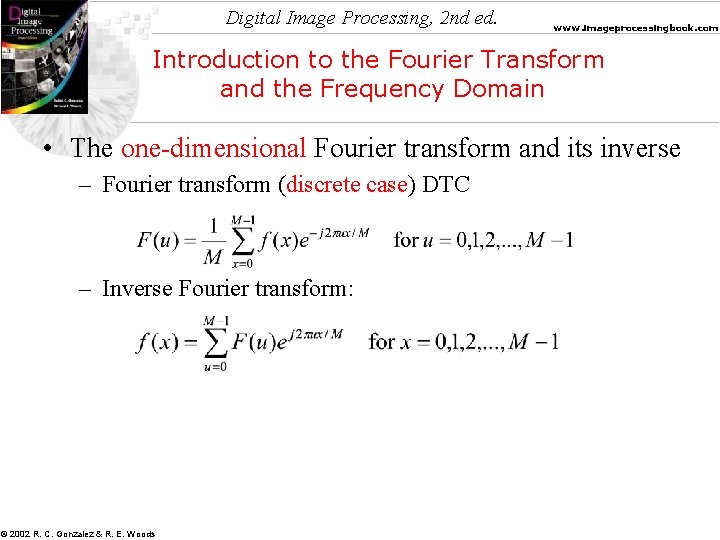
Digital Image Processing, 2 nd ed. www. imageprocessingbook. com Introduction to the Fourier Transform and the Frequency Domain • The one-dimensional Fourier transform and its inverse – Fourier transform (discrete case) DTC – Inverse Fourier transform: © 2002 R. C. Gonzalez & R. E. Woods
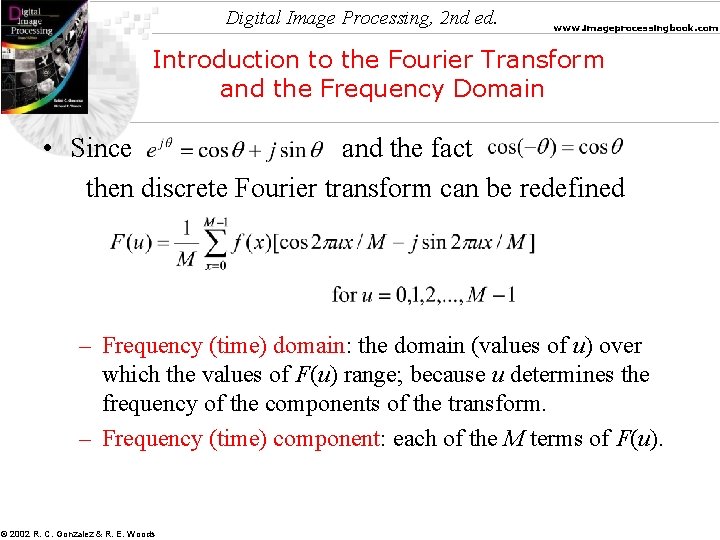
Digital Image Processing, 2 nd ed. www. imageprocessingbook. com Introduction to the Fourier Transform and the Frequency Domain • Since and the fact then discrete Fourier transform can be redefined – Frequency (time) domain: the domain (values of u) over which the values of F(u) range; because u determines the frequency of the components of the transform. – Frequency (time) component: each of the M terms of F(u). © 2002 R. C. Gonzalez & R. E. Woods
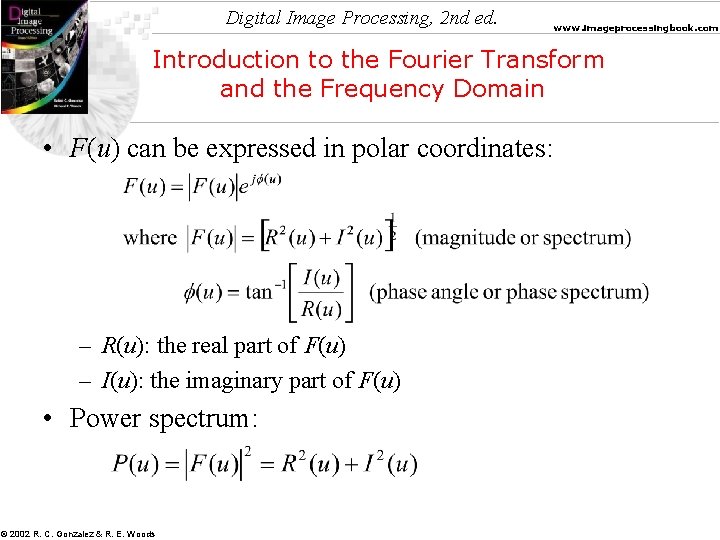
Digital Image Processing, 2 nd ed. www. imageprocessingbook. com Introduction to the Fourier Transform and the Frequency Domain • F(u) can be expressed in polar coordinates: – R(u): the real part of F(u) – I(u): the imaginary part of F(u) • Power spectrum: © 2002 R. C. Gonzalez & R. E. Woods
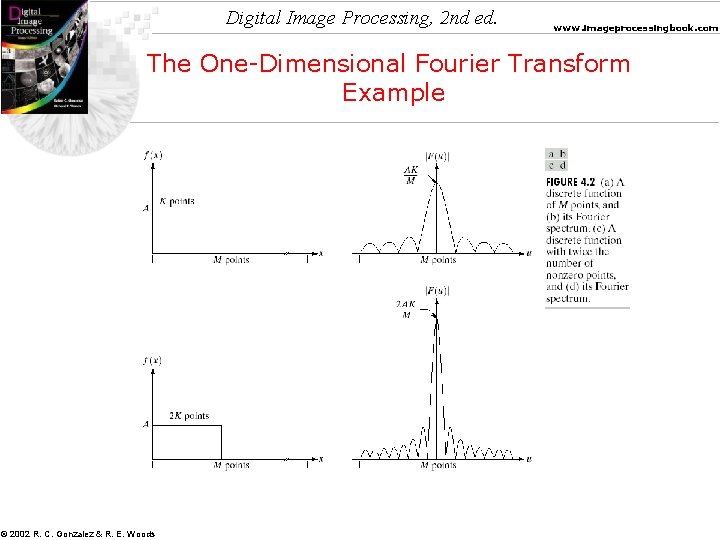
Digital Image Processing, 2 nd ed. www. imageprocessingbook. com The One-Dimensional Fourier Transform Example © 2002 R. C. Gonzalez & R. E. Woods
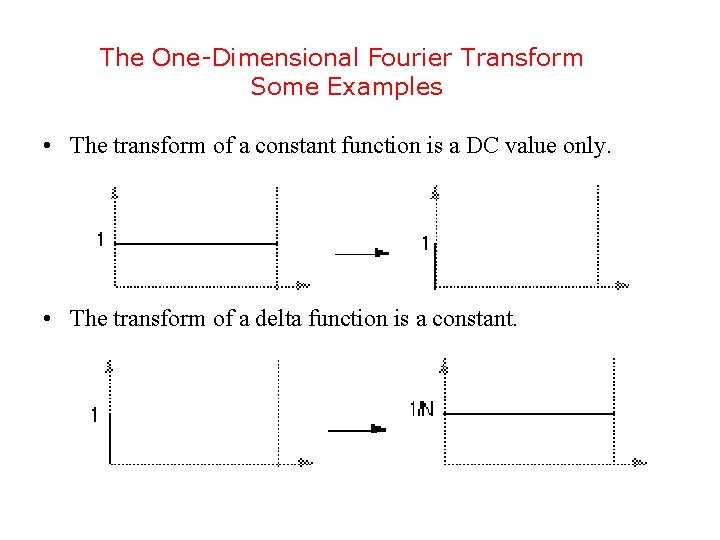
The One-Dimensional Fourier Transform Some Examples • The transform of a constant function is a DC value only. • The transform of a delta function is a constant.
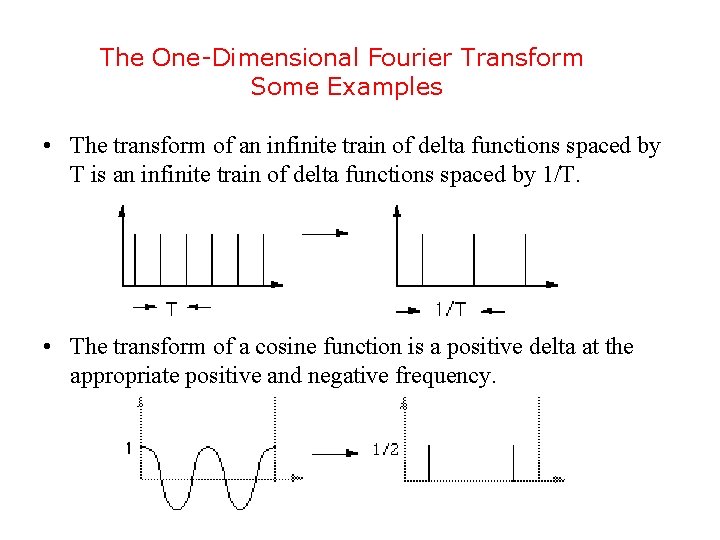
The One-Dimensional Fourier Transform Some Examples • The transform of an infinite train of delta functions spaced by T is an infinite train of delta functions spaced by 1/T. • The transform of a cosine function is a positive delta at the appropriate positive and negative frequency.
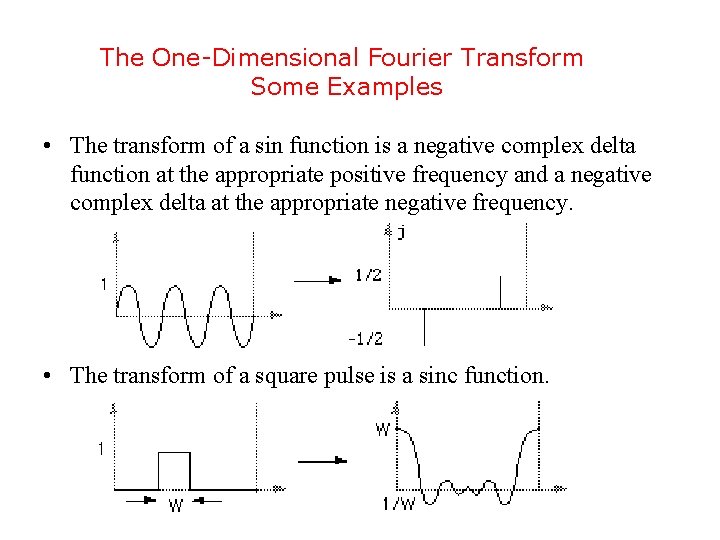
The One-Dimensional Fourier Transform Some Examples • The transform of a sin function is a negative complex delta function at the appropriate positive frequency and a negative complex delta at the appropriate negative frequency. • The transform of a square pulse is a sinc function.
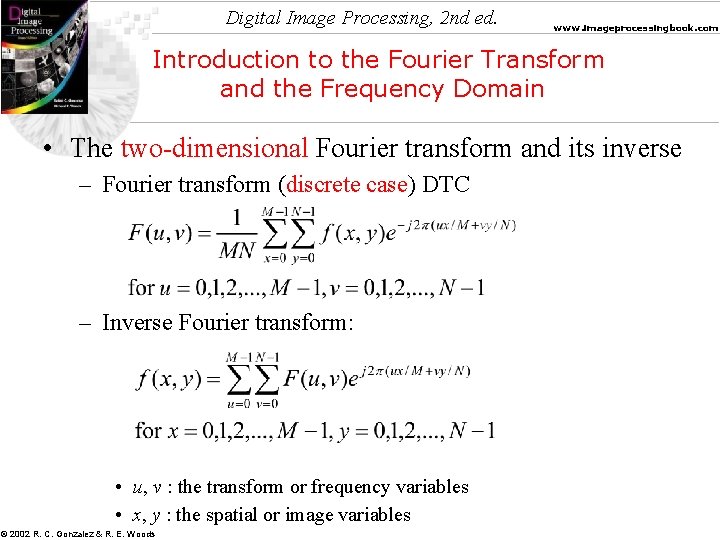
Digital Image Processing, 2 nd ed. www. imageprocessingbook. com Introduction to the Fourier Transform and the Frequency Domain • The two-dimensional Fourier transform and its inverse – Fourier transform (discrete case) DTC – Inverse Fourier transform: • u, v : the transform or frequency variables • x, y : the spatial or image variables © 2002 R. C. Gonzalez & R. E. Woods
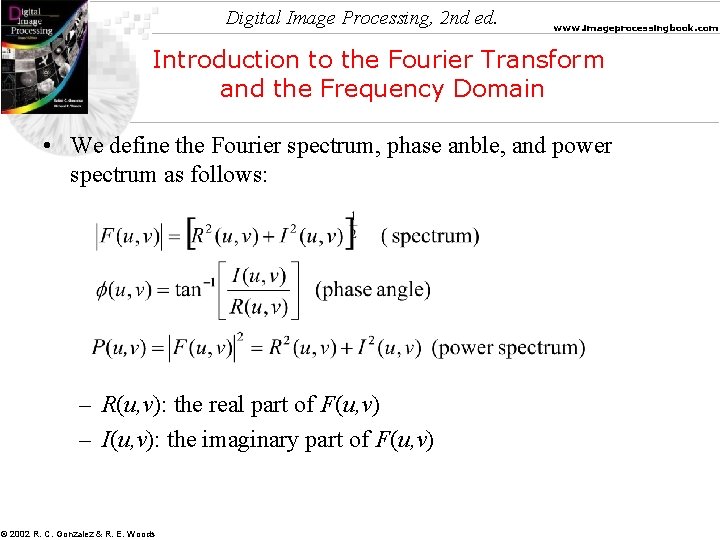
Digital Image Processing, 2 nd ed. www. imageprocessingbook. com Introduction to the Fourier Transform and the Frequency Domain • We define the Fourier spectrum, phase anble, and power spectrum as follows: – R(u, v): the real part of F(u, v) – I(u, v): the imaginary part of F(u, v) © 2002 R. C. Gonzalez & R. E. Woods
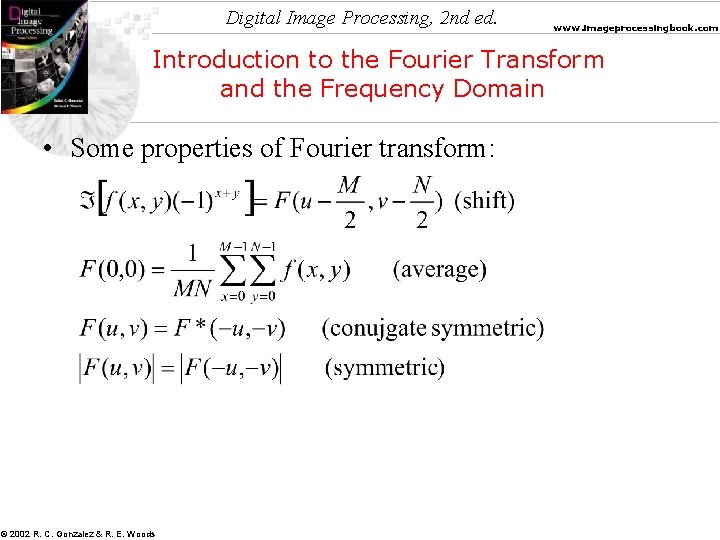
Digital Image Processing, 2 nd ed. www. imageprocessingbook. com Introduction to the Fourier Transform and the Frequency Domain • Some properties of Fourier transform: © 2002 R. C. Gonzalez & R. E. Woods
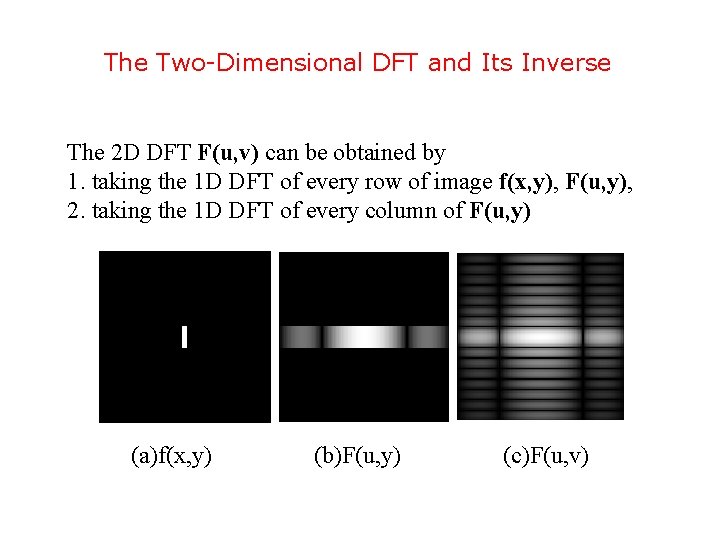
The Two-Dimensional DFT and Its Inverse The 2 D DFT F(u, v) can be obtained by 1. taking the 1 D DFT of every row of image f(x, y), F(u, y), 2. taking the 1 D DFT of every column of F(u, y) (a)f(x, y) (b)F(u, y) (c)F(u, v)
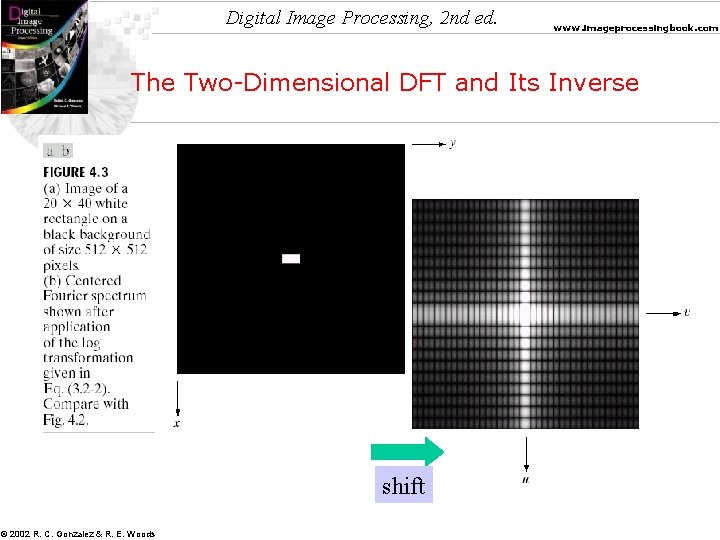
Digital Image Processing, 2 nd ed. www. imageprocessingbook. com The Two-Dimensional DFT and Its Inverse shift © 2002 R. C. Gonzalez & R. E. Woods
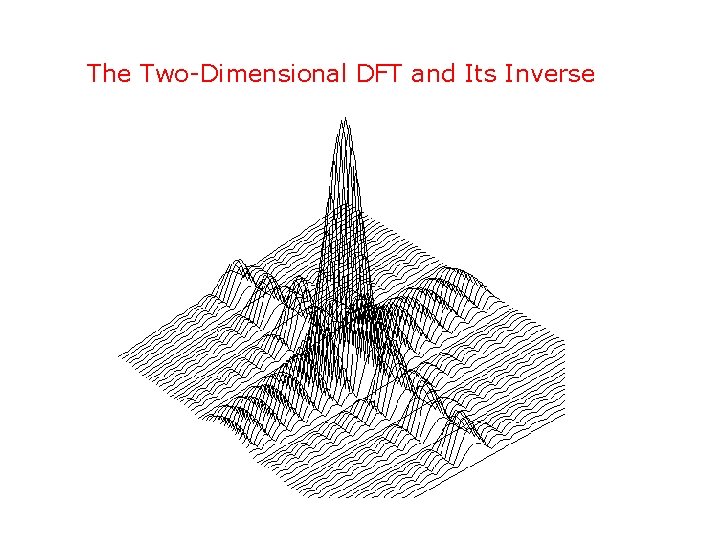
The Two-Dimensional DFT and Its Inverse
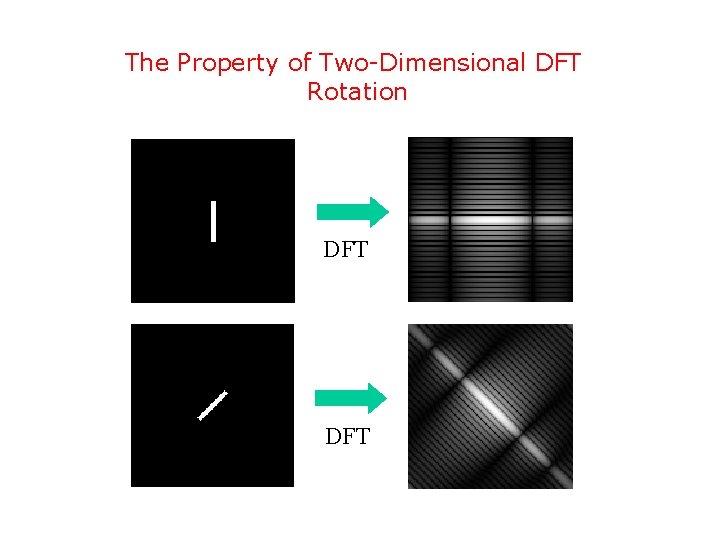
The Property of Two-Dimensional DFT Rotation DFT
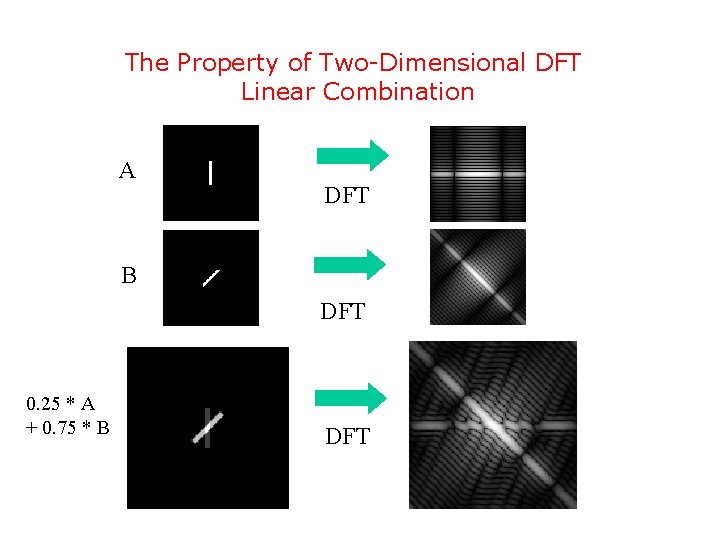
The Property of Two-Dimensional DFT Linear Combination A DFT B DFT 0. 25 * A + 0. 75 * B DFT
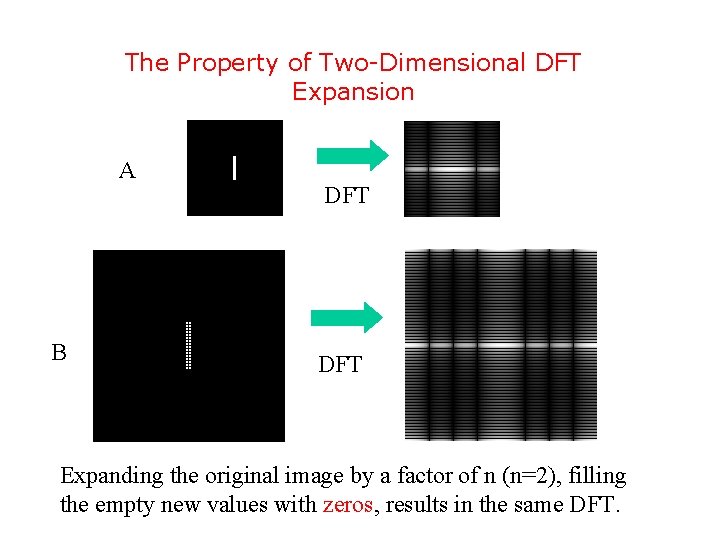
The Property of Two-Dimensional DFT Expansion A B DFT Expanding the original image by a factor of n (n=2), filling the empty new values with zeros, results in the same DFT.
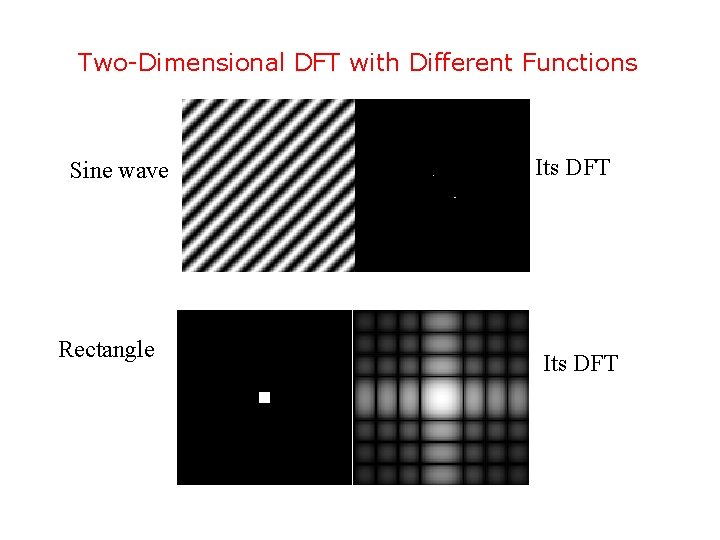
Two-Dimensional DFT with Different Functions Sine wave Rectangle Its DFT
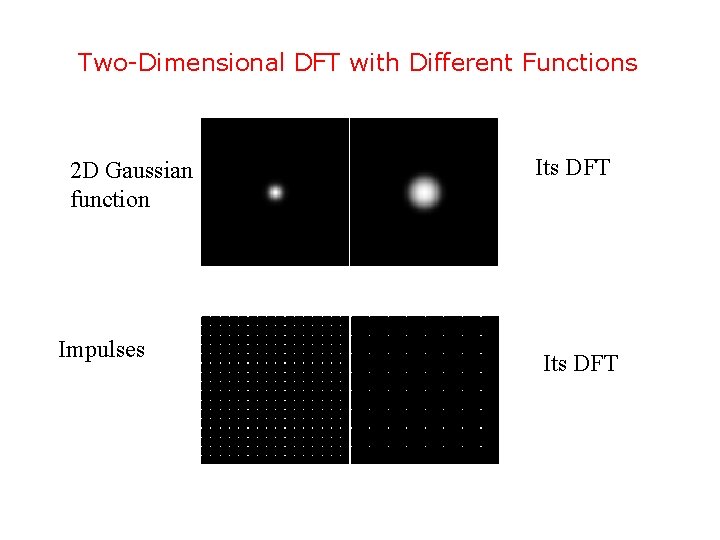
Two-Dimensional DFT with Different Functions 2 D Gaussian function Impulses Its DFT

Digital Image Processing, 2 nd ed. www. imageprocessingbook. com Filtering in the Frequency Domain © 2002 R. C. Gonzalez & R. E. Woods
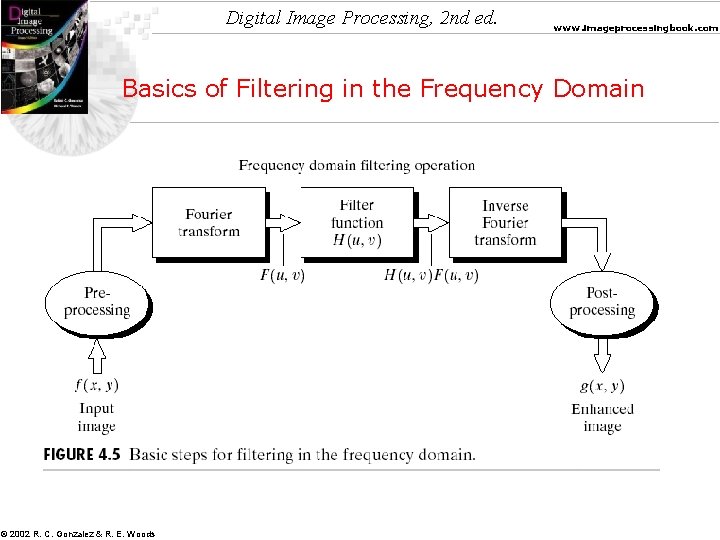
Digital Image Processing, 2 nd ed. www. imageprocessingbook. com Basics of Filtering in the Frequency Domain © 2002 R. C. Gonzalez & R. E. Woods
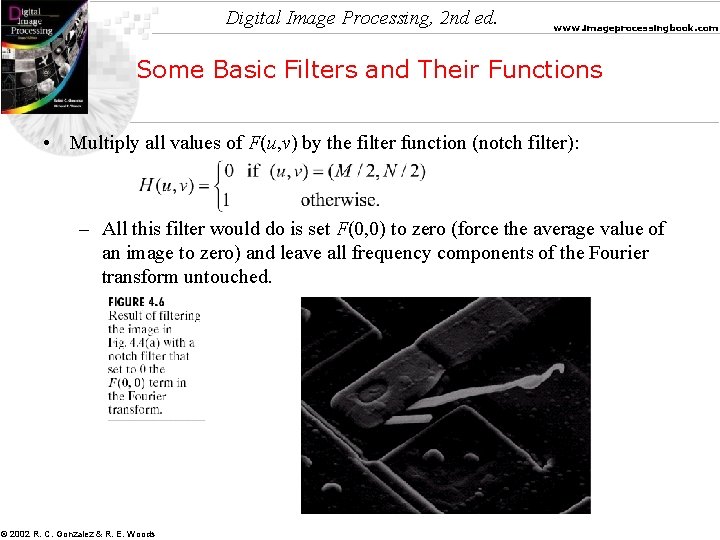
Digital Image Processing, 2 nd ed. www. imageprocessingbook. com Some Basic Filters and Their Functions • Multiply all values of F(u, v) by the filter function (notch filter): – All this filter would do is set F(0, 0) to zero (force the average value of an image to zero) and leave all frequency components of the Fourier transform untouched. © 2002 R. C. Gonzalez & R. E. Woods
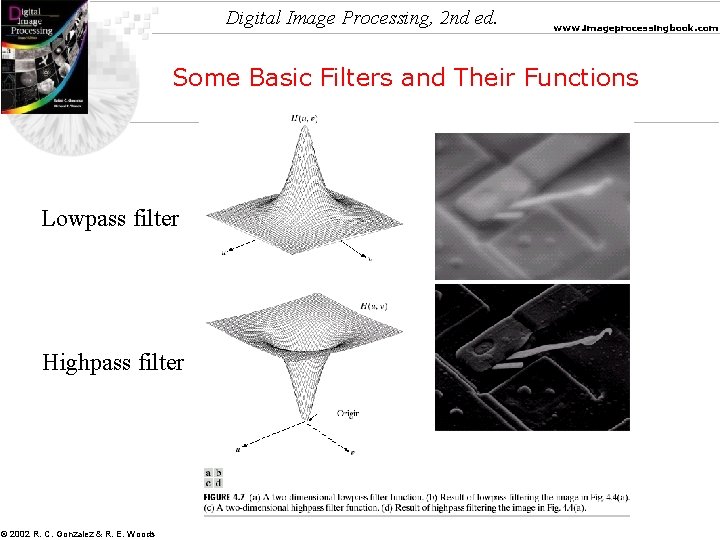
Digital Image Processing, 2 nd ed. www. imageprocessingbook. com Some Basic Filters and Their Functions Lowpass filter Highpass filter © 2002 R. C. Gonzalez & R. E. Woods
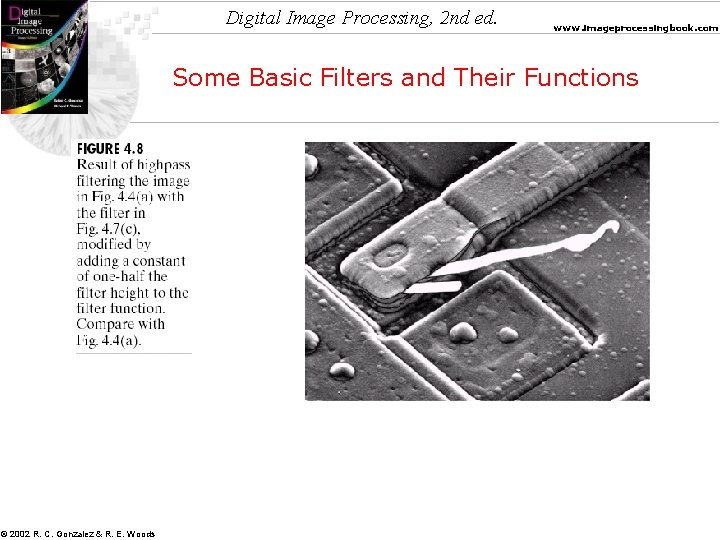
Digital Image Processing, 2 nd ed. www. imageprocessingbook. com Some Basic Filters and Their Functions © 2002 R. C. Gonzalez & R. E. Woods
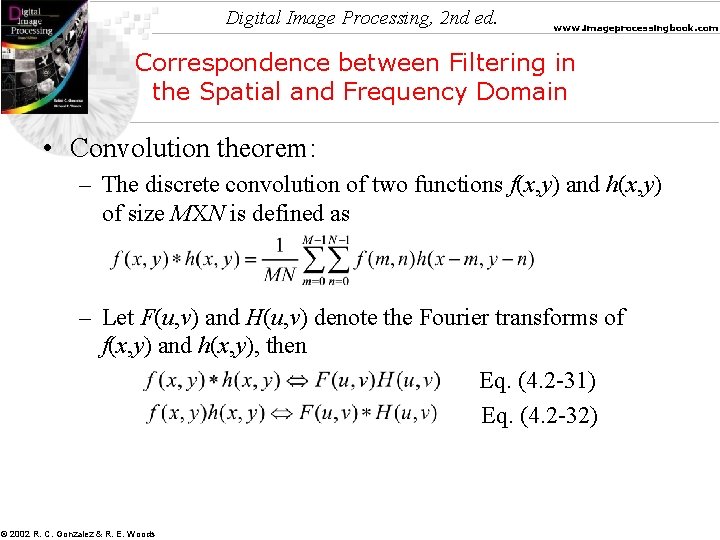
Digital Image Processing, 2 nd ed. www. imageprocessingbook. com Correspondence between Filtering in the Spatial and Frequency Domain • Convolution theorem: – The discrete convolution of two functions f(x, y) and h(x, y) of size MXN is defined as – Let F(u, v) and H(u, v) denote the Fourier transforms of f(x, y) and h(x, y), then Eq. (4. 2 -31) Eq. (4. 2 -32) © 2002 R. C. Gonzalez & R. E. Woods
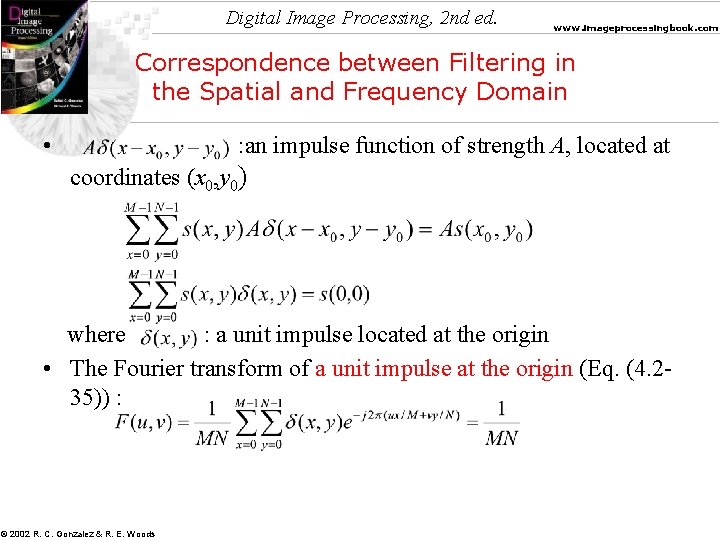
Digital Image Processing, 2 nd ed. www. imageprocessingbook. com Correspondence between Filtering in the Spatial and Frequency Domain • : an impulse function of strength A, located at coordinates (x 0, y 0) where : a unit impulse located at the origin • The Fourier transform of a unit impulse at the origin (Eq. (4. 235)) : © 2002 R. C. Gonzalez & R. E. Woods
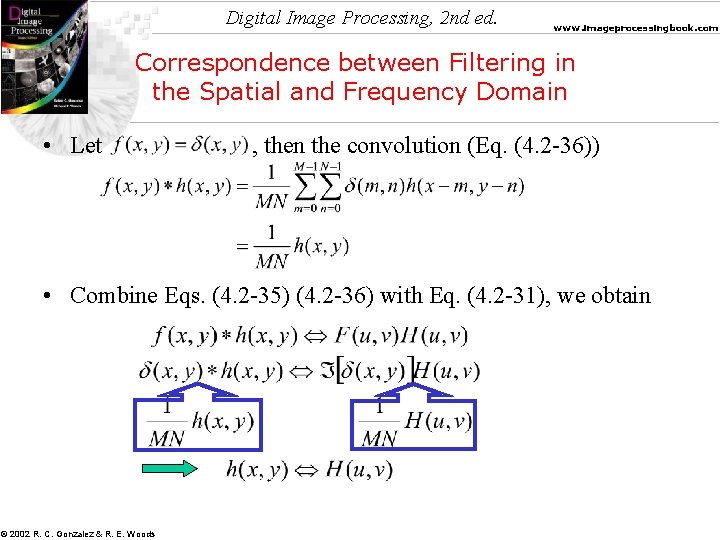
Digital Image Processing, 2 nd ed. www. imageprocessingbook. com Correspondence between Filtering in the Spatial and Frequency Domain • Let , then the convolution (Eq. (4. 2 -36)) • Combine Eqs. (4. 2 -35) (4. 2 -36) with Eq. (4. 2 -31), we obtain © 2002 R. C. Gonzalez & R. E. Woods
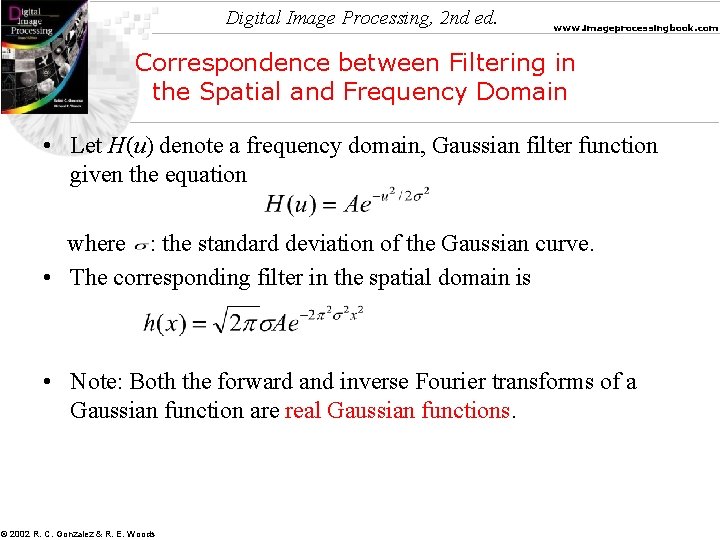
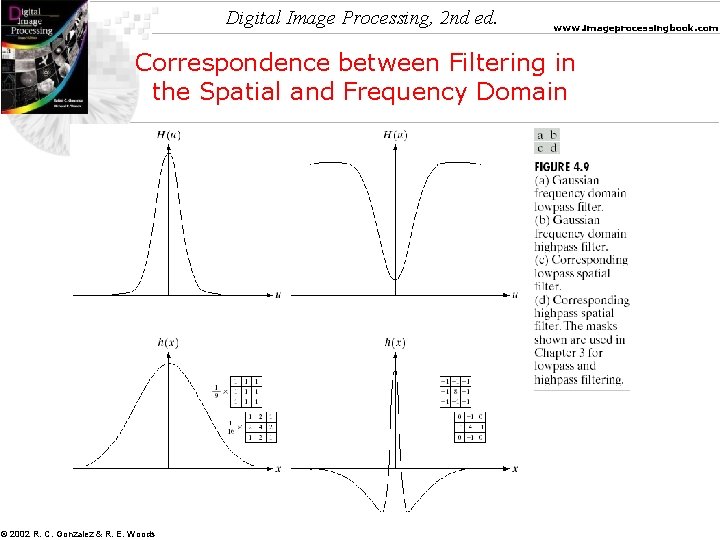
Digital Image Processing, 2 nd ed. www. imageprocessingbook. com Correspondence between Filtering in the Spatial and Frequency Domain • Let H(u) denote a frequency domain, Gaussian filter function given the equation where : the standard deviation of the Gaussian curve. • The corresponding filter in the spatial domain is • Note: Both the forward and inverse Fourier transforms of a Gaussian function are real Gaussian functions. © 2002 R. C. Gonzalez & R. E. Woods
Digital Image Processing, 2 nd ed. www. imageprocessingbook. com Correspondence between Filtering in the Spatial and Frequency Domain © 2002 R. C. Gonzalez & R. E. Woods
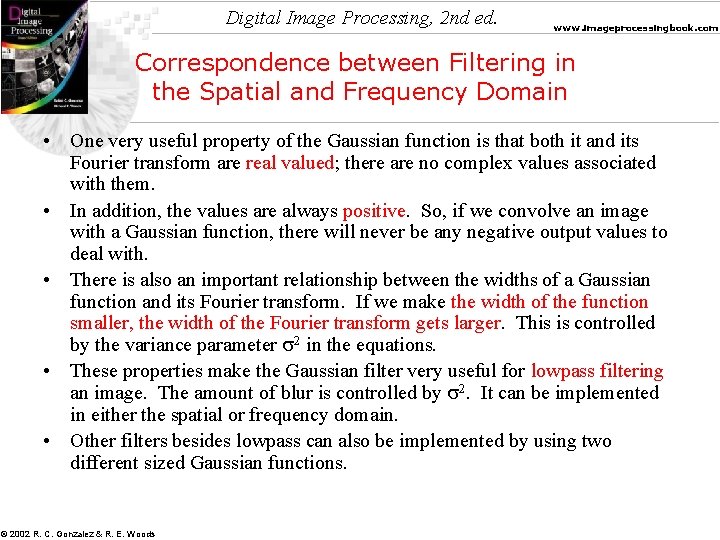
Digital Image Processing, 2 nd ed. www. imageprocessingbook. com Correspondence between Filtering in the Spatial and Frequency Domain • One very useful property of the Gaussian function is that both it and its Fourier transform are real valued; there are no complex values associated with them. • In addition, the values are always positive. So, if we convolve an image with a Gaussian function, there will never be any negative output values to deal with. • There is also an important relationship between the widths of a Gaussian function and its Fourier transform. If we make the width of the function smaller, the width of the Fourier transform gets larger. This is controlled by the variance parameter 2 in the equations. • These properties make the Gaussian filter very useful for lowpass filtering an image. The amount of blur is controlled by 2. It can be implemented in either the spatial or frequency domain. • Other filters besides lowpass can also be implemented by using two different sized Gaussian functions. © 2002 R. C. Gonzalez & R. E. Woods
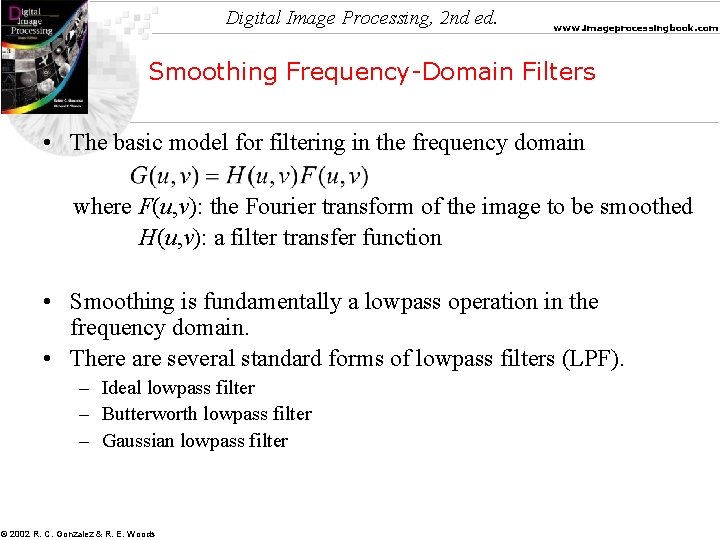
Digital Image Processing, 2 nd ed. www. imageprocessingbook. com Smoothing Frequency-Domain Filters • The basic model for filtering in the frequency domain where F(u, v): the Fourier transform of the image to be smoothed H(u, v): a filter transfer function • Smoothing is fundamentally a lowpass operation in the frequency domain. • There are several standard forms of lowpass filters (LPF). – Ideal lowpass filter – Butterworth lowpass filter – Gaussian lowpass filter © 2002 R. C. Gonzalez & R. E. Woods
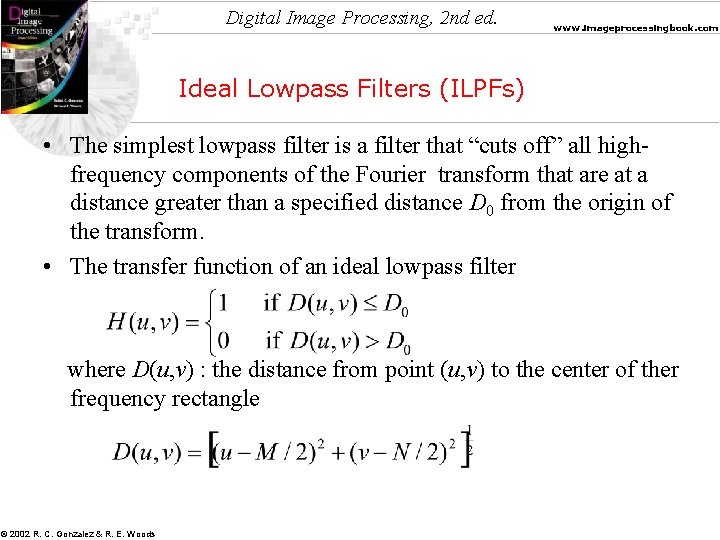
Digital Image Processing, 2 nd ed. www. imageprocessingbook. com Ideal Lowpass Filters (ILPFs) • The simplest lowpass filter is a filter that “cuts off” all highfrequency components of the Fourier transform that are at a distance greater than a specified distance D 0 from the origin of the transform. • The transfer function of an ideal lowpass filter where D(u, v) : the distance from point (u, v) to the center of ther frequency rectangle © 2002 R. C. Gonzalez & R. E. Woods
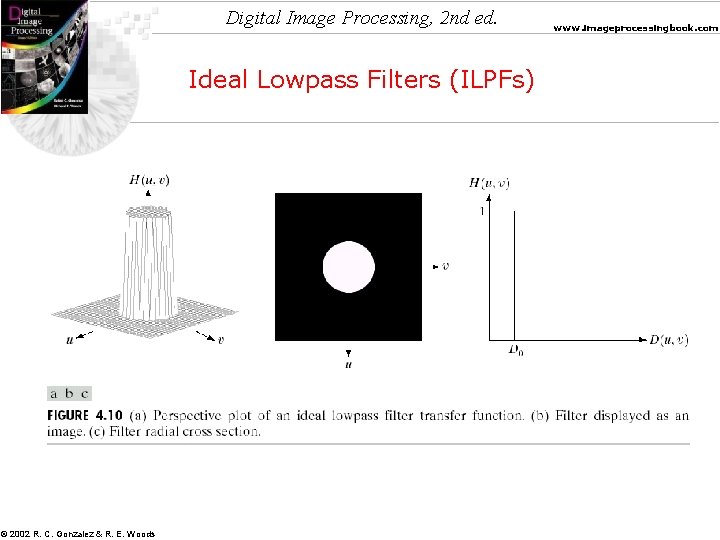
Digital Image Processing, 2 nd ed. Ideal Lowpass Filters (ILPFs) © 2002 R. C. Gonzalez & R. E. Woods www. imageprocessingbook. com
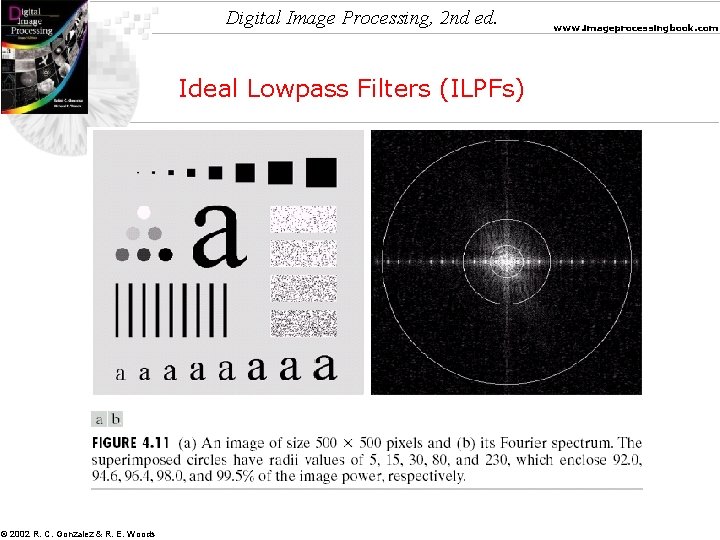
Digital Image Processing, 2 nd ed. Ideal Lowpass Filters (ILPFs) © 2002 R. C. Gonzalez & R. E. Woods www. imageprocessingbook. com
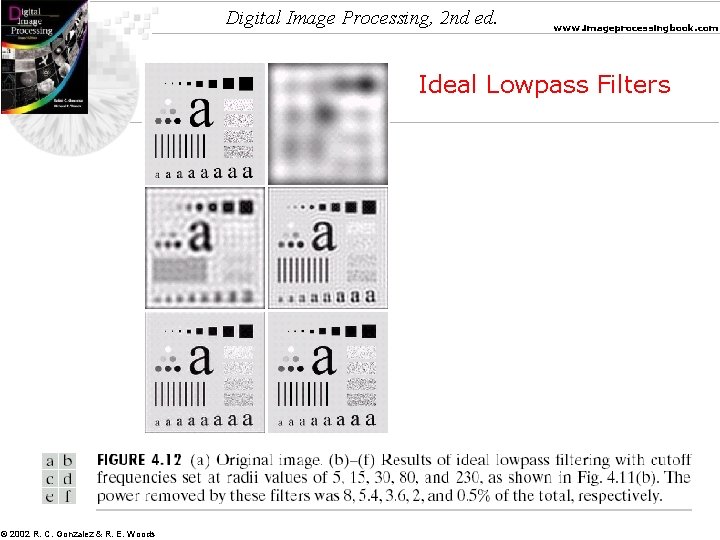
Digital Image Processing, 2 nd ed. www. imageprocessingbook. com Ideal Lowpass Filters © 2002 R. C. Gonzalez & R. E. Woods
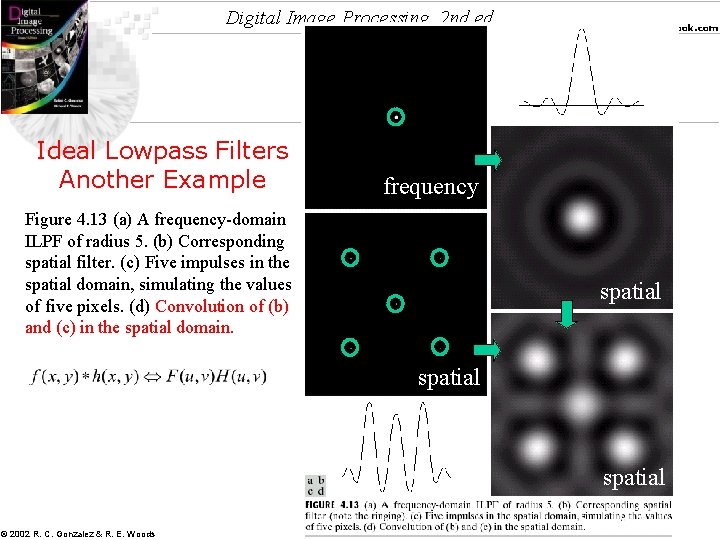
Digital Image Processing, 2 nd ed. Ideal Lowpass Filters Another Example www. imageprocessingbook. com frequency Figure 4. 13 (a) A frequency-domain ILPF of radius 5. (b) Corresponding spatial filter. (c) Five impulses in the spatial domain, simulating the values of five pixels. (d) Convolution of (b) and (c) in the spatial domain. spatial © 2002 R. C. Gonzalez & R. E. Woods
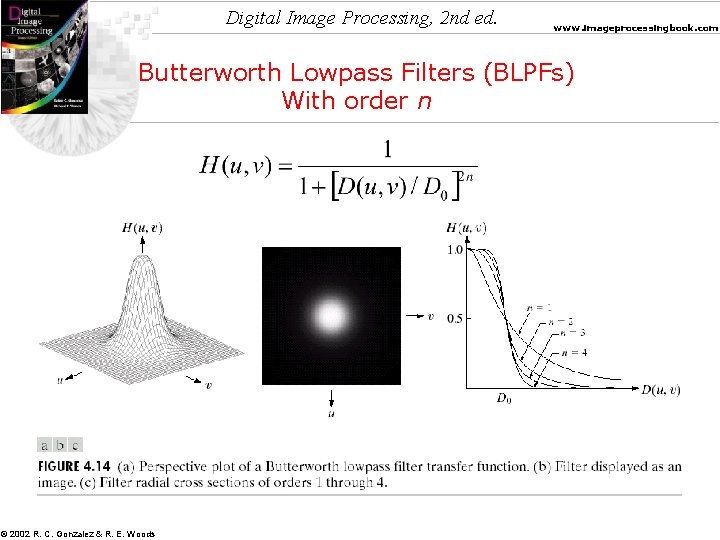
Digital Image Processing, 2 nd ed. www. imageprocessingbook. com Butterworth Lowpass Filters (BLPFs) With order n © 2002 R. C. Gonzalez & R. E. Woods
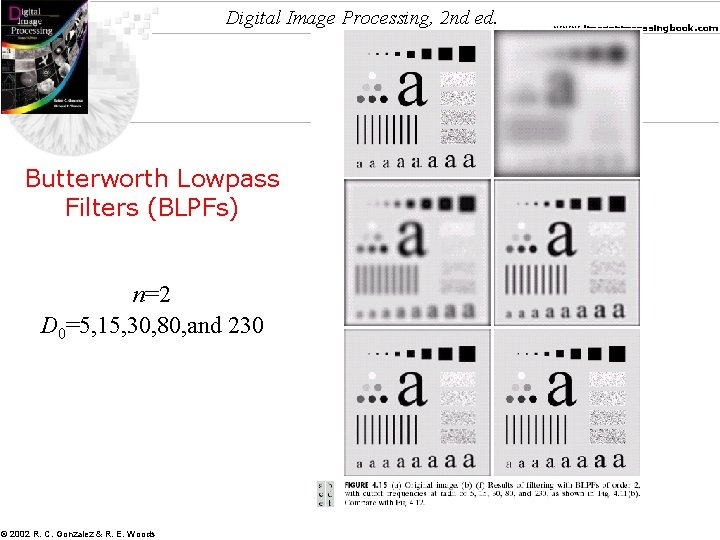
Digital Image Processing, 2 nd ed. Butterworth Lowpass Filters (BLPFs) n=2 D 0=5, 15, 30, 80, and 230 © 2002 R. C. Gonzalez & R. E. Woods www. imageprocessingbook. com
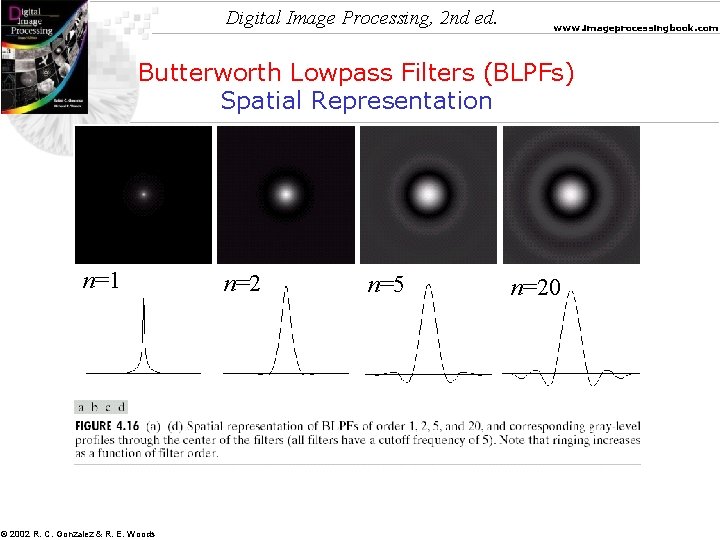
Digital Image Processing, 2 nd ed. www. imageprocessingbook. com Butterworth Lowpass Filters (BLPFs) Spatial Representation n=1 © 2002 R. C. Gonzalez & R. E. Woods n=2 n=5 n=20
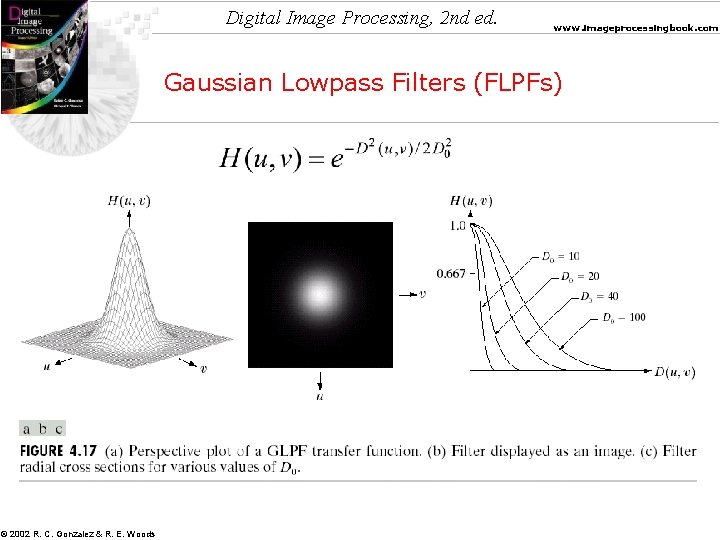
Digital Image Processing, 2 nd ed. www. imageprocessingbook. com Gaussian Lowpass Filters (FLPFs) © 2002 R. C. Gonzalez & R. E. Woods
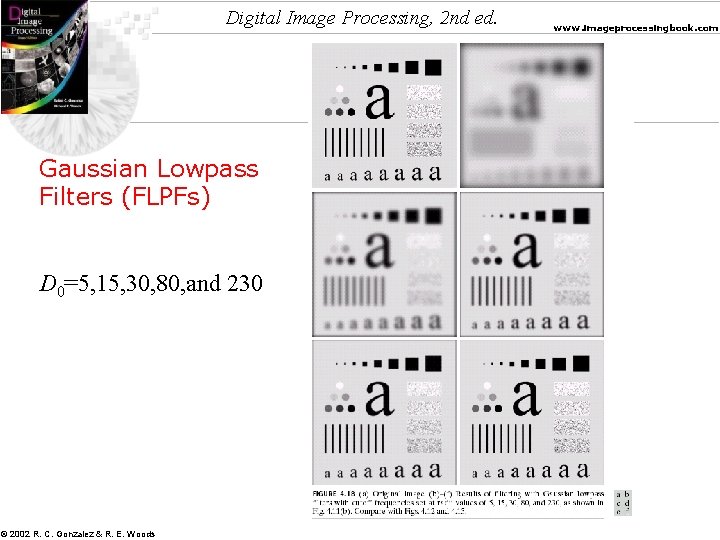
Digital Image Processing, 2 nd ed. Gaussian Lowpass Filters (FLPFs) D 0=5, 15, 30, 80, and 230 © 2002 R. C. Gonzalez & R. E. Woods www. imageprocessingbook. com
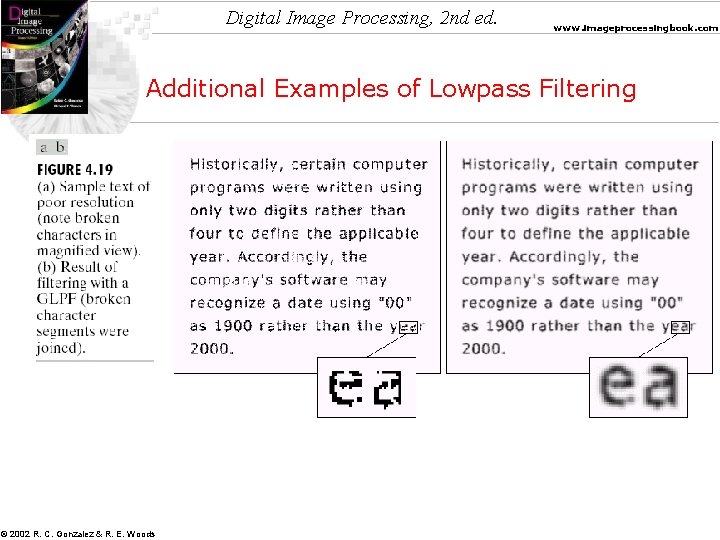
Digital Image Processing, 2 nd ed. www. imageprocessingbook. com Additional Examples of Lowpass Filtering © 2002 R. C. Gonzalez & R. E. Woods
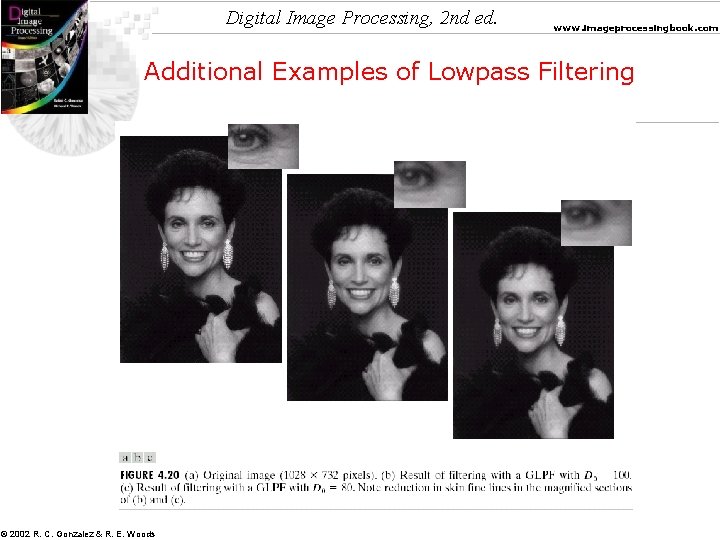
Digital Image Processing, 2 nd ed. www. imageprocessingbook. com Additional Examples of Lowpass Filtering © 2002 R. C. Gonzalez & R. E. Woods
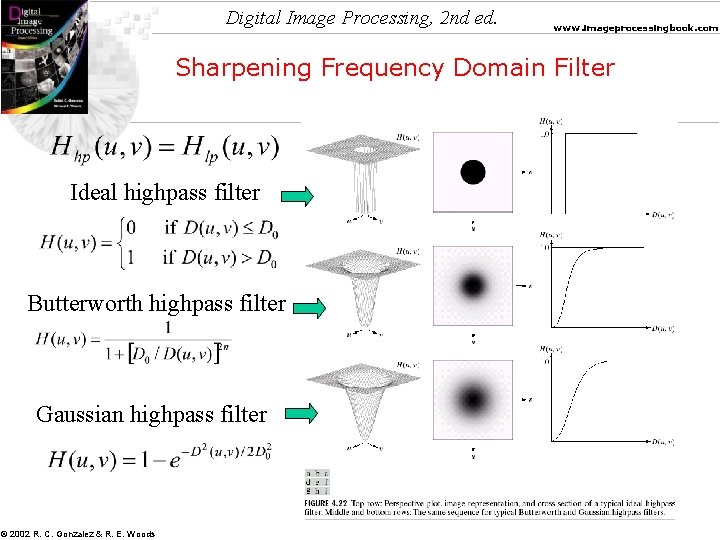
Digital Image Processing, 2 nd ed. www. imageprocessingbook. com Sharpening Frequency Domain Filter Ideal highpass filter Butterworth highpass filter Gaussian highpass filter © 2002 R. C. Gonzalez & R. E. Woods
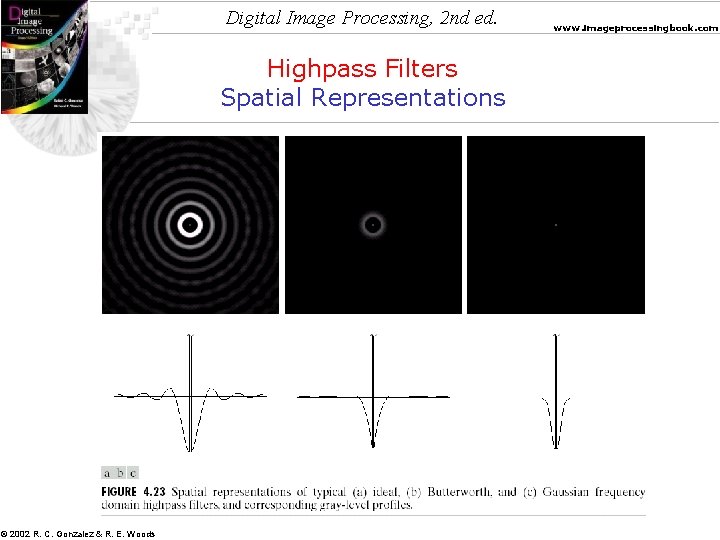
Digital Image Processing, 2 nd ed. Highpass Filters Spatial Representations © 2002 R. C. Gonzalez & R. E. Woods www. imageprocessingbook. com
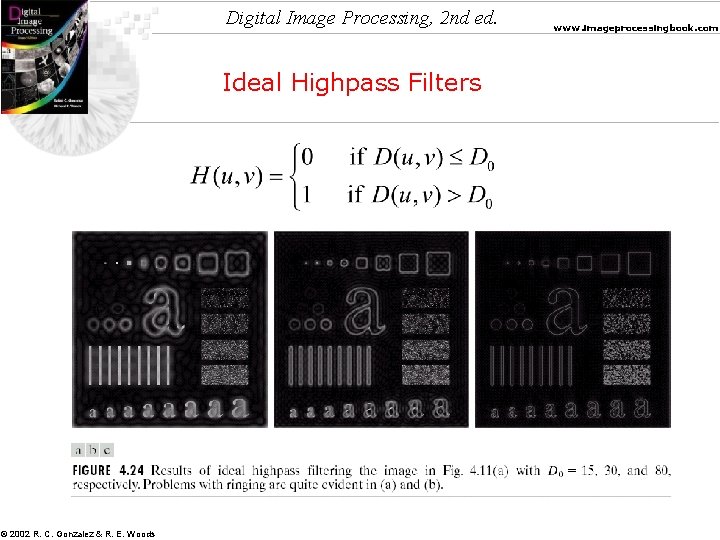
Digital Image Processing, 2 nd ed. Ideal Highpass Filters © 2002 R. C. Gonzalez & R. E. Woods www. imageprocessingbook. com
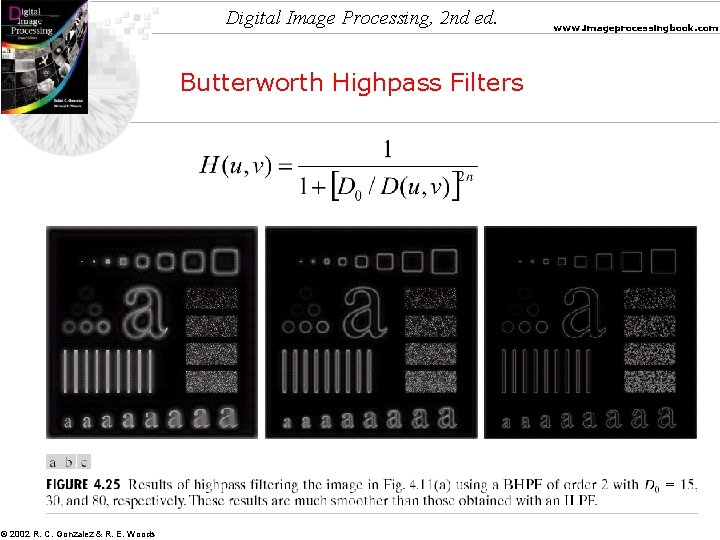
Digital Image Processing, 2 nd ed. Butterworth Highpass Filters © 2002 R. C. Gonzalez & R. E. Woods www. imageprocessingbook. com
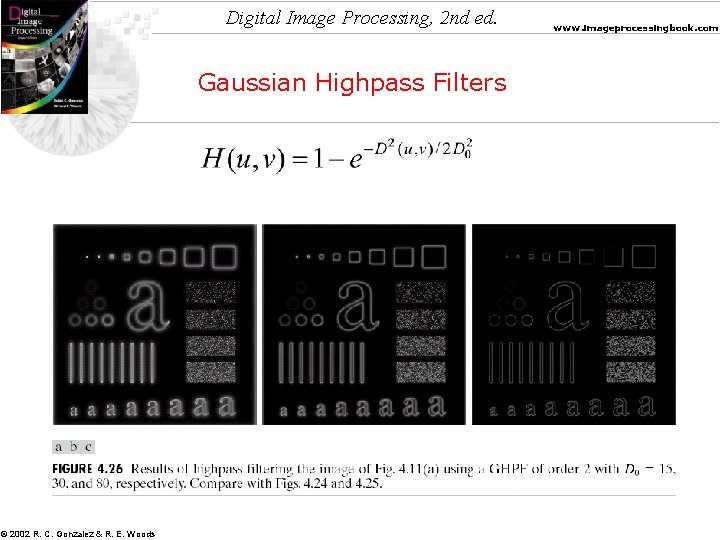
Digital Image Processing, 2 nd ed. Gaussian Highpass Filters © 2002 R. C. Gonzalez & R. E. Woods www. imageprocessingbook. com
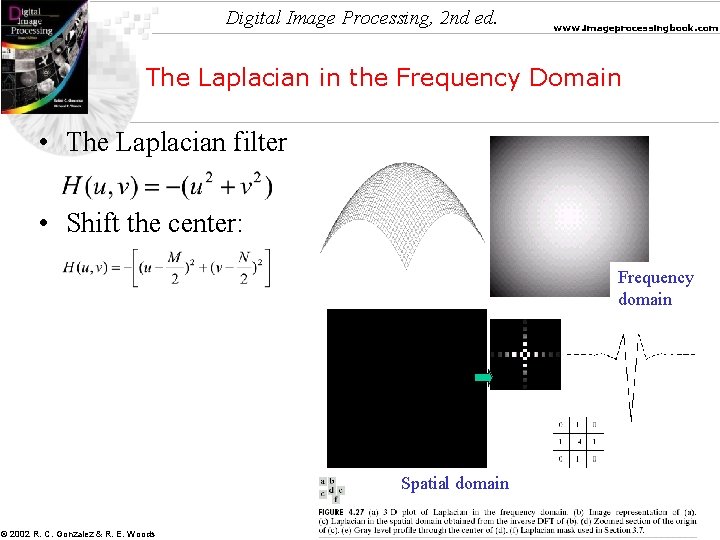
Digital Image Processing, 2 nd ed. www. imageprocessingbook. com The Laplacian in the Frequency Domain • The Laplacian filter • Shift the center: Frequency domain Spatial domain © 2002 R. C. Gonzalez & R. E. Woods
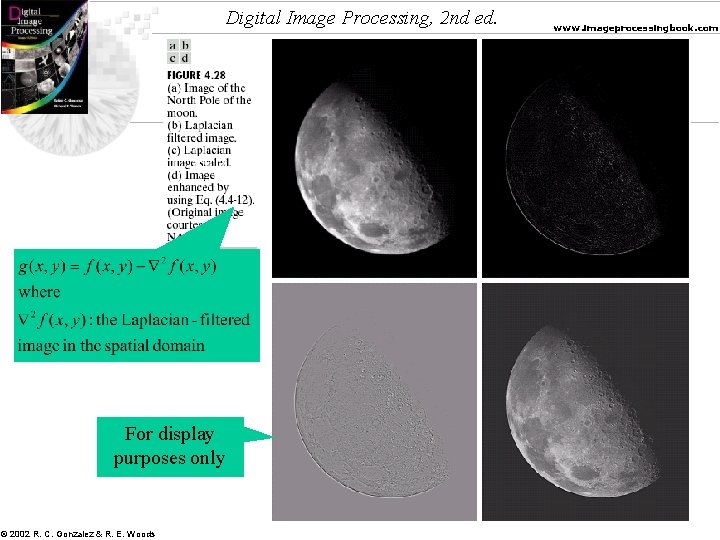
Digital Image Processing, 2 nd ed. For display purposes only © 2002 R. C. Gonzalez & R. E. Woods www. imageprocessingbook. com
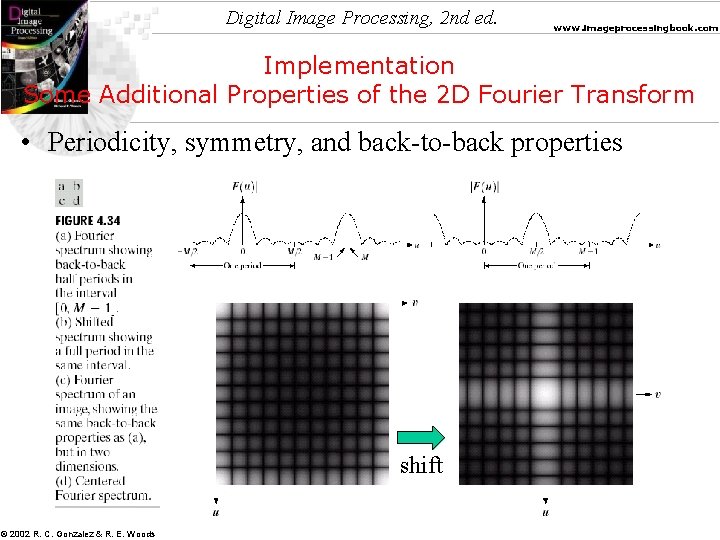
Digital Image Processing, 2 nd ed. www. imageprocessingbook. com Implementation Some Additional Properties of the 2 D Fourier Transform • Periodicity, symmetry, and back-to-back properties shift © 2002 R. C. Gonzalez & R. E. Woods
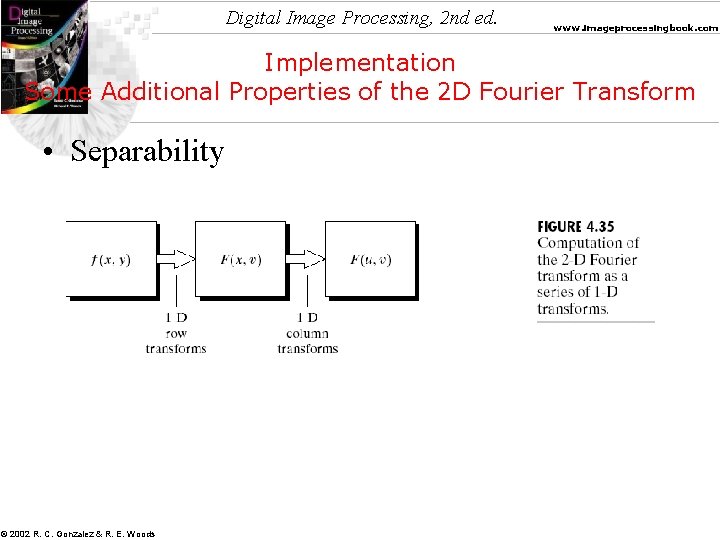
Digital Image Processing, 2 nd ed. www. imageprocessingbook. com Implementation Some Additional Properties of the 2 D Fourier Transform • Separability © 2002 R. C. Gonzalez & R. E. Woods
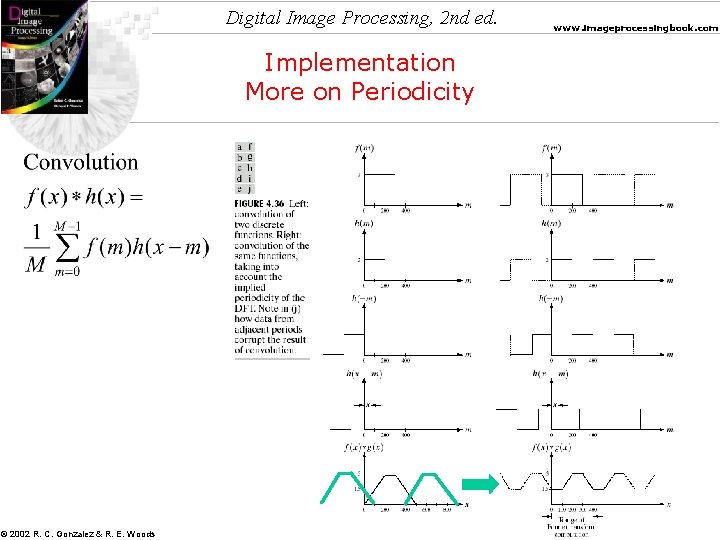
Digital Image Processing, 2 nd ed. Implementation More on Periodicity © 2002 R. C. Gonzalez & R. E. Woods www. imageprocessingbook. com
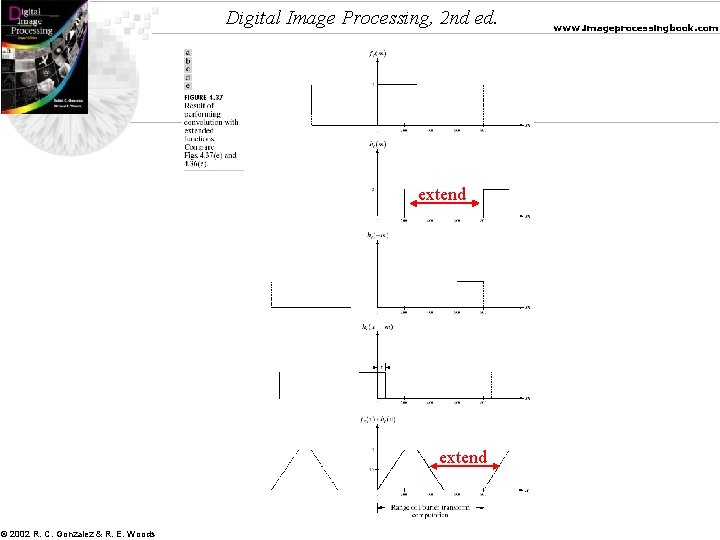
Digital Image Processing, 2 nd ed. extend © 2002 R. C. Gonzalez & R. E. Woods www. imageprocessingbook. com
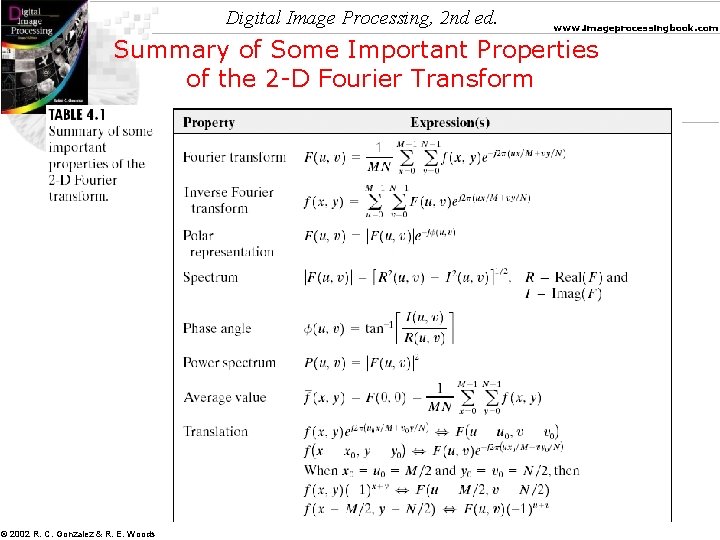
Digital Image Processing, 2 nd ed. www. imageprocessingbook. com Summary of Some Important Properties of the 2 -D Fourier Transform © 2002 R. C. Gonzalez & R. E. Woods
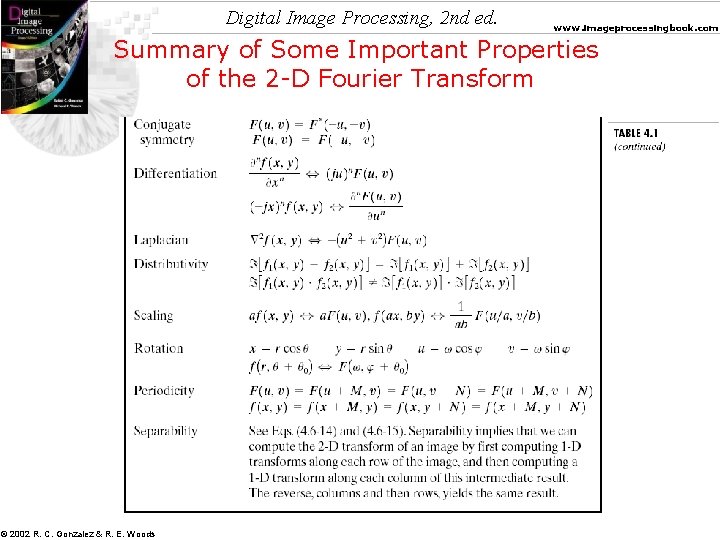
Digital Image Processing, 2 nd ed. www. imageprocessingbook. com Summary of Some Important Properties of the 2 -D Fourier Transform © 2002 R. C. Gonzalez & R. E. Woods

Digital Image Processing, 2 nd ed. www. imageprocessingbook. com Summary of Some Important Properties of the 2 -D Fourier Transform © 2002 R. C. Gonzalez & R. E. Woods
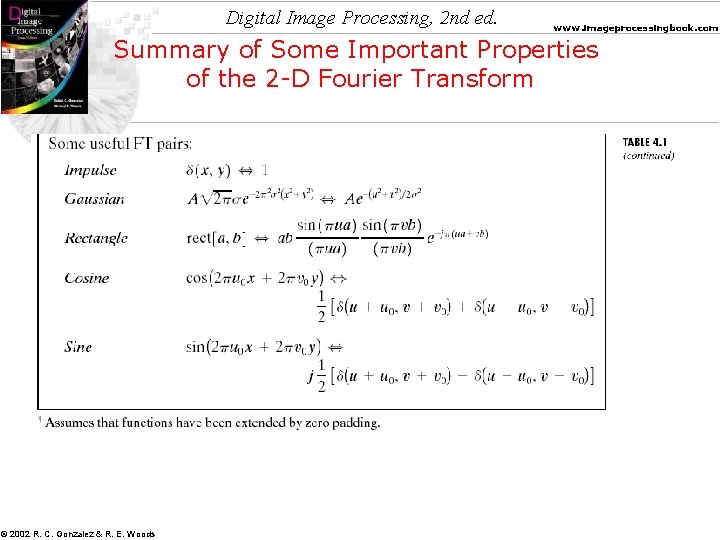
Digital Image Processing, 2 nd ed. www. imageprocessingbook. com Summary of Some Important Properties of the 2 -D Fourier Transform © 2002 R. C. Gonzalez & R. E. Woods
- Slides: 61