
DIGITAL IMAGE COMPRESSION USING THE HAARWAVELET TRANSFORM Anterpreet
- Slides: 1
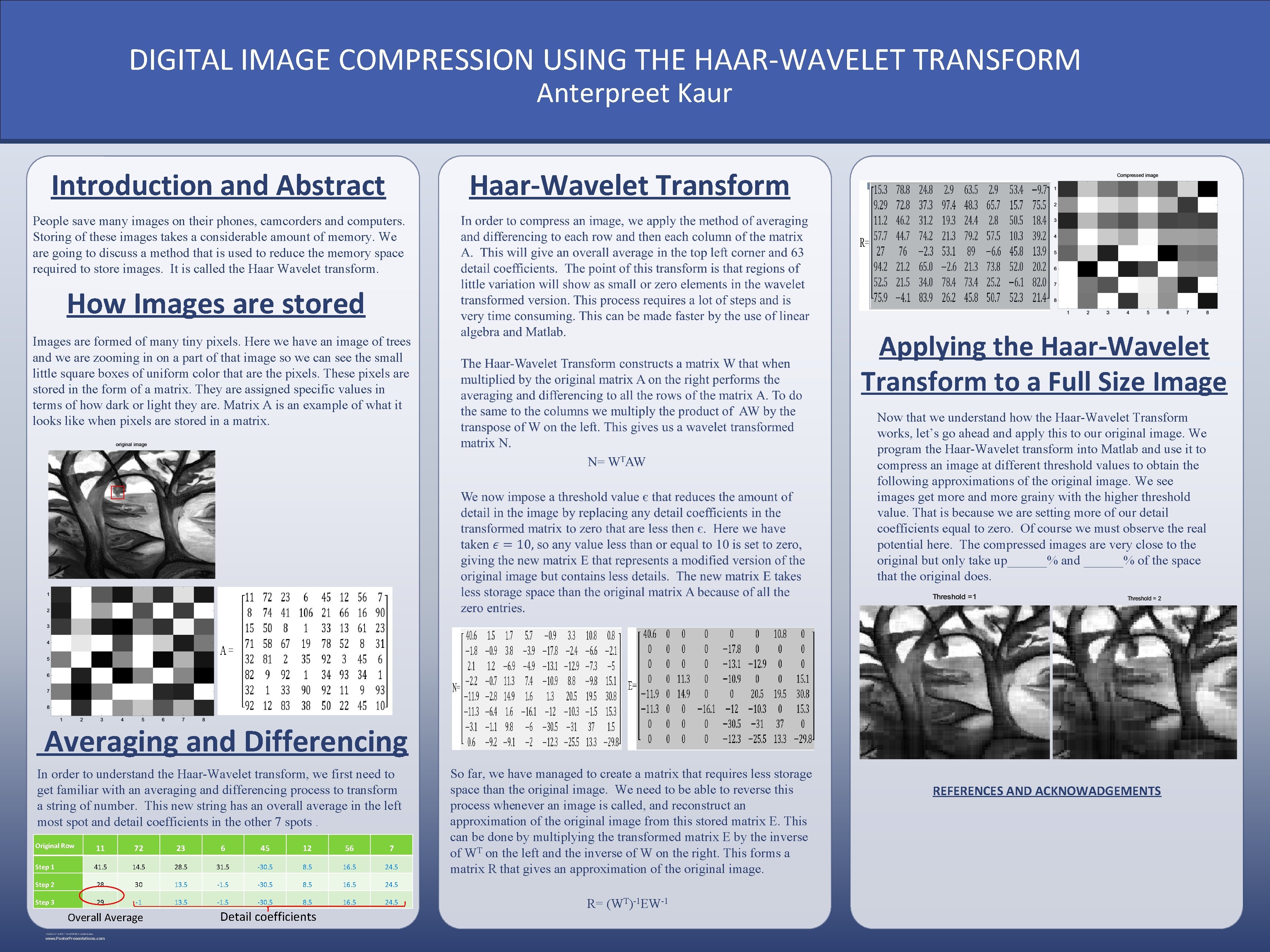
DIGITAL IMAGE COMPRESSION USING THE HAAR-WAVELET TRANSFORM Anterpreet Kaur Haar-Wavelet Transform Introduction and Abstract People save many images on their phones, camcorders and computers. Storing of these images takes a considerable amount of memory. We are going to discuss a method that is used to reduce the memory space required to store images. It is called the Haar Wavelet transform. How Images are stored Applying the Haar-Wavelet Transform to a Full Size Images are formed of many tiny pixels. Here we have an image of trees and we are zooming in on a part of that image so we can see the small little square boxes of uniform color that are the pixels. These pixels are stored in the form of a matrix. They are assigned specific values in terms of how dark or light they are. Matrix A is an example of what it looks like when pixels are stored in a matrix. Now that we understand how the Haar-Wavelet Transform works, let’s go ahead and apply this to our original image. We program the Haar-Wavelet transform into Matlab and use it to compress an image at different threshold values to obtain the following approximations of the original image. We see images get more and more grainy with the higher threshold value. That is because we are setting more of our detail coefficients equal to zero. Of course we must observe the real potential here. The compressed images are very close to the original but only take up______% and ______% of the space that the original does. Averaging and Differencing In order to understand the Haar-Wavelet transform, we first need to get familiar with an averaging and differencing process to transform a string of number. This new string has an overall average in the left most spot and detail coefficients in the other 7 spots. Original Row 11 72 23 6 45 12 56 7 Step 1 41. 5 14. 5 28. 5 31. 5 -30. 5 8. 5 16. 5 24. 5 Step 2 28 30 13. 5 -1. 5 -30. 5 8. 5 16. 5 24. 5 Step 3 29 -1 13. 5 -1. 5 -30. 5 8. 5 16. 5 24. 5 Overall Average RESEARCH POSTER PRESENTATION DESIGN © 2012 www. Poster. Presentations. com Detail coefficients So far, we have managed to create a matrix that requires less storage space than the original image. We need to be able to reverse this process whenever an image is called, and reconstruct an approximation of the original image from this stored matrix E. This can be done by multiplying the transformed matrix E by the inverse of WT on the left and the inverse of W on the right. This forms a matrix R that gives an approximation of the original image. R= (WT)-1 EW-1 REFERENCES AND ACKNOWADGEMENTS