
Digital Image Compositing Compositing for volume rendering The

- Slides: 20
Digital Image Compositing
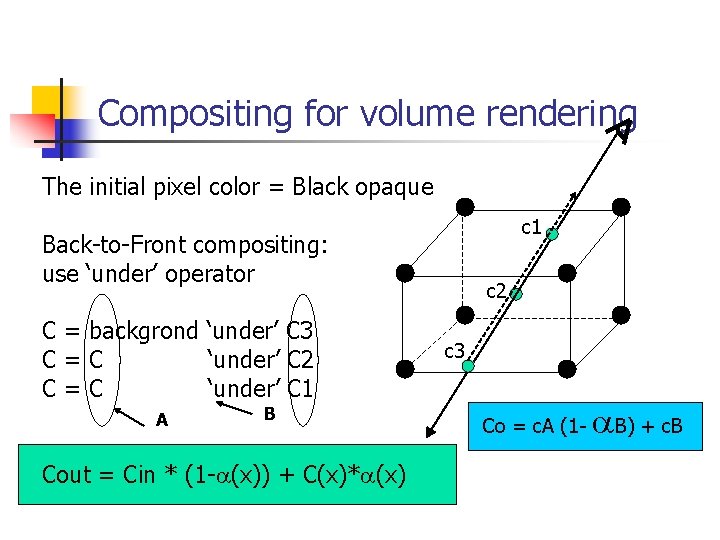
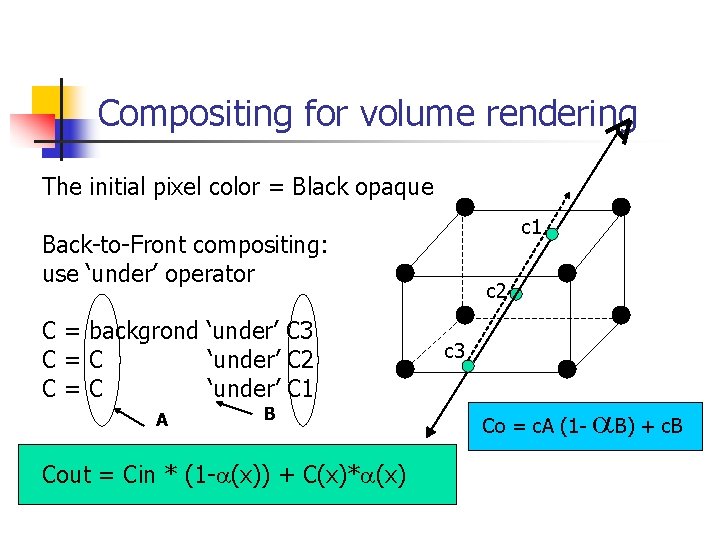
Compositing for volume rendering The initial pixel color = Black opaque c 1 Back-to-Front compositing: use ‘under’ operator C = backgrond ‘under’ C 3 C=C ‘under’ C 2 C=C ‘under’ C 1 A B Cout = Cin * (1 -a(x)) + C(x)*a(x) c 2 c 3 Co = c. A (1 - a. B) + c. B
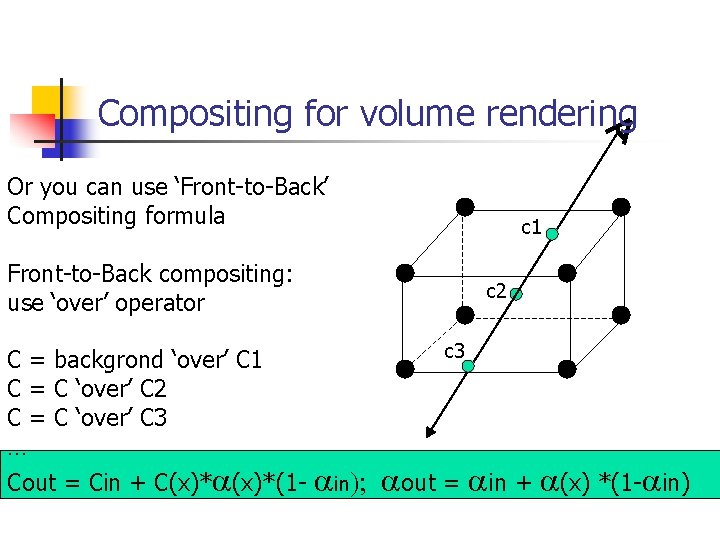
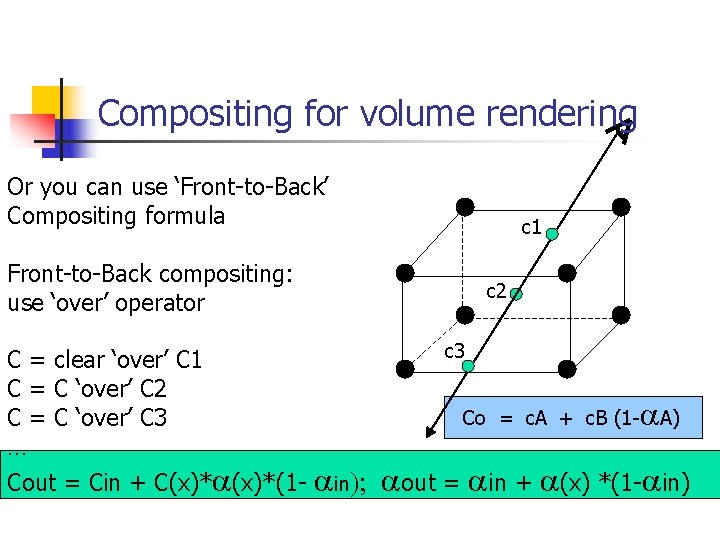
Compositing for volume rendering Or you can use ‘Front-to-Back’ Compositing formula c 1 Front-to-Back compositing: use ‘over’ operator C = backgrond ‘over’ C 1 C = C ‘over’ C 2 C = C ‘over’ C 3 … Cout = Cin + C(x)*a(x)*(1 - c 2 c 3 ain); aout = ain + a(x) *(1 -ain)
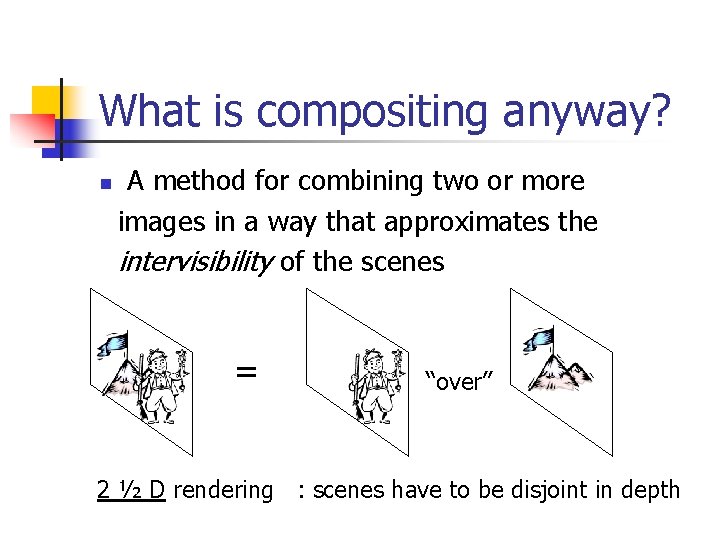
What is compositing anyway? n A method for combining two or more images in a way that approximates the intervisibility of the scenes = “over” 2 ½ D rendering : scenes have to be disjoint in depth
Why compositing? Special effects (shake hands with important people…) n Share the load of rendering n Render translucent objects (translucent polygons, volume rendering, etc) n
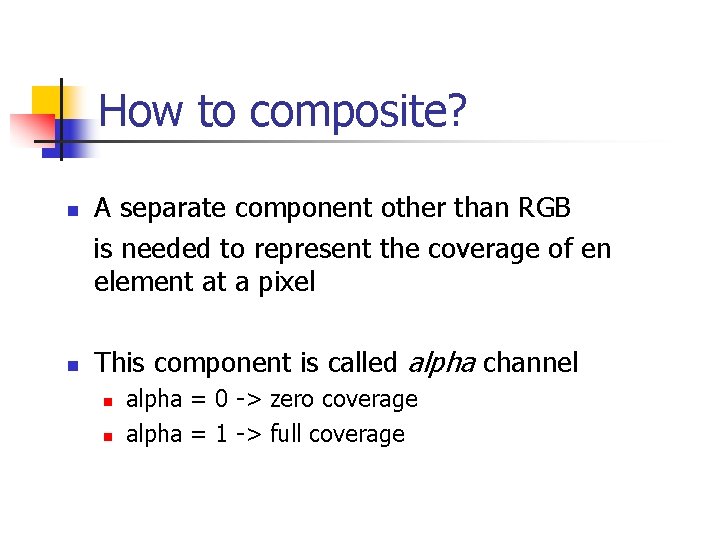
How to composite? n n A separate component other than RGB is needed to represent the coverage of en element at a pixel This component is called alpha channel n n alpha = 0 -> zero coverage alpha = 1 -> full coverage
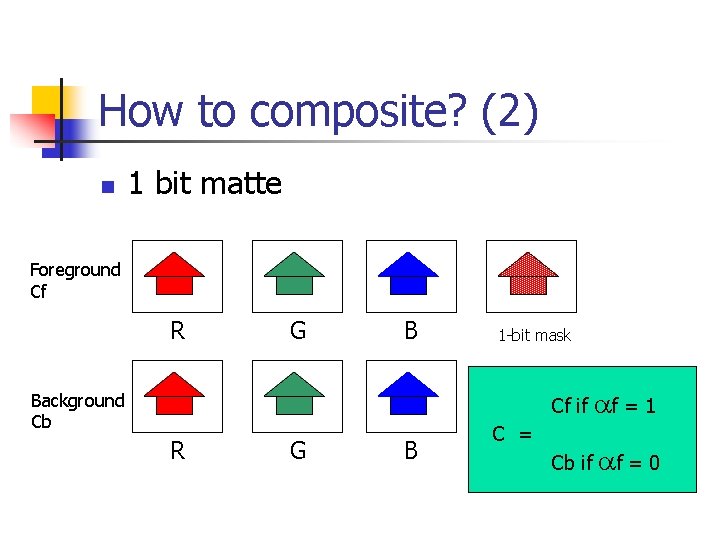
How to composite? (2) n 1 bit matte Foreground Cf R G B Background Cb R G B 1 -bit mask Cf if af = 1 Cb if af = 0 C =
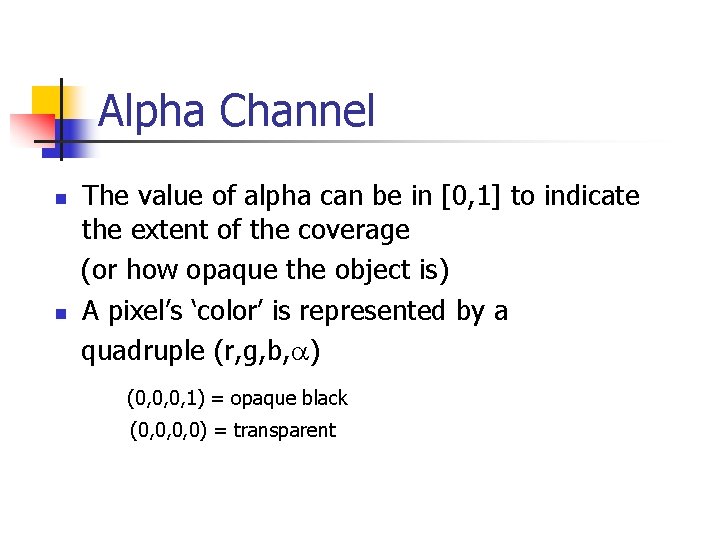
Alpha Channel n n The value of alpha can be in [0, 1] to indicate the extent of the coverage (or how opaque the object is) A pixel’s ‘color’ is represented by a quadruple (r, g, b, a) (0, 0, 0, 1) = opaque black (0, 0, 0, 0) = transparent
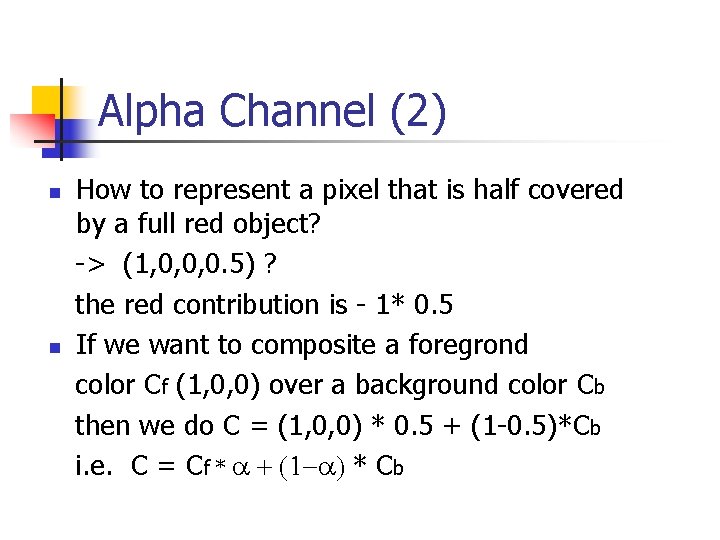
Alpha Channel (2) n n How to represent a pixel that is half covered by a full red object? -> (1, 0, 0, 0. 5) ? the red contribution is - 1* 0. 5 If we want to composite a foregrond color Cf (1, 0, 0) over a background color Cb then we do C = (1, 0, 0) * 0. 5 + (1 -0. 5)*Cb i. e. C = Cf * a + (1 -a) * Cb
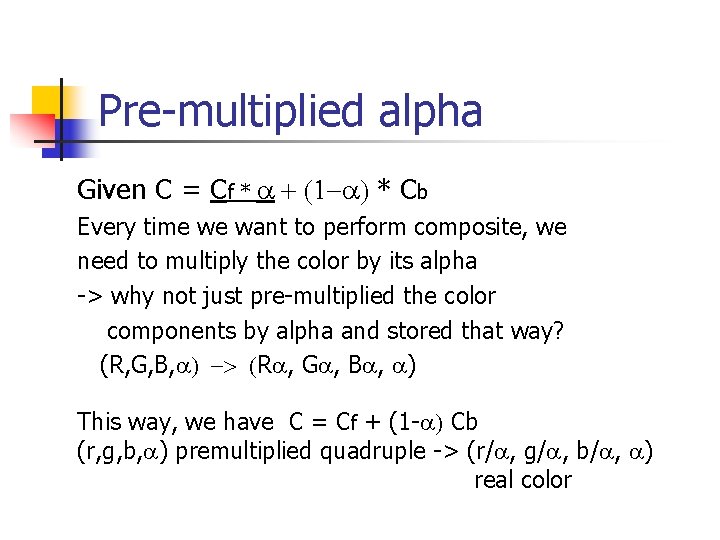
Pre-multiplied alpha Given C = Cf * a + (1 -a) * Cb Every time we want to perform composite, we need to multiply the color by its alpha -> why not just pre-multiplied the color components by alpha and stored that way? (R, G, B, a) -> (Ra, Ga, Ba, a) This way, we have C = Cf + (1 -a) Cb (r, g, b, a) premultiplied quadruple -> (r/a, g/a, b/a, a) real color
Compositing Algebra n n n Foreground over background is only one of the compositing (the simplest) methods. What are the formula for all possible kind of compositing (A over B, A under B, A in B…)? The issues is to understand formulate the interplay between the alpha values of two input picture
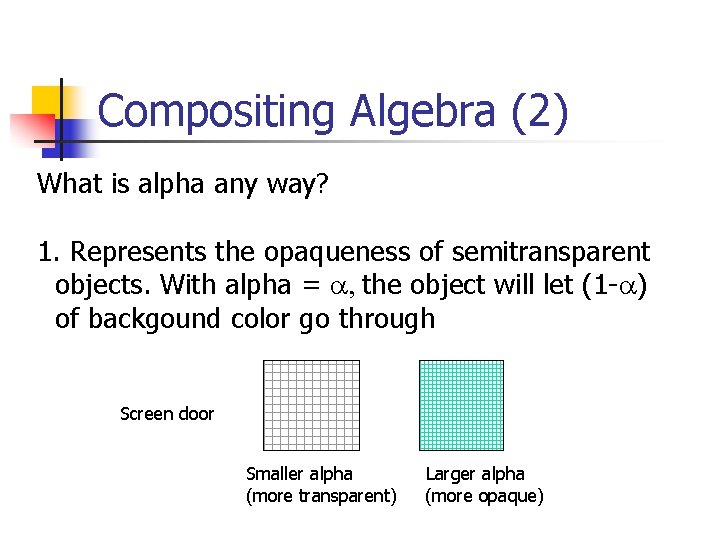
Compositing Algebra (2) What is alpha any way? 1. Represents the opaqueness of semitransparent objects. With alpha = a, the object will let (1 -a) of backgound color go through Screen door Smaller alpha (more transparent) Larger alpha (more opaque)
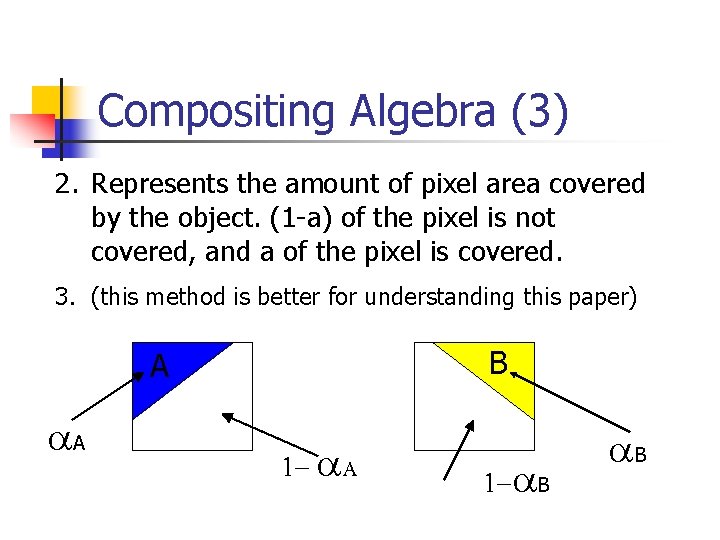
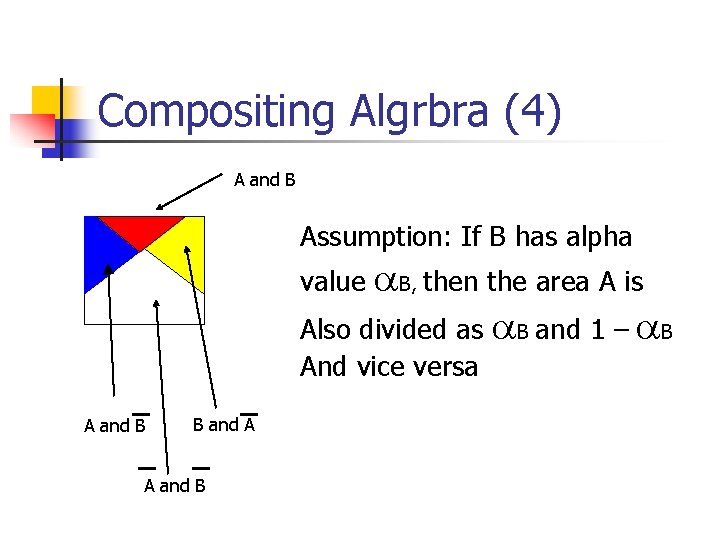
Compositing Algebra (3) 2. Represents the amount of pixel area covered by the object. (1 -a) of the pixel is not covered, and a of the pixel is covered. 3. (this method is better for understanding this paper) B A a. A 1 -a. B
Compositing Algrbra (4) A and B Assumption: If B has alpha a. B, then the area A is Also divided as a. B and 1 – a. B value And vice versa A and B B and A A and B
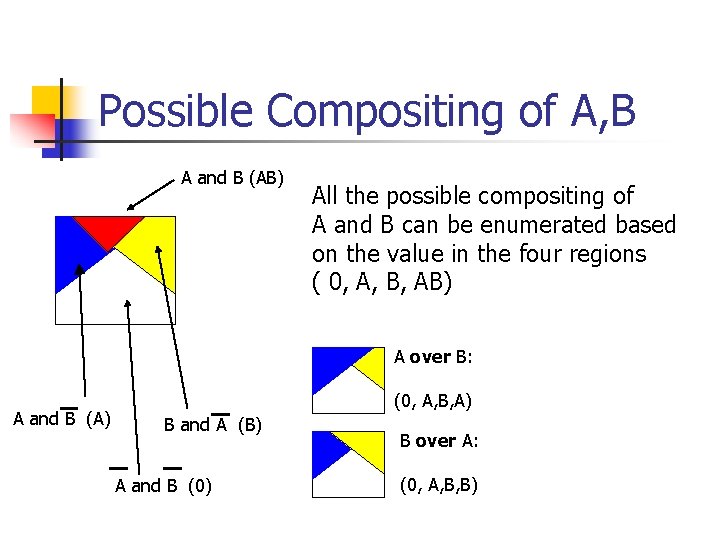
Possible Compositing of A, B A and B (AB) All the possible compositing of A and B can be enumerated based on the value in the four regions ( 0, A, B, AB) A over B: A and B (A) (0, A, B, A) B and A (B) A and B (0) B over A: (0, A, B, B)
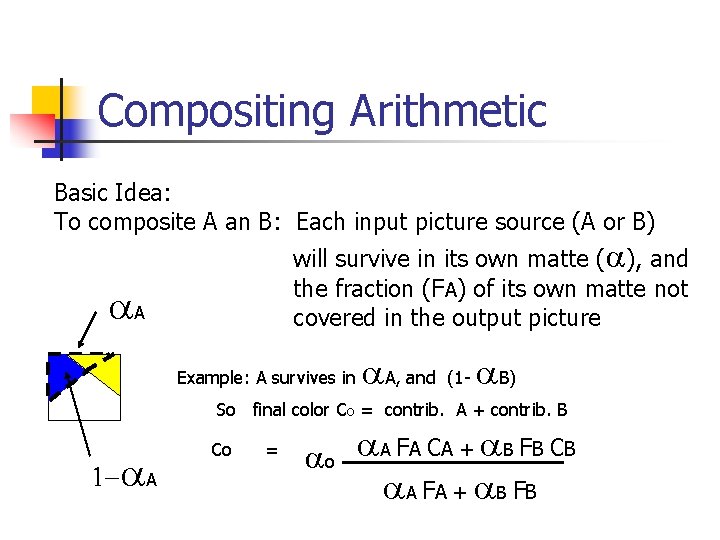
Compositing Arithmetic Basic Idea: To composite A an B: Each input picture source (A or B) will survive in its own matte ( a), and the fraction (FA) of its own matte not covered in the output picture a. A Example: A survives in So final color 1 -a. A co = a. A, and co = (1 - a. B) contrib. A + contrib. B a o a A FA CA + a B FB CB a A FA + a B FB
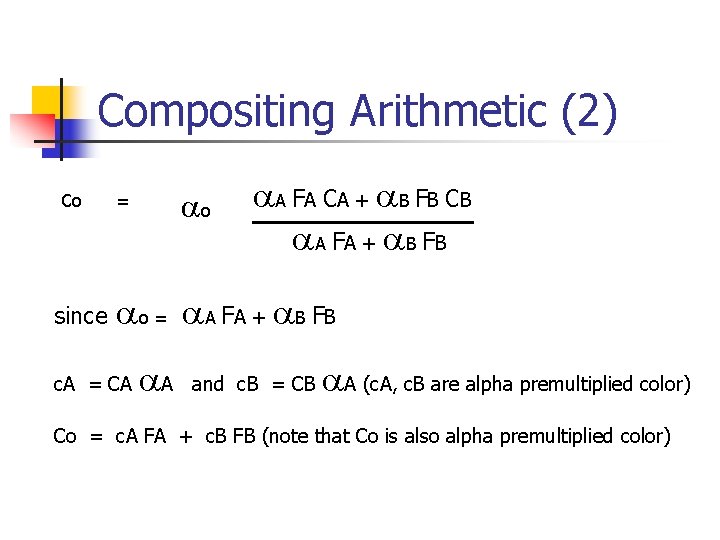
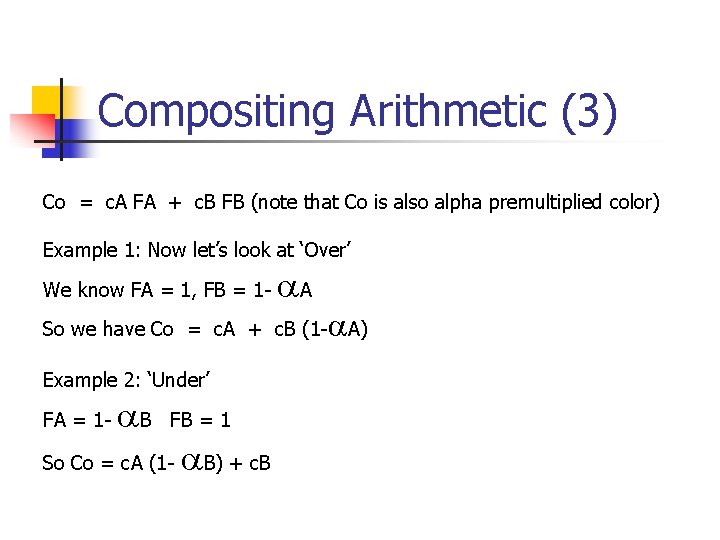
Compositing Arithmetic (2) co since ao = a A FA CA + a B FB CB a A FA + a B FB a o = a A FA + a B FB c. A = CA a. A and c. B = CB a. A (c. A, c. B are alpha premultiplied color) Co = c. A FA + c. B FB (note that Co is also alpha premultiplied color)
Compositing Arithmetic (3) Co = c. A FA + c. B FB (note that Co is also alpha premultiplied color) Example 1: Now let’s look at ‘Over’ We know FA = 1, FB = 1 - a. A So we have Co = c. A + c. B (1 Example 2: ‘Under’ FA = 1 - a. B FB = 1 So Co = c. A (1 - a. B) + c. B a. A)
Compositing for volume rendering Or you can use ‘Front-to-Back’ Compositing formula c 1 Front-to-Back compositing: use ‘over’ operator C = clear ‘over’ C 1 C = C ‘over’ C 2 C = C ‘over’ C 3 … Cout = Cin + C(x)*a(x)*(1 - c 2 c 3 Co = c. A + c. B (1 - a. A) ain); aout = ain + a(x) *(1 -ain)
Compositing for volume rendering The initial pixel color = Black opaque c 1 Back-to-Front compositing: use ‘under’ operator C = backgrond ‘under’ C 3 C=C ‘under’ C 2 C=C ‘under’ C 1 A B Cout = Cin * (1 -a(x)) + C(x)*a(x) c 2 c 3 Co = c. A (1 - a. B) + c. B