
Digital Electronics Principles Applications Fifth Edition Roger L

- Slides: 22
Digital Electronics Principles & Applications Fifth Edition Roger L. Tokheim Chapter 1 Digital Electronics © 1999 Glencoe/Mc. Graw-Hill
CHAPTER 1 PREVIEW • Analog vs. Digital • Why digital or analog? • Generating a digital signal • Multivibrators • Defining logic levels • Testing for digital signals • Using a logic probe • Mounting ICs
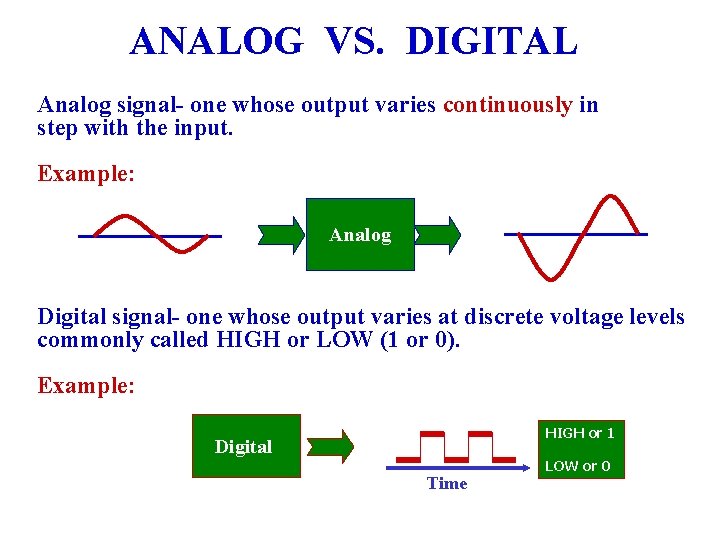
ANALOG VS. DIGITAL Analog signal- one whose output varies continuously in step with the input. Example: Analog Digital signal- one whose output varies at discrete voltage levels commonly called HIGH or LOW (1 or 0). Example: HIGH or 1 Digital Time LOW or 0
WHY DIGITAL? • Data can be stored (memory characteristic of digital). • Data can be used in calculations. • Compatible with display technologies. • Compatible with computer technologies. • Systems can be programmed. • Digital IC families make design easier.
WHY ANALOG? • Most “real-world” events are analog in nature. • Analog processing is usually simpler. • Analog processing is usually faster. • Traditional electronic systems were mostly analog in nature.
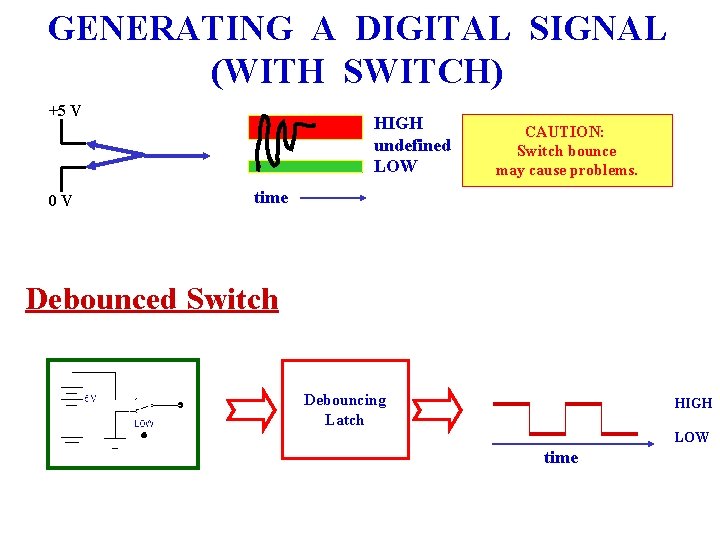
GENERATING A DIGITAL SIGNAL (WITH SWITCH) +5 V 0 V HIGH undefined LOW CAUTION: Note: signal goes H, L, H, Switch bounce UNDEFINED, and finally HIGH. may cause problems. time Debounced Switch Debouncing Latch HIGH LOW time
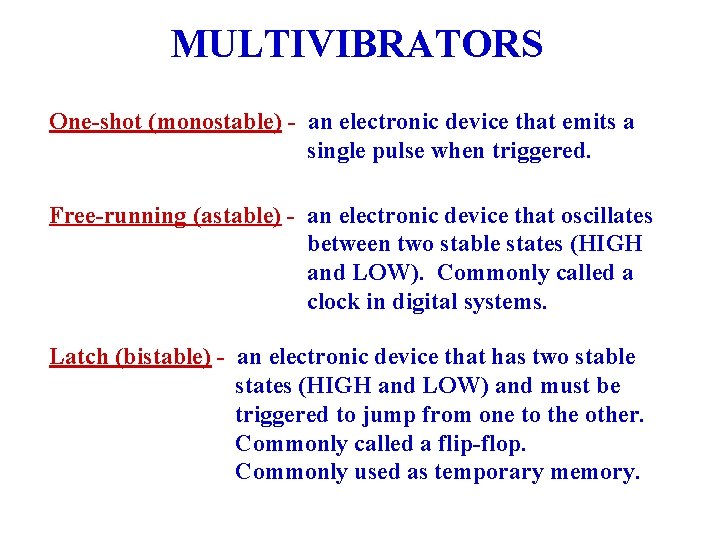
MULTIVIBRATORS One-shot (monostable) - an electronic device that emits a single pulse when triggered. Free-running (astable) - an electronic device that oscillates between two stable states (HIGH and LOW). Commonly called a clock in digital systems. Latch (bistable) - an electronic device that has two stable states (HIGH and LOW) and must be triggered to jump from one to the other. Commonly called a flip-flop. Commonly used as temporary memory.
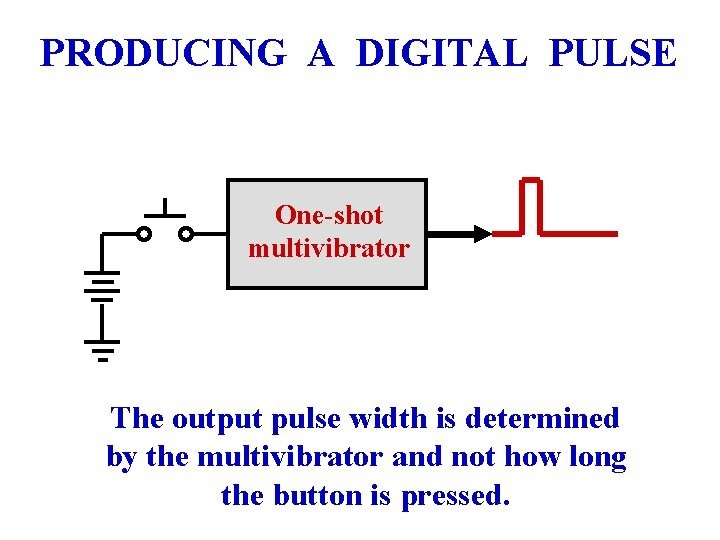
PRODUCING A DIGITAL PULSE One-shot multivibrator The output pulse width is determined by the multivibrator and not how long the button is pressed.
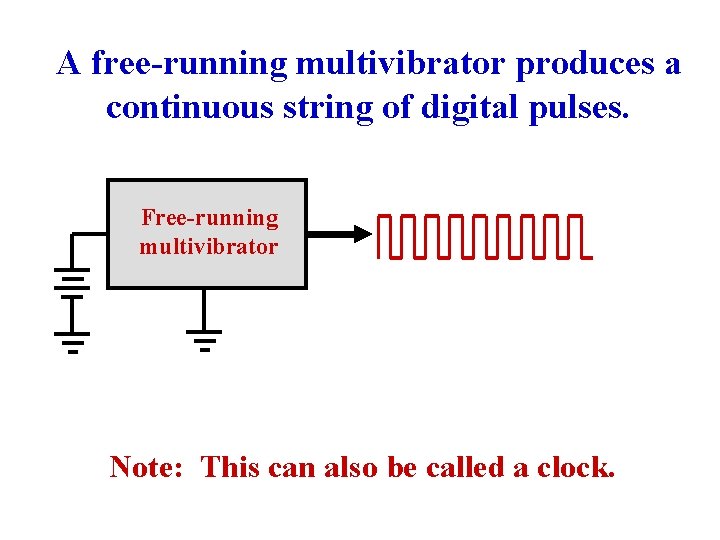
A free-running multivibrator produces a continuous string of digital pulses. Free-running multivibrator Note: This can also be called a clock.
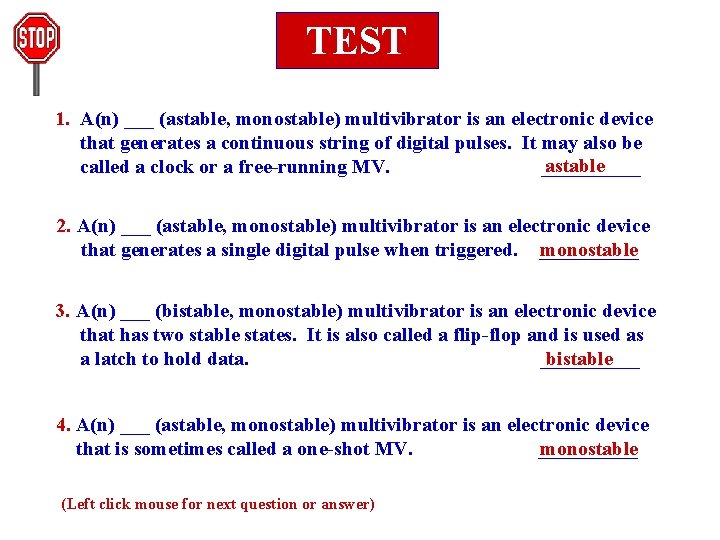
TEST 1. A(n) ___ (astable, monostable) multivibrator is an electronic device that generates a continuous string of digital pulses. It may also be astable called a clock or a free-running MV. _____ 2. A(n) ___ (astable, monostable) multivibrator is an electronic device that generates a single digital pulse when triggered. _____ monostable 3. A(n) ___ (bistable, monostable) multivibrator is an electronic device that has two stable states. It is also called a flip-flop and is used as a latch to hold data. _____ bistable 4. A(n) ___ (astable, monostable) multivibrator is an electronic device that is sometimes called a one-shot MV. _____ monostable (Left click mouse for next question or answer)
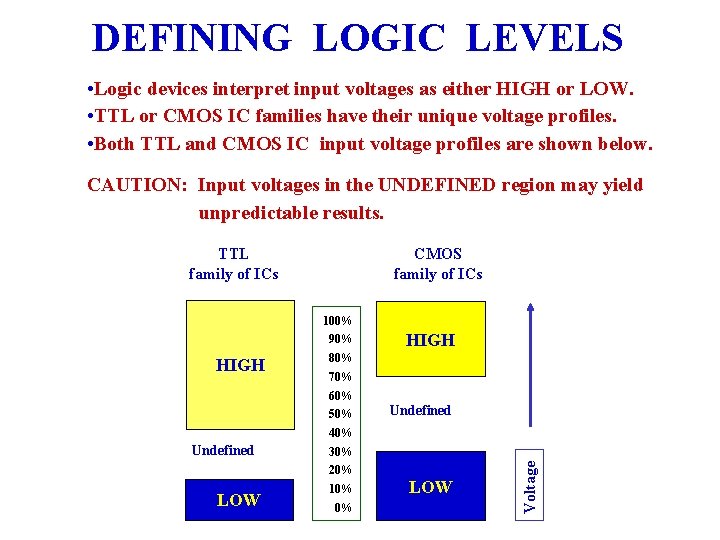
DEFINING LOGIC LEVELS • Logic devices interpret input voltages as either HIGH or LOW. • TTL or CMOS IC families have their unique voltage profiles. • Both TTL and CMOS IC input voltage profiles are shown below. CAUTION: Input voltages in the UNDEFINED region may yield unpredictable results. TTL family of ICs CMOS family of ICs 100% 90% HIGH 80% 70% 60% 50% Undefined 40% 30% 20% LOW 10% 0% LOW Voltage Undefined
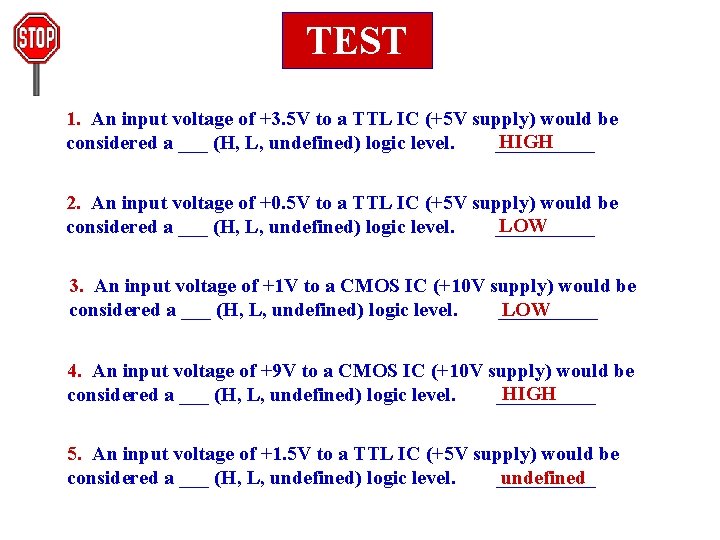
TEST 1. An input voltage of +3. 5 V to a TTL IC (+5 V supply) would be HIGH considered a ___ (H, L, undefined) logic level. _____ 2. An input voltage of +0. 5 V to a TTL IC (+5 V supply) would be LOW considered a ___ (H, L, undefined) logic level. _____ 3. An input voltage of +1 V to a CMOS IC (+10 V supply) would be considered a ___ (H, L, undefined) logic level. _____ LOW 4. An input voltage of +9 V to a CMOS IC (+10 V supply) would be HIGH considered a ___ (H, L, undefined) logic level. _____ 5. An input voltage of +1. 5 V to a TTL IC (+5 V supply) would be considered a ___ (H, L, undefined) logic level. _____ undefined
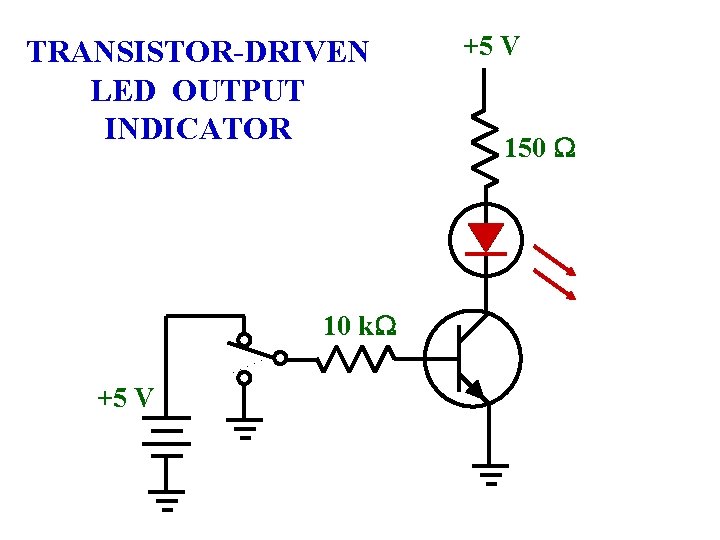
TESTING FOR A DIGITAL SIGNAL • LED output indicators • Logic probe • DMM or VOM • Oscilloscope • Logic Analyzer
TRANSISTOR-DRIVEN LED OUTPUT INDICATOR 10 k. W +5 V 150 W
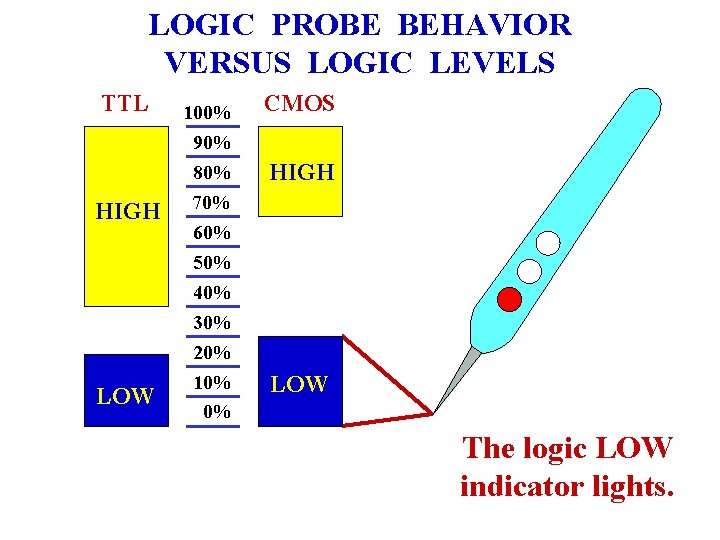
LOGIC PROBE BEHAVIOR VERSUS LOGIC LEVELS TTL 100% HIGH 90% 80% 70% 60% 50% LOW 40% 30% 20% 10% 0% CMOS HIGH LOW The logic LOW indicator lights.
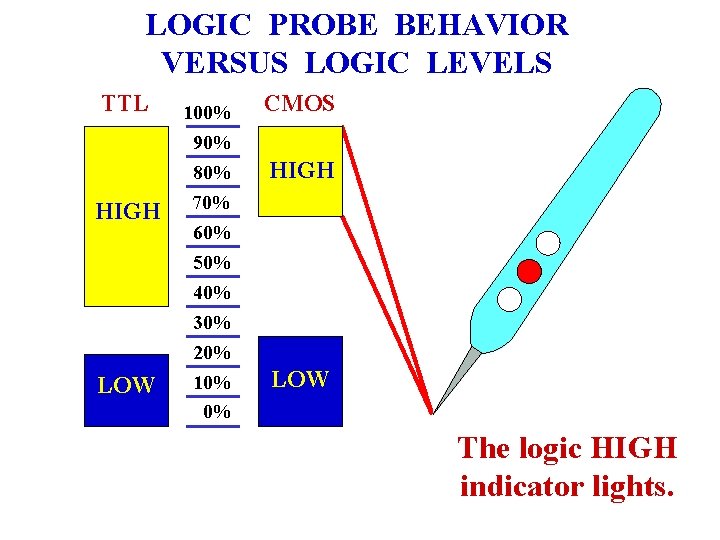
LOGIC PROBE BEHAVIOR VERSUS LOGIC LEVELS TTL 100% HIGH 90% 80% 70% 60% 50% LOW 40% 30% 20% 10% 0% CMOS HIGH LOW The logic HIGH indicator lights.
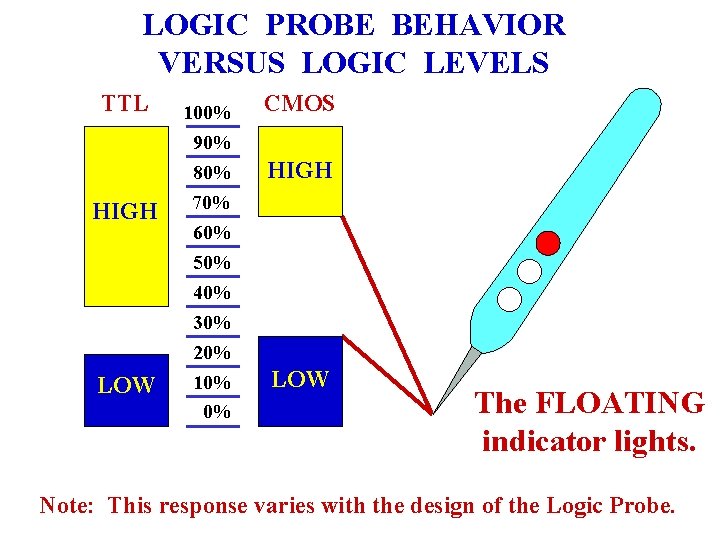
LOGIC PROBE BEHAVIOR VERSUS LOGIC LEVELS TTL 100% HIGH 90% 80% 70% 60% 50% LOW 40% 30% 20% 10% 0% CMOS HIGH LOW The FLOATING indicator lights. Note: This response varies with the design of the Logic Probe.
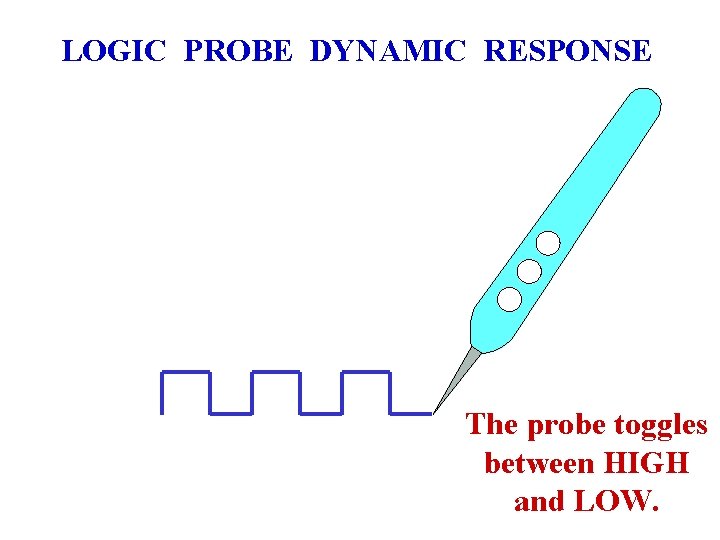
LOGIC PROBE DYNAMIC RESPONSE The probe toggles between HIGH and LOW.
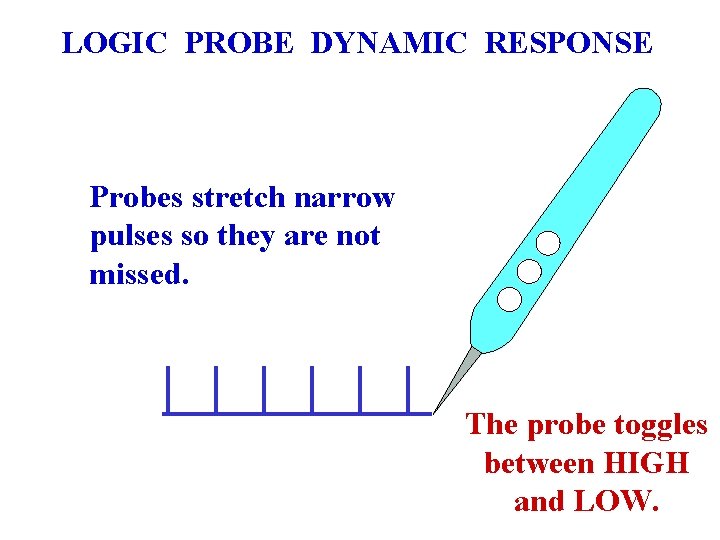
LOGIC PROBE DYNAMIC RESPONSE Probes stretch narrow pulses so they are not missed. The probe toggles between HIGH and LOW.
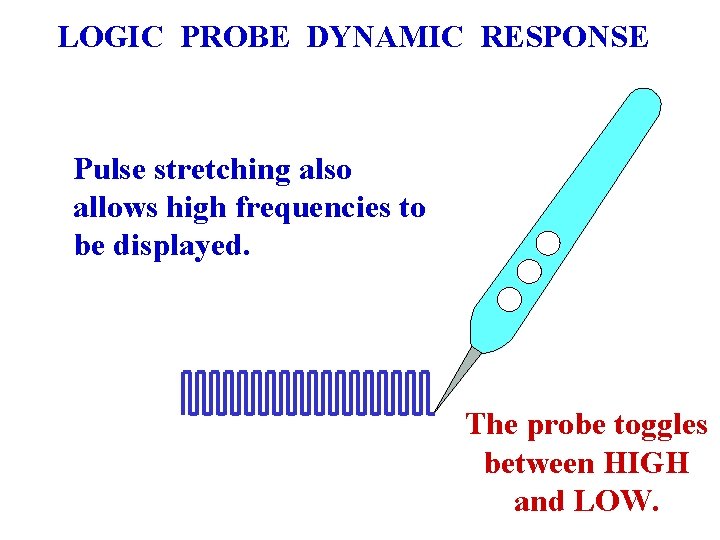
LOGIC PROBE DYNAMIC RESPONSE Pulse stretching also allows high frequencies to be displayed. The probe toggles between HIGH and LOW.
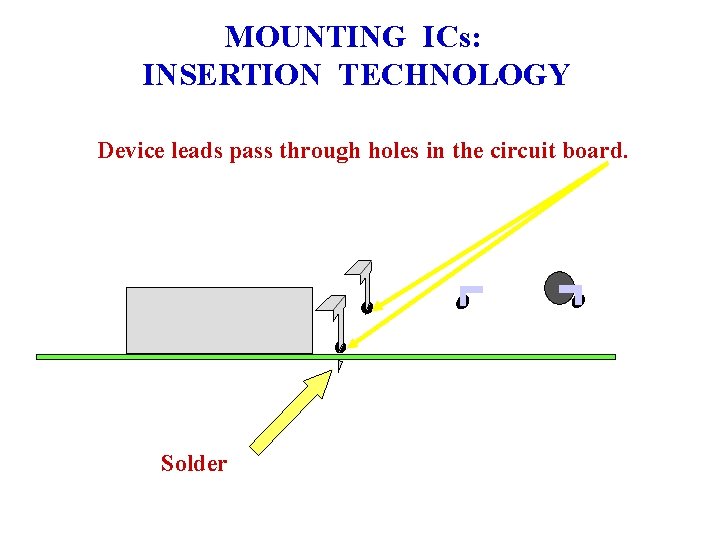
MOUNTING ICs: INSERTION TECHNOLOGY Device leads pass through holes in the circuit board. Solder
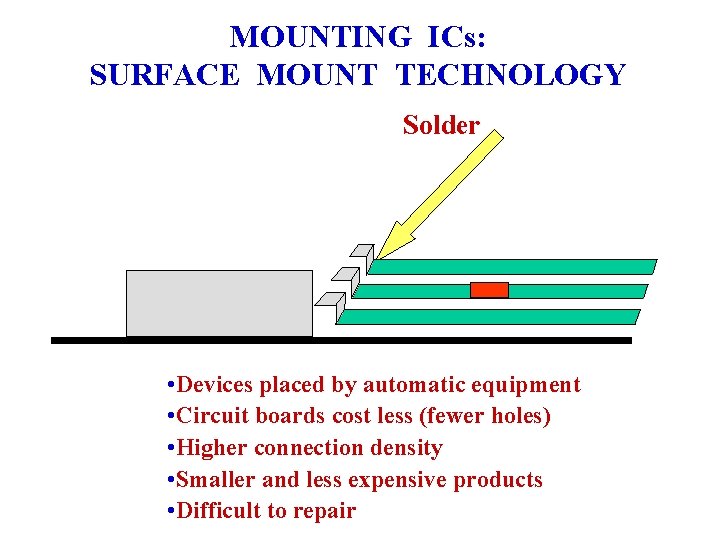
MOUNTING ICs: SURFACE MOUNT TECHNOLOGY Solder • Devices placed by automatic equipment • Circuit boards cost less (fewer holes) • Higher connection density • Smaller and less expensive products • Difficult to repair