
Digital Electronics Principles Applications Fifth Edition Roger L
- Slides: 12
Digital Electronics Principles & Applications Fifth Edition Roger L. Tokheim Chapter 13 Connecting with Analog Devices © 1999 Glencoe/Mc. Graw-Hill
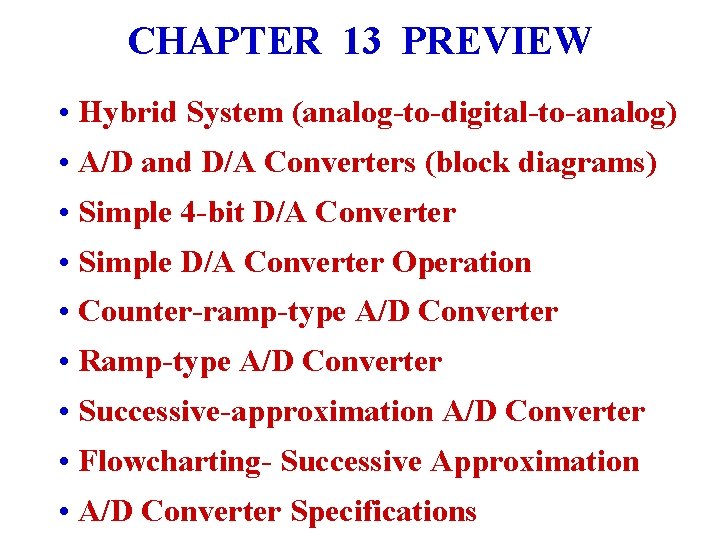
CHAPTER 13 PREVIEW • Hybrid System (analog-to-digital-to-analog) • A/D and D/A Converters (block diagrams) • Simple 4 -bit D/A Converter • Simple D/A Converter Operation • Counter-ramp-type A/D Converter • Ramp-type A/D Converter • Successive-approximation A/D Converter • Flowcharting- Successive Approximation • A/D Converter Specifications
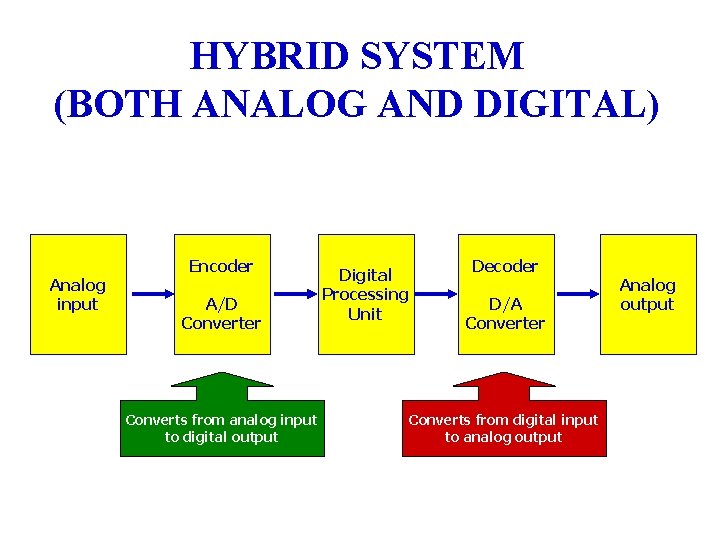
HYBRID SYSTEM (BOTH ANALOG AND DIGITAL) Analog input Encoder A/D Converter Converts from analog input to digital output Digital Processing Unit Decoder D/A Converter Converts from digital input to analog output Analog output
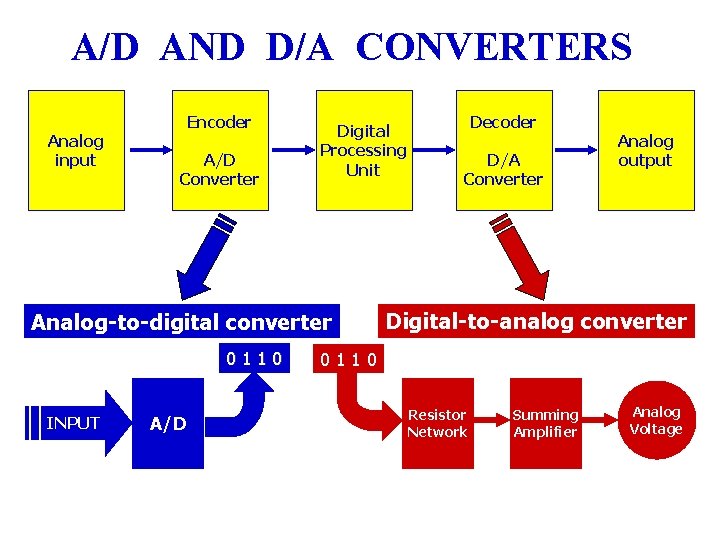
A/D AND D/A CONVERTERS Analog input Encoder A/D Converter Digital Processing Unit Analog-to-digital converter 0110 INPUT A/D Decoder D/A Converter Analog output Digital-to-analog converter 0110 Resistor Network Summing Amplifier Analog Voltage
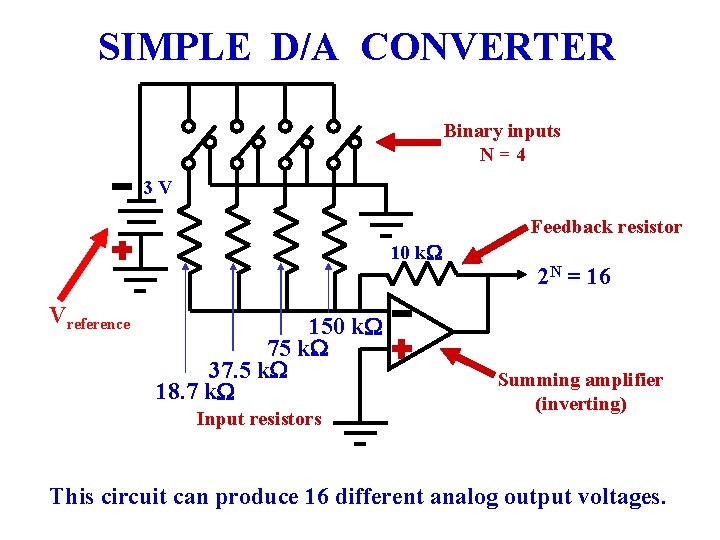
SIMPLE D/A CONVERTER Binary inputs N=4 3 V Feedback resistor 10 k Vreference 150 k 75 k 37. 5 k 18. 7 k Input resistors 2 N = 16 Summing amplifier (inverting) This circuit can produce 16 different analog output voltages.
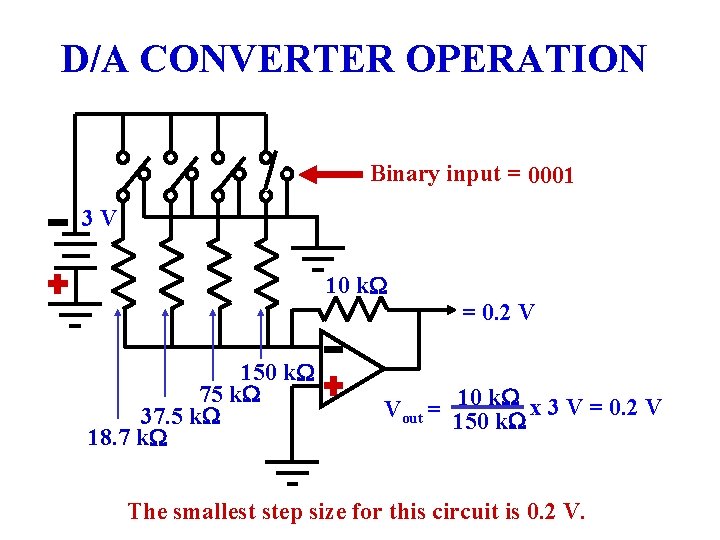
D/A CONVERTER OPERATION Binary input = 0000 0001 3 V 10 k = 0. 2 0 VV 150 k 75 k 37. 5 k 18. 7 k 10 k x 3 V = 0. 2 V Vout = 150 k The smallest step size for this circuit is 0. 2 V.
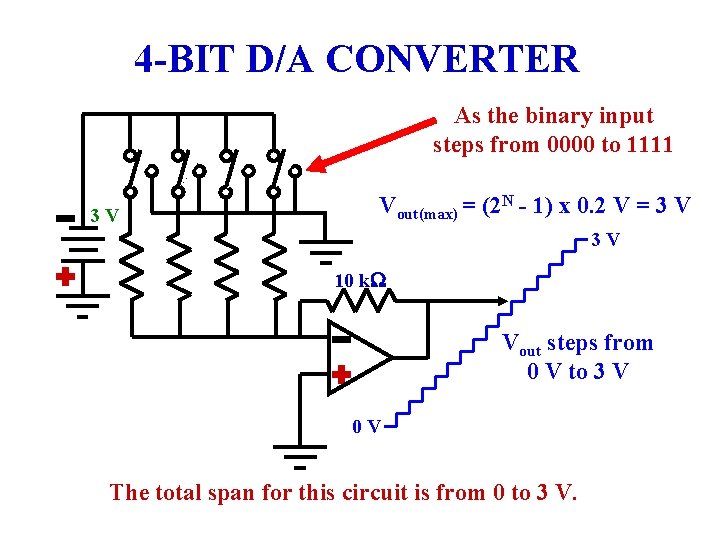
4 -BIT D/A CONVERTER As the binary input steps from 0000 to 1111 3 V Vout(max) = (2 N - 1) x 0. 2 V = 3 V 3 V 10 k Vout steps from 0 V to 3 V 0 V The total span for this circuit is from 0 to 3 V.
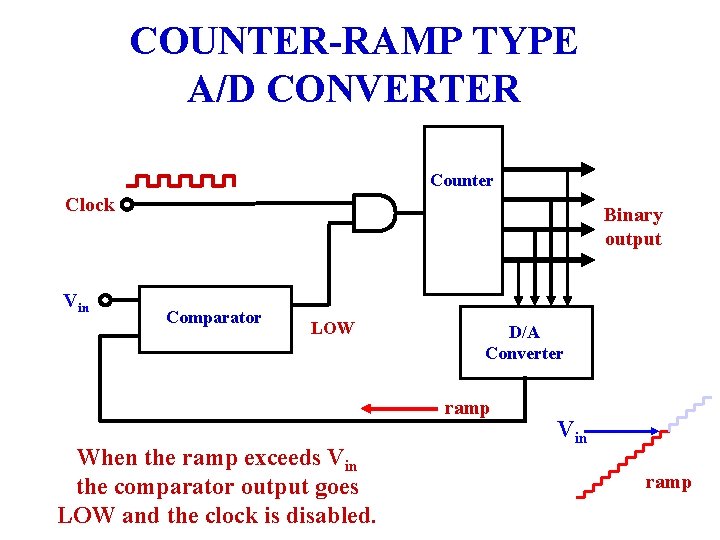
COUNTER-RAMP TYPE A/D CONVERTER Counter Clock Vin Binary output Comparator HIGH LOW D/A Converter ramp When the ramp exceeds Vin the comparator output goes LOW and the clock is disabled. Vin ramp
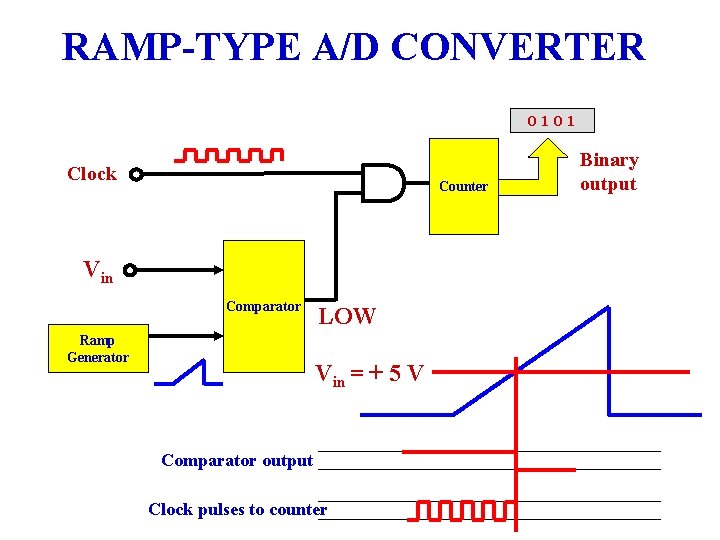
RAMP-TYPE A/D CONVERTER 0101 Clock Counter Vin Comparator Ramp Generator LOW Vin = + 5 V Comparator output Clock pulses to counter Binary output
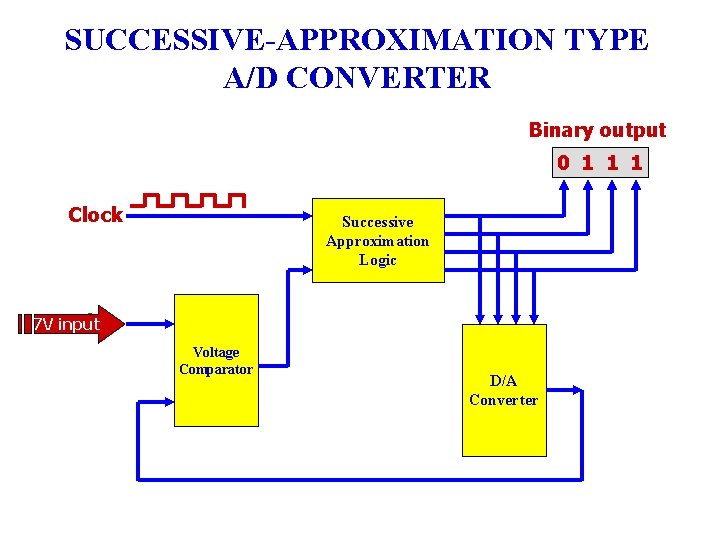
SUCCESSIVE-APPROXIMATION TYPE A/D CONVERTER Binary output 0 1 1 1 Clock Successive Approximation Logic Vin 7 V input Voltage Comparator D/A Converter
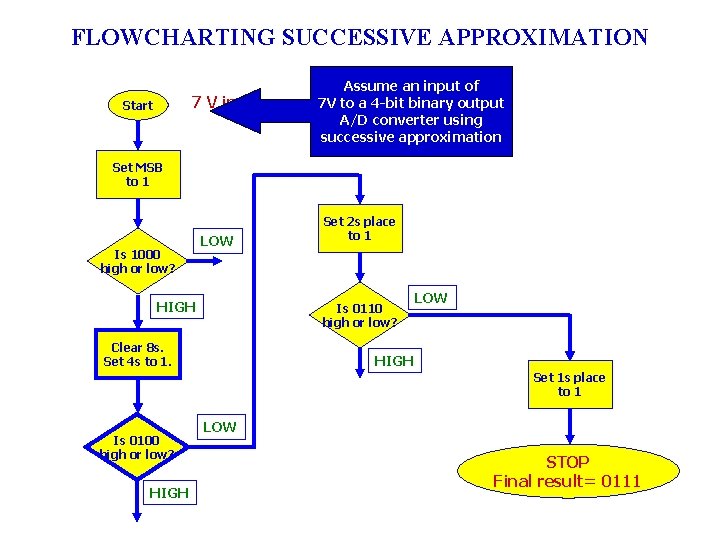
FLOWCHARTING SUCCESSIVE APPROXIMATION 7 V input Start Assume an input of 7 V to a 4 -bit binary output A/D converter using successive approximation Set MSB to 1 Is 1000 high or low? LOW HIGH Set 2 s place to 1 Is 0110 high or low? Clear 8 s. Set 4 s to 1. LOW HIGH Set 1 s place to 1 Is 0100 high or low? HIGH LOW STOP Final result= 0111
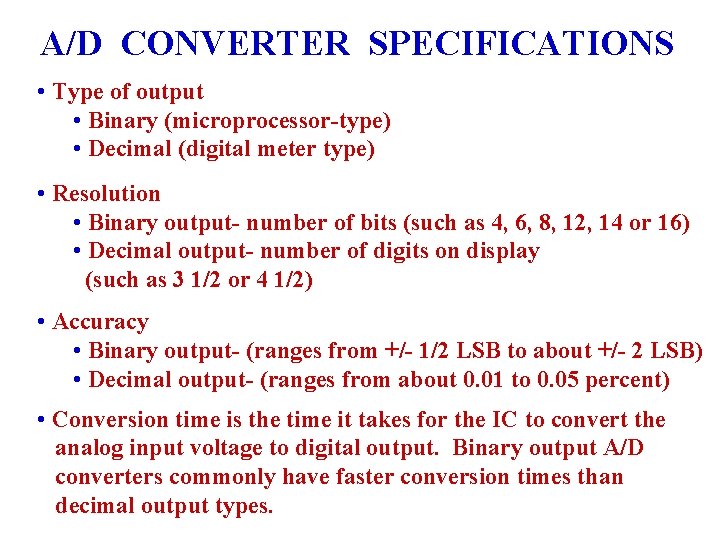
A/D CONVERTER SPECIFICATIONS • Type of output • Binary (microprocessor-type) • Decimal (digital meter type) • Resolution • Binary output- number of bits (such as 4, 6, 8, 12, 14 or 16) • Decimal output- number of digits on display (such as 3 1/2 or 4 1/2) • Accuracy • Binary output- (ranges from +/- 1/2 LSB to about +/- 2 LSB) • Decimal output- (ranges from about 0. 01 to 0. 05 percent) • Conversion time is the time it takes for the IC to convert the analog input voltage to digital output. Binary output A/D converters commonly have faster conversion times than decimal output types.