
Digital Design MODULE I SWITCHING FUNCTION Amit Kumar
- Slides: 29
Digital Design MODULE –I SWITCHING FUNCTION Amit Kumar Assistant Professor SCSE, Galgotias University, Greater Noida
Outline SWITCHING FUNCTION • CANONICAL AND STANDARD FORM • POS AND SOP FORM •
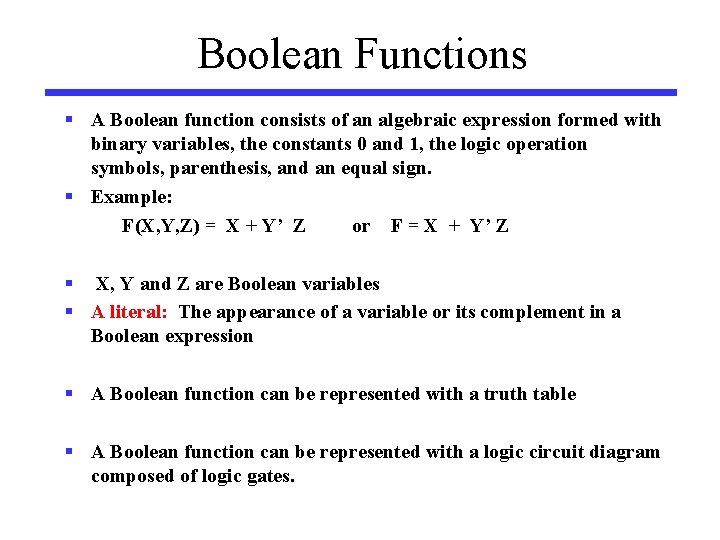
Boolean Functions § A Boolean function consists of an algebraic expression formed with binary variables, the constants 0 and 1, the logic operation symbols, parenthesis, and an equal sign. § Example: F(X, Y, Z) = X + Y’ Z or F = X + Y’ Z § X, Y and Z are Boolean variables § A literal: The appearance of a variable or its complement in a Boolean expression § A Boolean function can be represented with a truth table § A Boolean function can be represented with a logic circuit diagram composed of logic gates.
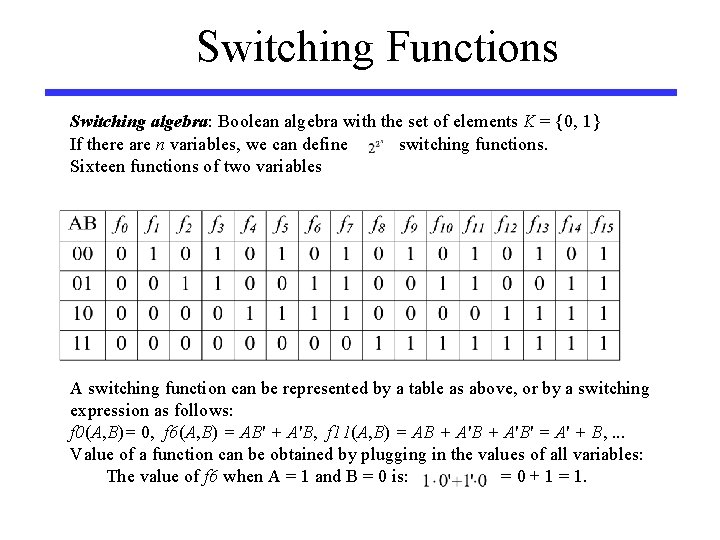
Switching Functions Switching algebra: Boolean algebra with the set of elements K = {0, 1} If there are n variables, we can define switching functions. Sixteen functions of two variables A switching function can be represented by a table as above, or by a switching expression as follows: f 0(A, B)= 0, f 6(A, B) = AB' + A'B, f 11(A, B) = AB + A'B' = A' + B, . . . Value of a function can be obtained by plugging in the values of all variables: The value of f 6 when A = 1 and B = 0 is: = 0 + 1 = 1.
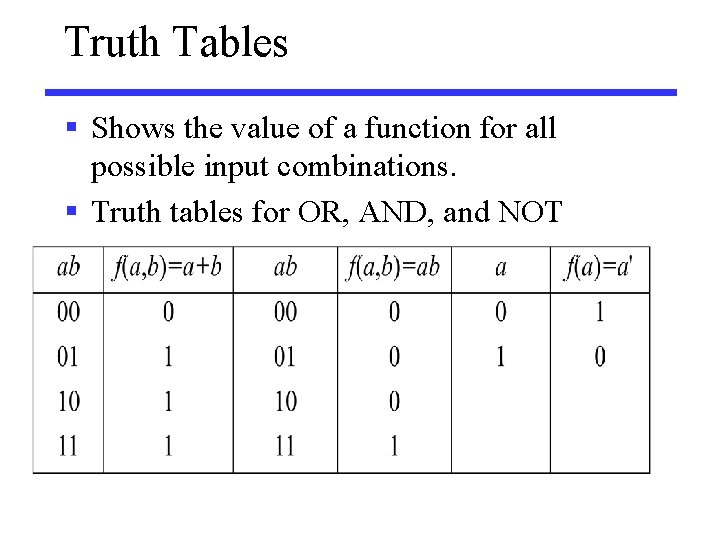
Truth Tables § Shows the value of a function for all possible input combinations. § Truth tables for OR, AND, and NOT
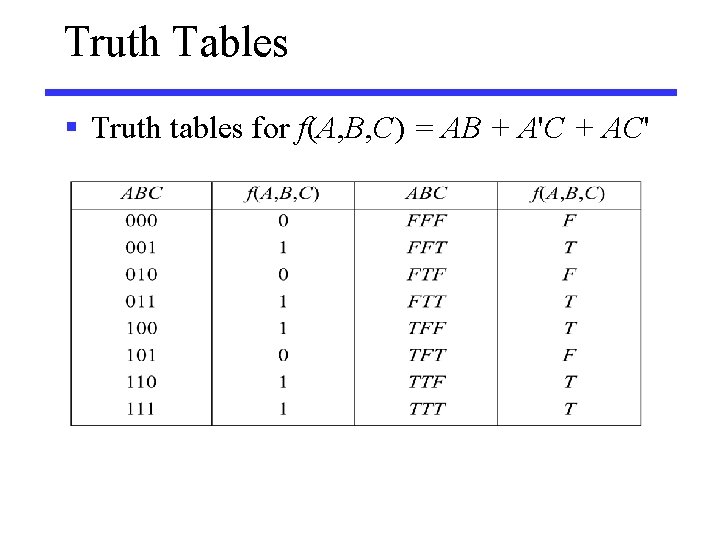
Truth Tables § Truth tables for f(A, B, C) = AB + A'C + AC'
Canonical Forms § Minterms and Maxterms § Sum-of-Minterm (SOM) Canonical Form § Product-of-Maxterm (POM) Canonical Form § Representation of Complements of Functions § Conversions between Representations
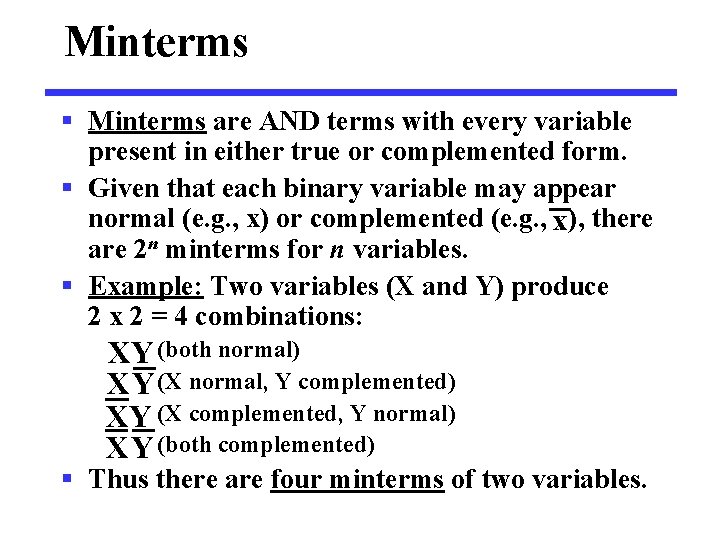
Minterms § Minterms are AND terms with every variable present in either true or complemented form. § Given that each binary variable may appear normal (e. g. , x) or complemented (e. g. , x), there are 2 n minterms for n variables. § Example: Two variables (X and Y) produce 2 x 2 = 4 combinations: XY (both normal) X Y (X normal, Y complemented) XY (X complemented, Y normal) X Y (both complemented) § Thus there are four minterms of two variables.
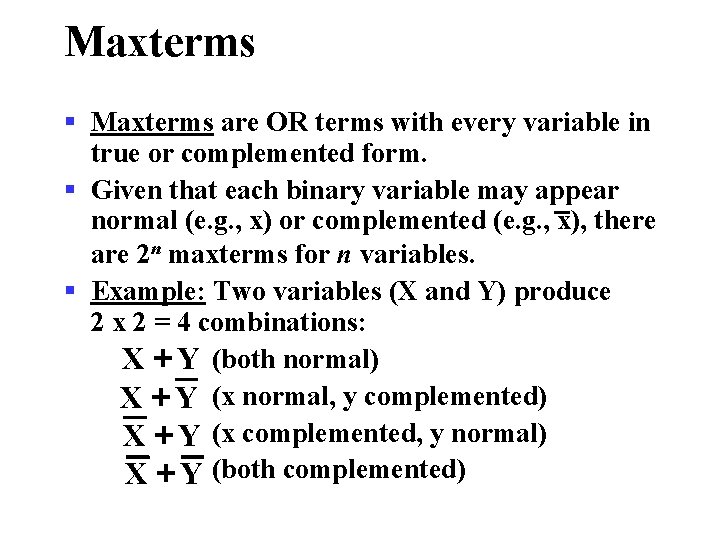
Maxterms § Maxterms are OR terms with every variable in true or complemented form. § Given that each binary variable may appear normal (e. g. , x) or complemented (e. g. , x), there are 2 n maxterms for n variables. § Example: Two variables (X and Y) produce 2 x 2 = 4 combinations: X + Y (both normal) X + Y (x normal, y complemented) X + Y (x complemented, y normal) X + Y (both complemented)
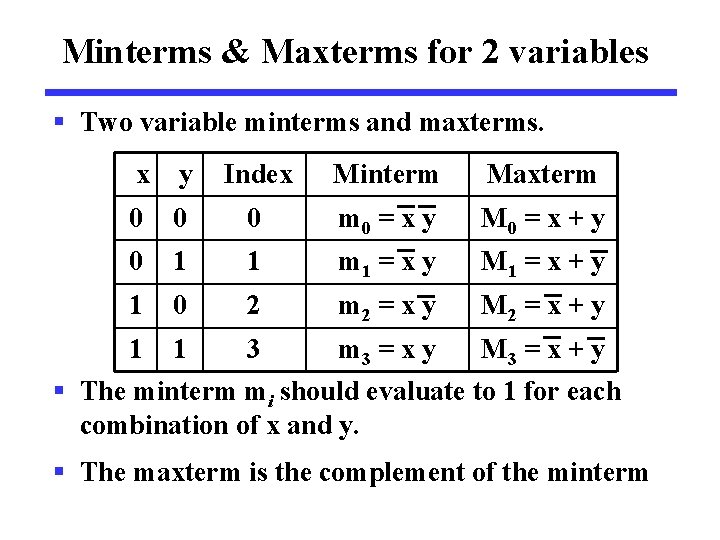
Minterms & Maxterms for 2 variables § Two variable minterms and maxterms. x y Index Minterm Maxterm 0 0 0 m 0 = x y M 0 = x + y 0 1 1 m 1 = x y M 1 = x + y 1 0 2 m 2 = x y M 2 = x + y 1 1 3 m 3 = x y M 3 = x + y § The minterm mi should evaluate to 1 for each combination of x and y. § The maxterm is the complement of the minterm
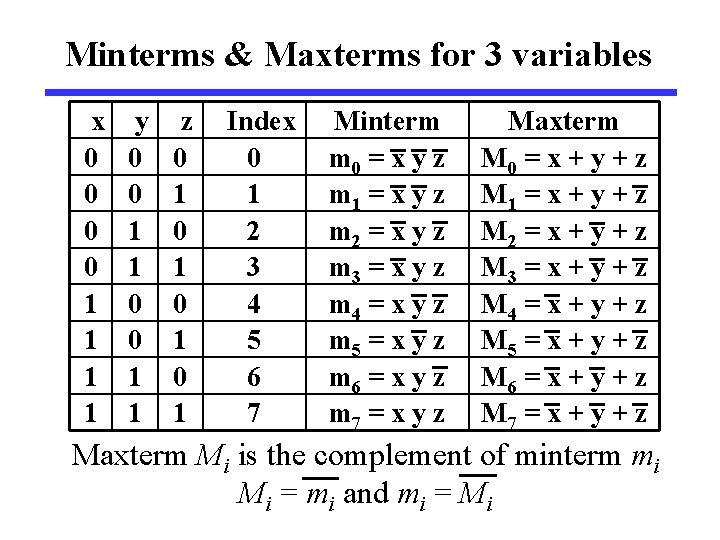
Minterms & Maxterms for 3 variables x 0 0 1 1 y 0 0 1 1 z 0 1 0 1 Index 0 1 2 3 4 5 6 7 Minterm m 0 = x y z m 1 = x y z m 2 = x y z m 3 = x y z m 4 = x y z m 5 = x y z m 6 = x y z m 7 = x y z Maxterm M 0 = x + y + z M 1 = x + y + z M 2 = x + y + z M 3 = x + y + z M 4 = x + y + z M 5 = x + y + z M 6 = x + y + z M 7 = x + y + z Maxterm Mi is the complement of minterm mi Mi = mi and mi = Mi
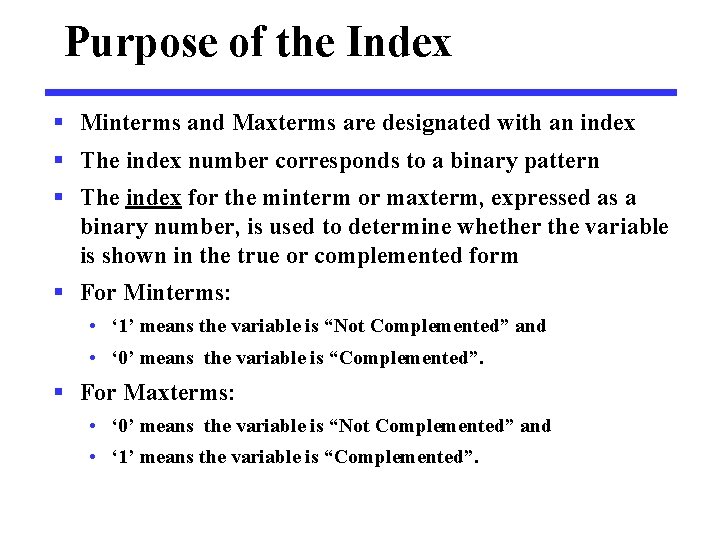
Purpose of the Index § Minterms and Maxterms are designated with an index § The index number corresponds to a binary pattern § The index for the minterm or maxterm, expressed as a binary number, is used to determine whether the variable is shown in the true or complemented form § For Minterms: • ‘ 1’ means the variable is “Not Complemented” and • ‘ 0’ means the variable is “Complemented”. § For Maxterms: • ‘ 0’ means the variable is “Not Complemented” and • ‘ 1’ means the variable is “Complemented”.
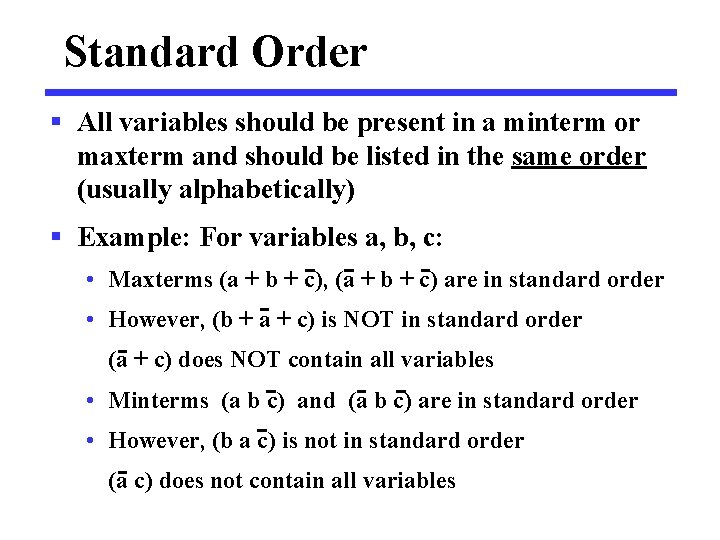
Standard Order § All variables should be present in a minterm or maxterm and should be listed in the same order (usually alphabetically) § Example: For variables a, b, c: • Maxterms (a + b + c), (a + b + c) are in standard order • However, (b + a + c) is NOT in standard order (a + c) does NOT contain all variables • Minterms (a b c) and (a b c) are in standard order • However, (b a c) is not in standard order (a c) does not contain all variables
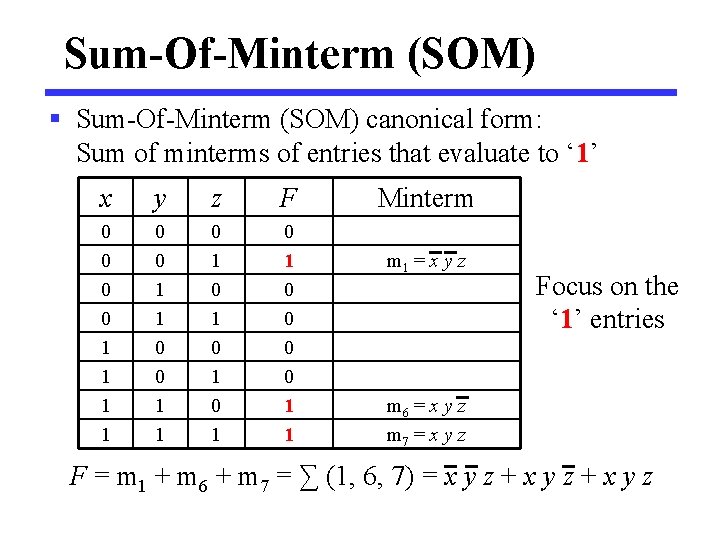
Sum-Of-Minterm (SOM) § Sum-Of-Minterm (SOM) canonical form: Sum of minterms of entries that evaluate to ‘ 1’ x y z F 0 0 1 1 0 1 0 1 0 1 0 0 1 1 Minterm m 1 = x y z Focus on the ‘ 1’ entries m 6 = x y z m 7 = x y z F = m 1 + m 6 + m 7 = ∑ (1, 6, 7) = x y z + x y z
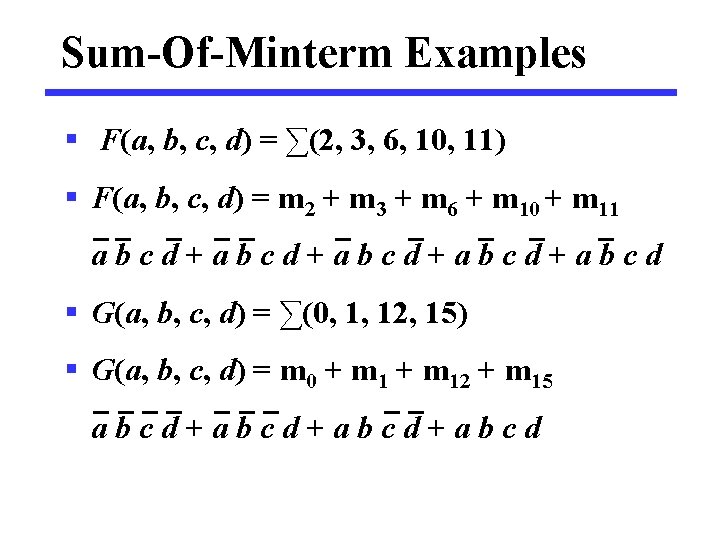
Sum-Of-Minterm Examples § F(a, b, c, d) = ∑(2, 3, 6, 10, 11) § F(a, b, c, d) = m 2 + m 3 + m 6 + m 10 + m 11 abcd+abcd+abcd § G(a, b, c, d) = ∑(0, 1, 12, 15) § G(a, b, c, d) = m 0 + m 12 + m 15 abcd+abcd+abcd
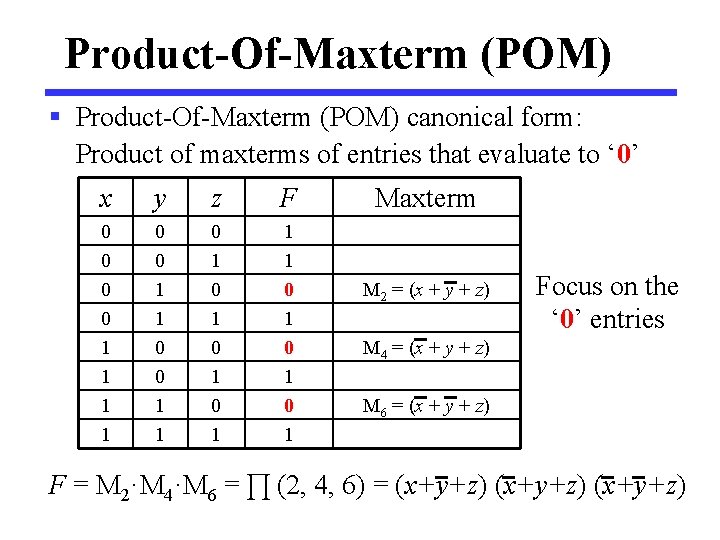
Product-Of-Maxterm (POM) § Product-Of-Maxterm (POM) canonical form: Product of maxterms of entries that evaluate to ‘ 0’ x y z F 0 0 1 1 0 1 0 1 1 1 0 1 0 1 Maxterm M 2 = (x + y + z) Focus on the ‘ 0’ entries M 4 = (x + y + z) M 6 = (x + y + z) F = M 2·M 4·M 6 = ∏ (2, 4, 6) = (x+y+z)
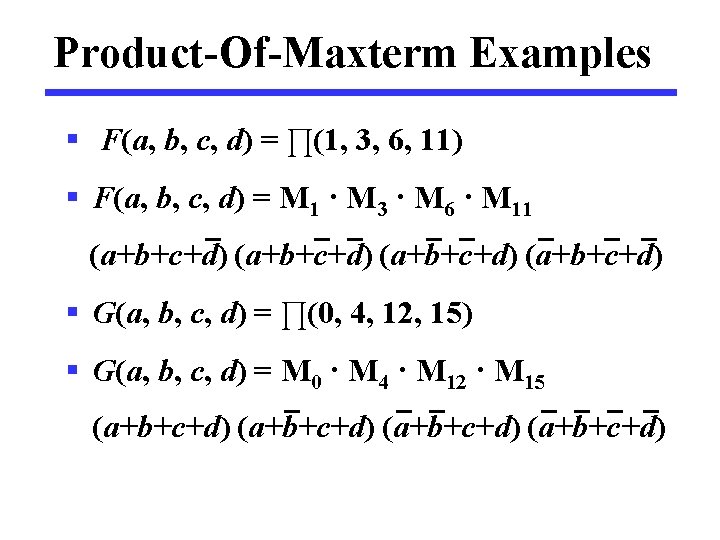
Product-Of-Maxterm Examples § F(a, b, c, d) = ∏(1, 3, 6, 11) § F(a, b, c, d) = M 1 · M 3 · M 6 · M 11 (a+b+c+d) § G(a, b, c, d) = ∏(0, 4, 12, 15) § G(a, b, c, d) = M 0 · M 4 · M 12 · M 15 (a+b+c+d)
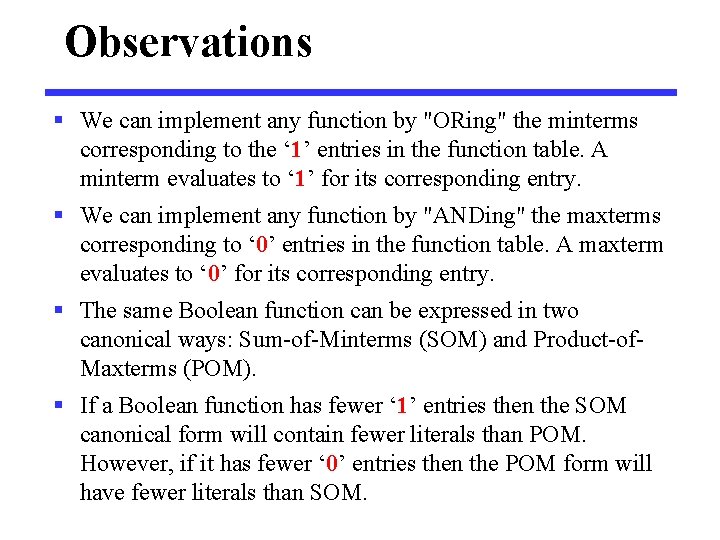
Observations § We can implement any function by "ORing" the minterms corresponding to the ‘ 1’ entries in the function table. A minterm evaluates to ‘ 1’ for its corresponding entry. § We can implement any function by "ANDing" the maxterms corresponding to ‘ 0’ entries in the function table. A maxterm evaluates to ‘ 0’ for its corresponding entry. § The same Boolean function can be expressed in two canonical ways: Sum-of-Minterms (SOM) and Product-of. Maxterms (POM). § If a Boolean function has fewer ‘ 1’ entries then the SOM canonical form will contain fewer literals than POM. However, if it has fewer ‘ 0’ entries then the POM form will have fewer literals than SOM.
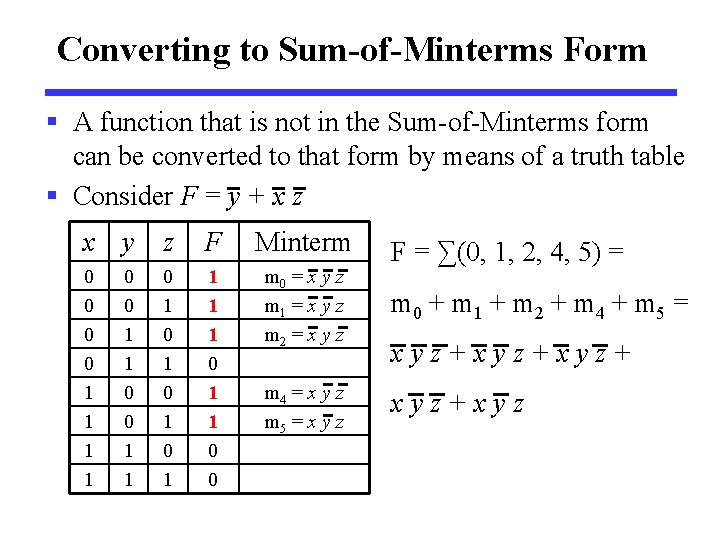
Converting to Sum-of-Minterms Form § A function that is not in the Sum-of-Minterms form can be converted to that form by means of a truth table § Consider F = y + x z x y z F Minterm 0 0 1 1 1 1 0 0 m 0 = x y z m 1 = x y z m 2 = x y z 0 0 1 1 0 1 0 1 m 4 = x y z m 5 = x y z F = ∑(0, 1, 2, 4, 5) = m 0 + m 1 + m 2 + m 4 + m 5 = xyz+xyz+xyz
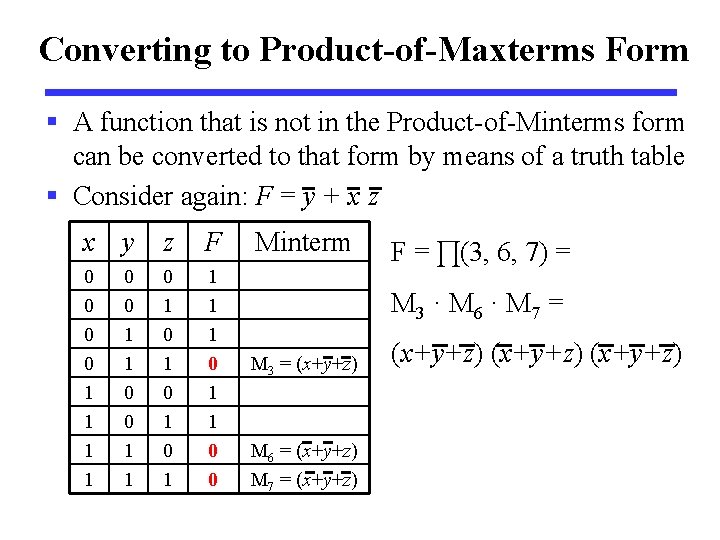
Converting to Product-of-Maxterms Form § A function that is not in the Product-of-Minterms form can be converted to that form by means of a truth table § Consider again: F = y + x z x y z F 0 0 1 1 1 1 0 0 1 1 0 1 0 1 Minterm F = ∏(3, 6, 7) = M 3 · M 6 · M 7 = M 3 = (x+y+z) M 6 = (x+y+z) M 7 = (x+y+z)
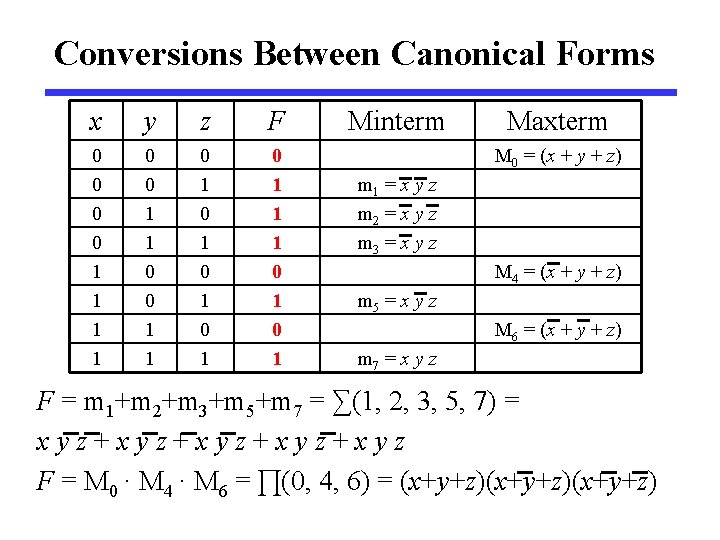
Conversions Between Canonical Forms x y z F 0 0 1 1 0 1 0 1 0 1 1 1 0 1 Minterm Maxterm M 0 = (x + y + z) m 1 = x y z m 2 = x y z m 3 = x y z M 4 = (x + y + z) m 5 = x y z M 6 = (x + y + z) m 7 = x y z F = m 1+m 2+m 3+m 5+m 7 = ∑(1, 2, 3, 5, 7) = xyz+xyz+xyz F = M 0 · M 4 · M 6 = ∏(0, 4, 6) = (x+y+z)(x+y+z)
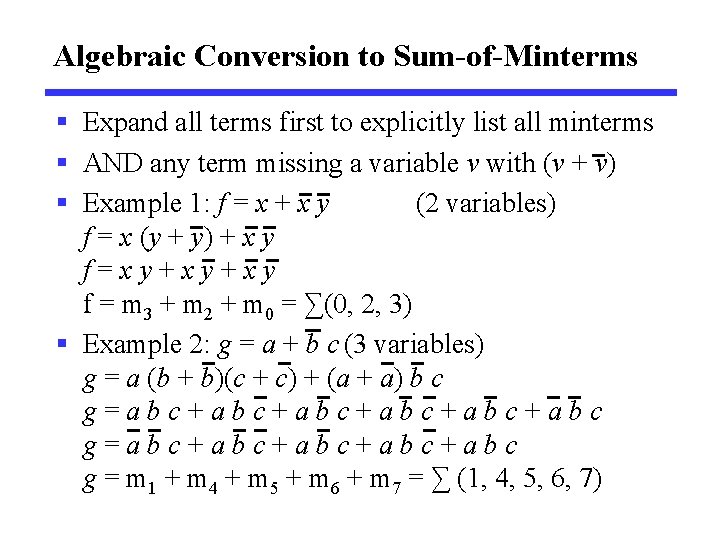
Algebraic Conversion to Sum-of-Minterms § Expand all terms first to explicitly list all minterms § AND any term missing a variable v with (v + v) § Example 1: f = x + x y (2 variables) f = x (y + y) + x y f=xy+xy+xy f = m 3 + m 2 + m 0 = ∑(0, 2, 3) § Example 2: g = a + b c (3 variables) g = a (b + b)(c + c) + (a + a) b c g=abc+abc+abc+abc g=abc+abc+abc g = m 1 + m 4 + m 5 + m 6 + m 7 = ∑ (1, 4, 5, 6, 7)
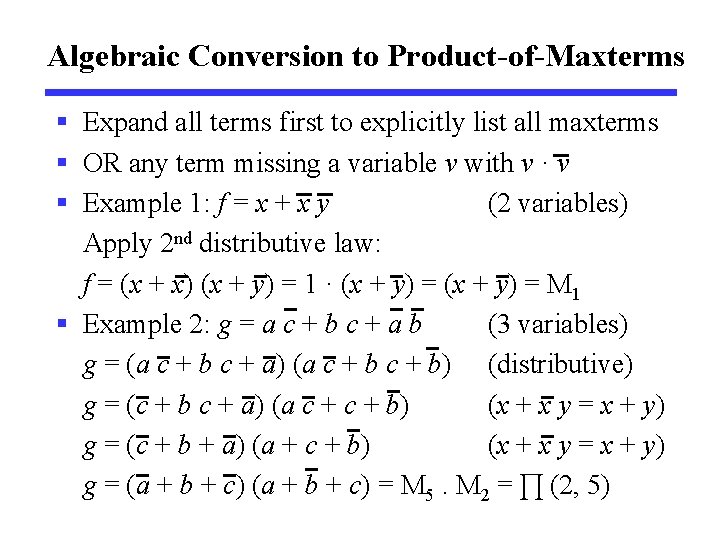
Algebraic Conversion to Product-of-Maxterms § Expand all terms first to explicitly list all maxterms § OR any term missing a variable v with v · v § Example 1: f = x + x y (2 variables) Apply 2 nd distributive law: f = (x + x) (x + y) = 1 · (x + y) = M 1 § Example 2: g = a c + b c + a b (3 variables) g = (a c + b c + a) (a c + b) (distributive) g = (c + b c + a) (a c + b) (x + x y = x + y) g = (c + b + a) (a + c + b) (x + x y = x + y) g = (a + b + c) = M 5. M 2 = ∏ (2, 5)
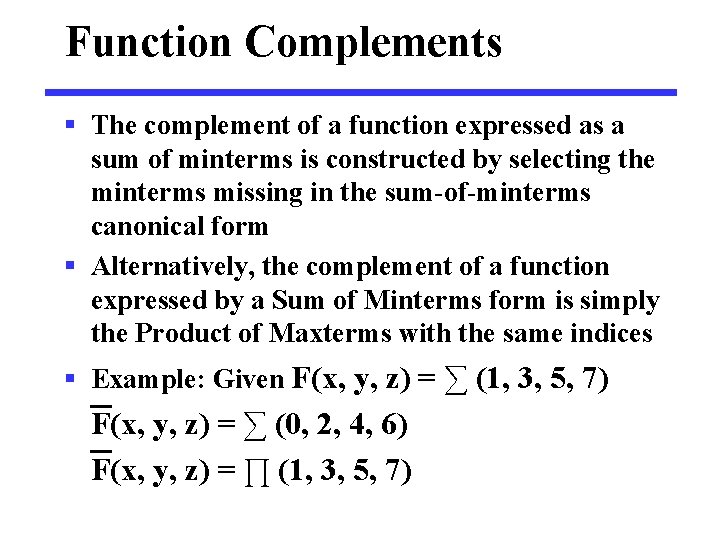
Function Complements § The complement of a function expressed as a sum of minterms is constructed by selecting the minterms missing in the sum-of-minterms canonical form § Alternatively, the complement of a function expressed by a Sum of Minterms form is simply the Product of Maxterms with the same indices § Example: Given F(x, y, z) = ∑ (1, 3, 5, 7) F(x, y, z) = ∑ (0, 2, 4, 6) F(x, y, z) = ∏ (1, 3, 5, 7)
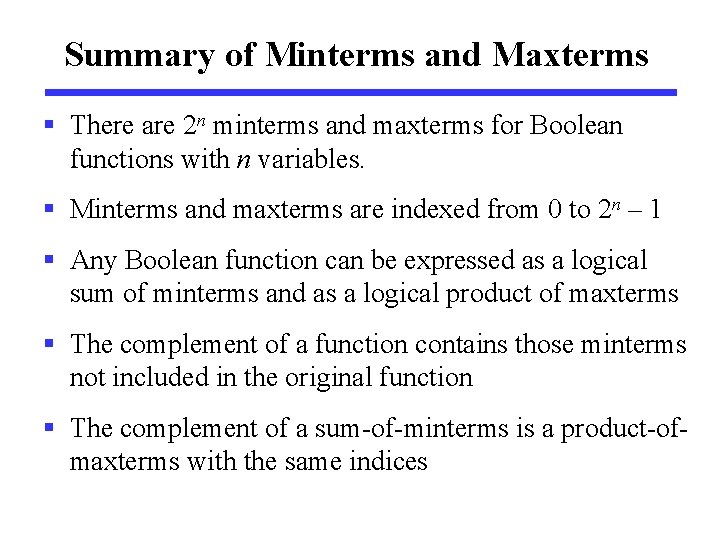
Summary of Minterms and Maxterms § There are 2 n minterms and maxterms for Boolean functions with n variables. § Minterms and maxterms are indexed from 0 to 2 n – 1 § Any Boolean function can be expressed as a logical sum of minterms and as a logical product of maxterms § The complement of a function contains those minterms not included in the original function § The complement of a sum-of-minterms is a product-ofmaxterms with the same indices
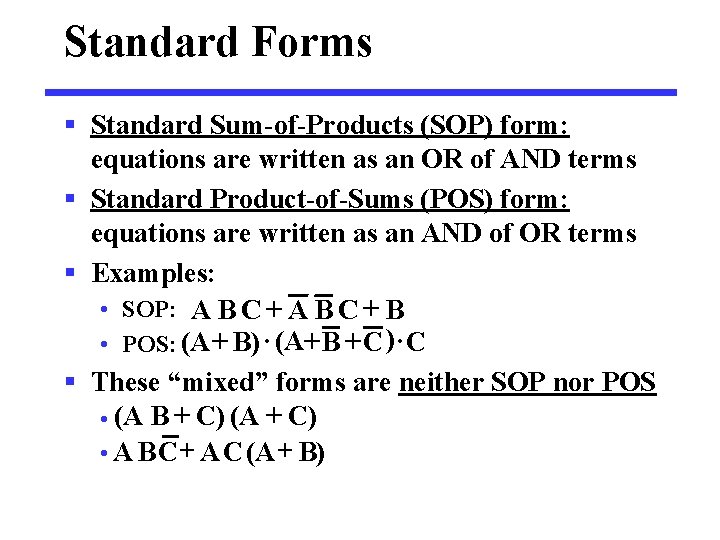
Standard Forms § Standard Sum-of-Products (SOP) form: equations are written as an OR of AND terms § Standard Product-of-Sums (POS) form: equations are written as an AND of OR terms § Examples: • SOP: A B C + B • POS: (A + B) · (A+ B + C )· C § These “mixed” forms are neither SOP nor POS • (A B + C) (A + C) • A B C + A C (A + B)
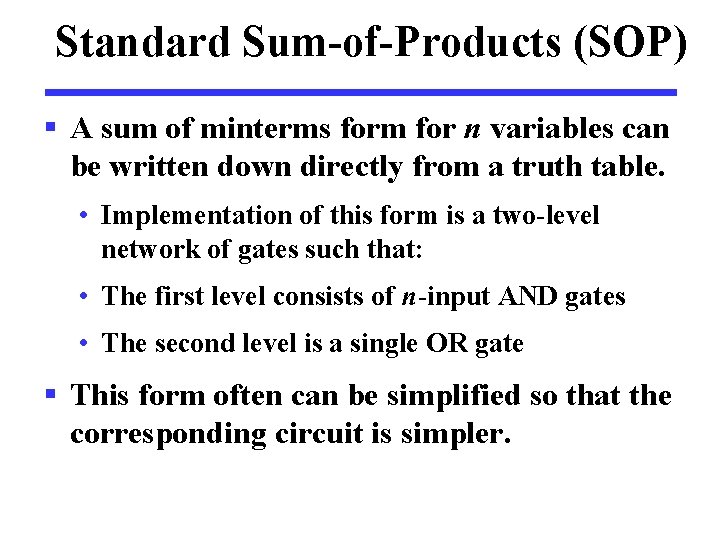
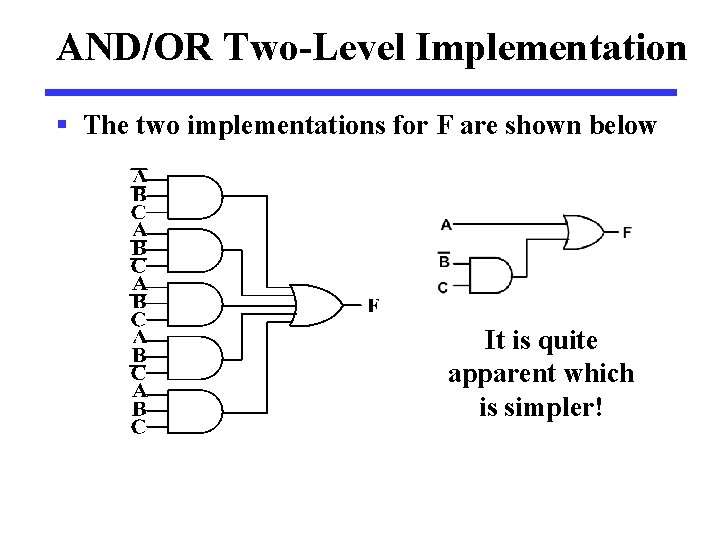
Standard Sum-of-Products (SOP) § A sum of minterms form for n variables can be written down directly from a truth table. • Implementation of this form is a two-level network of gates such that: • The first level consists of n-input AND gates • The second level is a single OR gate § This form often can be simplified so that the corresponding circuit is simpler.
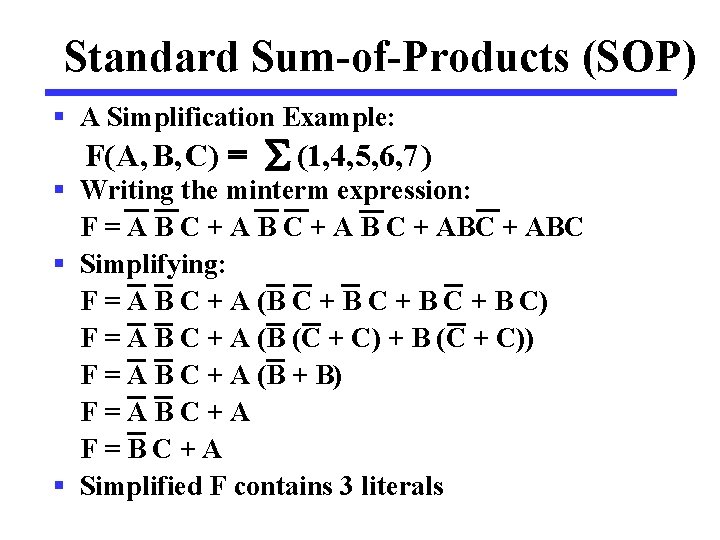
Standard Sum-of-Products (SOP) § A Simplification Example: F( A, B, C) = S (1, 4, 5, 6, 7) § Writing the minterm expression: F = A B C + ABC § Simplifying: F = A B C + A (B C + B C) F = A B C + A (B (C + C) + B (C + C)) F = A B C + A (B + B) F=ABC+A F=BC+A § Simplified F contains 3 literals
AND/OR Two-Level Implementation § The two implementations for F are shown below It is quite apparent which is simpler!