
Digital Design Debdeep Mukhopadhyay Associate Professor Dept of

Digital Design Debdeep Mukhopadhyay Associate Professor Dept of Computer Science and Engineering NYU Shanghai and IIT Kharagpur 1
Logical Design 2
Design with Basic Logic Gates Logic gates: perform logical operations on input signals Positive (negative) logic polarity: constant 1 (0) denotes a high voltage and constant 0 a low (high) voltage Synchronous circuits: driven by a clock that produces a train of equally spaced pulses Asynchronous circuits: are almost free-running and do not depend on a clock; controlled by initiation and completion signals Fanout: number of gate inputs driven by the output of a single gate Fanin: bound on the number of inputs a gate can have Propagation delay: time to propagate a signal through a gate 3
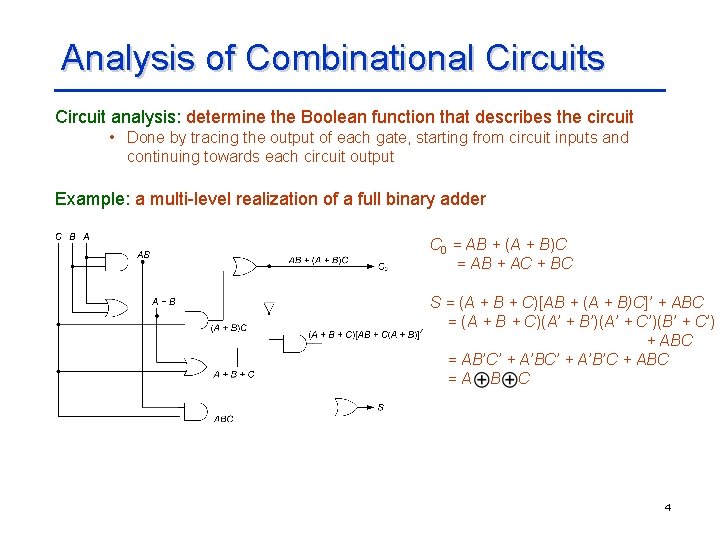
Analysis of Combinational Circuits Circuit analysis: determine the Boolean function that describes the circuit • Done by tracing the output of each gate, starting from circuit inputs and continuing towards each circuit output Example: a multi-level realization of a full binary adder C 0 = AB + (A + B)C = AB + AC + BC S = (A + B + C)[AB + (A + B)C]’ + ABC = (A + B + C)(A’ + B’)(A’ + C’)(B’ + C’) + ABC = AB’C’ + A’B’C + ABC =A B C 4
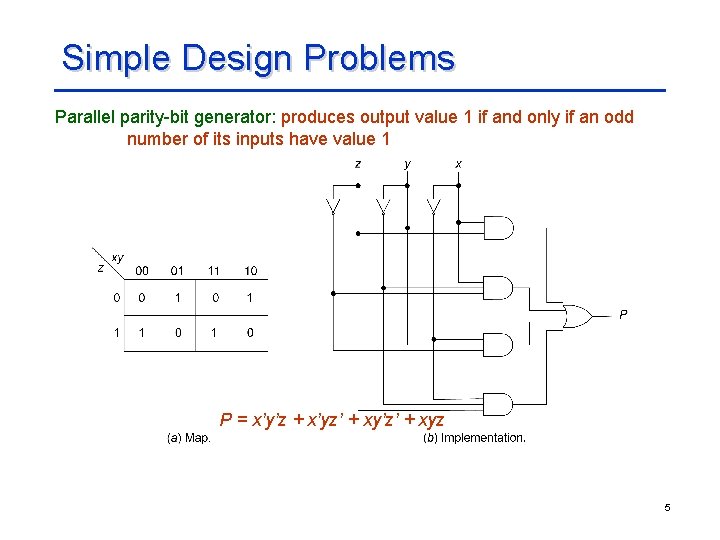
Simple Design Problems Parallel parity-bit generator: produces output value 1 if and only if an odd number of its inputs have value 1 P = x’y’z + x’yz’ + xy’z’ + xyz 5
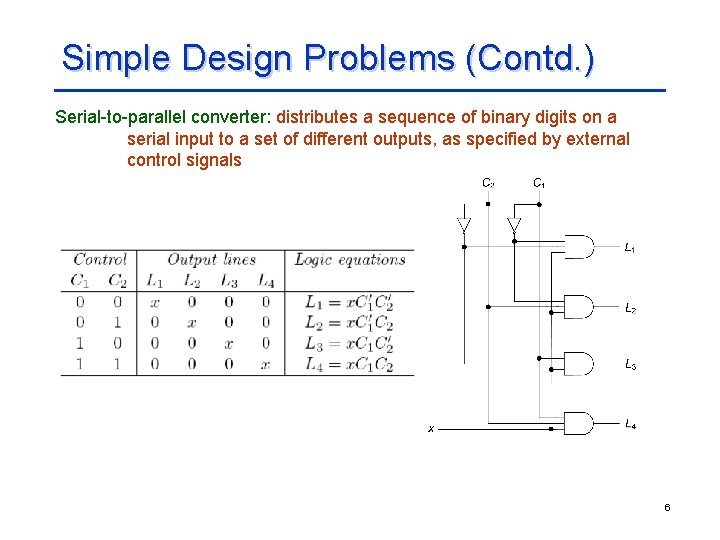
Simple Design Problems (Contd. ) Serial-to-parallel converter: distributes a sequence of binary digits on a serial input to a set of different outputs, as specified by external control signals 6
Logic Design with Integrated Circuits Small scale integration (SSI): integrated circuit packages containing a few gates; e. g. , AND, OR, NOT, NAND, NOR, XOR Medium scale integration (MSI): packages containing up to about 100 gates; e. g. , code converters, adders Large scale integration (LSI): packages containing thousands of gates; arithmetic unit Very large scale integration (VLSI): packages with millions of gates 7
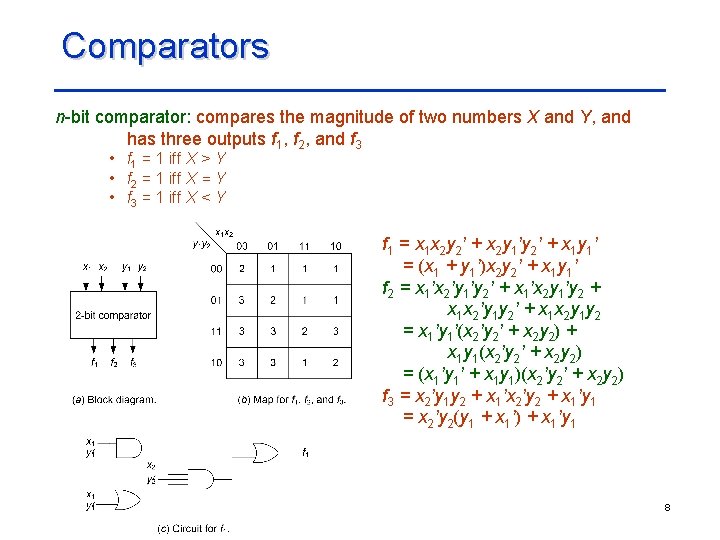
Comparators n-bit comparator: compares the magnitude of two numbers X and Y, and has three outputs f 1, f 2, and f 3 • f 1 = 1 iff X > Y • f 2 = 1 iff X = Y • f 3 = 1 iff X < Y f 1 = x 1 x 2 y 2’ + x 2 y 1’y 2’ + x 1 y 1’ = (x 1 + y 1’)x 2 y 2’ + x 1 y 1’ f 2 = x 1’x 2’y 1’y 2’ + x 1’x 2 y 1’y 2 + x 1 x 2’y 1 y 2’ + x 1 x 2 y 1 y 2 = x 1’y 1’(x 2’y 2’ + x 2 y 2) + x 1 y 1(x 2’y 2’ + x 2 y 2) = (x 1’y 1’ + x 1 y 1)(x 2’y 2’ + x 2 y 2) f 3 = x 2’y 1 y 2 + x 1’x 2’y 2 + x 1’y 1 = x 2’y 2(y 1 + x 1’) + x 1’y 1 8
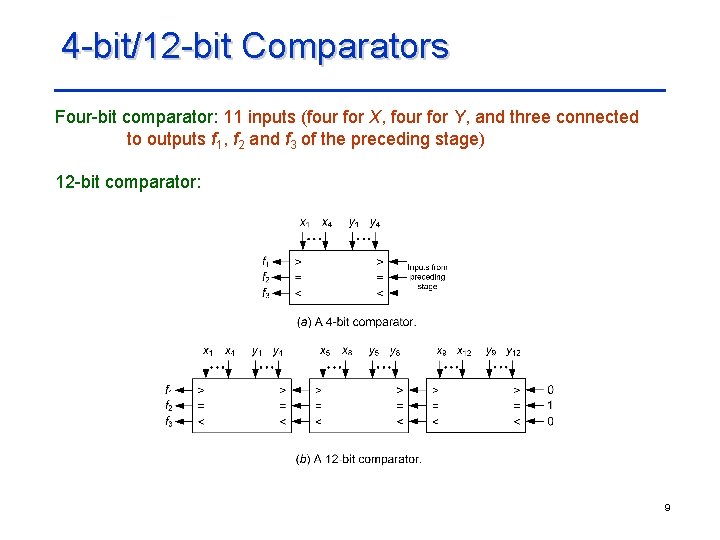
4 -bit/12 -bit Comparators Four-bit comparator: 11 inputs (four for X, four for Y, and three connected to outputs f 1, f 2 and f 3 of the preceding stage) 12 -bit comparator: 9

Data Selectors Multiplexer: electronic switch that connects one of n inputs to the output Data selector: application of multiplexer • n data input lines, D 0, D 1, …, Dn-1 • m select digit inputs s 0, s 1, …, sm-1 • 1 output 10
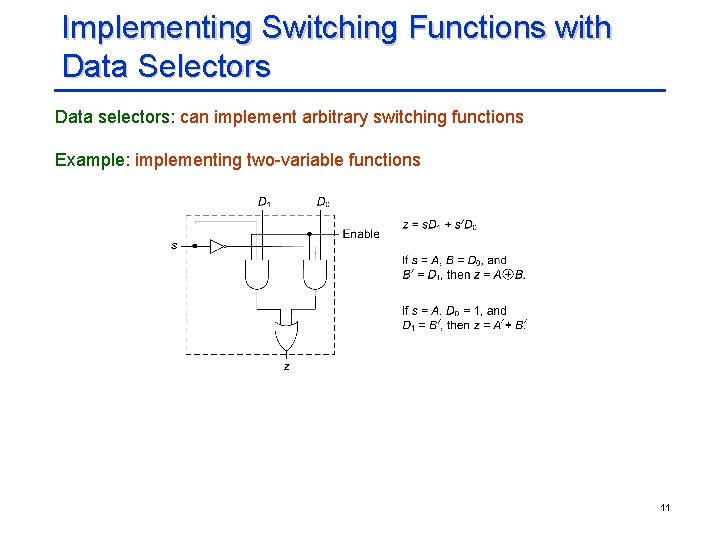
Implementing Switching Functions with Data Selectors Data selectors: can implement arbitrary switching functions Example: implementing two-variable functions 11
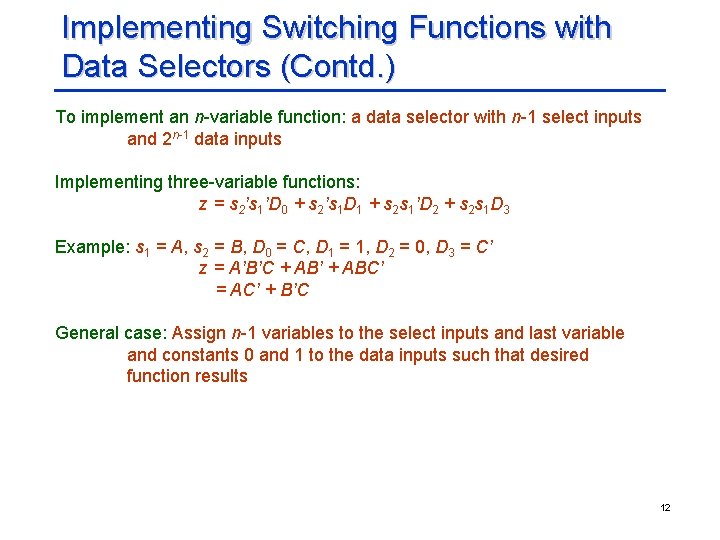
Implementing Switching Functions with Data Selectors (Contd. ) To implement an n-variable function: a data selector with n-1 select inputs and 2 n-1 data inputs Implementing three-variable functions: z = s 2’s 1’D 0 + s 2’s 1 D 1 + s 2 s 1’D 2 + s 2 s 1 D 3 Example: s 1 = A, s 2 = B, D 0 = C, D 1 = 1, D 2 = 0, D 3 = C’ z = A’B’C + AB’ + ABC’ = AC’ + B’C General case: Assign n-1 variables to the select inputs and last variable and constants 0 and 1 to the data inputs such that desired function results 12
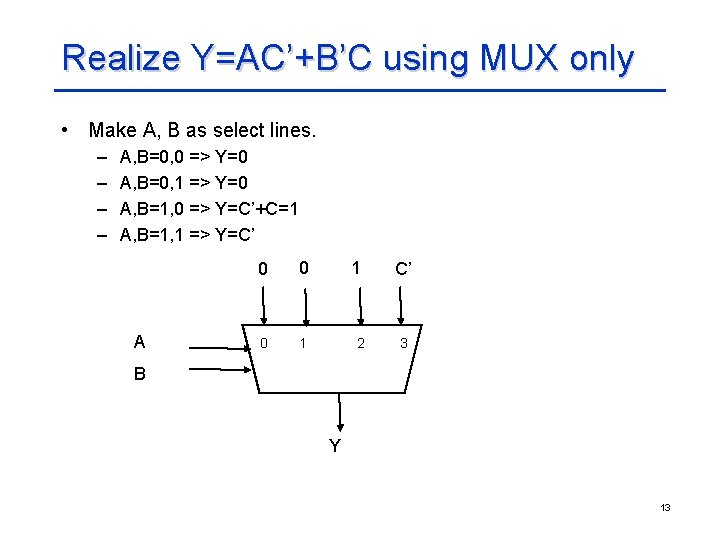
Realize Y=AC’+B’C using MUX only • Make A, B as select lines. – – A, B=0, 0 => Y=0 A, B=0, 1 => Y=0 A, B=1, 0 => Y=C’+C=1 A, B=1, 1 => Y=C’ A 0 0 0 1 1 2 C’ 3 B Y 13
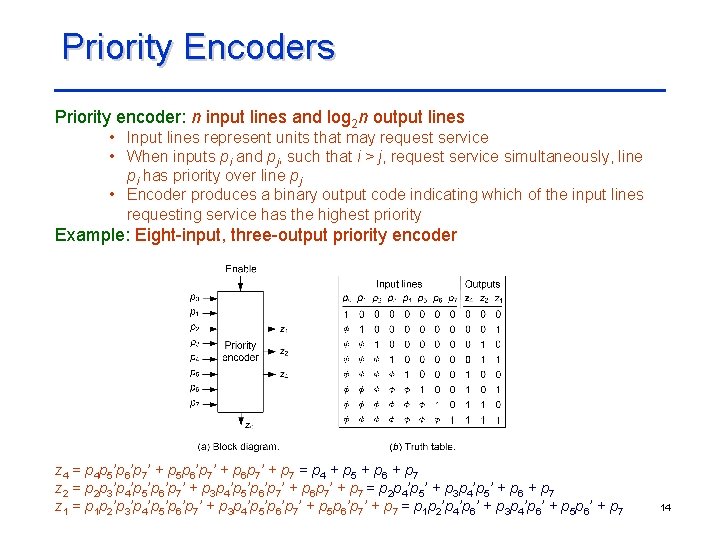
Priority Encoders Priority encoder: n input lines and log 2 n output lines • Input lines represent units that may request service • When inputs pi and pj, such that i > j, request service simultaneously, line pi has priority over line pj • Encoder produces a binary output code indicating which of the input lines requesting service has the highest priority Example: Eight-input, three-output priority encoder z 4 = p 4 p 5’p 6’p 7’ + p 5 p 6’p 7’ + p 6 p 7’ + p 7 = p 4 + p 5 + p 6 + p 7 z 2 = p 2 p 3’p 4’p 5’p 6’p 7’ + p 3 p 4’p 5’p 6’p 7’ + p 6 p 7’ + p 7 = p 2 p 4’p 5’ + p 3 p 4’p 5’ + p 6 + p 7 z 1 = p 1 p 2’p 3’p 4’p 5’p 6’p 7’ + p 3 p 4’p 5’p 6’p 7’ + p 5 p 6’p 7’ + p 7 = p 1 p 2’p 4’p 6’ + p 3 p 4’p 6’ + p 5 p 6’ + p 7 14
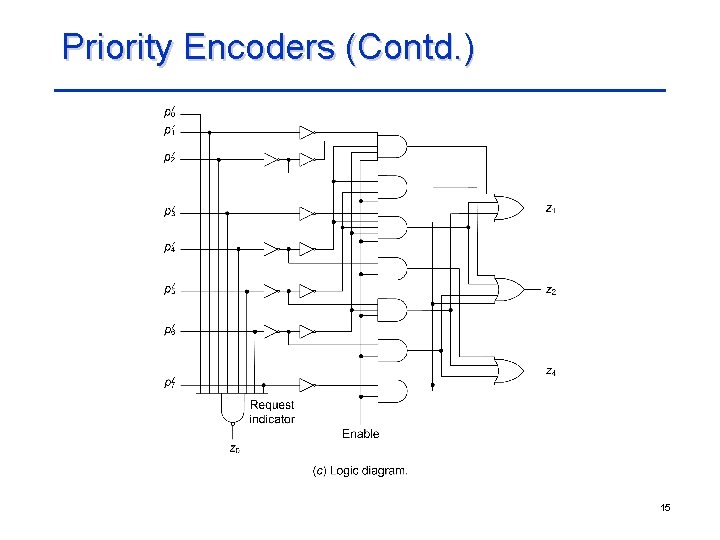
Priority Encoders (Contd. ) 15
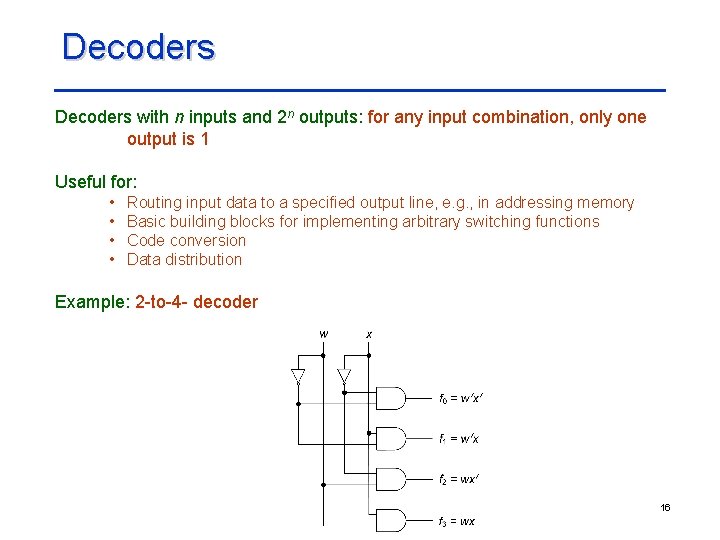
Decoders with n inputs and 2 n outputs: for any input combination, only one output is 1 Useful for: • • Routing input data to a specified output line, e. g. , in addressing memory Basic building blocks for implementing arbitrary switching functions Code conversion Data distribution Example: 2 -to-4 - decoder 16
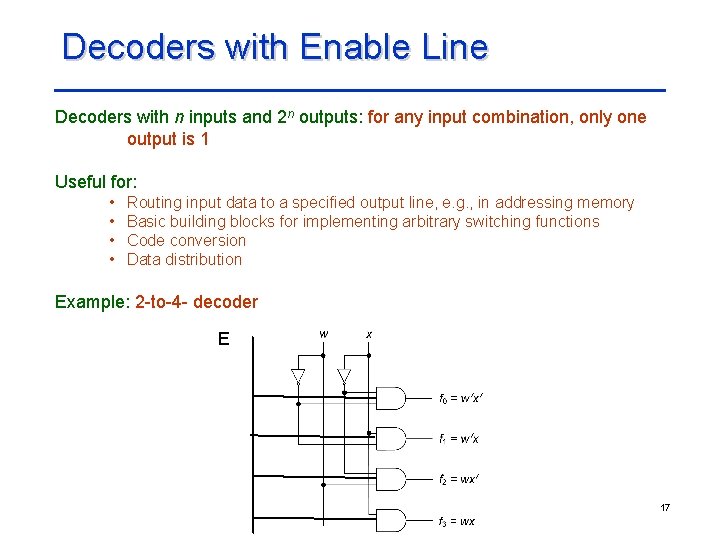
Decoders with Enable Line Decoders with n inputs and 2 n outputs: for any input combination, only one output is 1 Useful for: • • Routing input data to a specified output line, e. g. , in addressing memory Basic building blocks for implementing arbitrary switching functions Code conversion Data distribution Example: 2 -to-4 - decoder E 17
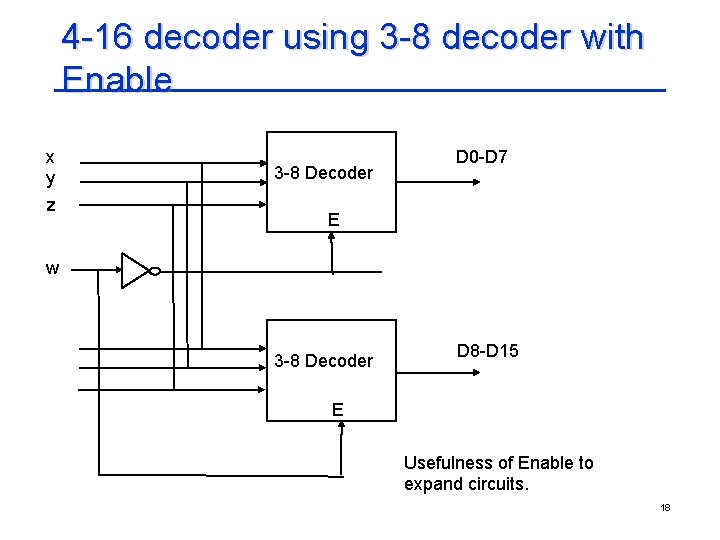
4 -16 decoder using 3 -8 decoder with Enable x y z 3 -8 Decoder D 0 -D 7 E w 3 -8 Decoder D 8 -D 15 E Usefulness of Enable to expand circuits. 18
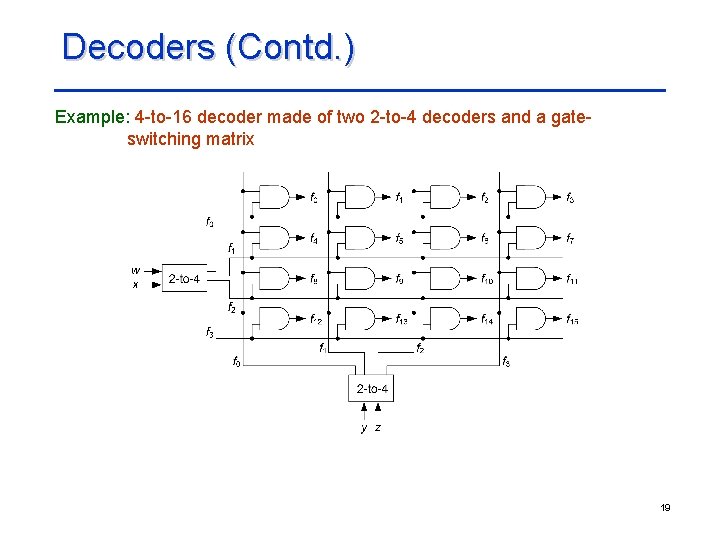
Decoders (Contd. ) Example: 4 -to-16 decoder made of two 2 -to-4 decoders and a gateswitching matrix 19
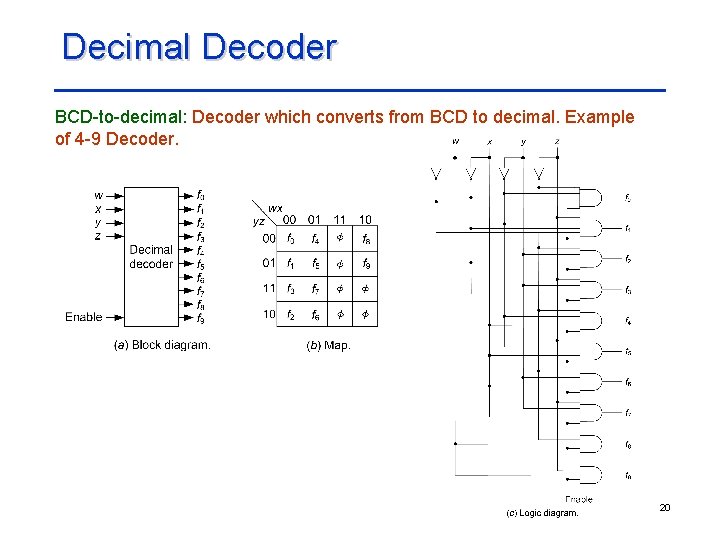
Decimal Decoder BCD-to-decimal: Decoder which converts from BCD to decimal. Example of 4 -9 Decoder. 20
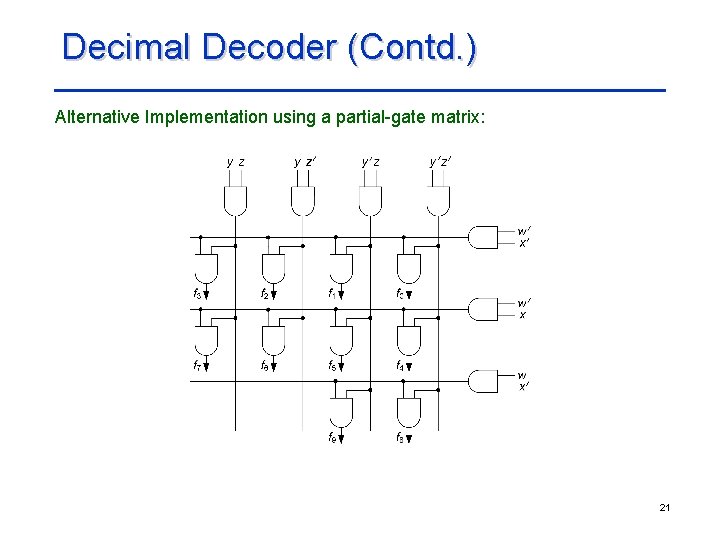
Decimal Decoder (Contd. ) Alternative Implementation using a partial-gate matrix: 21
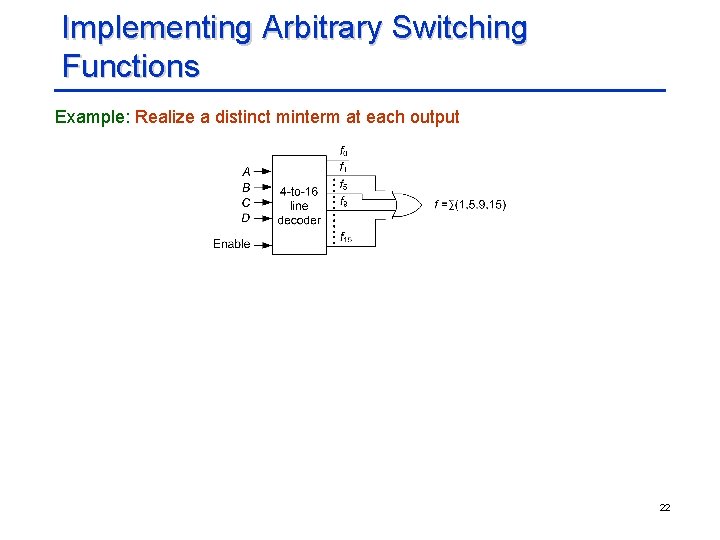
Implementing Arbitrary Switching Functions Example: Realize a distinct minterm at each output 22
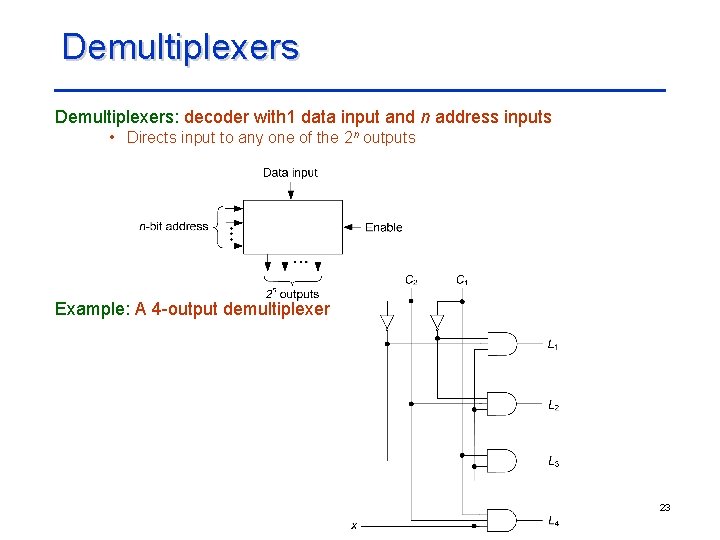
Demultiplexers: decoder with 1 data input and n address inputs • Directs input to any one of the 2 n outputs Example: A 4 -output demultiplexer 23
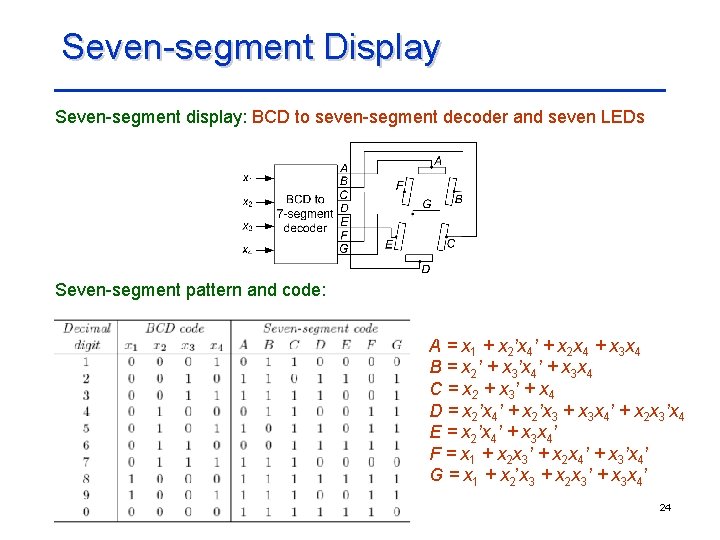
Seven-segment Display Seven-segment display: BCD to seven-segment decoder and seven LEDs Seven-segment pattern and code: A = x 1 + x 2’x 4’ + x 2 x 4 + x 3 x 4 B = x 2’ + x 3’x 4’ + x 3 x 4 C = x 2 + x 3’ + x 4 D = x 2’x 4’ + x 2’x 3 + x 3 x 4’ + x 2 x 3’x 4 E = x 2’x 4’ + x 3 x 4’ F = x 1 + x 2 x 3’ + x 2 x 4’ + x 3’x 4’ G = x 1 + x 2’x 3 + x 2 x 3’ + x 3 x 4’ 24
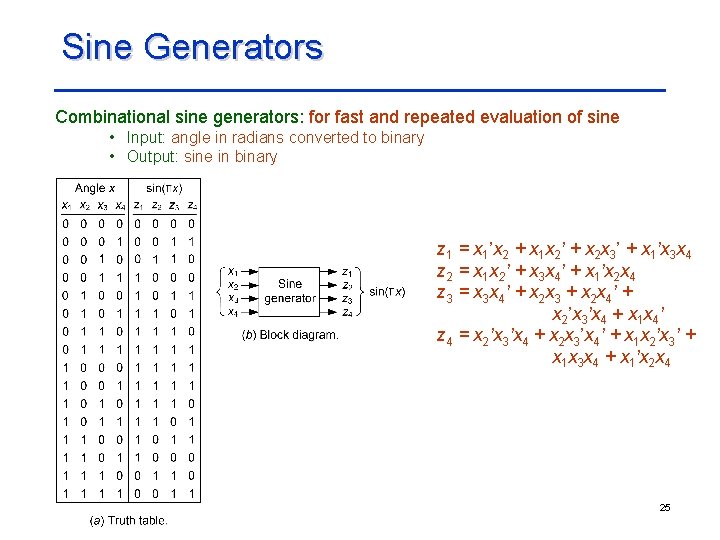
Sine Generators Combinational sine generators: for fast and repeated evaluation of sine • Input: angle in radians converted to binary • Output: sine in binary z 1 = x 1’x 2 + x 1 x 2’ + x 2 x 3’ + x 1’x 3 x 4 z 2 = x 1 x 2’ + x 3 x 4’ + x 1’x 2 x 4 z 3 = x 3 x 4’ + x 2 x 3 + x 2 x 4’ + x 2’x 3’x 4 + x 1 x 4’ z 4 = x 2’x 3’x 4 + x 2 x 3’x 4’ + x 1 x 2’x 3’ + x 1 x 3 x 4 + x 1’x 2 x 4 25
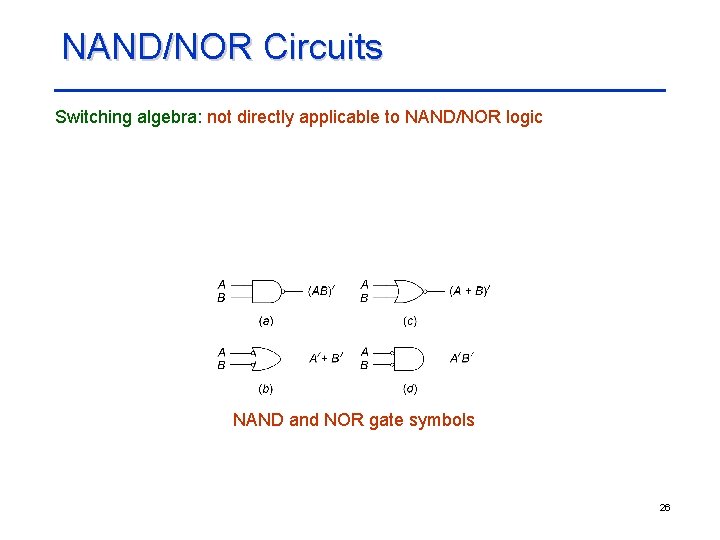
NAND/NOR Circuits Switching algebra: not directly applicable to NAND/NOR logic NAND and NOR gate symbols 26
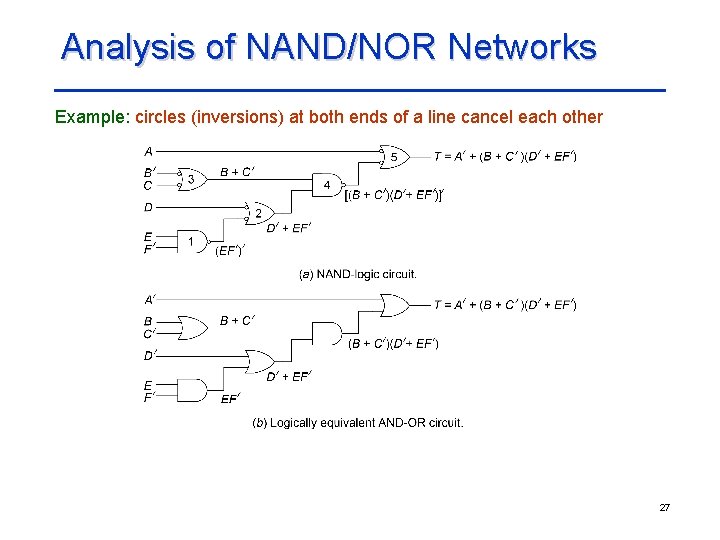
Analysis of NAND/NOR Networks Example: circles (inversions) at both ends of a line cancel each other 27
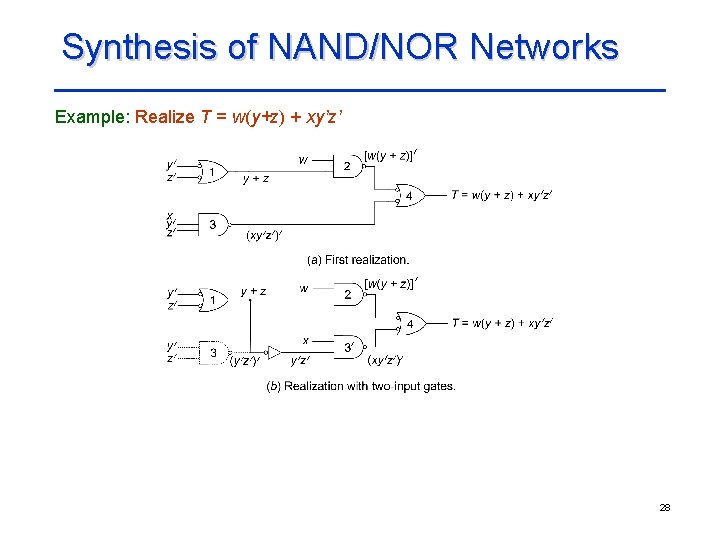
Synthesis of NAND/NOR Networks Example: Realize T = w(y+z) + xy’z’ 28
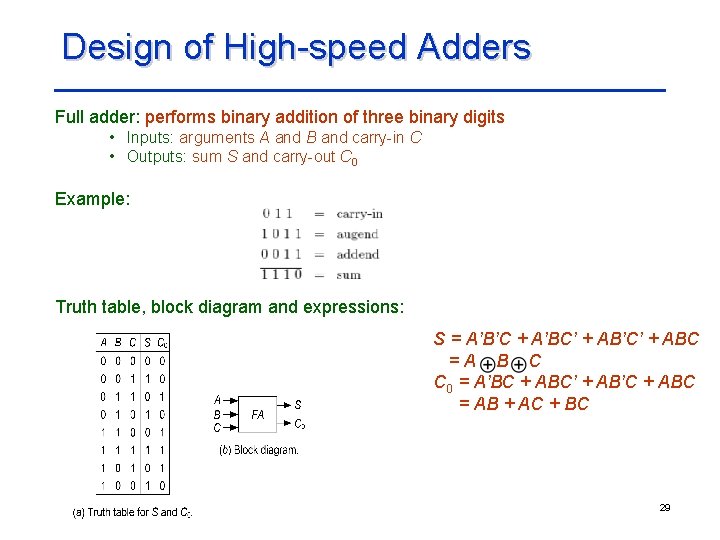
Design of High-speed Adders Full adder: performs binary addition of three binary digits • Inputs: arguments A and B and carry-in C • Outputs: sum S and carry-out C 0 Example: Truth table, block diagram and expressions: S = A’B’C + A’BC’ + AB’C’ + ABC =A B C C 0 = A’BC + ABC’ + AB’C + ABC = AB + AC + BC 29
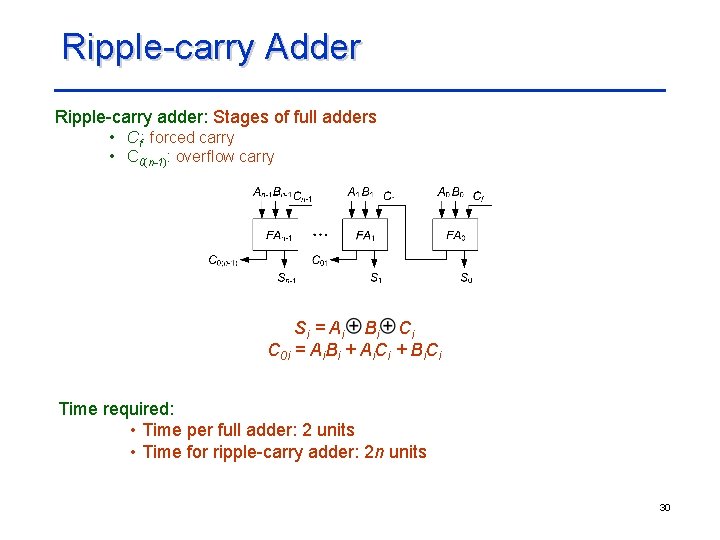
Ripple-carry Adder Ripple-carry adder: Stages of full adders • Cf: forced carry • C 0(n-1): overflow carry Si = A i B i C 0 i = Ai. Bi + Ai. Ci + Bi. Ci Time required: • Time per full adder: 2 units • Time for ripple-carry adder: 2 n units 30
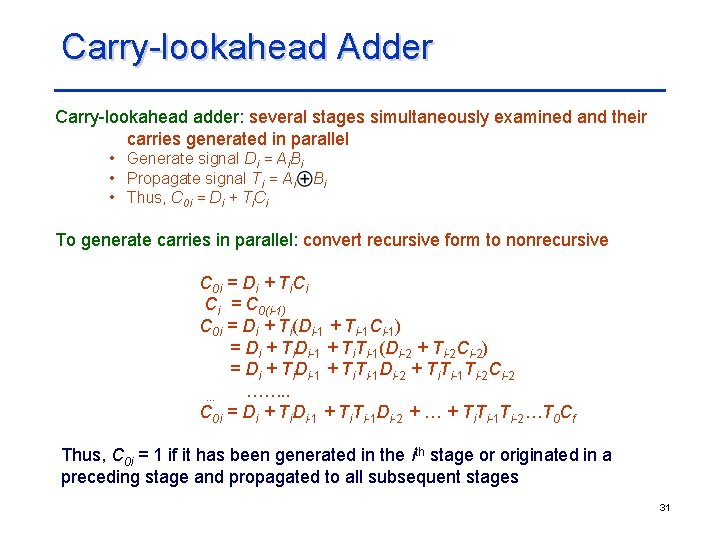
Carry-lookahead Adder Carry-lookahead adder: several stages simultaneously examined and their carries generated in parallel • Generate signal Di = Ai. Bi • Propagate signal Ti = Ai Bi • Thus, C 0 i = Di + Ti. Ci To generate carries in parallel: convert recursive form to nonrecursive C 0 i = Di + Ti. Ci Ci = C 0(i-1) C 0 i = Di + Ti(Di-1 + Ti-1 Ci-1) = Di + Ti. Di-1 + Ti. Ti-1(Di-2 + Ti-2 Ci-2) = Di + Ti. Di-1 + Ti. Ti-1 Di-2 + Ti. Ti-1 Ti-2 Ci-2 ……. . . C 0 i = Di + Ti. Di-1 + Ti. Ti-1 Di-2 + … + Ti. Ti-1 Ti-2…T 0 Cf Thus, C 0 i = 1 if it has been generated in the ith stage or originated in a preceding stage and propagated to all subsequent stages 31
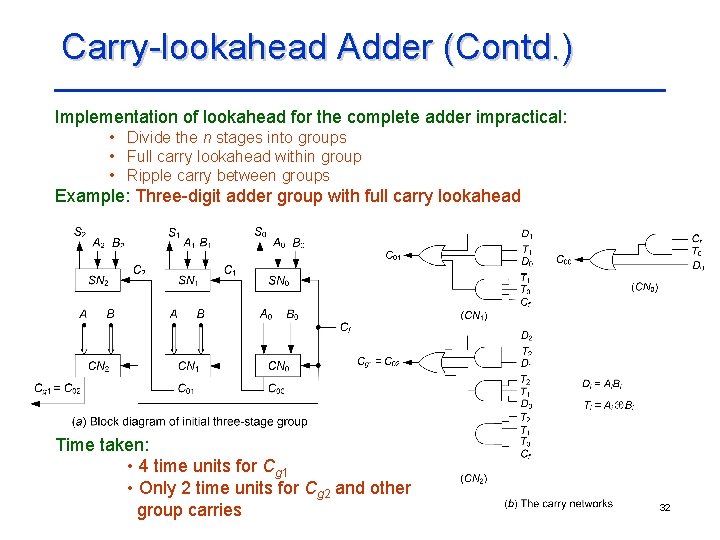
Carry-lookahead Adder (Contd. ) Implementation of lookahead for the complete adder impractical: • Divide the n stages into groups • Full carry lookahead within group • Ripple carry between groups Example: Three-digit adder group with full carry lookahead Time taken: • 4 time units for Cg 1 • Only 2 time units for Cg 2 and other group carries 32
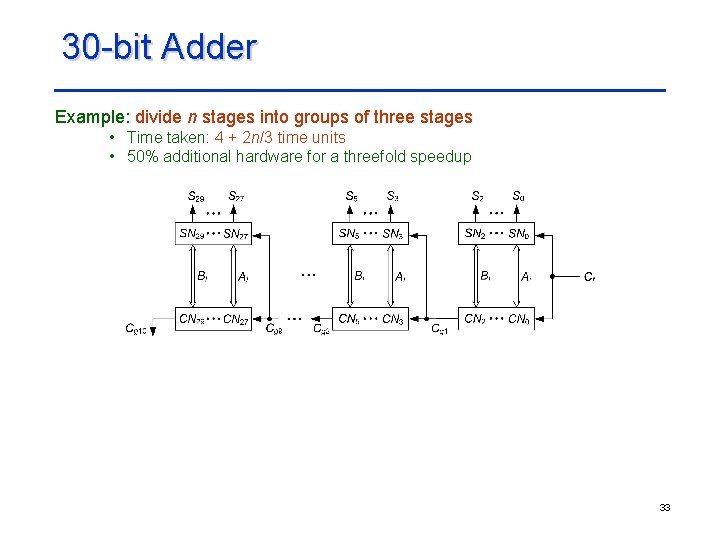
30 -bit Adder Example: divide n stages into groups of three stages • Time taken: 4 + 2 n/3 time units • 50% additional hardware for a threefold speedup 33
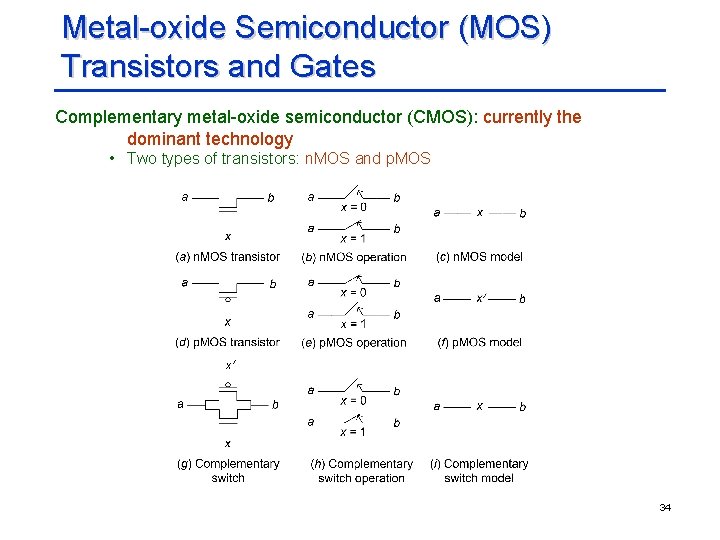
Metal-oxide Semiconductor (MOS) Transistors and Gates Complementary metal-oxide semiconductor (CMOS): currently the dominant technology • Two types of transistors: n. MOS and p. MOS 34
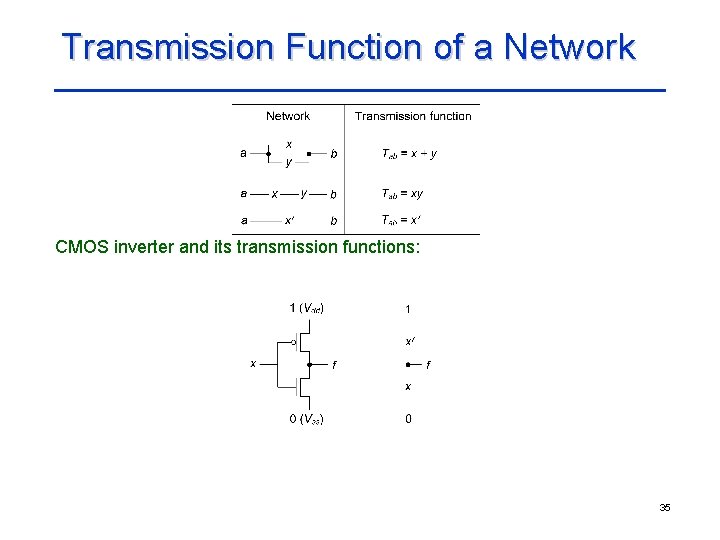
Transmission Function of a Network CMOS inverter and its transmission functions: 35
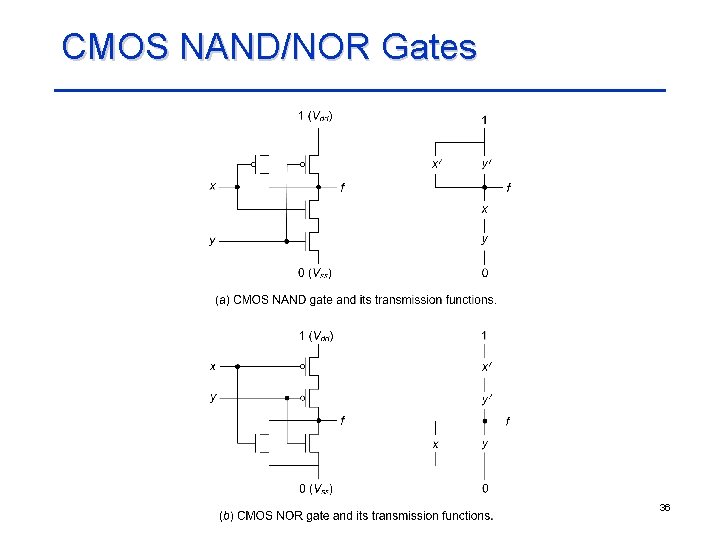
CMOS NAND/NOR Gates 36
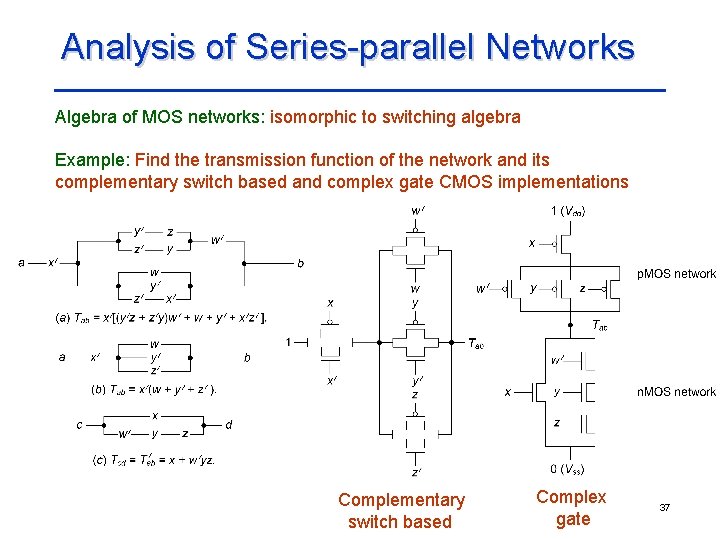
Analysis of Series-parallel Networks Algebra of MOS networks: isomorphic to switching algebra Example: Find the transmission function of the network and its complementary switch based and complex gate CMOS implementations Complementary switch based Complex gate 37
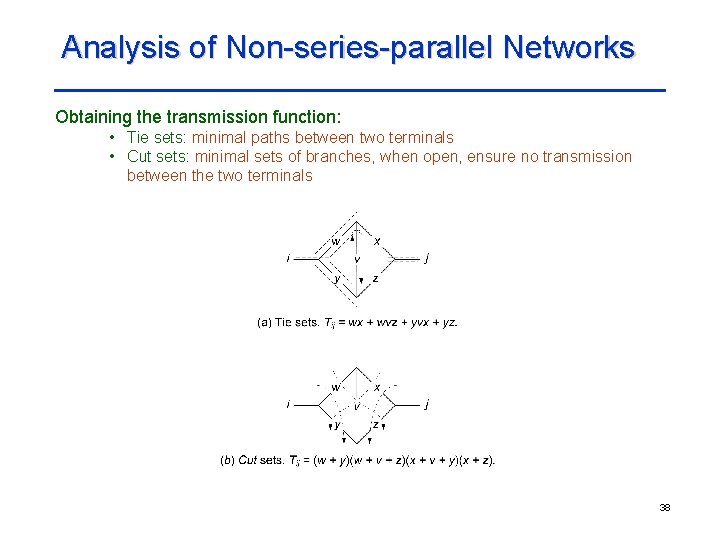
Analysis of Non-series-parallel Networks Obtaining the transmission function: • Tie sets: minimal paths between two terminals • Cut sets: minimal sets of branches, when open, ensure no transmission between the two terminals 38
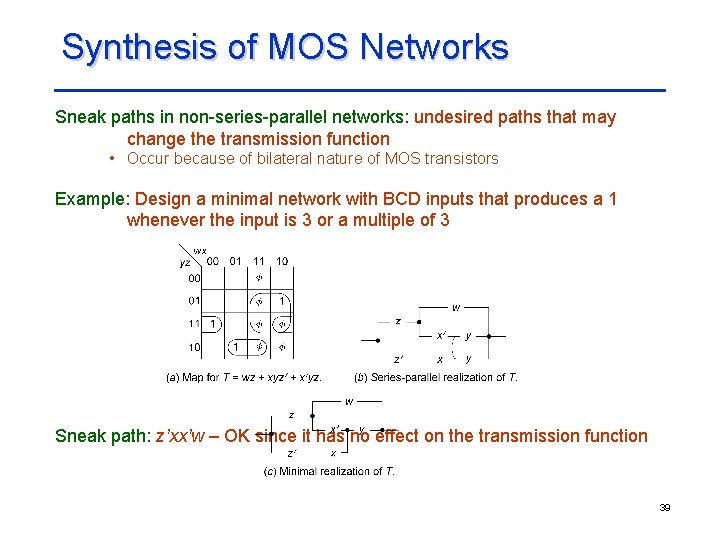
Synthesis of MOS Networks Sneak paths in non-series-parallel networks: undesired paths that may change the transmission function • Occur because of bilateral nature of MOS transistors Example: Design a minimal network with BCD inputs that produces a 1 whenever the input is 3 or a multiple of 3 Sneak path: z’xx’w – OK since it has no effect on the transmission function 39
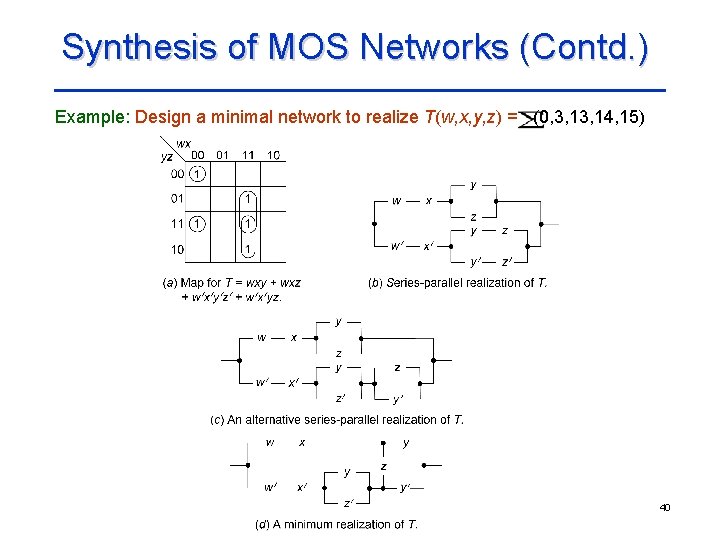
Synthesis of MOS Networks (Contd. ) Example: Design a minimal network to realize T(w, x, y, z) = (0, 3, 14, 15) 40

41

42
- Slides: 42