
Digital Design Computer Arch Lecture 7 a Sequential
- Slides: 38
Digital Design & Computer Arch. Lecture 7 a: Sequential Logic Design II Prof. Onur Mutlu ETH Zürich Spring 2020 12 March 2020
Agenda for This Week n Today q Wrap up Sequential Logic q Hardware Description Languages and Verilog n n n Combinational Logic Sequential Logic Tomorrow q Timing and Verification 2
Agenda for Next Week n Thursday q q Von Neumann Model of Execution Instruction Set Architecture n n LC-3 and MIPS Friday q ISA and Assembly Programming 3
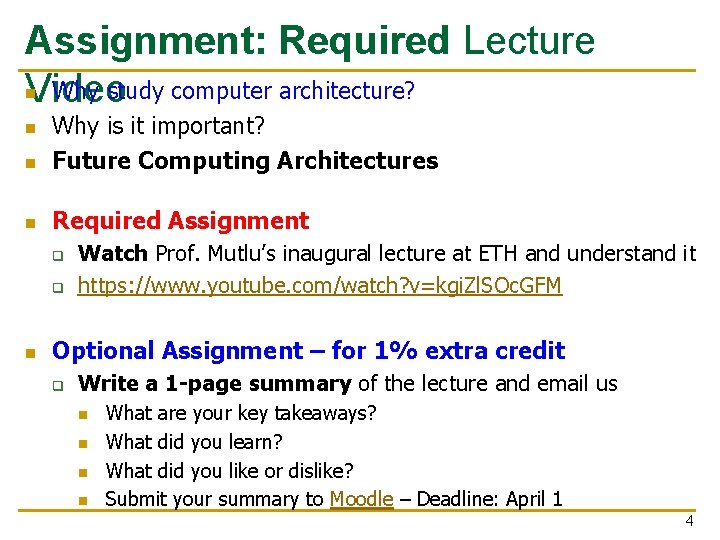
Assignment: Required Lecture n Why study computer architecture? Video n Why is it important? Future Computing Architectures n Required Assignment n q q n Watch Prof. Mutlu’s inaugural lecture at ETH and understand it https: //www. youtube. com/watch? v=kgi. Zl. SOc. GFM Optional Assignment – for 1% extra credit q Write a 1 -page summary of the lecture and email us n n What are your key takeaways? What did you learn? What did you like or dislike? Submit your summary to Moodle – Deadline: April 1 4
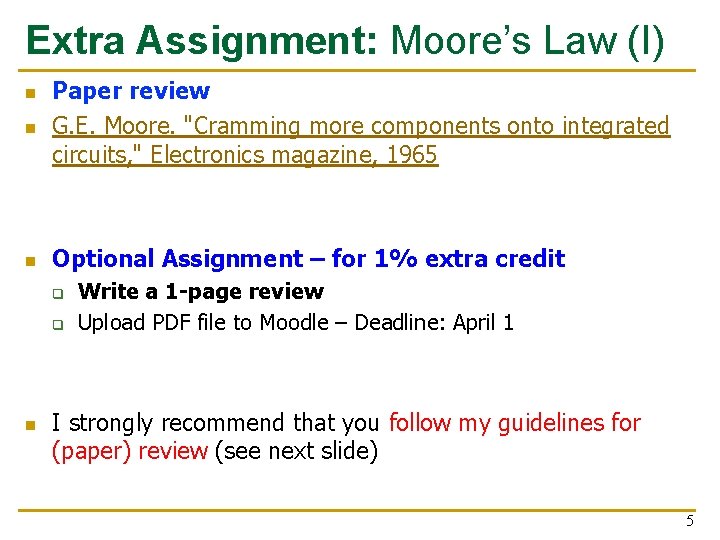
Extra Assignment: Moore’s Law (I) n Paper review G. E. Moore. "Cramming more components onto integrated circuits, " Electronics magazine, 1965 n Optional Assignment – for 1% extra credit n q q n Write a 1 -page review Upload PDF file to Moodle – Deadline: April 1 I strongly recommend that you follow my guidelines for (paper) review (see next slide) 5
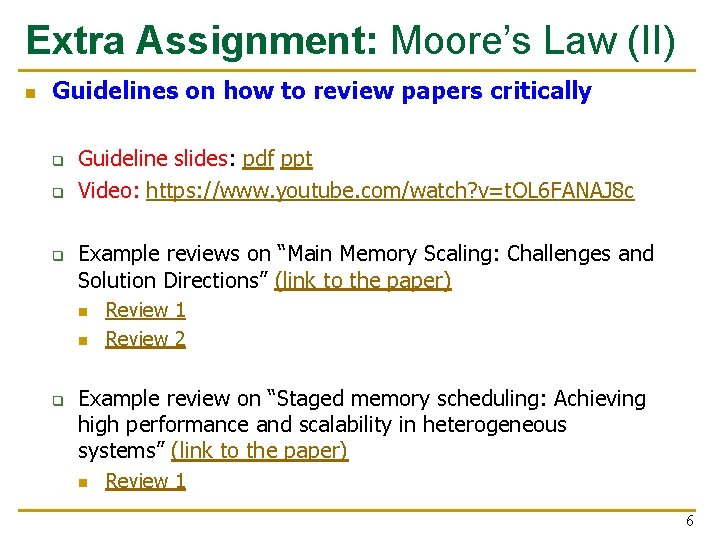
Extra Assignment: Moore’s Law (II) n Guidelines on how to review papers critically q q q Guideline slides: pdf ppt Video: https: //www. youtube. com/watch? v=t. OL 6 FANAJ 8 c Example reviews on “Main Memory Scaling: Challenges and Solution Directions” (link to the paper) n n q Review 1 Review 2 Example review on “Staged memory scheduling: Achieving high performance and scalability in heterogeneous systems” (link to the paper) n Review 1 6
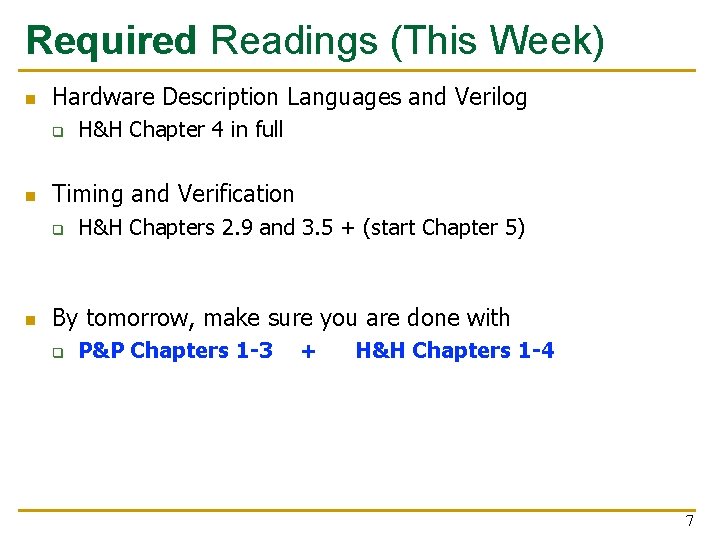
Required Readings (This Week) n Hardware Description Languages and Verilog q n Timing and Verification q n H&H Chapter 4 in full H&H Chapters 2. 9 and 3. 5 + (start Chapter 5) By tomorrow, make sure you are done with q P&P Chapters 1 -3 + H&H Chapters 1 -4 7
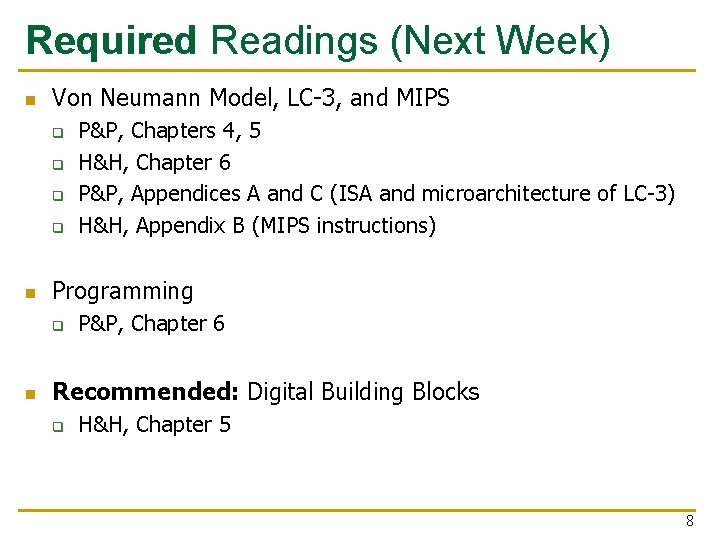
Required Readings (Next Week) n Von Neumann Model, LC-3, and MIPS q q n Programming q n P&P, Chapters 4, 5 H&H, Chapter 6 P&P, Appendices A and C (ISA and microarchitecture of LC-3) H&H, Appendix B (MIPS instructions) P&P, Chapter 6 Recommended: Digital Building Blocks q H&H, Chapter 5 8
Wrap-Up Sequential Logic Circuits and Design 9
Finite State Machine: Schematic 10
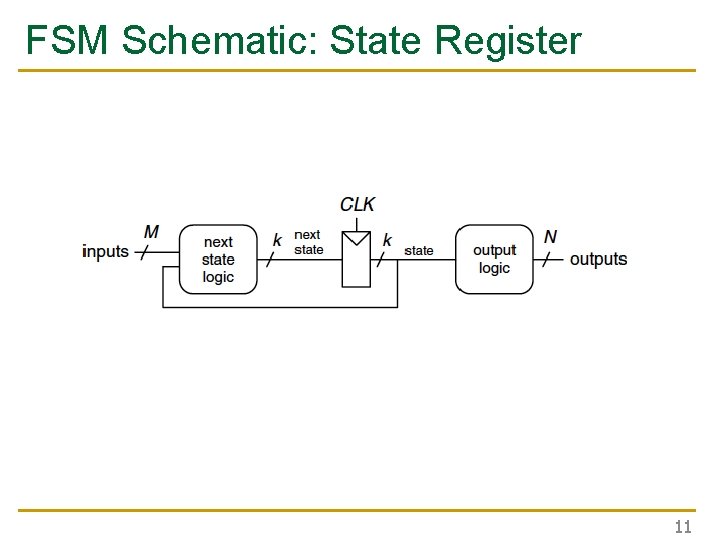
FSM Schematic: State Register 11
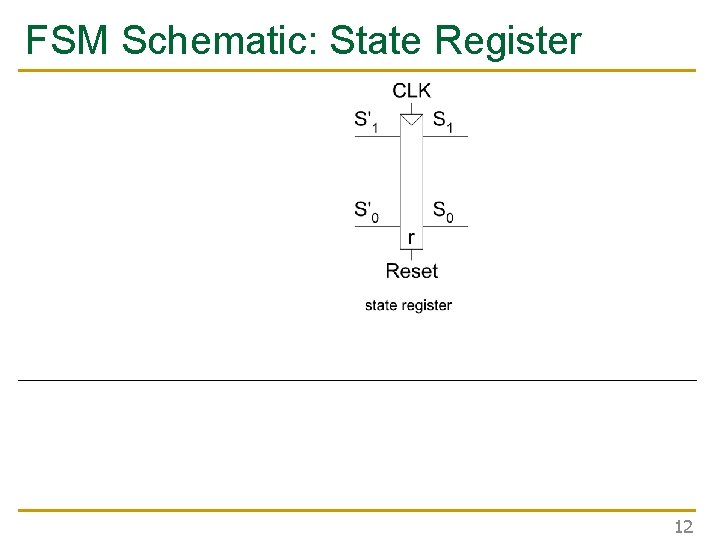
FSM Schematic: State Register 12
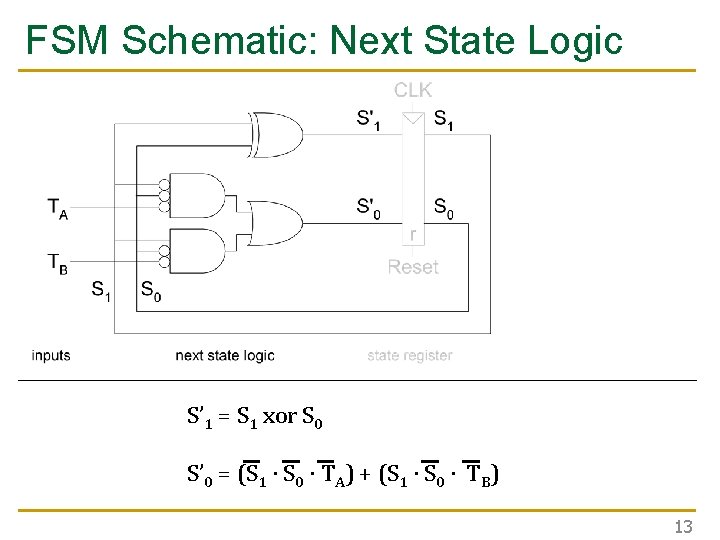
FSM Schematic: Next State Logic S’ 1 = S 1 xor S 0 S’ 0 = (S 1 ∙ S 0 ∙ TA) + (S 1 ∙ S 0 ∙ TB) 13
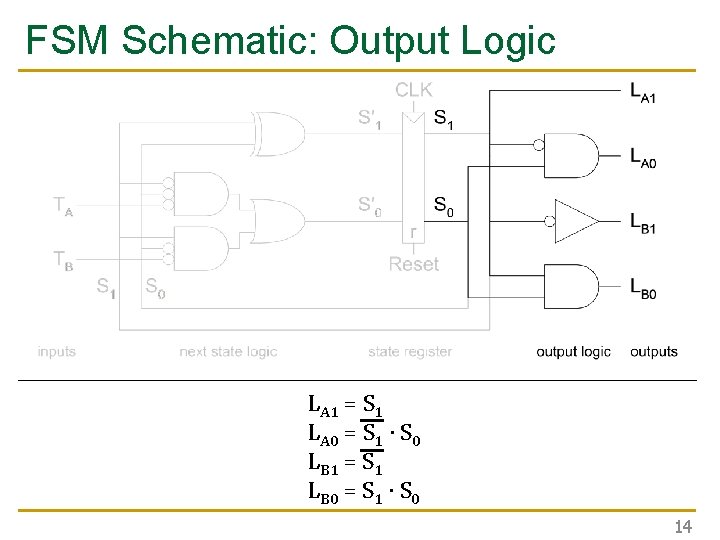
FSM Schematic: Output Logic LA 1 = S 1 LA 0 = S 1 ∙ S 0 LB 1 = S 1 LB 0 = S 1 ∙ S 0 14
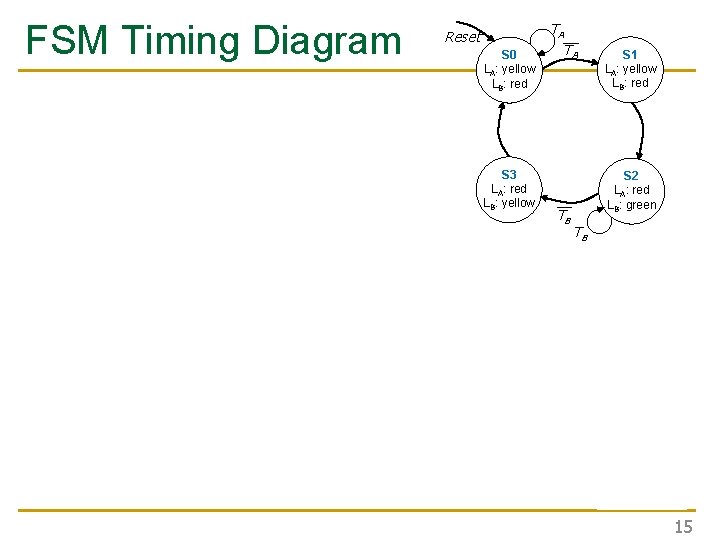
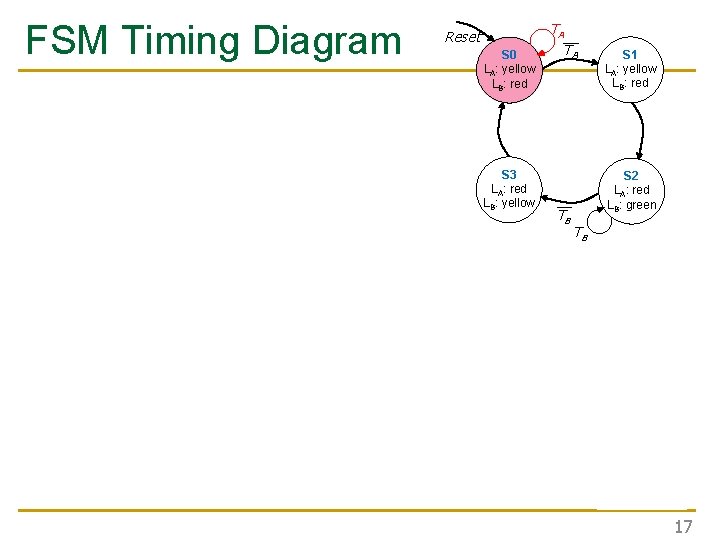
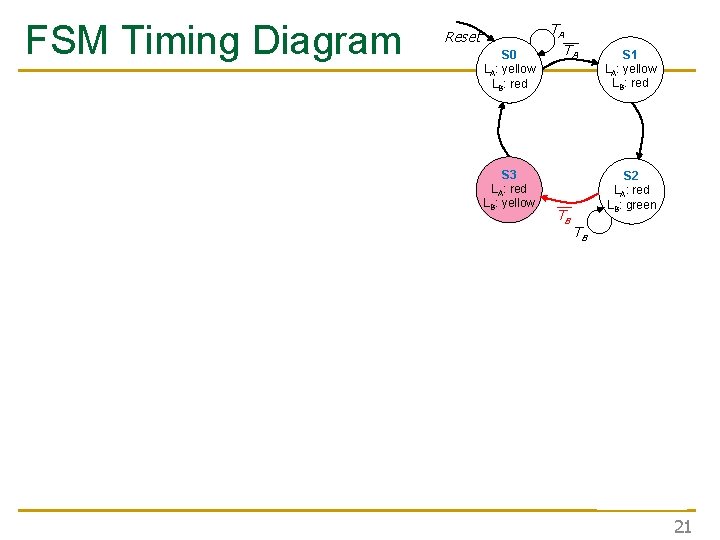
FSM Timing Diagram Reset S 0 LA: yellow LB: red S 3 LA: red LB: yellow TA__ TA S 2 LA: red LB: green __ TB S 1 LA: yellow LB: red TB 15
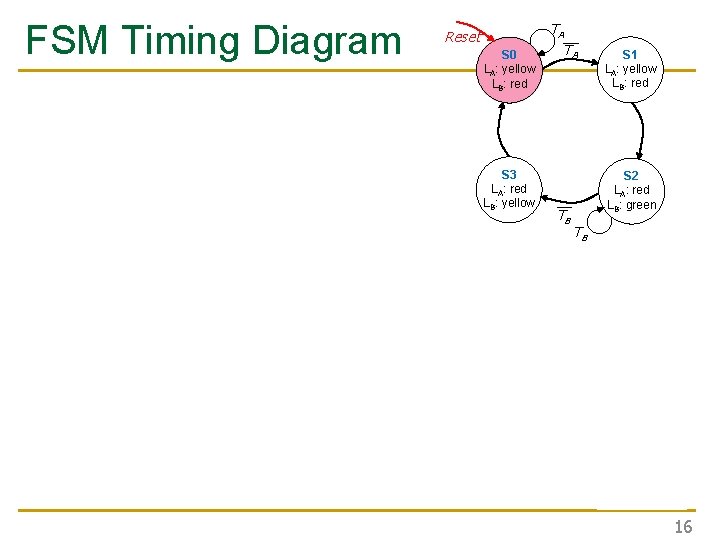
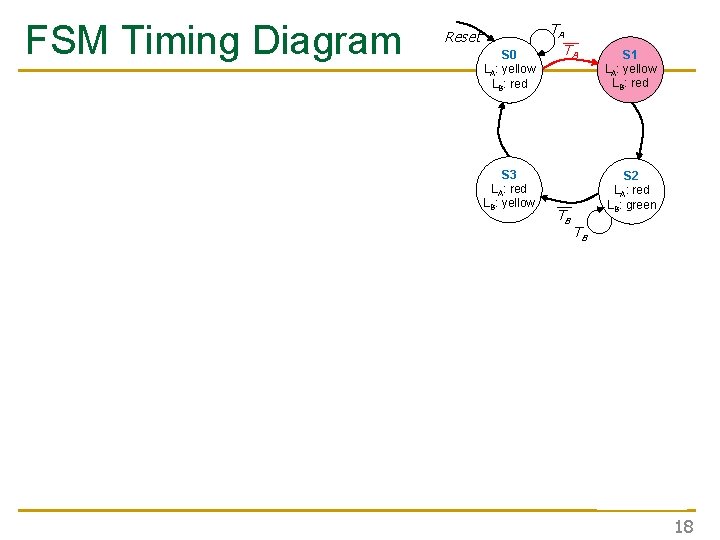
FSM Timing Diagram Reset S 0 LA: yellow LB: red S 3 LA: red LB: yellow TA__ TA S 2 LA: red LB: green __ TB S 1 LA: yellow LB: red TB 16
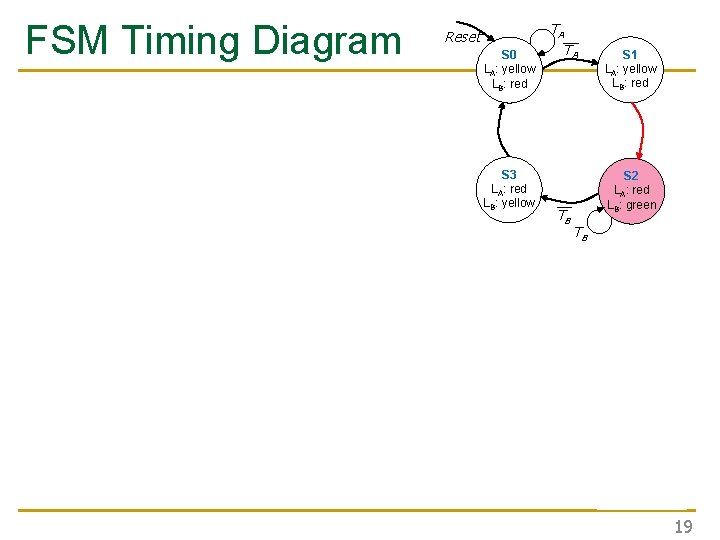
FSM Timing Diagram Reset S 0 LA: yellow LB: red S 3 LA: red LB: yellow TA__ TA S 2 LA: red LB: green __ TB S 1 LA: yellow LB: red TB 17
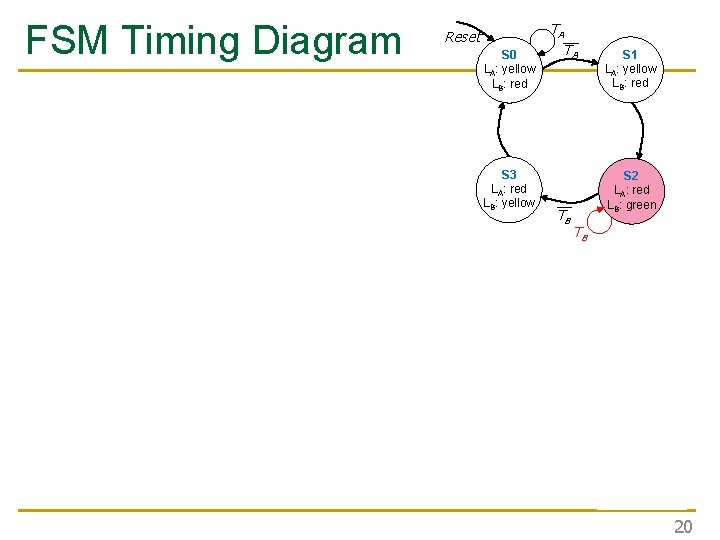
FSM Timing Diagram Reset S 0 LA: yellow LB: red S 3 LA: red LB: yellow TA__ TA S 2 LA: red LB: green __ TB S 1 LA: yellow LB: red TB 18
FSM Timing Diagram Reset S 0 LA: yellow LB: red S 3 LA: red LB: yellow TA__ TA S 2 LA: red LB: green __ TB S 1 LA: yellow LB: red TB 19
FSM Timing Diagram Reset S 0 LA: yellow LB: red S 3 LA: red LB: yellow TA__ TA S 2 LA: red LB: green __ TB S 1 LA: yellow LB: red TB 20
FSM Timing Diagram Reset S 0 LA: yellow LB: red S 3 LA: red LB: yellow TA__ TA S 2 LA: red LB: green __ TB S 1 LA: yellow LB: red TB 21
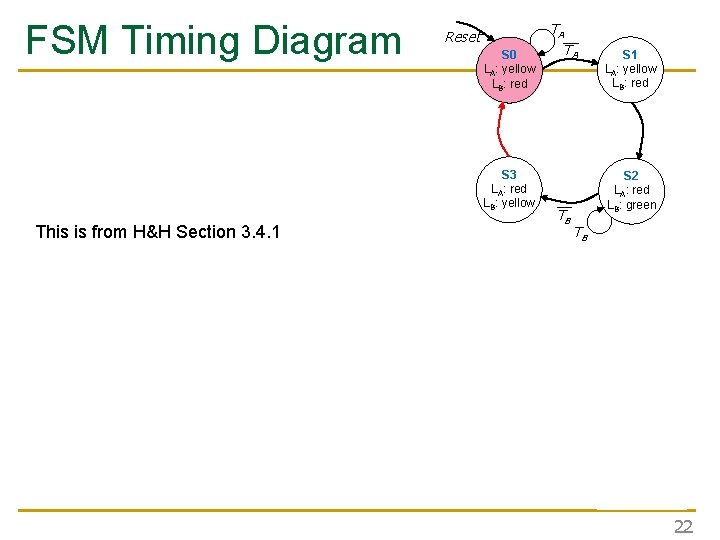
FSM Timing Diagram Reset S 0 LA: yellow LB: red S 3 LA: red LB: yellow This is from H&H Section 3. 4. 1 TA__ TA S 2 LA: red LB: green __ TB S 1 LA: yellow LB: red TB 22
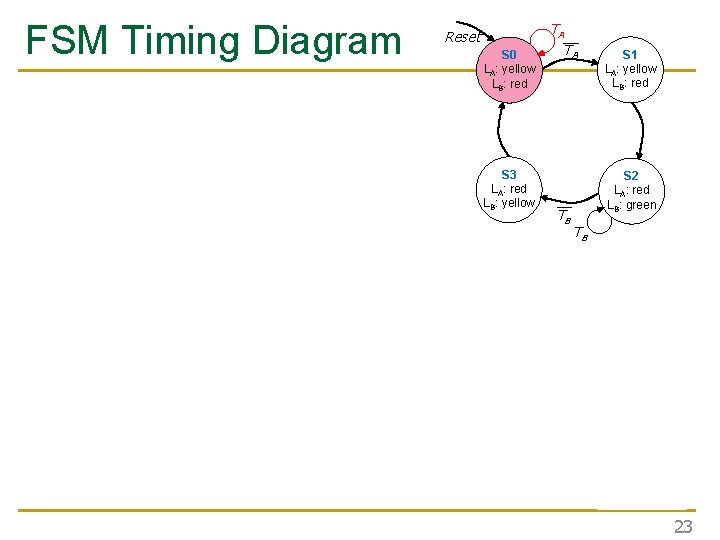
FSM Timing Diagram Reset S 0 LA: yellow LB: red S 3 LA: red LB: yellow TA__ TA S 2 LA: red LB: green __ TB S 1 LA: yellow LB: red TB 23
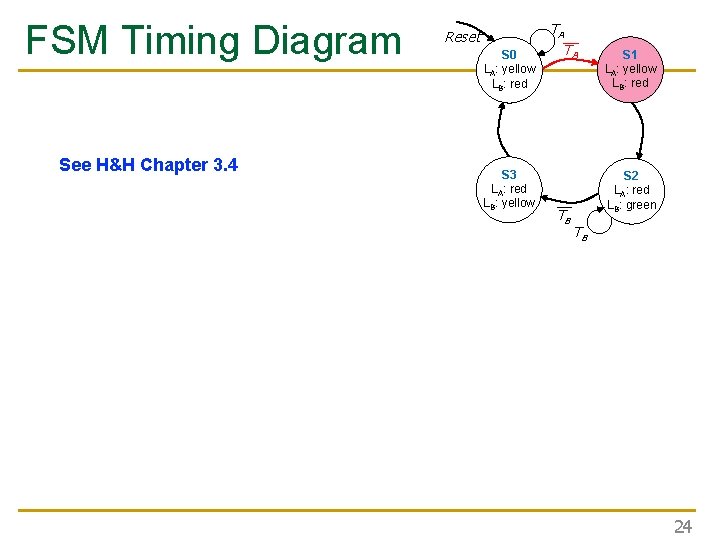
FSM Timing Diagram See H&H Chapter 3. 4 Reset S 0 LA: yellow LB: red S 3 LA: red LB: yellow TA__ TA S 2 LA: red LB: green __ TB S 1 LA: yellow LB: red TB 24
Finite State Machine: State Encoding 25
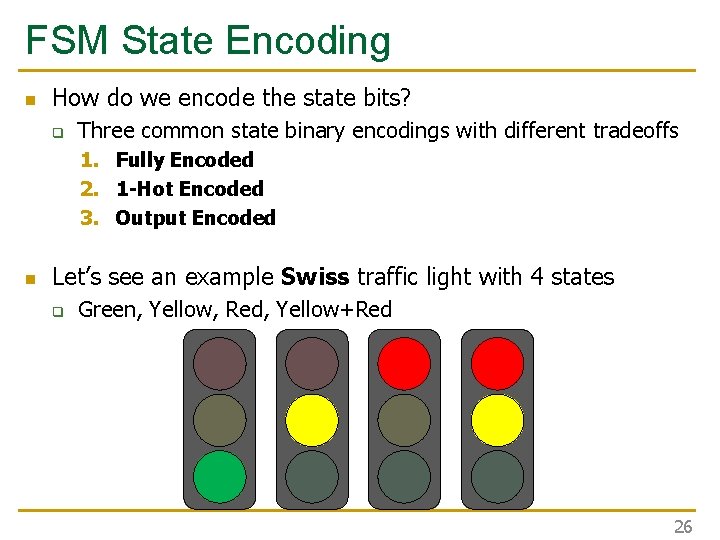
FSM State Encoding n How do we encode the state bits? q Three common state binary encodings with different tradeoffs 1. Fully Encoded 2. 1 -Hot Encoded 3. Output Encoded n Let’s see an example Swiss traffic light with 4 states q Green, Yellow, Red, Yellow+Red 26
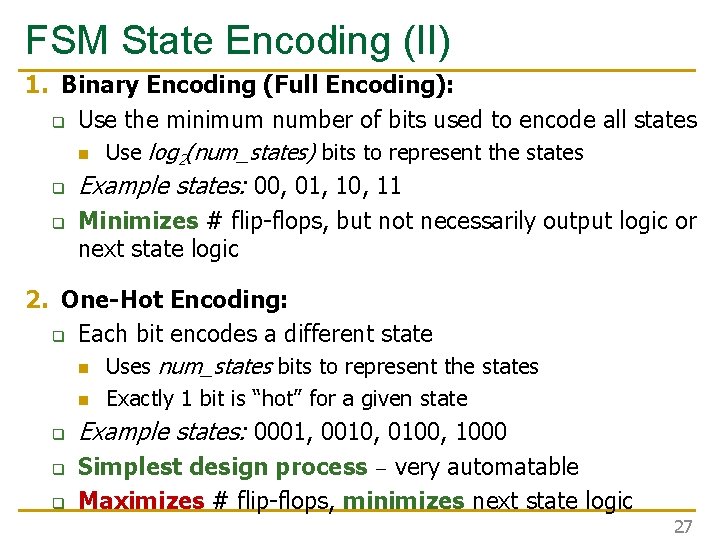
FSM State Encoding (II) 1. Binary Encoding (Full Encoding): q Use the minimum number of bits used to encode all states n Use log 2(num_states) bits to represent the states q Example states: 00, 01, 10, 11 q Minimizes # flip-flops, but not necessarily output logic or next state logic 2. One-Hot Encoding: q Each bit encodes a different state n Uses num_states bits to represent the states n q q q Exactly 1 bit is “hot” for a given state Example states: 0001, 0010, 0100, 1000 Simplest design process – very automatable Maximizes # flip-flops, minimizes next state logic 27
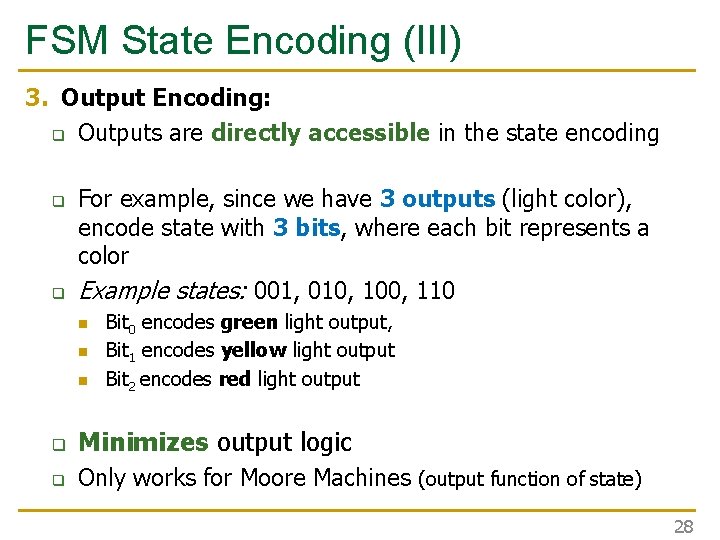
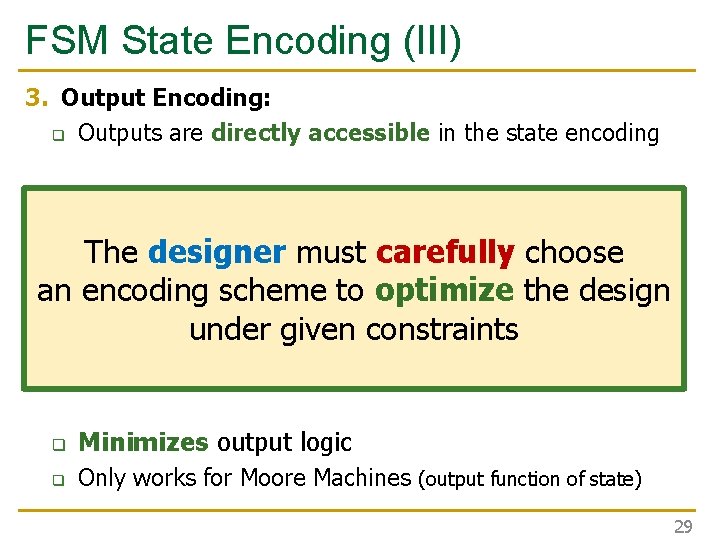
FSM State Encoding (III) 3. Output Encoding: q Outputs are directly accessible in the state encoding q q For example, since we have 3 outputs (light color), encode state with 3 bits, where each bit represents a color Example states: 001, 010, 100, 110 n n n Bit 0 encodes green light output, Bit 1 encodes yellow light output Bit 2 encodes red light output q Minimizes output logic q Only works for Moore Machines (output function of state) 28
FSM State Encoding (III) 3. Output Encoding: q Outputs are directly accessible in the state encoding For example, since we have 3 outputs (light color), encode state with 3 bits, where each bit represents a The designer must carefully choose color q Example states: 001, 010, 110 an encoding scheme to 100, optimize the design q n n n under given constraints Bit 0 encodes green light output, Bit 1 encodes yellow light output Bit 2 encodes red light output q Minimizes output logic q Only works for Moore Machines (output function of state) 29
Moore vs. Mealy Machines 30
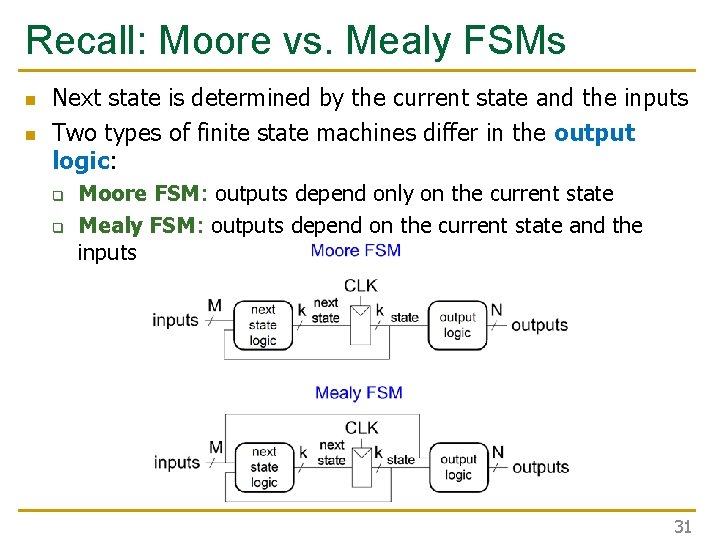
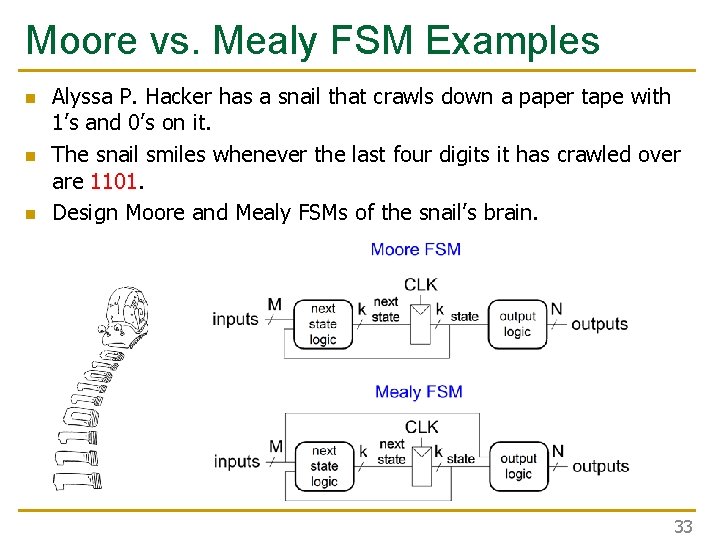
Recall: Moore vs. Mealy FSMs n n Next state is determined by the current state and the inputs Two types of finite state machines differ in the output logic: q q Moore FSM: outputs depend only on the current state Mealy FSM: outputs depend on the current state and the inputs 31
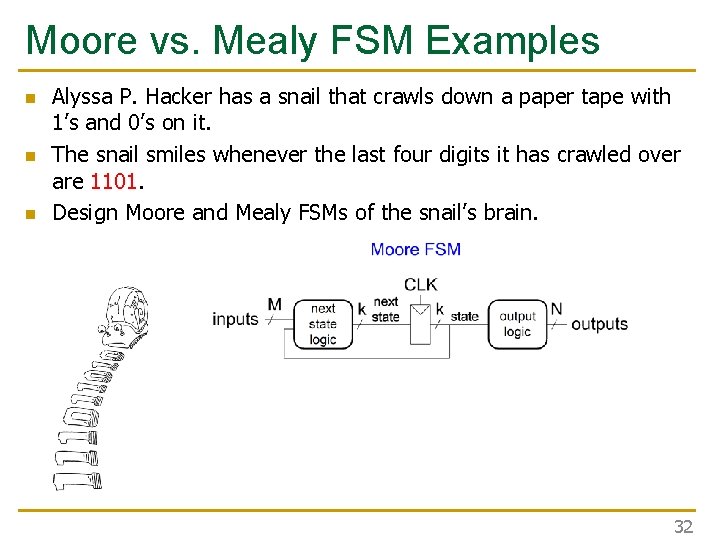
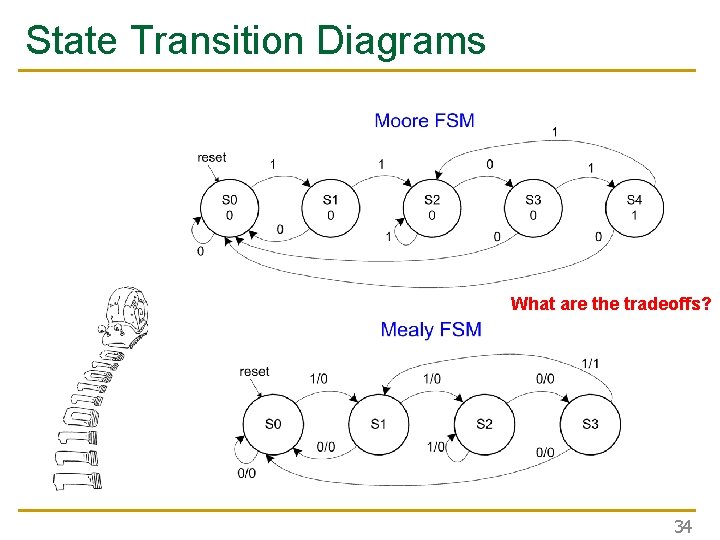
Moore vs. Mealy FSM Examples n n n Alyssa P. Hacker has a snail that crawls down a paper tape with 1’s and 0’s on it. The snail smiles whenever the last four digits it has crawled over are 1101. Design Moore and Mealy FSMs of the snail’s brain. 32
Moore vs. Mealy FSM Examples n n n Alyssa P. Hacker has a snail that crawls down a paper tape with 1’s and 0’s on it. The snail smiles whenever the last four digits it has crawled over are 1101. Design Moore and Mealy FSMs of the snail’s brain. 33
State Transition Diagrams What are the tradeoffs? 34
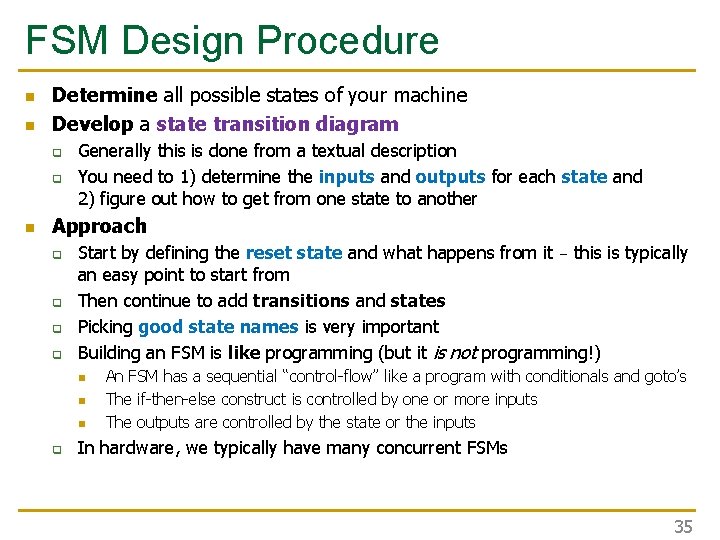
FSM Design Procedure n n Determine all possible states of your machine Develop a state transition diagram q q n Generally this is done from a textual description You need to 1) determine the inputs and outputs for each state and 2) figure out how to get from one state to another Approach q q Start by defining the reset state and what happens from it – this is typically an easy point to start from Then continue to add transitions and states Picking good state names is very important Building an FSM is like programming (but it is not programming!) n n n q An FSM has a sequential “control-flow” like a program with conditionals and goto’s The if-then-else construct is controlled by one or more inputs The outputs are controlled by the state or the inputs In hardware, we typically have many concurrent FSMs 35
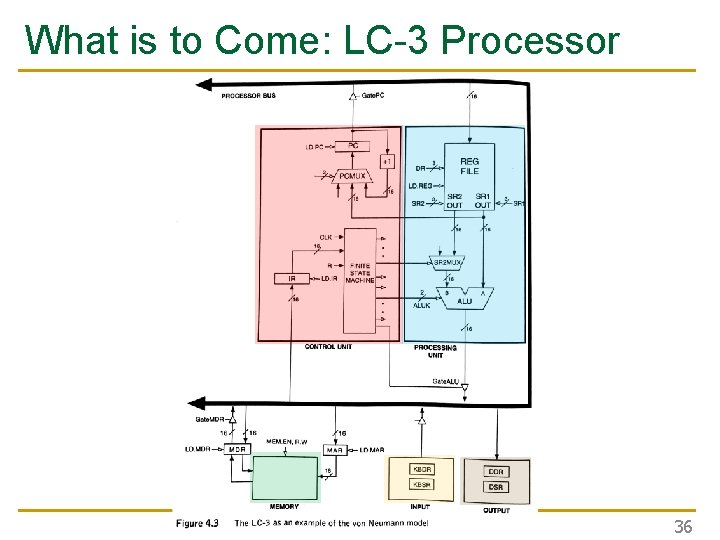
What is to Come: LC-3 Processor 36
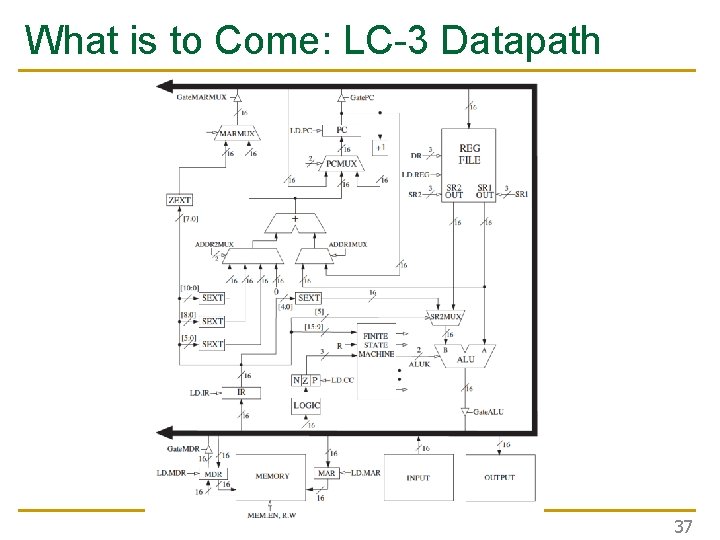
What is to Come: LC-3 Datapath 37
Digital Design & Computer Arch. Lecture 7 a: Sequential Logic Design II Prof. Onur Mutlu ETH Zürich Spring 2020 12 March 2020