
Digital Design Computer Arch Lecture 6 Sequential Logic

![Putting it all Together Let’s enable reading and writing to a memory array Addr[0]](https://slidetodoc.com/presentation_image_h2/0e5b93ac8f040d7af2f3526f799c761a/image-37.jpg "Putting it all Together Let’s enable reading and writing to a memory array Addr[0]")
![A Bigger Memory Array (4 locations X 3 bits) Addr[1: 0] Di[1] Di[2] Di[0]](https://slidetodoc.com/presentation_image_h2/0e5b93ac8f040d7af2f3526f799c761a/image-38.jpg "A Bigger Memory Array (4 locations X 3 bits) Addr[1: 0] Di[1] Di[2] Di[0]")
![A Bigger Memory Array (4 locations X 3 bits) Addr[1: 0] Di[1] Di[2] Di[0]](https://slidetodoc.com/presentation_image_h2/0e5b93ac8f040d7af2f3526f799c761a/image-39.jpg "A Bigger Memory Array (4 locations X 3 bits) Addr[1: 0] Di[1] Di[2] Di[0]")
- Slides: 126
Digital Design & Computer Arch. Lecture 6: Sequential Logic Design Prof. Onur Mutlu ETH Zürich Spring 2021 12 March 2021
We Are Done with This n Building blocks of modern computers q q Transistors Logic gates n Combinational circuits n Boolean algebra n n How to use Boolean algebra to represent combinational circuits Minimizing logic circuits 2
Agenda for Today and Next Week n Today q n Start (and finish) Sequential Logic Next week q Hardware Description Languages and Verilog n n q Combinational Logic Sequential Logic Timing and Verification 3
Assignment: Required Lecture n Why study computer architecture? Why is it important? Video n Future Computing Platforms: Challenges & Opportunities n Required Assignment q q q n Watch one of Prof. Mutlu’s lectures and analyze either (or both) https: //www. youtube. com/watch? v=kgi. Zl. SOc. GFM (May 2017) https: //www. youtube. com/watch? v=msk. Te. Nnf-i 0 (Feb 2021) Optional Assignment – for 1% extra credit q Write a 1 -page summary of one of the lectures and email us n n What are your key takeaways? What did you learn? What did you like or dislike? Submit your summary to Moodle – Deadline: April 5 4
Extra Assignment: Moore’s Law (I) n Paper review G. E. Moore. "Cramming more components onto integrated circuits, " Electronics magazine, 1965 n Optional Assignment – for 1% extra credit n q q n Write a 1 -page review Upload PDF file to Moodle – Deadline: April 5 I strongly recommend that you follow my guidelines for (paper) review (see next slide) 5
Extra Assignment 2: Moore’s Law n Guidelines on how to review papers critically (II) q q q Guideline slides: pdf ppt Video: https: //www. youtube. com/watch? v=t. OL 6 FANAJ 8 c Example reviews on “Main Memory Scaling: Challenges and Solution Directions” (link to the paper) n n q Review 1 Review 2 Example review on “Staged memory scheduling: Achieving high performance and scalability in heterogeneous systems” (link to the paper) n Review 1 6
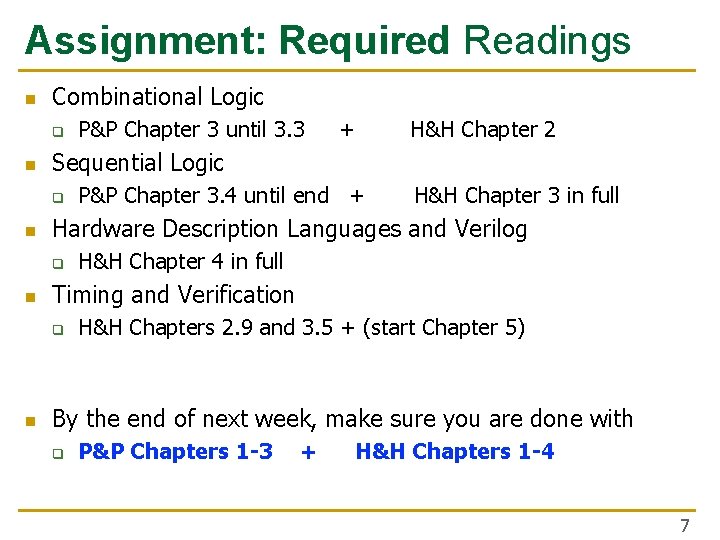
Assignment: Required Readings n Combinational Logic q n P&P Chapter 3. 4 until end + H&H Chapter 3 in full H&H Chapter 4 in full Timing and Verification q n H&H Chapter 2 Hardware Description Languages and Verilog q n + Sequential Logic q n P&P Chapter 3 until 3. 3 H&H Chapters 2. 9 and 3. 5 + (start Chapter 5) By the end of next week, make sure you are done with q P&P Chapters 1 -3 + H&H Chapters 1 -4 7
Required Readings (for Next Week) n Hardware Description Languages and Verilog q n Timing and Verification q n H&H Chapter 4 in full H&H Chapters 2. 9 and 3. 5 + (start Chapter 5) By tomorrow, make sure you are done with q P&P Chapters 1 -3 + H&H Chapters 1 -4 8
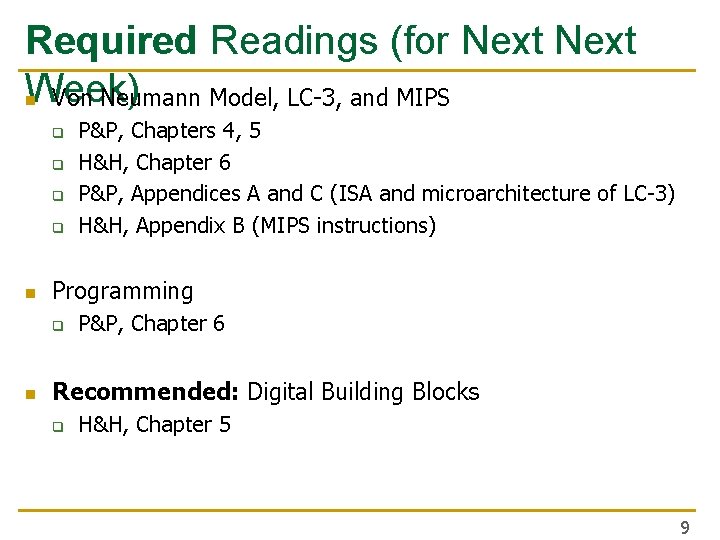
Required Readings (for Next Week) n Von Neumann Model, LC-3, and MIPS q q n Programming q n P&P, Chapters 4, 5 H&H, Chapter 6 P&P, Appendices A and C (ISA and microarchitecture of LC-3) H&H, Appendix B (MIPS instructions) P&P, Chapter 6 Recommended: Digital Building Blocks q H&H, Chapter 5 9
Sequential Logic Circuits and Design 10
What We Will Learn Today n Circuits that can store information q q q n Finite State Machines (FSM) q q n Cross-coupled inverter R-S Latch Gated D Latch D Flip-Flop Register Moore Machine Mealy Machine Verilog implementations of sequential circuits (next week) 11
Circuits that Can Store Information 12
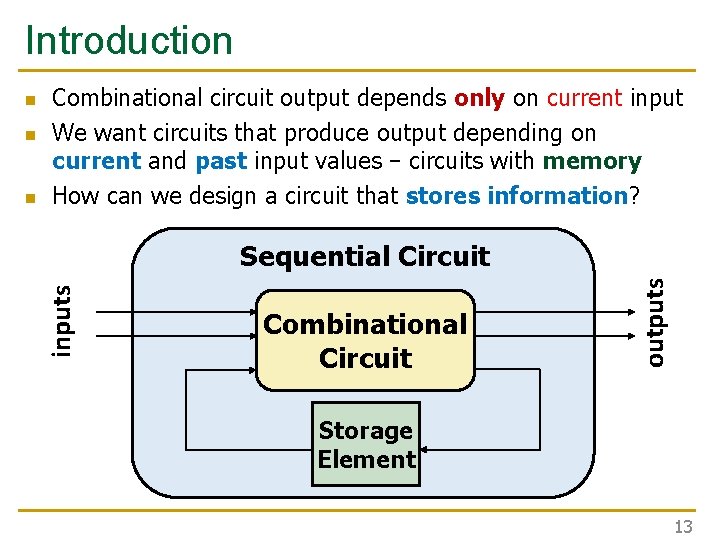
Introduction n Sequential Circuit Combinational Circuit outputs n Combinational circuit output depends only on current input We want circuits that produce output depending on current and past input values – circuits with memory How can we design a circuit that stores information? inputs n Storage Element 13
Capturing Data 14
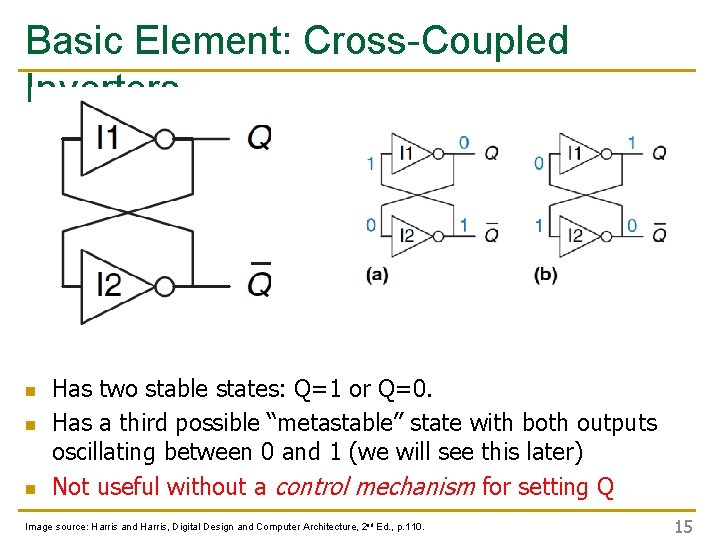
Basic Element: Cross-Coupled Inverters n n n Has two stable states: Q=1 or Q=0. Has a third possible “metastable” state with both outputs oscillating between 0 and 1 (we will see this later) Not useful without a control mechanism for setting Q Image source: Harris and Harris, Digital Design and Computer Architecture, 2 nd Ed. , p. 110. 15
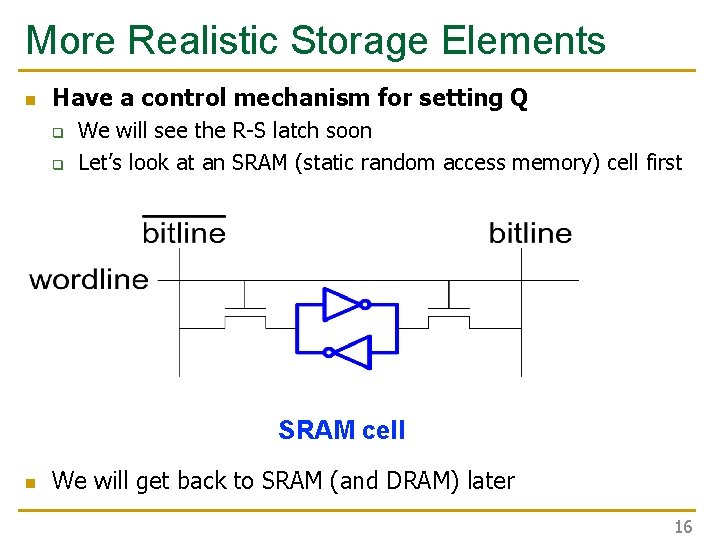
More Realistic Storage Elements n Have a control mechanism for setting Q q q We will see the R-S latch soon Let’s look at an SRAM (static random access memory) cell first SRAM cell n We will get back to SRAM (and DRAM) later 16
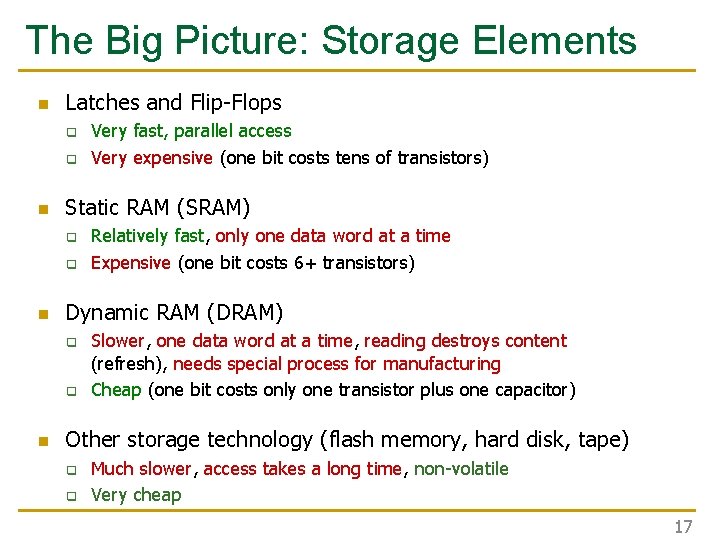
The Big Picture: Storage Elements n Latches and Flip-Flops q q n Static RAM (SRAM) q q n Relatively fast, only one data word at a time Expensive (one bit costs 6+ transistors) Dynamic RAM (DRAM) q q n Very fast, parallel access Very expensive (one bit costs tens of transistors) Slower, one data word at a time, reading destroys content (refresh), needs special process for manufacturing Cheap (one bit costs only one transistor plus one capacitor) Other storage technology (flash memory, hard disk, tape) q q Much slower, access takes a long time, non-volatile Very cheap 17
Basic Storage Element: The R-S Latch 18
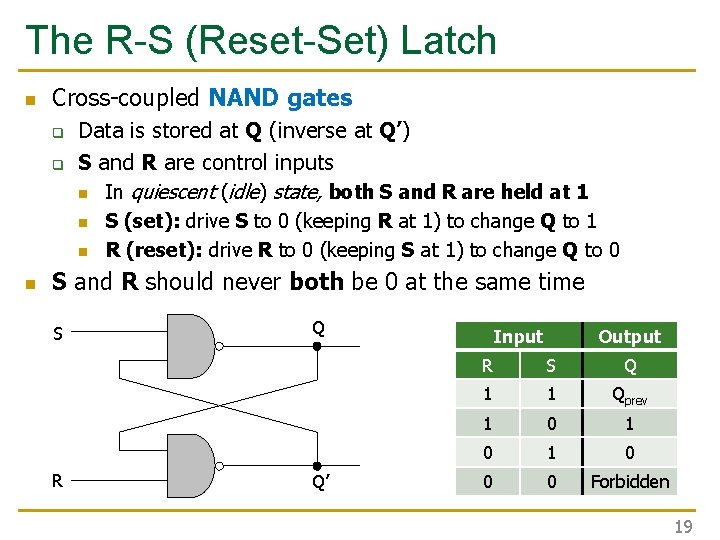
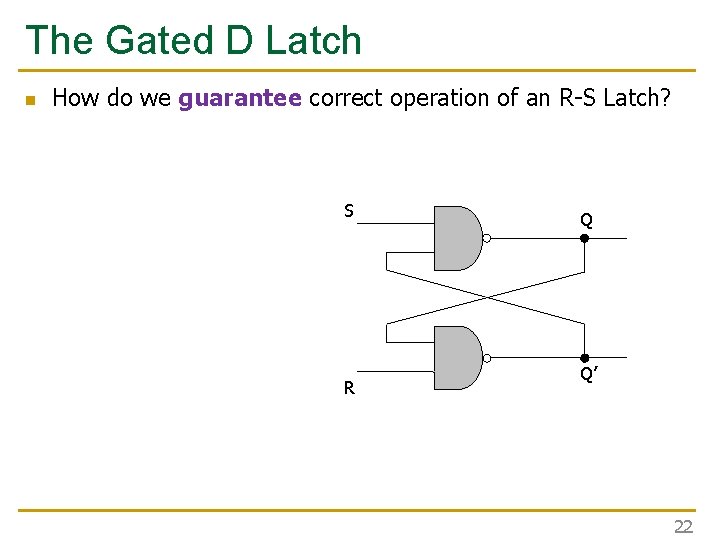
The R-S (Reset-Set) Latch n Cross-coupled NAND gates q q Data is stored at Q (inverse at Q’) S and R are control inputs n In quiescent (idle) state, both S and R are held at 1 n n n S (set): drive S to 0 (keeping R at 1) to change Q to 1 R (reset): drive R to 0 (keeping S at 1) to change Q to 0 S and R should never both be 0 at the same time S R Q Q’ Input Output R S Q 1 1 Qprev 1 0 1 0 0 0 Forbidden 19
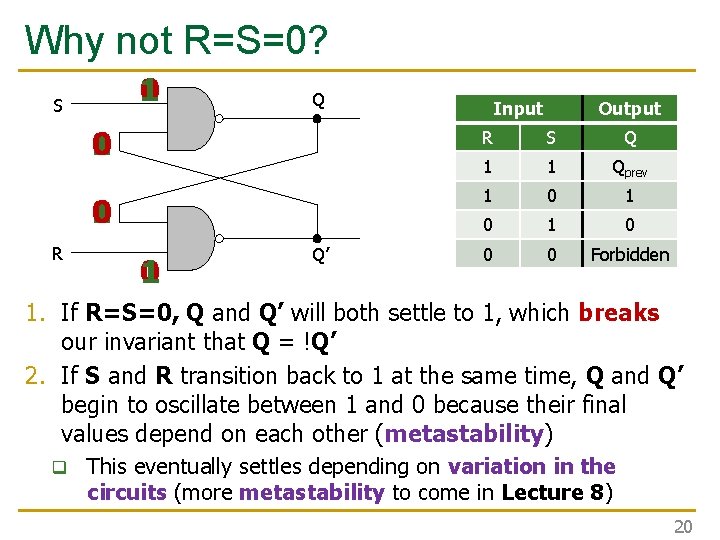
Why not R=S=0? 1 0 S R Q Input Output 1 0 R S Q 1 1 Qprev 1 0 1 0 0 0 Forbidden 1 0 Q’ 1. If R=S=0, Q and Q’ will both settle to 1, which breaks our invariant that Q = !Q’ 2. If S and R transition back to 1 at the same time, Q and Q’ begin to oscillate between 1 and 0 because their final values depend on each other (metastability) q This eventually settles depending on variation in the circuits (more metastability to come in Lecture 8) 20
The Gated D Latch 21
The Gated D Latch n How do we guarantee correct operation of an R-S Latch? S R Q Q’ 22
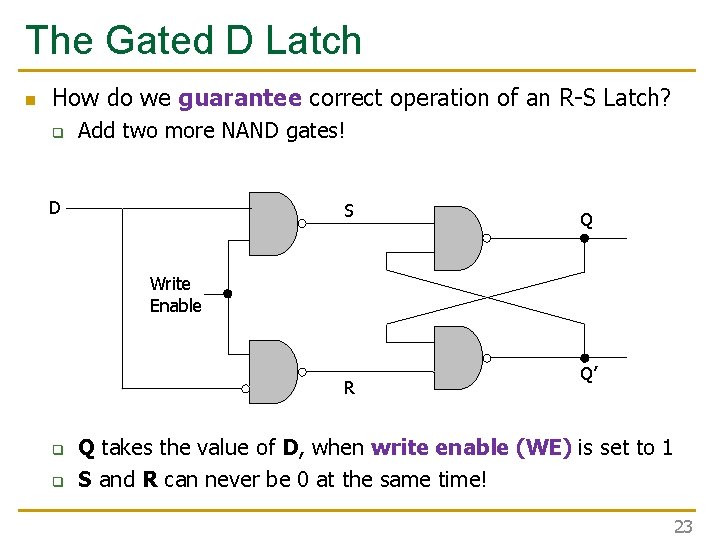
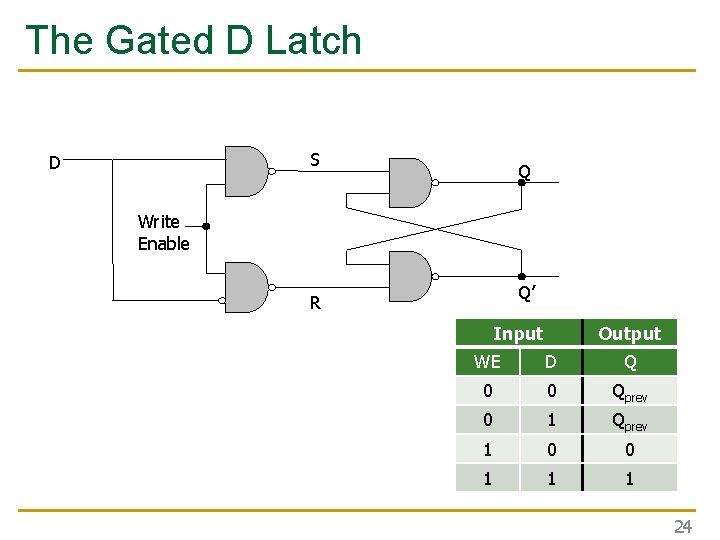
The Gated D Latch n How do we guarantee correct operation of an R-S Latch? q Add two more NAND gates! D S Q Write Enable R q q Q’ Q takes the value of D, when write enable (WE) is set to 1 S and R can never be 0 at the same time! 23
The Gated D Latch S D Q Write Enable Q’ R Input Output WE D Q 0 0 Qprev 0 1 Qprev 1 0 0 1 1 1 24
The Register 25
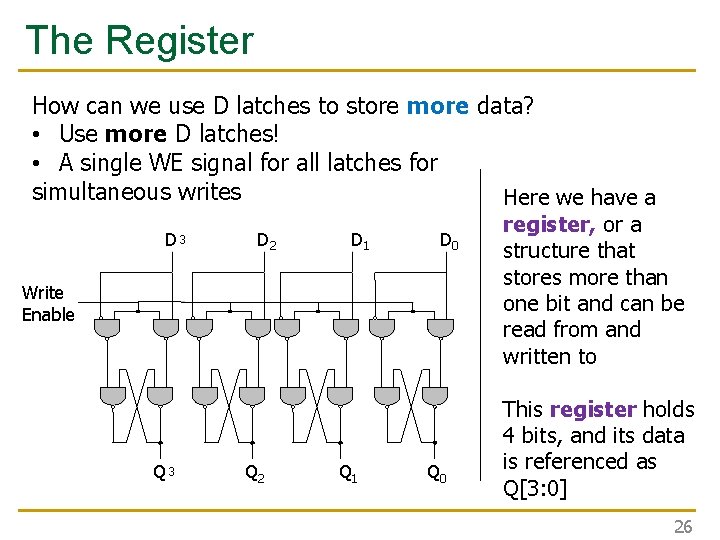
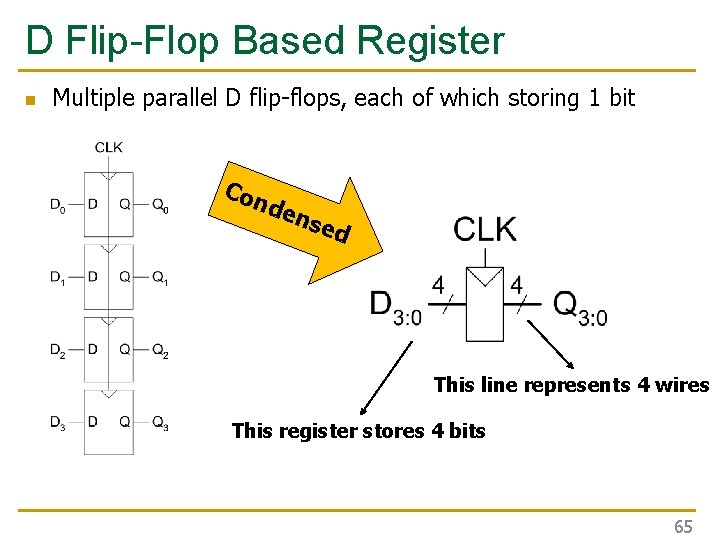
The Register How can we use D latches to store more data? • Use more D latches! • A single WE signal for all latches for simultaneous writes Here we have a D 3 D 2 D 1 D 0 Write Enable Q 3 Q 2 Q 1 Q 0 register, or a structure that stores more than one bit and can be read from and written to This register holds 4 bits, and its data is referenced as Q[3: 0] 26
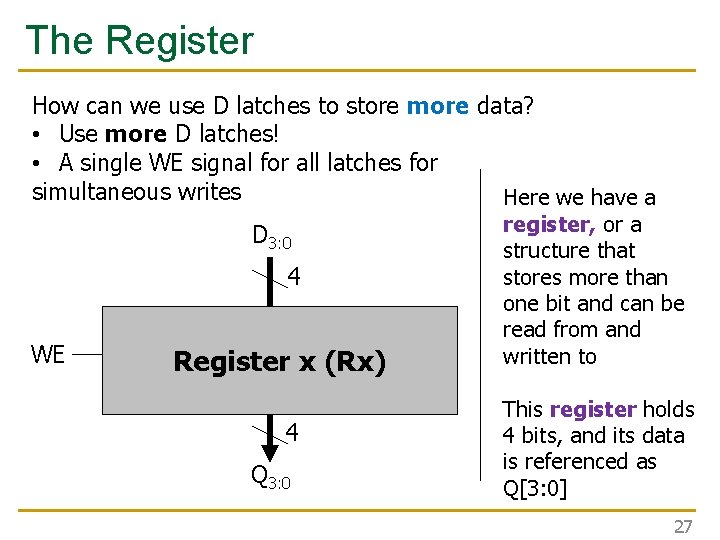
The Register How can we use D latches to store more data? • Use more D latches! • A single WE signal for all latches for simultaneous writes Here we have a D 3: 0 4 WE Register x (Rx) 4 Q 3: 0 register, or a structure that stores more than one bit and can be read from and written to This register holds 4 bits, and its data is referenced as Q[3: 0] 27
Memory 28
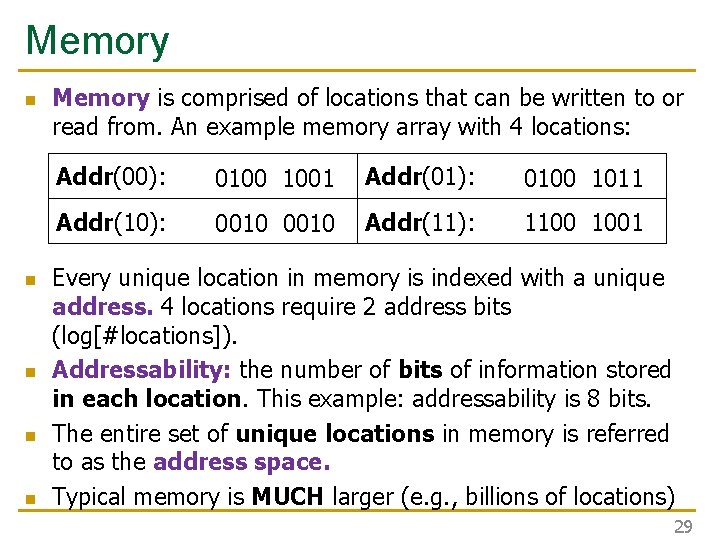
Memory n n n Memory is comprised of locations that can be written to or read from. An example memory array with 4 locations: Addr(00): 0100 1001 Addr(01): 0100 1011 Addr(10): 0010 Addr(11): 1100 1001 Every unique location in memory is indexed with a unique address. 4 locations require 2 address bits (log[#locations]). Addressability: the number of bits of information stored in each location. This example: addressability is 8 bits. The entire set of unique locations in memory is referred to as the address space. Typical memory is MUCH larger (e. g. , billions of locations) 29
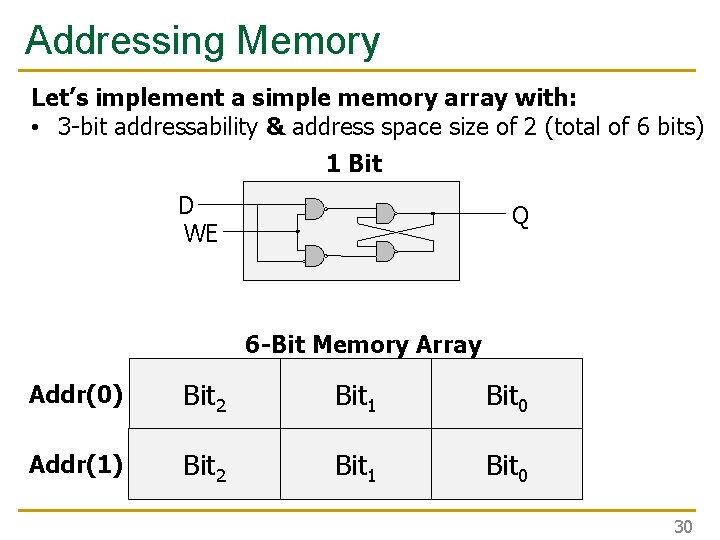
Addressing Memory Let’s implement a simple memory array with: • 3 -bit addressability & address space size of 2 (total of 6 bits) 1 Bit D WE Q 6 -Bit Memory Array Addr(0) Bit 2 Bit 1 Bit 0 Addr(1) Bit 2 Bit 1 Bit 0 30
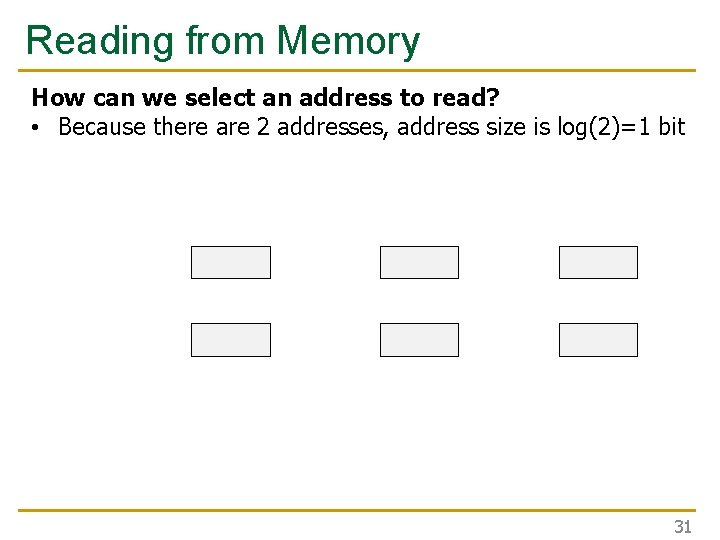
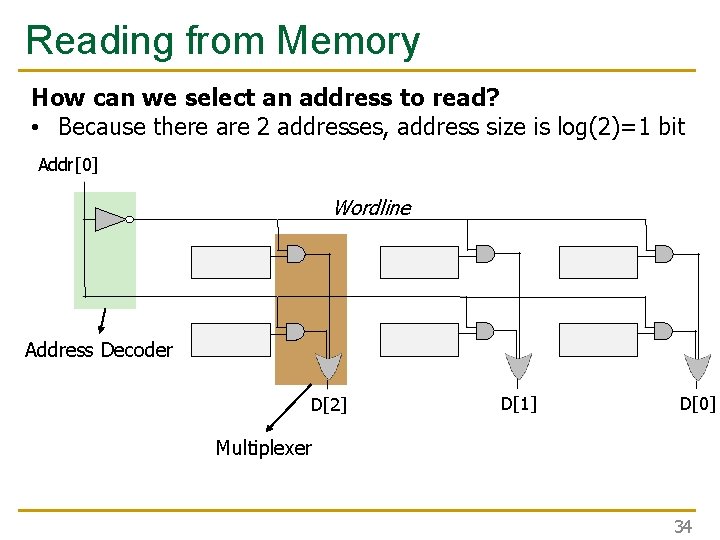
Reading from Memory How can we select an address to read? • Because there are 2 addresses, address size is log(2)=1 bit 31
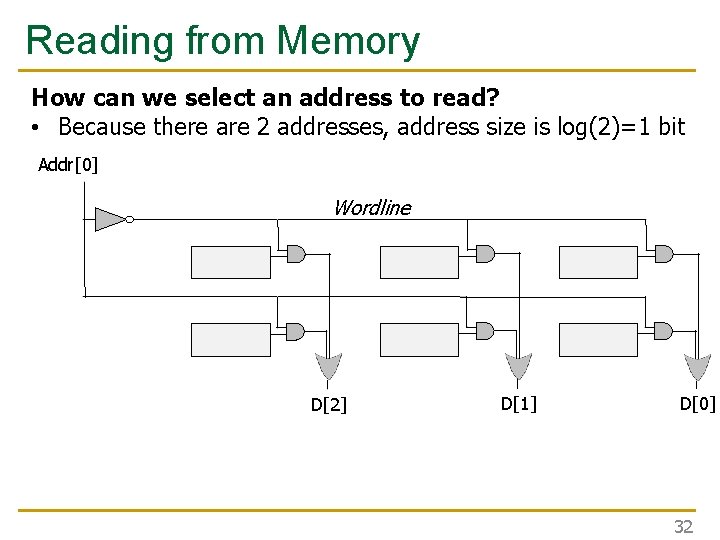
Reading from Memory How can we select an address to read? • Because there are 2 addresses, address size is log(2)=1 bit Addr[0] Wordline D[2] D[1] D[0] 32
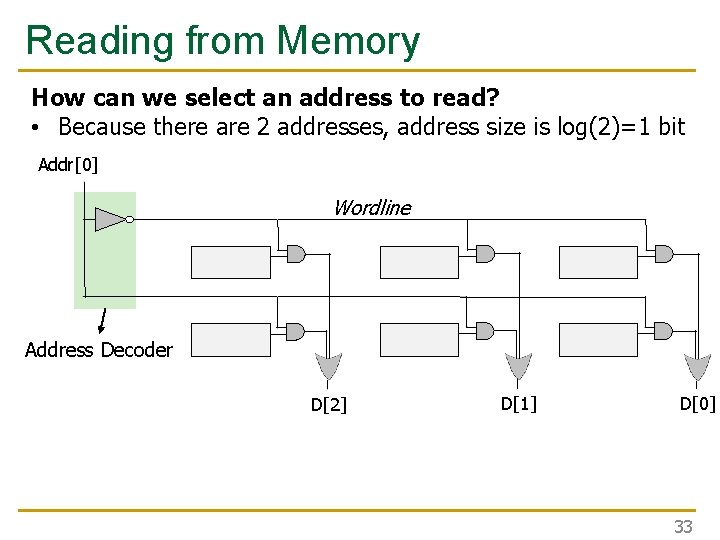
Reading from Memory How can we select an address to read? • Because there are 2 addresses, address size is log(2)=1 bit Addr[0] Wordline Address Decoder D[2] D[1] D[0] 33
Reading from Memory How can we select an address to read? • Because there are 2 addresses, address size is log(2)=1 bit Addr[0] Wordline Address Decoder D[2] D[1] D[0] Multiplexer 34
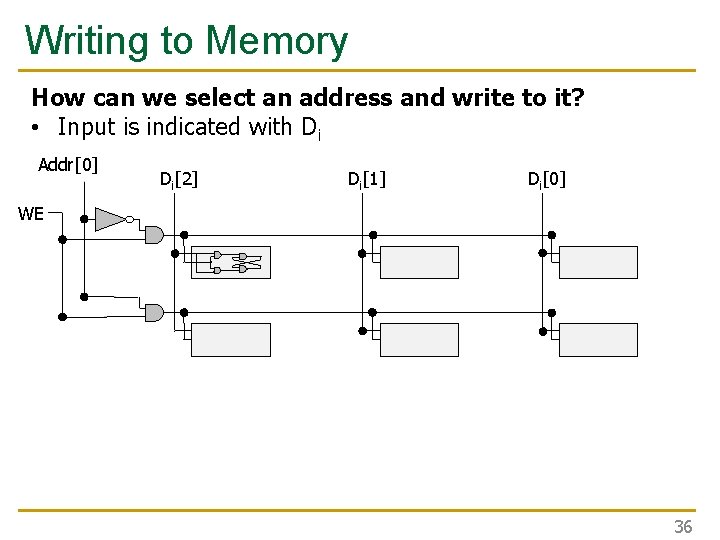
Writing to Memory How can we select an address and write to it? 35
Writing to Memory How can we select an address and write to it? • Input is indicated with Di Addr[0] Di[2] Di[1] Di[0] WE 36
Putting it all Together Let’s enable reading and writing to a memory array Addr[0] Di[1] Di[2] Di[0] WE D[2] D[1] D[0] 37
A Bigger Memory Array (4 locations X 3 bits) Addr[1: 0] Di[1] Di[2] Di[0] WE D[2] D[1] D[0] 38
A Bigger Memory Array (4 locations X 3 bits) Addr[1: 0] Di[1] Di[2] Di[0] WE Address Decoder Multiplexer D[2] D[1] D[0] 39
Aside: Implementing Logic Functions Using Memory 40
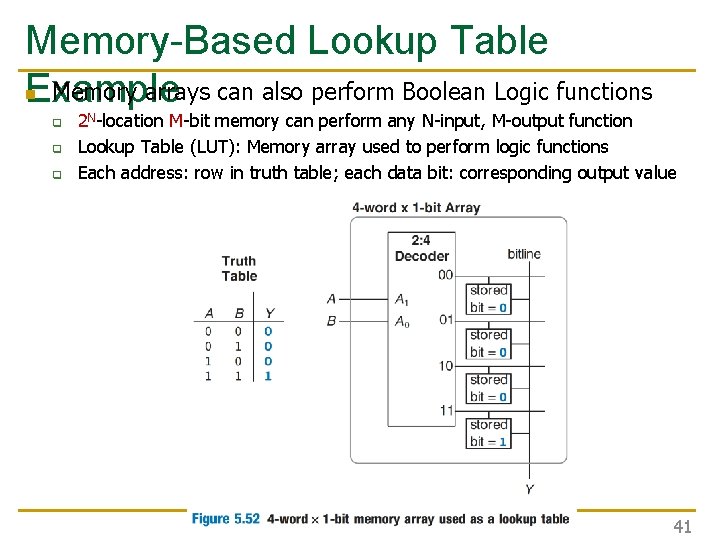
Memory-Based Lookup Table n Memory arrays can also perform Boolean Logic functions Example q q q 2 N-location M-bit memory can perform any N-input, M-output function Lookup Table (LUT): Memory array used to perform logic functions Each address: row in truth table; each data bit: corresponding output value 41
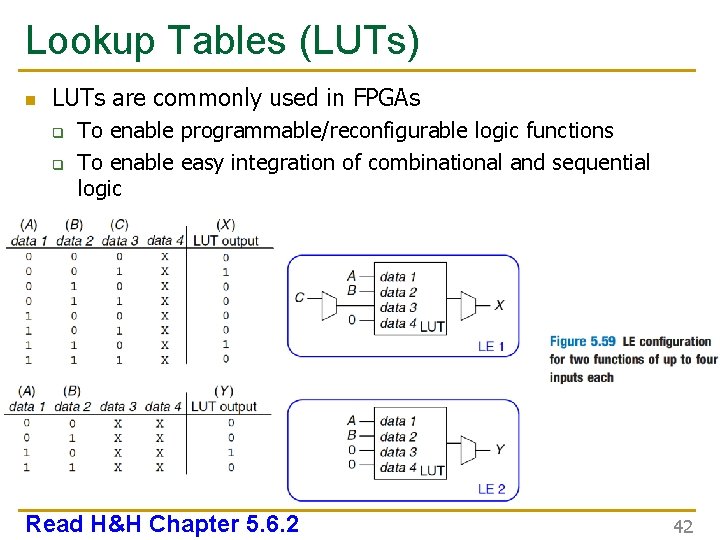
Lookup Tables (LUTs) n LUTs are commonly used in FPGAs q q To enable programmable/reconfigurable logic functions To enable easy integration of combinational and sequential logic Read H&H Chapter 5. 6. 2 42
Sequential Logic Circuits 43
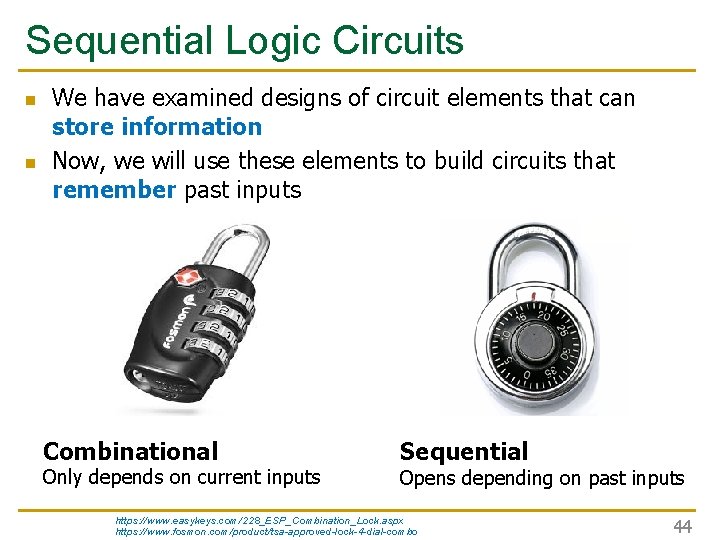
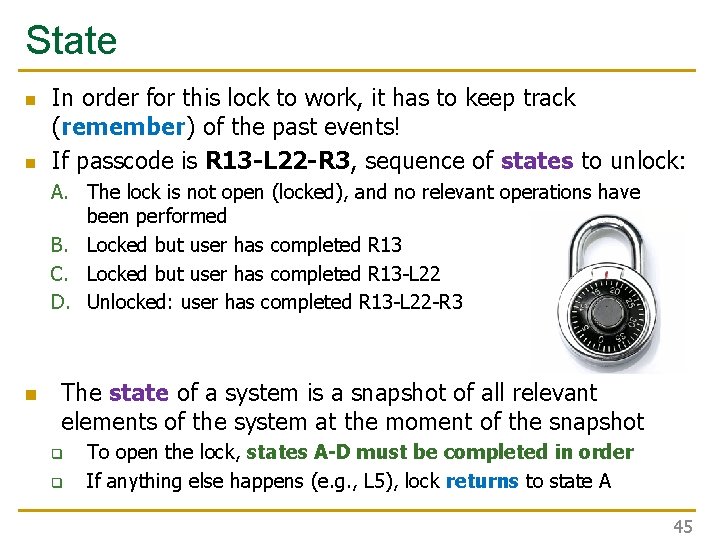
Sequential Logic Circuits n n We have examined designs of circuit elements that can store information Now, we will use these elements to build circuits that remember past inputs Combinational Only depends on current inputs Sequential Opens depending on past inputs https: //www. easykeys. com/228_ESP_Combination_Lock. aspx https: //www. fosmon. com/product/tsa-approved-lock-4 -dial-combo 44
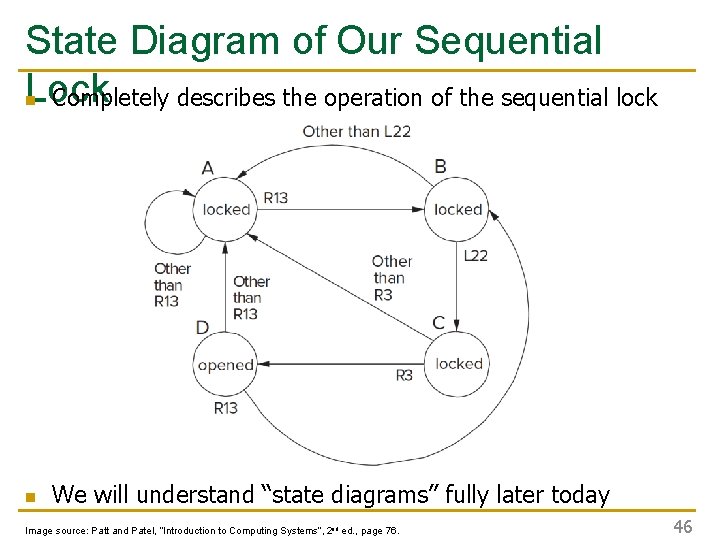
State n n In order for this lock to work, it has to keep track (remember) of the past events! If passcode is R 13 -L 22 -R 3, sequence of states to unlock: A. The lock is not open (locked), and no relevant operations have been performed B. Locked but user has completed R 13 C. Locked but user has completed R 13 -L 22 D. Unlocked: user has completed R 13 -L 22 -R 3 n The state of a system is a snapshot of all relevant elements of the system at the moment of the snapshot q q To open the lock, states A-D must be completed in order If anything else happens (e. g. , L 5), lock returns to state A 45
State Diagram of Our Sequential Lock n Completely describes the operation of the sequential lock n We will understand “state diagrams” fully later today Image source: Patt and Patel, “Introduction to Computing Systems”, 2 nd ed. , page 76. 46
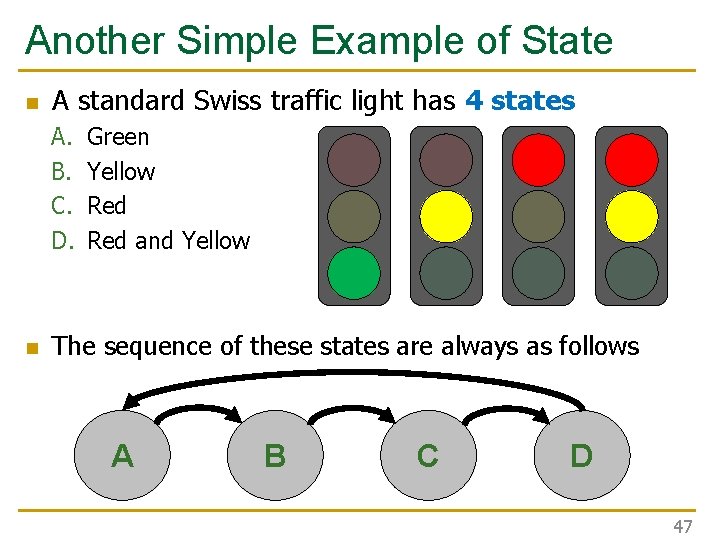
Another Simple Example of State n A standard Swiss traffic light has 4 states A. B. C. D. n Green Yellow Red and Yellow The sequence of these states are always as follows A B C D 47
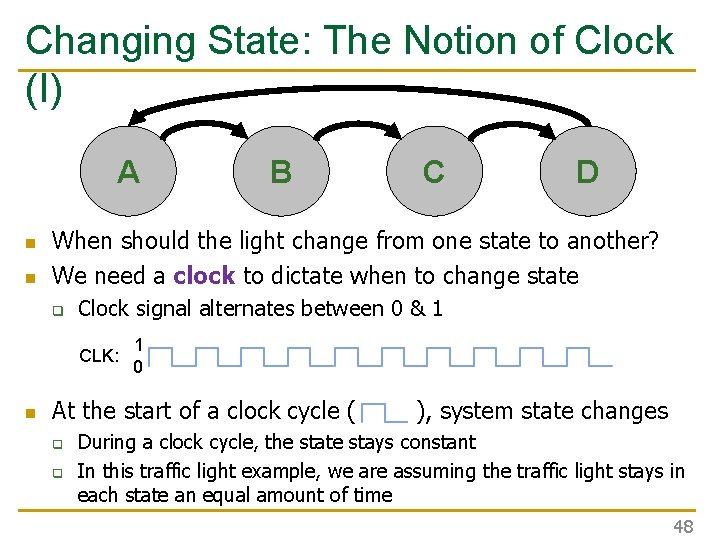
Changing State: The Notion of Clock (I) A n n C D When should the light change from one state to another? We need a clock to dictate when to change state q Clock signal alternates between 0 & 1 CLK: n B 1 0 At the start of a clock cycle ( q q ), system state changes During a clock cycle, the state stays constant In this traffic light example, we are assuming the traffic light stays in each state an equal amount of time 48
Changing State: The Notion of Clock (II) n Clock is a general mechanism that triggers transition from one state to another in a sequential circuit n n n Clock synchronizes state changes across many sequential circuit elements Combinational logic evaluates for the length of the clock cycle Clock cycle should be chosen to accommodate maximum combinational circuit delay q More on this later, when we discuss timing (Lecture 8) 49
Finite State Machines 50
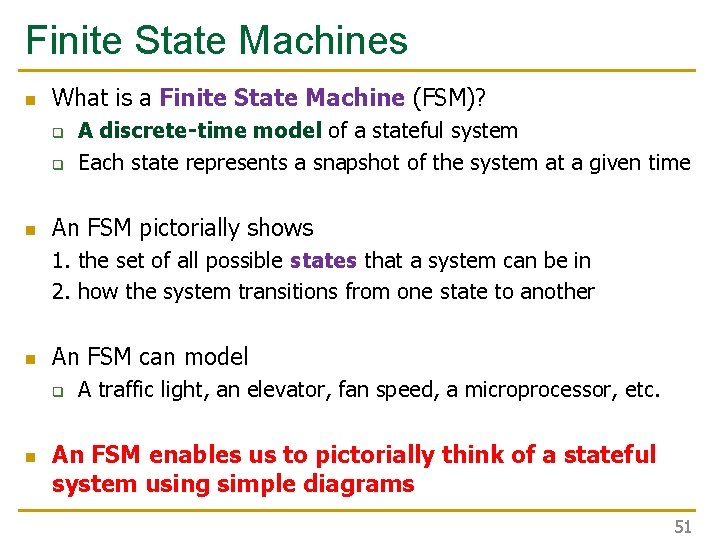
Finite State Machines n What is a Finite State Machine (FSM)? q q n A discrete-time model of a stateful system Each state represents a snapshot of the system at a given time An FSM pictorially shows 1. the set of all possible states that a system can be in 2. how the system transitions from one state to another n An FSM can model q n A traffic light, an elevator, fan speed, a microprocessor, etc. An FSM enables us to pictorially think of a stateful system using simple diagrams 51
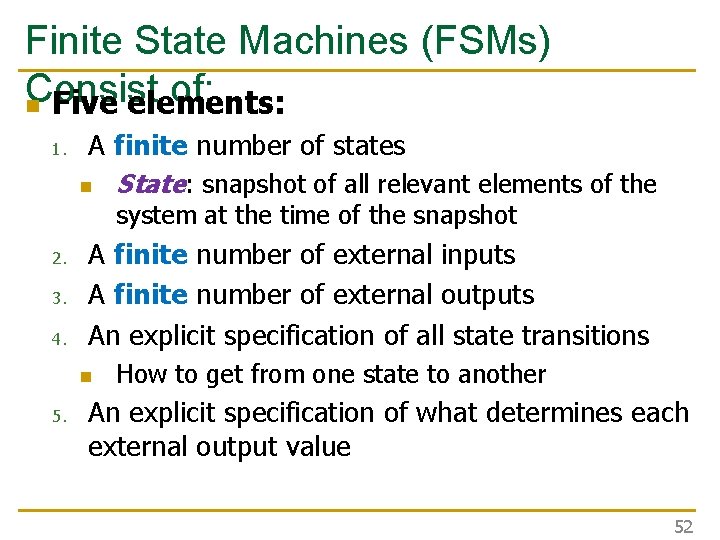
Finite State Machines (FSMs) Consist of: n Five elements: 1. A finite number of states n State: snapshot of all relevant elements of the system at the time of the snapshot 2. 3. 4. A finite number of external inputs A finite number of external outputs An explicit specification of all state transitions n 5. How to get from one state to another An explicit specification of what determines each external output value 52
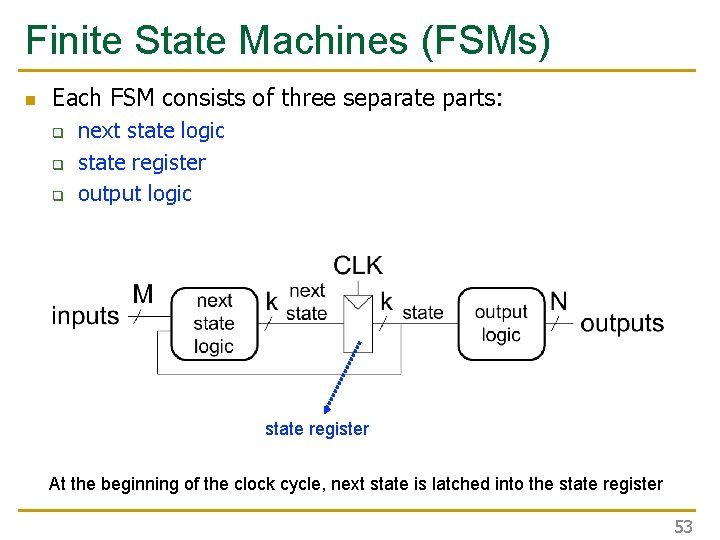
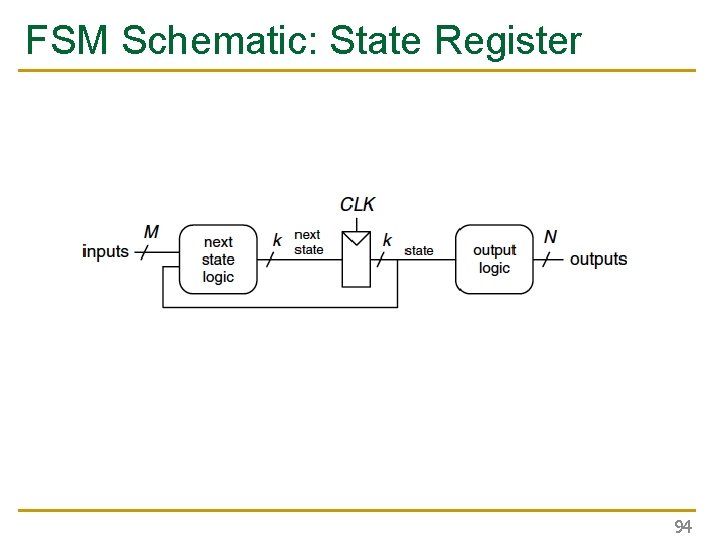
Finite State Machines (FSMs) n Each FSM consists of three separate parts: q q q next state logic state register output logic state register At the beginning of the clock cycle, next state is latched into the state register 53
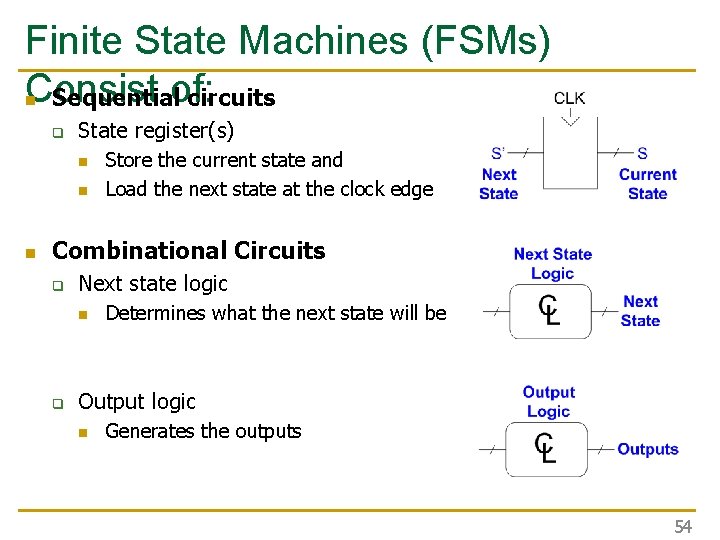
Finite State Machines (FSMs) Consist of: n Sequential circuits q State register(s) n n n Store the current state and Load the next state at the clock edge Combinational Circuits q Next state logic n q Determines what the next state will be Output logic n Generates the outputs 54
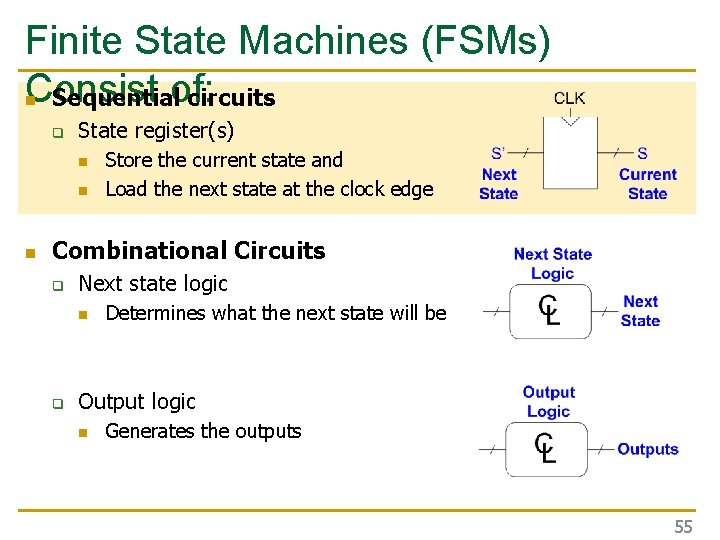
Finite State Machines (FSMs) Consist of: n Sequential circuits q State register(s) n n n Store the current state and Load the next state at the clock edge Combinational Circuits q Next state logic n q Determines what the next state will be Output logic n Generates the outputs 55
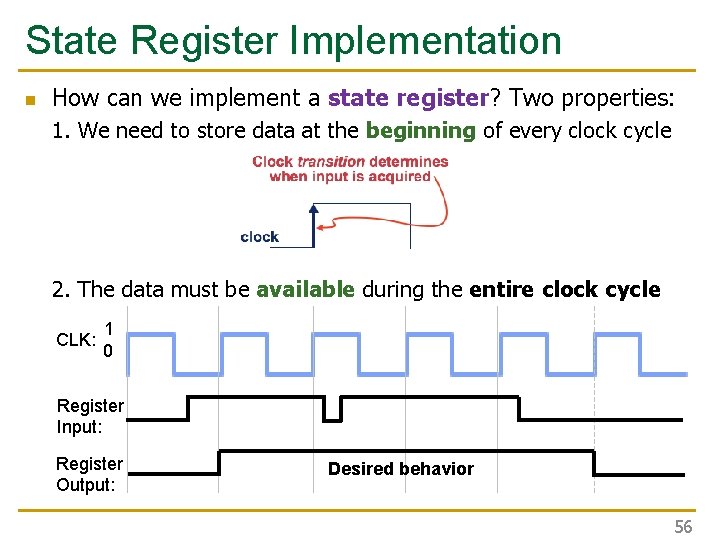
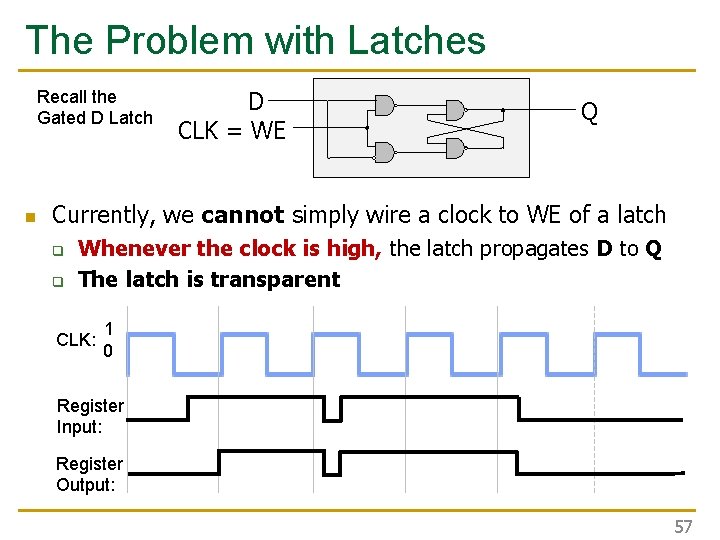
State Register Implementation n How can we implement a state register? Two properties: 1. We need to store data at the beginning of every clock cycle 2. The data must be available during the entire clock cycle CLK: 1 0 Register Input: Register Output: Desired behavior 56
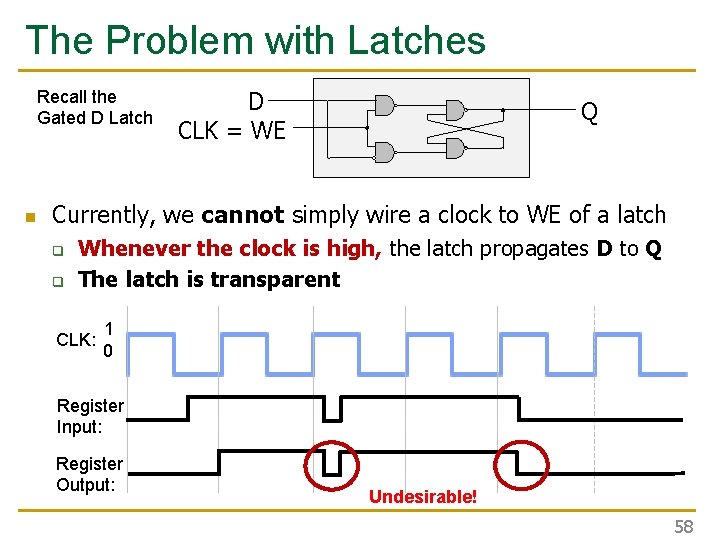
The Problem with Latches Recall the Gated D Latch n D CLK = WE Q Currently, we cannot simply wire a clock to WE of a latch q q Whenever the clock is high, the latch propagates D to Q The latch is transparent CLK: 1 0 Register Input: Register Output: 57
The Problem with Latches Recall the Gated D Latch n D CLK = WE Q Currently, we cannot simply wire a clock to WE of a latch q q Whenever the clock is high, the latch propagates D to Q The latch is transparent CLK: 1 0 Register Input: Register Output: Undesirable! 58
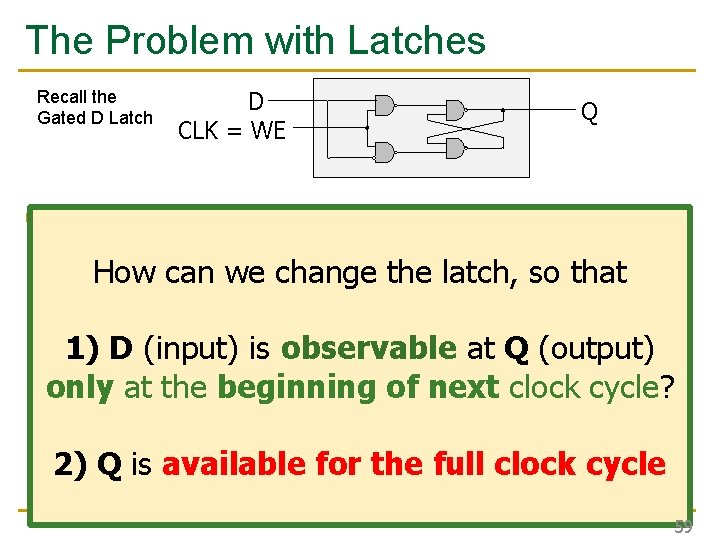
The Problem with Latches Recall the Gated D Latch n D CLK = WE Q Currently, we cannot simply wire a clock to WE of a latch q q When the clock is high Q will not take on D’s value AND Howthe can weis change thewilllatch, so. Dthat When clock low the latch propagate to Q 1 0 1) D (input) is observable at Q (output) only at the beginning of next clock cycle? Input: CLK: Output: 2) Q is available for the full clock cycle 59
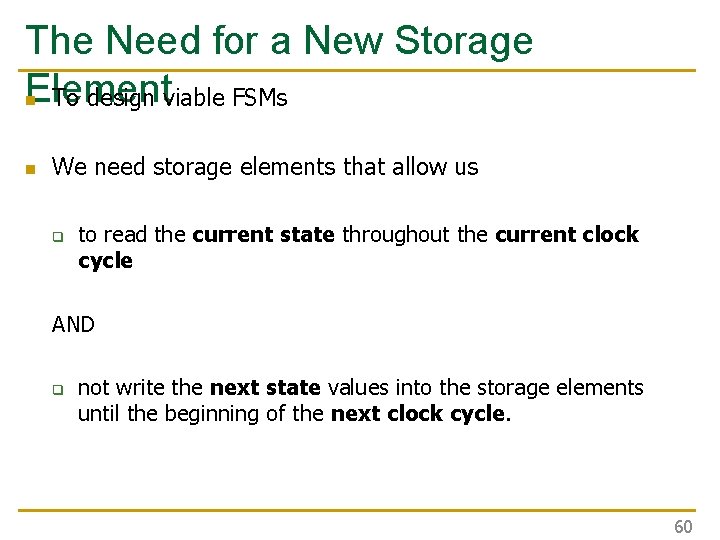
The Need for a New Storage Element n To design viable FSMs n We need storage elements that allow us q to read the current state throughout the current clock cycle AND q not write the next state values into the storage elements until the beginning of the next clock cycle. 60
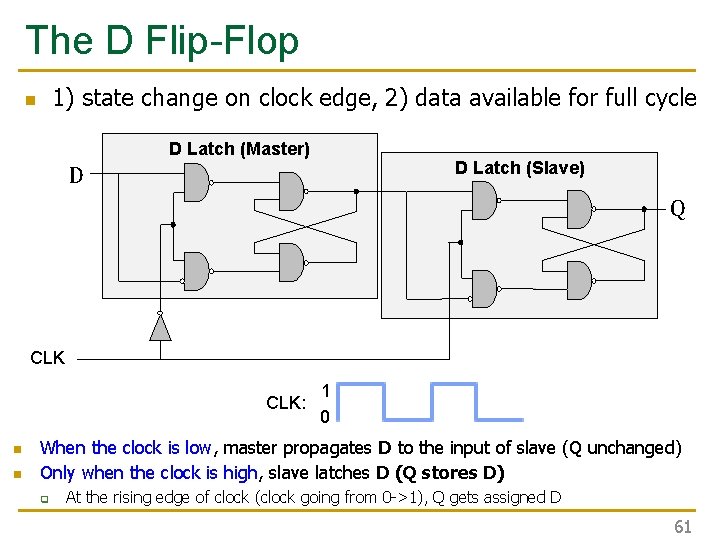
The D Flip-Flop 1) state change on clock edge, 2) data available for full cycle n D Latch (Master) D Latch (Slave) D Q CLK: n n 1 0 When the clock is low, master propagates D to the input of slave (Q unchanged) Only when the clock is high, slave latches D (Q stores D) q At the rising edge of clock (clock going from 0 ->1), Q gets assigned D 61
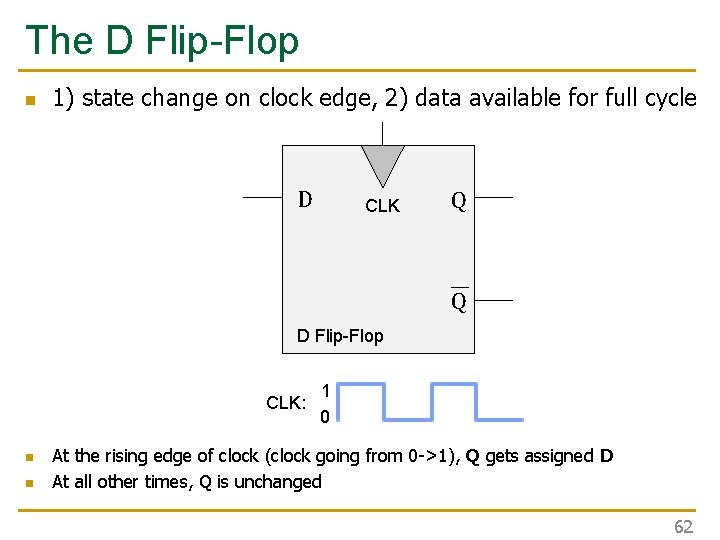
The D Flip-Flop n 1) state change on clock edge, 2) data available for full cycle D CLK Q __ Q D Flip-Flop CLK: n n 1 0 At the rising edge of clock (clock going from 0 ->1), Q gets assigned D At all other times, Q is unchanged 62
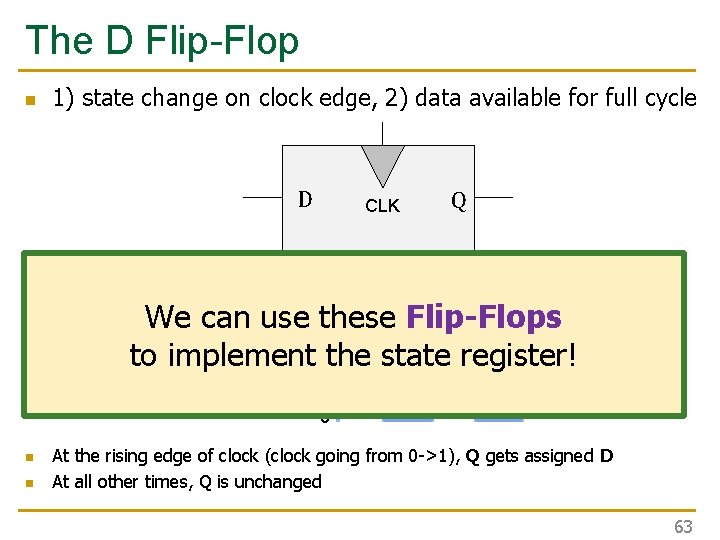
The D Flip-Flop n 1) state change on clock edge, 2) data available for full cycle D CLK Q __ Q We can use. D Flip-Flop these Flip-Flops to implement the state register! CLK: n n 1 0 At the rising edge of clock (clock going from 0 ->1), Q gets assigned D At all other times, Q is unchanged 63
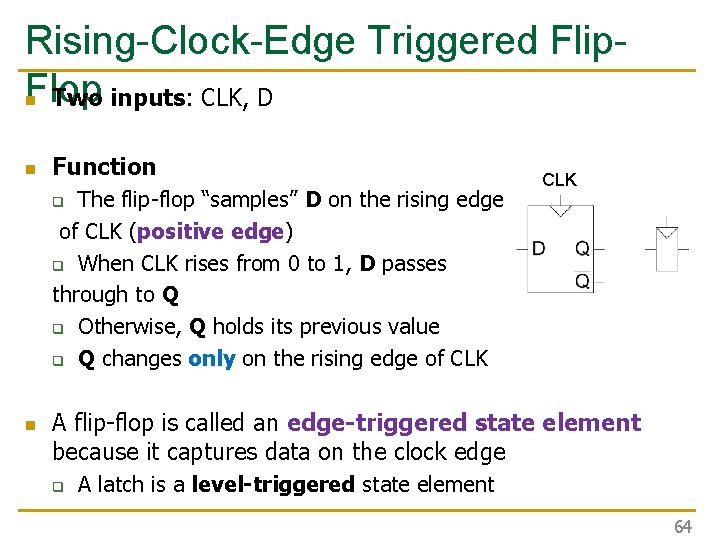
Rising-Clock-Edge Triggered Flip. Flop n Two inputs: CLK, D n Function The flip-flop “samples” D on the rising edge of CLK (positive edge) q When CLK rises from 0 to 1, D passes through to Q q Otherwise, Q holds its previous value q Q changes only on the rising edge of CLK q n A flip-flop is called an edge-triggered state element because it captures data on the clock edge q A latch is a level-triggered state element 64
D Flip-Flop Based Register n Multiple parallel D flip-flops, each of which storing 1 bit Con den sed This line represents 4 wires This register stores 4 bits 65
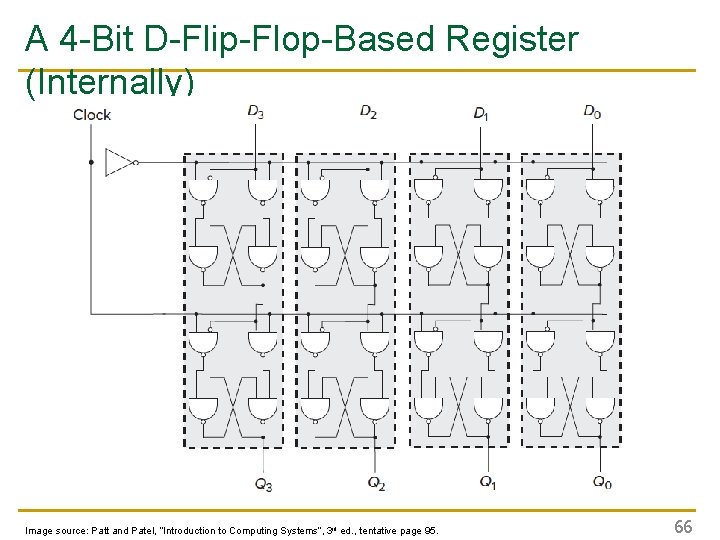
A 4 -Bit D-Flip-Flop-Based Register (Internally) Image source: Patt and Patel, “Introduction to Computing Systems”, 3 rd ed. , tentative page 95. 66
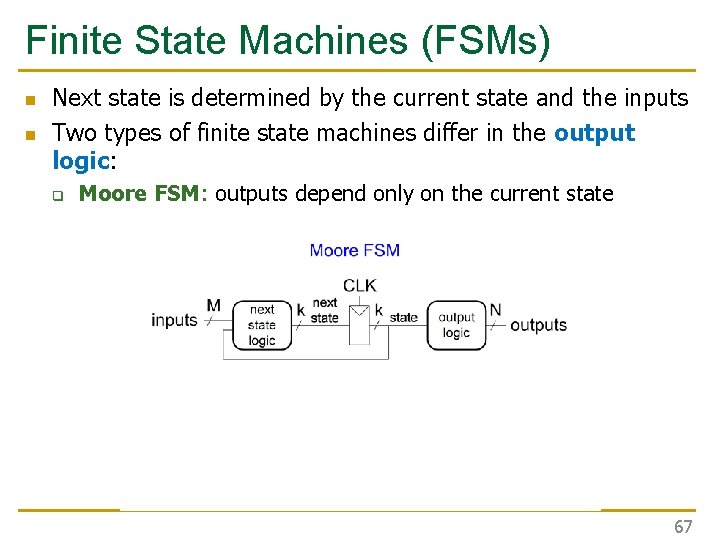
Finite State Machines (FSMs) n n Next state is determined by the current state and the inputs Two types of finite state machines differ in the output logic: q Moore FSM: outputs depend only on the current state 67
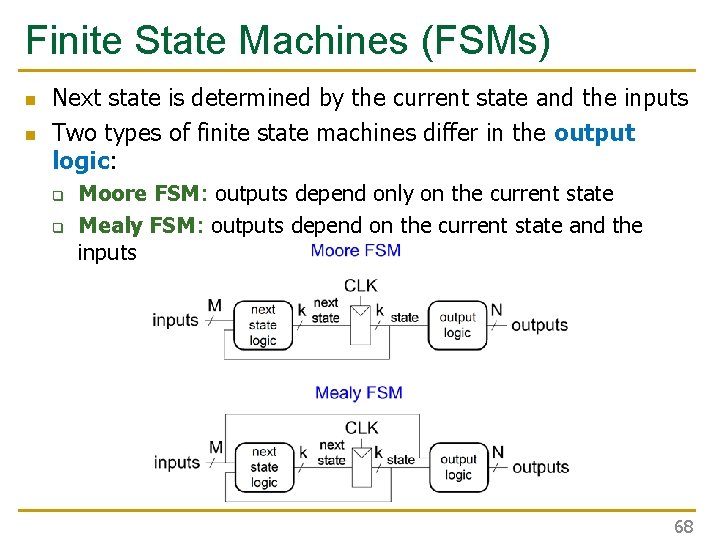
Finite State Machines (FSMs) n n Next state is determined by the current state and the inputs Two types of finite state machines differ in the output logic: q q Moore FSM: outputs depend only on the current state Mealy FSM: outputs depend on the current state and the inputs 68
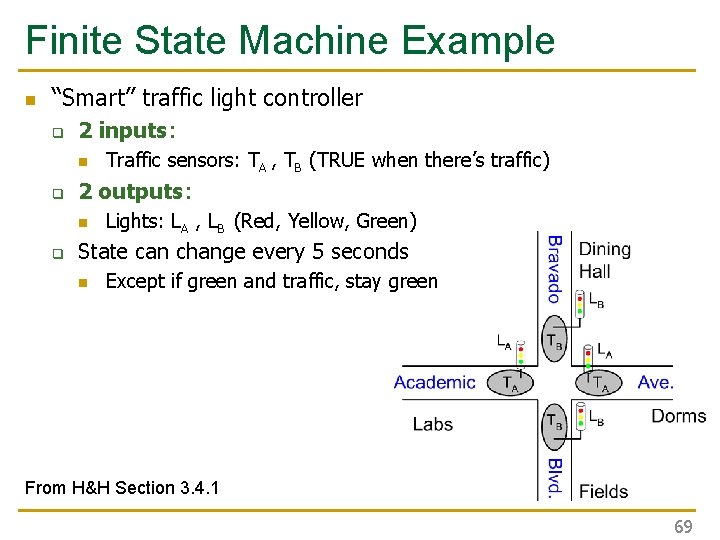
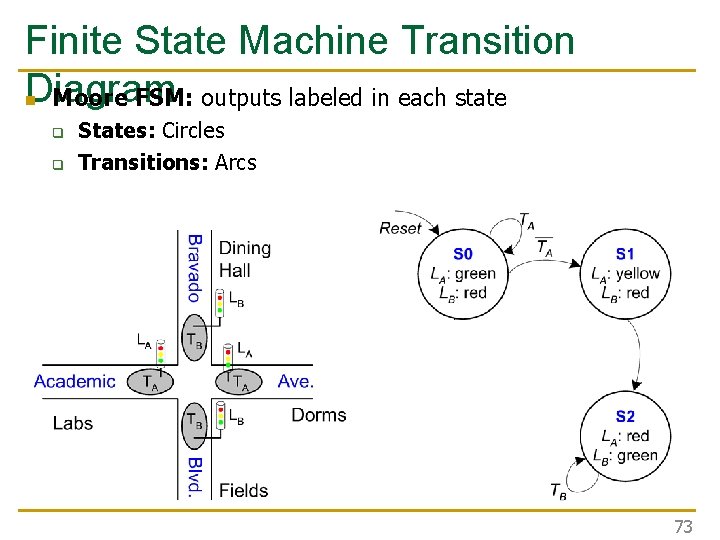
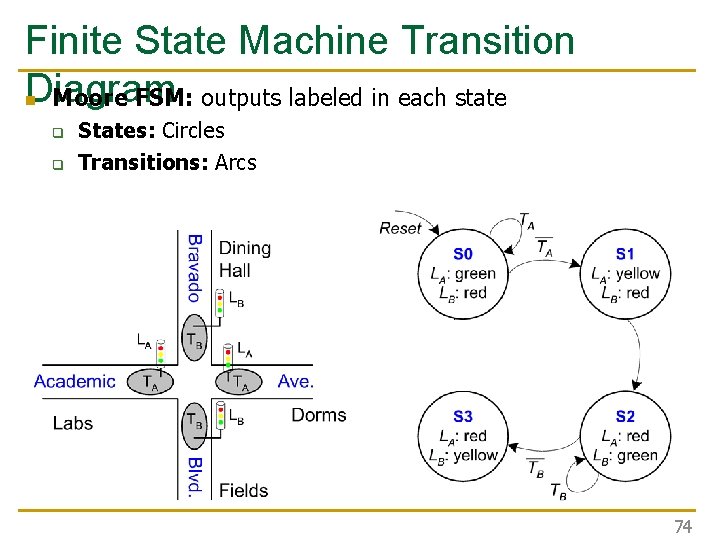
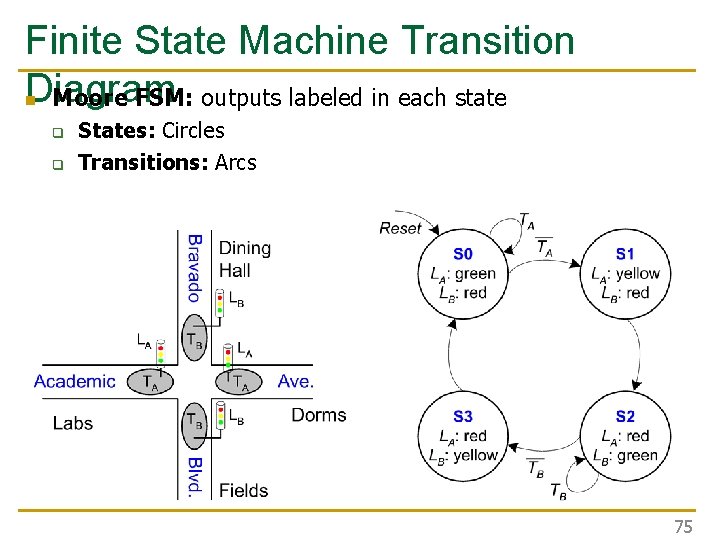
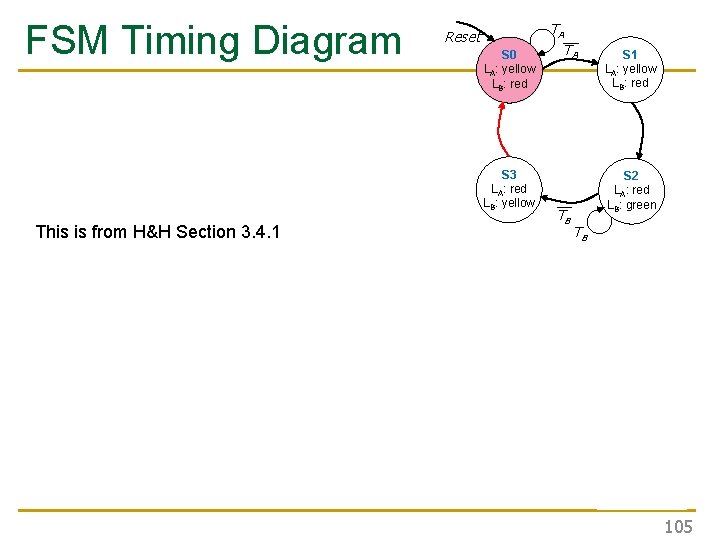
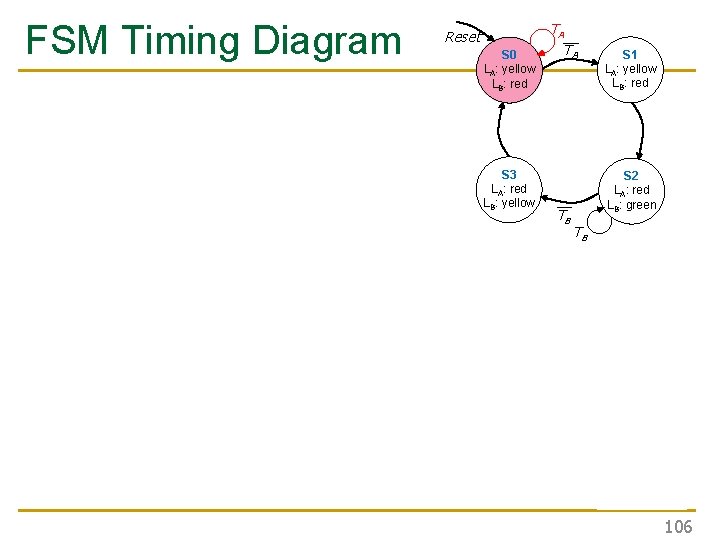
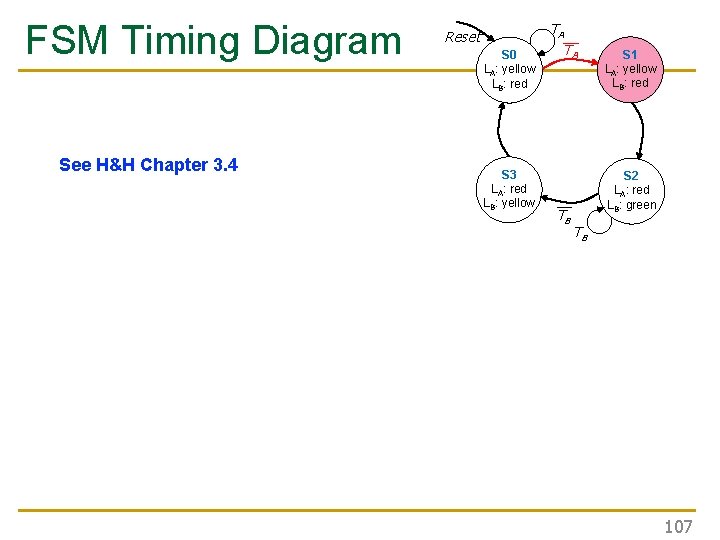
Finite State Machine Example n “Smart” traffic light controller q 2 inputs: n q 2 outputs: n q Traffic sensors: TA , TB (TRUE when there’s traffic) Lights: LA , LB (Red, Yellow, Green) State can change every 5 seconds n Except if green and traffic, stay green From H&H Section 3. 4. 1 69
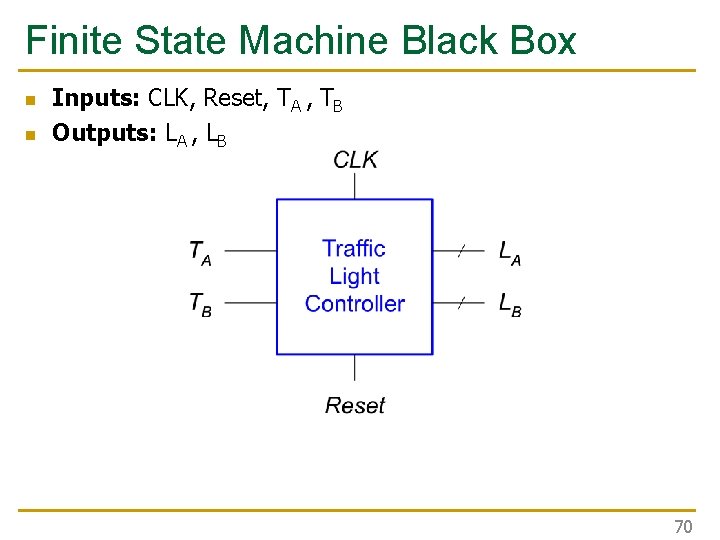
Finite State Machine Black Box n n Inputs: CLK, Reset, TA , TB Outputs: LA , LB 70
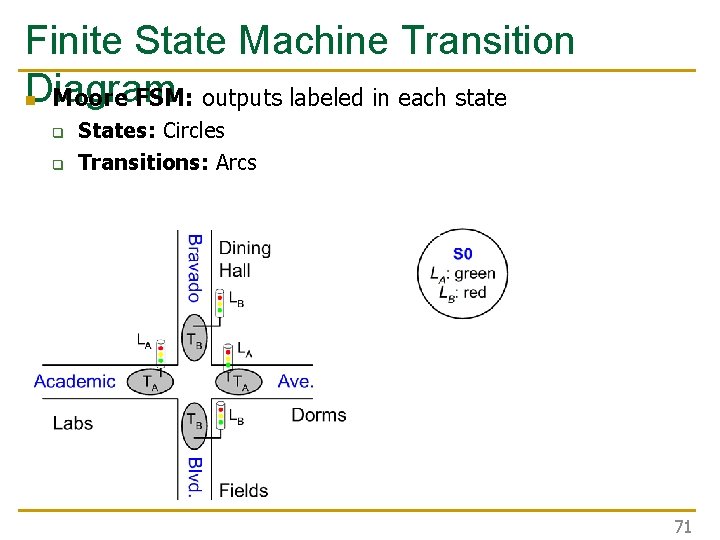
Finite State Machine Transition Diagram n Moore FSM: outputs labeled in each state q q States: Circles Transitions: Arcs 71
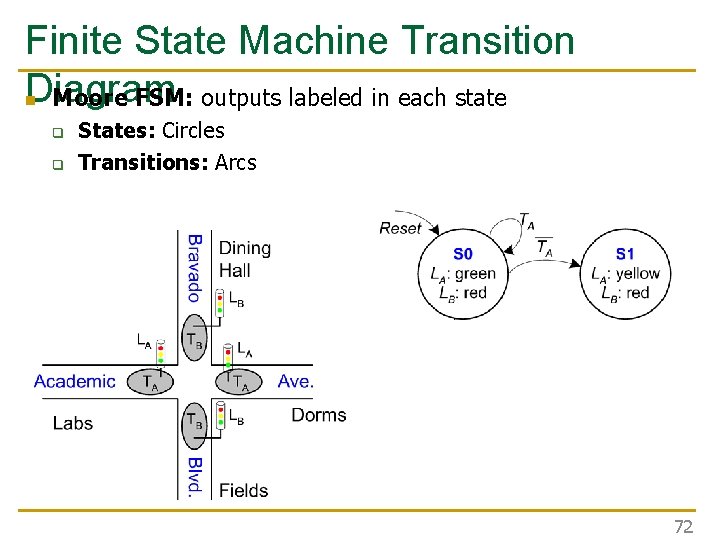
Finite State Machine Transition Diagram n Moore FSM: outputs labeled in each state q q States: Circles Transitions: Arcs 72
Finite State Machine Transition Diagram n Moore FSM: outputs labeled in each state q q States: Circles Transitions: Arcs 73
Finite State Machine Transition Diagram n Moore FSM: outputs labeled in each state q q States: Circles Transitions: Arcs 74
Finite State Machine Transition Diagram n Moore FSM: outputs labeled in each state q q States: Circles Transitions: Arcs 75
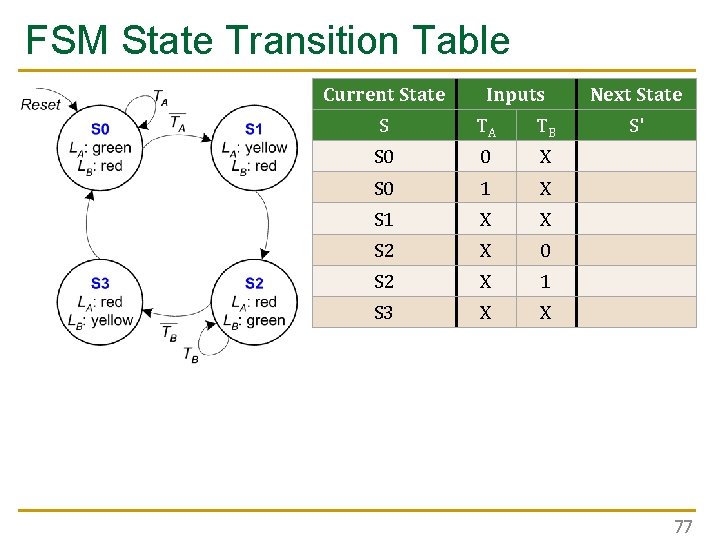
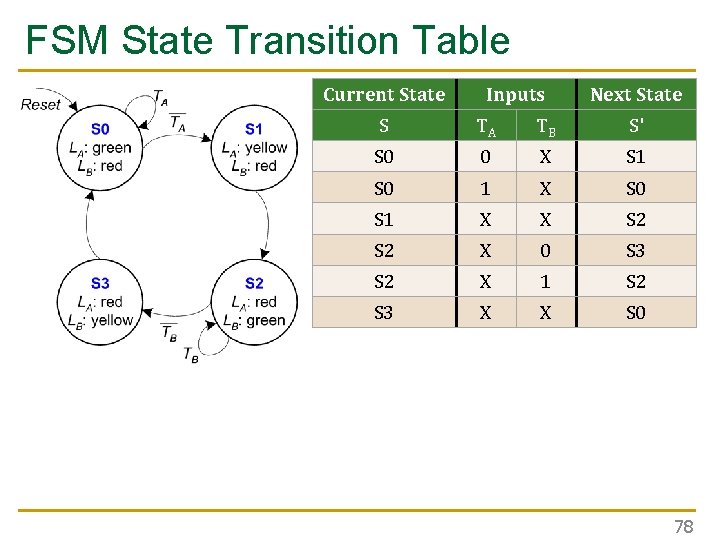
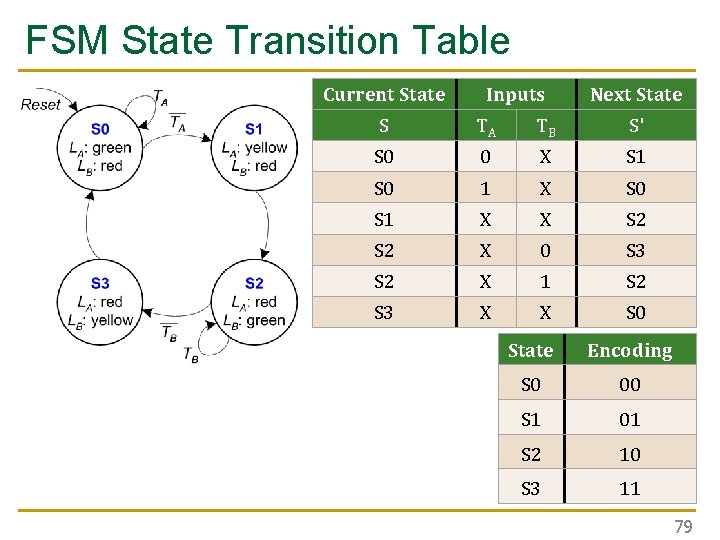
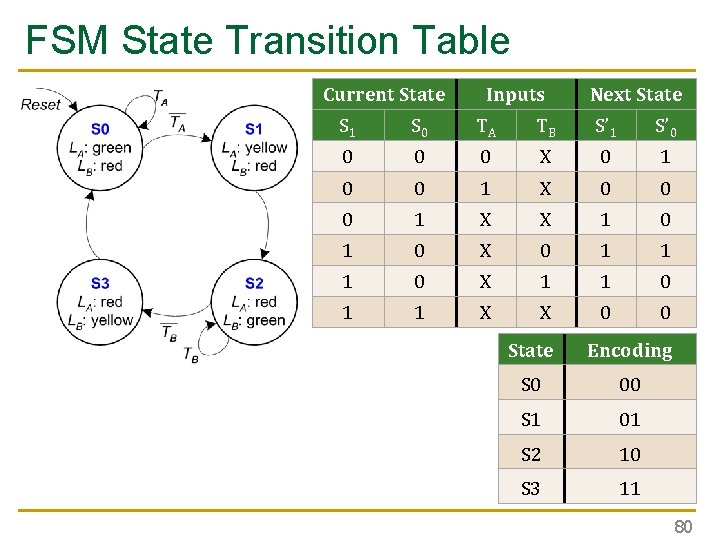
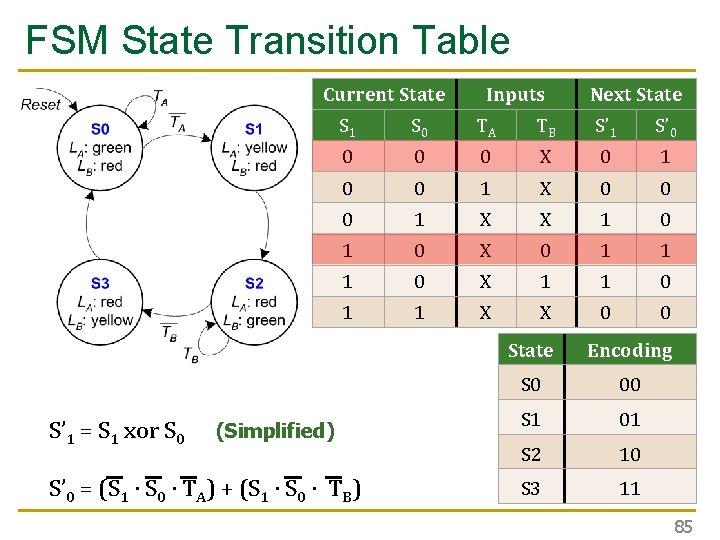
Finite State Machine: State Transition Table 76
FSM State Transition Table Current State Inputs S TA TB S 0 0 X S 0 1 X S 1 X X S 2 X 0 S 2 X 1 S 3 X X Next State S' 77
FSM State Transition Table Current State Inputs Next State S TA TB S' S 0 0 X S 1 S 0 1 X S 0 S 1 X X S 2 X 0 S 3 S 2 X 1 S 2 S 3 X X S 0 78
FSM State Transition Table Current State Inputs Next State S TA TB S' S 0 0 X S 1 S 0 1 X S 0 S 1 X X S 2 X 0 S 3 S 2 X 1 S 2 S 3 X X S 0 State Encoding S 0 00 S 1 01 S 2 10 S 3 11 79
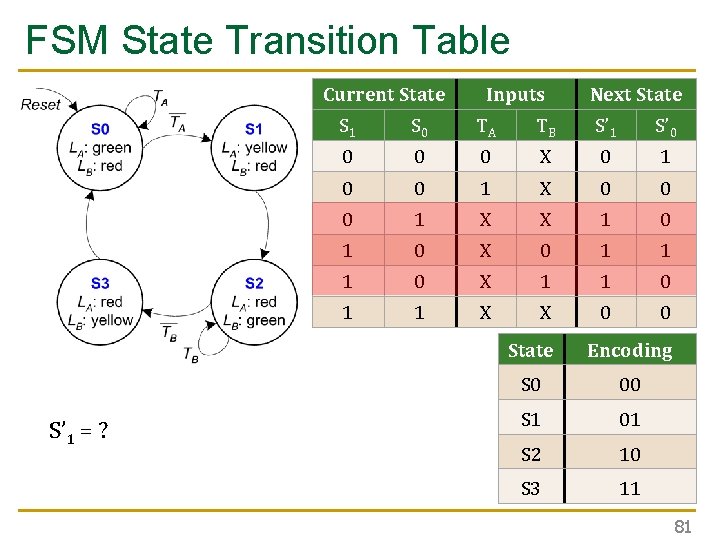
FSM State Transition Table Current State Inputs Next State S 1 S 0 TA TB S’ 1 S’ 0 0 X 0 1 0 0 1 X 0 0 0 1 X X 1 0 X 0 1 1 1 0 X 1 1 0 1 1 X X 0 0 State Encoding S 0 00 S 1 01 S 2 10 S 3 11 80
FSM State Transition Table Current State S’ 1 = ? Inputs Next State S 1 S 0 TA TB S’ 1 S’ 0 0 X 0 1 0 0 1 X 0 0 0 1 X X 1 0 X 0 1 1 1 0 X 1 1 0 1 1 X X 0 0 State Encoding S 0 00 S 1 01 S 2 10 S 3 11 81
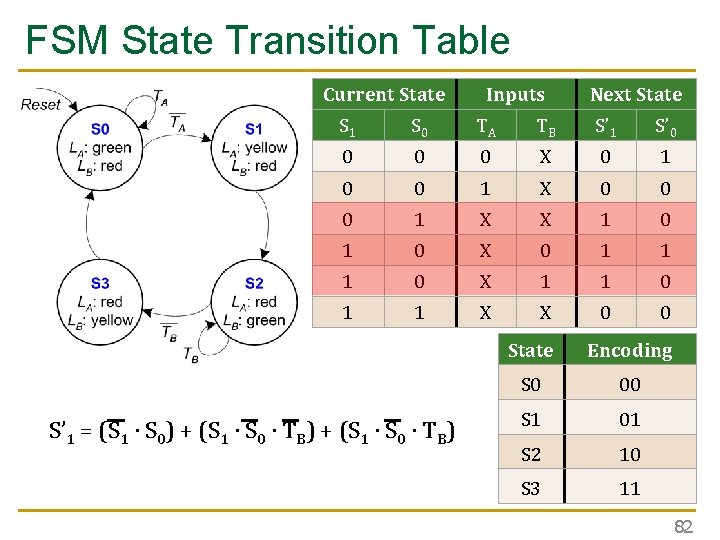
FSM State Transition Table Current State Inputs Next State S 1 S 0 TA TB S’ 1 S’ 0 0 X 0 1 0 0 1 X 0 0 0 1 X X 1 0 X 0 1 1 1 0 X 1 1 0 1 1 X X 0 0 S’ 1 = (S 1 ∙ S 0) + (S 1 ∙ S 0 ∙ TB) State Encoding S 0 00 S 1 01 S 2 10 S 3 11 82
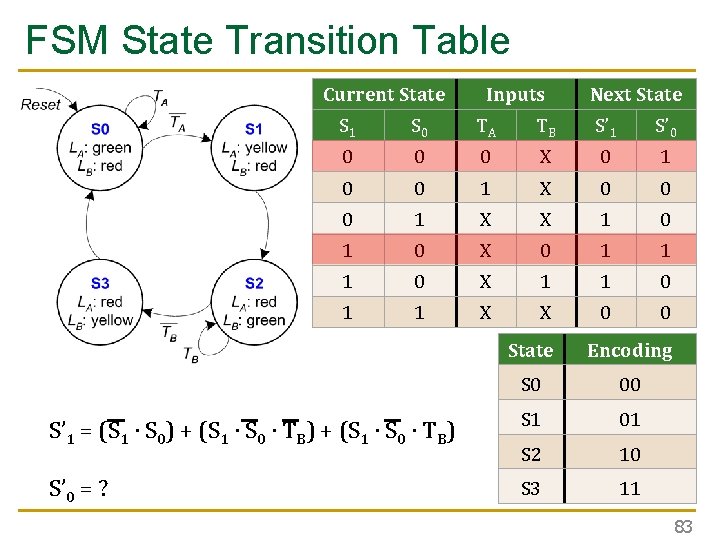
FSM State Transition Table Current State Inputs Next State S 1 S 0 TA TB S’ 1 S’ 0 0 X 0 1 0 0 1 X 0 0 0 1 X X 1 0 X 0 1 1 1 0 X 1 1 0 1 1 X X 0 0 State Encoding S 0 00 S’ 1 = (S 1 ∙ S 0) + (S 1 ∙ S 0 ∙ TB) S 1 01 S 2 10 S’ 0 = ? S 3 11 83
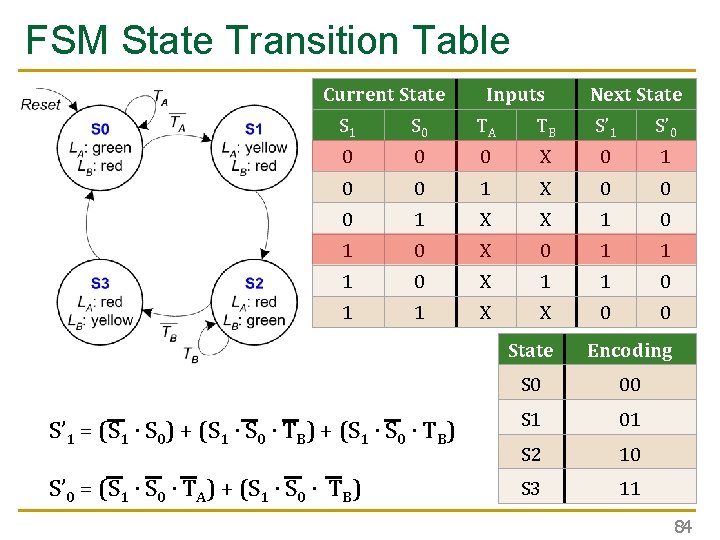
FSM State Transition Table Current State Inputs Next State S 1 S 0 TA TB S’ 1 S’ 0 0 X 0 1 0 0 1 X 0 0 0 1 X X 1 0 X 0 1 1 1 0 X 1 1 0 1 1 X X 0 0 State Encoding S 0 00 S’ 1 = (S 1 ∙ S 0) + (S 1 ∙ S 0 ∙ TB) S 1 01 S 2 10 S’ 0 = (S 1 ∙ S 0 ∙ TA) + (S 1 ∙ S 0 ∙ TB) S 3 11 84
FSM State Transition Table Current State S’ 1 = S 1 xor S 0 Inputs Next State S 1 S 0 TA TB S’ 1 S’ 0 0 X 0 1 0 0 1 X 0 0 0 1 X X 1 0 X 0 1 1 1 0 X 1 1 0 1 1 X X 0 0 (Simplified) S’ 0 = (S 1 ∙ S 0 ∙ TA) + (S 1 ∙ S 0 ∙ TB) State Encoding S 0 00 S 1 01 S 2 10 S 3 11 85
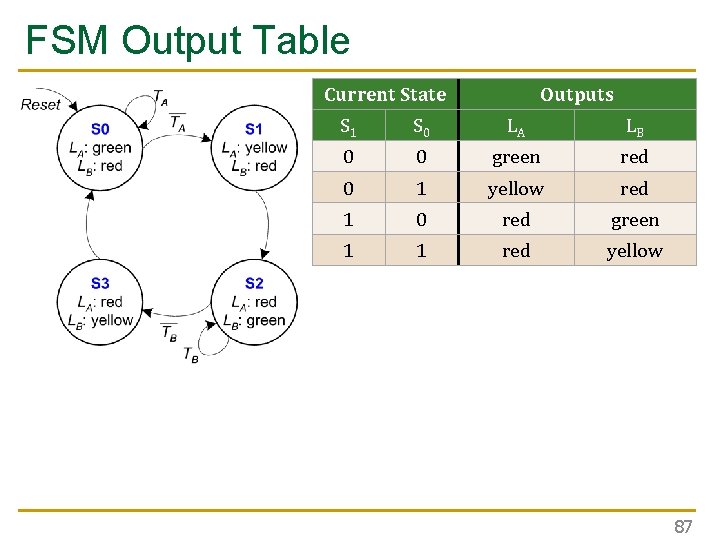
Finite State Machine: Output Table 86
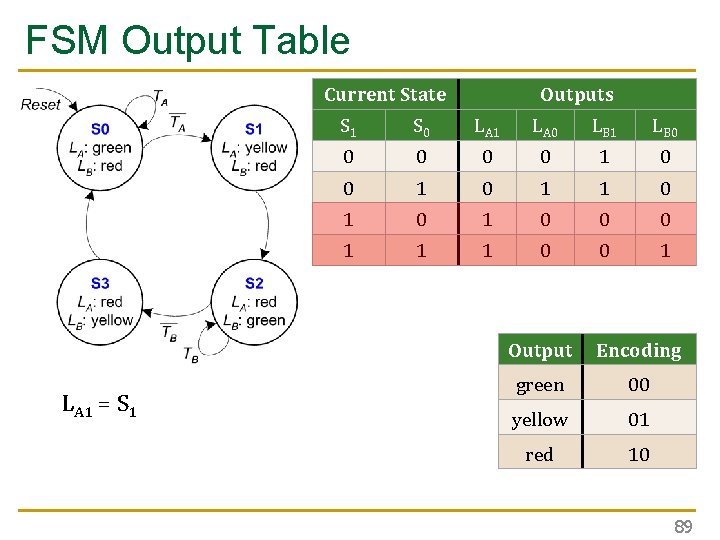
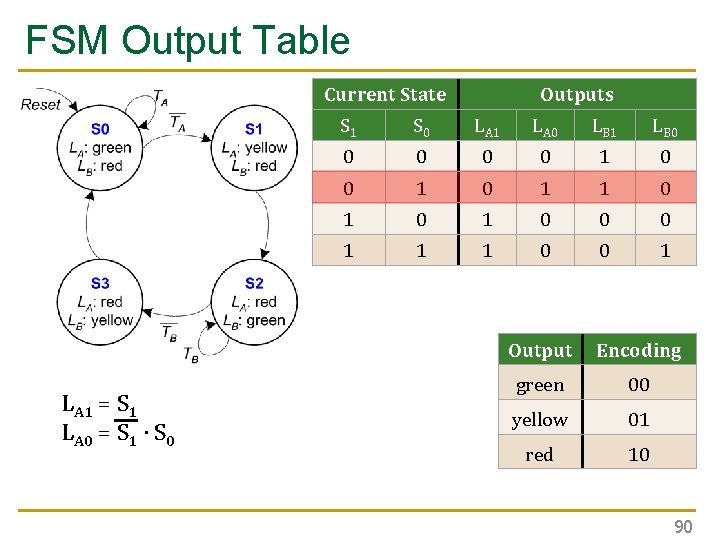
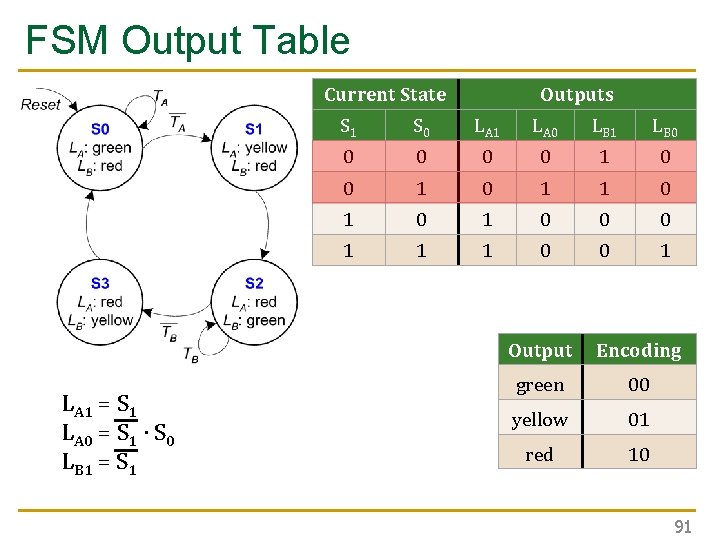
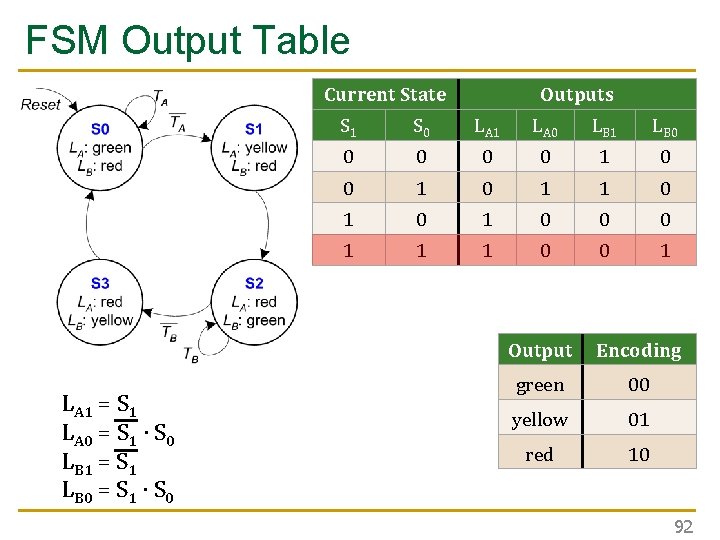
FSM Output Table Current State Outputs S 1 S 0 LA LB 0 0 green red 0 1 yellow red 1 0 red green 1 1 red yellow 87
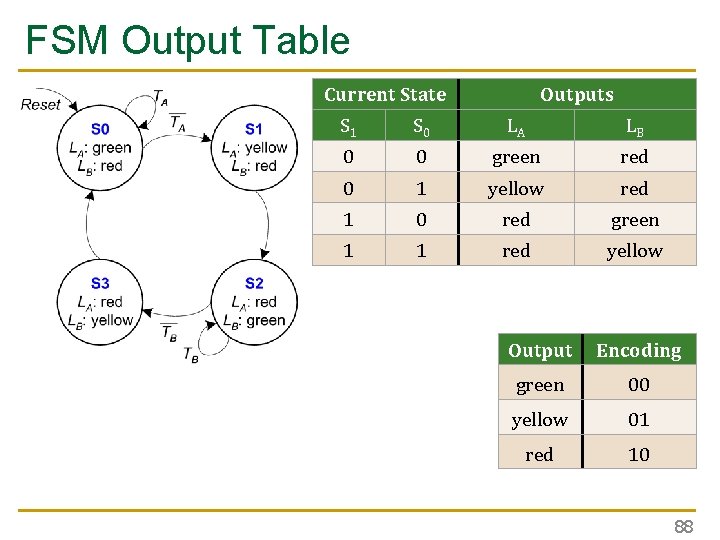
FSM Output Table Current State Outputs S 1 S 0 LA LB 0 0 green red 0 1 yellow red 1 0 red green 1 1 red yellow Output Encoding green 00 yellow 01 red 10 88
FSM Output Table Current State LA 1 = S 1 Outputs S 1 S 0 LA 1 LA 0 LB 1 LB 0 0 0 1 0 1 0 0 0 1 1 1 0 0 1 Output Encoding green 00 yellow 01 red 10 89
FSM Output Table Current State LA 1 = S 1 LA 0 = S 1 ∙ S 0 Outputs S 1 S 0 LA 1 LA 0 LB 1 LB 0 0 0 1 0 1 0 0 0 1 1 1 0 0 1 Output Encoding green 00 yellow 01 red 10 90
FSM Output Table Current State LA 1 = S 1 LA 0 = S 1 ∙ S 0 LB 1 = S 1 Outputs S 1 S 0 LA 1 LA 0 LB 1 LB 0 0 0 1 0 1 0 0 0 1 1 1 0 0 1 Output Encoding green 00 yellow 01 red 10 91
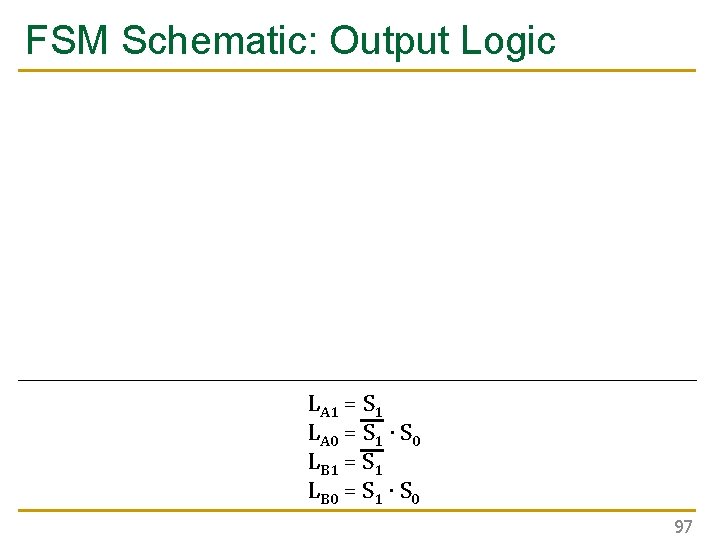
FSM Output Table Current State LA 1 = S 1 LA 0 = S 1 ∙ S 0 LB 1 = S 1 LB 0 = S 1 ∙ S 0 Outputs S 1 S 0 LA 1 LA 0 LB 1 LB 0 0 0 1 0 1 0 0 0 1 1 1 0 0 1 Output Encoding green 00 yellow 01 red 10 92
Finite State Machine: Schematic 93
FSM Schematic: State Register 94
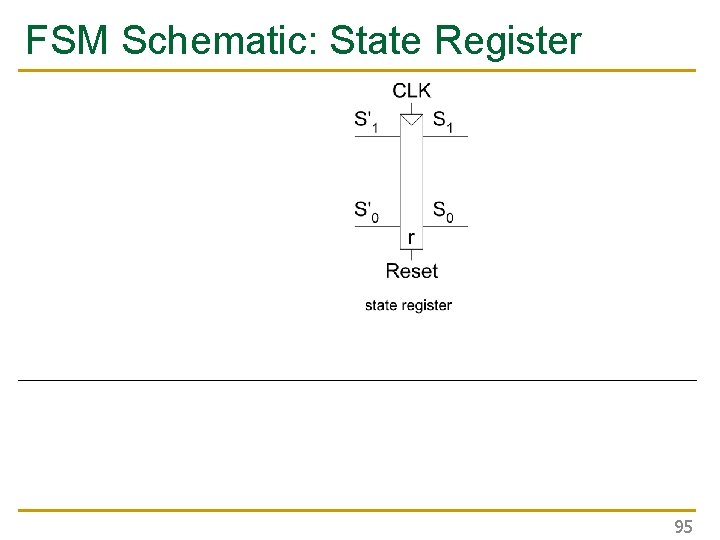
FSM Schematic: State Register 95
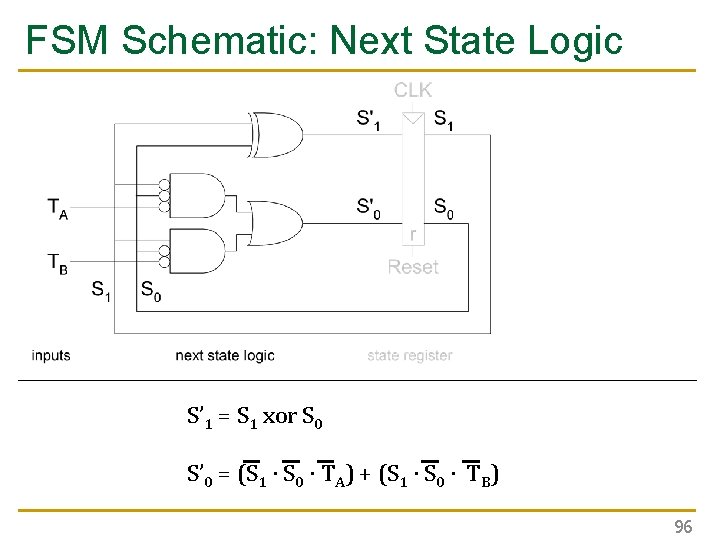
FSM Schematic: Next State Logic S’ 1 = S 1 xor S 0 S’ 0 = (S 1 ∙ S 0 ∙ TA) + (S 1 ∙ S 0 ∙ TB) 96
FSM Schematic: Output Logic LA 1 = S 1 LA 0 = S 1 ∙ S 0 LB 1 = S 1 LB 0 = S 1 ∙ S 0 97
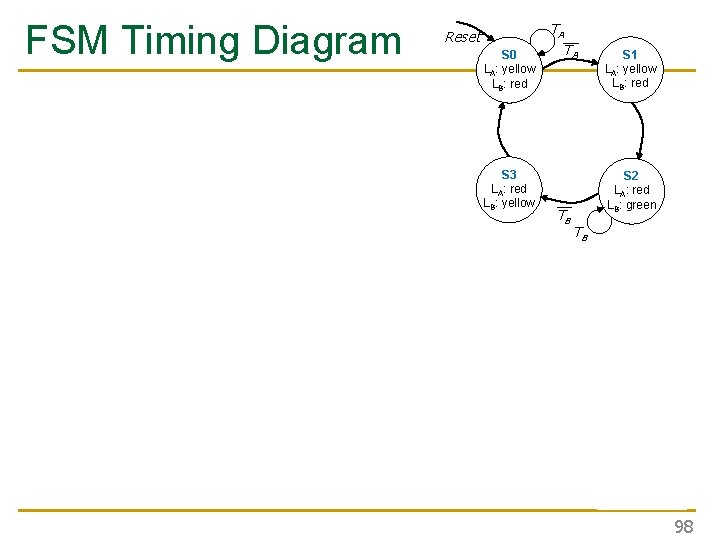
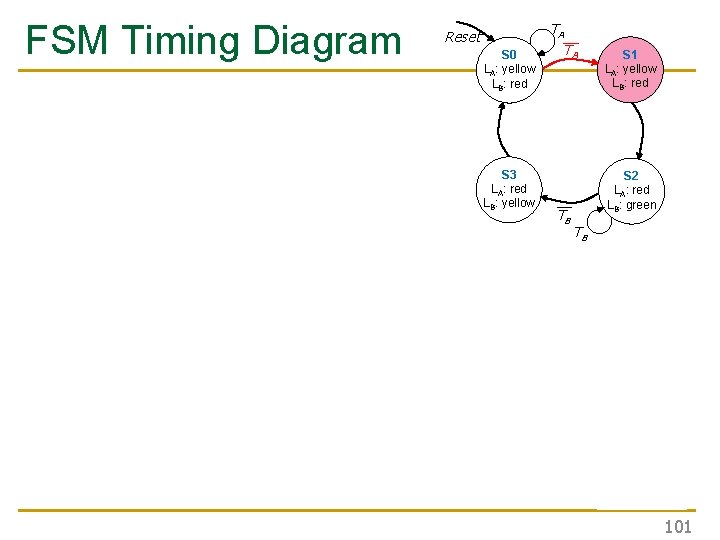
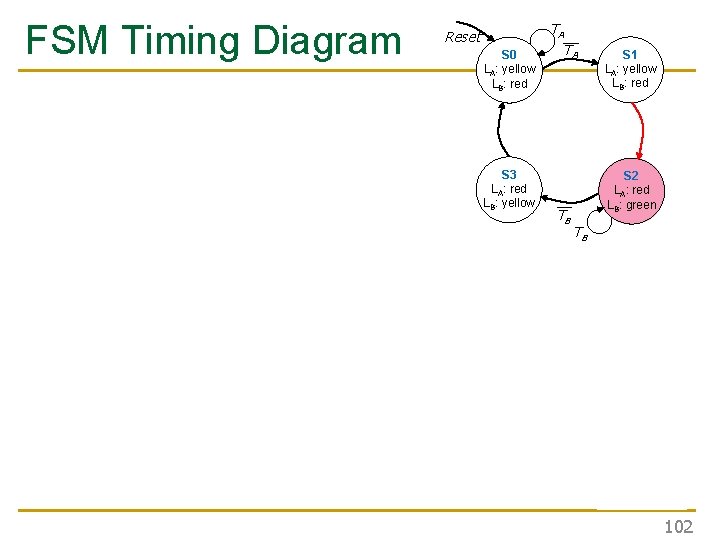
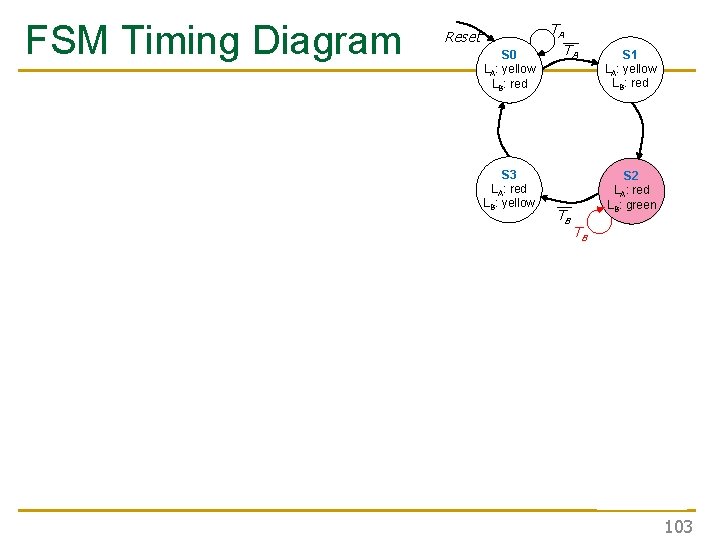
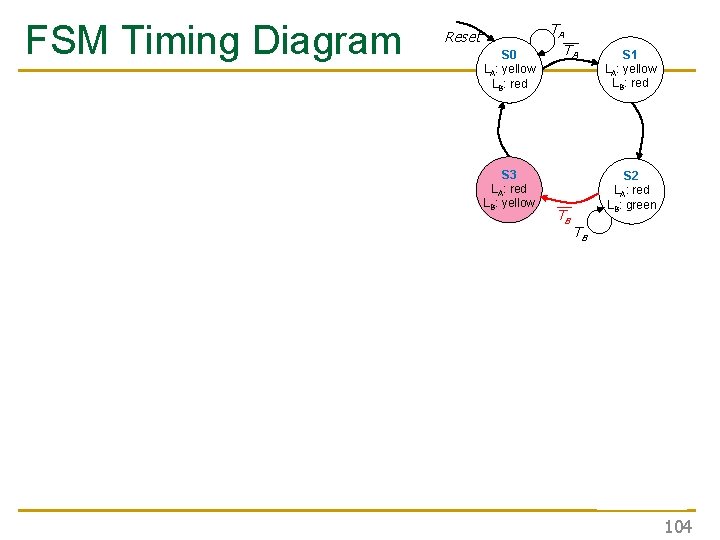
FSM Timing Diagram Reset S 0 LA: yellow LB: red S 3 LA: red LB: yellow TA__ TA S 2 LA: red LB: green __ TB S 1 LA: yellow LB: red TB 98
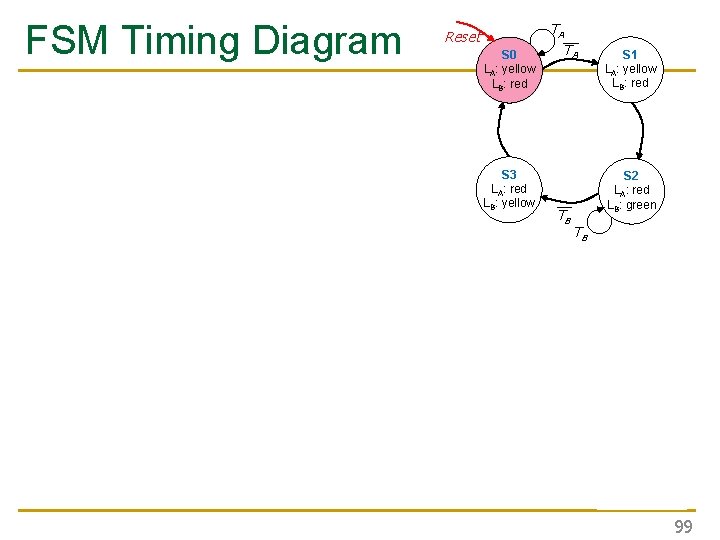
FSM Timing Diagram Reset S 0 LA: yellow LB: red S 3 LA: red LB: yellow TA__ TA S 2 LA: red LB: green __ TB S 1 LA: yellow LB: red TB 99
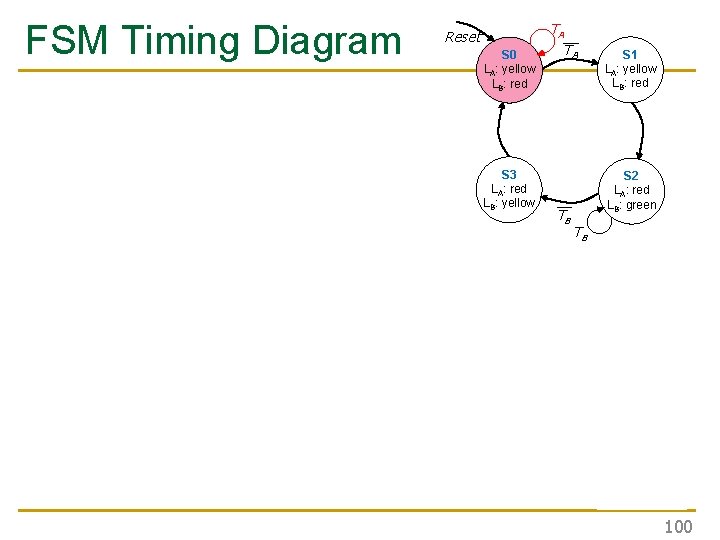
FSM Timing Diagram Reset S 0 LA: yellow LB: red S 3 LA: red LB: yellow TA__ TA S 2 LA: red LB: green __ TB S 1 LA: yellow LB: red TB 100
FSM Timing Diagram Reset S 0 LA: yellow LB: red S 3 LA: red LB: yellow TA__ TA S 2 LA: red LB: green __ TB S 1 LA: yellow LB: red TB 101
FSM Timing Diagram Reset S 0 LA: yellow LB: red S 3 LA: red LB: yellow TA__ TA S 2 LA: red LB: green __ TB S 1 LA: yellow LB: red TB 102
FSM Timing Diagram Reset S 0 LA: yellow LB: red S 3 LA: red LB: yellow TA__ TA S 2 LA: red LB: green __ TB S 1 LA: yellow LB: red TB 103
FSM Timing Diagram Reset S 0 LA: yellow LB: red S 3 LA: red LB: yellow TA__ TA S 2 LA: red LB: green __ TB S 1 LA: yellow LB: red TB 104
FSM Timing Diagram Reset S 0 LA: yellow LB: red S 3 LA: red LB: yellow This is from H&H Section 3. 4. 1 TA__ TA S 2 LA: red LB: green __ TB S 1 LA: yellow LB: red TB 105
FSM Timing Diagram Reset S 0 LA: yellow LB: red S 3 LA: red LB: yellow TA__ TA S 2 LA: red LB: green __ TB S 1 LA: yellow LB: red TB 106
FSM Timing Diagram See H&H Chapter 3. 4 Reset S 0 LA: yellow LB: red S 3 LA: red LB: yellow TA__ TA S 2 LA: red LB: green __ TB S 1 LA: yellow LB: red TB 107
Finite State Machine: State Encoding 108
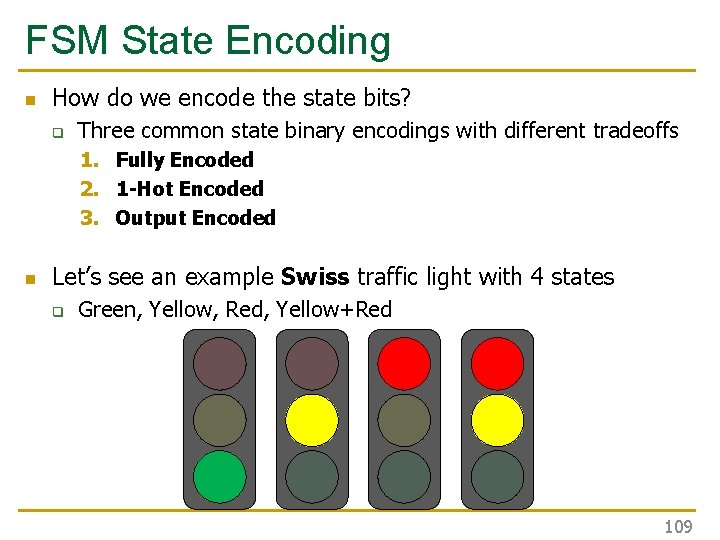
FSM State Encoding n How do we encode the state bits? q Three common state binary encodings with different tradeoffs 1. Fully Encoded 2. 1 -Hot Encoded 3. Output Encoded n Let’s see an example Swiss traffic light with 4 states q Green, Yellow, Red, Yellow+Red 109
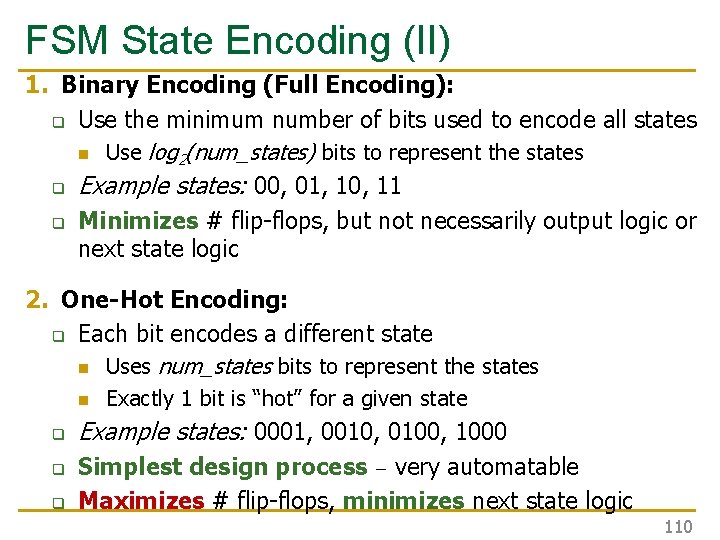
FSM State Encoding (II) 1. Binary Encoding (Full Encoding): q Use the minimum number of bits used to encode all states n Use log 2(num_states) bits to represent the states q Example states: 00, 01, 10, 11 q Minimizes # flip-flops, but not necessarily output logic or next state logic 2. One-Hot Encoding: q Each bit encodes a different state n Uses num_states bits to represent the states n q q q Exactly 1 bit is “hot” for a given state Example states: 0001, 0010, 0100, 1000 Simplest design process – very automatable Maximizes # flip-flops, minimizes next state logic 110
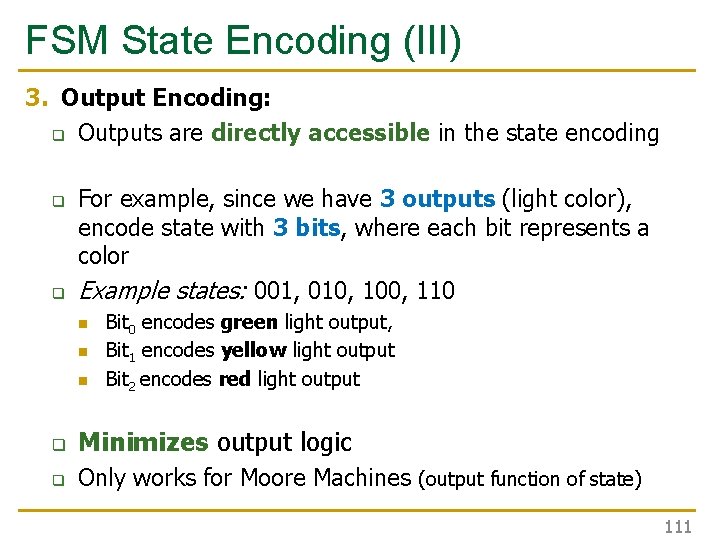
FSM State Encoding (III) 3. Output Encoding: q Outputs are directly accessible in the state encoding q q For example, since we have 3 outputs (light color), encode state with 3 bits, where each bit represents a color Example states: 001, 010, 100, 110 n n n Bit 0 encodes green light output, Bit 1 encodes yellow light output Bit 2 encodes red light output q Minimizes output logic q Only works for Moore Machines (output function of state) 111
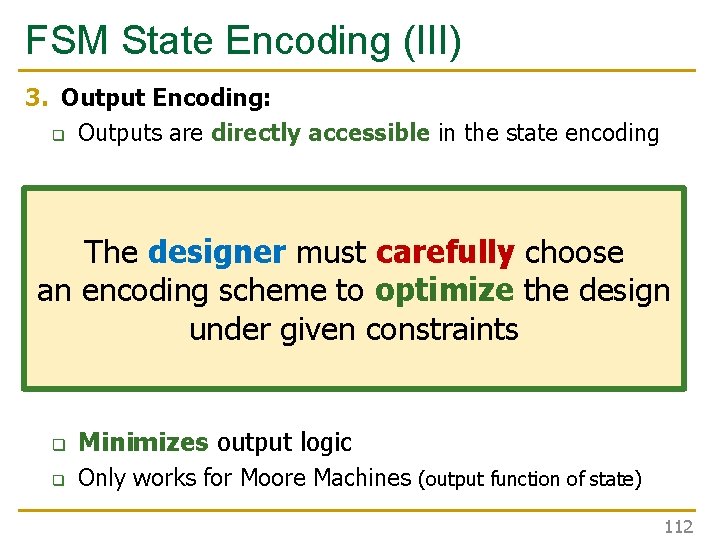
FSM State Encoding (III) 3. Output Encoding: q Outputs are directly accessible in the state encoding For example, since we have 3 outputs (light color), encode state with 3 bits, where each bit represents a The designer must carefully choose color q Example states: 001, 010, 110 an encoding scheme to 100, optimize the design q n n n under given constraints Bit 0 encodes green light output, Bit 1 encodes yellow light output Bit 2 encodes red light output q Minimizes output logic q Only works for Moore Machines (output function of state) 112
Moore vs. Mealy Machines 113
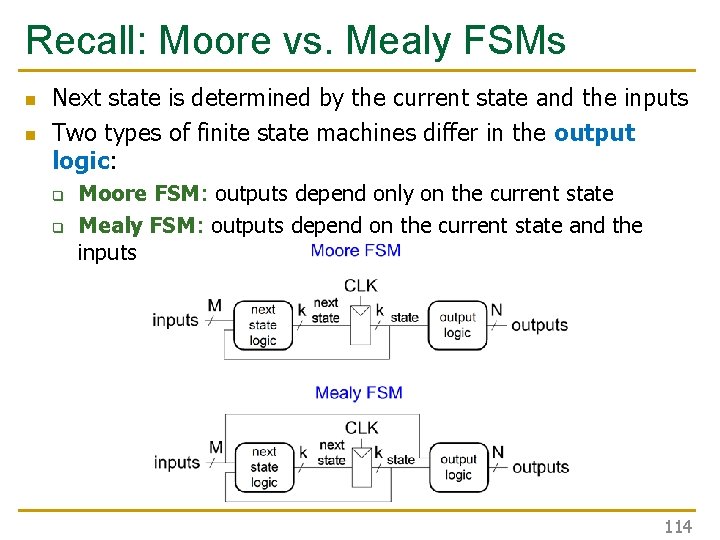
Recall: Moore vs. Mealy FSMs n n Next state is determined by the current state and the inputs Two types of finite state machines differ in the output logic: q q Moore FSM: outputs depend only on the current state Mealy FSM: outputs depend on the current state and the inputs 114
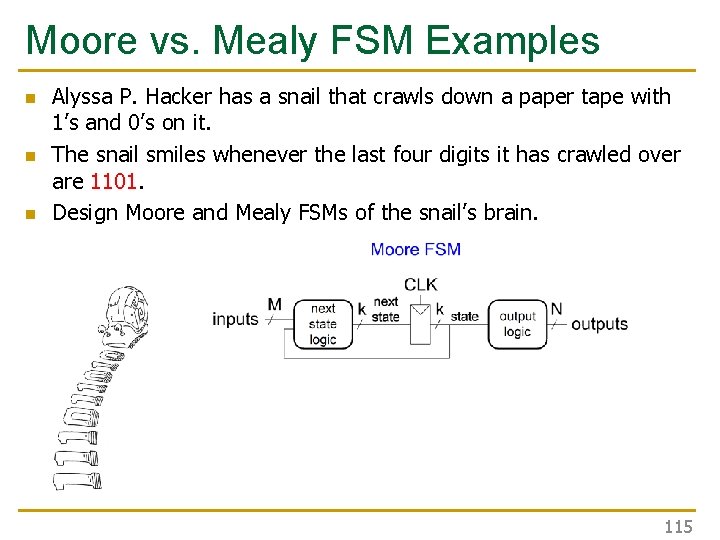
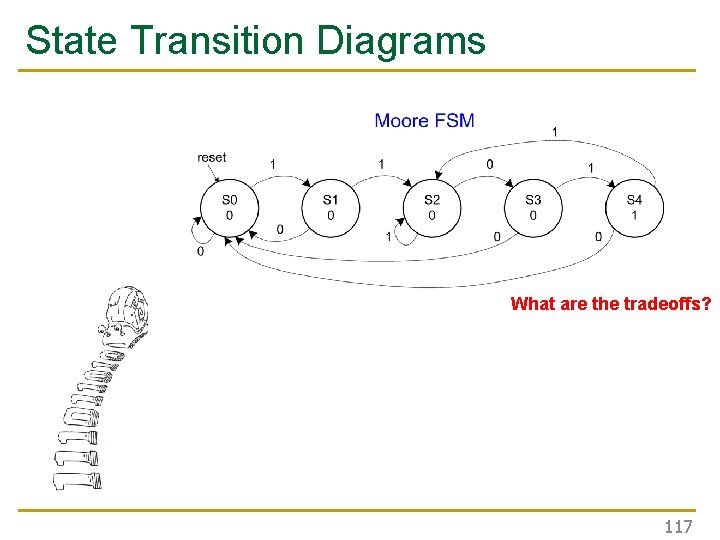
Moore vs. Mealy FSM Examples n n n Alyssa P. Hacker has a snail that crawls down a paper tape with 1’s and 0’s on it. The snail smiles whenever the last four digits it has crawled over are 1101. Design Moore and Mealy FSMs of the snail’s brain. 115
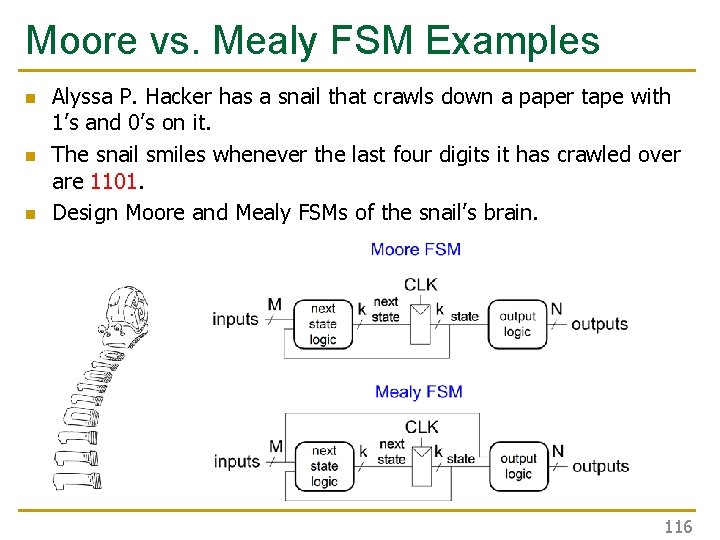
Moore vs. Mealy FSM Examples n n n Alyssa P. Hacker has a snail that crawls down a paper tape with 1’s and 0’s on it. The snail smiles whenever the last four digits it has crawled over are 1101. Design Moore and Mealy FSMs of the snail’s brain. 116
State Transition Diagrams What are the tradeoffs? 117
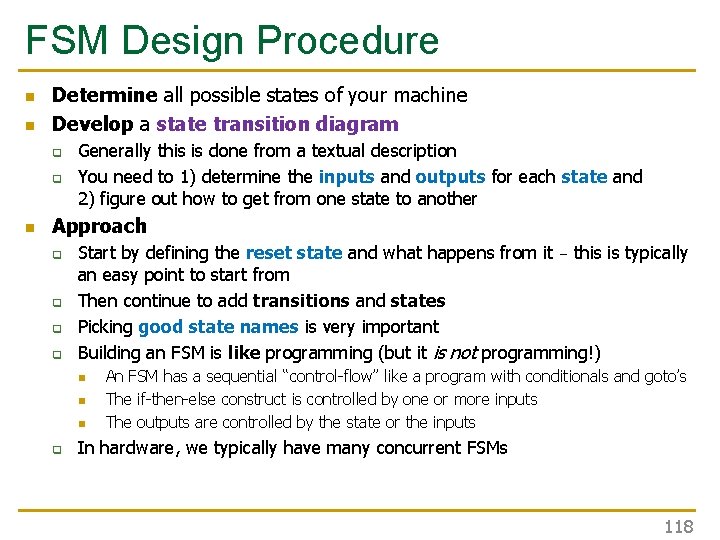
FSM Design Procedure n n Determine all possible states of your machine Develop a state transition diagram q q n Generally this is done from a textual description You need to 1) determine the inputs and outputs for each state and 2) figure out how to get from one state to another Approach q q Start by defining the reset state and what happens from it – this is typically an easy point to start from Then continue to add transitions and states Picking good state names is very important Building an FSM is like programming (but it is not programming!) n n n q An FSM has a sequential “control-flow” like a program with conditionals and goto’s The if-then-else construct is controlled by one or more inputs The outputs are controlled by the state or the inputs In hardware, we typically have many concurrent FSMs 118
What is to Come: LC-3 Processor 119
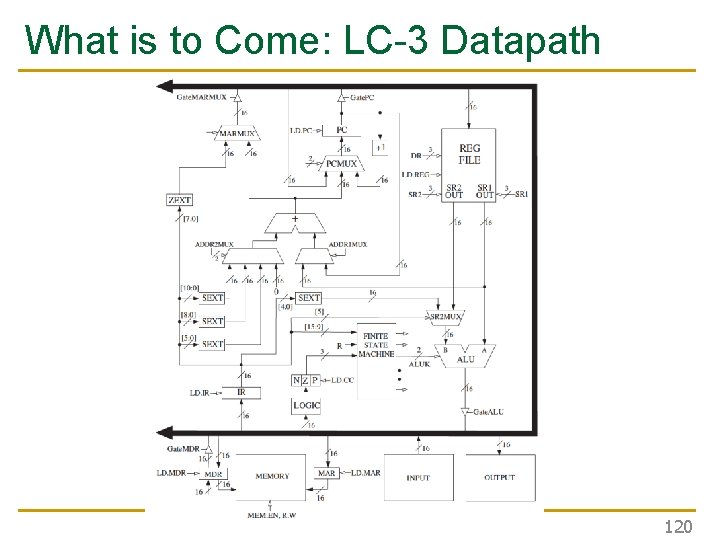
What is to Come: LC-3 Datapath 120
Digital Design & Computer Arch. Lecture 6: Sequential Logic Design Prof. Onur Mutlu ETH Zürich Spring 2021 12 March 2021 121
Backup Slides: Different Types of Flip Flops 122
Enabled Flip-Flops n Inputs: CLK, D, EN q n The enable input (EN) controls when new data (D) is stored Function: q q EN = 1: D passes through to Q on the clock edge EN = 0: the flip-flop retains its previous state 123
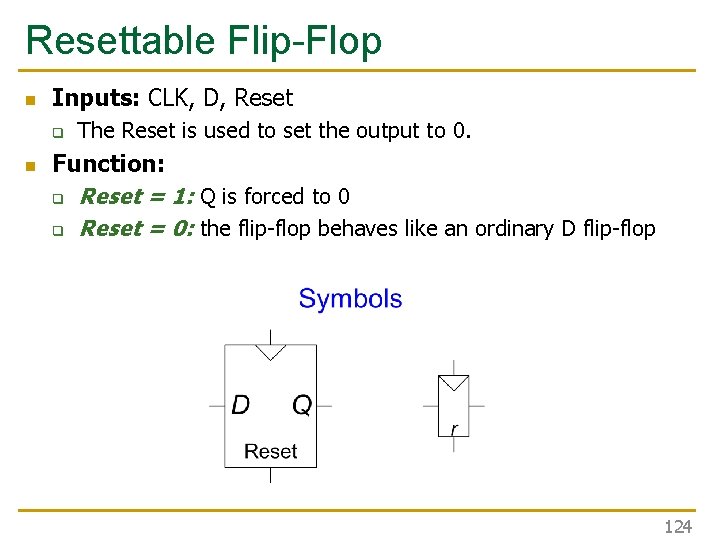
Resettable Flip-Flop n Inputs: CLK, D, Reset q n The Reset is used to set the output to 0. Function: q Reset = 1: Q is forced to 0 q Reset = 0: the flip-flop behaves like an ordinary D flip-flop 124
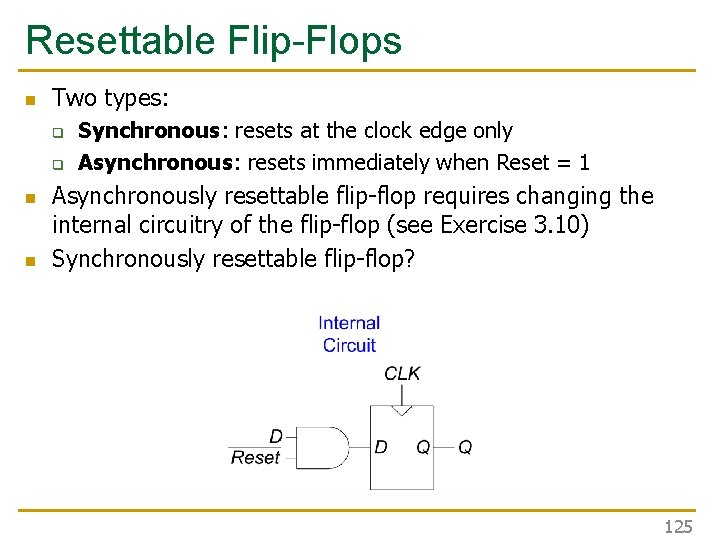
Resettable Flip-Flops n Two types: q q n n Synchronous: resets at the clock edge only Asynchronous: resets immediately when Reset = 1 Asynchronously resettable flip-flop requires changing the internal circuitry of the flip-flop (see Exercise 3. 10) Synchronously resettable flip-flop? 125
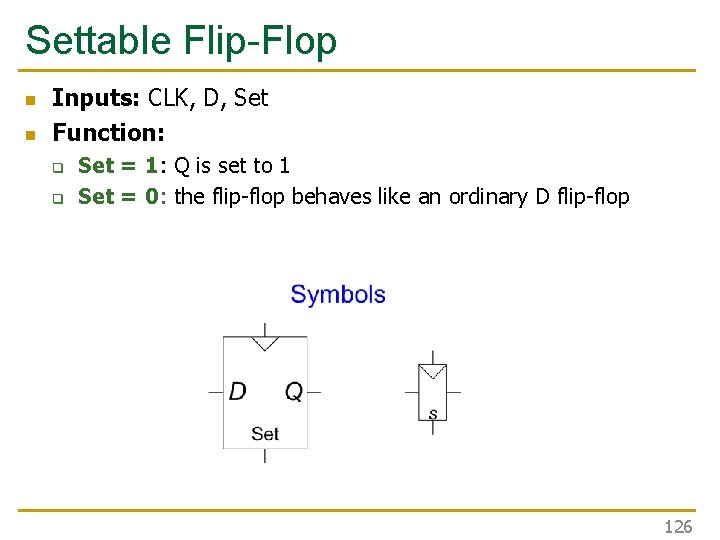
Settable Flip-Flop n n Inputs: CLK, D, Set Function: q q Set = 1: Q is set to 1 Set = 0: the flip-flop behaves like an ordinary D flip-flop 126