
Digital Design Computer Arch Lecture 3 a Mysteries



![Bloom Filter n n [Bloom, CACM 1970] Probabilistic data structure that compactly represents set](https://slidetodoc.com/presentation_image_h2/a109584ae10d503087684755cbb1c166/image-47.jpg "Bloom Filter n n [Bloom, CACM 1970] Probabilistic data structure that compactly represents set")
- Slides: 55
Digital Design & Computer Arch. Lecture 3 a: Mysteries in Comp. Arch. Prof. Onur Mutlu ETH Zürich Spring 2020 27 February 2020
Four Mysteries, Continued n Meltdown & Spectre (2017 -2018) n Rowhammer (2012 -2014) n Memories Forget: Refresh (2011 -2012) n Memory Performance Attacks (2006 -2007) 2
Mystery #3: DRAM Refresh 3
Recall: DRAM Refresh n n DRAM capacitor charge leaks over time The memory controller needs to refresh each row periodically to restore charge q q n Activate each row every N ms Typical N = 64 ms Downsides of refresh -- Energy consumption: Each refresh consumes energy -- Performance degradation: DRAM rank/bank unavailable while refreshed -- Qo. S/predictability impact: (Long) pause times during refresh -- Refresh rate limits DRAM capacity scaling 4
Recall: How Do We Solve the Problem? n Observation: All DRAM rows are refreshed every 64 ms. n n Critical thinking: Do we need to refresh all rows every 64 ms? What if we knew what happened underneath and exposed that information to upper layers? 5
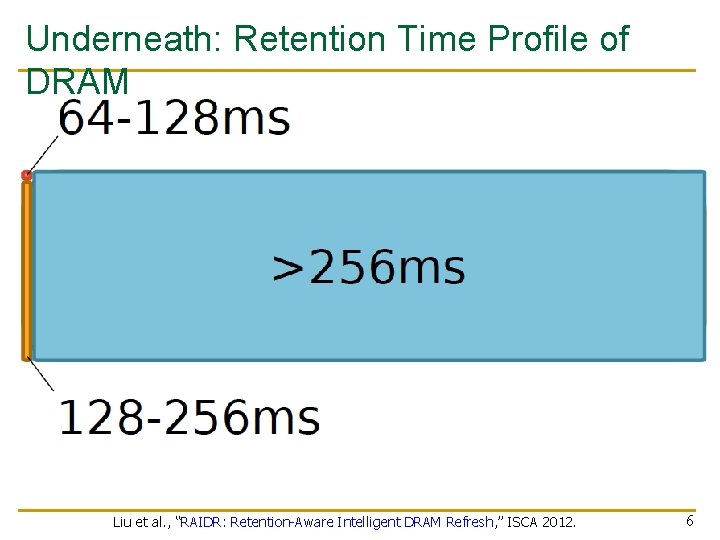
Underneath: Retention Time Profile of DRAM Liu et al. , “RAIDR: Retention-Aware Intelligent DRAM Refresh, ” ISCA 2012. 6
Aside: Why Do We Have Such a Profile? n Answer: Manufacturing is not perfect n Not all DRAM cells are exactly the same n Some are more leaky than others n This is called Manufacturing Process Variation 7
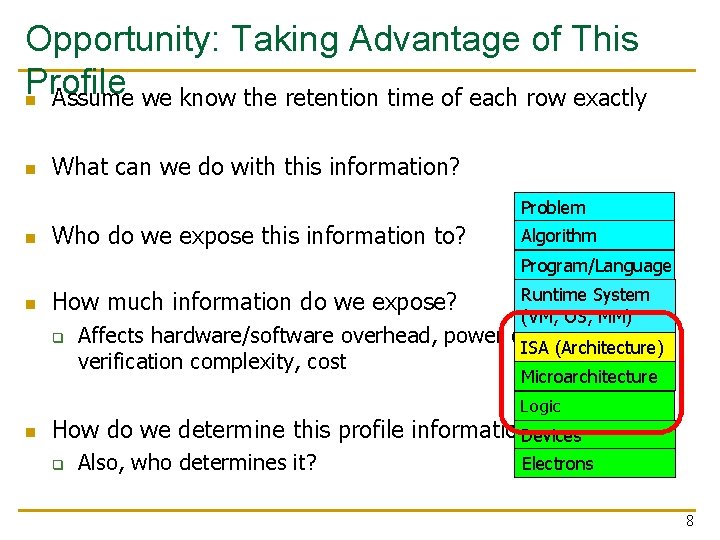
Opportunity: Taking Advantage of This Profile n Assume we know the retention time of each row exactly n What can we do with this information? Problem n Who do we expose this information to? Algorithm Program/Language n How much information do we expose? q Runtime System (VM, OS, MM) Affects hardware/software overhead, power consumption, ISA (Architecture) verification complexity, cost Microarchitecture Logic n How do we determine this profile information? Devices q Also, who determines it? Electrons 8
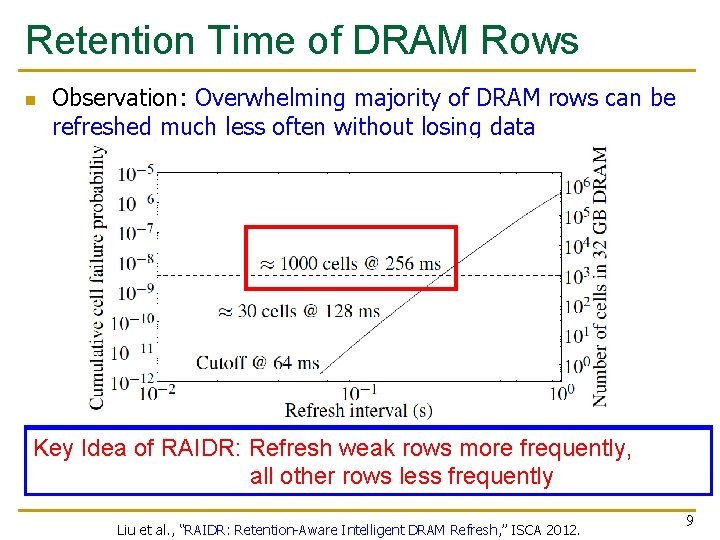
Retention Time of DRAM Rows n Observation: Overwhelming majority of DRAM rows can be refreshed much less often without losing data n. Only Can~1000 we exploit to reduce refresh rows this in 32 GB DRAM need at low cost? refresh every 64 ms, Key Idea of RAIDR: Refresh weak rowsoperations more frequently, but we refresh all rows 64 msless frequently all every other rows Liu et al. , “RAIDR: Retention-Aware Intelligent DRAM Refresh, ” ISCA 2012. 9
RAIDR: Eliminating Unnecessary DRAM Refreshes Liu, Jaiyen, Veras, Mutlu, RAIDR: Retention-Aware Intelligent DRAM Refresh ISCA 2012. 10
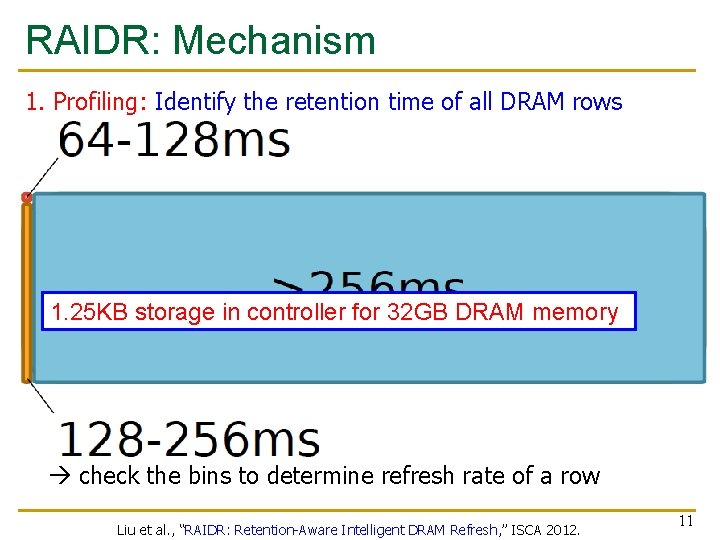
RAIDR: Mechanism 1. Profiling: Identify the retention time of all DRAM rows can be done at design time or during operation 2. Binning: Store rows into bins by retention time use Bloom Filters for efficient and scalable storage 1. 25 KB storage in controller for 32 GB DRAM memory 3. Refreshing: Memory controller refreshes rows in different bins at different rates check the bins to determine refresh rate of a row Liu et al. , “RAIDR: Retention-Aware Intelligent DRAM Refresh, ” ISCA 2012. 11
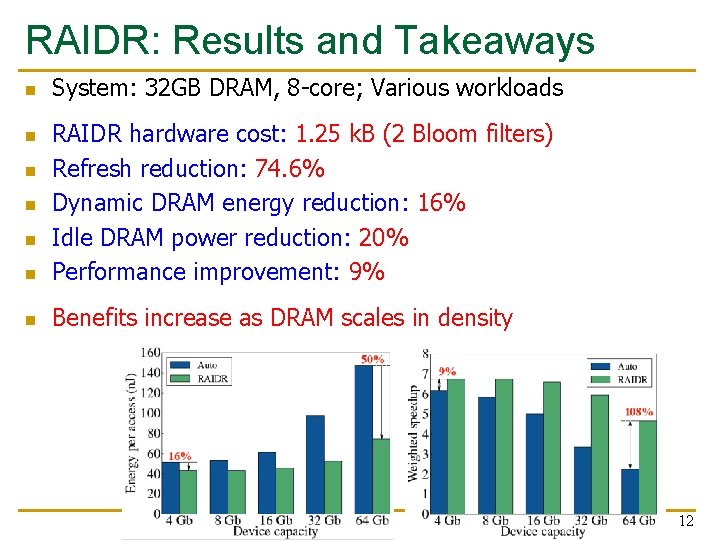
RAIDR: Results and Takeaways n System: 32 GB DRAM, 8 -core; Various workloads n RAIDR hardware cost: 1. 25 k. B (2 Bloom filters) Refresh reduction: 74. 6% Dynamic DRAM energy reduction: 16% Idle DRAM power reduction: 20% Performance improvement: 9% n Benefits increase as DRAM scales in density n n 12
Reading for the Really Interested n Jamie Liu, Ben Jaiyen, Richard Veras, and Onur Mutlu, "RAIDR: Retention-Aware Intelligent DRAM Refresh" Proceedings of the 39 th International Symposium on Computer Architecture (ISCA), Portland, OR, June 2012. Slides (pdf) 13
Really Interested? … Further Onur Mutlu, Readings n "Memory Scaling: A Systems Architecture Perspective" Technical talk at Mem. Con 2013 (MEMCON), Santa Clara, CA, August 2013. Slides (pptx) (pdf) Video n Kevin Chang, Donghyuk Lee, Zeshan Chishti, Alaa Alameldeen, Chris Wilkerson, Yoongu Kim, and Onur Mutlu, "Improving DRAM Performance by Parallelizing Refreshes with Accesses" Proceedings of the 20 th International Symposium on High-Performance Computer Architecture (HPCA), Orlando, FL, February 2014. Slides (pptx) (pdf) 14
Takeaway Breaking the abstraction layers (between components and transformation hierarchy levels) and knowing what is underneath enables you to understand solve problems 15
Mystery #4: Memory Performance Attacks 16
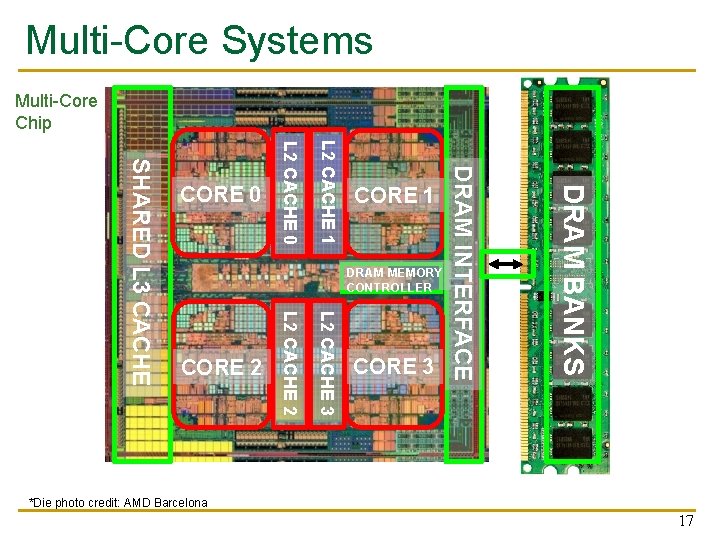
Multi-Core Systems Multi-Core Chip DRAM MEMORY CONTROLLER L 2 CACHE 3 L 2 CACHE 2 CORE 3 DRAM BANKS CORE 1 DRAM INTERFACE L 2 CACHE 1 L 2 CACHE 0 SHARED L 3 CACHE CORE 0 *Die photo credit: AMD Barcelona 17
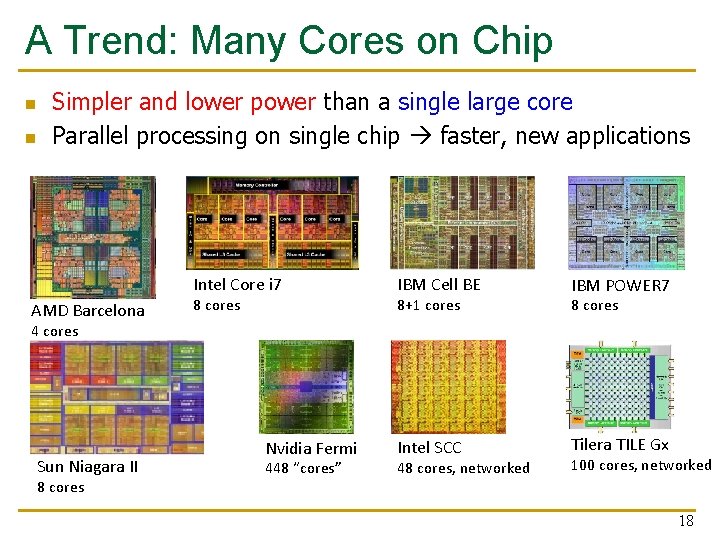
A Trend: Many Cores on Chip n n Simpler and lower power than a single large core Parallel processing on single chip faster, new applications Intel Core i 7 AMD Barcelona 8 cores IBM Cell BE IBM POWER 7 Intel SCC Tilera TILE Gx 8+1 cores 8 cores 4 cores Sun Niagara II 8 cores Nvidia Fermi 448 “cores” 48 cores, networked 100 cores, networked 18
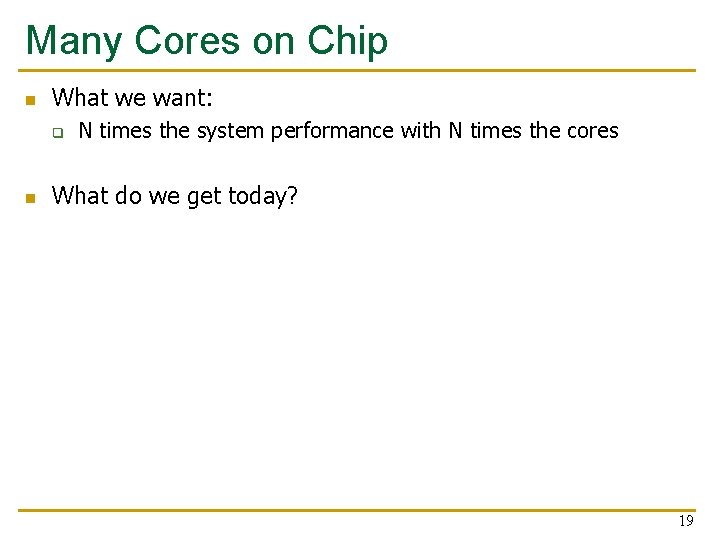
Many Cores on Chip n What we want: q n N times the system performance with N times the cores What do we get today? 19
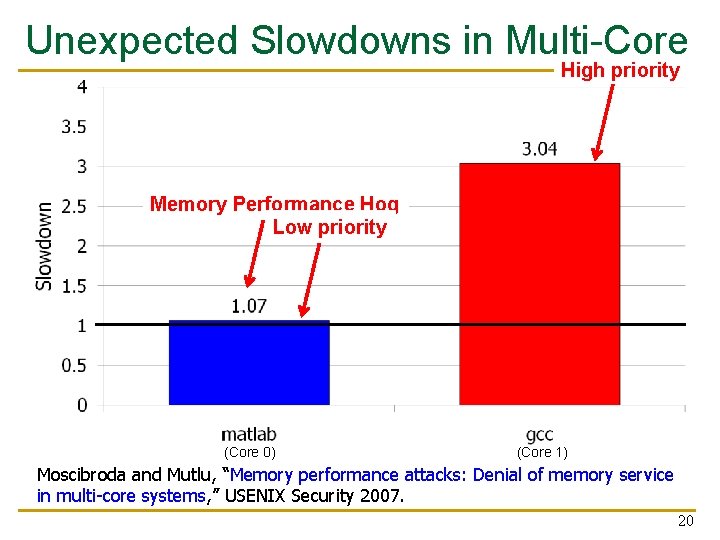
Unexpected Slowdowns in Multi-Core High priority Memory Performance Hog Low priority (Core 0) (Core 1) Moscibroda and Mutlu, “Memory performance attacks: Denial of memory service in multi-core systems, ” USENIX Security 2007. 20
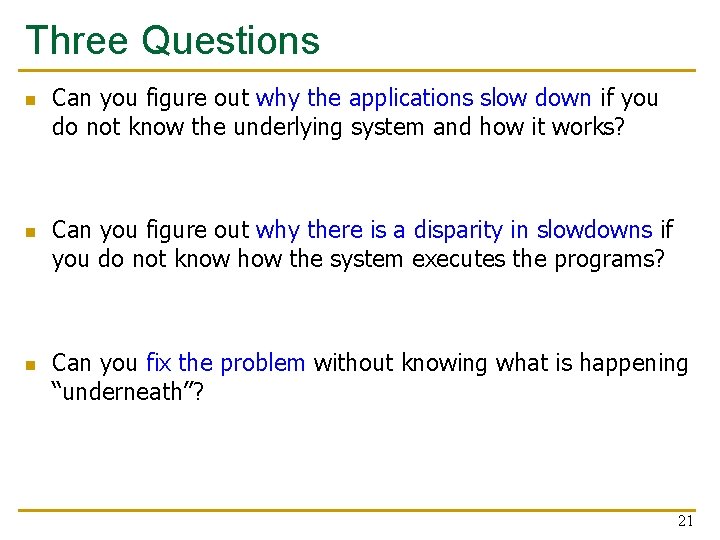
Three Questions n n n Can you figure out why the applications slow down if you do not know the underlying system and how it works? Can you figure out why there is a disparity in slowdowns if you do not know how the system executes the programs? Can you fix the problem without knowing what is happening “underneath”? 21
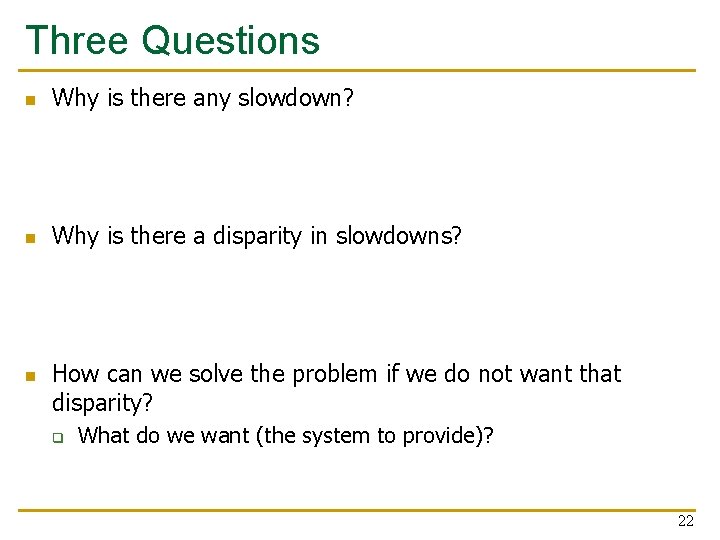
Three Questions n Why is there any slowdown? n Why is there a disparity in slowdowns? n How can we solve the problem if we do not want that disparity? q What do we want (the system to provide)? 22
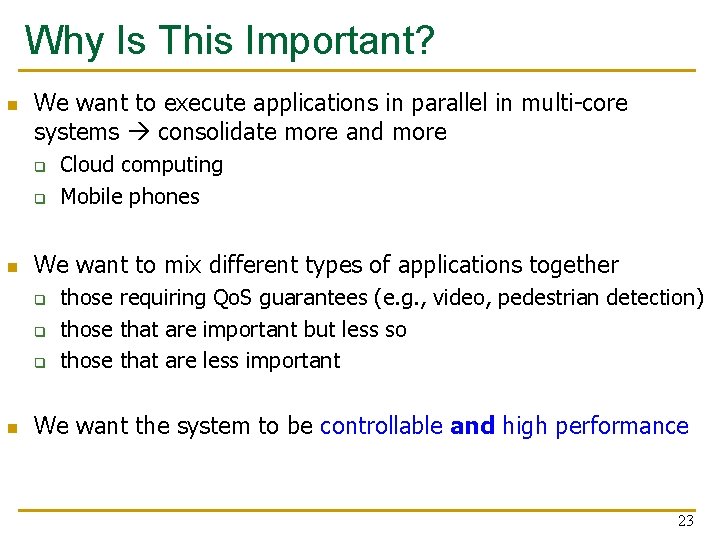
Why Is This Important? n We want to execute applications in parallel in multi-core systems consolidate more and more q q n We want to mix different types of applications together q q q n Cloud computing Mobile phones those requiring Qo. S guarantees (e. g. , video, pedestrian detection) those that are important but less so those that are less important We want the system to be controllable and high performance 23
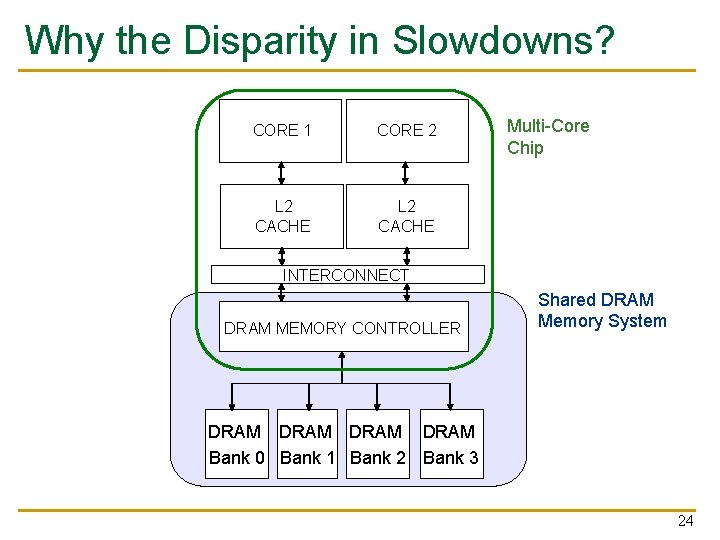
Why the Disparity in Slowdowns? CORE 1 CORE 2 L 2 CACHE Multi-Core Chip INTERCONNECT DRAM MEMORY CONTROLLER Shared DRAM Memory System DRAM Bank 0 Bank 1 Bank 2 Bank 3 24
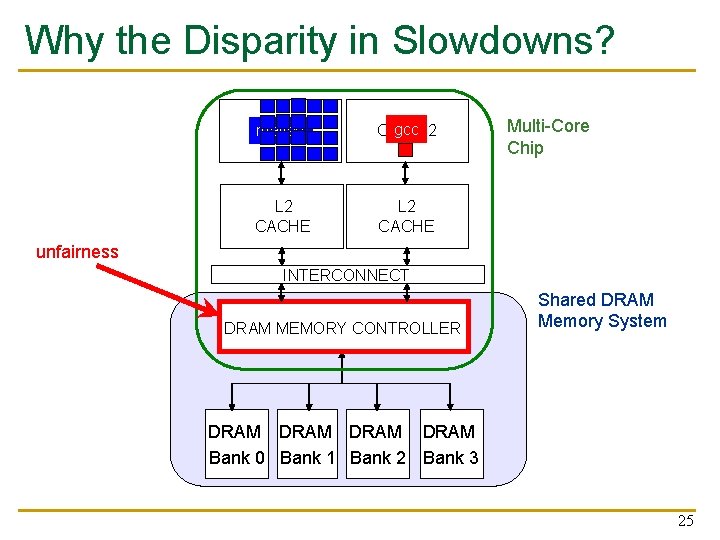
Why the Disparity in Slowdowns? matlab 1 CORE gcc 2 CORE L 2 CACHE Multi-Core Chip unfairness INTERCONNECT DRAM MEMORY CONTROLLER Shared DRAM Memory System DRAM Bank 0 Bank 1 Bank 2 Bank 3 25
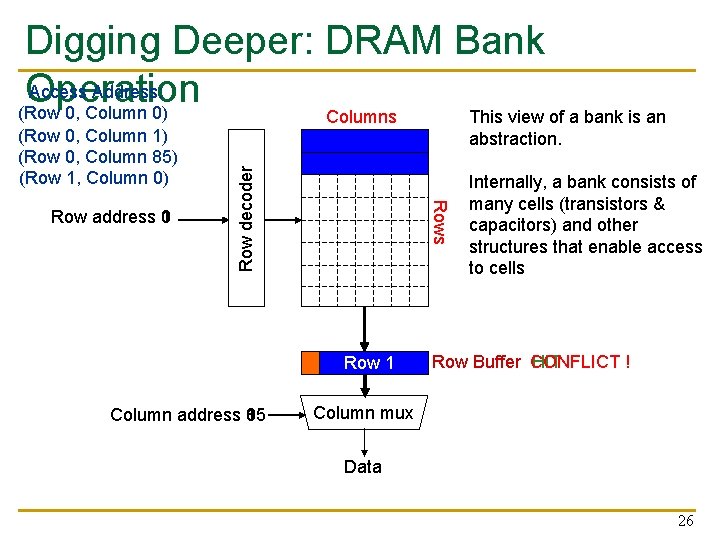
Digging Deeper: DRAM Bank Access Address: Operation (Row 0, Column 0) Rows Row address 0 1 Row decoder (Row 0, Column 1) (Row 0, Column 85) (Row 1, Column 0) This view of a bank is an abstraction. Columns Row 01 Row Empty Column address 0 1 85 Internally, a bank consists of many cells (transistors & capacitors) and other structures that enable access to cells Row Buffer CONFLICT HIT ! Column mux Data 26
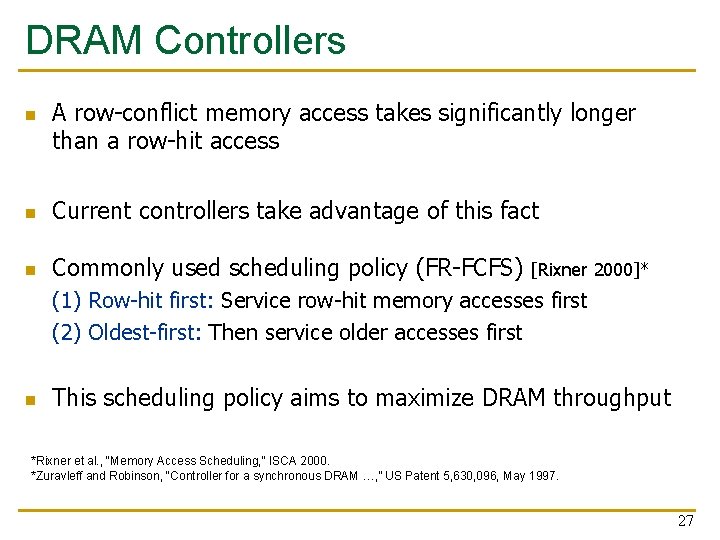
DRAM Controllers n A row-conflict memory access takes significantly longer than a row-hit access n Current controllers take advantage of this fact n Commonly used scheduling policy (FR-FCFS) [Rixner 2000]* (1) Row-hit first: Service row-hit memory accesses first (2) Oldest-first: Then service older accesses first n This scheduling policy aims to maximize DRAM throughput *Rixner et al. , “Memory Access Scheduling, ” ISCA 2000. *Zuravleff and Robinson, “Controller for a synchronous DRAM …, ” US Patent 5, 630, 096, May 1997. 27
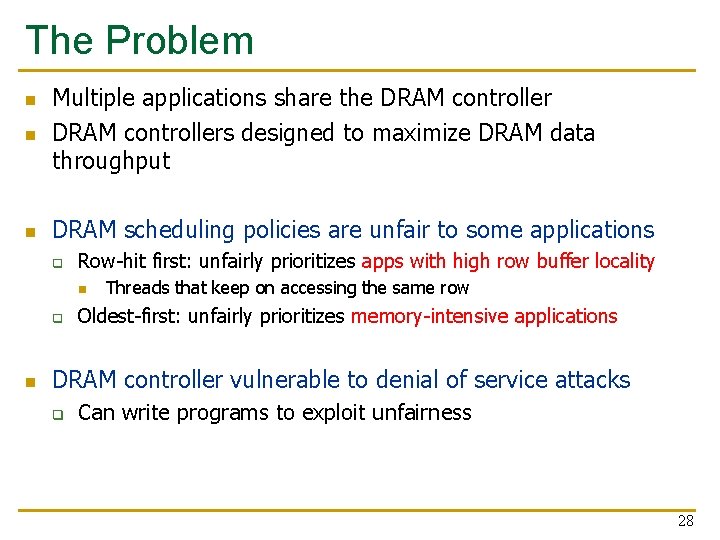
The Problem n Multiple applications share the DRAM controllers designed to maximize DRAM data throughput n DRAM scheduling policies are unfair to some applications n q Row-hit first: unfairly prioritizes apps with high row buffer locality n q n Threads that keep on accessing the same row Oldest-first: unfairly prioritizes memory-intensive applications DRAM controller vulnerable to denial of service attacks q Can write programs to exploit unfairness 28
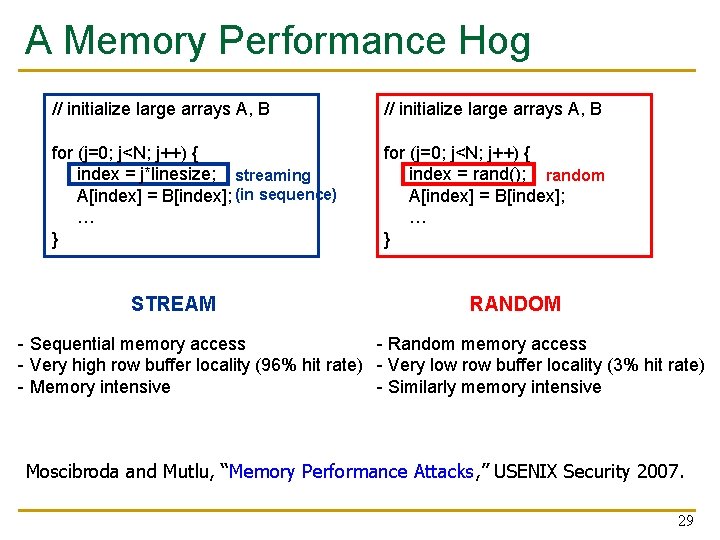
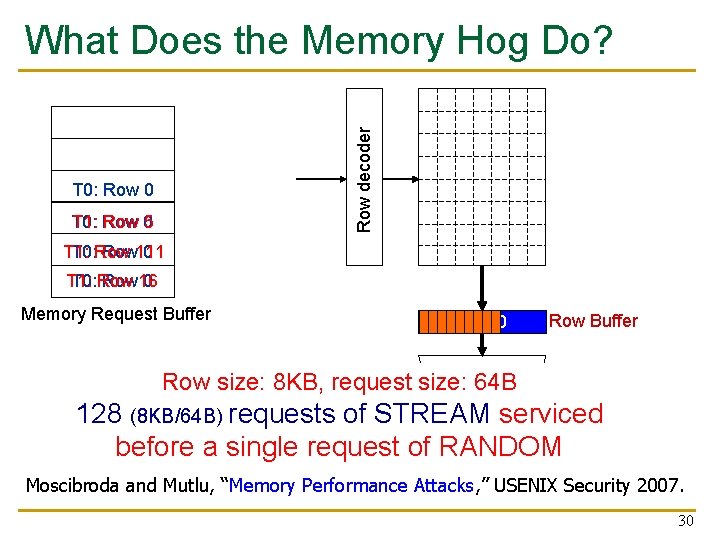
A Memory Performance Hog // initialize large arrays A, B for (j=0; j<N; j++) { index = j*linesize; streaming A[index] = B[index]; (in sequence) … } for (j=0; j<N; j++) { index = rand(); random A[index] = B[index]; … } STREAM RANDOM - Sequential memory access - Random memory access - Very high row buffer locality (96% hit rate) - Very low row buffer locality (3% hit rate) - Memory intensive - Similarly memory intensive Moscibroda and Mutlu, “Memory Performance Attacks, ” USENIX Security 2007. 29
Row decoder What Does the Memory Hog Do? T 0: Row 0 T 0: T 1: Row 05 T 1: T 0: Row 111 0 T 1: T 0: Row 16 0 Memory Request Buffer Row 00 Row Buffer Column mux Row size: 8 KB, request size: 64 B T 0: STREAM 128 (8 KB/64 B) T 1: RANDOM requests of STREAM Dataserviced before a single request of RANDOM Moscibroda and Mutlu, “Memory Performance Attacks, ” USENIX Security 2007. 30
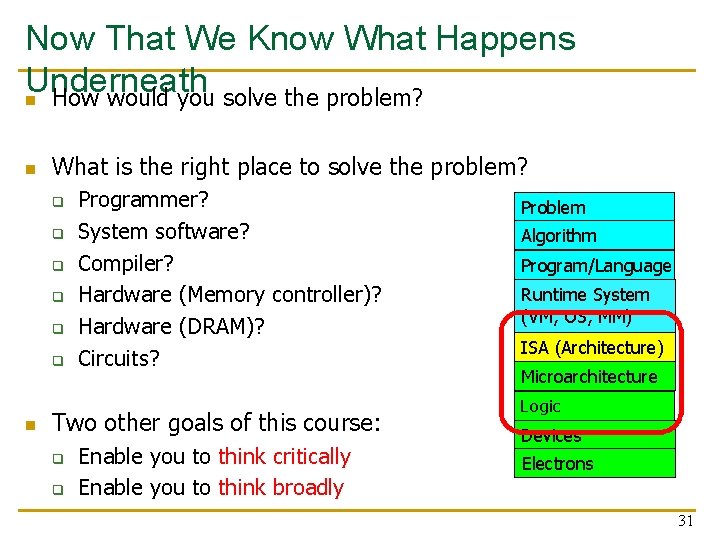
Now That We Know What Happens Underneath n How would you solve the problem? n What is the right place to solve the problem? q q q n Programmer? System software? Compiler? Hardware (Memory controller)? Hardware (DRAM)? Circuits? Two other goals of this course: q q Enable you to think critically Enable you to think broadly Problem Algorithm Program/Language Runtime System (VM, OS, MM) ISA (Architecture) Microarchitecture Logic Devices Electrons 31
For the Really Interested… n Thomas Moscibroda and Onur Mutlu, "Memory Performance Attacks: Denial of Memory Service in Multi-Core Systems" Proceedings of the 16 th USENIX Security Symposium (USENIX SECURITY), pages 257 -274, Boston, MA, August 2007. Slides (ppt) 32
Really Interested? … Further Onur Mutlu and Thomas Moscibroda, Readings n "Stall-Time Fair Memory Access Scheduling for Chip Multiprocessors" Proceedings of the 40 th International Symposium on Microarchitecture (MICRO), pages 146 -158, Chicago, IL, December 2007. Slides (ppt) n Onur Mutlu and Thomas Moscibroda, "Parallelism-Aware Batch Scheduling: Enhancing both Performance and Fairness of Shared DRAM Systems” Proceedings of the 35 th International Symposium on Computer Architecture (ISCA) [Slides (ppt)] n Sai Prashanth Muralidhara, Lavanya Subramanian, Onur Mutlu, Mahmut Kandemir, and Thomas Moscibroda, "Reducing Memory Interference in Multicore Systems via Application-Aware Memory Channel Partitioning" Proceedings of the 44 th International Symposium on Microarchitecture (MICRO), Porto Alegre, Brazil, December 2011. Slides (pptx) 33
Takeaway I Breaking the abstraction layers (between components and transformation hierarchy levels) and knowing what is underneath enables you to understand solve problems 34
Takeaway II Cooperation between multiple components and layers can enable more effective solutions and systems 35
Recap: Mysteries No Longer! n Meltdown & Spectre (2017 -2018) n Rowhammer (2012 -2014) n Memories Forget: Refresh (2011 -2012) n Memory Performance Attacks (2006 -2007) 36
Takeaways 37
Takeaways n n It is an exciting time to be understanding and designing computing architectures Many challenging and exciting problems in platform design q q n Driven by huge hunger for data (Big Data), new applications (ML/AI, graph analytics, genomics), ever-greater realism, … q n That no one has tackled (or thought about) before That can have huge impact on the world’s future We can easily collect more data than we can analyze/understand Driven by significant difficulties in keeping up with that hunger at the technology layer q Five walls: Energy, reliability, complexity, security, scalability 38
Computer Architecture as an Enabler of the Future 39
Assignment: Required Lecture n Why study computer architecture? Video n Why is it important? Future Computing Architectures n Required Assignment n q q n Watch Prof. Mutlu’s inaugural lecture at ETH and understand it https: //www. youtube. com/watch? v=kgi. Zl. SOc. GFM Optional Assignment – for 1% extra credit q Write a 1 -page summary of the lecture and email us n n What are your key takeaways? What did you learn? What did you like or dislike? Submit your summary to Moodle 40
Digital Design & Computer Arch. Lecture 3 a: Mysteries in Comp. Arch. Prof. Onur Mutlu ETH Zürich Spring 2020 27 February 2020
Backup Slides For Your Benefit. Not Covered in Lecture. 42
Bloom Filters 43
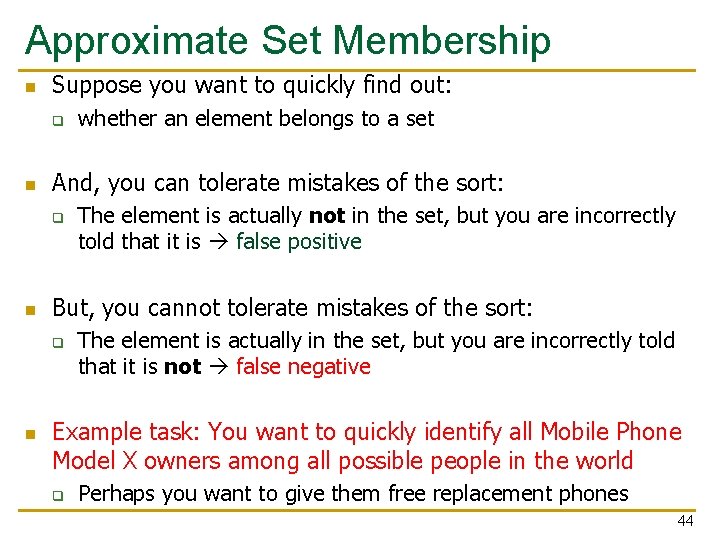
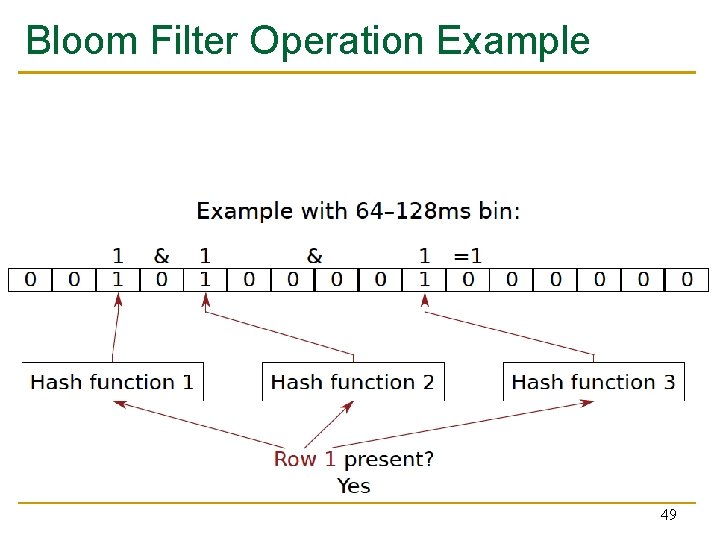
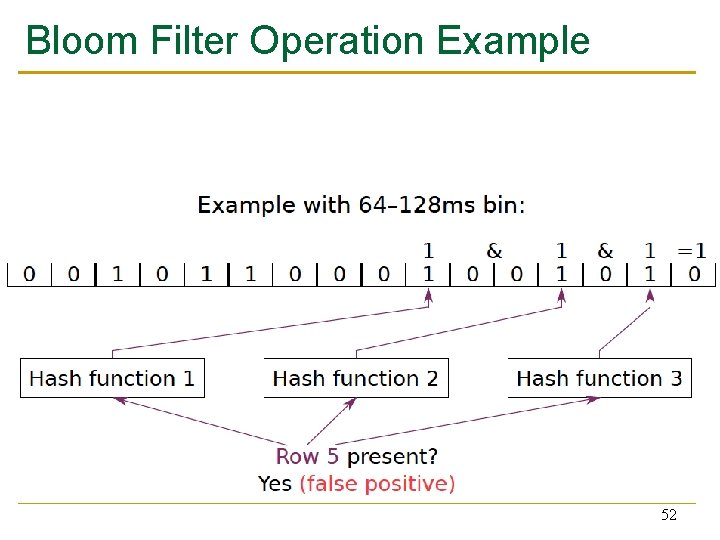
Approximate Set Membership n Suppose you want to quickly find out: q n And, you can tolerate mistakes of the sort: q n The element is actually not in the set, but you are incorrectly told that it is false positive But, you cannot tolerate mistakes of the sort: q n whether an element belongs to a set The element is actually in the set, but you are incorrectly told that it is not false negative Example task: You want to quickly identify all Mobile Phone Model X owners among all possible people in the world q Perhaps you want to give them free replacement phones 44
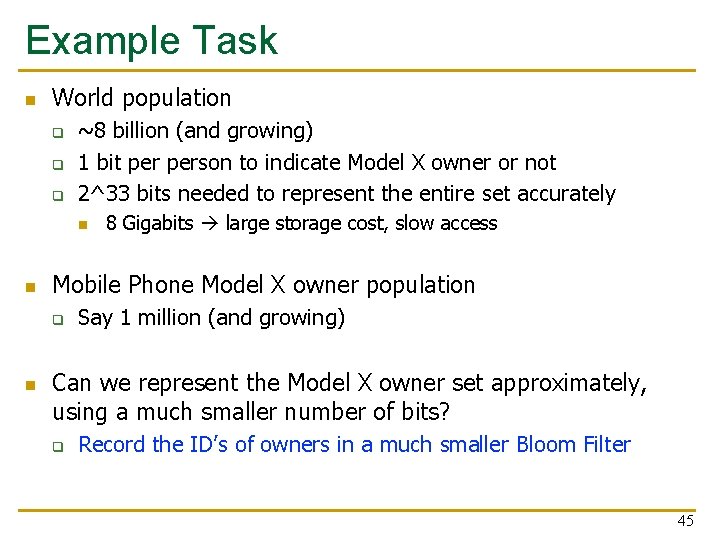
Example Task n World population q q q ~8 billion (and growing) 1 bit person to indicate Model X owner or not 2^33 bits needed to represent the entire set accurately n n Mobile Phone Model X owner population q n 8 Gigabits large storage cost, slow access Say 1 million (and growing) Can we represent the Model X owner set approximately, using a much smaller number of bits? q Record the ID’s of owners in a much smaller Bloom Filter 45
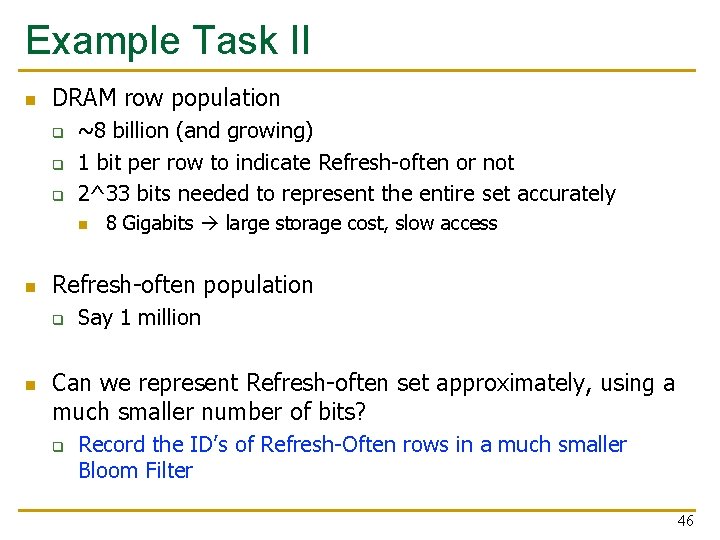
Example Task II n DRAM row population q q q ~8 billion (and growing) 1 bit per row to indicate Refresh-often or not 2^33 bits needed to represent the entire set accurately n n Refresh-often population q n 8 Gigabits large storage cost, slow access Say 1 million Can we represent Refresh-often set approximately, using a much smaller number of bits? q Record the ID’s of Refresh-Often rows in a much smaller Bloom Filter 46
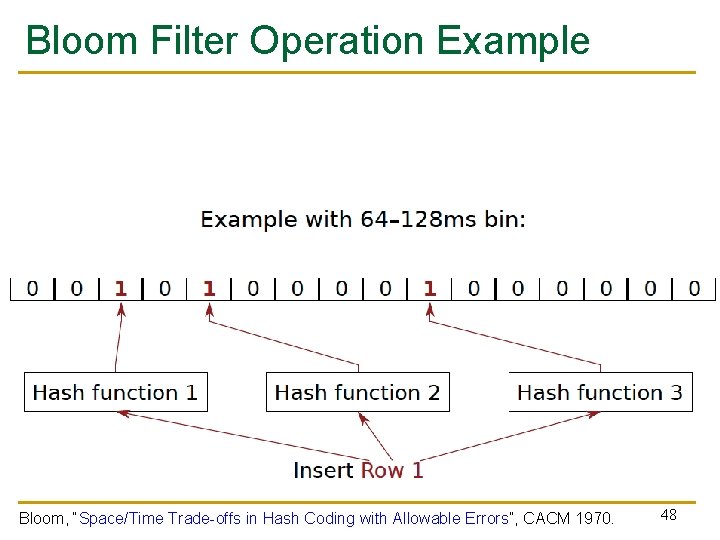
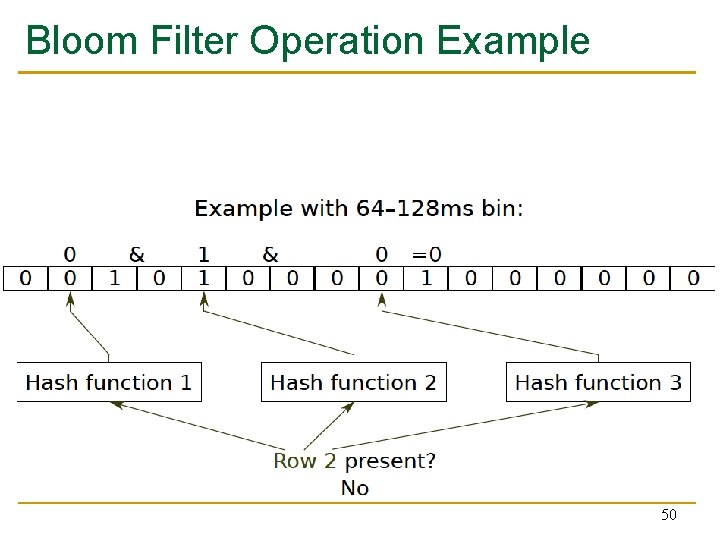
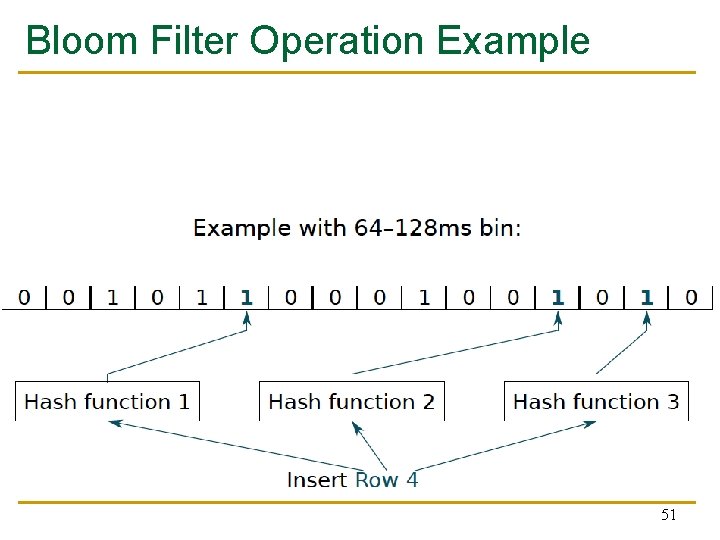
Bloom Filter n n [Bloom, CACM 1970] Probabilistic data structure that compactly represents set membership (presence or absence of element in a set) Non-approximate set membership: Use 1 bit per element to indicate absence/presence of each element from an element space of N elements Approximate set membership: use a much smaller number of bits and indicate each element’s presence/absence with a subset of those bits q n Some elements map to the bits other elements also map to Operations: 1) insert, 2) test, 3) remove all elements Bloom, “Space/Time Trade-offs in Hash Coding with Allowable Errors”, CACM 1970. 47
Bloom Filter Operation Example Bloom, “Space/Time Trade-offs in Hash Coding with Allowable Errors”, CACM 1970. 48
Bloom Filter Operation Example 49
Bloom Filter Operation Example 50
Bloom Filter Operation Example 51
Bloom Filter Operation Example 52
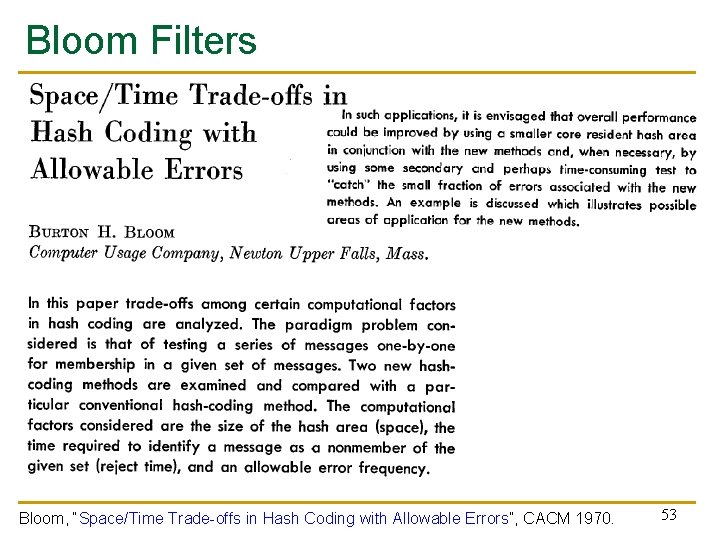
Bloom Filters Bloom, “Space/Time Trade-offs in Hash Coding with Allowable Errors”, CACM 1970. 53
Bloom Filters: Pros and Cons n Advantages + Enables storage-efficient representation of set membership + Insertion and testing for set membership (presence) are fast + No false negatives: If Bloom Filter says an element is not present in the set, the element must not have been inserted + Enables tradeoffs between time & storage efficiency & false positive rate (via sizing and hashing) n Disadvantages -- False positives: An element may be deemed to be present in the set by the Bloom Filter but it may never have been inserted Not the right data structure when you cannot tolerate false positives Bloom, “Space/Time Trade-offs in Hash Coding with Allowable Errors”, CACM 1970. 54
Benefits of Bloom Filters as Refresh Rate Bins n False positives: a row may be declared present in the Bloom filter even if it was never inserted q n n n Not a problem: Refresh some rows more frequently than needed No false negatives: rows are never refreshed less frequently than needed (no correctness problems) Scalable: a Bloom filter never overflows (unlike a fixed-size table) Efficient: No need to store info on a per-row basis; simple hardware 1. 25 KB for 2 filters for 32 GB DRAM system 55