
Digital Control Systems DCS Lecture27 Digital Implementation of

- Slides: 18
Digital Control Systems (DCS) Lecture-27 Digital Implementation of Analog Controllers Dr. Imtiaz Hussain Associate Professor email: imtiaz. hussain@faculty. muet. edu. pk URL : http: //imtiazhussainkalwar. weebly. com/ 1
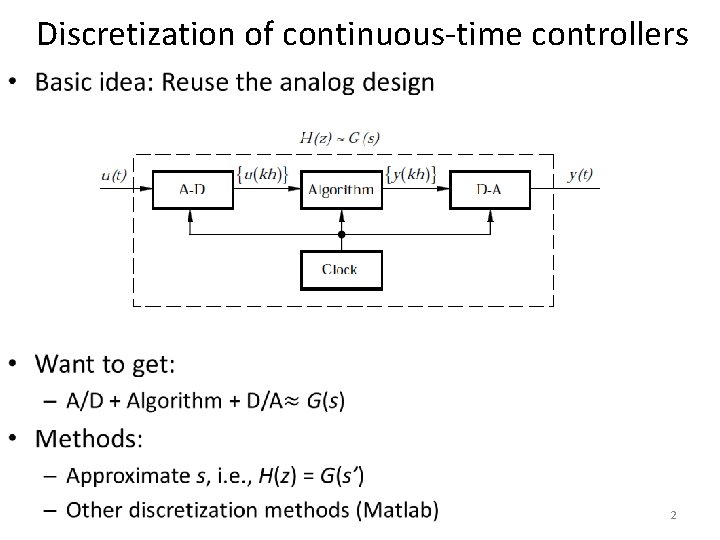
Discretization of continuous-time controllers • 2
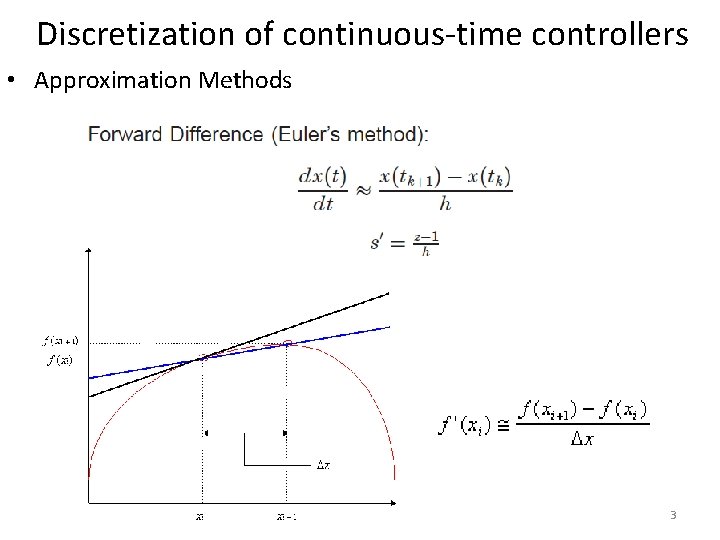
Discretization of continuous-time controllers • Approximation Methods 3
Discretization of continuous-time controllers • Approximation Methods 4
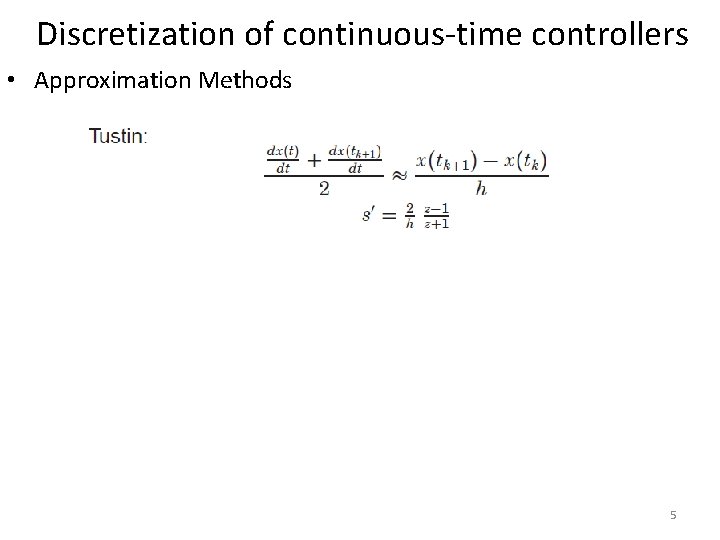
Discretization of continuous-time controllers • Approximation Methods 5
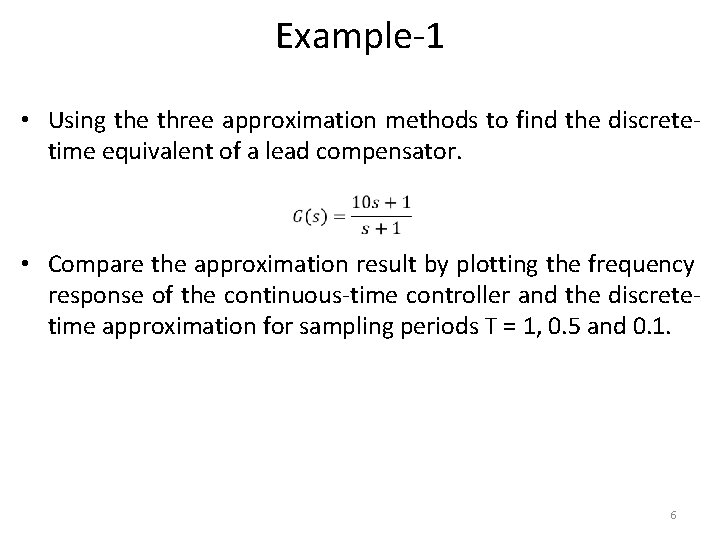
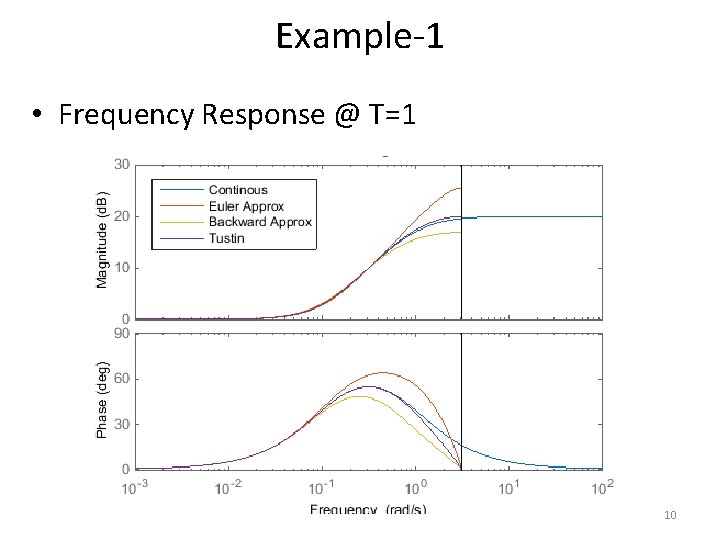
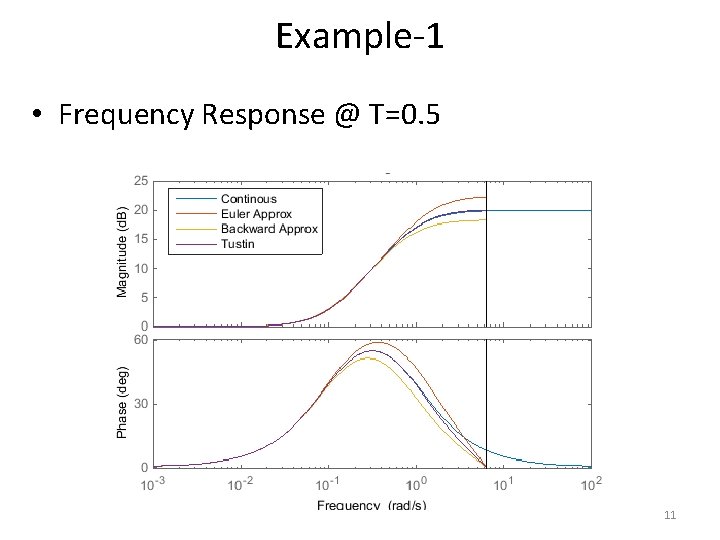
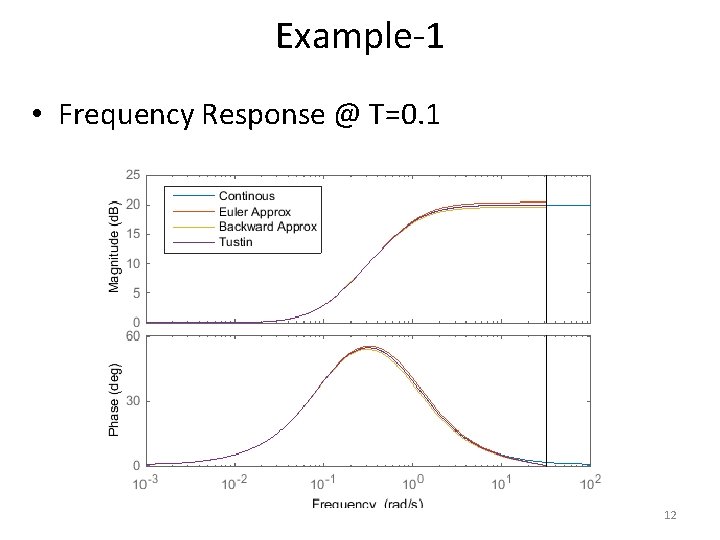
Example-1 • Using the three approximation methods to find the discretetime equivalent of a lead compensator. • Compare the approximation result by plotting the frequency response of the continuous-time controller and the discretetime approximation for sampling periods T = 1, 0. 5 and 0. 1. 6
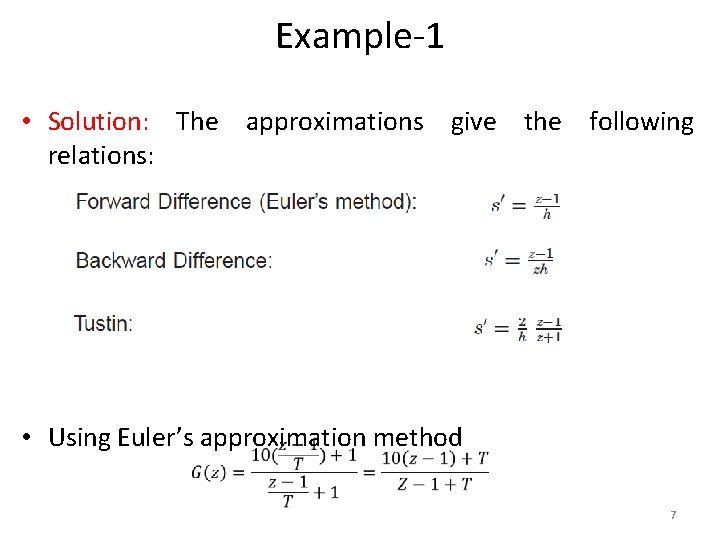
Example-1 • Solution: The approximations give the following relations: • Using Euler’s approximation method 7
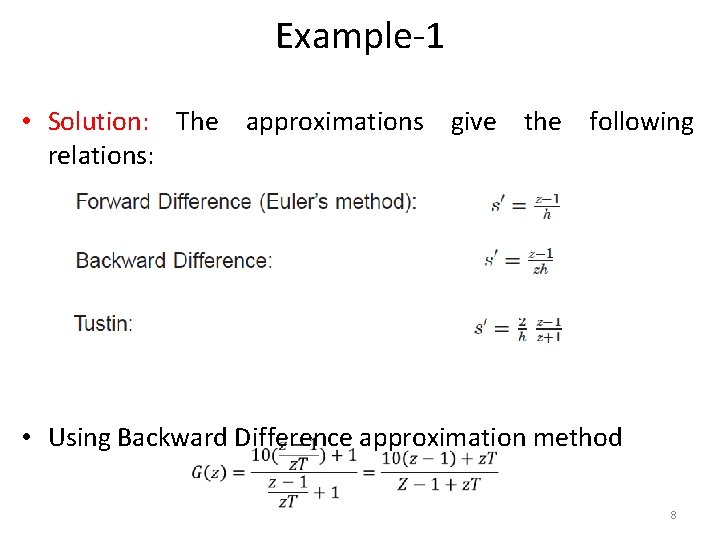
Example-1 • Solution: The approximations give the following relations: • Using Backward Difference approximation method 8
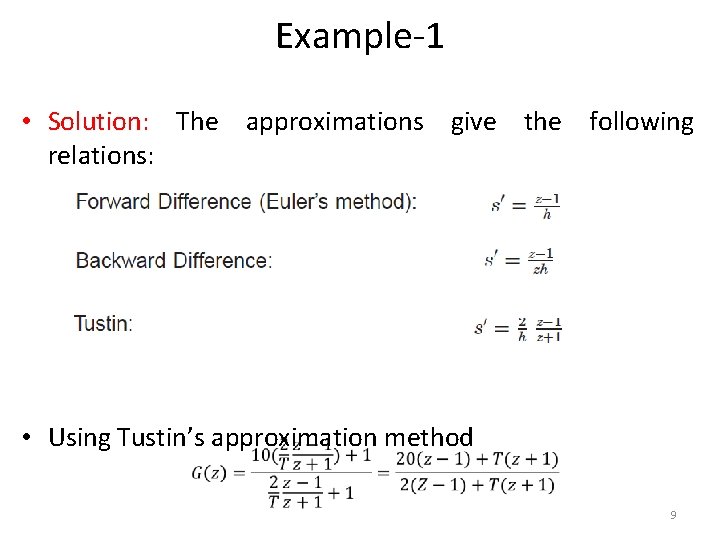
Example-1 • Solution: The approximations give the following relations: • Using Tustin’s approximation method 9
Example-1 • Frequency Response @ T=1 10
Example-1 • Frequency Response @ T=0. 5 11
Example-1 • Frequency Response @ T=0. 1 12
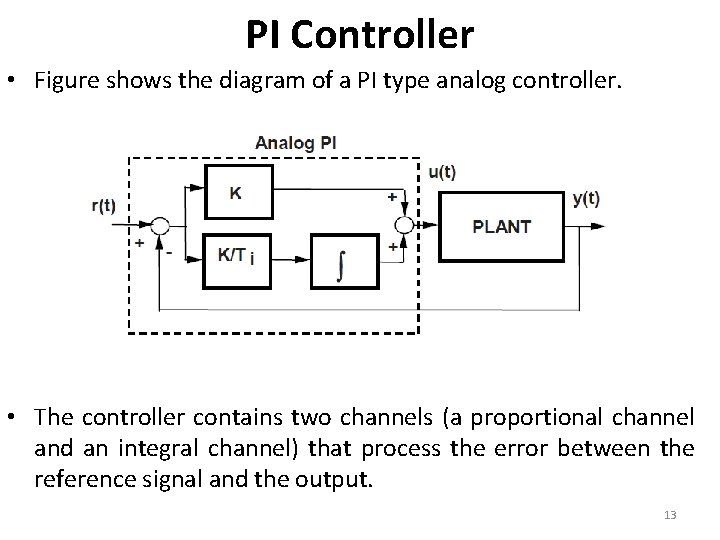
PI Controller • Figure shows the diagram of a PI type analog controller. • The controller contains two channels (a proportional channel and an integral channel) that process the error between the reference signal and the output. 13
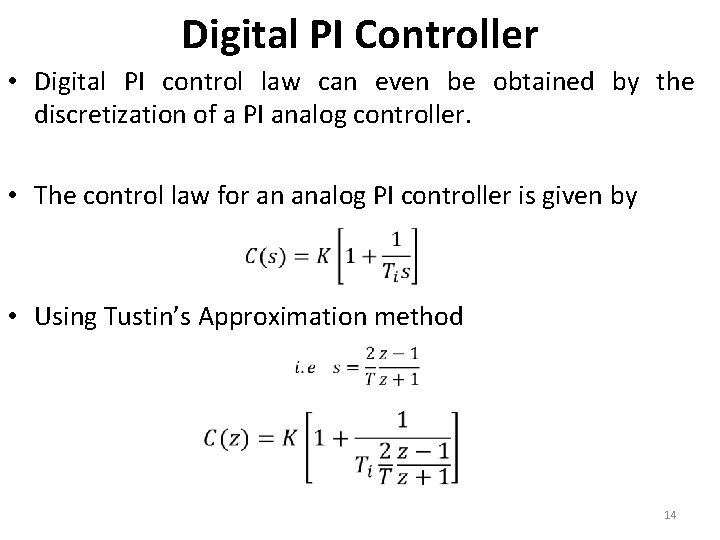
Digital PI Controller • Digital PI control law can even be obtained by the discretization of a PI analog controller. • The control law for an analog PI controller is given by • Using Tustin’s Approximation method 14
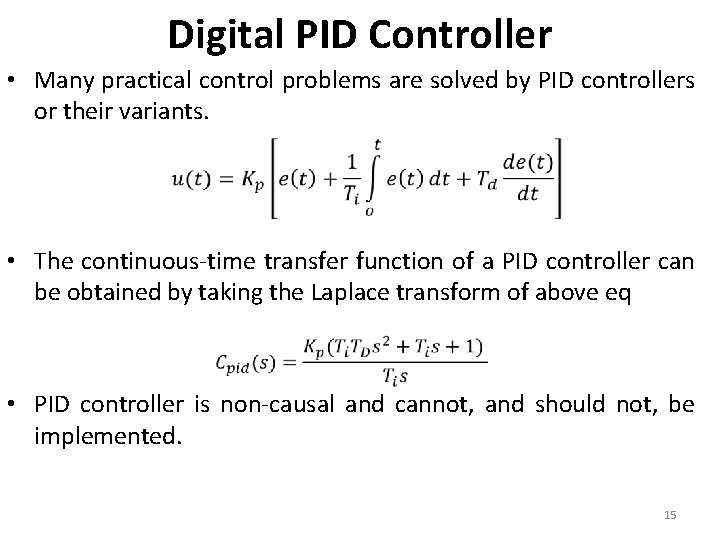
Digital PID Controller • Many practical control problems are solved by PID controllers or their variants. • The continuous-time transfer function of a PID controller can be obtained by taking the Laplace transform of above eq • PID controller is non-causal and cannot, and should not, be implemented. 15
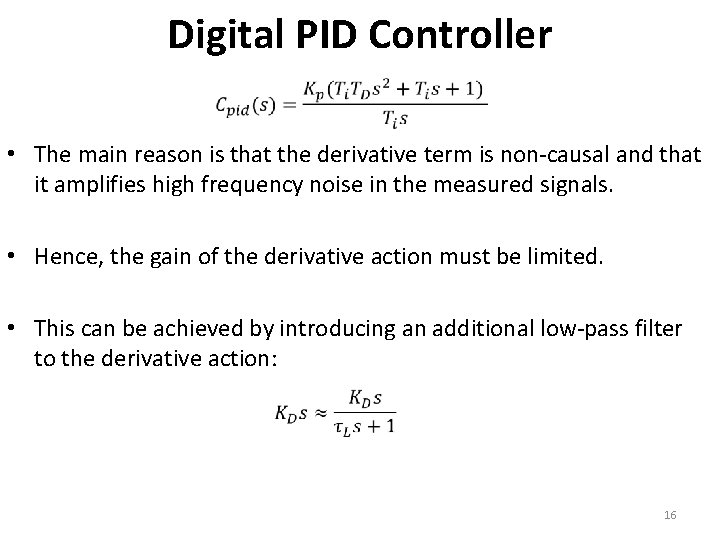
Digital PID Controller • The main reason is that the derivative term is non-causal and that it amplifies high frequency noise in the measured signals. • Hence, the gain of the derivative action must be limited. • This can be achieved by introducing an additional low-pass filter to the derivative action: 16
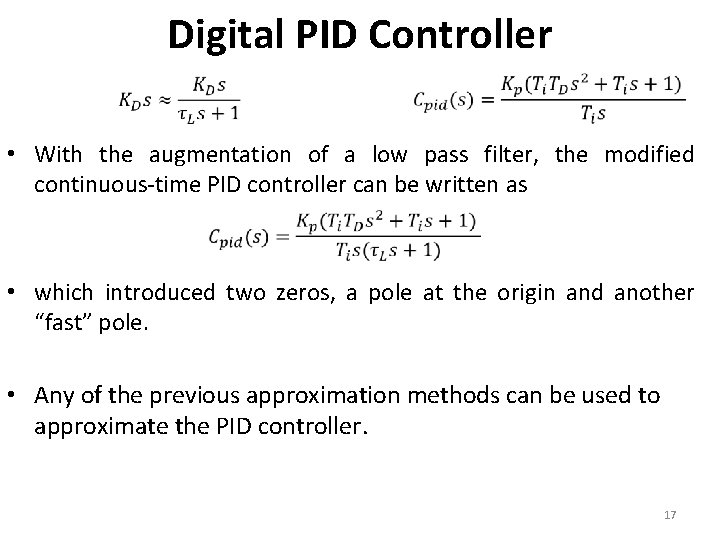
Digital PID Controller • With the augmentation of a low pass filter, the modified continuous-time PID controller can be written as • which introduced two zeros, a pole at the origin and another “fast” pole. • Any of the previous approximation methods can be used to approximate the PID controller. 17
To download this lecture visit http: //imtiazhussainkalwar. weebly. com/ END OF LECTURE-27 18