
Digital Components Chapter 25 Introduction Gate Characteristics Logic
- Slides: 12
Digital Components Chapter 25 § Introduction § Gate Characteristics § Logic Families § Logic Family Characteristics § A Comparison of Logic Families § Complementary Metal Oxide Semiconductor § Transistor-Transistor Logic Storey: Electrical & Electronic Systems © Pearson Education Limited 2004 OHT 25. 1
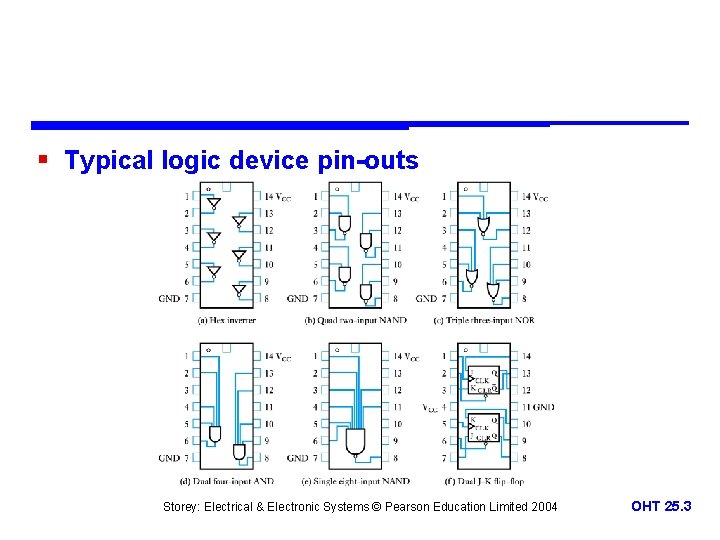
Introduction 25. 1 § Earlier we looked at a range of digital applications based on logic gates – at that time we treated the gates as ‘black boxes’ § We will now consider the construction of such gates, and their characteristics § In this lecture we will concentrate on small- and medium-scale integration circuits containing just a handful of gates – typical gates are shown on the next slide Storey: Electrical & Electronic Systems © Pearson Education Limited 2004 OHT 25. 2
§ Typical logic device pin-outs Storey: Electrical & Electronic Systems © Pearson Education Limited 2004 OHT 25. 3
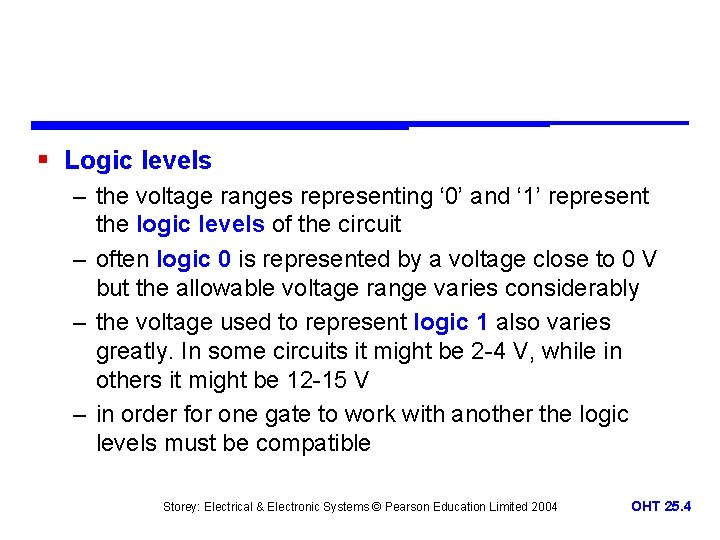
§ Logic levels – the voltage ranges representing ‘ 0’ and ‘ 1’ represent the logic levels of the circuit – often logic 0 is represented by a voltage close to 0 V but the allowable voltage range varies considerably – the voltage used to represent logic 1 also varies greatly. In some circuits it might be 2 -4 V, while in others it might be 12 -15 V – in order for one gate to work with another the logic levels must be compatible Storey: Electrical & Electronic Systems © Pearson Education Limited 2004 OHT 25. 4
§ Noise immunity – noise is present in all real systems – this adds random fluctuations to voltages representing logic levels – to cope with noise, the voltage ranges defining the logic levels are more tightly constrained at the output of a gate than at the input – thus small amounts of noise will not affect the circuit – the maximum noise voltage that can be tolerated by a circuit is termed its noise immunity, VNI Storey: Electrical & Electronic Systems © Pearson Education Limited 2004 OHT 25. 5
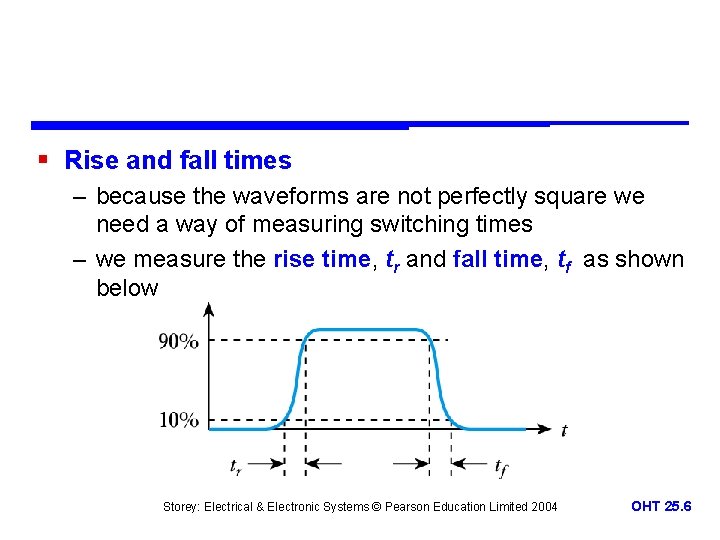
§ Rise and fall times – because the waveforms are not perfectly square we need a way of measuring switching times – we measure the rise time, tr and fall time, tf as shown below Storey: Electrical & Electronic Systems © Pearson Education Limited 2004 OHT 25. 6
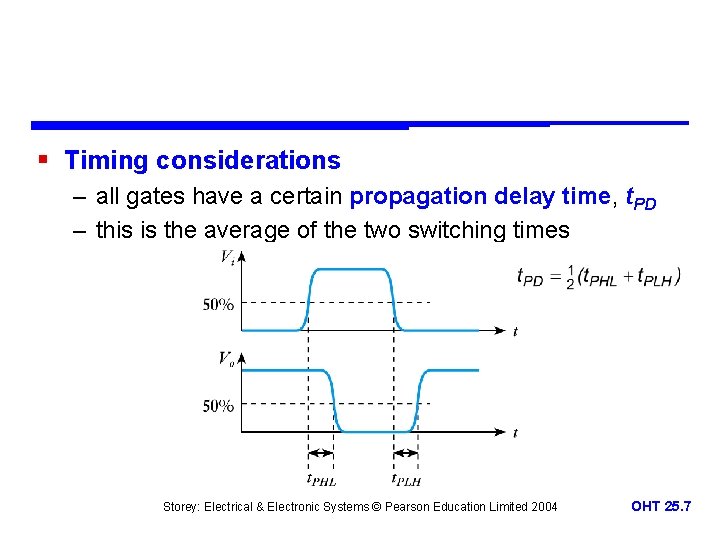
§ Timing considerations – all gates have a certain propagation delay time, t. PD – this is the average of the two switching times Storey: Electrical & Electronic Systems © Pearson Education Limited 2004 OHT 25. 7
Logic Families 25. 3 § We have seen that different devices use different voltages ranges for their logic levels § They also differ in other characteristics § In order to assure correct operation when gates are interconnected they are normally produced in families § The most widely used families are: – complementary metal oxide semiconductor (CMOS) – transistor-transistor logic (TTL) – emitter-coupled logic (ECL) Storey: Electrical & Electronic Systems © Pearson Education Limited 2004 OHT 25. 8
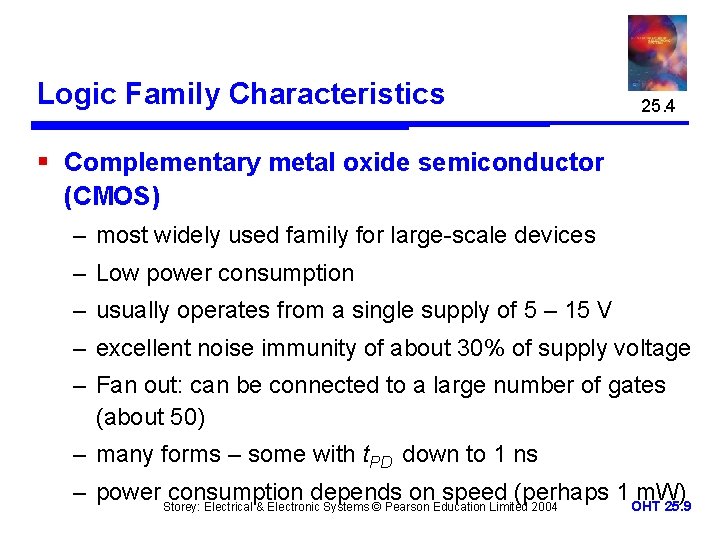
Logic Family Characteristics 25. 4 § Complementary metal oxide semiconductor (CMOS) – most widely used family for large-scale devices – Low power consumption – usually operates from a single supply of 5 – 15 V – excellent noise immunity of about 30% of supply voltage – Fan out: can be connected to a large number of gates (about 50) – many forms – some with t. PD down to 1 ns – power Storey: consumption depends on speed (perhaps 1 OHT m. W) Electrical & Electronic Systems © Pearson Education Limited 2004 25. 9
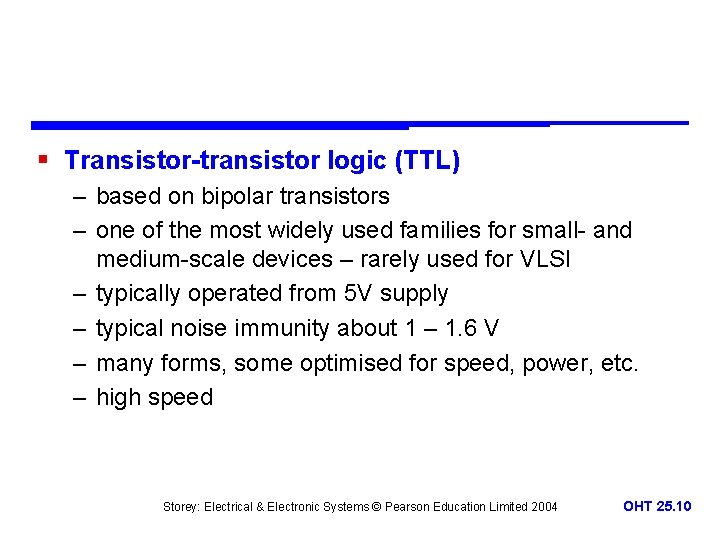
§ Transistor-transistor logic (TTL) – based on bipolar transistors – one of the most widely used families for small- and medium-scale devices – rarely used for VLSI – typically operated from 5 V supply – typical noise immunity about 1 – 1. 6 V – many forms, some optimised for speed, power, etc. – high speed Storey: Electrical & Electronic Systems © Pearson Education Limited 2004 OHT 25. 10
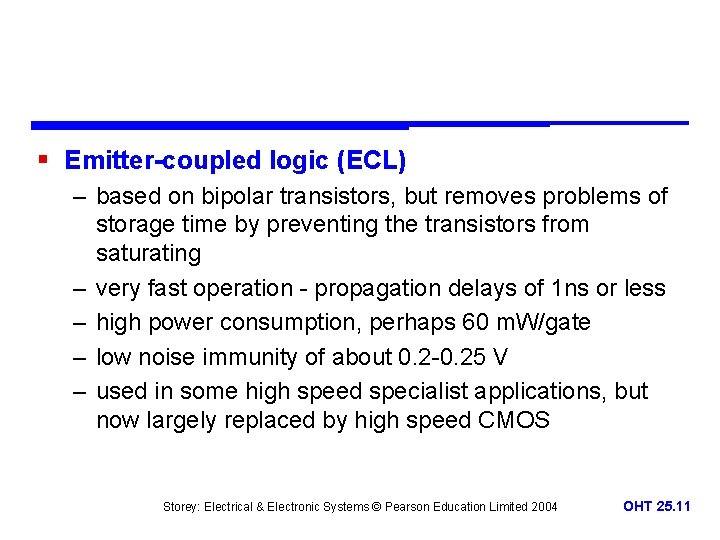
§ Emitter-coupled logic (ECL) – based on bipolar transistors, but removes problems of storage time by preventing the transistors from saturating – very fast operation - propagation delays of 1 ns or less – high power consumption, perhaps 60 m. W/gate – low noise immunity of about 0. 2 -0. 25 V – used in some high speed specialist applications, but now largely replaced by high speed CMOS Storey: Electrical & Electronic Systems © Pearson Education Limited 2004 OHT 25. 11
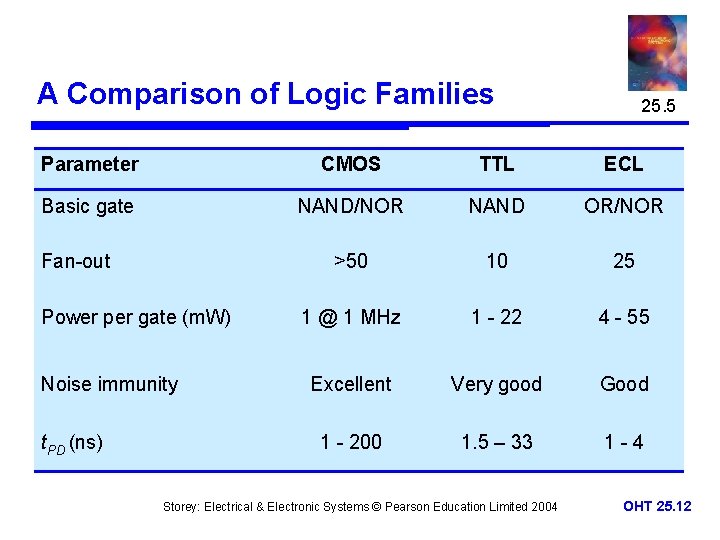
A Comparison of Logic Families 25. 5 Parameter CMOS TTL ECL Basic gate NAND/NOR NAND OR/NOR >50 10 25 1 @ 1 MHz 1 - 22 4 - 55 Excellent Very good Good 1 - 200 1. 5 – 33 1 -4 Fan-out Power per gate (m. W) Noise immunity t. PD (ns) Storey: Electrical & Electronic Systems © Pearson Education Limited 2004 OHT 25. 12