
Digital Communications Introduction Sedat Grm Ph D Outline
- Slides: 21
Digital Communications: Introduction Sedat Görmüş, Ph. D
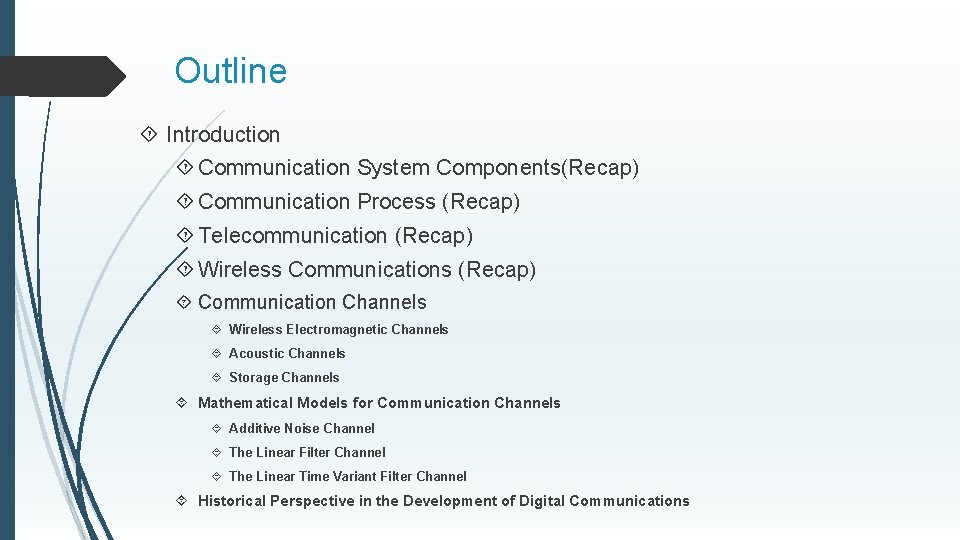
Outline Introduction Communication System Components(Recap) Communication Process (Recap) Telecommunication (Recap) Wireless Communications (Recap) Communication Channels Wireless Electromagnetic Channels Acoustic Channels Storage Channels Mathematical Models for Communication Channels Additive Noise Channel The Linear Filter Channel The Linear Time Variant Filter Channel Historical Perspective in the Development of Digital Communications
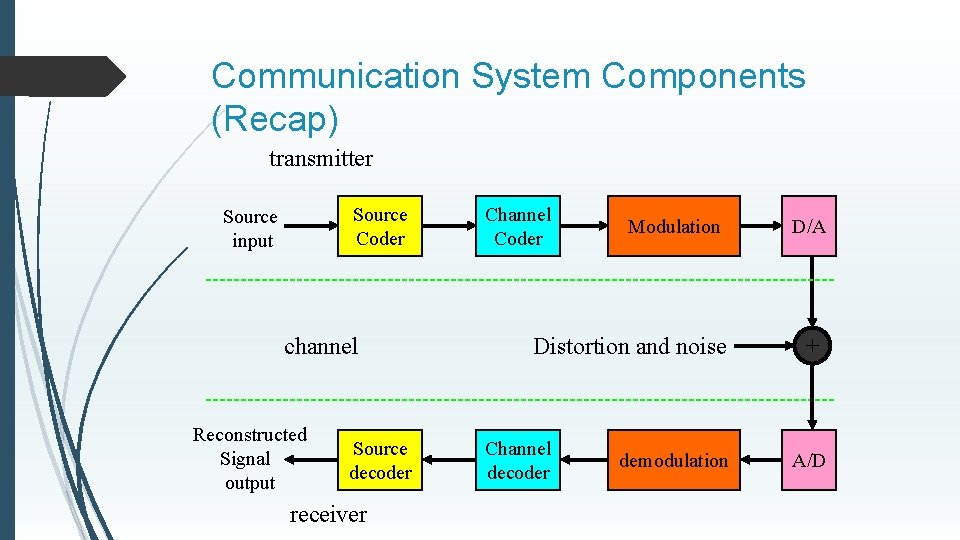
Communication System Components (Recap) transmitter Source Coder Source input channel Reconstructed Signal output Source decoder receiver Channel Coder Modulation Distortion and noise Channel decoder demodulation D/A + A/D
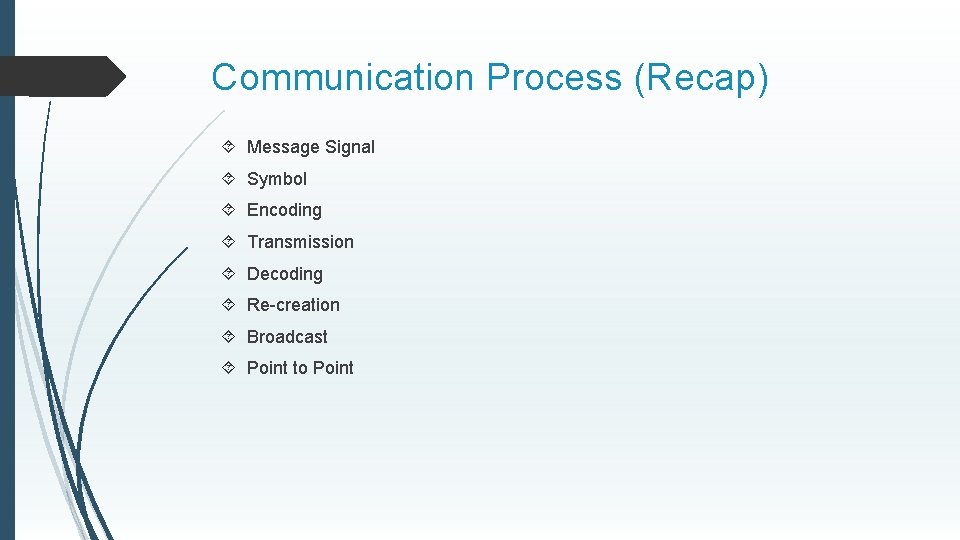
Communication Process (Recap) Message Signal Symbol Encoding Transmission Decoding Re-creation Broadcast Point to Point
Telecommunication (Recap) Telegraph Fixed line telephone Cable Wired networks Internet Fiber communications Communication bus inside computers to communicate between CPU and memory
Wireless Communications (Recap) Satellite TV Cordless phone Cellular phone Wireless LAN, WIFI Wireless MAN, WIMAX Bluetooth Ultra Wide Band Wireless Laser Microwave GPS Ad hoc/Sensor Networks
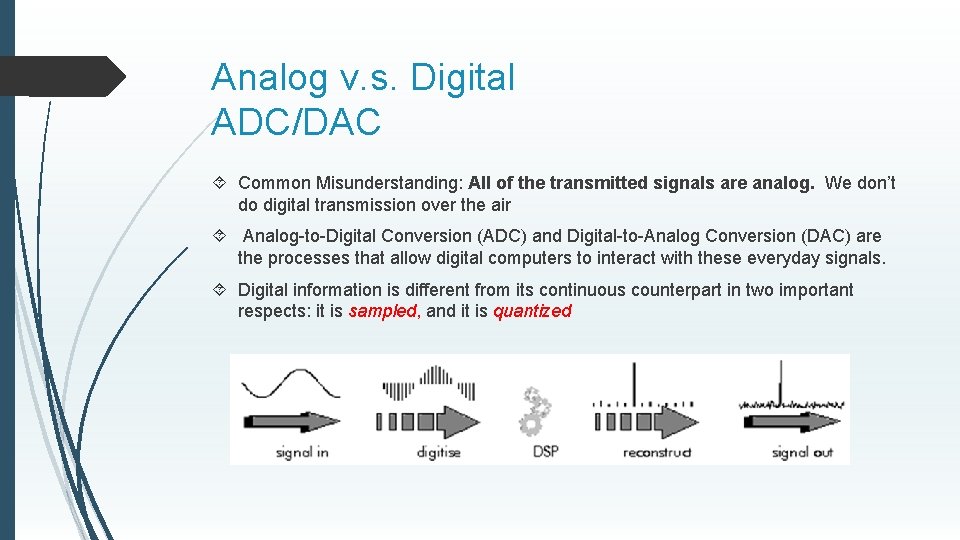
Analog v. s. Digital ADC/DAC Common Misunderstanding: All of the transmitted signals are analog. We don’t do digital transmission over the air Analog-to-Digital Conversion (ADC) and Digital-to-Analog Conversion (DAC) are the processes that allow digital computers to interact with these everyday signals. Digital information is different from its continuous counterpart in two important respects: it is sampled, and it is quantized
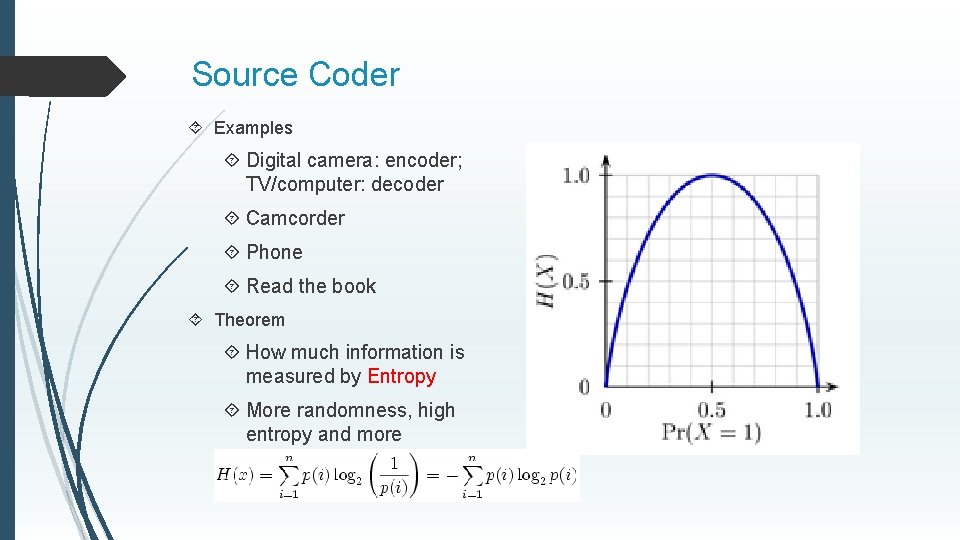
Source Coder Examples Digital camera: encoder; TV/computer: decoder Camcorder Phone Read the book Theorem How much information is measured by Entropy More randomness, high entropy and more information
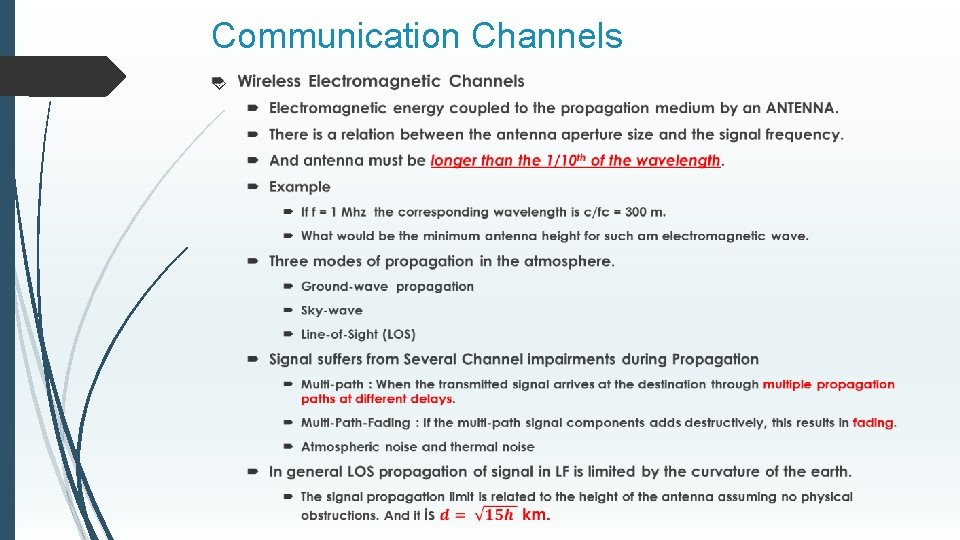
Communication Channels
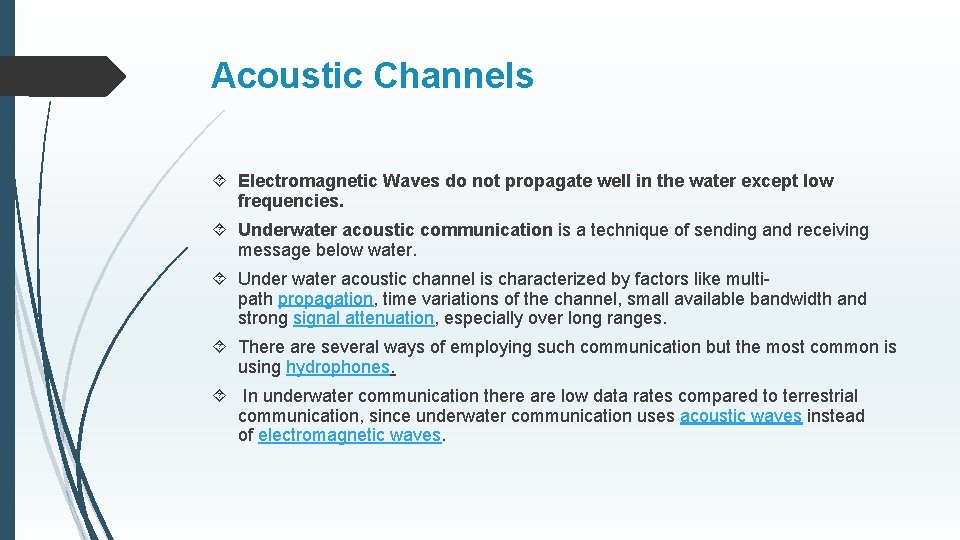
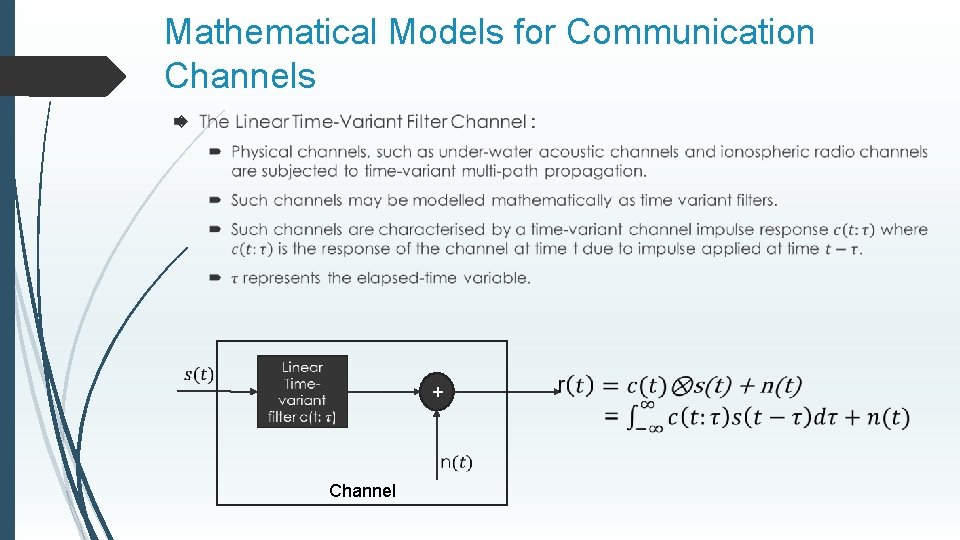
Acoustic Channels Electromagnetic Waves do not propagate well in the water except low frequencies. Underwater acoustic communication is a technique of sending and receiving message below water. Under water acoustic channel is characterized by factors like multipath propagation, time variations of the channel, small available bandwidth and strong signal attenuation, especially over long ranges. There are several ways of employing such communication but the most common is using hydrophones. In underwater communication there are low data rates compared to terrestrial communication, since underwater communication uses acoustic waves instead of electromagnetic waves.
Storage Channels Examples are magnetic tape, video and audio tapes, magnetic disks. The process of storing data on magnetic tape is equivalent to transmitting data over wireless channels.
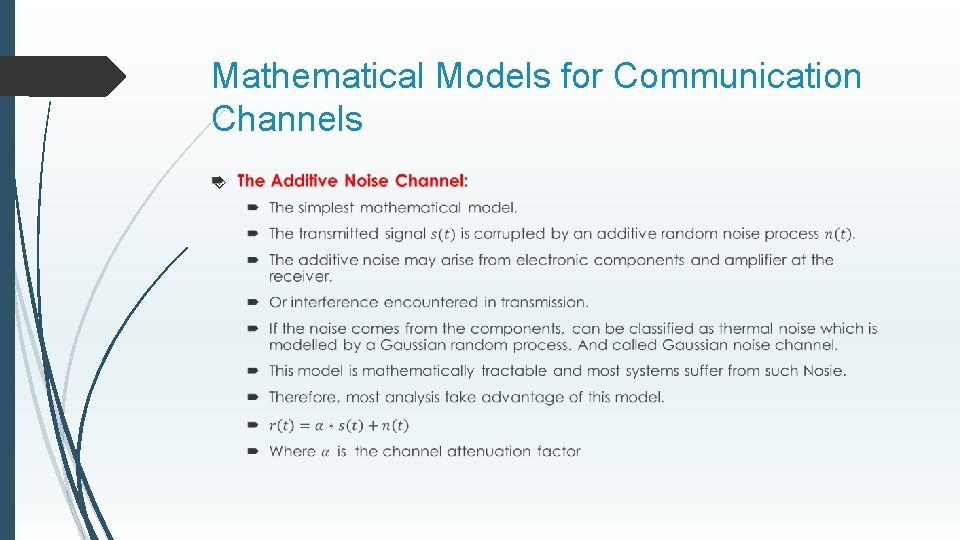
Mathematical Models for Communication Channels
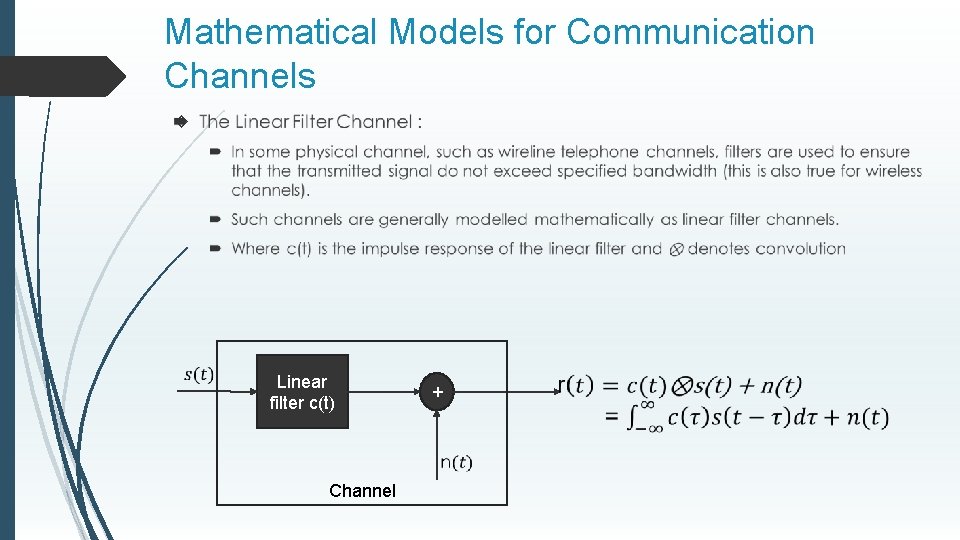
Mathematical Models for Communication Channels Linear filter c(t) + Channel
Mathematical Models for Communication Channels + Channel
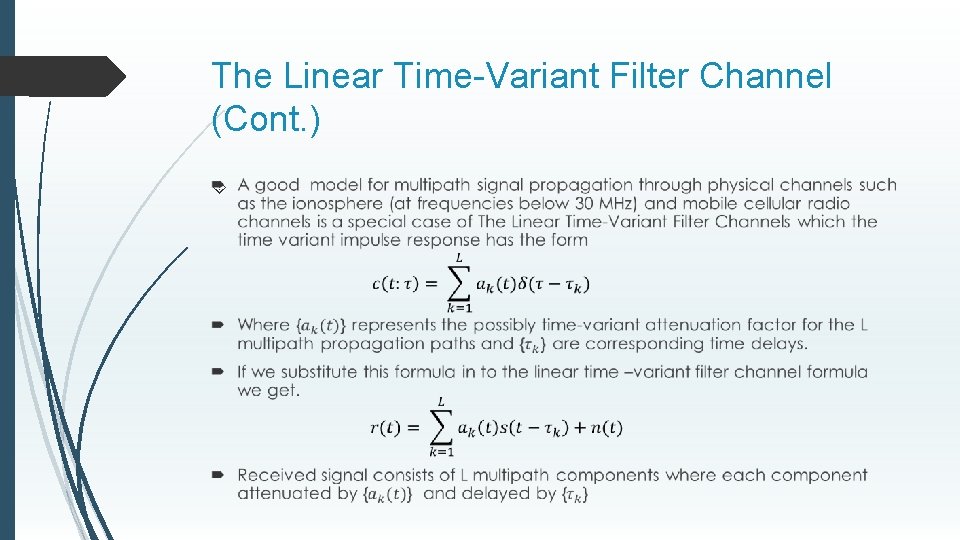
The Linear Time-Variant Filter Channel (Cont. )
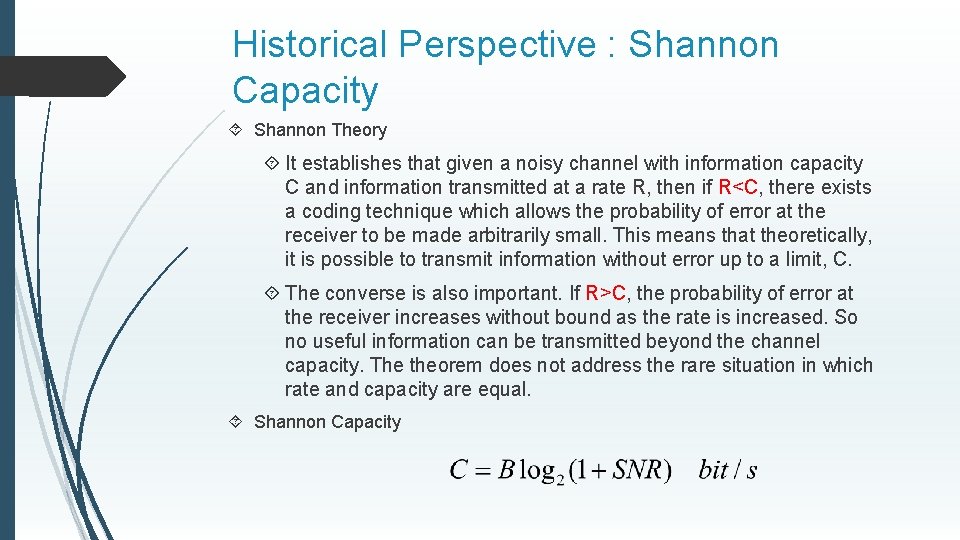
Historical Perspective : Shannon Capacity Shannon Theory It establishes that given a noisy channel with information capacity C and information transmitted at a rate R, then if R<C, there exists a coding technique which allows the probability of error at the receiver to be made arbitrarily small. This means that theoretically, it is possible to transmit information without error up to a limit, C. The converse is also important. If R>C, the probability of error at the receiver increases without bound as the rate is increased. So no useful information can be transmitted beyond the channel capacity. The theorem does not address the rare situation in which rate and capacity are equal. Shannon Capacity
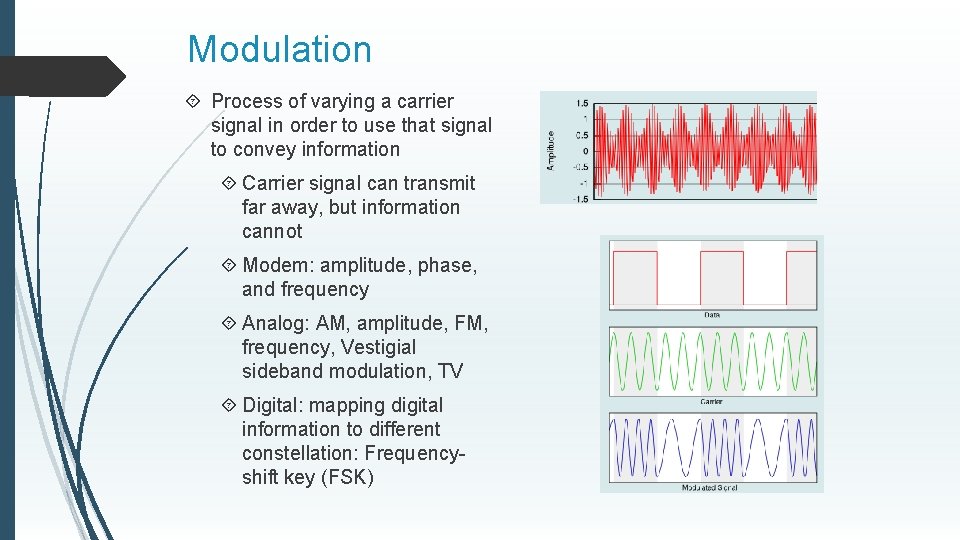
Modulation Process of varying a carrier signal in order to use that signal to convey information Carrier signal can transmit far away, but information cannot Modem: amplitude, phase, and frequency Analog: AM, amplitude, FM, frequency, Vestigial sideband modulation, TV Digital: mapping digital information to different constellation: Frequencyshift key (FSK)
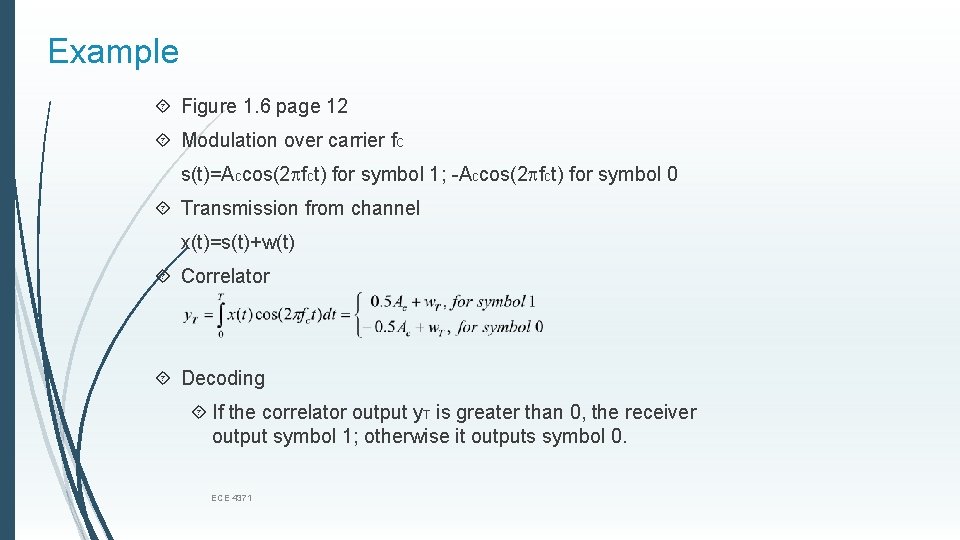
Example Figure 1. 6 page 12 Modulation over carrier fc s(t)=Accos(2 fct) for symbol 1; -Accos(2 fct) for symbol 0 Transmission from channel x(t)=s(t)+w(t) Correlator Decoding If the correlator output y. T is greater than 0, the receiver output symbol 1; otherwise it outputs symbol 0. ECE 4371
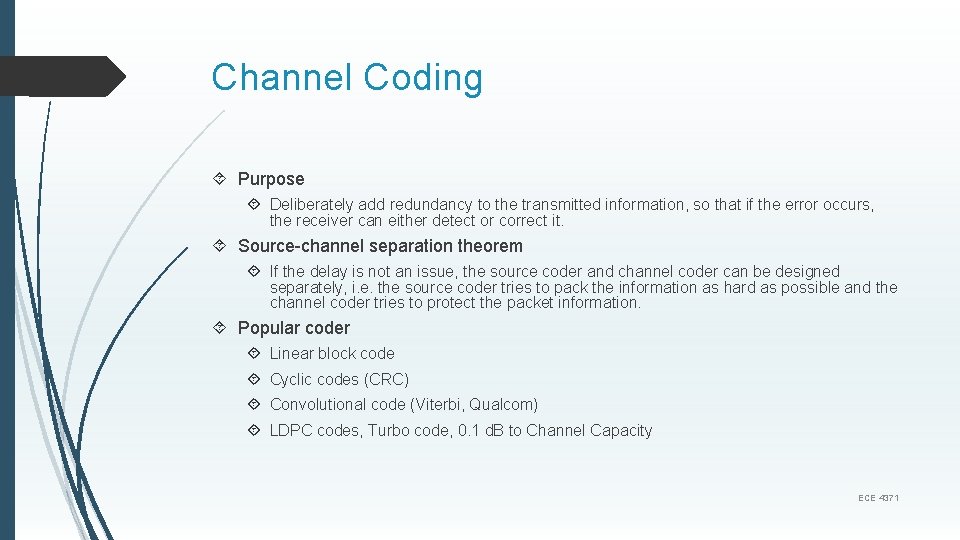
Channel Coding Purpose Deliberately add redundancy to the transmitted information, so that if the error occurs, the receiver can either detect or correct it. Source-channel separation theorem If the delay is not an issue, the source coder and channel coder can be designed separately, i. e. the source coder tries to pack the information as hard as possible and the channel coder tries to protect the packet information. Popular coder Linear block code Cyclic codes (CRC) Convolutional code (Viterbi, Qualcom) LDPC codes, Turbo code, 0. 1 d. B to Channel Capacity ECE 4371
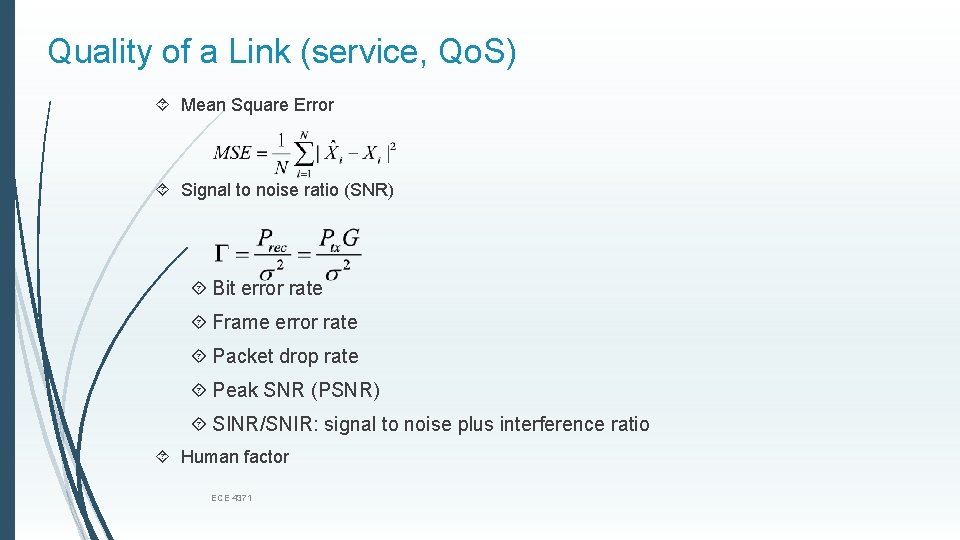
Quality of a Link (service, Qo. S) Mean Square Error Signal to noise ratio (SNR) Bit error rate Frame error rate Packet drop rate Peak SNR (PSNR) SINR/SNIR: signal to noise plus interference ratio Human factor ECE 4371
Thank You for Your Attention.