
Digital Communications Chapter 1 Signals and Spectra Signal


![Noise in Communication System (cont´d) [ Power spectral density & Autocorrelation function ] Signal](https://slidetodoc.com/presentation_image_h/94b3c2d9e93dda87fdacb90093309f2d/image-19.jpg "Noise in Communication System (cont´d) [ Power spectral density & Autocorrelation function ] Signal")

- Slides: 26
Digital Communications Chapter 1 Signals and Spectra Signal Processing Lab
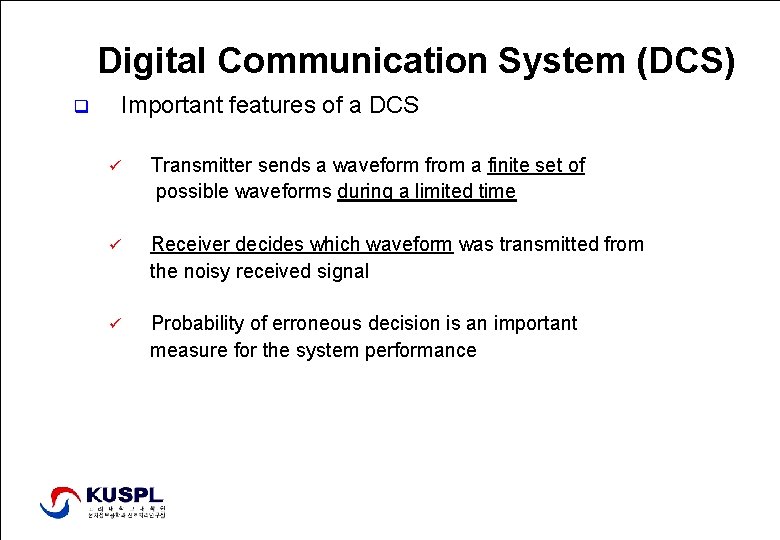
Digital Communication System (DCS) q Important features of a DCS ü Transmitter sends a waveform from a finite set of possible waveforms during a limited time ü Receiver decides which waveform was transmitted from the noisy received signal ü Probability of erroneous decision is an important measure for the system performance Signal Processing Lab. , http: //signal. korea. ac. kr Dept. of Elec. and Info. Engr. , Korea Univ.
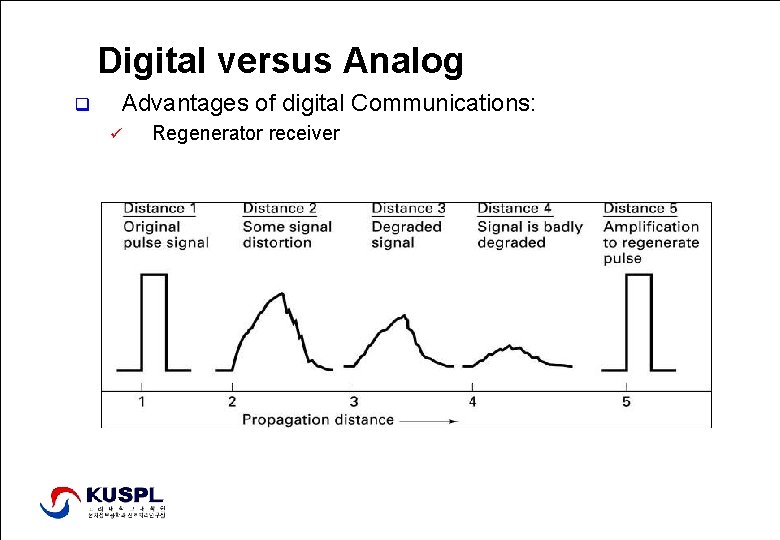
Digital versus Analog q Advantages of digital Communications: ü Regenerator receiver Signal Processing Lab. , http: //signal. korea. ac. kr Dept. of Elec. and Info. Engr. , Korea Univ.
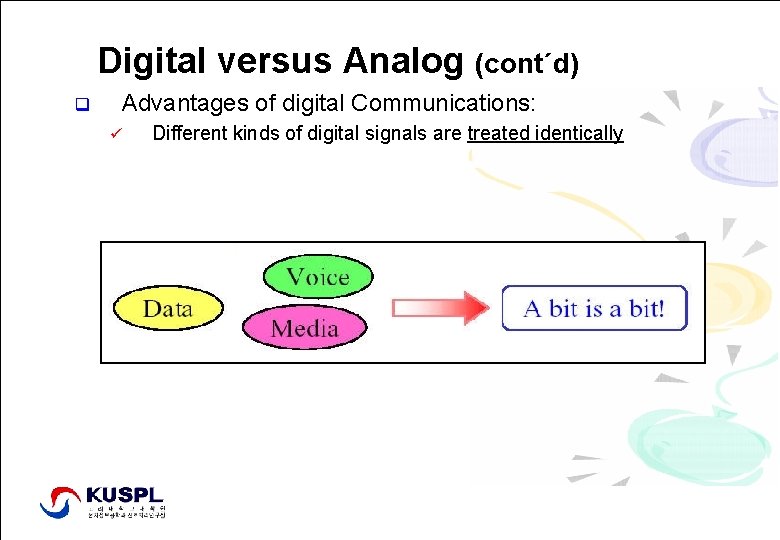
Digital versus Analog (cont´d) q Advantages of digital Communications: ü Different kinds of digital signals are treated identically Signal Processing Lab. , http: //signal. korea. ac. kr Dept. of Elec. and Info. Engr. , Korea Univ.
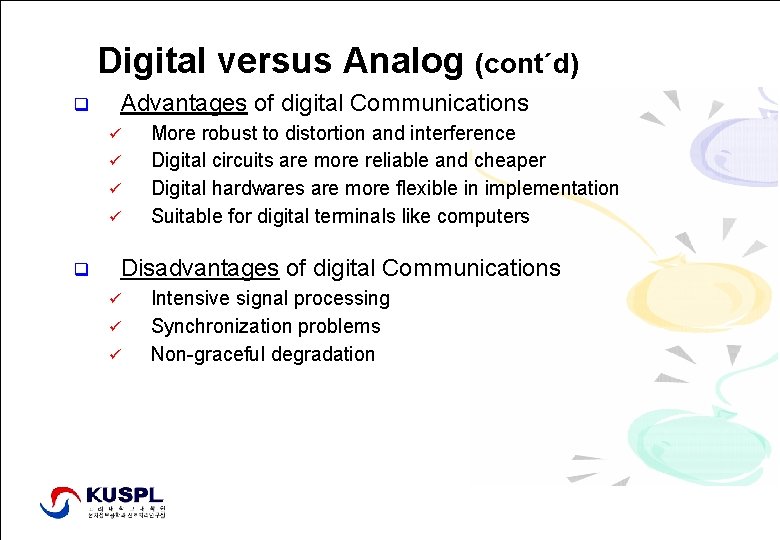
Digital versus Analog (cont´d) q Advantages of digital Communications ü ü q More robust to distortion and interference Digital circuits are more reliable and cheaper Digital hardwares are more flexible in implementation Suitable for digital terminals like computers Disadvantages of digital Communications ü ü ü Intensive signal processing Synchronization problems Non-graceful degradation Signal Processing Lab. , http: //signal. korea. ac. kr Dept. of Elec. and Info. Engr. , Korea Univ.
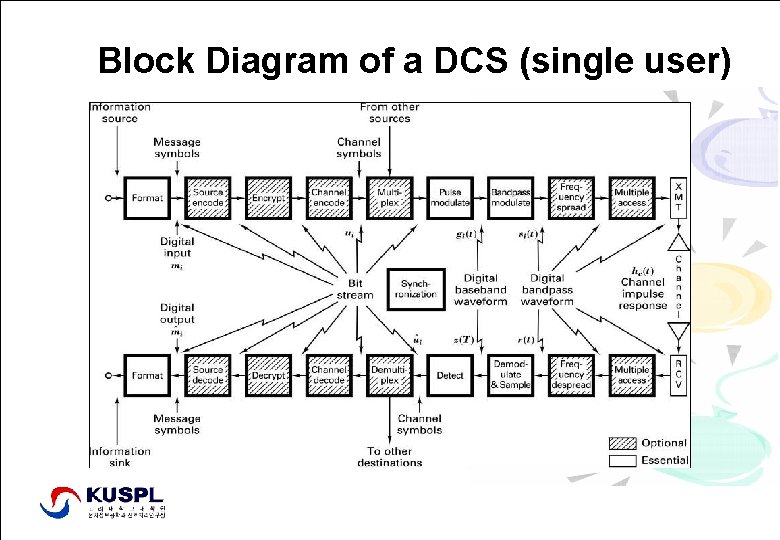
Block Diagram of a DCS (single user) Signal Processing Lab. , http: //signal. korea. ac. kr Dept. of Elec. and Info. Engr. , Korea Univ.
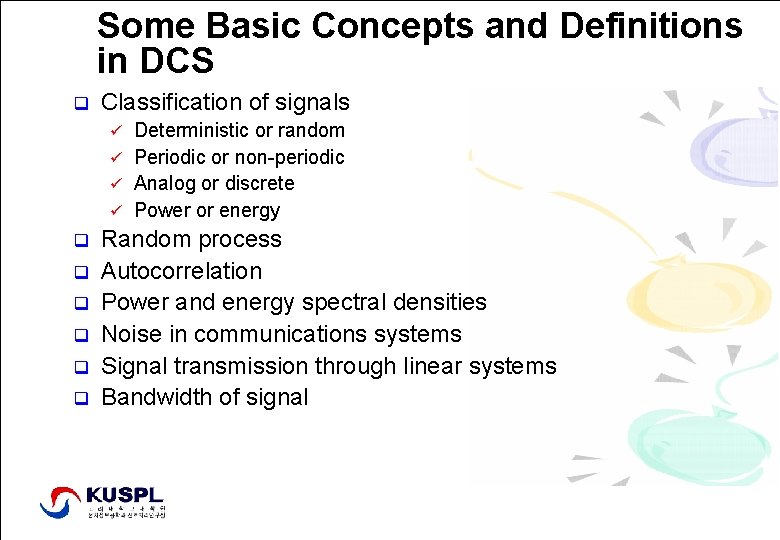
Some Basic Concepts and Definitions in DCS q Classification of signals Deterministic or random ü Periodic or non-periodic ü Analog or discrete ü Power or energy ü q q q Random process Autocorrelation Power and energy spectral densities Noise in communications systems Signal transmission through linear systems Bandwidth of signal Signal Processing Lab. , http: //signal. korea. ac. kr Dept. of Elec. and Info. Engr. , Korea Univ.
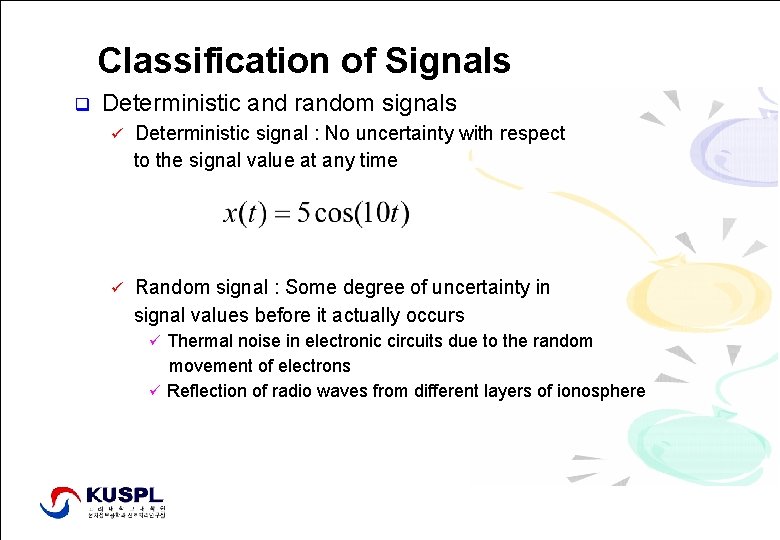
Classification of Signals q Deterministic and random signals ü Deterministic signal : No uncertainty with respect to the signal value at any time ü Random signal : Some degree of uncertainty in signal values before it actually occurs Thermal noise in electronic circuits due to the random movement of electrons ü Reflection of radio waves from different layers of ionosphere ü Signal Processing Lab. , http: //signal. korea. ac. kr Dept. of Elec. and Info. Engr. , Korea Univ.
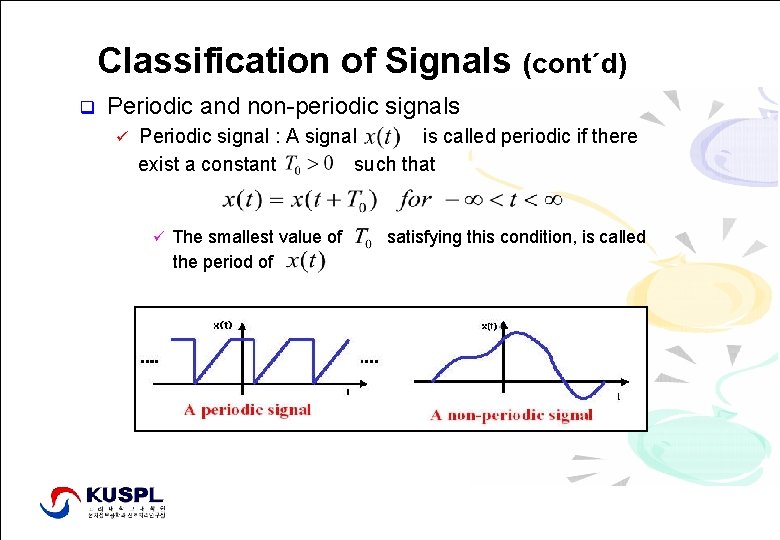
Classification of Signals (cont´d) q Periodic and non-periodic signals ü Periodic signal : A signal is called periodic if there exist a constant such that ü The smallest value of the period of satisfying this condition, is called Signal Processing Lab. , http: //signal. korea. ac. kr Dept. of Elec. and Info. Engr. , Korea Univ.
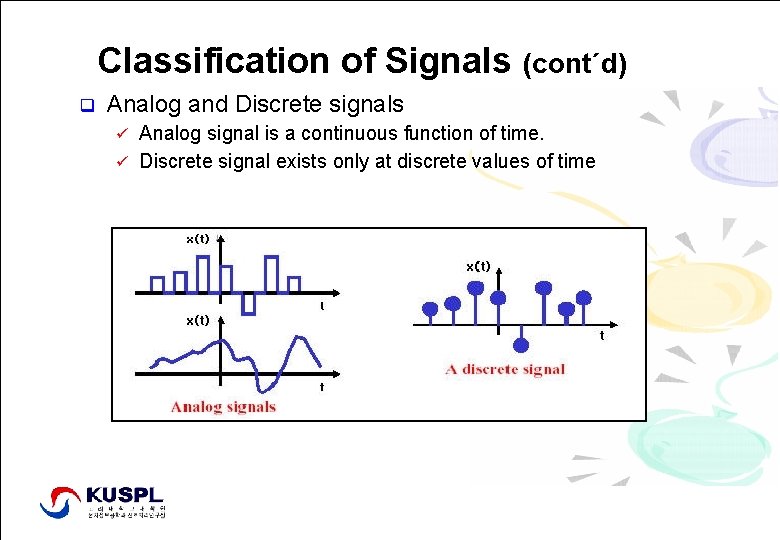
Classification of Signals (cont´d) q Analog and Discrete signals Analog signal is a continuous function of time. ü Discrete signal exists only at discrete values of time ü Signal Processing Lab. , http: //signal. korea. ac. kr Dept. of Elec. and Info. Engr. , Korea Univ.
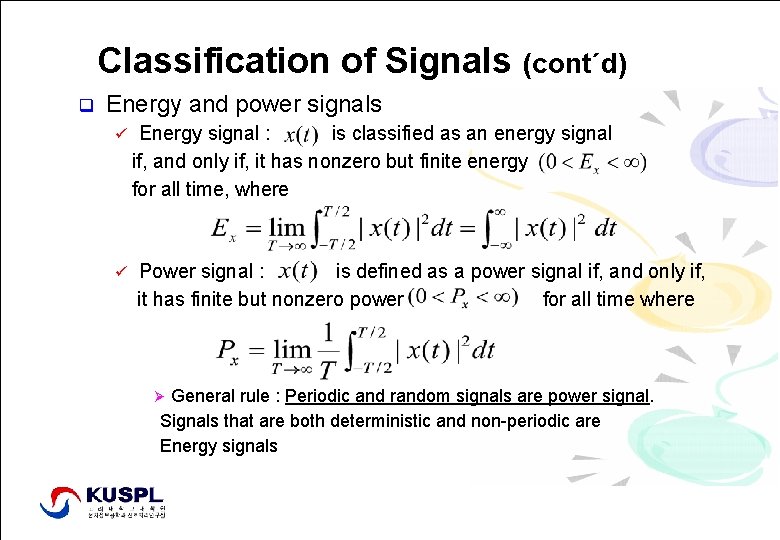
Classification of Signals (cont´d) q Energy and power signals ü ü Energy signal : is classified as an energy signal if, and only if, it has nonzero but finite energy for all time, where Power signal : is defined as a power signal if, and only if, it has finite but nonzero power for all time where General rule : Periodic and random signals are power signal. Signals that are both deterministic and non-periodic are Energy signals Ø Signal Processing Lab. , http: //signal. korea. ac. kr Dept. of Elec. and Info. Engr. , Korea Univ.
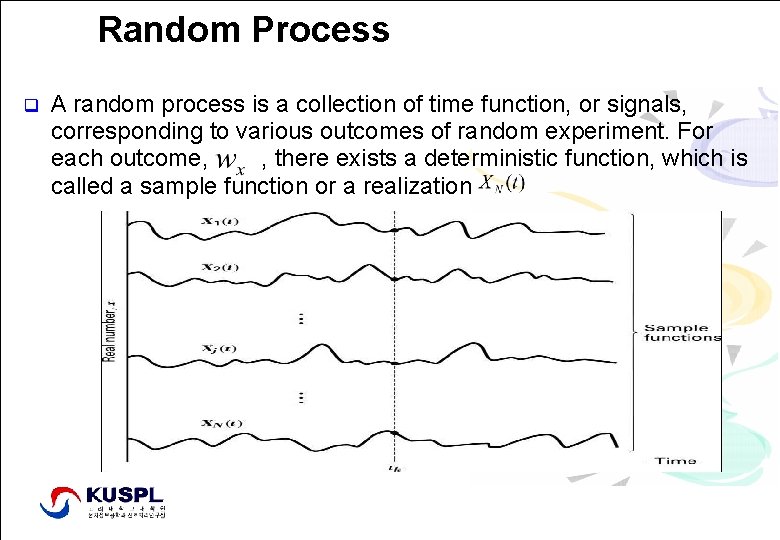
Random Process q A random process is a collection of time function, or signals, corresponding to various outcomes of random experiment. For each outcome, , there exists a deterministic function, which is called a sample function or a realization Signal Processing Lab. , http: //signal. korea. ac. kr Dept. of Elec. and Info. Engr. , Korea Univ.
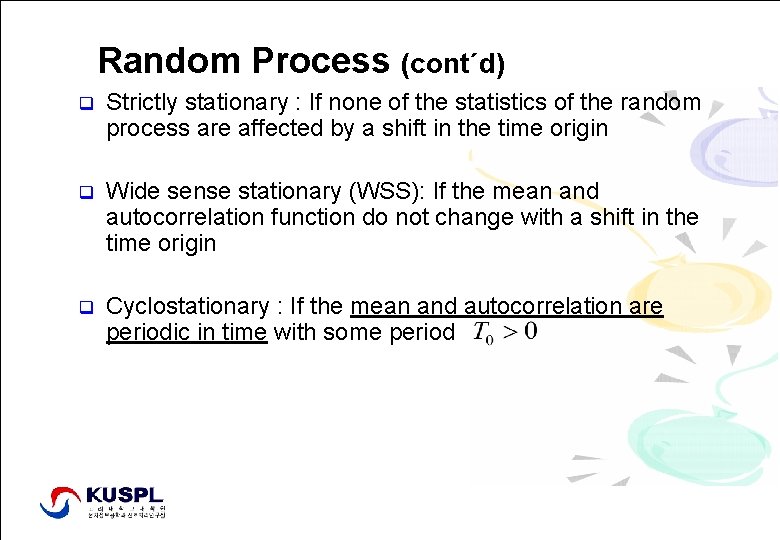
Random Process (cont´d) q Strictly stationary : If none of the statistics of the random process are affected by a shift in the time origin q Wide sense stationary (WSS): If the mean and autocorrelation function do not change with a shift in the time origin q Cyclostationary : If the mean and autocorrelation are periodic in time with some period Signal Processing Lab. , http: //signal. korea. ac. kr Dept. of Elec. and Info. Engr. , Korea Univ.
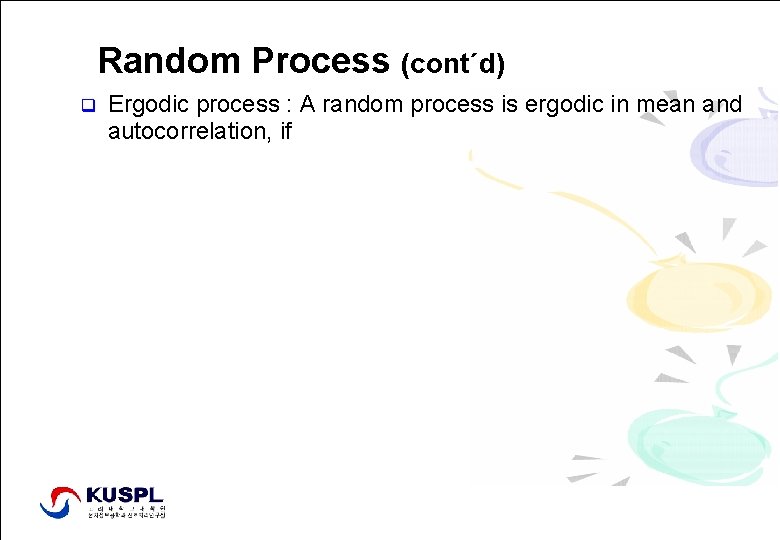
Random Process (cont´d) q Ergodic process : A random process is ergodic in mean and autocorrelation, if Signal Processing Lab. , http: //signal. korea. ac. kr Dept. of Elec. and Info. Engr. , Korea Univ.
Autocorrelation q Autocorrelation of an energy signal q Autocorrelation of a power signal ü For a periodic signal : q Autocorrelation of a random signal q For a WSS process : Signal Processing Lab. , http: //signal. korea. ac. kr Dept. of Elec. and Info. Engr. , Korea Univ.
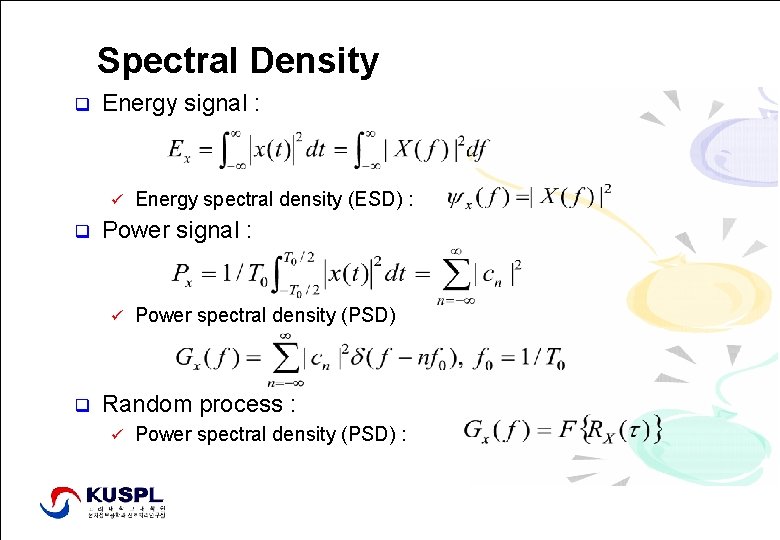
Spectral Density q Energy signal : ü q Power signal : ü q Energy spectral density (ESD) : Power spectral density (PSD) Random process : ü Power spectral density (PSD) : Signal Processing Lab. , http: //signal. korea. ac. kr Dept. of Elec. and Info. Engr. , Korea Univ.
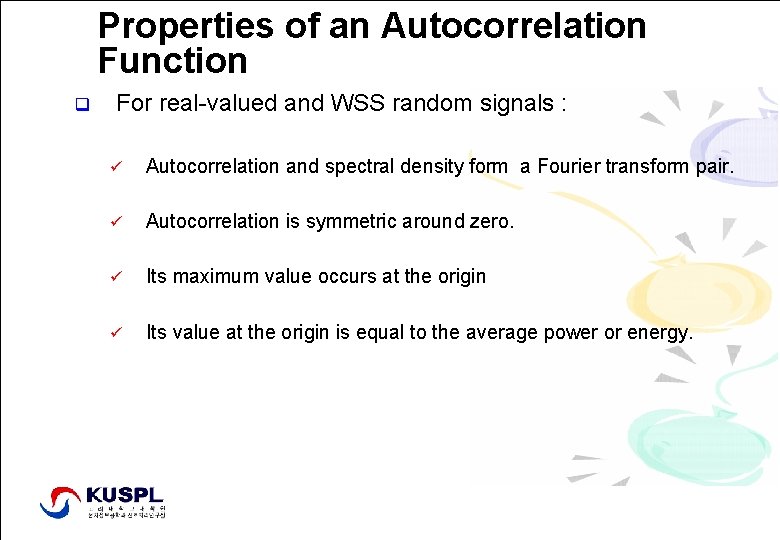
Properties of an Autocorrelation Function q For real-valued and WSS random signals : ü Autocorrelation and spectral density form a Fourier transform pair. ü Autocorrelation is symmetric around zero. ü Its maximum value occurs at the origin ü Its value at the origin is equal to the average power or energy. Signal Processing Lab. , http: //signal. korea. ac. kr Dept. of Elec. and Info. Engr. , Korea Univ.
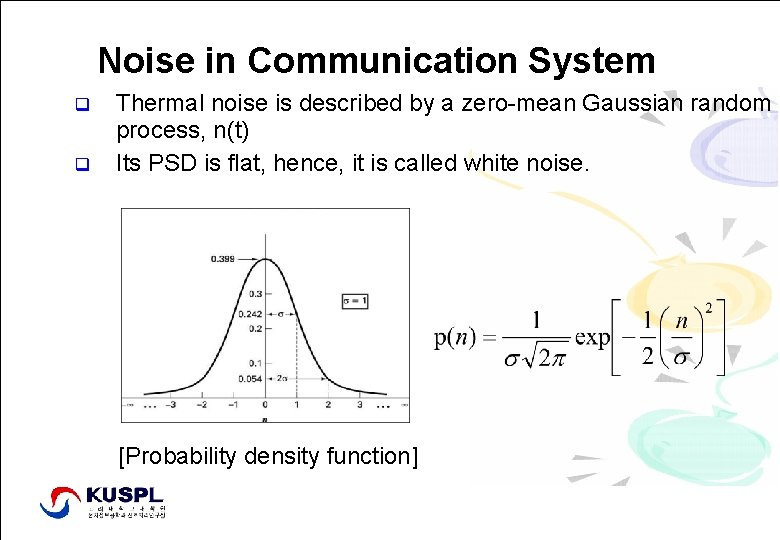
Noise in Communication System q q Thermal noise is described by a zero-mean Gaussian random process, n(t) Its PSD is flat, hence, it is called white noise. [Probability density function] Signal Processing Lab. , http: //signal. korea. ac. kr Dept. of Elec. and Info. Engr. , Korea Univ.
Noise in Communication System (cont´d) [ Power spectral density & Autocorrelation function ] Signal Processing Lab. , http: //signal. korea. ac. kr Dept. of Elec. and Info. Engr. , Korea Univ.
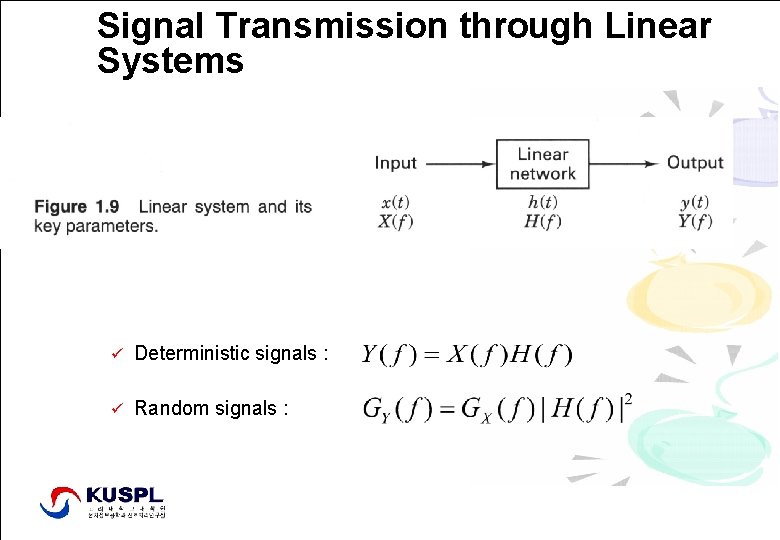
Signal Transmission through Linear Systems ü Deterministic signals : ü Random signals : Signal Processing Lab. , http: //signal. korea. ac. kr Dept. of Elec. and Info. Engr. , Korea Univ.
Ideal Pulse Signal Processing Lab. , http: //signal. korea. ac. kr Dept. of Elec. and Info. Engr. , Korea Univ.
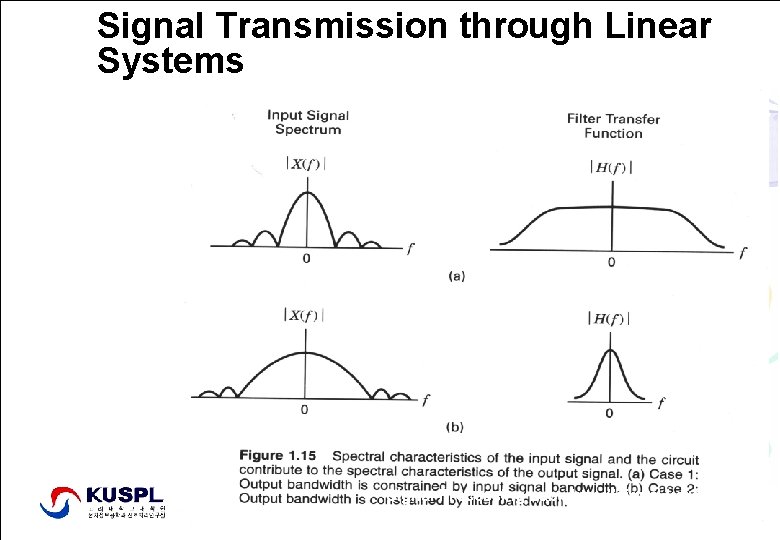
Signal Transmission through Linear Systems Signal Processing Lab. , http: //signal. korea. ac. kr Dept. of Elec. and Info. Engr. , Korea Univ.
Signal Transmission q Ideal filters : Signal Processing Lab. , http: //signal. korea. ac. kr Dept. of Elec. and Info. Engr. , Korea Univ.
Baseband versus Bandpass Signal Processing Lab. , http: //signal. korea. ac. kr Dept. of Elec. and Info. Engr. , Korea Univ.
Signal Processing Lab. , http: //signal. korea. ac. kr Dept. of Elec. and Info. Engr. , Korea Univ.
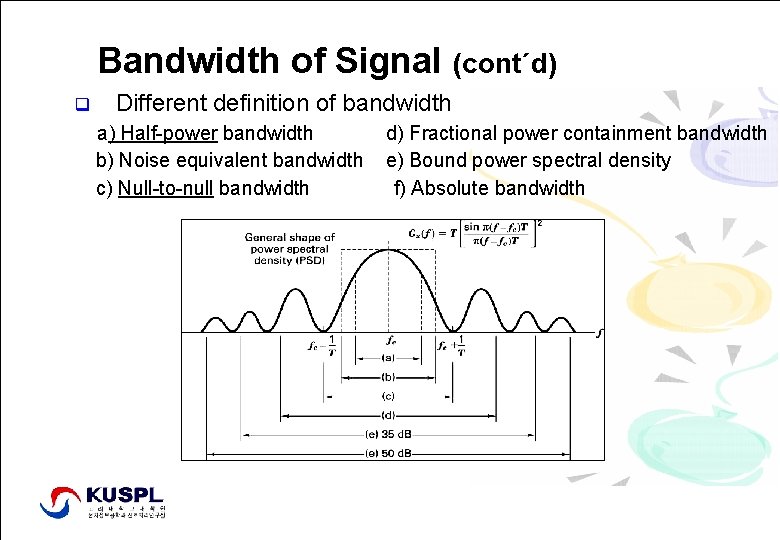
Bandwidth of Signal (cont´d) q Different definition of bandwidth a) Half-power bandwidth b) Noise equivalent bandwidth c) Null-to-null bandwidth d) Fractional power containment bandwidth e) Bound power spectral density f) Absolute bandwidth Signal Processing Lab. , http: //signal. korea. ac. kr Dept. of Elec. and Info. Engr. , Korea Univ.