
Digital Communication Systems Lecture 5 Prof Dr Habibullah
Digital Communication Systems Lecture 5, Prof. Dr. Habibullah Jamal Under Graduate, Spring 2008 1
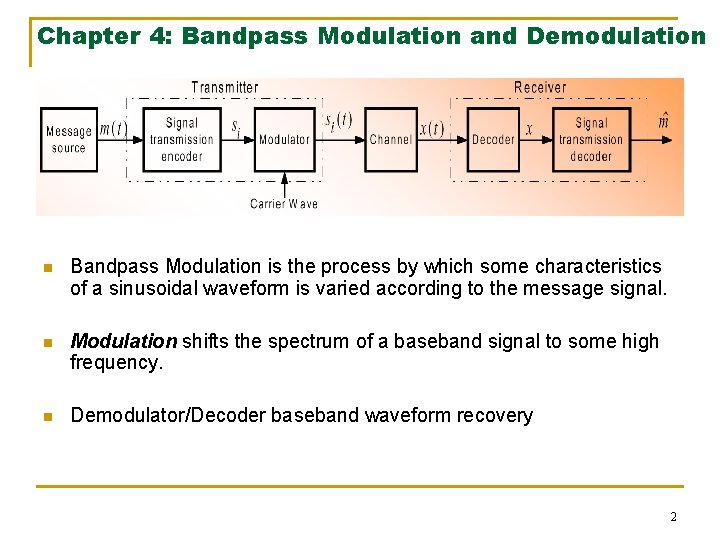
Chapter 4: Bandpass Modulation and Demodulation n Bandpass Modulation is the process by which some characteristics of a sinusoidal waveform is varied according to the message signal. n Modulation shifts the spectrum of a baseband signal to some high frequency. n Demodulator/Decoder baseband waveform recovery 2
4. 1 Why Modulate? n n n Most channels require that the baseband signal be shifted to a higher frequency For example in case of a wireless channel antenna size is inversely proportional to the center frequency, this is difficult to realize for baseband signals. q For speech signal f = 3 k. Hz =c/f=(3 x 108)/(3 x 103) q Antenna size without modulation /4=105 /4 meters = 15 miles - practically unrealizable q Same speech signal if amplitude modulated using fc=900 MHz will require an antenna size of about 8 cm. q This is evident that efficient antenna of realistic physical size is needed for radio communication system Modulation also required if channel has to be shared by several transmitters (Frequency division multiplexing). 3
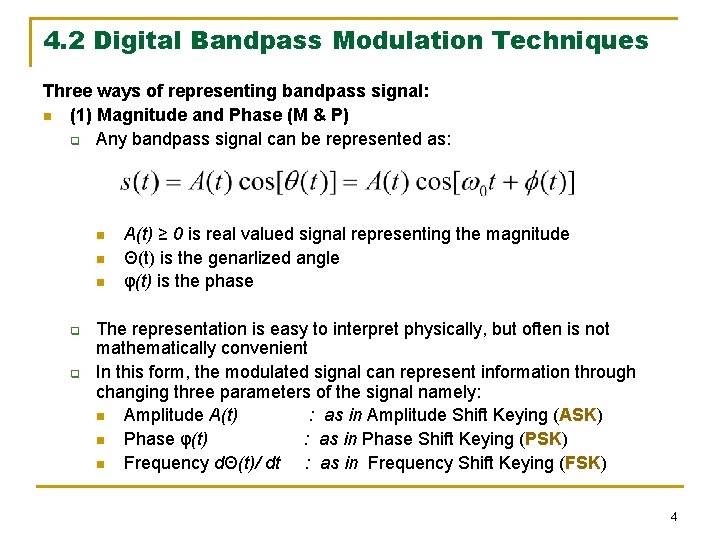
4. 2 Digital Bandpass Modulation Techniques Three ways of representing bandpass signal: n (1) Magnitude and Phase (M & P) q Any bandpass signal can be represented as: n n n q q A(t) ≥ 0 is real valued signal representing the magnitude Θ(t) is the genarlized angle φ(t) is the phase The representation is easy to interpret physically, but often is not mathematically convenient In this form, the modulated signal can represent information through changing three parameters of the signal namely: n Amplitude A(t) : as in Amplitude Shift Keying (ASK) n Phase φ(t) : as in Phase Shift Keying (PSK) n Frequency dΘ(t)/ dt : as in Frequency Shift Keying (FSK) 4
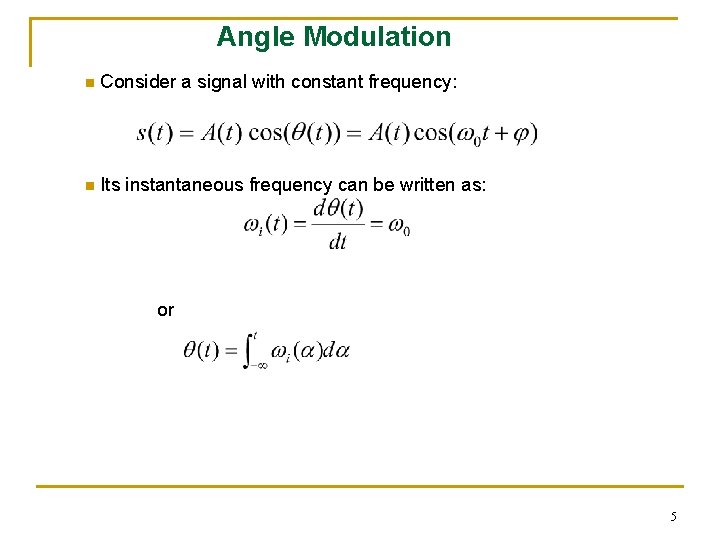
Angle Modulation n Consider a signal with constant frequency: n Its instantaneous frequency can be written as: or 5
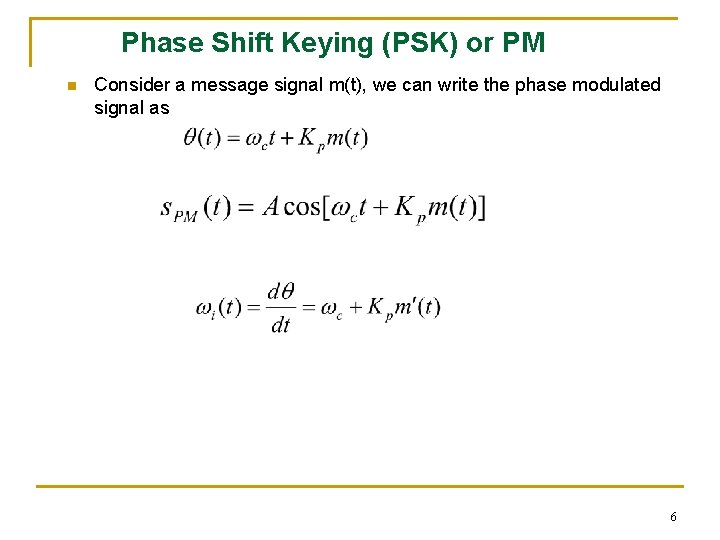
Phase Shift Keying (PSK) or PM n Consider a message signal m(t), we can write the phase modulated signal as 6
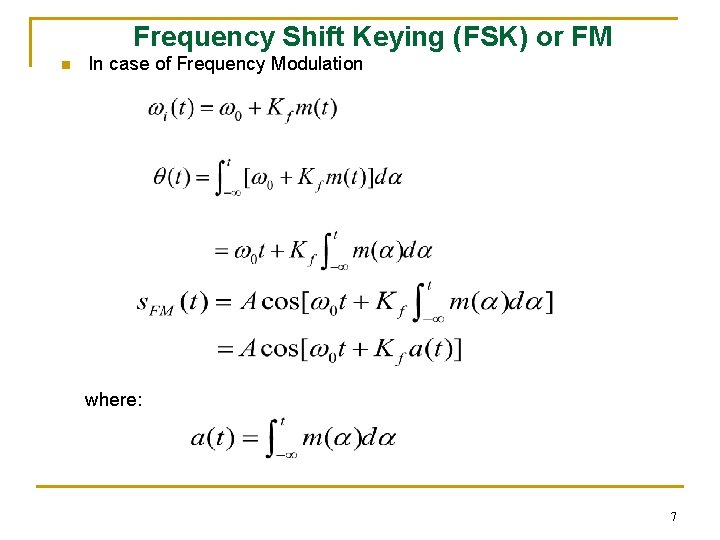
Frequency Shift Keying (FSK) or FM n In case of Frequency Modulation where: 7

Example 8
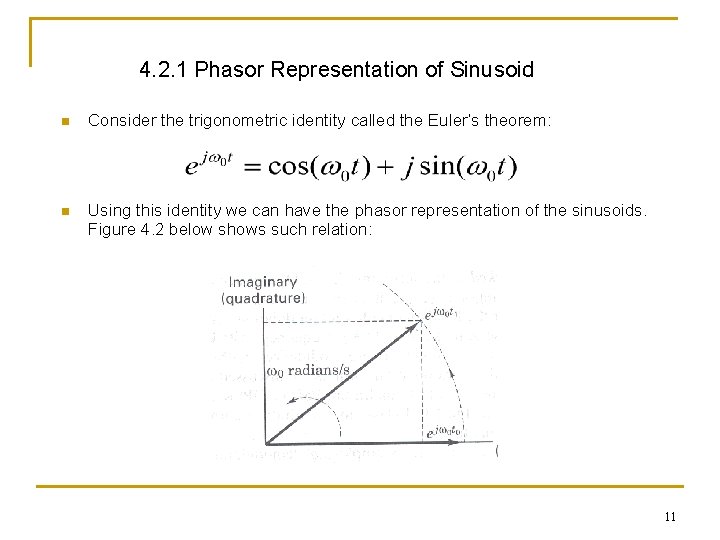
4. 2. 1 Phasor Representation of Sinusoid n Consider the trigonometric identity called the Euler’s theorem: n Using this identity we can have the phasor representation of the sinusoids. Figure 4. 2 below shows such relation: 11
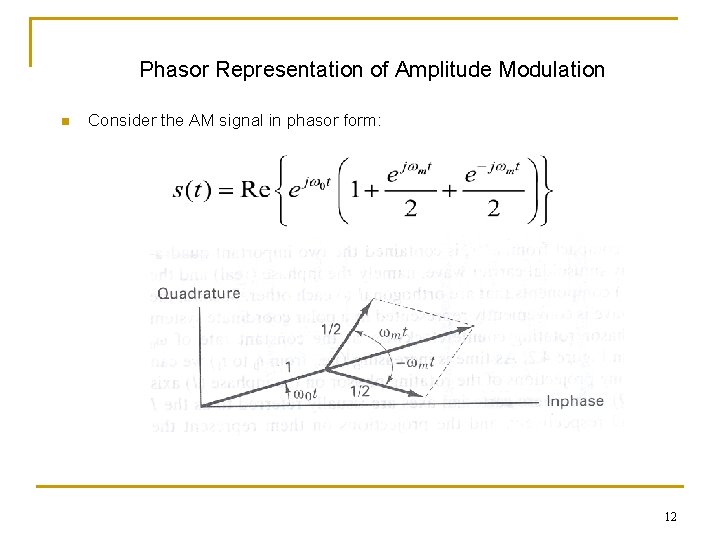
Phasor Representation of Amplitude Modulation n Consider the AM signal in phasor form: 12
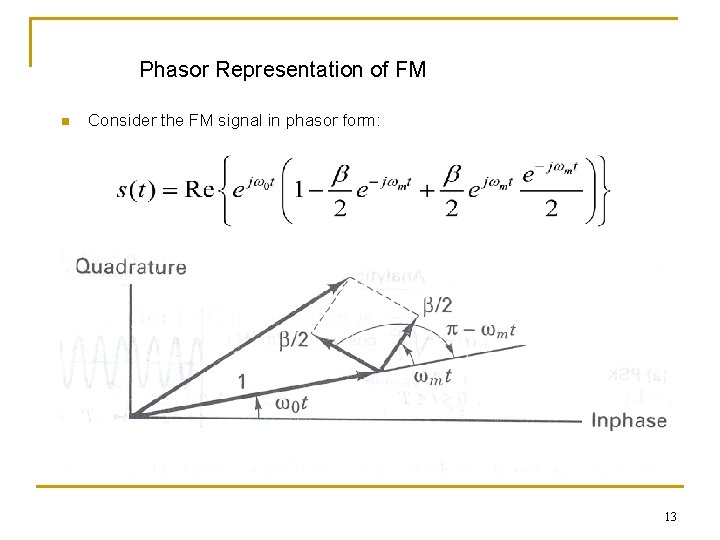
Phasor Representation of FM n Consider the FM signal in phasor form: 13
Digital Modulation Schemes n Basic Digital Modulation Schemes: q Amplitude Shift Keying (ASK) q Frequency Shift Keying (FSK) q Phase Shift Keying (PSK) q Amplitude Phase Keying (APK) n For Binary signals (M = 2), we have q Binary Amplitude Shift Keying (BASK) q Binary Phase Shift Keying (BPSK) q Binary Frequency Shift Keying (BFSK) n For M > 2, many variations of the above techniques exit usually classified as M-ary Modulation/detection 18
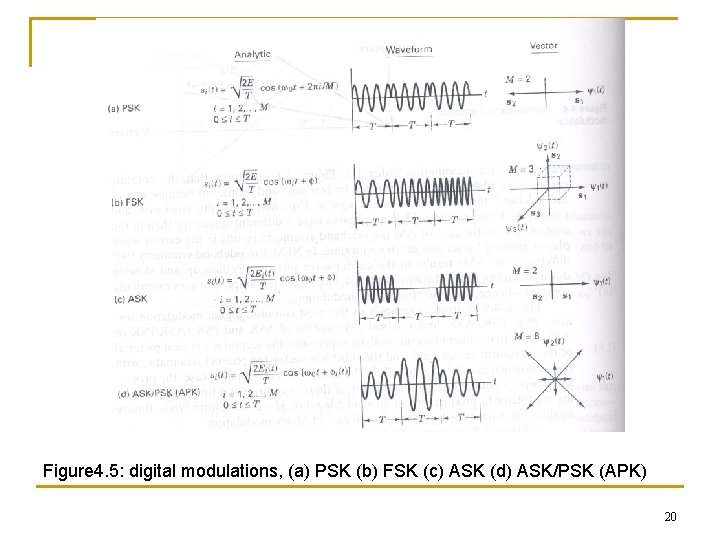
Figure 4. 5: digital modulations, (a) PSK (b) FSK (c) ASK (d) ASK/PSK (APK) 20
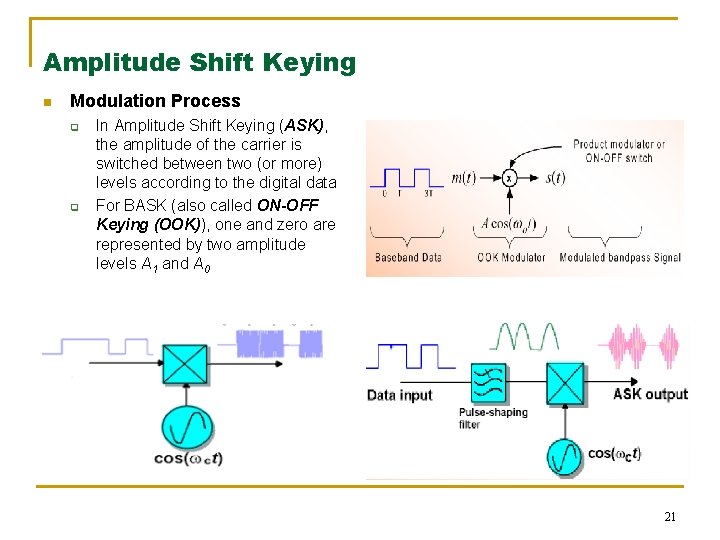
Amplitude Shift Keying n Modulation Process q q In Amplitude Shift Keying (ASK), the amplitude of the carrier is switched between two (or more) levels according to the digital data For BASK (also called ON-OFF Keying (OOK)), one and zero are represented by two amplitude levels A 1 and A 0 21
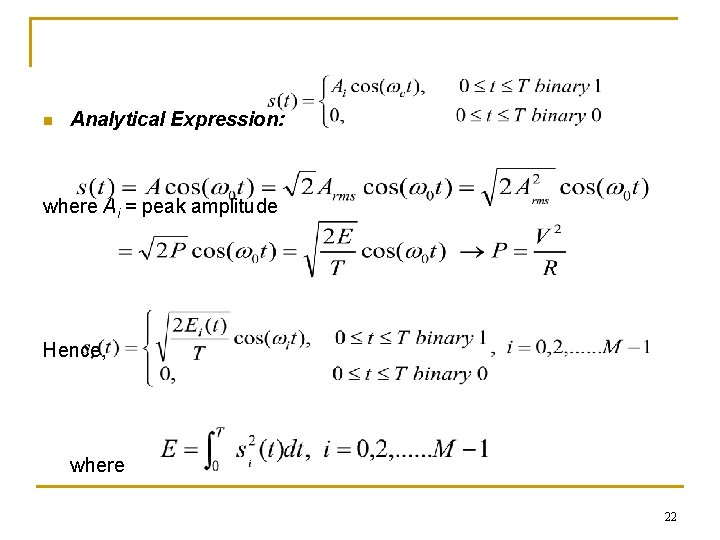
n Analytical Expression: where Ai = peak amplitude Hence, where 22
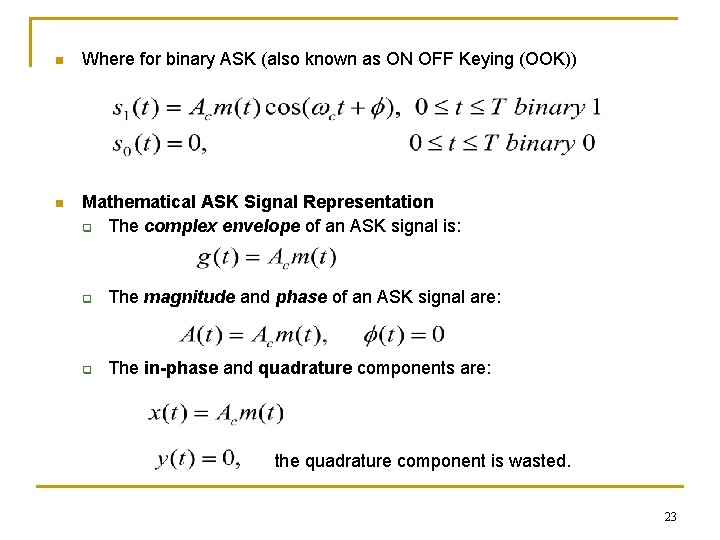
n Where for binary ASK (also known as ON OFF Keying (OOK)) n Mathematical ASK Signal Representation q The complex envelope of an ASK signal is: q The magnitude and phase of an ASK signal are: q The in-phase and quadrature components are: the quadrature component is wasted. 23
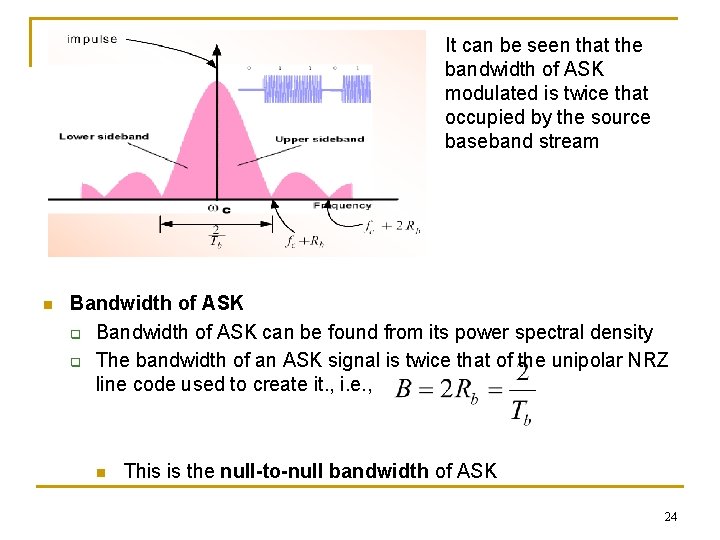
• n It can be seen that the bandwidth of ASK modulated is twice that occupied by the source baseband stream Bandwidth of ASK q Bandwidth of ASK can be found from its power spectral density q The bandwidth of an ASK signal is twice that of the unipolar NRZ line code used to create it. , i. e. , n This is the null-to-null bandwidth of ASK 24
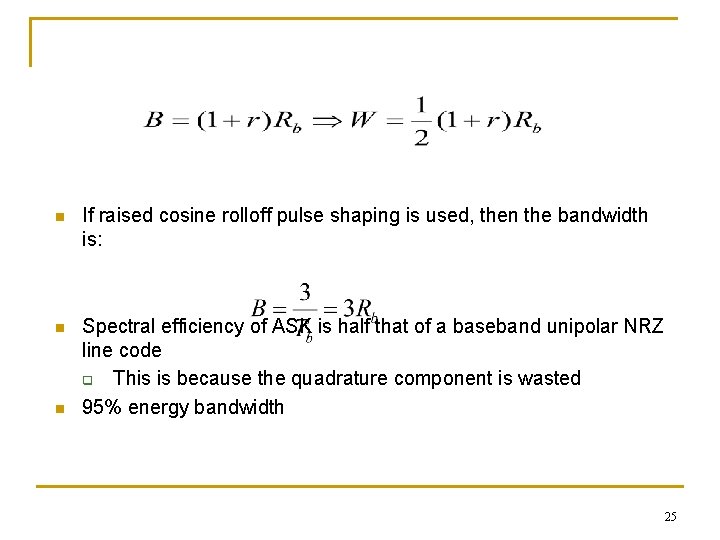
n If raised cosine rolloff pulse shaping is used, then the bandwidth is: n Spectral efficiency of ASK is half that of a baseband unipolar NRZ line code q This is because the quadrature component is wasted 95% energy bandwidth n 25
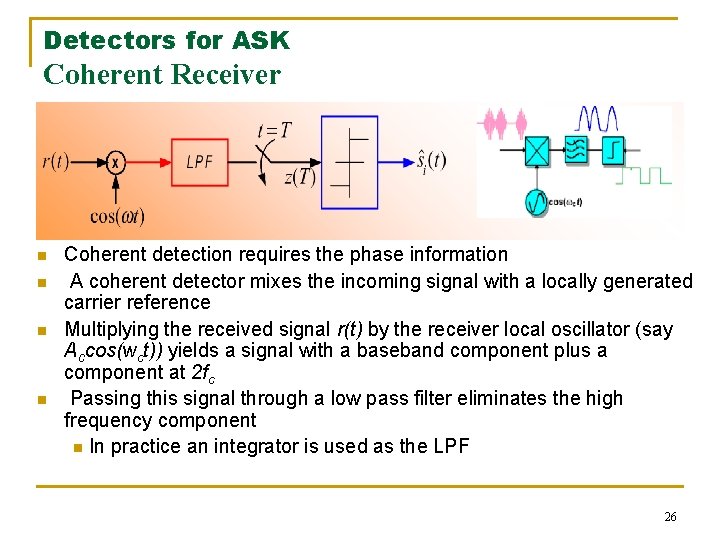
Detectors for ASK Coherent Receiver n n Coherent detection requires the phase information A coherent detector mixes the incoming signal with a locally generated carrier reference Multiplying the received signal r(t) by the receiver local oscillator (say Accos(wct)) yields a signal with a baseband component plus a component at 2 fc Passing this signal through a low pass filter eliminates the high frequency component n In practice an integrator is used as the LPF 26
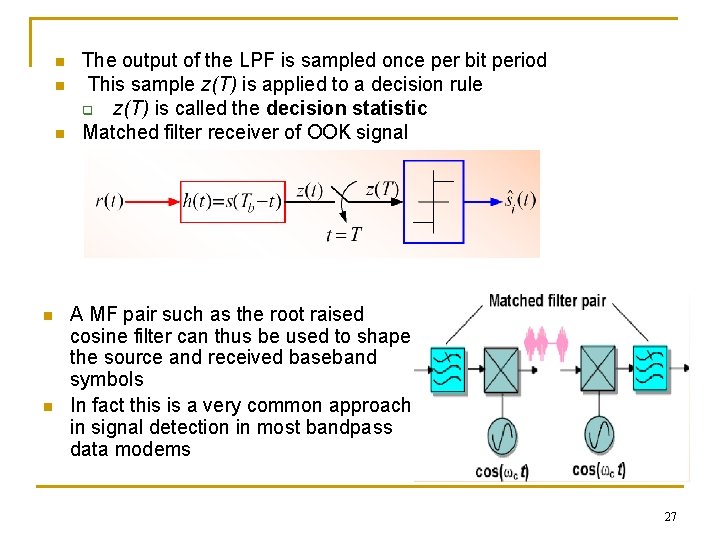
n n n The output of the LPF is sampled once per bit period This sample z(T) is applied to a decision rule q z(T) is called the decision statistic Matched filter receiver of OOK signal A MF pair such as the root raised cosine filter can thus be used to shape the source and received baseband symbols In fact this is a very common approach in signal detection in most bandpass data modems 27
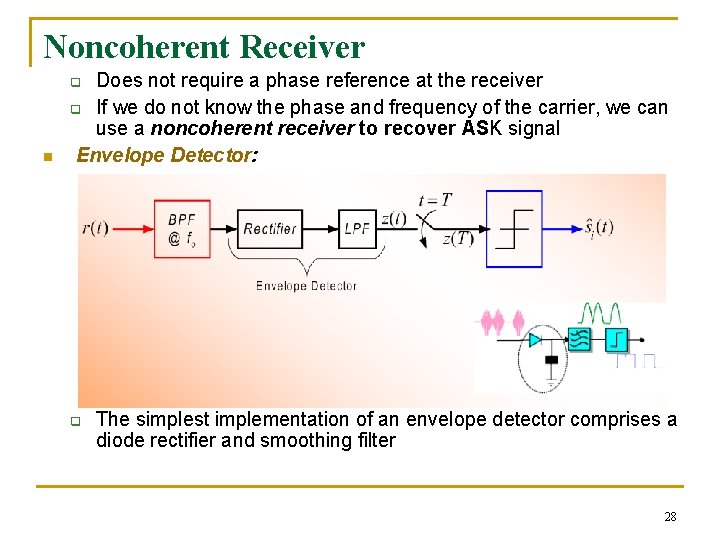
Noncoherent Receiver Does not require a phase reference at the receiver q If we do not know the phase and frequency of the carrier, we can use a noncoherent receiver to recover ASK signal Envelope Detector: q n q The simplest implementation of an envelope detector comprises a diode rectifier and smoothing filter 28
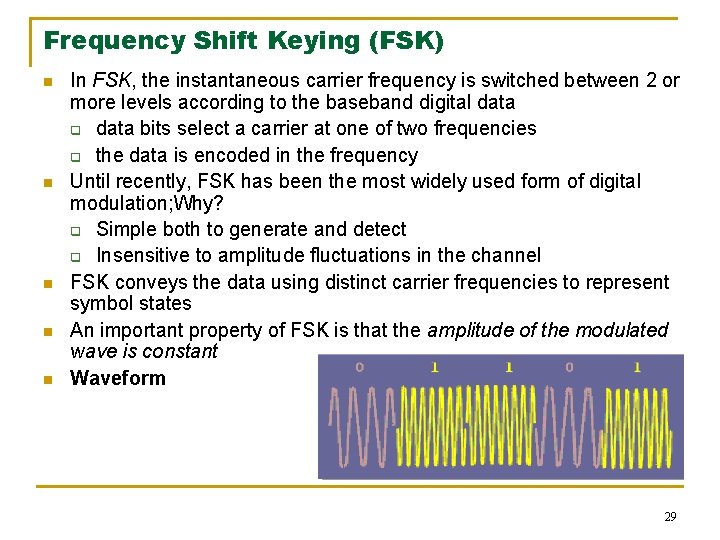
Frequency Shift Keying (FSK) n n n In FSK, the instantaneous carrier frequency is switched between 2 or more levels according to the baseband digital data q data bits select a carrier at one of two frequencies q the data is encoded in the frequency Until recently, FSK has been the most widely used form of digital modulation; Why? q Simple both to generate and detect q Insensitive to amplitude fluctuations in the channel FSK conveys the data using distinct carrier frequencies to represent symbol states An important property of FSK is that the amplitude of the modulated wave is constant Waveform 29
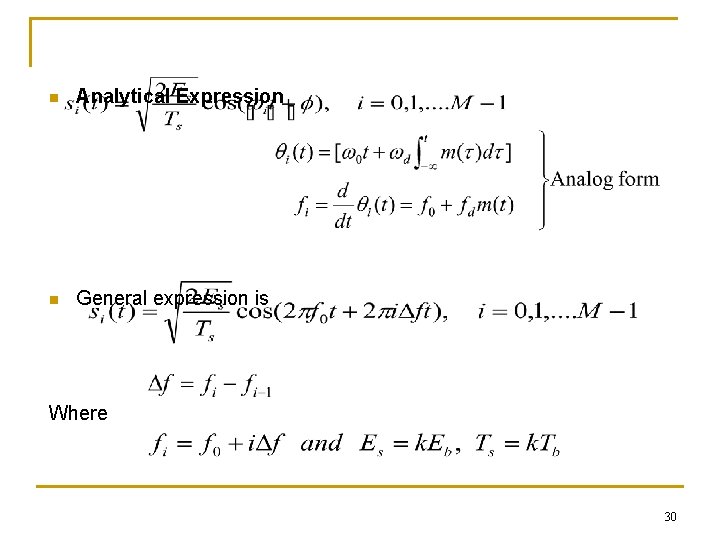
n Analytical Expression n General expression is Where 30
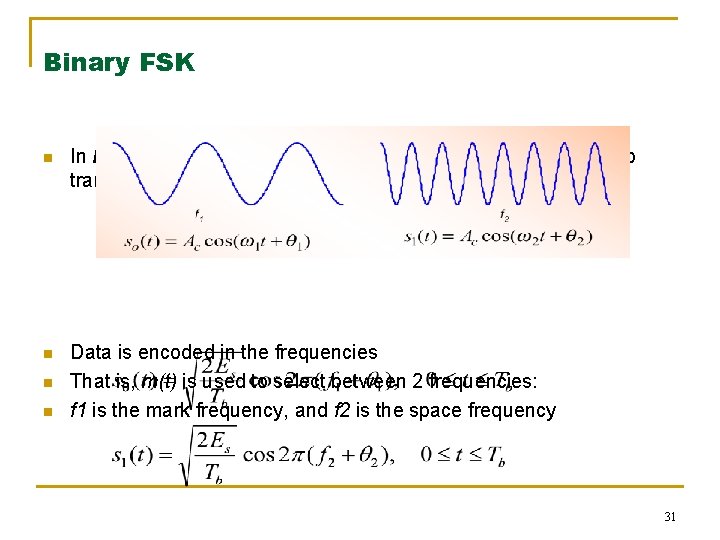
Binary FSK n In BFSK, 2 different frequencies, f 1 and f 2 = f 1 + ∆ f are used to transmit binary information n Data is encoded in the frequencies That is, m(t) is used to select between 2 frequencies: f 1 is the mark frequency, and f 2 is the space frequency n n 31
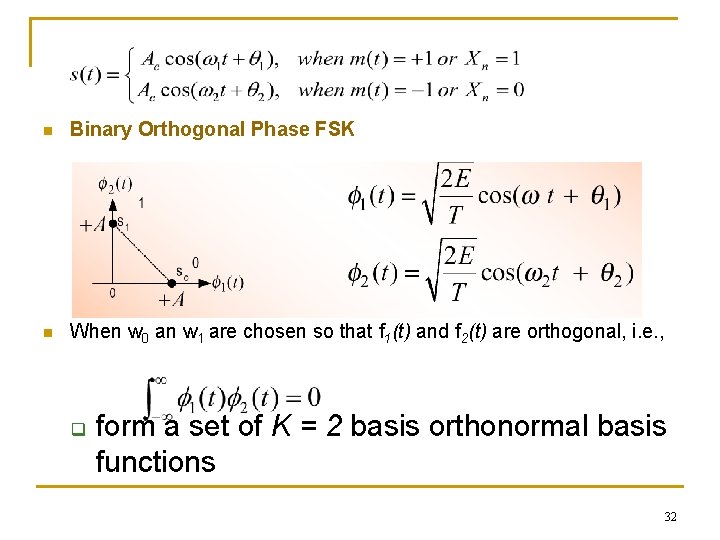
n Binary Orthogonal Phase FSK n When w 0 an w 1 are chosen so that f 1(t) and f 2(t) are orthogonal, i. e. , q form a set of K = 2 basis orthonormal basis functions 32
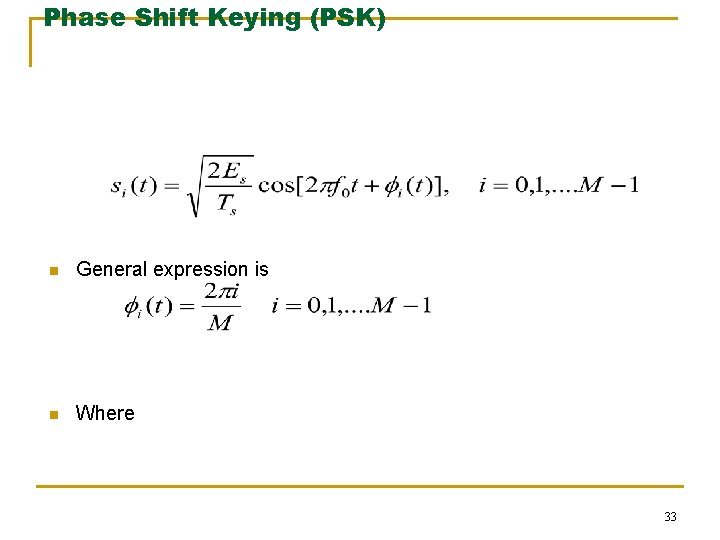
Phase Shift Keying (PSK) n General expression is n Where 33
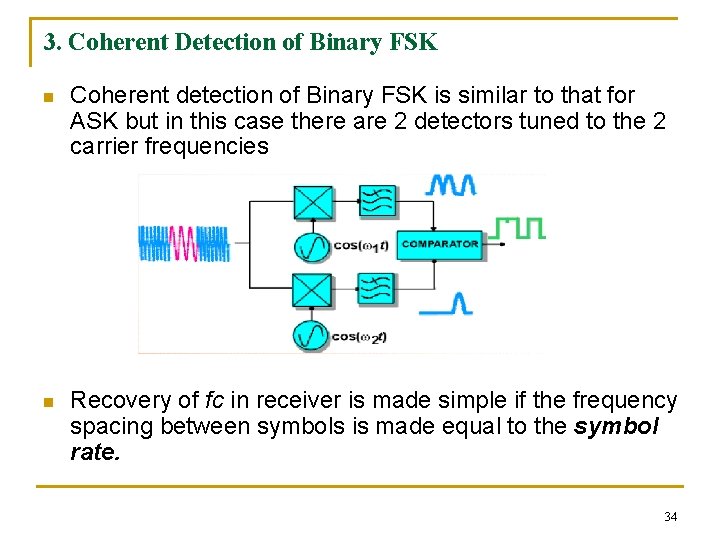
3. Coherent Detection of Binary FSK n Coherent detection of Binary FSK is similar to that for ASK but in this case there are 2 detectors tuned to the 2 carrier frequencies n Recovery of fc in receiver is made simple if the frequency spacing between symbols is made equal to the symbol rate. 34
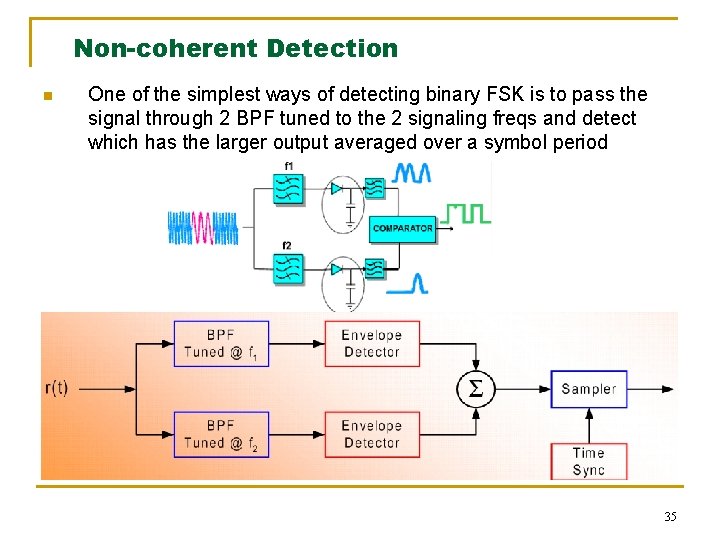
Non-coherent Detection n One of the simplest ways of detecting binary FSK is to pass the signal through 2 BPF tuned to the 2 signaling freqs and detect which has the larger output averaged over a symbol period 35
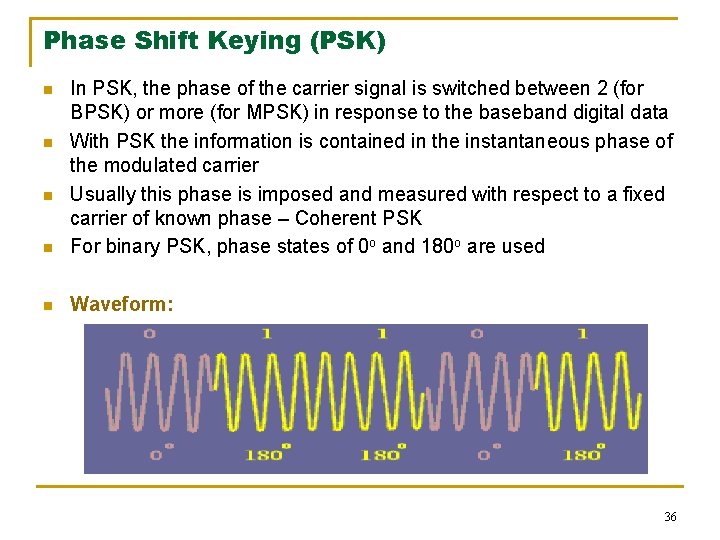
Phase Shift Keying (PSK) n In PSK, the phase of the carrier signal is switched between 2 (for BPSK) or more (for MPSK) in response to the baseband digital data With PSK the information is contained in the instantaneous phase of the modulated carrier Usually this phase is imposed and measured with respect to a fixed carrier of known phase – Coherent PSK For binary PSK, phase states of 0 o and 180 o are used n Waveform: n n n 36
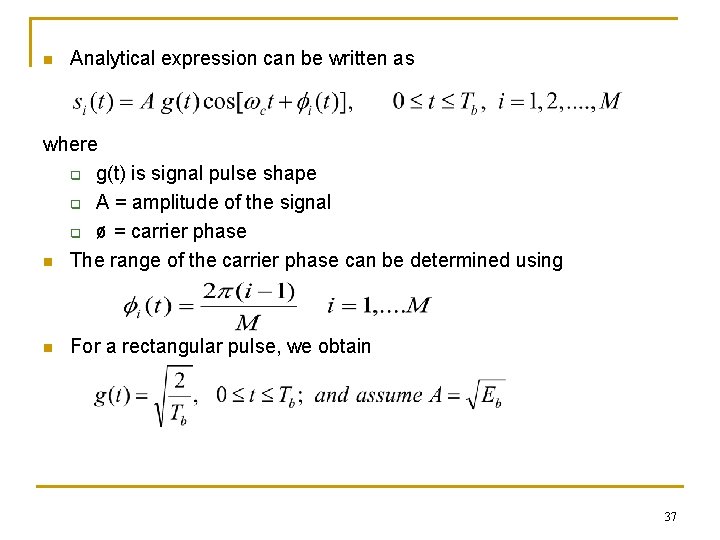
n Analytical expression can be written as where q g(t) is signal pulse shape q A = amplitude of the signal q ø = carrier phase n The range of the carrier phase can be determined using n For a rectangular pulse, we obtain 37
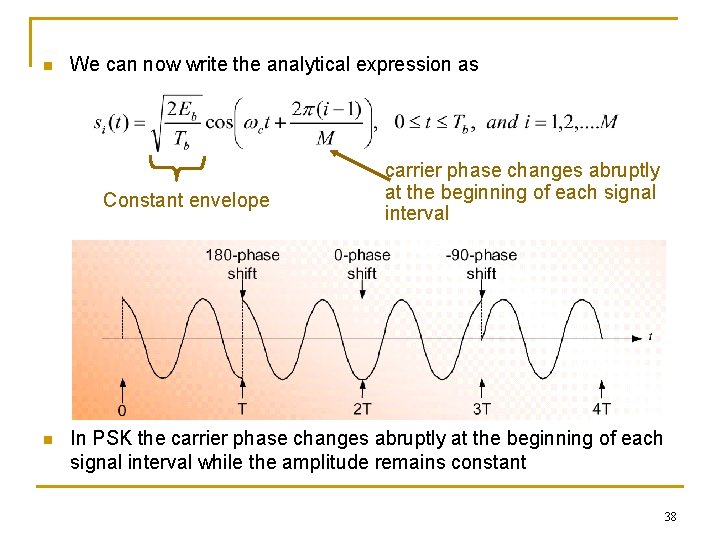
n We can now write the analytical expression as Constant envelope n carrier phase changes abruptly at the beginning of each signal interval In PSK the carrier phase changes abruptly at the beginning of each signal interval while the amplitude remains constant 38
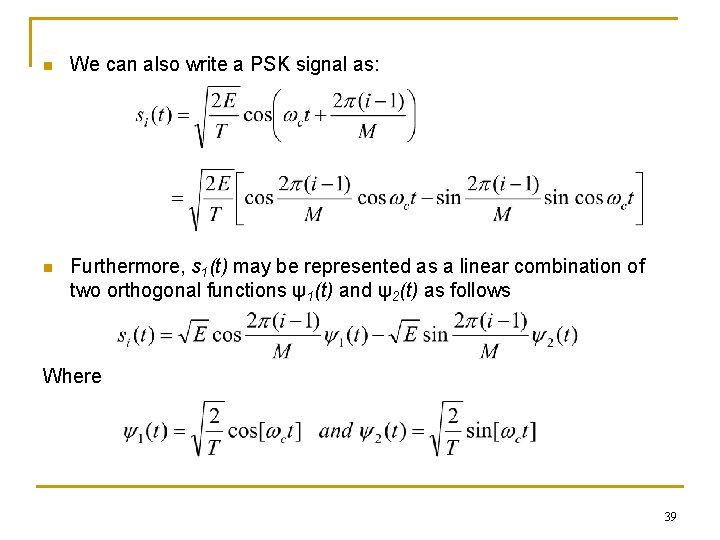
n We can also write a PSK signal as: n Furthermore, s 1(t) may be represented as a linear combination of two orthogonal functions ψ1(t) and ψ2(t) as follows Where 39
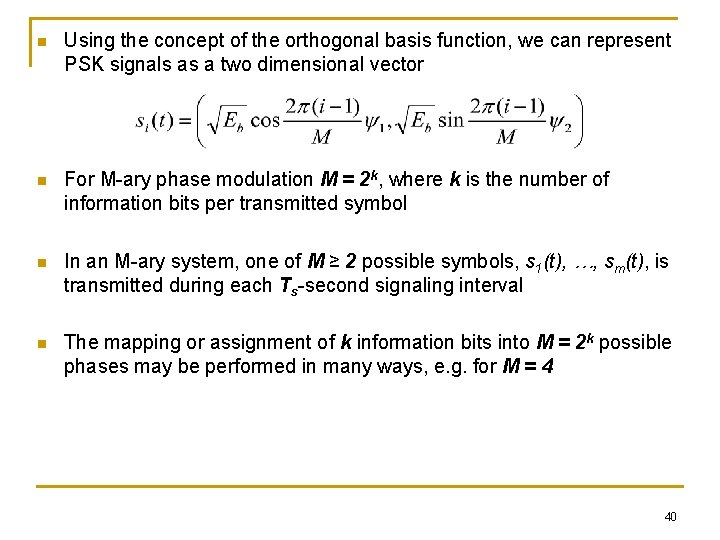
n Using the concept of the orthogonal basis function, we can represent PSK signals as a two dimensional vector n For M-ary phase modulation M = 2 k, where k is the number of information bits per transmitted symbol n In an M-ary system, one of M ≥ 2 possible symbols, s 1(t), …, sm(t), is transmitted during each Ts-second signaling interval n The mapping or assignment of k information bits into M = 2 k possible phases may be performed in many ways, e. g. for M = 4 40
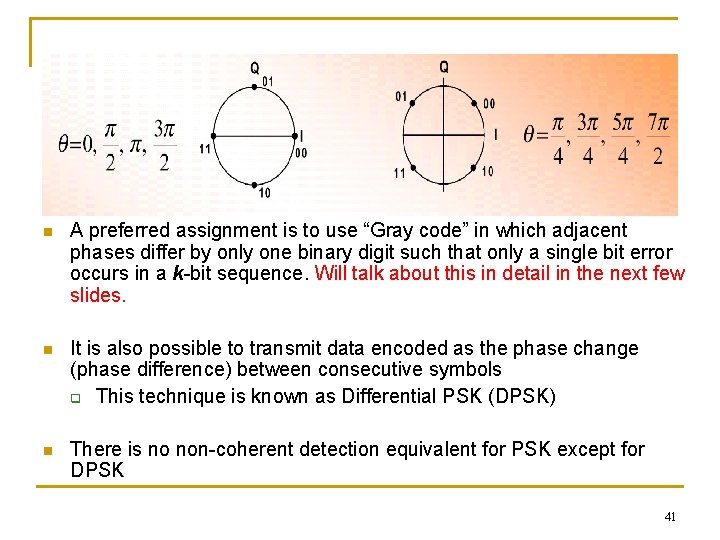
n A preferred assignment is to use “Gray code” in which adjacent phases differ by only one binary digit such that only a single bit error occurs in a k-bit sequence. Will talk about this in detail in the next few slides. n It is also possible to transmit data encoded as the phase change (phase difference) between consecutive symbols q This technique is known as Differential PSK (DPSK) n There is no non-coherent detection equivalent for PSK except for DPSK 41
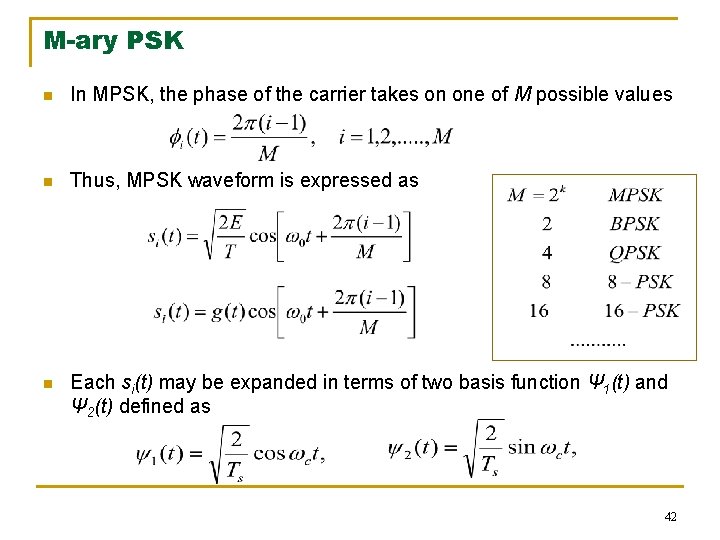
M-ary PSK n In MPSK, the phase of the carrier takes on one of M possible values n Thus, MPSK waveform is expressed as n Each si(t) may be expanded in terms of two basis function Ψ 1(t) and Ψ 2(t) defined as 42
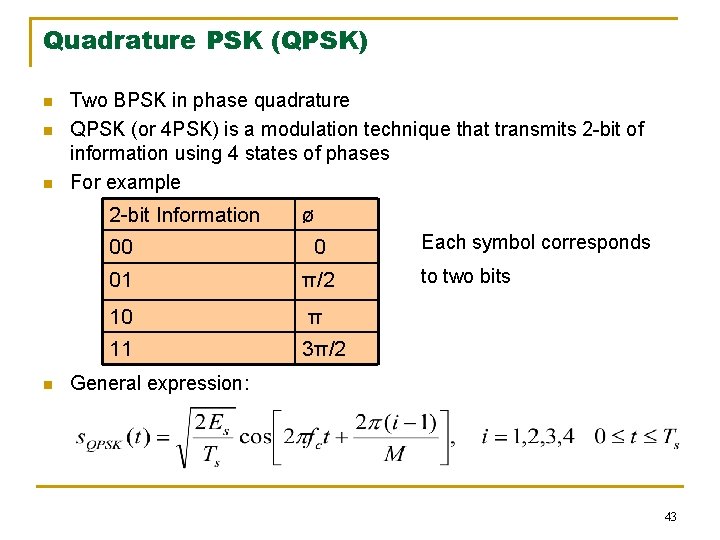
Quadrature PSK (QPSK) n n n Two BPSK in phase quadrature QPSK (or 4 PSK) is a modulation technique that transmits 2 -bit of information using 4 states of phases For example 2 -bit Information n ø 00 0 01 π/2 10 π 11 3π/2 Each symbol corresponds to two bits General expression: 43
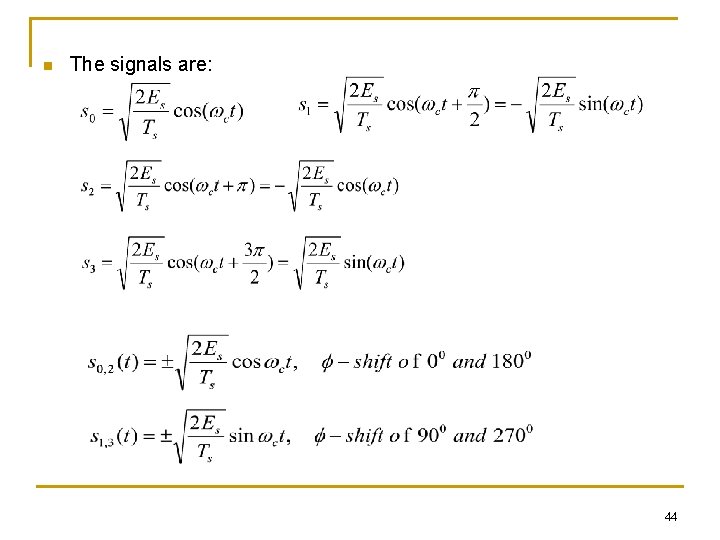
n The signals are: 44
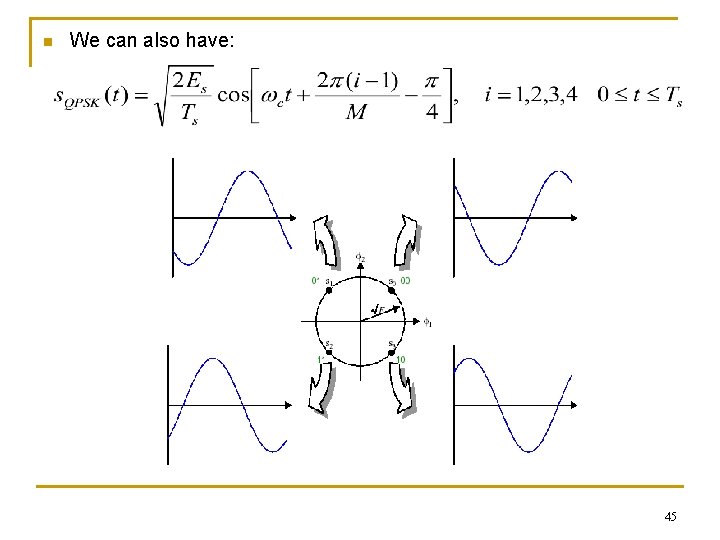
n We can also have: 45
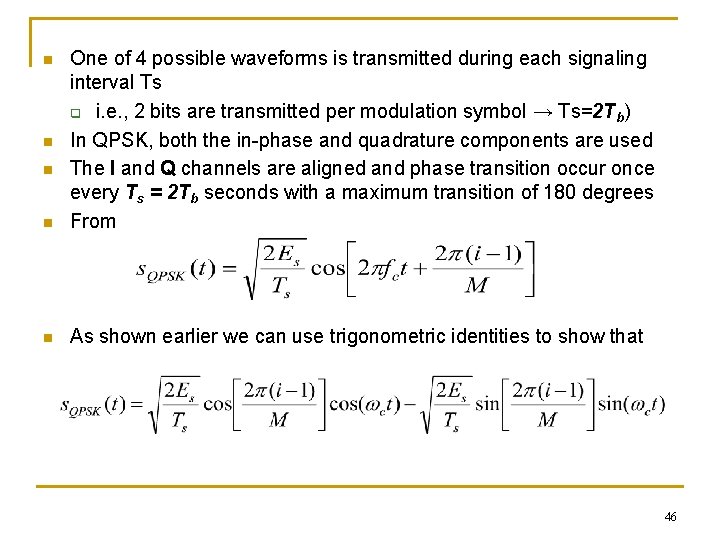
n One of 4 possible waveforms is transmitted during each signaling interval Ts q i. e. , 2 bits are transmitted per modulation symbol → Ts=2 Tb) In QPSK, both the in-phase and quadrature components are used The I and Q channels are aligned and phase transition occur once every Ts = 2 Tb seconds with a maximum transition of 180 degrees From n As shown earlier we can use trigonometric identities to show that n n n 46
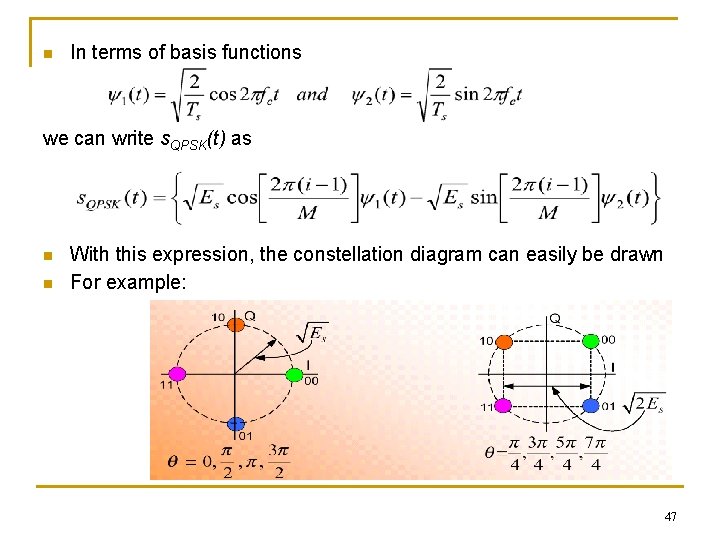
n In terms of basis functions we can write s. QPSK(t) as n n With this expression, the constellation diagram can easily be drawn For example: 47
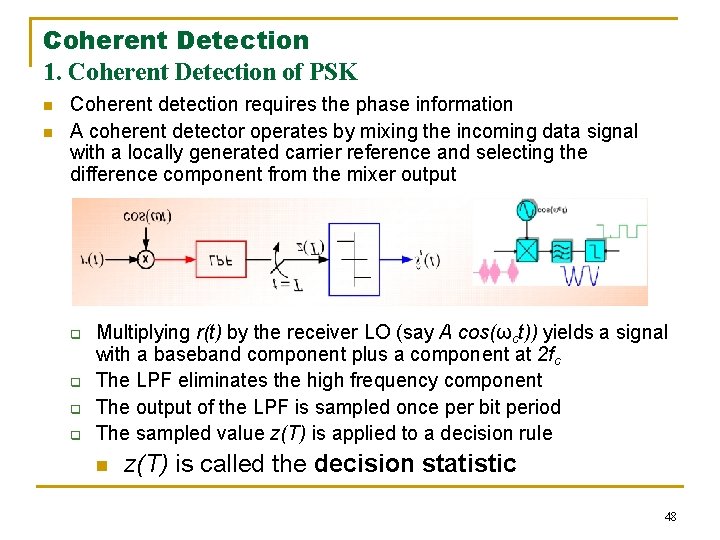
Coherent Detection 1. Coherent Detection of PSK n n Coherent detection requires the phase information A coherent detector operates by mixing the incoming data signal with a locally generated carrier reference and selecting the difference component from the mixer output q q Multiplying r(t) by the receiver LO (say A cos(ωct)) yields a signal with a baseband component plus a component at 2 fc The LPF eliminates the high frequency component The output of the LPF is sampled once per bit period The sampled value z(T) is applied to a decision rule n z(T) is called the decision statistic 48
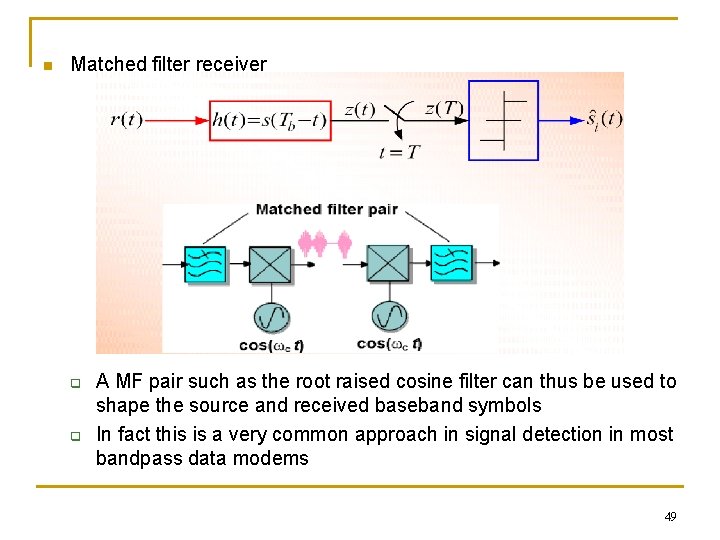
n Matched filter receiver q q A MF pair such as the root raised cosine filter can thus be used to shape the source and received baseband symbols In fact this is a very common approach in signal detection in most bandpass data modems 49
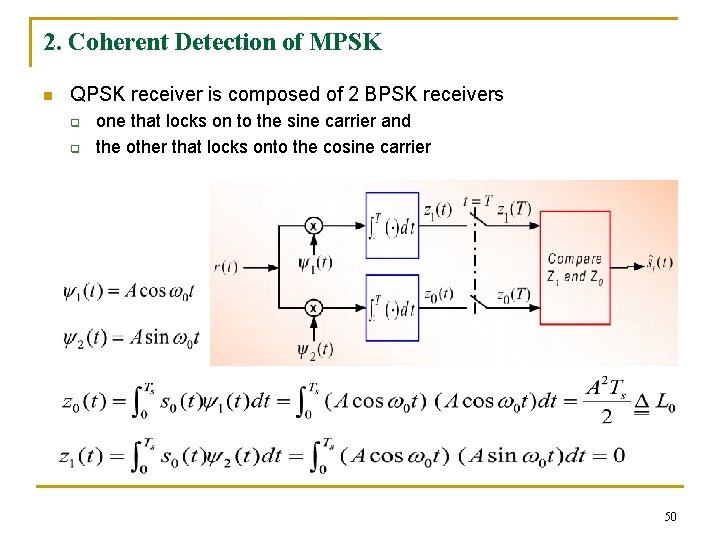
2. Coherent Detection of MPSK n QPSK receiver is composed of 2 BPSK receivers q q one that locks on to the sine carrier and the other that locks onto the cosine carrier 50
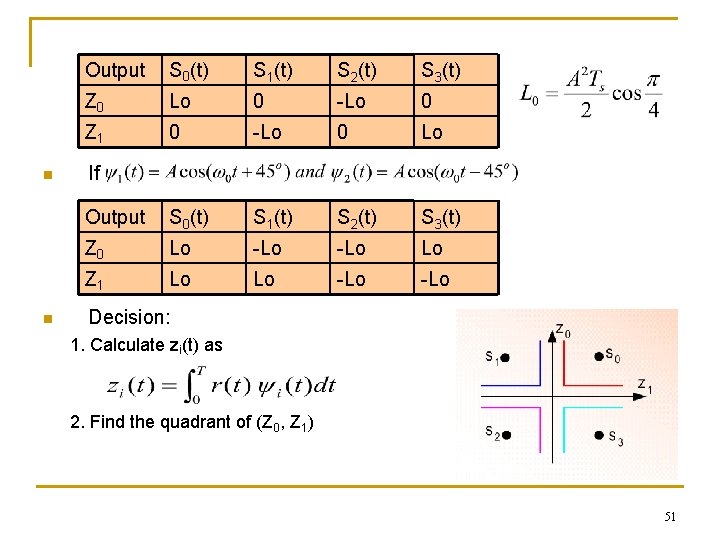
n n Output S 0(t) S 1(t) S 2(t) S 3(t) Z 0 Lo 0 -Lo 0 Z 1 0 -Lo 0 Lo Output S 0(t) S 1(t) S 2(t) S 3(t) Z 0 Lo -Lo Lo Z 1 Lo Lo -Lo If Decision: 1. Calculate zi(t) as 2. Find the quadrant of (Z 0, Z 1) 51
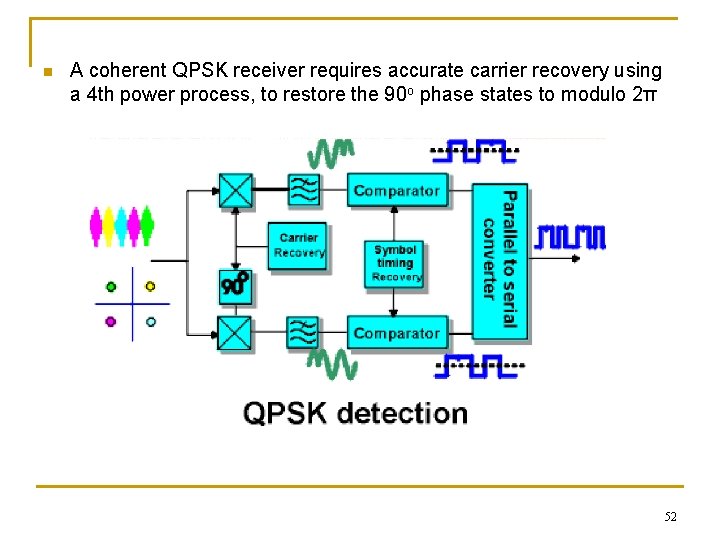
n A coherent QPSK receiver requires accurate carrier recovery using a 4 th power process, to restore the 90 o phase states to modulo 2π 52
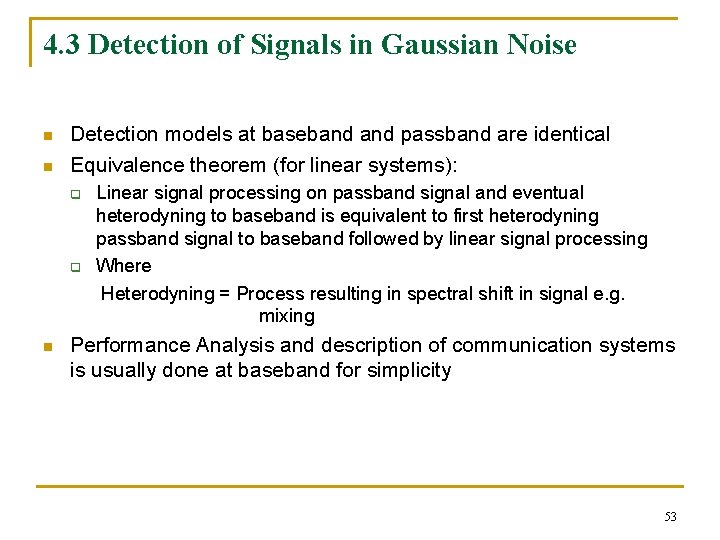
4. 3 Detection of Signals in Gaussian Noise n n Detection models at baseband passband are identical Equivalence theorem (for linear systems): q q n Linear signal processing on passband signal and eventual heterodyning to baseband is equivalent to first heterodyning passband signal to baseband followed by linear signal processing Where Heterodyning = Process resulting in spectral shift in signal e. g. mixing Performance Analysis and description of communication systems is usually done at baseband for simplicity 53
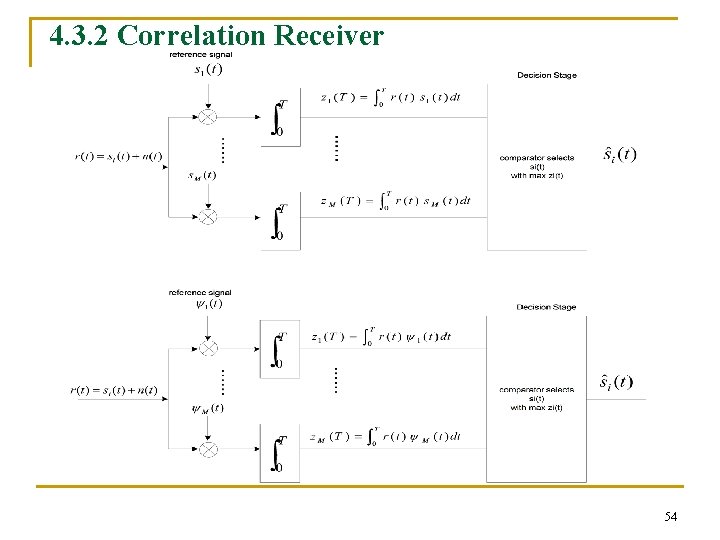
4. 3. 2 Correlation Receiver 54
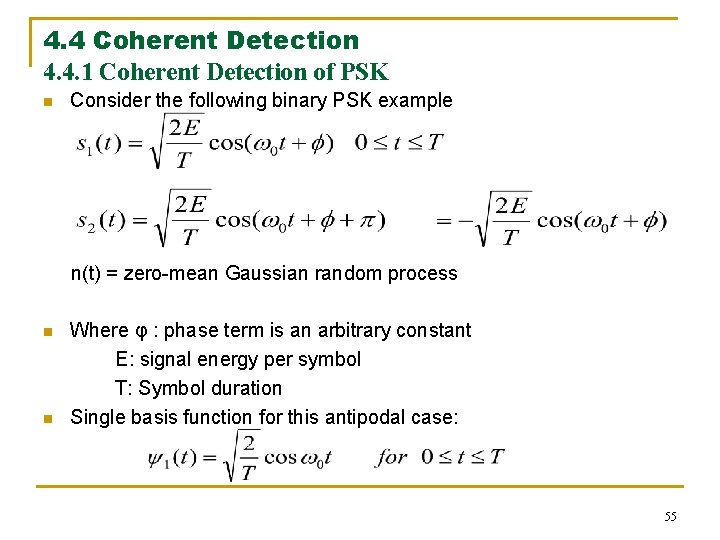
4. 4 Coherent Detection 4. 4. 1 Coherent Detection of PSK n Consider the following binary PSK example n(t) = zero-mean Gaussian random process n n Where φ : phase term is an arbitrary constant E: signal energy per symbol T: Symbol duration Single basis function for this antipodal case: 55
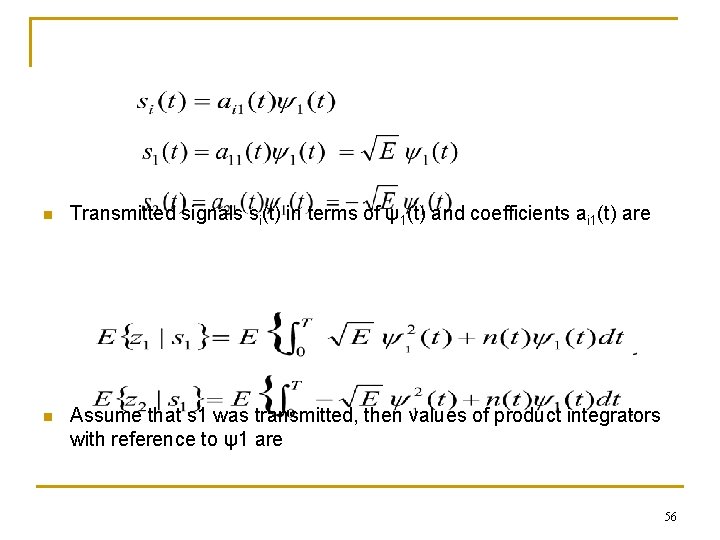
n Transmitted signals si(t) in terms of ψ1(t) and coefficients ai 1(t) are n Assume that s 1 was transmitted, then values of product integrators with reference to ψ1 are 56
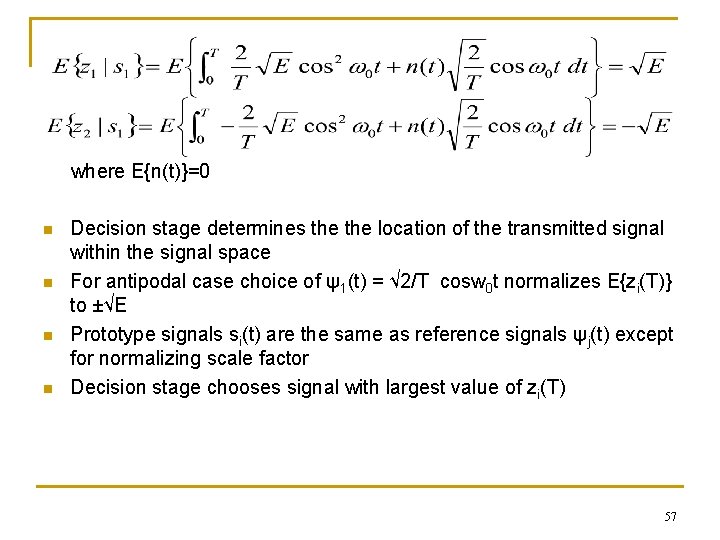
where E{n(t)}=0 n n Decision stage determines the location of the transmitted signal within the signal space For antipodal case choice of ψ1(t) = √ 2/T cosw 0 t normalizes E{zi(T)} to ±√E Prototype signals si(t) are the same as reference signals ψj(t) except for normalizing scale factor Decision stage chooses signal with largest value of zi(T) 57
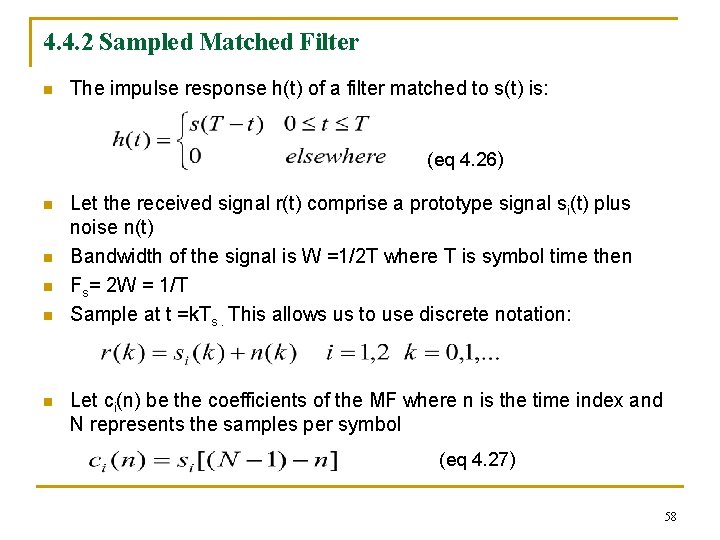
4. 4. 2 Sampled Matched Filter n The impulse response h(t) of a filter matched to s(t) is: (eq 4. 26) n n n Let the received signal r(t) comprise a prototype signal si(t) plus noise n(t) Bandwidth of the signal is W =1/2 T where T is symbol time then Fs= 2 W = 1/T Sample at t =k. Ts. This allows us to use discrete notation: Let ci(n) be the coefficients of the MF where n is the time index and N represents the samples per symbol (eq 4. 27) 58
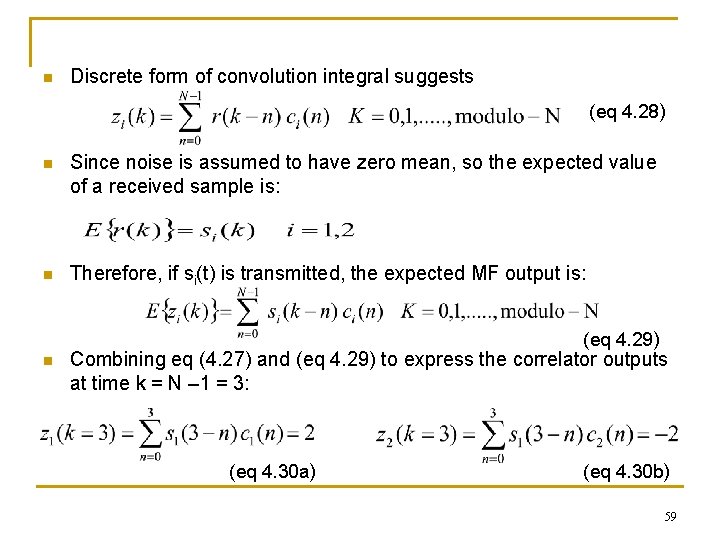
n Discrete form of convolution integral suggests (eq 4. 28) n Since noise is assumed to have zero mean, so the expected value of a received sample is: n Therefore, if si(t) is transmitted, the expected MF output is: (eq 4. 29) n Combining eq (4. 27) and (eq 4. 29) to express the correlator outputs at time k = N – 1 = 3: (eq 4. 30 a) (eq 4. 30 b) 59
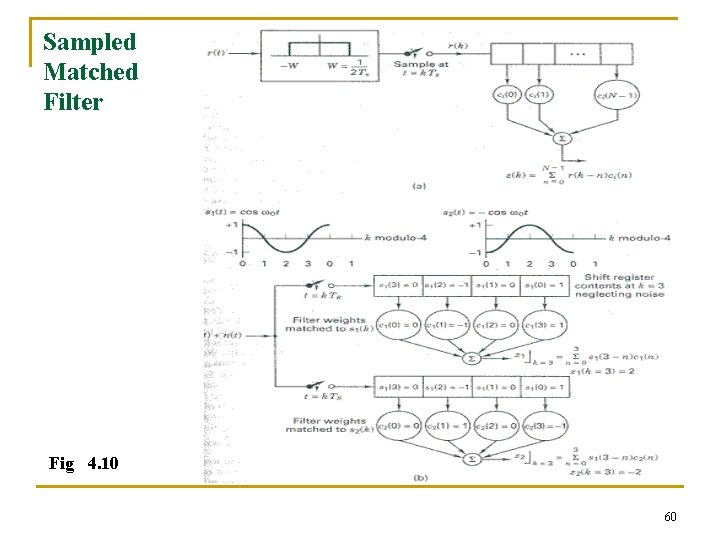
Sampled Matched Filter Fig 4. 10 60
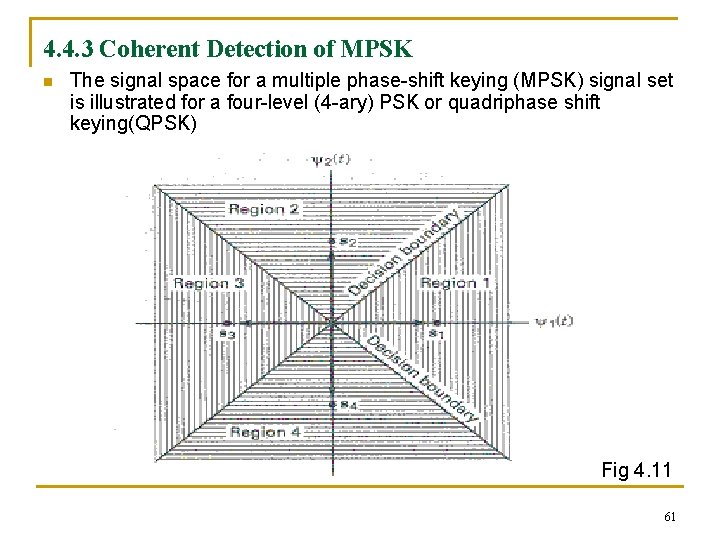
4. 4. 3 Coherent Detection of MPSK n The signal space for a multiple phase-shift keying (MPSK) signal set is illustrated for a four-level (4 -ary) PSK or quadriphase shift keying(QPSK) Fig 4. 11 61
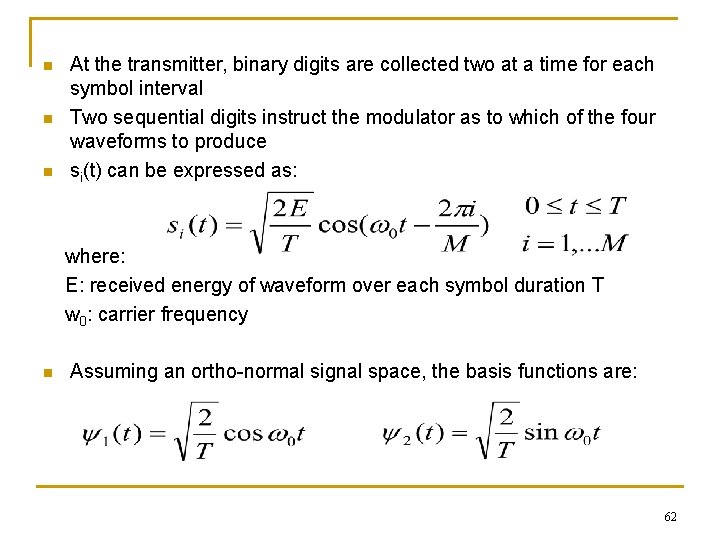
n n n At the transmitter, binary digits are collected two at a time for each symbol interval Two sequential digits instruct the modulator as to which of the four waveforms to produce si(t) can be expressed as: where: E: received energy of waveform over each symbol duration T w 0: carrier frequency n Assuming an ortho-normal signal space, the basis functions are: 62
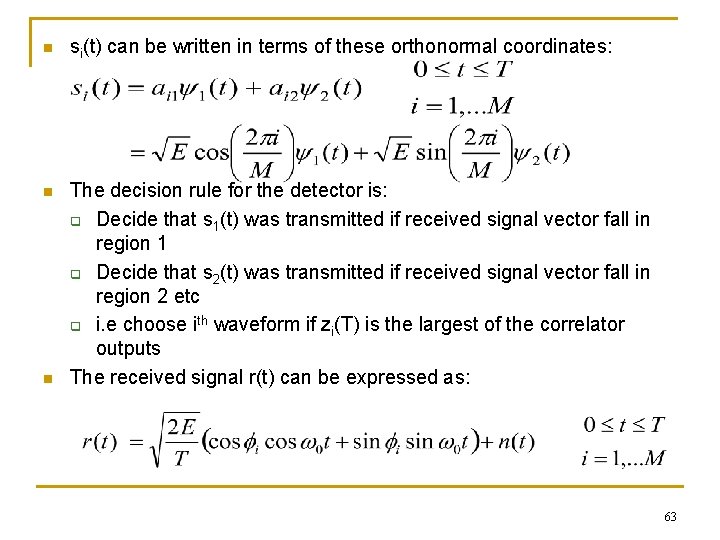
n si(t) can be written in terms of these orthonormal coordinates: n The decision rule for the detector is: q Decide that s 1(t) was transmitted if received signal vector fall in region 1 q Decide that s 2(t) was transmitted if received signal vector fall in region 2 etc q i. e choose ith waveform if zi(T) is the largest of the correlator outputs The received signal r(t) can be expressed as: n 63
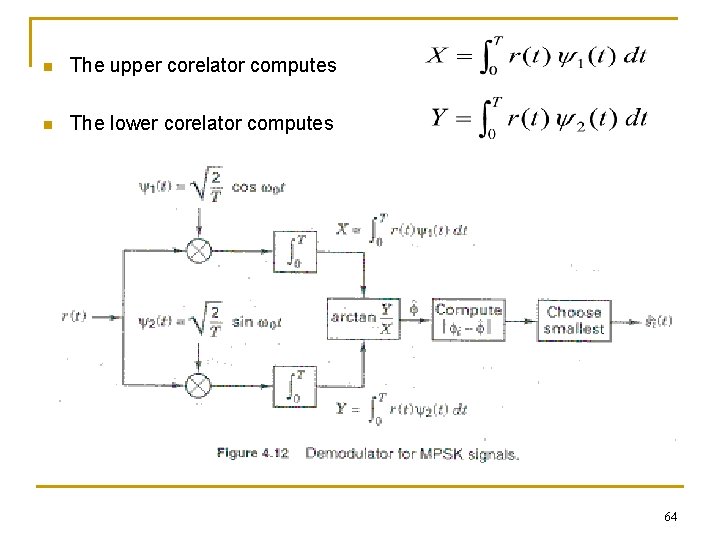
n The upper corelator computes n The lower corelator computes 64
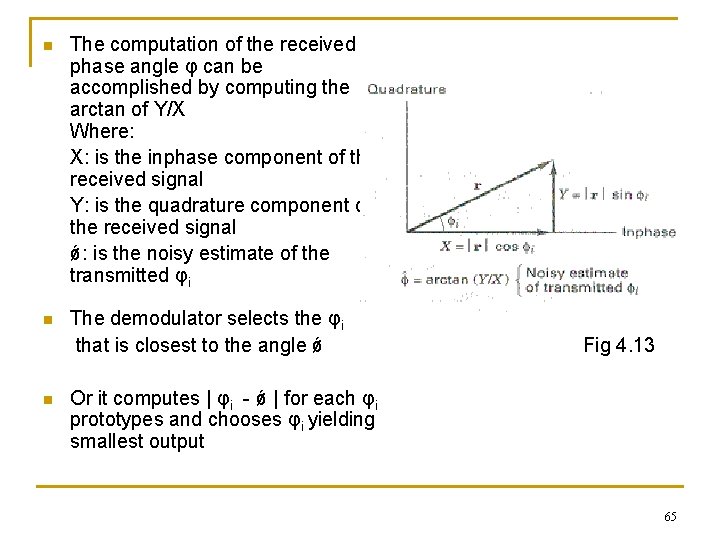
n The computation of the received phase angle φ can be accomplished by computing the arctan of Y/X Where: X: is the inphase component of the received signal Y: is the quadrature component of the received signal ǿ: is the noisy estimate of the transmitted φi n The demodulator selects the φi that is closest to the angle ǿ n Fig 4. 13 Or it computes | φi - ǿ | for each φi prototypes and chooses φi yielding smallest output 65
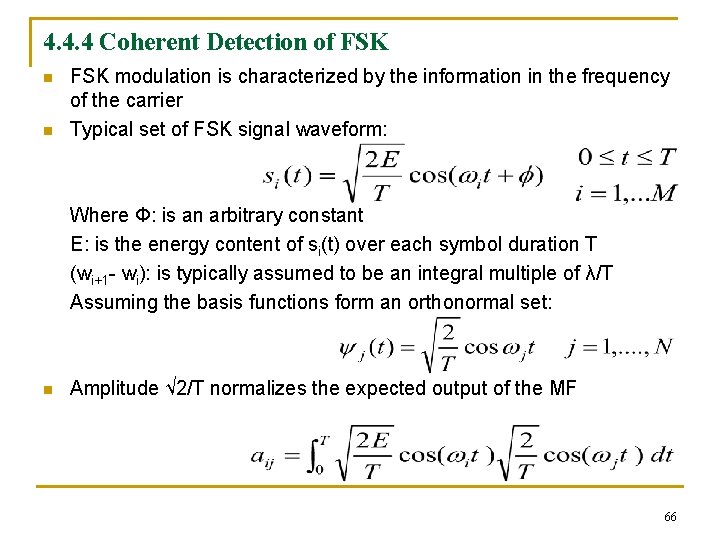
4. 4. 4 Coherent Detection of FSK n n FSK modulation is characterized by the information in the frequency of the carrier Typical set of FSK signal waveform: Where Φ: is an arbitrary constant E: is the energy content of si(t) over each symbol duration T (wi+1 - wi): is typically assumed to be an integral multiple of λ/T Assuming the basis functions form an orthonormal set: n Amplitude √ 2/T normalizes the expected output of the MF 66
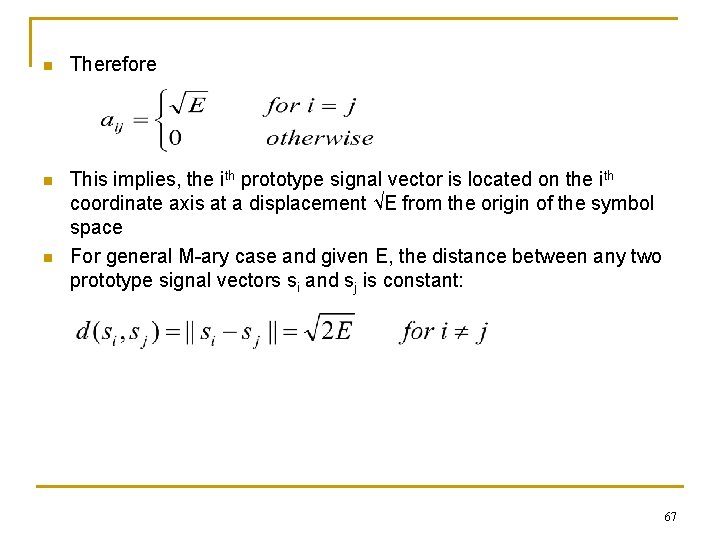
n Therefore n This implies, the ith prototype signal vector is located on the ith coordinate axis at a displacement √E from the origin of the symbol space For general M-ary case and given E, the distance between any two prototype signal vectors si and sj is constant: n 67
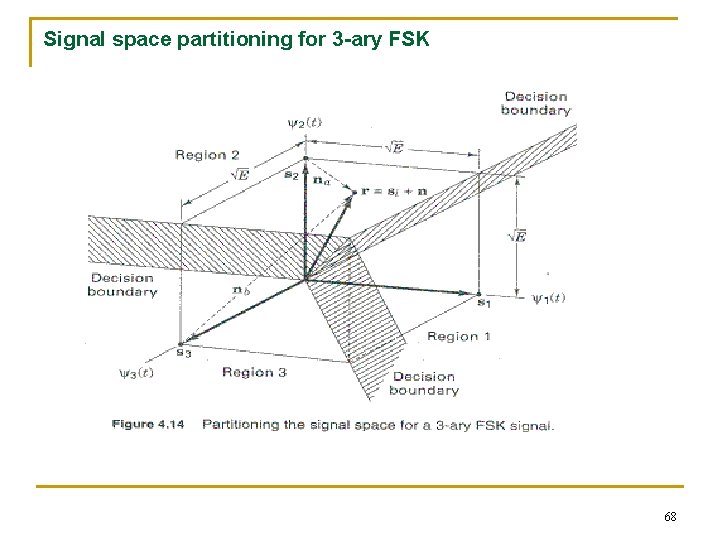
Signal space partitioning for 3 -ary FSK 68
- Slides: 61