
Digital communication Band pass signals ASK PSK FSK
Digital communication (Band pass signals) ASK, PSK, FSK, Demodulation, M-ary communication, M-ASK, PSK & FSK, PSD of ASK, PSK&FSK, And Signals orthogonality, more on quantization
Digital carrier systems • In baseband digital systems, signals are transmitted without shift in frequencies of the signal. • Because, baseband signals have high power at low bandwidth e. g. . Local telephone exchange. • Baseband signals cannot be transmitted over radio link, because it would require large size antennas.
Digital carrier systems… • Hence for such purpose, signal spectrum must be shifted to high frequency range. • A spectrum shift to higher frequencies is also required to transmit several messages simultaneously by sharing the large bandwidth of the transmission medium for e. g. Frequency Division Multiplexing (FDM). • One of the basic form of modulation is amplitude modulation (AM).
Digital carrier systems… Amplitude-Shift Keying (ASK) • In AM, the carrier amplitude is varied in proportion to the modulating signal (i. e. the baseband signal). • This is shown in Fig. 3. 35. An un-modulated carrier cos ωct is shown in Fig. 3. 35 a. The onoff baseband signal m(t) (the modulating signal) is shown in Fig. 3. 35 b. • When the carrier amplitude is varied in proportion to m(t), we have the modulated
Digital carrier systems… ASK… • Carrier m(t)cos ωct , as shown in Fig. 3. 35 c. • Note that modulated signal is still an onoff signal. • This modulation scheme of transmitting binary data is known as on-off keying (OOK) or amplitude -shift keying (ASK).

Digital carrier systems… ASK…
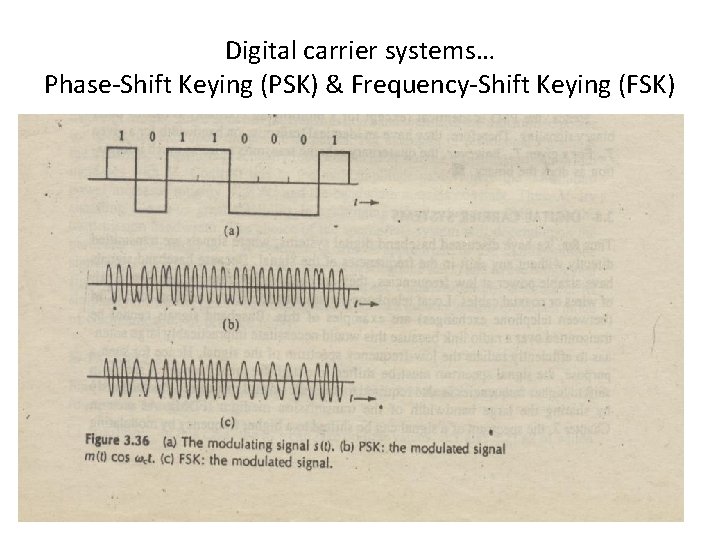
Digital carrier systems… Phase-Shift Keying (PSK) • If the baseband signal m(t) were polar (Fig. 3. 36 a), the corresponding modulated signal m(t) cos ωct would appear as shown in Fig. 3. 36 b. • In this case if p(t) is basic pulse, we are transmitting 1 by a pulse • p(t) cos ωct • and 0 by –p(t) cos ωct = p(t) cos (ωct + π).
Digital carrier systems… PSK, FSK • The information resides in the phase of the pulse. For this reason this is known as phaseshift keying and the transmission is still polar. • When the data is transmitted by varying the frequency, we have the case frequency-shift keying (FSK) as shown in Fig. 3. 36 c. • A 0 is transmitted by ωc 0 and 1 by ωc 1 • Information about the transmitted data resides in the carrier frequency.
Digital carrier systems… Phase-Shift Keying (PSK) & Frequency-Shift Keying (FSK)
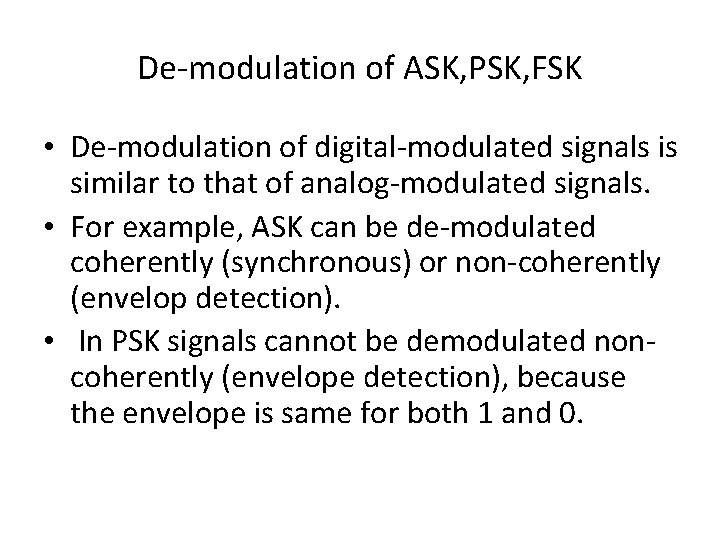
De-modulation of ASK, PSK, FSK • De-modulation of digital-modulated signals is similar to that of analog-modulated signals. • For example, ASK can be de-modulated coherently (synchronous) or non-coherently (envelop detection). • In PSK signals cannot be demodulated noncoherently (envelope detection), because the envelope is same for both 1 and 0.
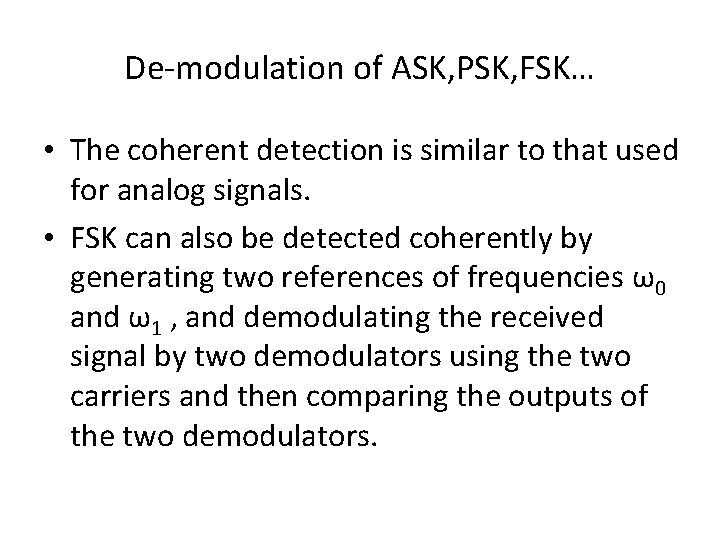
De-modulation of ASK, PSK, FSK… • The coherent detection is similar to that used for analog signals. • FSK can also be detected coherently by generating two references of frequencies ω0 and ω1 , and demodulating the received signal by two demodulators using the two carriers and then comparing the outputs of the two demodulators.
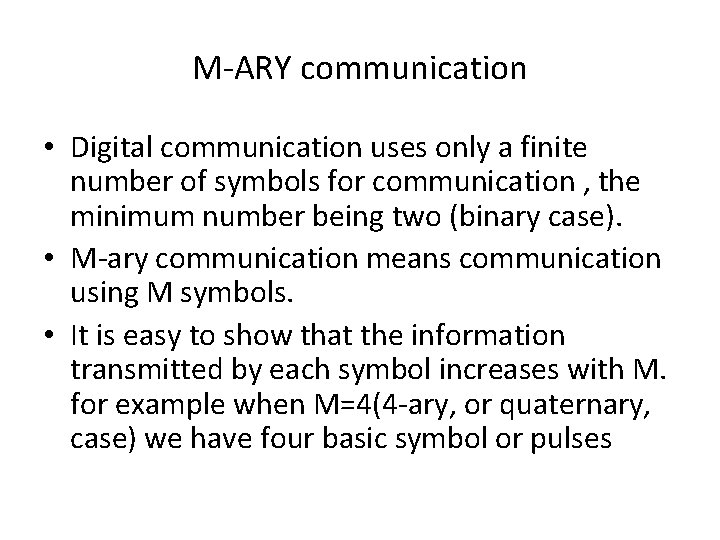
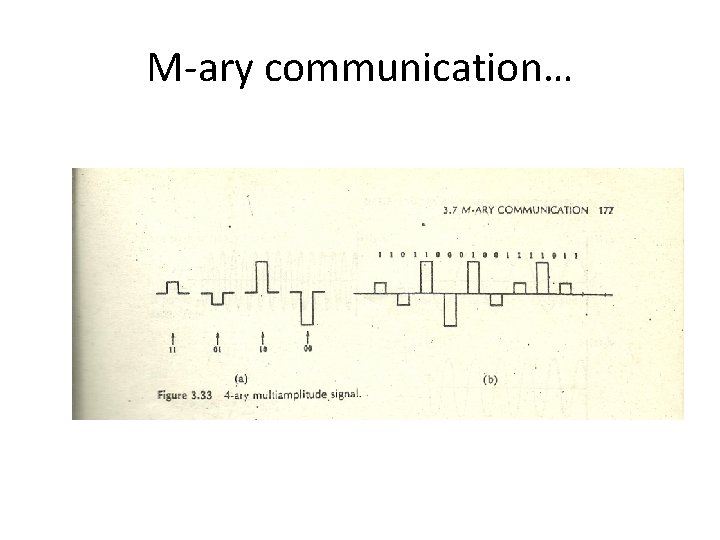
M-ARY communication • Digital communication uses only a finite number of symbols for communication , the minimum number being two (binary case). • M-ary communication means communication using M symbols. • It is easy to show that the information transmitted by each symbol increases with M. for example when M=4(4 -ary, or quaternary, case) we have four basic symbol or pulses
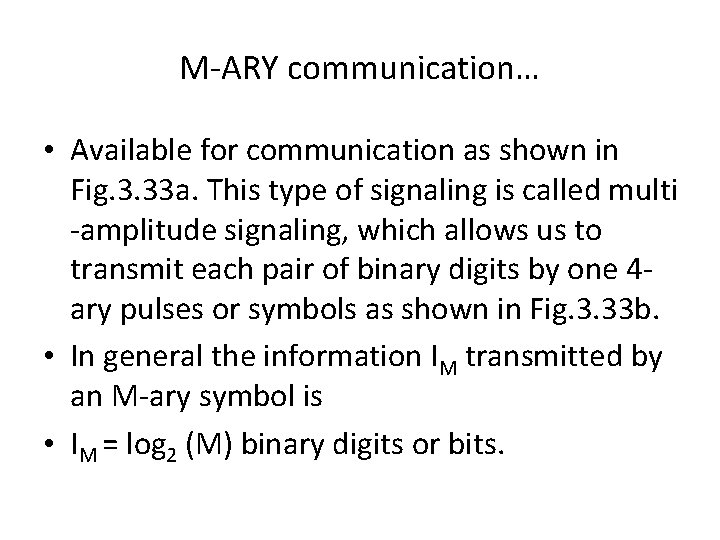
M-ARY communication… • Available for communication as shown in Fig. 3. 33 a. This type of signaling is called multi -amplitude signaling, which allows us to transmit each pair of binary digits by one 4 ary pulses or symbols as shown in Fig. 3. 33 b. • In general the information IM transmitted by an M-ary symbol is • IM = log 2 (M) binary digits or bits.
M-ary communication…
M-ARY communication… • This means that as the rate of information increases by log 2 (M) the transmitted power required also increases as M 2. • Example 16 -ary • IM = log 2 (16) • IM = 4 bits per sec (transmits at a time)
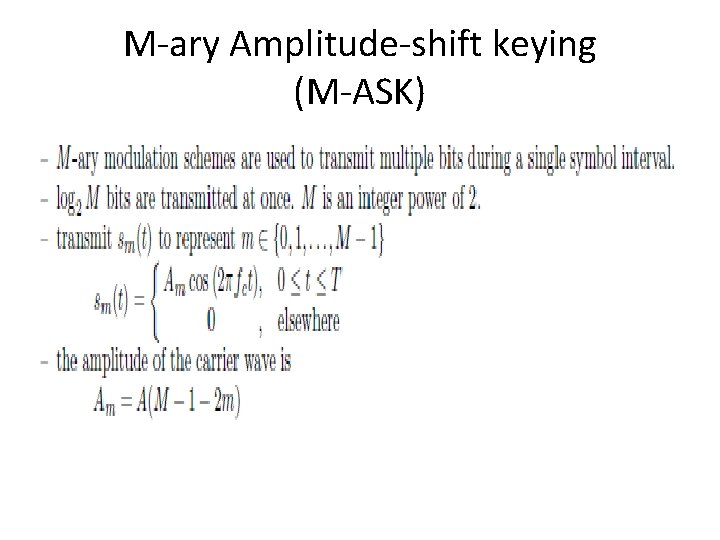
M-ary Amplitude-shift keying (M-ASK)
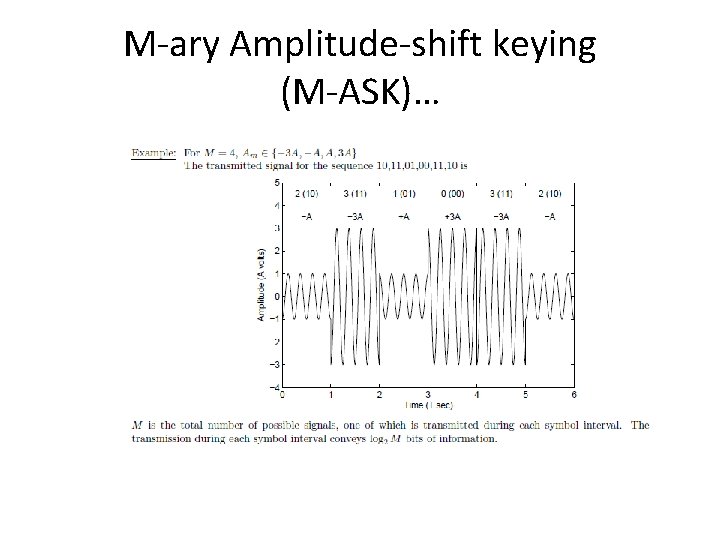
M-ary Amplitude-shift keying (M-ASK)…
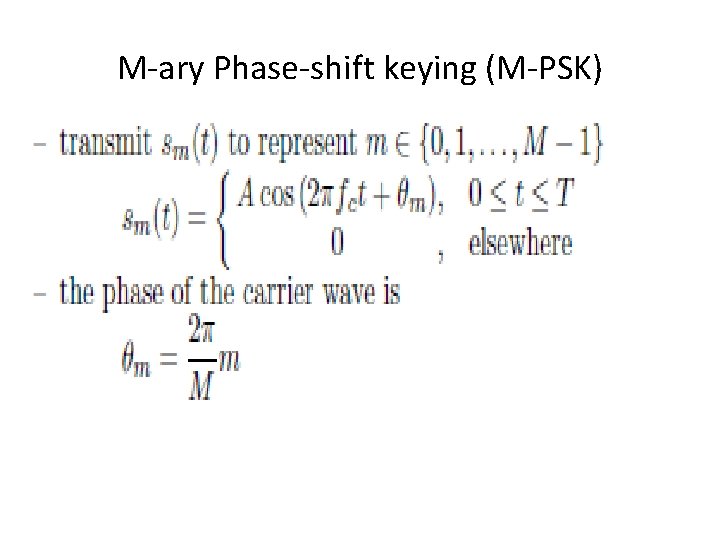
M-ary Phase-shift keying (M-PSK)
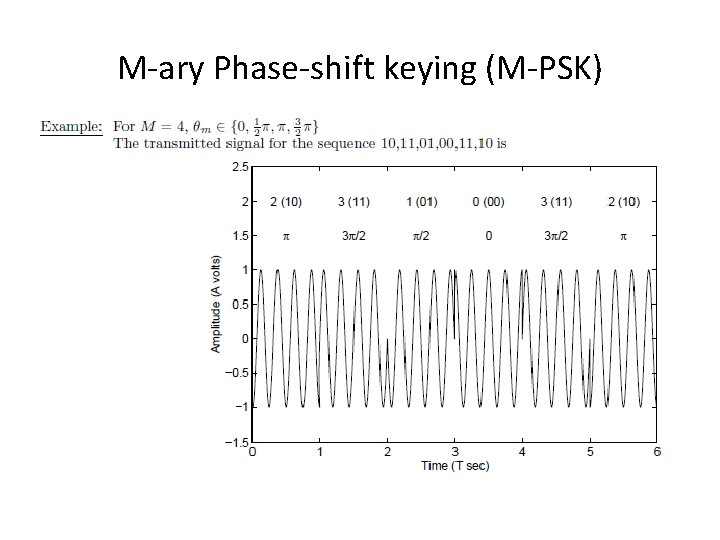
M-ary Phase-shift keying (M-PSK)
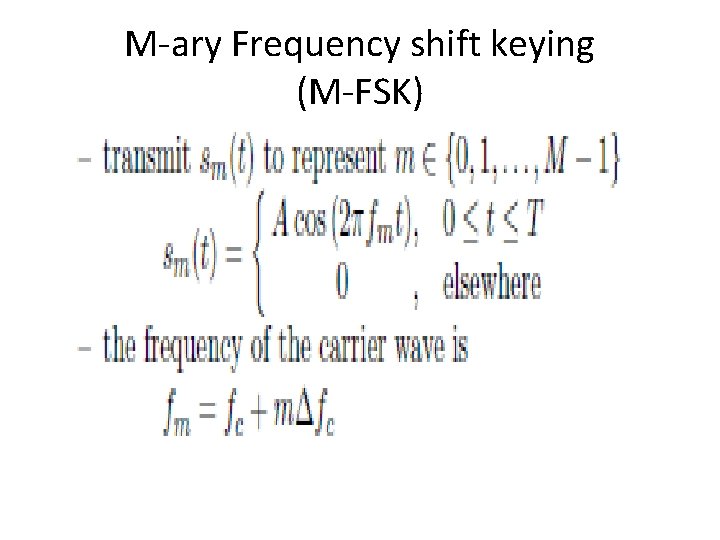
M-ary Frequency shift keying (M-FSK)
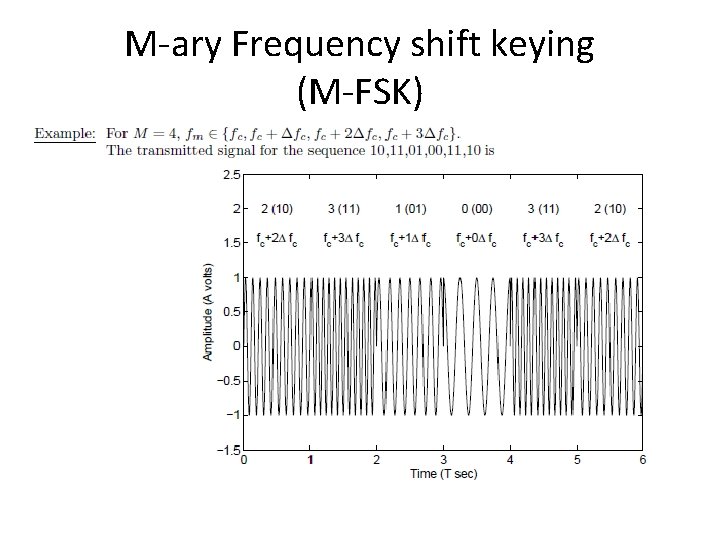
M-ary Frequency shift keying (M-FSK)
Power spectral density (PSD) of ASK, PSK and FSK • Modulation causes a shift in the baseband signal spectrum. • The ASK signal in Fig. 3. 35 c is an on-off signal (using a full width or Non Return to Zero (NRZ)). The PSD of ASK signal is shown in Fig. 3. 37 a. Note that it has a non -zero PSD (discrete component present) at ω = 0.
Power spectral density (PSD)… of ASK, PSK, FSK • This will rule out the use of ac coupling during transmission, ac coupling helps in impedance matching. • The other disadvantages are less immune to noise, bandwidth requirements are excessive, no error detection and correction capability, & requires high power. • The PSK signal on the other hand is a
Power spectral density (PSD)… of ASK, PSK and FSK • Note that at ω =0; PSD=0 (no discrete component), otherwise PSD of PSK and ASK are same. • FSK signal may be viewed as a some of two interleaved ASK signals as shown in Fig. 3. 37 c. • Hence the spectrum of FSK is the sum of two ASK. No discrete component appear in the spectrum.
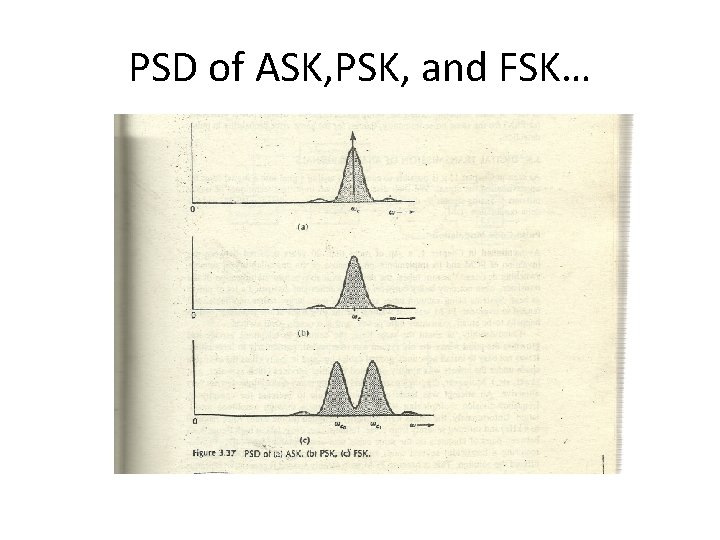
PSD of ASK, PSK, and FSK…
- Slides: 25