
Digital Audio The Nuts and Bolts A digital
Digital Audio — The Nuts and Bolts A digital audio overview ranging from bit rate, sample rate, and compression types to room acoustics, microphones, and digital effects
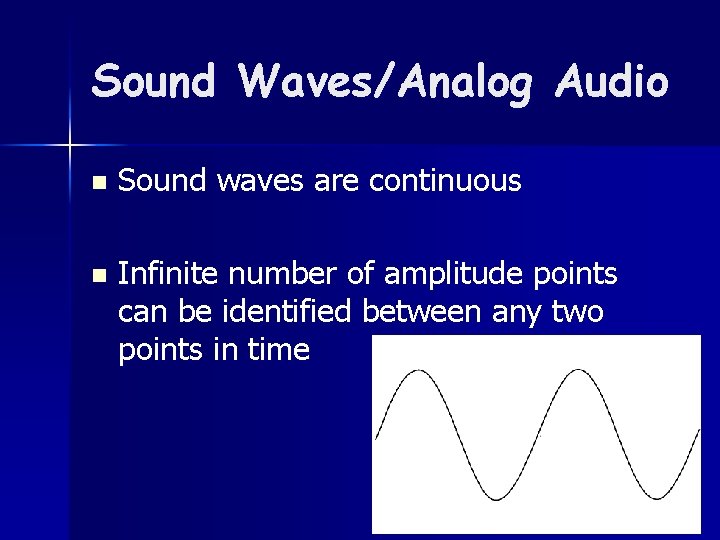
Sound Waves/Analog Audio n Sound waves are continuous n Infinite number of amplitude points can be identified between any two points in time
Digital Audio n Computers don’t deal with continuous concepts (infinity) n Digital technology converts analog audio to computer values
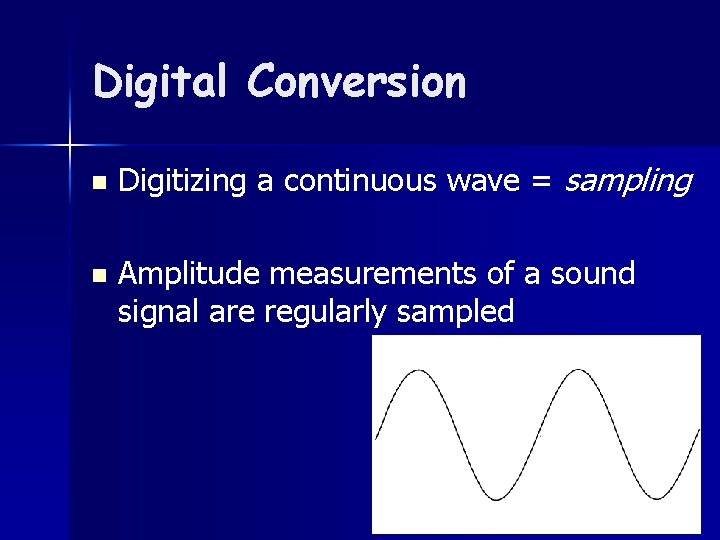
Digital Conversion n n Digitizing a continuous wave = sampling Amplitude measurements of a sound signal are regularly sampled
ADC and DAC n ADC – Analog to Digital Converter Converts analog signal to digital samples n DAC – Digital to Analog Converter Converts digital samples to analog signal
Characteristics of Digital Audio n Sampling Rate – How often signal is sampled – Number of samples per second n Bit Depth – Size of number used to store samples – larger number gives more degrees of value
Sampling Rate n Harry Nyquist (Bell Labs – 1925) n Nyquist Theorem: To represent digitally a signal containing frequency components up to X Hz, it is necessary to use a sampling rate of at least 2 X. n Humans hear to 20 k. Hz, requiring sample rate of at least 40 k
Aliasing n In movies, car wheels appear to move backwards if between ½ and 1 revolution per frame n In sound, this is not acceptable n Filters are used to remove any frequencies above Nyquist frequency
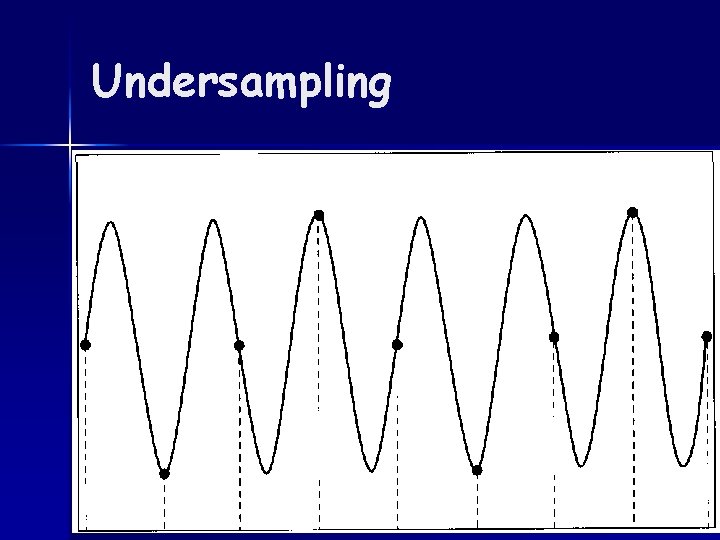
Undersampling
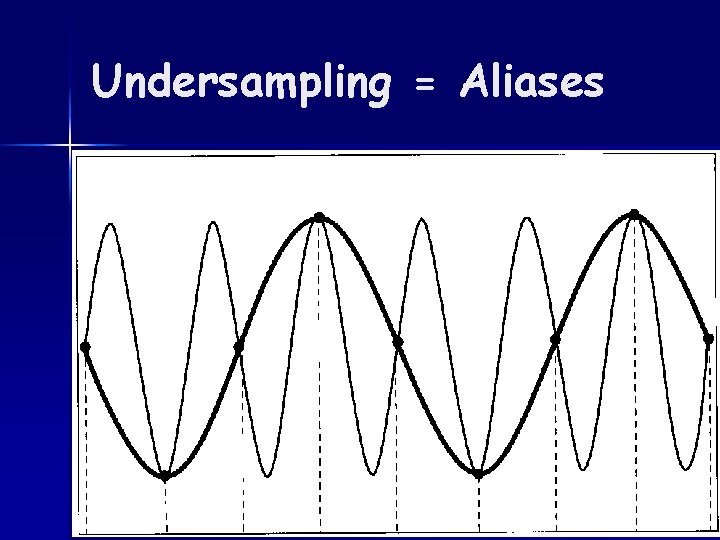
Undersampling = Aliases

Critical Sampling
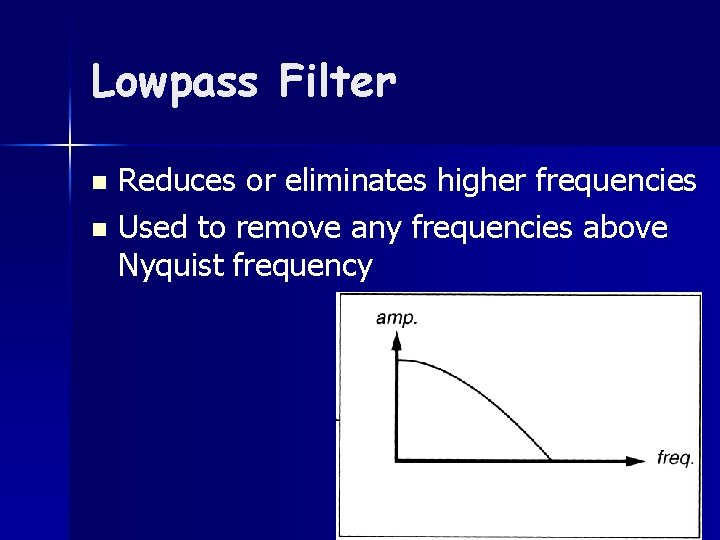
Lowpass Filter Reduces or eliminates higher frequencies n Used to remove any frequencies above Nyquist frequency n
Bit Depth (Quantization) n Amplitude values are stored as binary numbers n Accuracy depends on how many bits are available to represent these values n For CD Audio we use 16 bits
Quantization n No matter how many bits are used, there is always a margin of error n Low-level signals do not use all available bits, so signal-to-error ratio is greater
Quantization n Quantization error creates a kind of distortion n Dither adds low-level noise to audio signal before sampling n Dither turns distortion (bad) into noise (less bad) – still less noise than analog
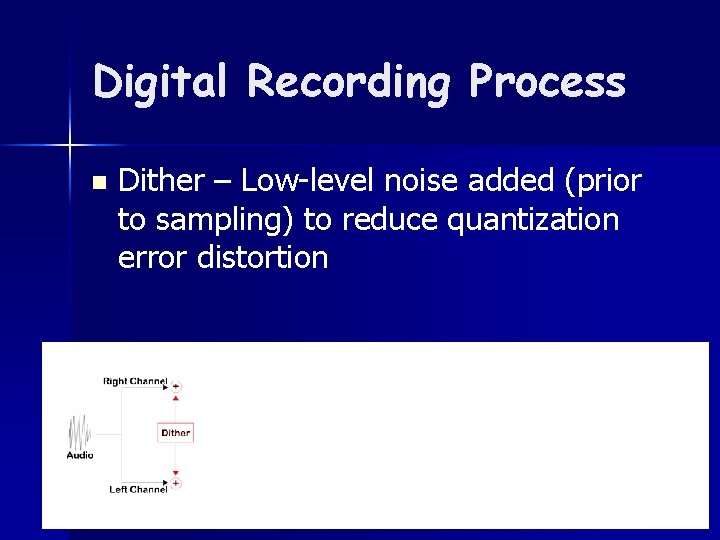
Digital Recording Process n Dither – Low-level noise added (prior to sampling) to reduce quantization error distortion
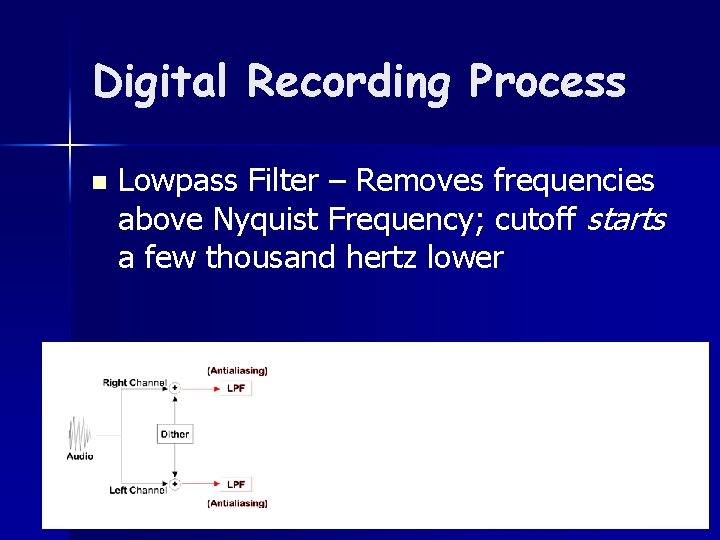
Digital Recording Process n Lowpass Filter – Removes frequencies above Nyquist Frequency; cutoff starts a few thousand hertz lower
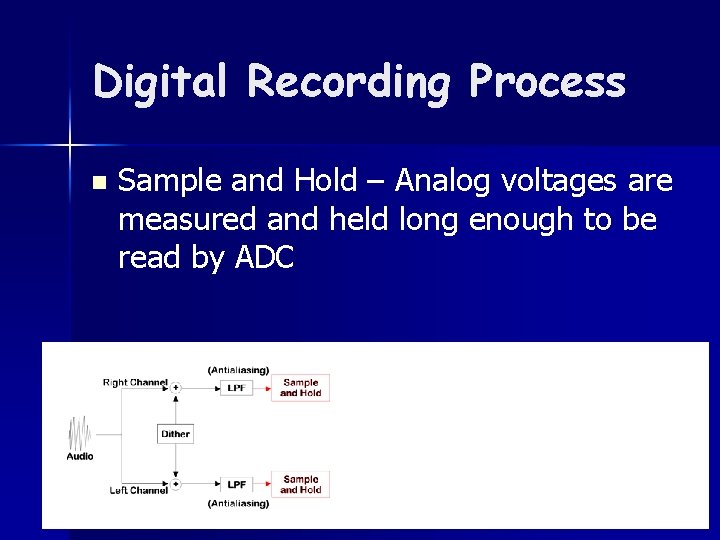
Digital Recording Process n Sample and Hold – Analog voltages are measured and held long enough to be read by ADC
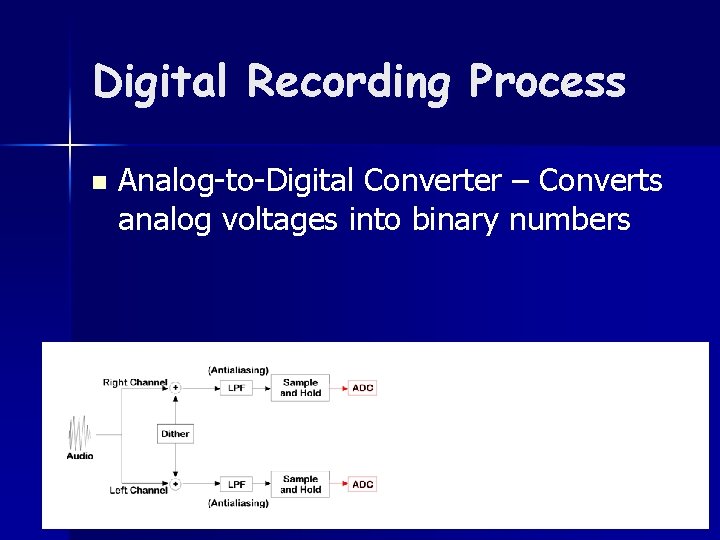
Digital Recording Process n Analog-to-Digital Converter – Converts analog voltages into binary numbers
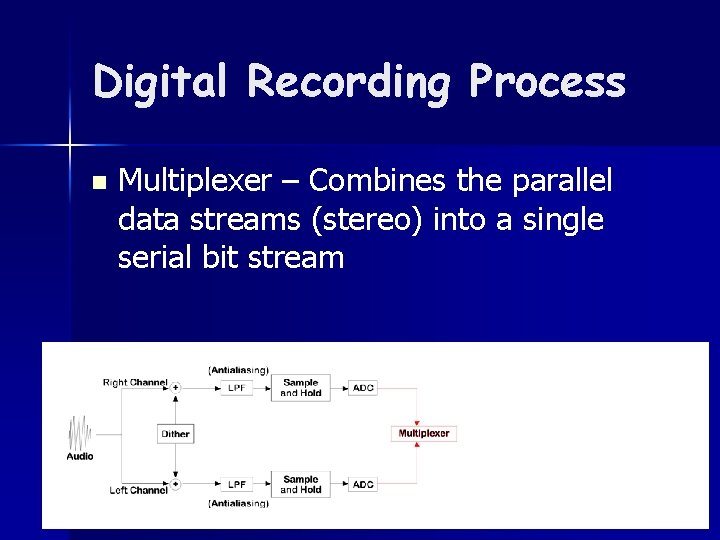
Digital Recording Process n Multiplexer – Combines the parallel data streams (stereo) into a single serial bit stream
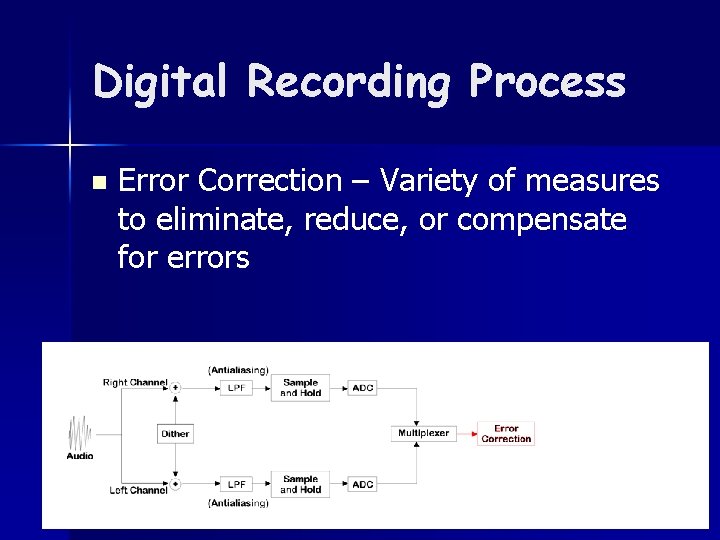
Digital Recording Process n Error Correction – Variety of measures to eliminate, reduce, or compensate for errors
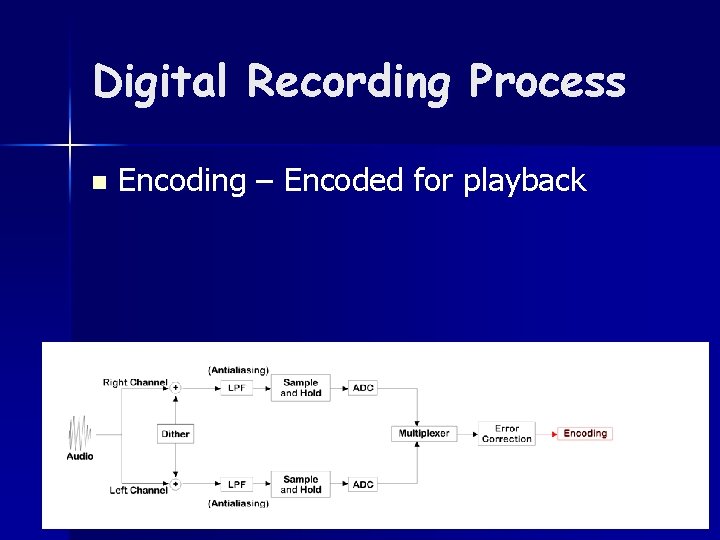
Digital Recording Process n Encoding – Encoded for playback
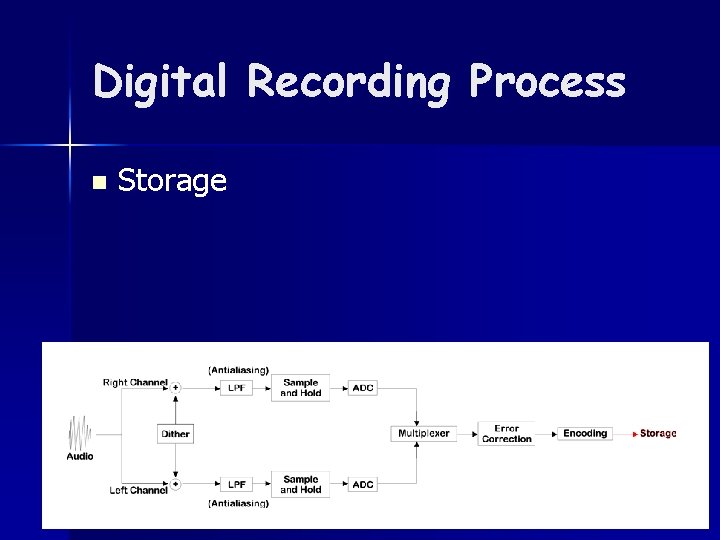
Digital Recording Process n Storage
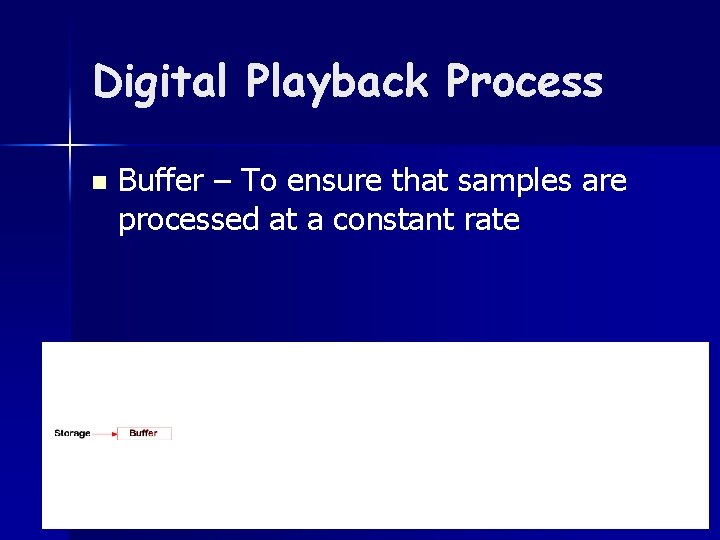
Digital Playback Process n Buffer – To ensure that samples are processed at a constant rate
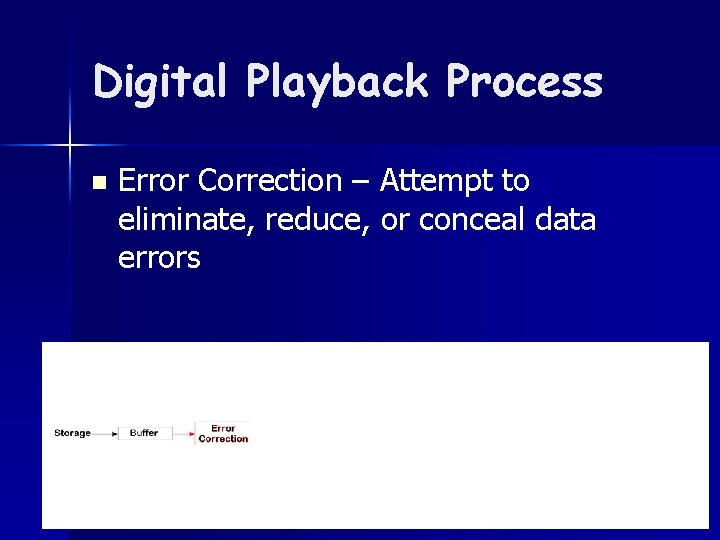
Digital Playback Process n Error Correction – Attempt to eliminate, reduce, or conceal data errors
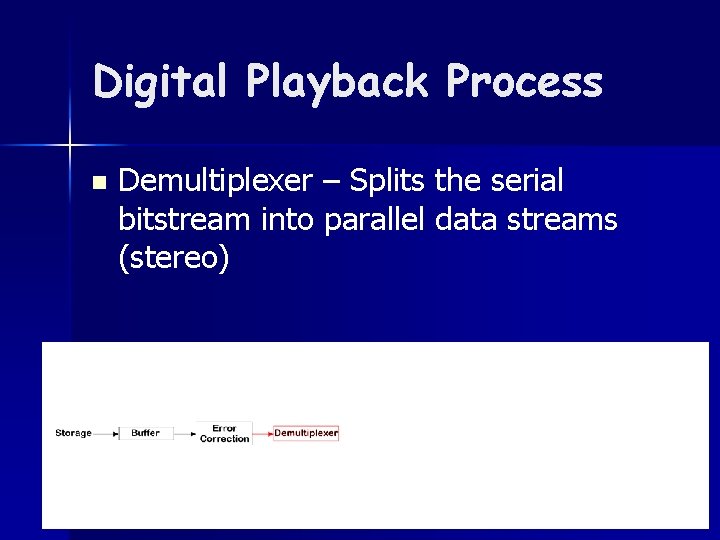
Digital Playback Process n Demultiplexer – Splits the serial bitstream into parallel data streams (stereo)
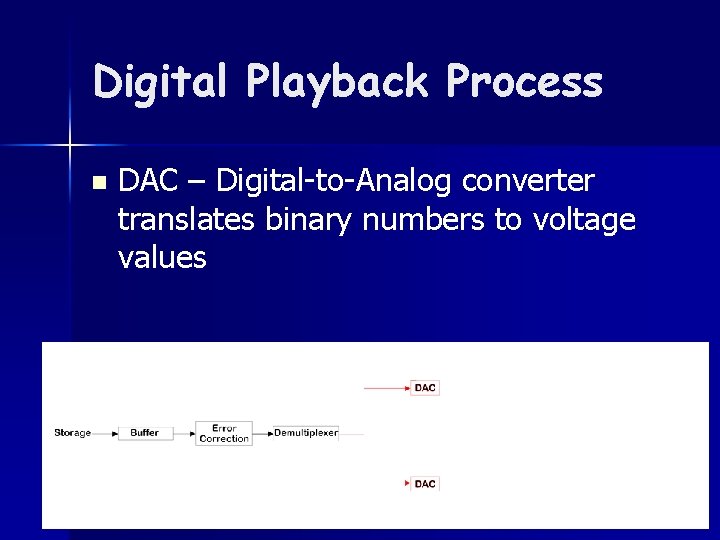
Digital Playback Process n DAC – Digital-to-Analog converter translates binary numbers to voltage values
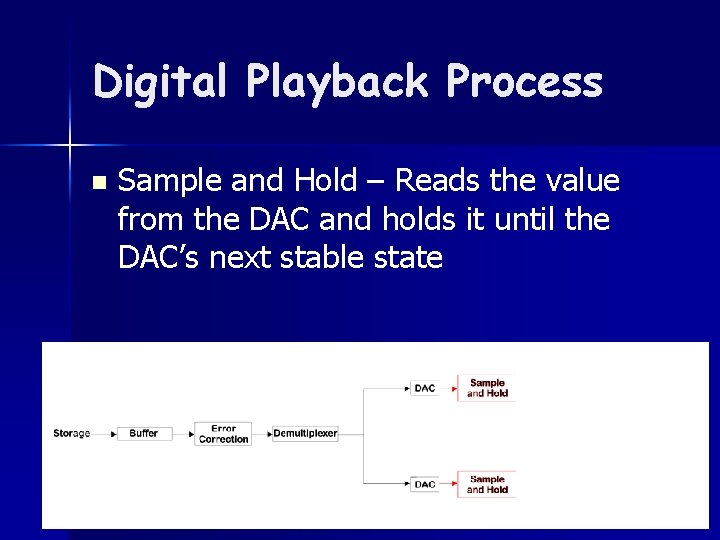
Digital Playback Process n Sample and Hold – Reads the value from the DAC and holds it until the DAC’s next stable state
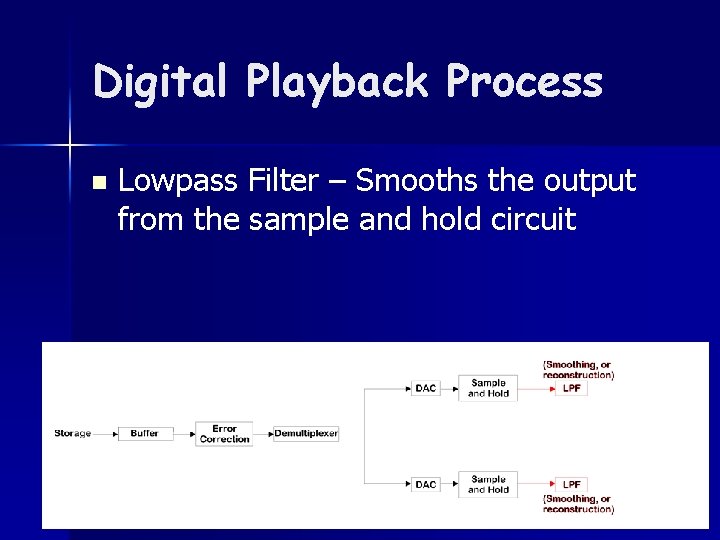
Digital Playback Process n Lowpass Filter – Smooths the output from the sample and hold circuit
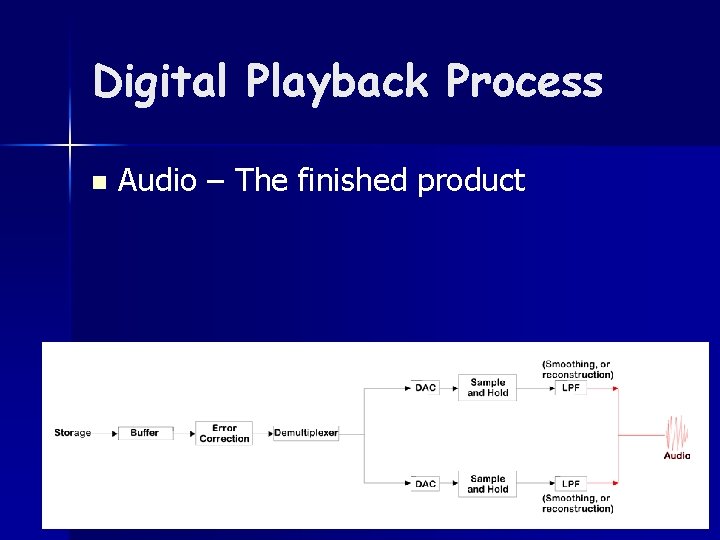
Digital Playback Process n Audio – The finished product
Room Acoustics n Characteristic room sound is determined by the relationship between direct and reflected sound n Virtually all sound reaching listeners is a combination of direct & reflected n At greater distances, most sound is reflected sound
Room Acoustics n Direct Sound – Directly from the source to the listener – Direct sound arrives before reflected sound; even if reflected sound is louder, we hear direct sound first and determine direction of the source
Room Acoustics n Early Reflections – First-order reflections that reach the listener after reflecting once from the floor, ceiling, or walls – If arriving in the first 35 ms after the direct sound, reinforces with clarity & intelligibility – “Intimate” halls have first-order reflections of less than 20 ms
Room Acoustics n Diffuse Reverberations – Second- (and higher) order reflections – Reverberation time is the time required for the SPL to drop 60 d. B – Larger room is likely to have longer reverberation time than a smaller room – Reverberation time is frequency dependent; lower frequencies reverberate longer
Types of Reflections n Specular – Reflections off smooth and regular surfaces – reflection in one direction n Diffuse – Reflections off irregular surfaces – Reflections scattered in many directions – Contribute to sound of older concert halls
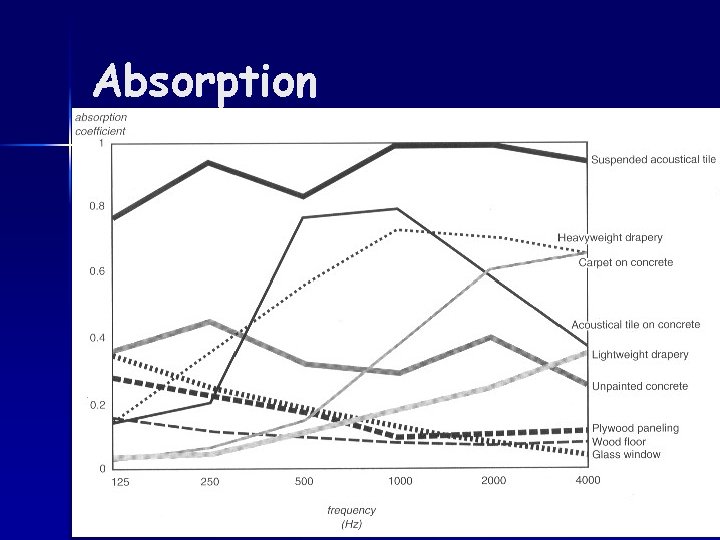
Absorption
Small Room Space has potential to act as closed tube, producing standing wave n Result is amplification of certain frequencies based on room’s dimensions n Not a factor in large rooms because air temperature varies more n
Microphones n Receptor type – Diaphragm acts as receptor – Diaphragm vibrates n Transducer type – Transducer converts vibrations to electricity n Directionality – Determines strength of signal produced by sounds arriving from different directions
Receptor Types n Pressure – Diaphragm responds to sound pressure changes on only one side of diaphragm n Pressure Gradient – Diaphragm responds to sound pressure changes from the front or rear – Signal is determined by difference (gradient) of pressures from either side
Transducer Types n Dynamic (Electrodynamic, Electromagnetic, Ribbon, Moving Coil) – Principle of magnetic induction – wire moves within a magnetic field, producing a current – Inexpensive and sturdy n Condenser (Capacitor) – Two oppositely-charged metal plates – Current moves from one to the other – Sharper transients – Expensive
Directionality n Determines the strength of signal produced by sounds arriving from different directions n Directionality varies with frequency n Specs often include polar plot with patterns for different frequencies
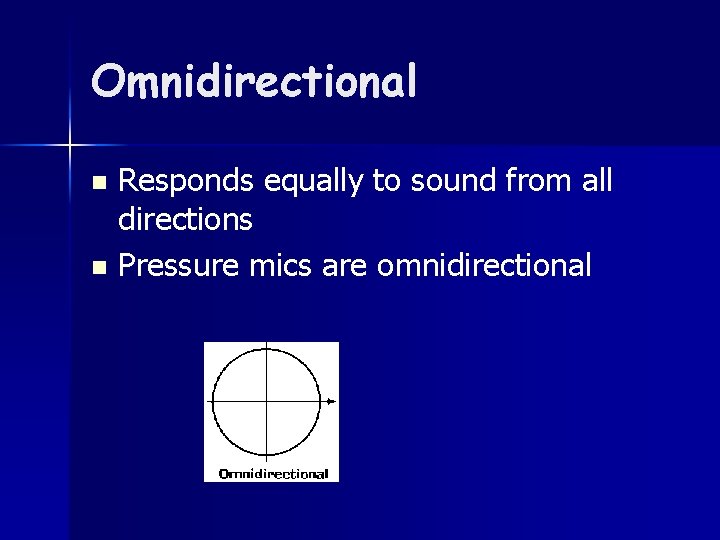
Omnidirectional Responds equally to sound from all directions n Pressure mics are omnidirectional n
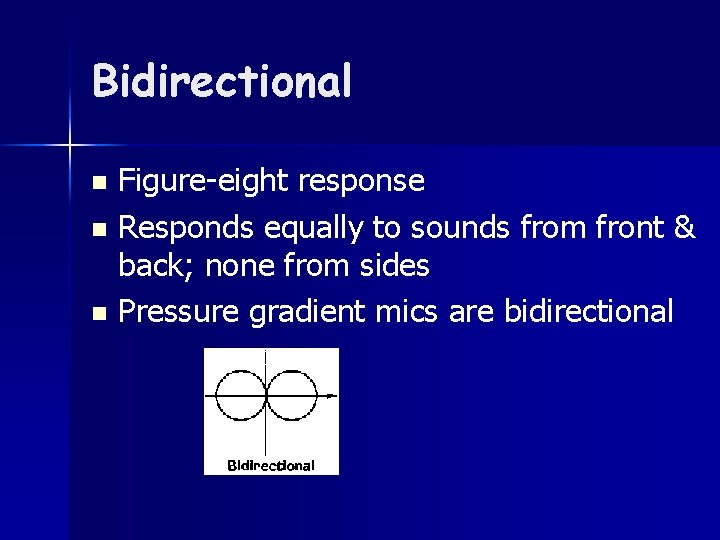
Bidirectional Figure-eight response n Responds equally to sounds from front & back; none from sides n Pressure gradient mics are bidirectional n
First-Order Cardioid n Most common directional microphones n Cardioid refers to heart-shaped pattern n Directional patterns are obtained by combining pressure and pressure gradient elements in varying proportions
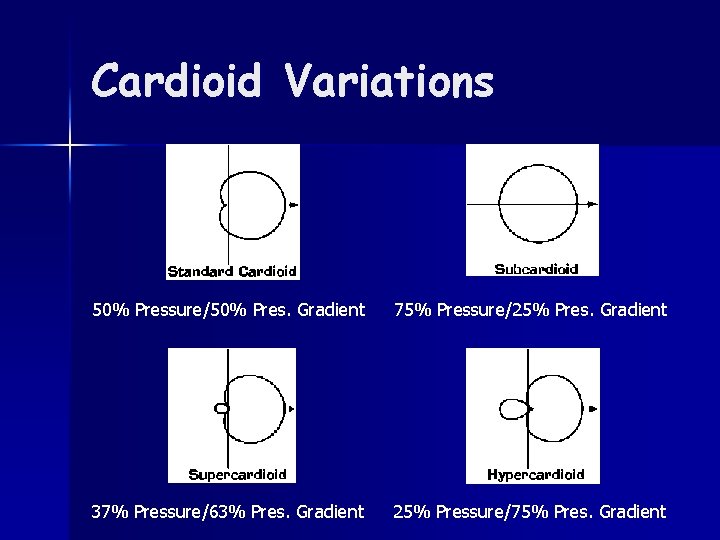
Cardioid Variations 50% Pressure/50% Pres. Gradient 75% Pressure/25% Pres. Gradient 37% Pressure/63% Pres. Gradient 25% Pressure/75% Pres. Gradient
Effects n All music that is recorded or amplified relies on effects to enhance the sound. n Effects are necessary to make electronic audio signals sound like natural sound.
Effects = Filters n Effects are created by filter combinations n Filtering involves combining original signal with delayed version n Higher internal processing bit rate means more accurate arithmetic
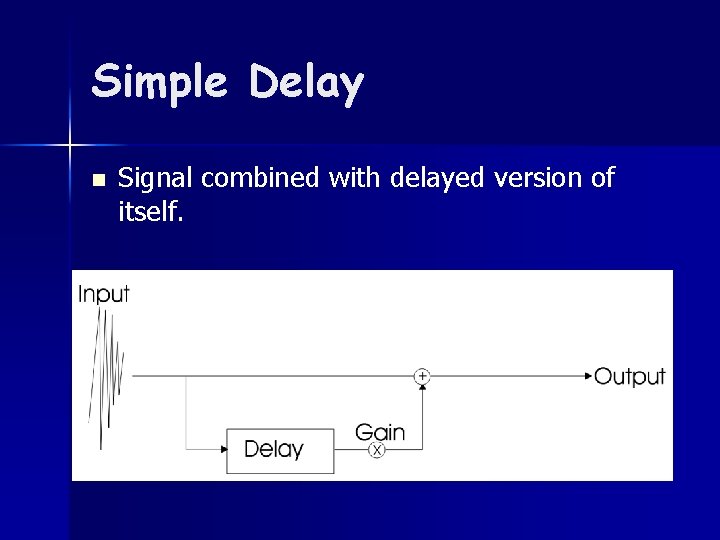
Simple Delay n Signal combined with delayed version of itself.
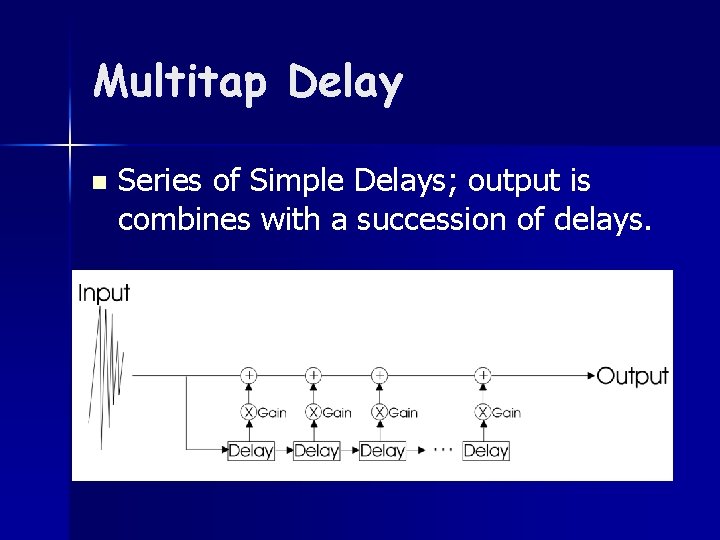
Multitap Delay n Series of Simple Delays; output is combines with a succession of delays.
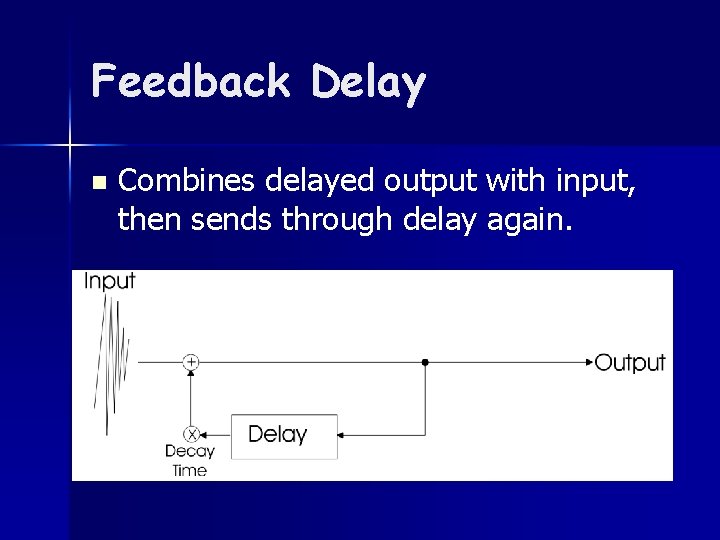
Feedback Delay n Combines delayed output with input, then sends through delay again.
Delay-Based Effects Flanging n Chorusing n Phase Shifting n Reverberation n
Non-Delay-Based Effects Ring Modulation n Amplitude Modulation n Compression/Limiting n Expansion/Noise Gating n
- Slides: 52