
Digital Audio Signal Processing Lecture 5 Adaptive Filters



- Slides: 40
Digital Audio Signal Processing Lecture 5 Adaptive Filters for Acoustic Echo and Feedback Cancellation Marc Moonen Dept. E. E. /ESAT-STADIUS, KU Leuven marc. moonen@kuleuven. be homes. esat. kuleuven. be/~moonen/
Outline • Introduction – AEC - Acoustic echo cancellation – AFC - Adaptive/Acoustic feedback cancellation – Acoustic channels • Adaptive Filters for AEC – – NLMS Frequency domain adaptive filters (FDAF/PB-FDAF) Control algorithm / Post-processing Stereo AEC • Adaptive Filters for AFC – AFC basics – Closed-loop signal decorrelation Digital Audio Signal Processing Version 2015 -2016 Lecture-5: Acoustic Echo & Feedback Cancellation p. 2
Introduction AEC - Acoustic Echo Cancellation Suppress echo. . – to guarantee normal conversation conditions – to prevent the closed-loop system from becoming unstable Applications – Teleconferencing – Hands-free telephony – Handsets, . . Digital Audio Signal Processing Version 2015 -2016 Lecture-5: Acoustic Echo & Feedback Cancellation p. 3
Introduction AEC Standardization ITU-T (*) recommendations (G. 167) on acoustic echo controllers state that – Input/output delay of the AEC should be smaller than 16 ms – Far-end signal suppression should reach 40. . 45 d. B (depending on application), if no near-end signal is present – In presence of near-end signals the suppression should be at least 25 d. B – Many other requirements … (*) International Telecommunication Union - Telecommunication Standardization Sector Digital Audio Signal Processing Version 2015 -2016 Lecture-5: Acoustic Echo & Feedback Cancellation p. 4
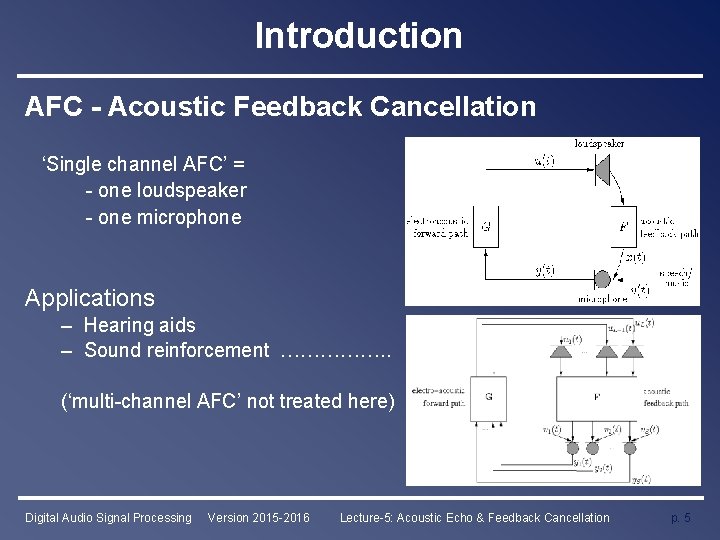
Introduction AFC - Acoustic Feedback Cancellation ‘Single channel AFC’ = - one loudspeaker - one microphone Applications – Hearing aids – Sound reinforcement ……………. . (‘multi-channel AFC’ not treated here) Digital Audio Signal Processing Version 2015 -2016 Lecture-5: Acoustic Echo & Feedback Cancellation p. 5
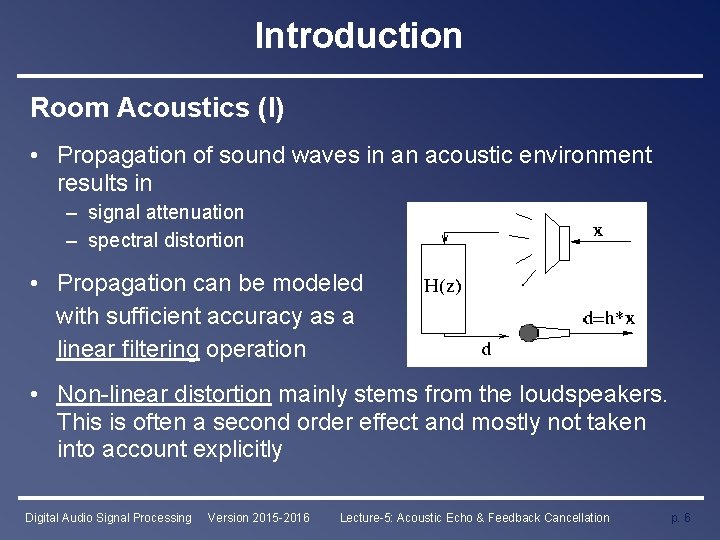
Introduction Room Acoustics (I) • Propagation of sound waves in an acoustic environment results in – signal attenuation – spectral distortion • Propagation can be modeled with sufficient accuracy as a linear filtering operation • Non-linear distortion mainly stems from the loudspeakers. This is often a second order effect and mostly not taken into account explicitly Digital Audio Signal Processing Version 2015 -2016 Lecture-5: Acoustic Echo & Feedback Cancellation p. 6
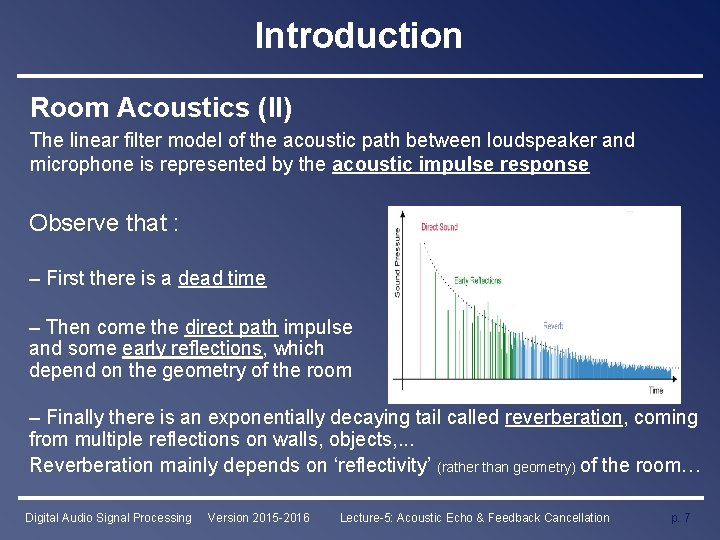
Introduction Room Acoustics (II) The linear filter model of the acoustic path between loudspeaker and microphone is represented by the acoustic impulse response Observe that : – First there is a dead time – Then come the direct path impulse and some early reflections, which depend on the geometry of the room – Finally there is an exponentially decaying tail called reverberation, coming from multiple reflections on walls, objects, . . . Reverberation mainly depends on ‘reflectivity’ (rather than geometry) of the room… Digital Audio Signal Processing Version 2015 -2016 Lecture-5: Acoustic Echo & Feedback Cancellation p. 7
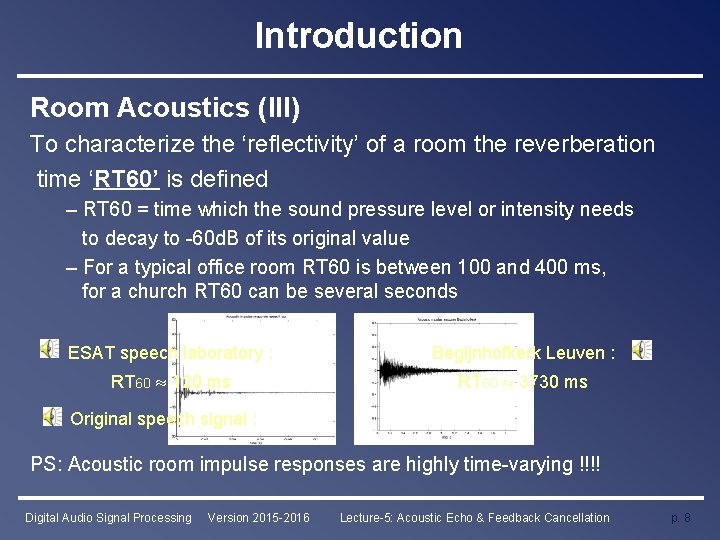
Introduction Room Acoustics (III) To characterize the ‘reflectivity’ of a room the reverberation time ‘RT 60’ is defined – RT 60 = time which the sound pressure level or intensity needs to decay to -60 d. B of its original value – For a typical office room RT 60 is between 100 and 400 ms, for a church RT 60 can be several seconds ESAT speech laboratory : Begijnhofkerk Leuven : RT 60 120 ms RT 60 3730 ms Original speech signal : PS: Acoustic room impulse responses are highly time-varying !!!! Digital Audio Signal Processing Version 2015 -2016 Lecture-5: Acoustic Echo & Feedback Cancellation p. 8
Introduction Acoustic Impulse Response : FIR or IIR ? • If the acoustic impulse response is modeled as – an FIR filter many hundreds to several thousands of filter taps are needed – an IIR filter order can be reduced, but still hundreds of filter coeffs (num. + denom. ) may be needed (sigh!) • Hence FIR models are used in practice because… – these are guaranteed to be stable – in a speech comms set-up the acoustics are highly time-varying, hence adaptive filtering techniques are called for (see DSP-CIS): • FIR adaptive filters : simple adaptation rules, no local minima, . . • IIR adaptive filters : more complex adaptation, local minima Digital Audio Signal Processing Version 2015 -2016 Lecture-5: Acoustic Echo & Feedback Cancellation p. 9
Outline • Introduction – AEC - Acoustic echo cancellation – AFC - Adaptive/Acoustic feedback cancellation – Acoustic channels • Adaptive Filters for AEC – – NLMS Frequency domain adaptive filters (FDAF/PB-FDAF) Control algorithm / Post-processing Stereo AEC • Adaptive Filters for AFC – AFC basics – Closed-loop signal decorrelation Digital Audio Signal Processing Version 2015 -2016 Lecture-5: Acoustic Echo & Feedback Cancellation p. 10
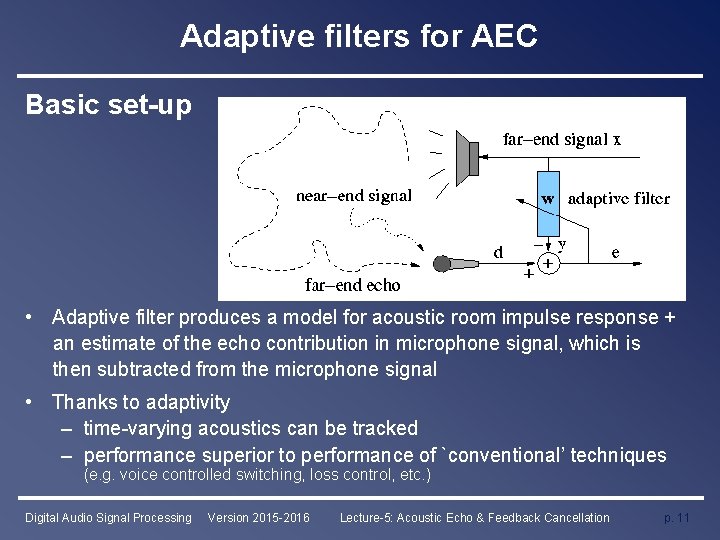
Adaptive filters for AEC Basic set-up • Adaptive filter produces a model for acoustic room impulse response + an estimate of the echo contribution in microphone signal, which is then subtracted from the microphone signal • Thanks to adaptivity – time-varying acoustics can be tracked – performance superior to performance of `conventional’ techniques (e. g. voice controlled switching, loss control, etc. ) Digital Audio Signal Processing Version 2015 -2016 Lecture-5: Acoustic Echo & Feedback Cancellation p. 11
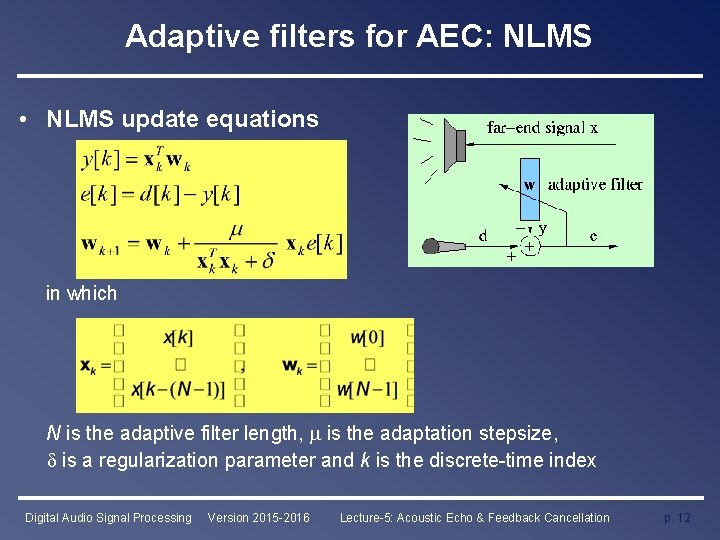
Adaptive filters for AEC: NLMS • NLMS update equations in which N is the adaptive filter length, is the adaptation stepsize, is a regularization parameter and k is the discrete-time index Digital Audio Signal Processing Version 2015 -2016 Lecture-5: Acoustic Echo & Feedback Cancellation p. 12
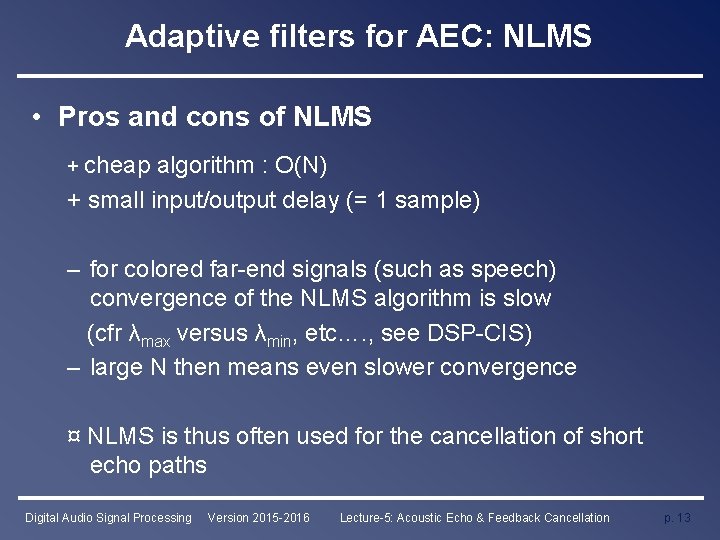
Adaptive filters for AEC: NLMS • Pros and cons of NLMS + cheap algorithm : O(N) + small input/output delay (= 1 sample) – for colored far-end signals (such as speech) convergence of the NLMS algorithm is slow (cfr λmax versus λmin, etc…. , see DSP-CIS) – large N then means even slower convergence ¤ NLMS is thus often used for the cancellation of short echo paths Digital Audio Signal Processing Version 2015 -2016 Lecture-5: Acoustic Echo & Feedback Cancellation p. 13
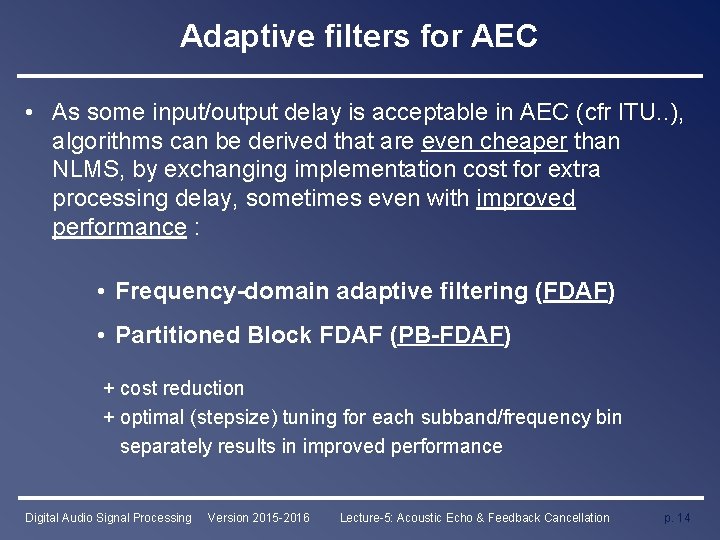
Adaptive filters for AEC • As some input/output delay is acceptable in AEC (cfr ITU. . ), algorithms can be derived that are even cheaper than NLMS, by exchanging implementation cost for extra processing delay, sometimes even with improved performance : • Frequency-domain adaptive filtering (FDAF) • Partitioned Block FDAF (PB-FDAF) + cost reduction + optimal (stepsize) tuning for each subband/frequency bin separately results in improved performance Digital Audio Signal Processing Version 2015 -2016 Lecture-5: Acoustic Echo & Feedback Cancellation p. 14
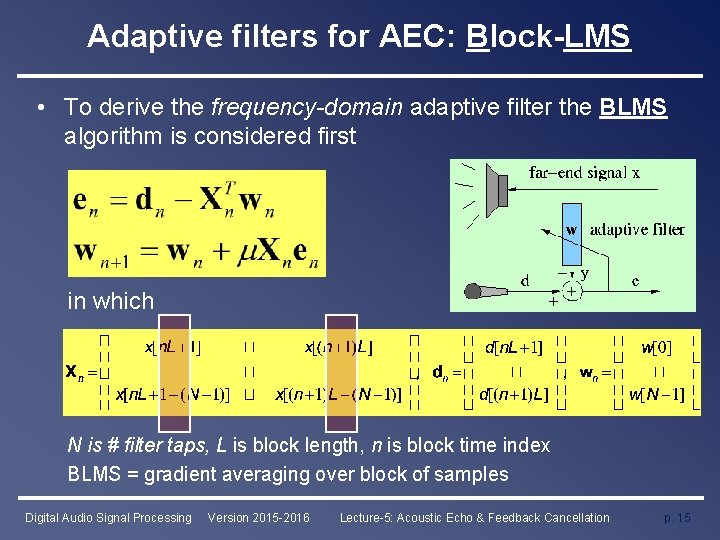
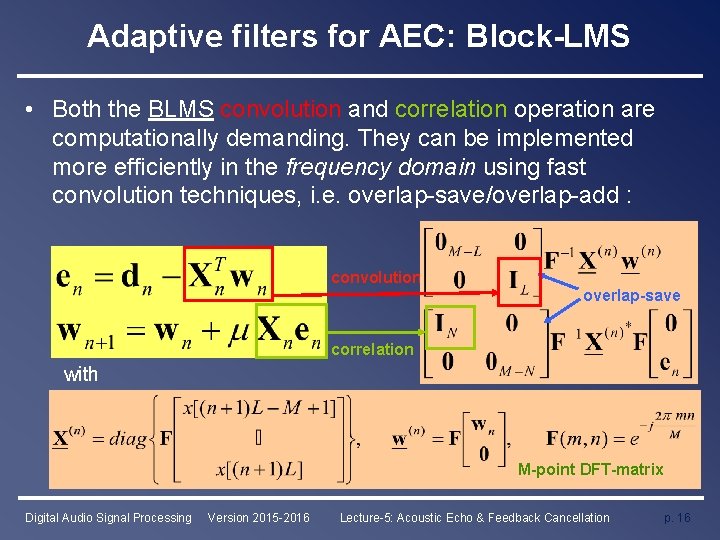
Adaptive filters for AEC: Block-LMS • To derive the frequency-domain adaptive filter the BLMS algorithm is considered first in which N is # filter taps, L is block length, n is block time index BLMS = gradient averaging over block of samples Digital Audio Signal Processing Version 2015 -2016 Lecture-5: Acoustic Echo & Feedback Cancellation p. 15
Adaptive filters for AEC: Block-LMS • Both the BLMS convolution and correlation operation are computationally demanding. They can be implemented more efficiently in the frequency domain using fast convolution techniques, i. e. overlap-save/overlap-add : convolution overlap-save correlation with M-point DFT-matrix Digital Audio Signal Processing Version 2015 -2016 Lecture-5: Acoustic Echo & Feedback Cancellation p. 16
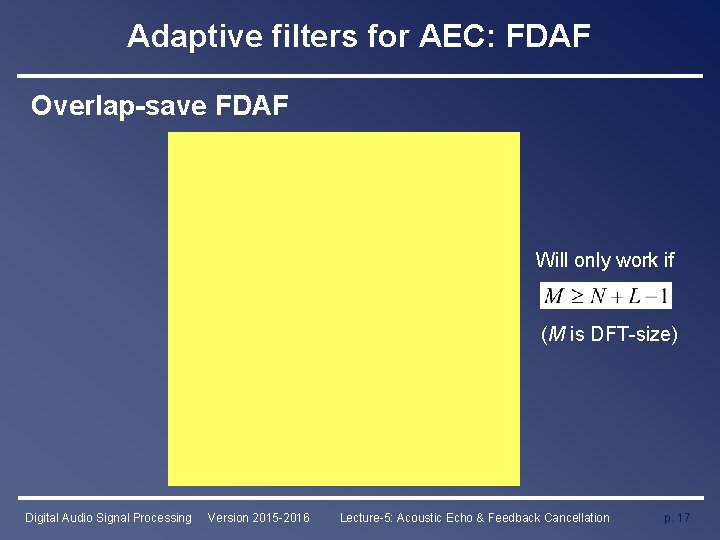
Adaptive filters for AEC: FDAF Overlap-save FDAF Will only work if (M is DFT-size) Digital Audio Signal Processing Version 2015 -2016 Lecture-5: Acoustic Echo & Feedback Cancellation p. 17
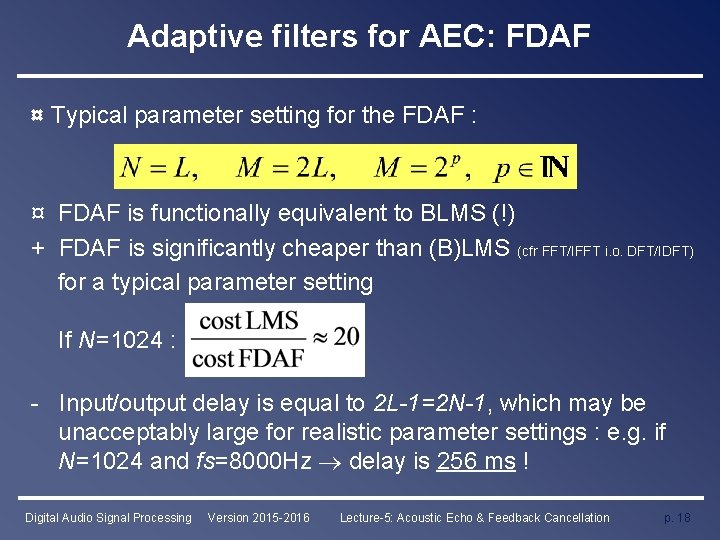
Adaptive filters for AEC: FDAF ¤ Typical parameter setting for the FDAF : ¤ FDAF is functionally equivalent to BLMS (!) + FDAF is significantly cheaper than (B)LMS (cfr FFT/IFFT i. o. DFT/IDFT) for a typical parameter setting If N=1024 : - Input/output delay is equal to 2 L-1=2 N-1, which may be unacceptably large for realistic parameter settings : e. g. if N=1024 and fs=8000 Hz delay is 256 ms ! Digital Audio Signal Processing Version 2015 -2016 Lecture-5: Acoustic Echo & Feedback Cancellation p. 18
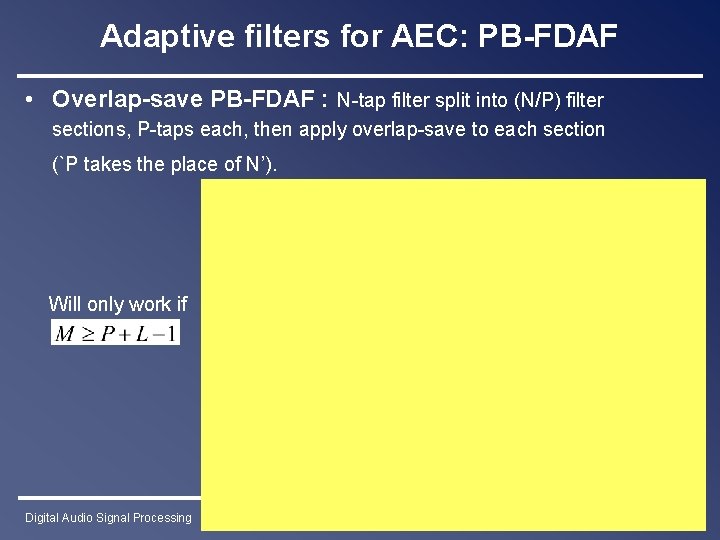
Adaptive filters for AEC: PB-FDAF • Overlap-save PB-FDAF : N-tap filter split into (N/P) filter sections, P-taps each, then apply overlap-save to each section (`P takes the place of N’). Will only work if Digital Audio Signal Processing Version 2015 -2016 Lecture-5: Acoustic Echo & Feedback Cancellation p. 19
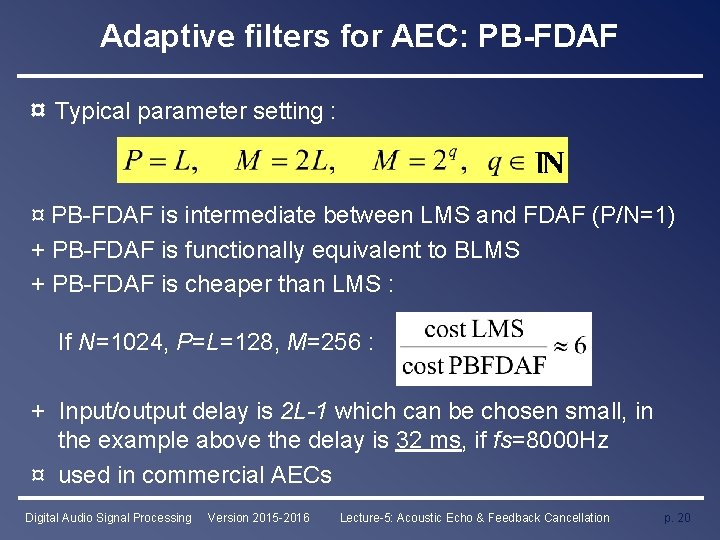
Adaptive filters for AEC: PB-FDAF ¤ Typical parameter setting : ¤ PB-FDAF is intermediate between LMS and FDAF (P/N=1) + PB-FDAF is functionally equivalent to BLMS + PB-FDAF is cheaper than LMS : If N=1024, P=L=128, M=256 : + Input/output delay is 2 L-1 which can be chosen small, in the example above the delay is 32 ms, if fs=8000 Hz ¤ used in commercial AECs Digital Audio Signal Processing Version 2015 -2016 Lecture-5: Acoustic Echo & Feedback Cancellation p. 20
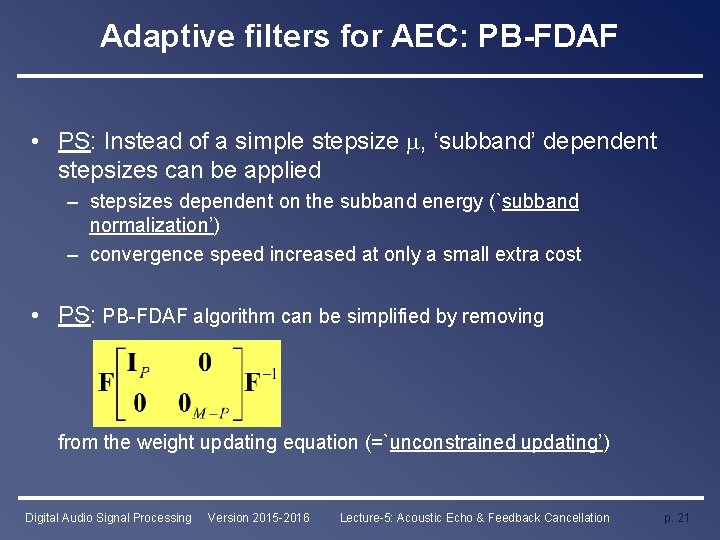
Adaptive filters for AEC: PB-FDAF • PS: Instead of a simple stepsize , ‘subband’ dependent stepsizes can be applied – stepsizes dependent on the subband energy (`subband normalization’) – convergence speed increased at only a small extra cost • PS: PB-FDAF algorithm can be simplified by removing from the weight updating equation (=`unconstrained updating’) Digital Audio Signal Processing Version 2015 -2016 Lecture-5: Acoustic Echo & Feedback Cancellation p. 21
Adaptive filters for AEC: Control Algorithm • Adaptation speed ( ) should be adjusted… – to the far-end signal power, in order to avoid instability of the adaptive filter stepsize normalization (e. g. NLMS) – to the amount of near-end activity, in order to prevent the filter to move away from the optimal solution (see DSP-CIS on ‘excess MSE’) double-talk detection Double talk refers to the situation where both the far-end and the near-end speaker are active. Digital Audio Signal Processing Version 2015 -2016 Lecture-5: Acoustic Echo & Feedback Cancellation p. 22
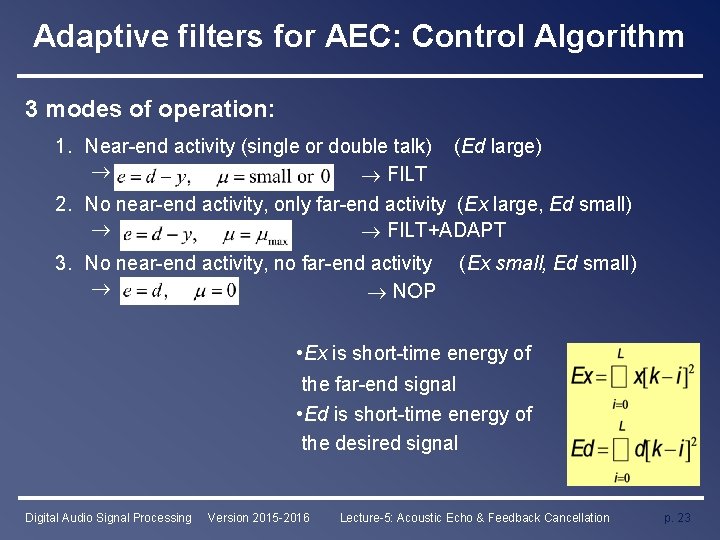
Adaptive filters for AEC: Control Algorithm 3 modes of operation: 1. Near-end activity (single or double talk) FILT (Ed large) 2. No near-end activity, only far-end activity (Ex large, Ed small) FILT+ADAPT 3. No near-end activity, no far-end activity NOP (Ex small, Ed small) • Ex is short-time energy of the far-end signal • Ed is short-time energy of the desired signal Digital Audio Signal Processing Version 2015 -2016 Lecture-5: Acoustic Echo & Feedback Cancellation p. 23
Adaptive filters for AEC: Control Algorithm Double-talk Detection (DTD) • Difficult problem: detection of speech during speech • Desired properties – Limited number of false alarms – Small delay – Low complexity • Different approaches exist in the literature which are based on – – Energy Correlation Spectral contents … Digital Audio Signal Processing Version 2015 -2016 Lecture-5: Acoustic Echo & Feedback Cancellation p. 24
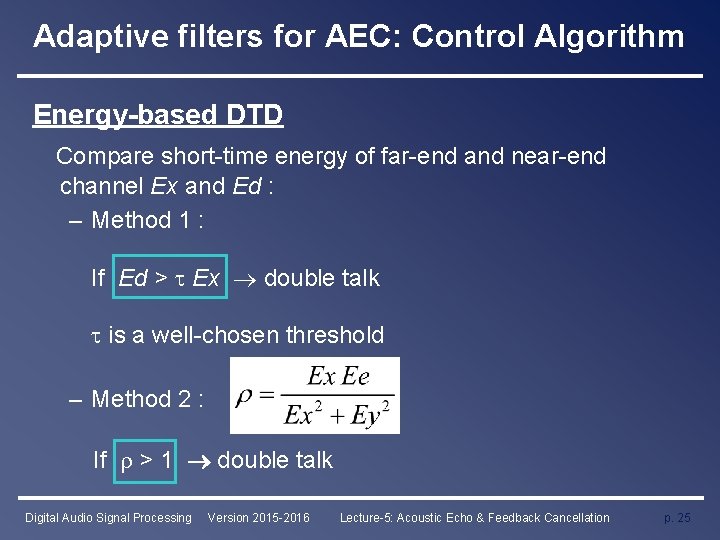
Adaptive filters for AEC: Control Algorithm Energy-based DTD Compare short-time energy of far-end and near-end channel Ex and Ed : – Method 1 : If Ed > Ex double talk is a well-chosen threshold – Method 2 : If > 1 double talk Digital Audio Signal Processing Version 2015 -2016 Lecture-5: Acoustic Echo & Feedback Cancellation p. 25
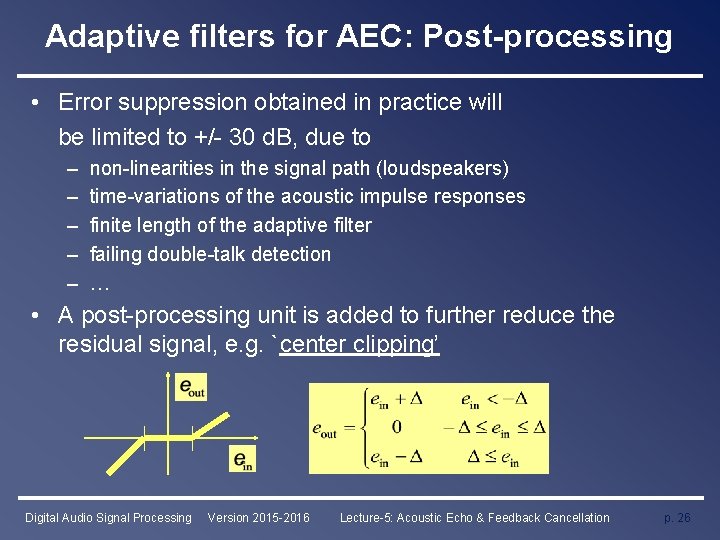
Adaptive filters for AEC: Post-processing • Error suppression obtained in practice will be limited to +/- 30 d. B, due to – – – non-linearities in the signal path (loudspeakers) time-variations of the acoustic impulse responses finite length of the adaptive filter failing double-talk detection … • A post-processing unit is added to further reduce the residual signal, e. g. `center clipping’ Digital Audio Signal Processing Version 2015 -2016 Lecture-5: Acoustic Echo & Feedback Cancellation p. 26
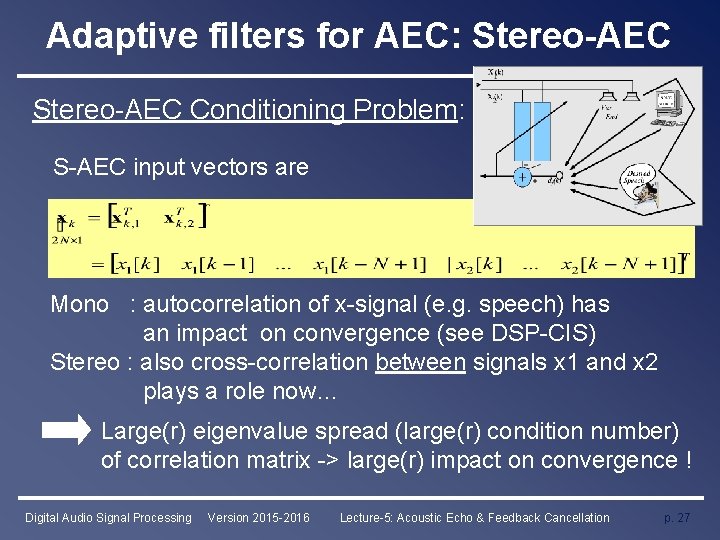
Adaptive filters for AEC: Stereo-AEC Conditioning Problem: S-AEC input vectors are Mono : autocorrelation of x-signal (e. g. speech) has an impact on convergence (see DSP-CIS) Stereo : also cross-correlation between signals x 1 and x 2 plays a role now… Large(r) eigenvalue spread (large(r) condition number) of correlation matrix -> large(r) impact on convergence ! Digital Audio Signal Processing Version 2015 -2016 Lecture-5: Acoustic Echo & Feedback Cancellation p. 27
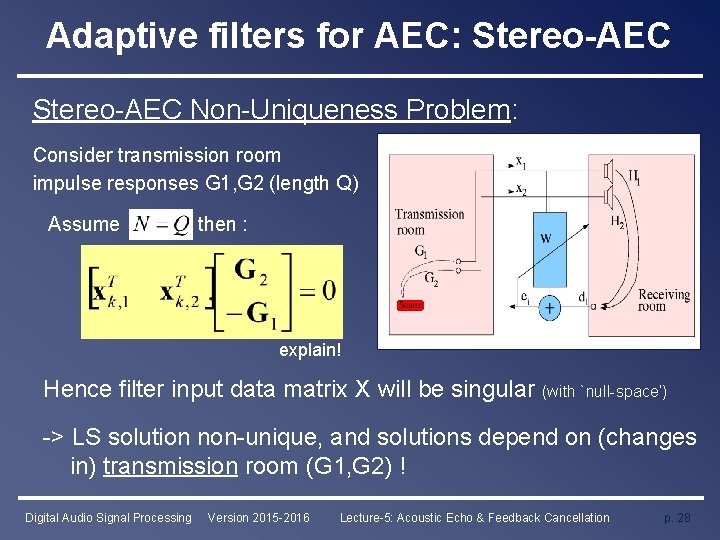
Adaptive filters for AEC: Stereo-AEC Non-Uniqueness Problem: Consider transmission room impulse responses G 1, G 2 (length Q) Assume then : explain! Hence filter input data matrix X will be singular (with `null-space’) -> LS solution non-unique, and solutions depend on (changes in) transmission room (G 1, G 2) ! Digital Audio Signal Processing Version 2015 -2016 Lecture-5: Acoustic Echo & Feedback Cancellation p. 28
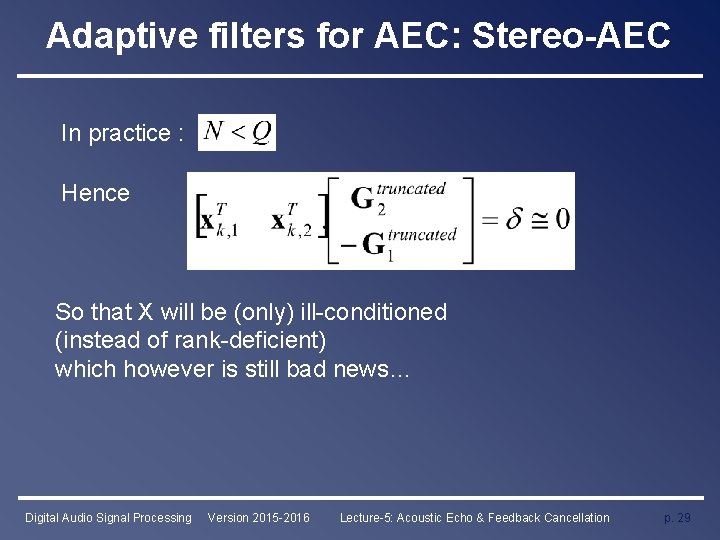
Adaptive filters for AEC: Stereo-AEC In practice : Hence So that X will be (only) ill-conditioned (instead of rank-deficient) which however is still bad news… Digital Audio Signal Processing Version 2015 -2016 Lecture-5: Acoustic Echo & Feedback Cancellation p. 29
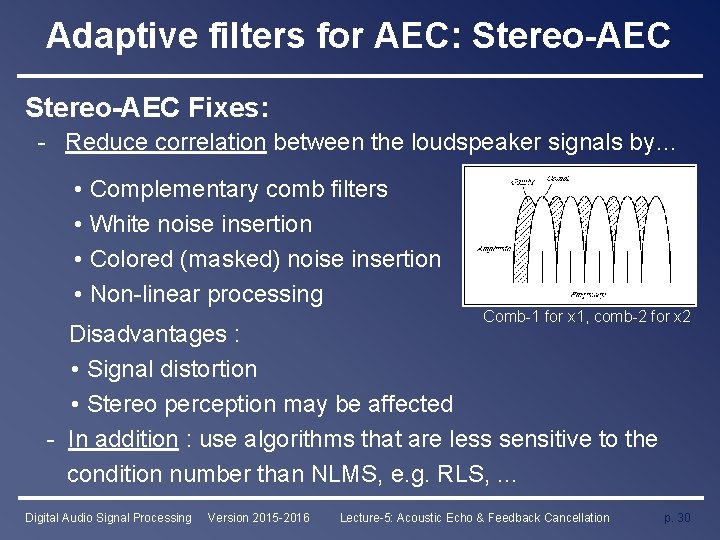
Adaptive filters for AEC: Stereo-AEC Fixes: - Reduce correlation between the loudspeaker signals by… • Complementary comb filters • White noise insertion • Colored (masked) noise insertion • Non-linear processing Comb-1 for x 1, comb-2 for x 2 Disadvantages : • Signal distortion • Stereo perception may be affected - In addition : use algorithms that are less sensitive to the condition number than NLMS, e. g. RLS, . . . Digital Audio Signal Processing Version 2015 -2016 Lecture-5: Acoustic Echo & Feedback Cancellation p. 30
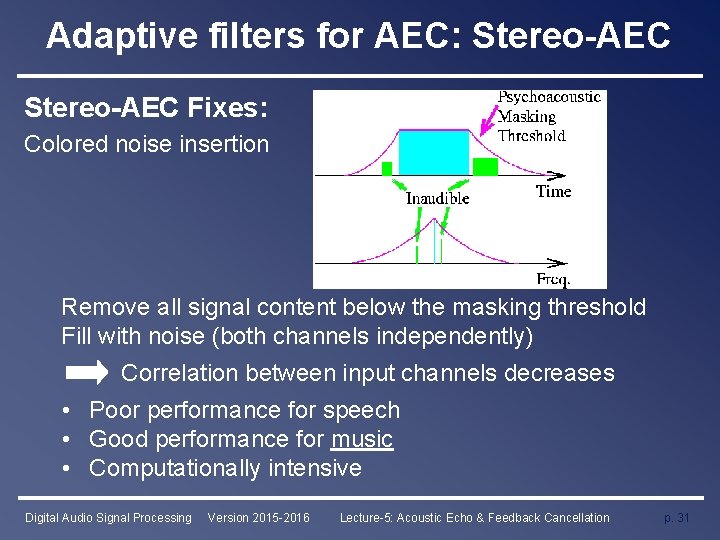
Adaptive filters for AEC: Stereo-AEC Fixes: Colored noise insertion Remove all signal content below the masking threshold Fill with noise (both channels independently) Correlation between input channels decreases • Poor performance for speech • Good performance for music • Computationally intensive Digital Audio Signal Processing Version 2015 -2016 Lecture-5: Acoustic Echo & Feedback Cancellation p. 31
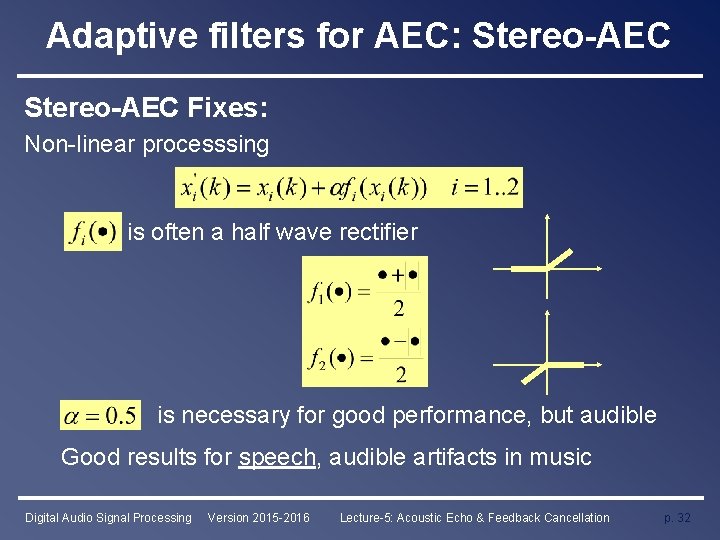
Adaptive filters for AEC: Stereo-AEC Fixes: Non-linear processsing is often a half wave rectifier is necessary for good performance, but audible Good results for speech, audible artifacts in music Digital Audio Signal Processing Version 2015 -2016 Lecture-5: Acoustic Echo & Feedback Cancellation p. 32
Outline • Introduction – AEC - Acoustic echo cancellation – AFC - Adaptive/Acoustic feedback cancellation – Acoustic channels • Adaptive Filters for AEC – – NLMS Frequency domain adaptive filters (FDAF/PB-FDAF) Control algorithm / Post-processing Stereo AEC • Adaptive Filters for AFC – AFC basics – Closed-loop signal decorrelation Digital Audio Signal Processing Version 2015 -2016 Lecture-5: Acoustic Echo & Feedback Cancellation p. 33
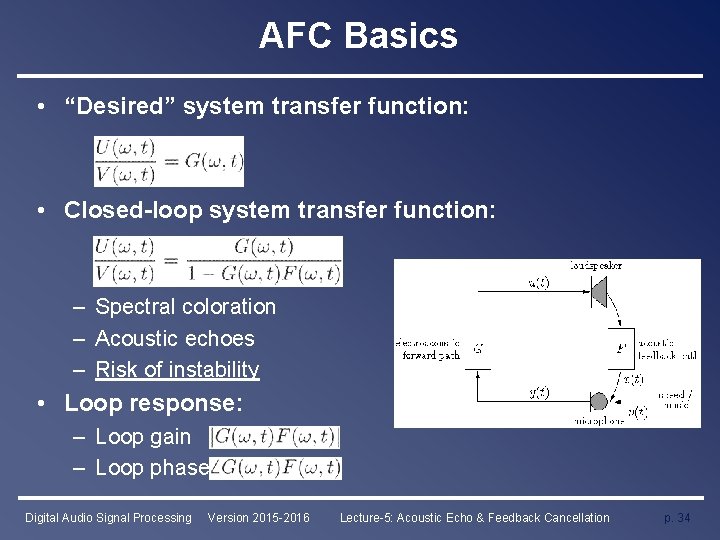
AFC Basics • “Desired” system transfer function: • Closed-loop system transfer function: – Spectral coloration – Acoustic echoes – Risk of instability • Loop response: – Loop gain – Loop phase Digital Audio Signal Processing Version 2015 -2016 Lecture-5: Acoustic Echo & Feedback Cancellation p. 34
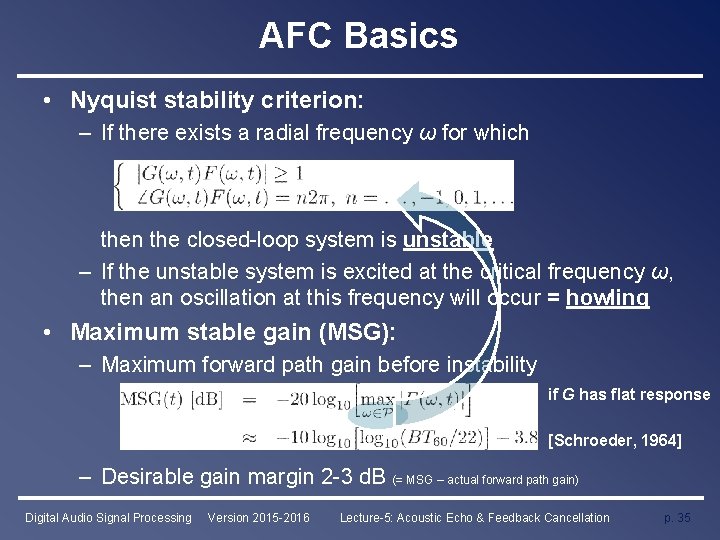
AFC Basics • Nyquist stability criterion: – If there exists a radial frequency ω for which then the closed-loop system is unstable – If the unstable system is excited at the critical frequency ω, then an oscillation at this frequency will occur = howling • Maximum stable gain (MSG): – Maximum forward path gain before instability if G has flat response [Schroeder, 1964] – Desirable gain margin 2 -3 d. B (= MSG – actual forward path gain) Digital Audio Signal Processing Version 2015 -2016 Lecture-5: Acoustic Echo & Feedback Cancellation p. 35
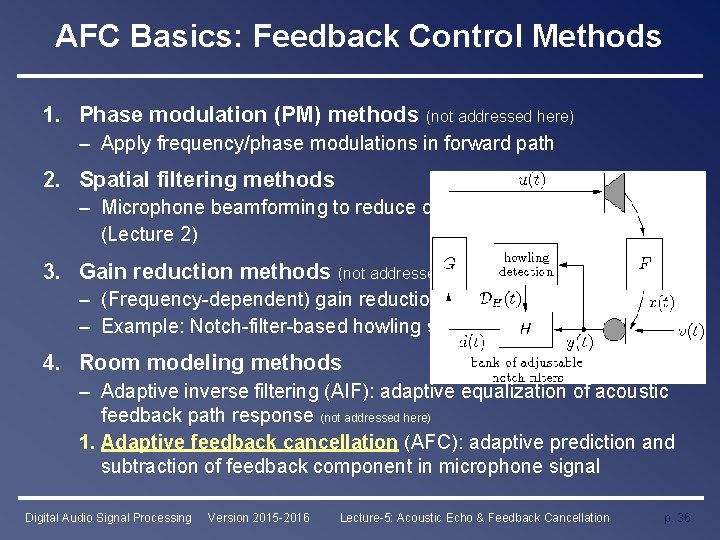
AFC Basics: Feedback Control Methods 1. Phase modulation (PM) methods (not addressed here) – Apply frequency/phase modulations in forward path 2. Spatial filtering methods – Microphone beamforming to reduce direct coupling (Lecture 2) 3. Gain reduction methods (not addressed here) – (Frequency-dependent) gain reduction after howling detection – Example: Notch-filter-based howling suppression 4. Room modeling methods – Adaptive inverse filtering (AIF): adaptive equalization of acoustic feedback path response (not addressed here) 1. Adaptive feedback cancellation (AFC): adaptive prediction and subtraction of feedback component in microphone signal Digital Audio Signal Processing Version 2015 -2016 Lecture-5: Acoustic Echo & Feedback Cancellation p. 36
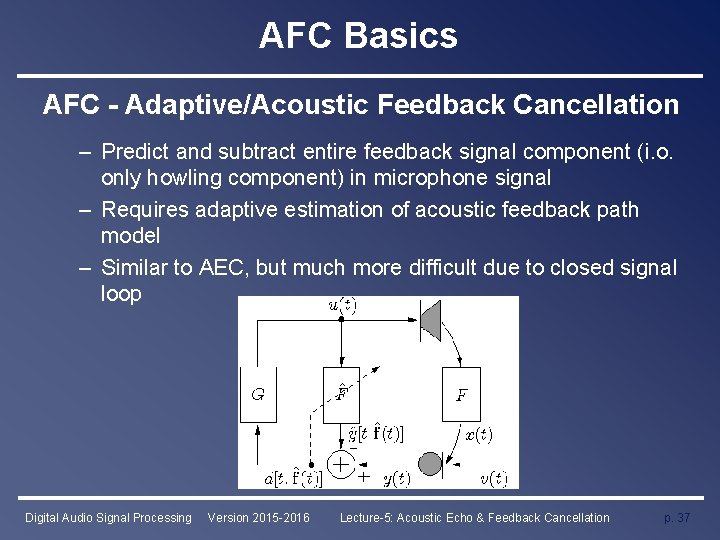
AFC Basics AFC - Adaptive/Acoustic Feedback Cancellation – Predict and subtract entire feedback signal component (i. o. only howling component) in microphone signal – Requires adaptive estimation of acoustic feedback path model – Similar to AEC, but much more difficult due to closed signal loop Digital Audio Signal Processing Version 2015 -2016 Lecture-5: Acoustic Echo & Feedback Cancellation p. 37
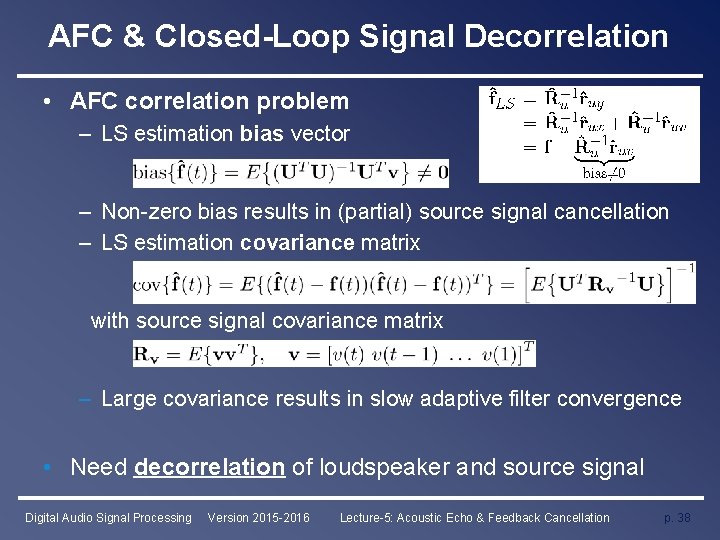
AFC & Closed-Loop Signal Decorrelation • AFC correlation problem – LS estimation bias vector – Non-zero bias results in (partial) source signal cancellation – LS estimation covariance matrix with source signal covariance matrix – Large covariance results in slow adaptive filter convergence • Need decorrelation of loudspeaker and source signal Digital Audio Signal Processing Version 2015 -2016 Lecture-5: Acoustic Echo & Feedback Cancellation p. 38
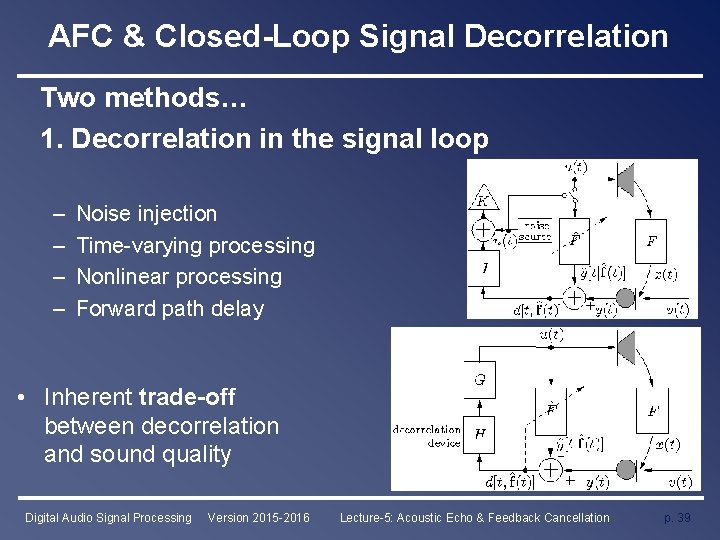
AFC & Closed-Loop Signal Decorrelation Two methods… 1. Decorrelation in the signal loop – – Noise injection Time-varying processing Nonlinear processing Forward path delay • Inherent trade-off between decorrelation and sound quality Digital Audio Signal Processing Version 2015 -2016 Lecture-5: Acoustic Echo & Feedback Cancellation p. 39
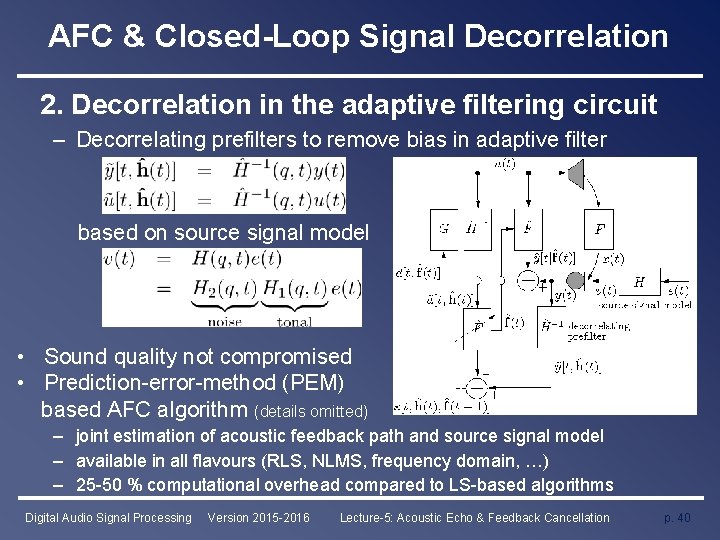
AFC & Closed-Loop Signal Decorrelation 2. Decorrelation in the adaptive filtering circuit – Decorrelating prefilters to remove bias in adaptive filter based on source signal model • Sound quality not compromised • Prediction-error-method (PEM) based AFC algorithm (details omitted) – joint estimation of acoustic feedback path and source signal model – available in all flavours (RLS, NLMS, frequency domain, …) – 25 -50 % computational overhead compared to LS-based algorithms Digital Audio Signal Processing Version 2015 -2016 Lecture-5: Acoustic Echo & Feedback Cancellation p. 40