
Digital and NonLinear Control State Space Modelling Lecture
- Slides: 18
Digital and Non-Linear Control State Space Modelling
Lecture Outline • Introduction to state space – Basic Definitions – State Equations – State Diagram – State Controllability – State Observability – Output Controllability
Introduction • Modern control theory is contrasted with conventional control theory in that the former is applicable to multiple -input, multiple-output systems, which may be linear or nonlinear, time invariant or time varying, while the latter is applicable only to linear time invariant single-input, single-output systems.
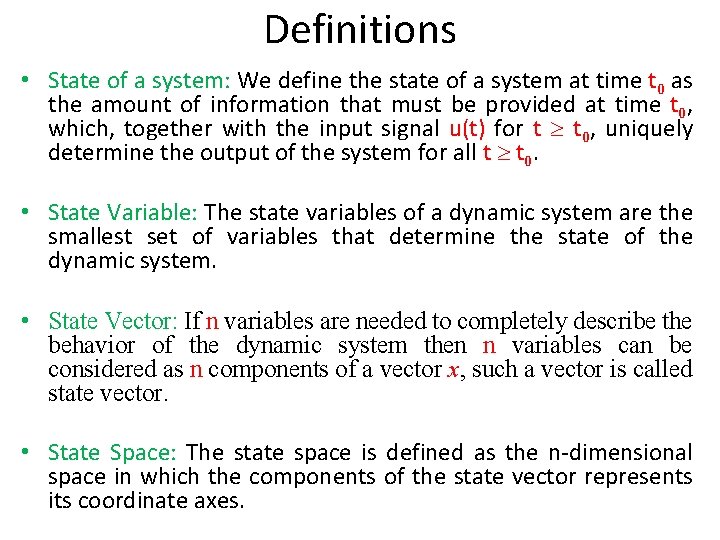
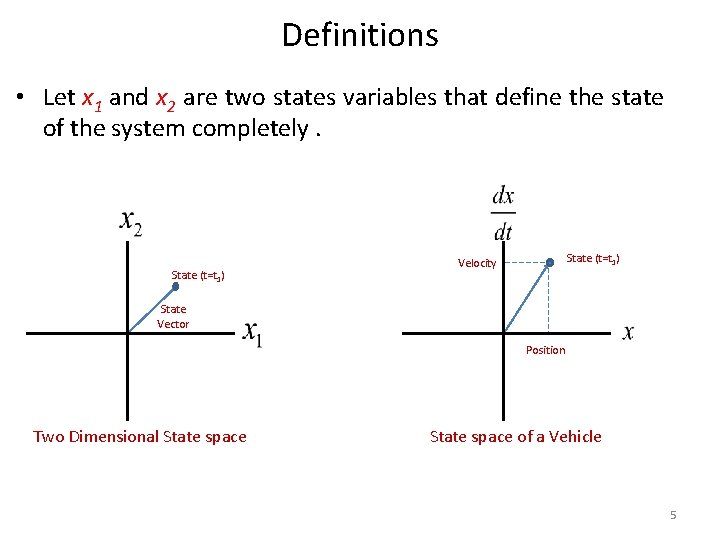
Definitions • State of a system: We define the state of a system at time t 0 as the amount of information that must be provided at time t 0, which, together with the input signal u(t) for t t 0, uniquely determine the output of the system for all t t 0. • State Variable: The state variables of a dynamic system are the smallest set of variables that determine the state of the dynamic system. • State Vector: If n variables are needed to completely describe the behavior of the dynamic system then n variables can be considered as n components of a vector x, such a vector is called state vector. • State Space: The state space is defined as the n-dimensional space in which the components of the state vector represents its coordinate axes.
Definitions • Let x 1 and x 2 are two states variables that define the state of the system completely. State (t=t 1) Velocity State Vector Position Two Dimensional State space of a Vehicle 5
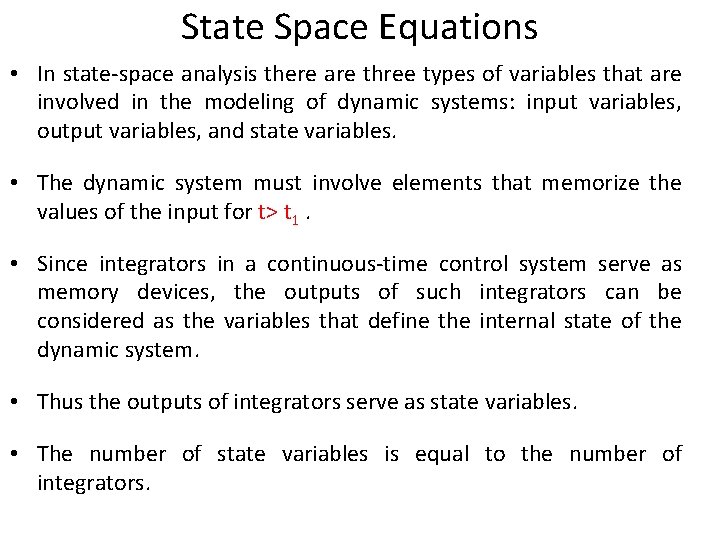
State Space Equations • In state-space analysis there are three types of variables that are involved in the modeling of dynamic systems: input variables, output variables, and state variables. • The dynamic system must involve elements that memorize the values of the input for t> t 1. • Since integrators in a continuous-time control system serve as memory devices, the outputs of such integrators can be considered as the variables that define the internal state of the dynamic system. • Thus the outputs of integrators serve as state variables. • The number of state variables is equal to the number of integrators.
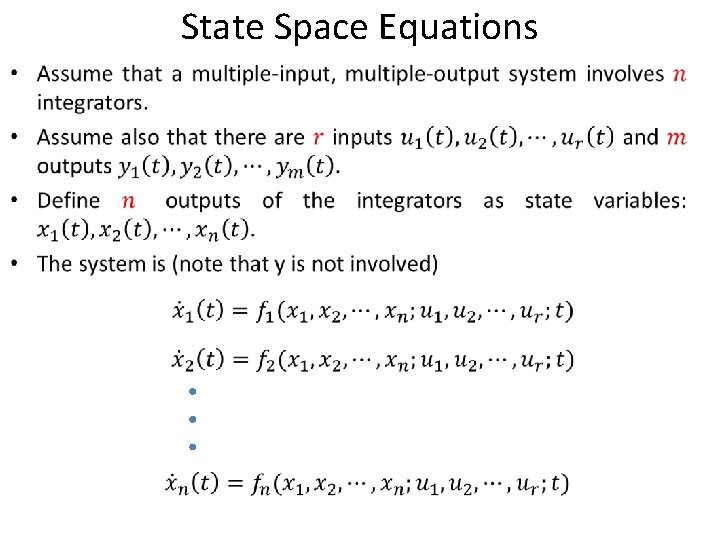
State Space Equations •
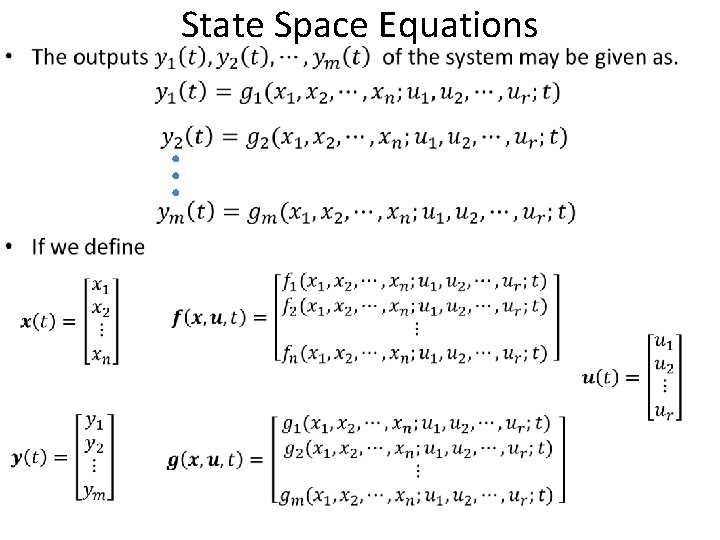
State Space Equations •
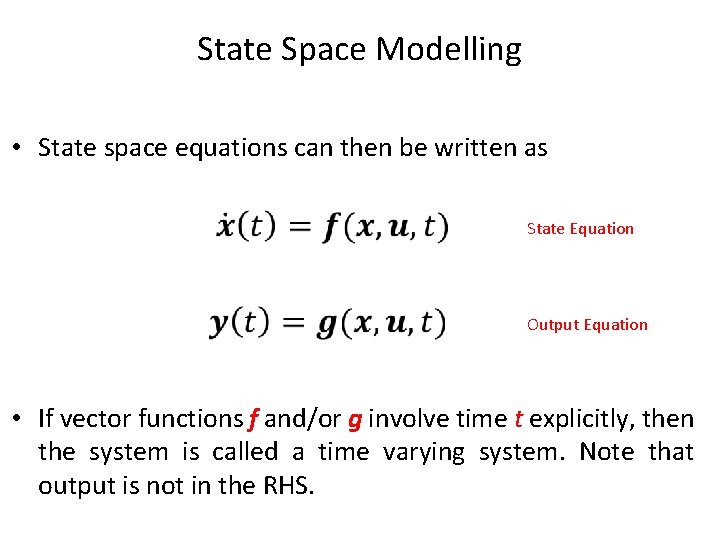
State Space Modelling • State space equations can then be written as State Equation Output Equation • If vector functions f and/or g involve time t explicitly, then the system is called a time varying system. Note that output is not in the RHS.
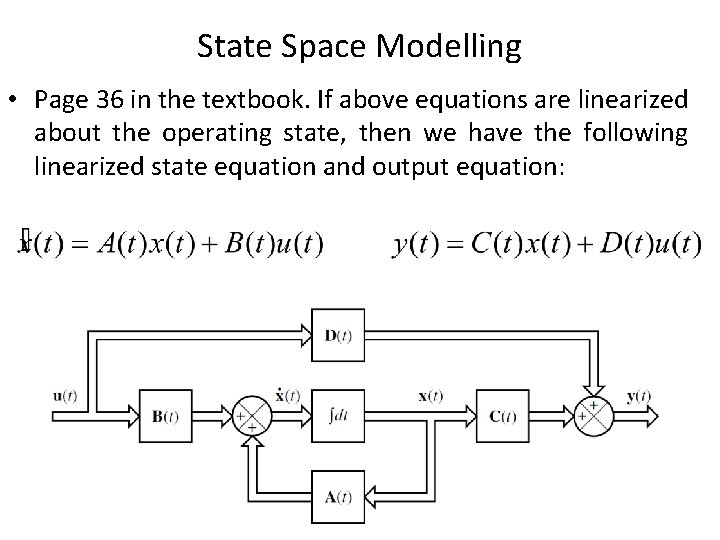
State Space Modelling • Page 36 in the textbook. If above equations are linearized about the operating state, then we have the following linearized state equation and output equation:
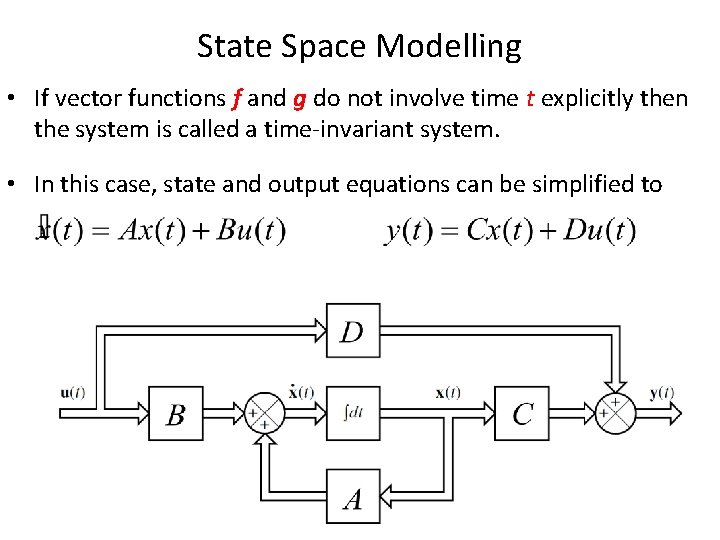
State Space Modelling • If vector functions f and g do not involve time t explicitly then the system is called a time-invariant system. • In this case, state and output equations can be simplified to
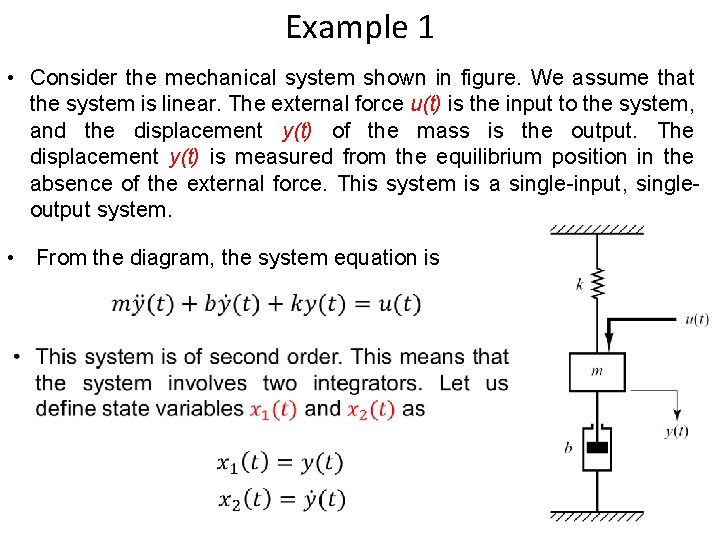
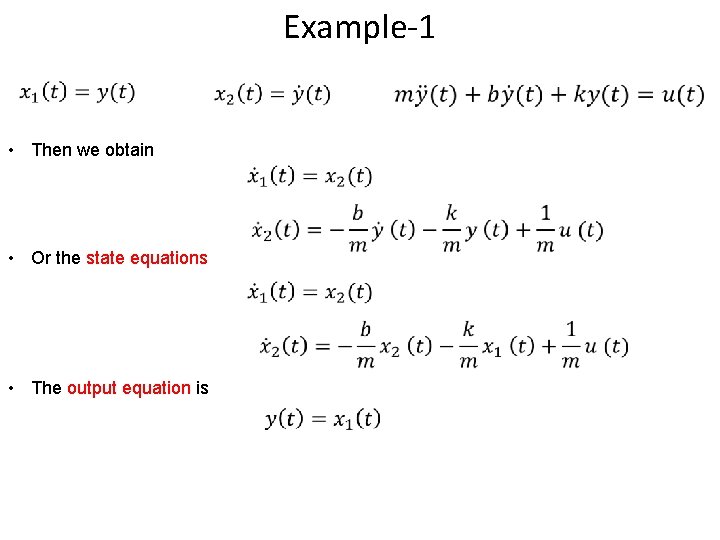
Example 1 • Consider the mechanical system shown in figure. We assume that the system is linear. The external force u(t) is the input to the system, and the displacement y(t) of the mass is the output. The displacement y(t) is measured from the equilibrium position in the absence of the external force. This system is a single-input, singleoutput system. • From the diagram, the system equation is
Example-1 • Then we obtain • Or the state equations • The output equation is
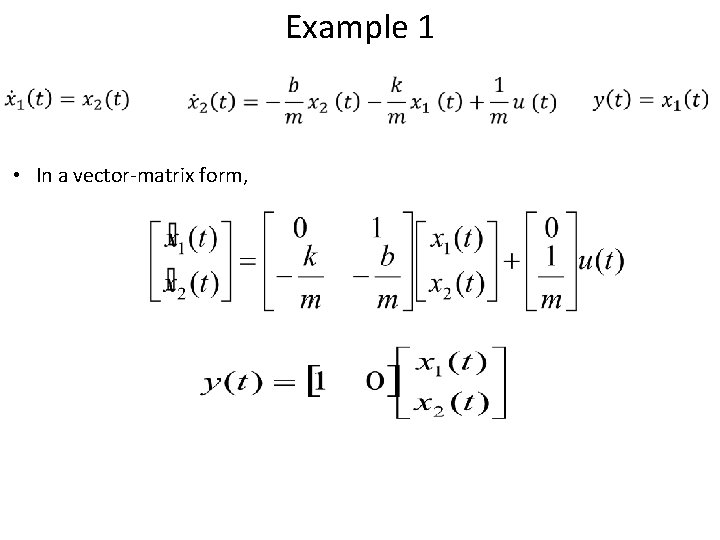
Example 1 • In a vector-matrix form,
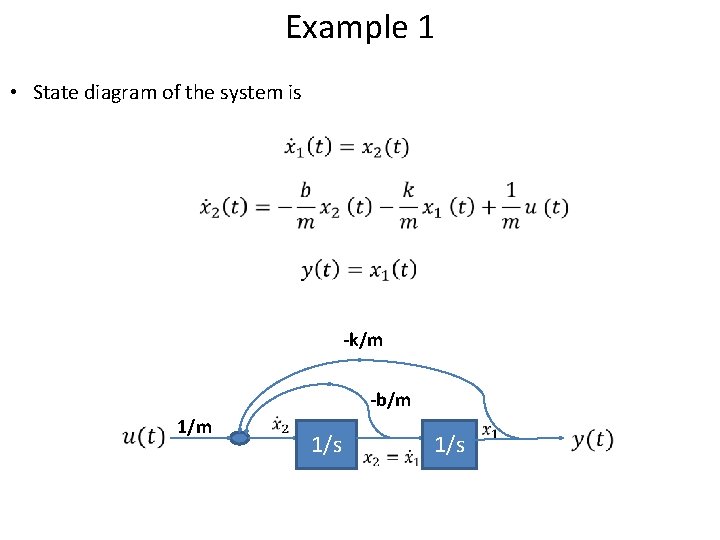
Example 1 • State diagram of the system is -k/m -b/m 1/m 1/s
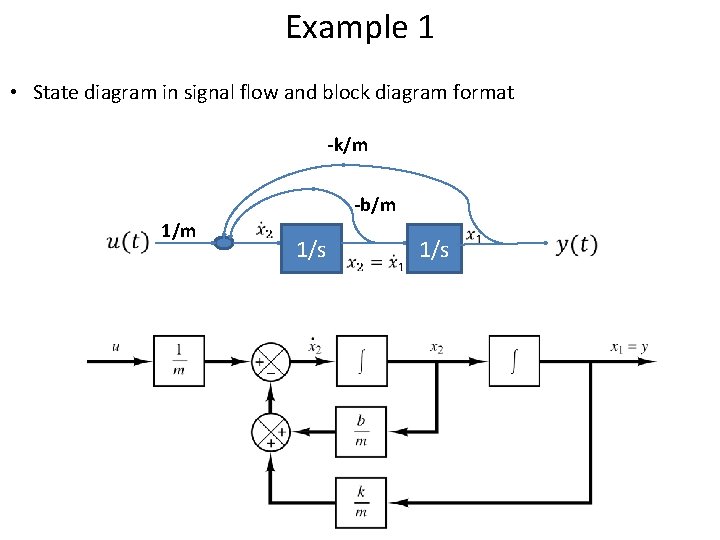
Example 1 • State diagram in signal flow and block diagram format -k/m -b/m 1/m 1/s
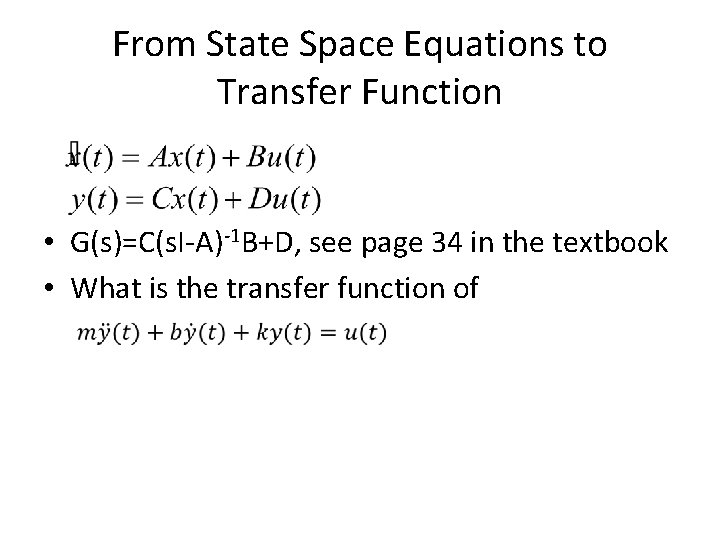
From State Space Equations to Transfer Function • G(s)=C(s. I-A)-1 B+D, see page 34 in the textbook • What is the transfer function of
From Transfer Function to State Space Equations • See the example in page 40 of the textbook • Given any transfer function, compare it with the general form at page 39 in the textbook and compute A, B, C, D in the state space equations