
Digestive Systems Chris Ellason Digestion and Absorption 4
Digestive Systems Chris Ellason

Digestion and Absorption: 4 The process of digestion includes: – The prehension of food or feed – The mechanical chewing and grinding – Mixing with digestive acids and enzymes to chemically break down feedstuffs 4 The process of absorption includes: – Transport of the digested foods across the intestinal mucosa to the blood or lymph system
General Terms 4 Prehension: to take into the mouth 4 Mastication: chewing 4 Deglutition: swallowing 4 Regurgitation: the backward flow of food through the esophagus
Three Major Categories 4 Carnivore: consume flesh of other animals, examples are dogs and cats 4 Omnivore: consume both plants and flesh, examples are primates 4 Herbivore: consume plant material, examples are horses and cattle
Carnivore 4 Very Well developed stomach 4 Uncomplicated intestine 4 Limited fiber digestion
Omnivore 4 Combination of carnivores/herbivores 4 More complicated GIT than carnivores 4 Colonic digesters – Pigs, humans 4 Cecal digesters – rat
Herbivore 4 Cow, horse, rabbit – Each has a different type of GIT 4 Cow- ruminant 4 Horse- simple stomach, large cecum, large sacculated LI 4 Rabbit- larger stomach, very large sacculated cecum, unsacculated LI

Salivary Glands 4 3 pair – Parotid – Mandibular – Sublingual 4 Water - moistens food aids in swallowing 4 Mucin - lubrication for swallowing 4 Bicarbonate salts 4 Enzymes
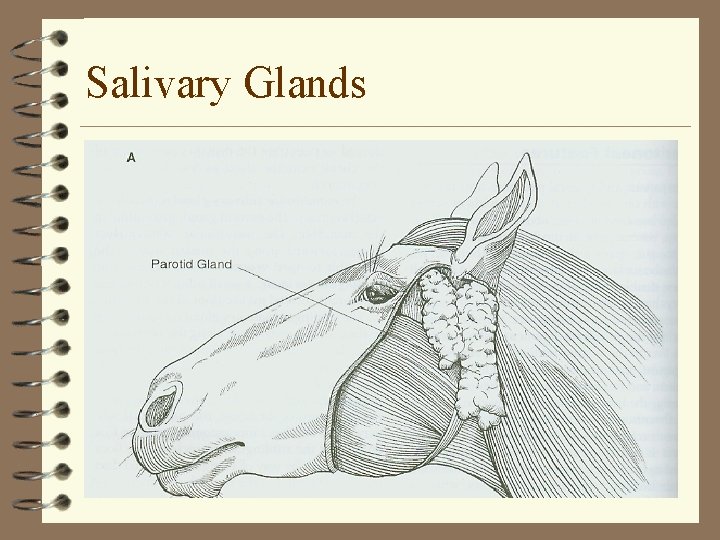
Salivary Glands
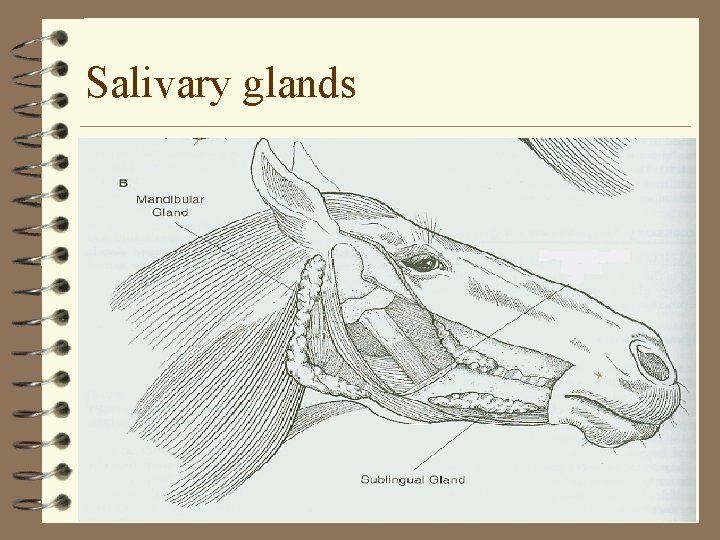
Salivary glands
Different Digestive Tracts 4 Farm animals have a variety of digestive systems – Ruminants: have 4 different compartments to the stomach • Examples include cattle, sheep, goats – Nonruminants (also known as monogastrics) • Hogs, dogs, and cats have a single, simple stomach • Poultry have a two part stomach • Horses have a large, functional cecum
Pregastric vs Postgastric 4 Pregastric: Fermentation that occurs in the rumen of ruminant animals. It occurs before food passes into the portion of the digestive tract in which digestion actually occurs. 4 Postgastric: The fermentation of feed occurs in the cecum, behind the area where digestion has occurred.
Pregastric vs Postgastric 4 Ruminants – More efficient – Less intake 4 Non- ruminant herbivores – Only postgastric – Less efficient – Greater intake
Monogastric Systems 4 Mouth: prehension and chewing of food; some carbohydrate enzyme activity 4 Esophagus 4 Stomach – Storage – Muscular movements (break down food) – Secretes Digestive Juices (hydrochloric acid) • p. H about 2
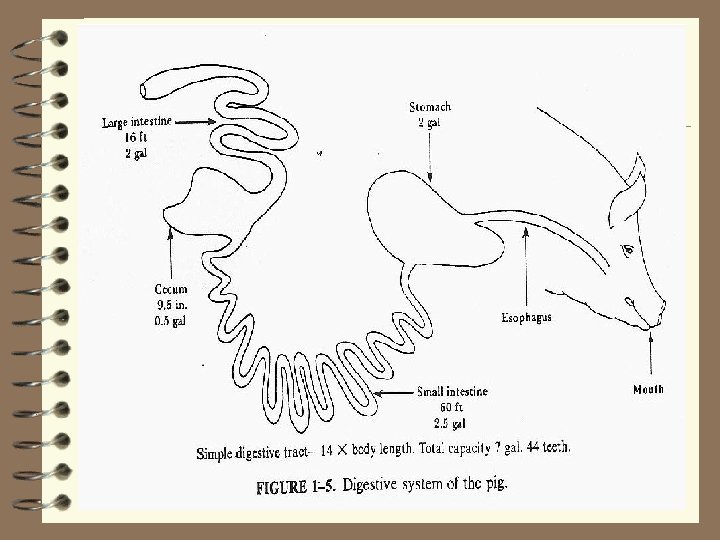
Monogastric Systems

Small Intestine 4 Duodenum – Active Digestion Site – Produce enzymes • Pancreas – Helps to neutralize ingesta entering the SI • Liver – Produces bile; breaks down fats • Intestinal Walls
Small Intestine 4 Jejunum – Active in nutrient absorption 4 Ileum – Active in nutrient absorption 4 Villi 4 p. H 6 to 7
Large Intestine 4 3 Sections – cecum – colon – rectum 4 Active in water resorption 4 Secretion of some minerals 4 *Bacterial Fermentation*
Horses are Different 4 Saliva – contains no enzymes – may secrete up to 10 gallons/day – stimulated by scratching 4 Esophagus – only one way peristaltic movement • Impossible for regurgitation
Horses are Different 4 Stomach – much smaller in comparison to other species – not very extensive muscular contraction – So how should we feed differently? 4 Small Intestine – same as pig but no gall bladder • Can’t handle a high fat diet
Horses are Different 4 Large Intestine – over 60% of GIT – 4 parts • • cecum large colon small colon rectum
Cecum and Large Colon 4 Similar to Rumen – bacterial cellulose breakdown – bacterial protein breakdown – VFA production – Water Soluble Vitamin production
Small Colon and Rectum 4 Primary site for water resorption 4 Can become impacted with feed
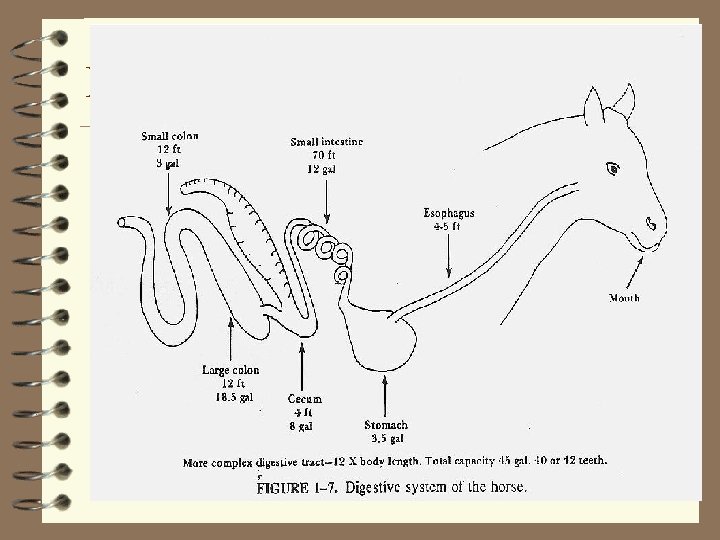
Horse GI Tract
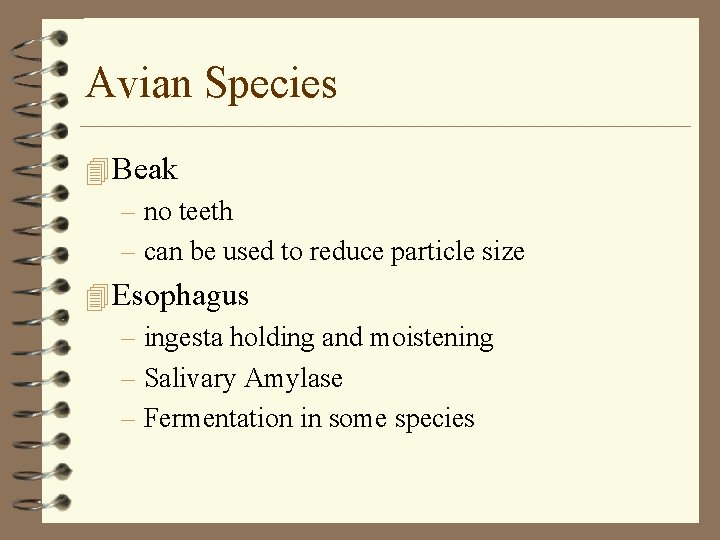
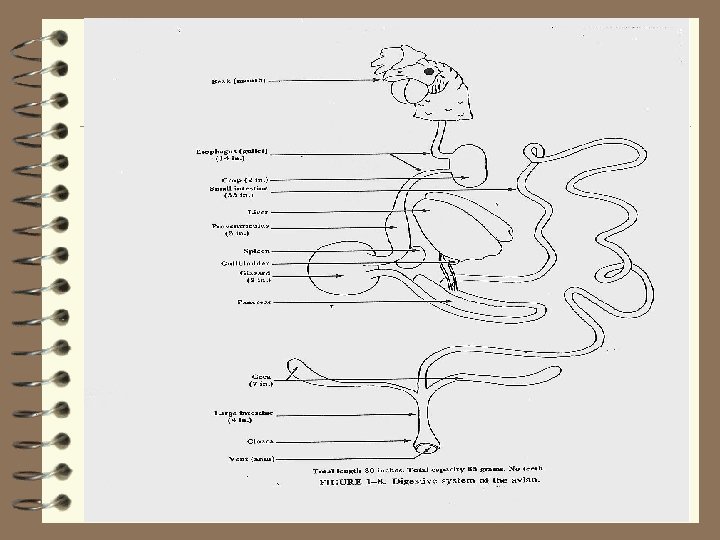
Avian Species 4 Beak – no teeth – can be used to reduce particle size 4 Esophagus – ingesta holding and moistening – Salivary Amylase – Fermentation in some species
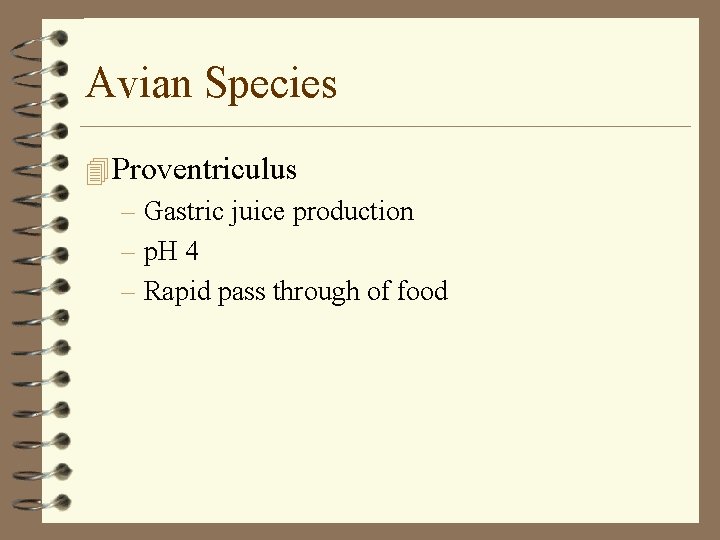
Avian Species 4 Proventriculus – Gastric juice production – p. H 4 – Rapid pass through of food
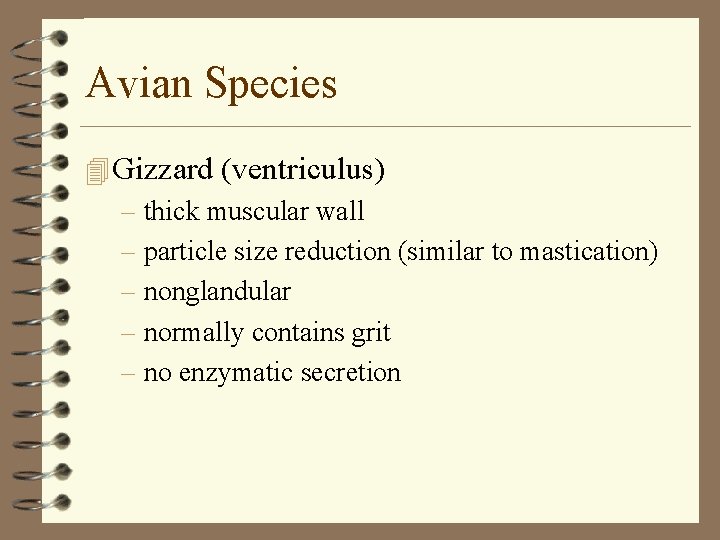
Avian Species 4 Gizzard (ventriculus) – thick muscular wall – particle size reduction (similar to mastication) – nonglandular – normally contains grit – no enzymatic secretion
Avian Small Intestine 4 Functions in digestion and absorption of feed and nutrients just as in other monogastrics 4 p. H is slightly acidic 4 Most enzymes found in mammals except?
Avian Large Intestine 4 Contains 2 blind pouches instead of ? 4 Mostly water absorption 4 Some bacterial activity but less than in most mammals 4 very short in comparison
Avian Species
Ruminant Digestive System 4 Mouth – what is unique about the teeth? – Can only chew on one side of mouth at a time 4 Saliva production is continuous 4 Production about 12 gallons/d

Rumen Stomach 4 4 PARTS – reticulum – rumen – omasum – abomasum

Reticulum 4 Honeycomb 4 most cranial 4 not truly separated from rumen 4 no enzymatic secretion 4 walls are tough, tend to catch heavy objects
Rumen 4 Large compartment extends from diaphragm to pelvis 4 papillae 4 Fermentation chamber 4 Majority of absorption of byproducts and conversion to volatile fatty acids
Rumen Digestion 4 Reticulorumen provides a favorable environment for bacterial fermentation 4 Continuous turnover of digesta and removal of fermented digesta 4 Anaerobic fermentation
Omasum 4 Manyplies (Stockmans Bible) 4 short blunt papillae 4 very muscular 4 no enzymatic secretion 4 reduction of particle size 4 water resorption
Abomasum 4 True Stomach 4 First Glandular portion of the tract 4 Very similar in structure and function to nonruminant stomach
Other Unique Points 4 Esophageal Groove – cardia to omasum – milk bypass 4 Rumination: The process where rumen contents are regurgitated, remasticated, and reswallowed for further digestion 4 Eructation: expulsion of accumulated fermentation gases from rumen via esophagus

Ruminant GI Tract
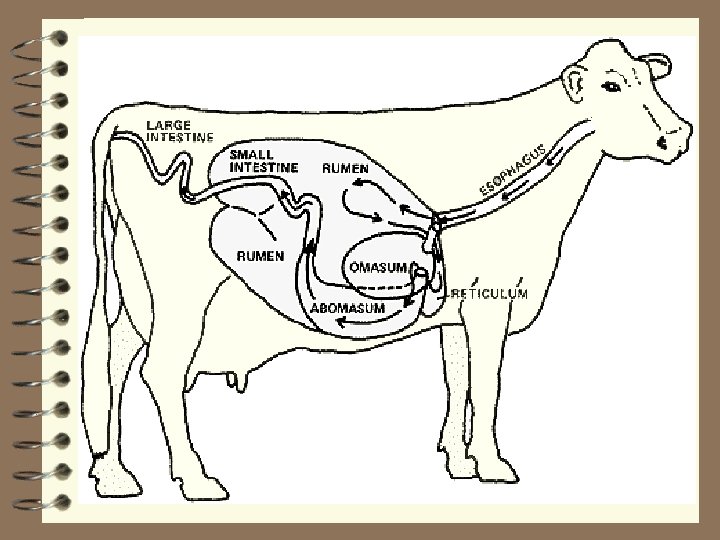

Rumination 4 Regurgitation of ingesta with mastication – reticular contraction that concentrates ingesta at the cardia – increased inhalation of air at same time – contraction of diaphragm – ballooning of esophageal walls – ingesta sucked into esophagus – returned to mouth by reverse peristalsis
Rumination 4 Excess liquids are swallowed 4 Mastication commences 4 More time spent masticating here than initial intake 4 Amount of time ruminating is a function of diet composition
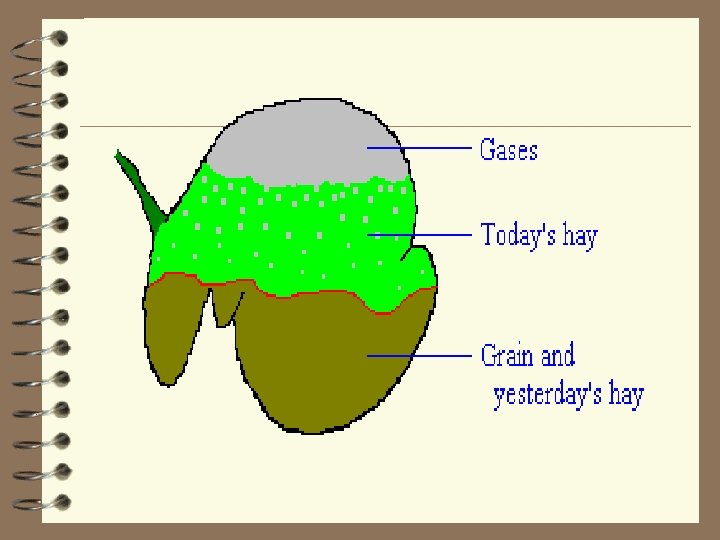
Rumen Contents and Motility 4 Rumen contents are not uniform 4 Occur in stratified layers 4 Change from ventral to dorsal 4 Rumen mat – high concentrate diets eliminate mat – more viscous fluid in high grain diets – lowest dry matter in high forage diets
Rumen Contents and Motility 4 Motility of rumen mixes contents 4 Divided into – primary contractions – secondary contractions 4 Contractions require up to 50 seconds to complete
Rumen Contents and Motility 4 Contractions begin with reticulum 4 Progress dorsally 4 Finish with ventral blind sac and ventral pillars
Rumen and Acute Acidosis 4 Optimal rumen p. H is 6. 7 4 Variation in p. H is normally +/- 0. 5 4 Introduction of high grains result in – breakdown of rumen mat – proliferation of facultative anaerobes – these produce high levels of lactic acid

Rumen and Acute Acidosis 4 Lactate is a much stronger acid that other VFAs 4 In severe cases lactate can make-up well over 50% of total rumen acids 4 Succinate and Formate can also appear in high quantities
Rumen and Acute Acidosis 4 Increased acids can reduce p. H as far as 4. 0 4 Severe rumenitis occurs at these p. H levels 4 Absorption of lactic acid results in systemic acidosis 4 All chronic acidosis results in rumen parakeratosis
Factors Affecting Digestibility 4 Rate of passage: increased rate of passage of digesta through the tract reduces digestibility – Factors increasing rate of passage include: • Increased level of feeding/intake (ruminants) • Finer processing (such as grinding) of feed Note: grinding grain usually increases digestibility but grinding hay decreases digestibility
- Slides: 50