
DIGESTIVE SYSTEM ORAL CAVITY Oral cavity consists of




- Slides: 46
DIGESTIVE SYSTEM
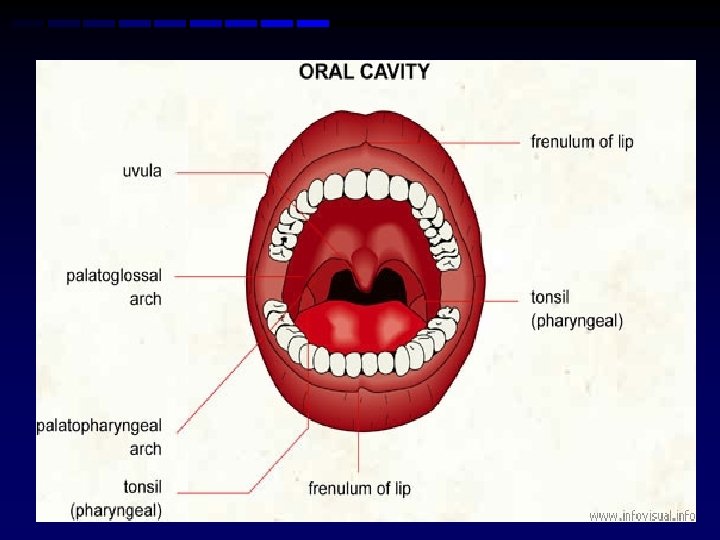
ORAL CAVITY Oral cavity consists of the mouth and its structures, which include the tongue, teeth and their supporting structures (periodontium), major and minor salivary glands, and tonsils. Divided into vestibule and oral cavity proper.
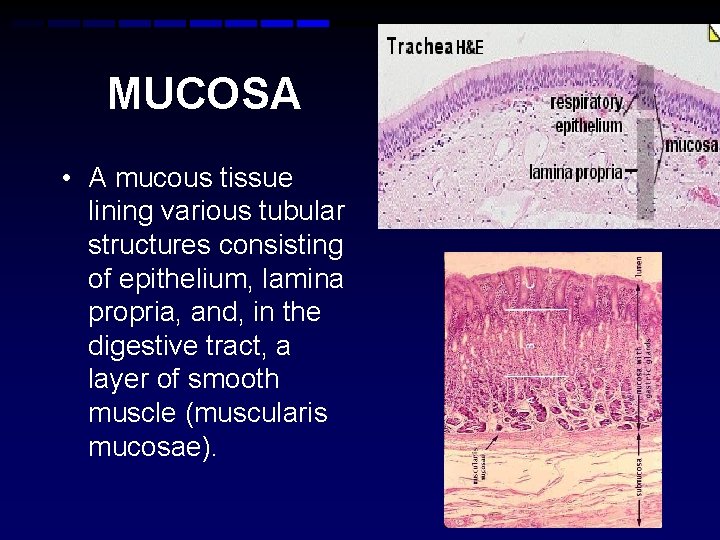
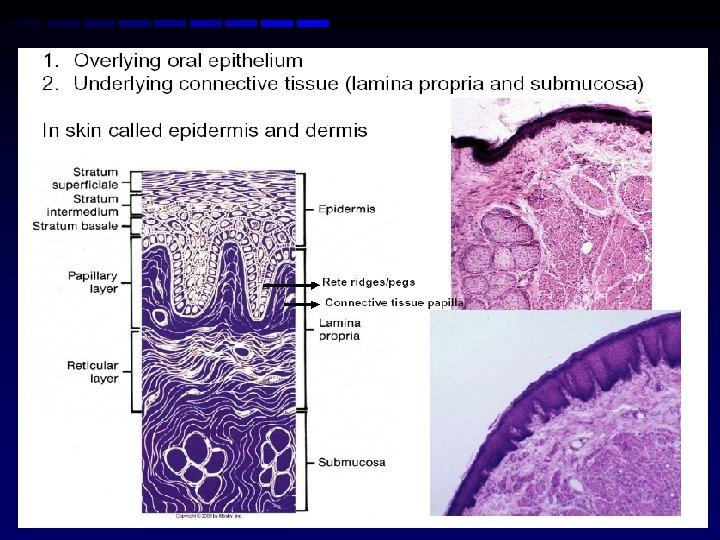
MUCOSA • A mucous tissue lining various tubular structures consisting of epithelium, lamina propria, and, in the digestive tract, a layer of smooth muscle (muscularis mucosae).
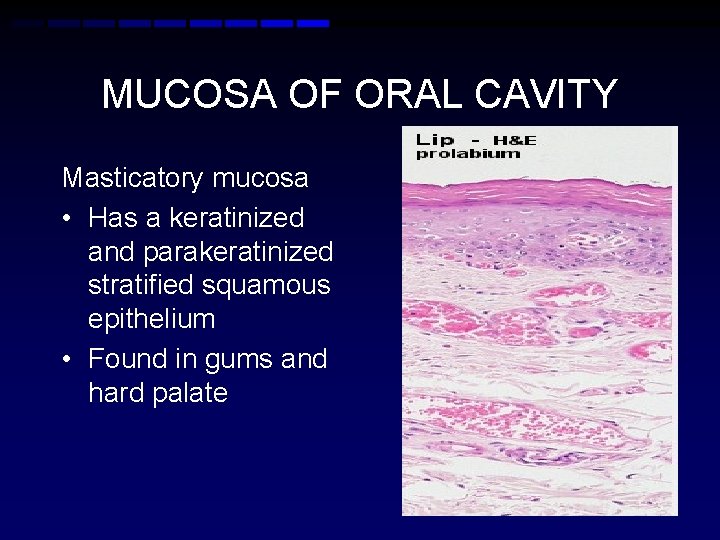
MUCOSA OF ORAL CAVITY Masticatory mucosa • Has a keratinized and parakeratinized stratified squamous epithelium • Found in gums and hard palate
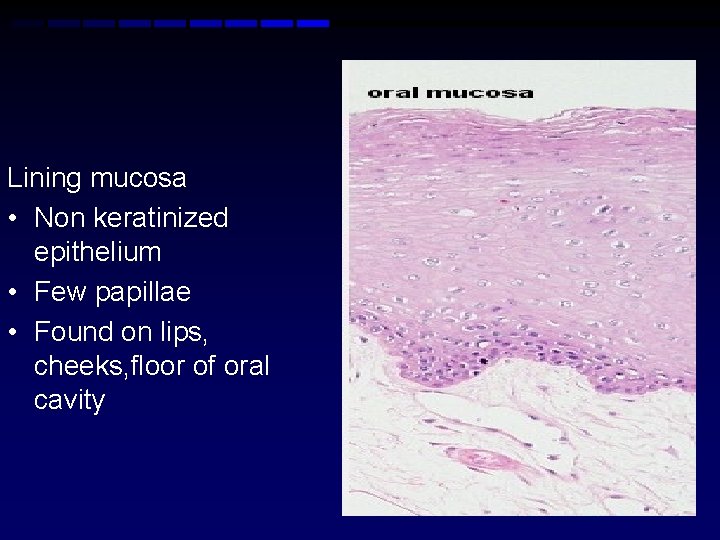
Lining mucosa • Non keratinized epithelium • Few papillae • Found on lips, cheeks, floor of oral cavity
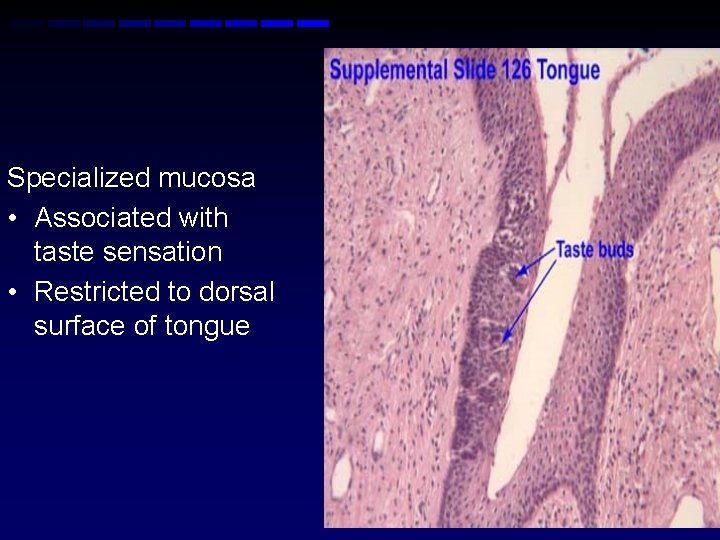
Specialized mucosa • Associated with taste sensation • Restricted to dorsal surface of tongue
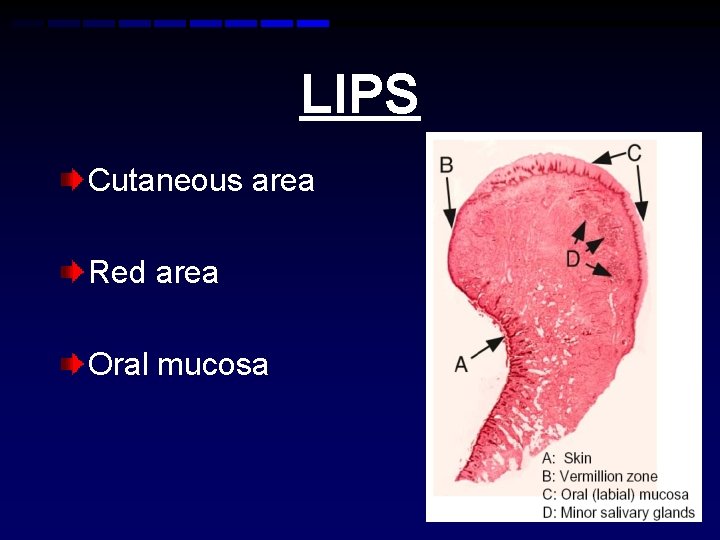
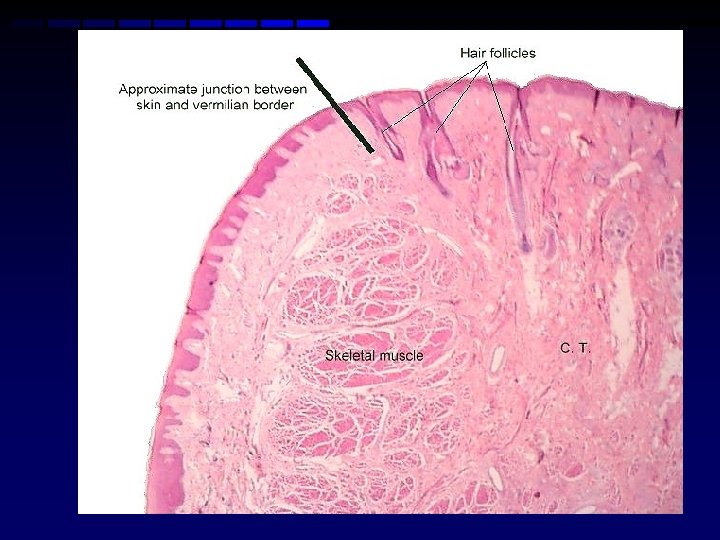
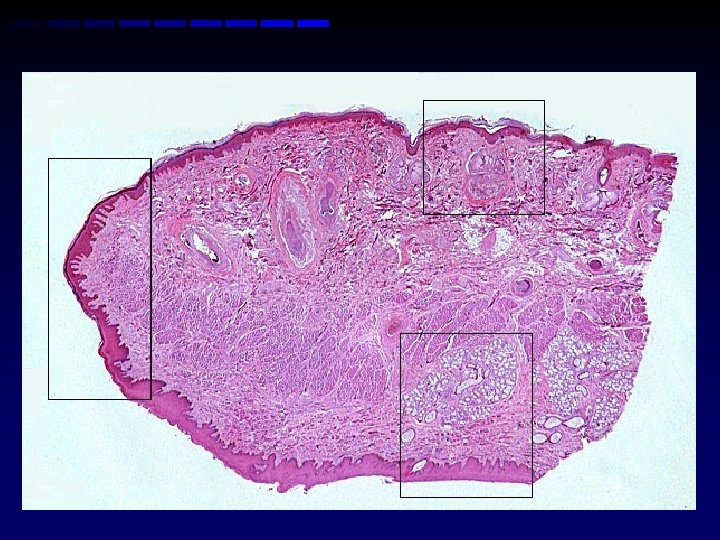
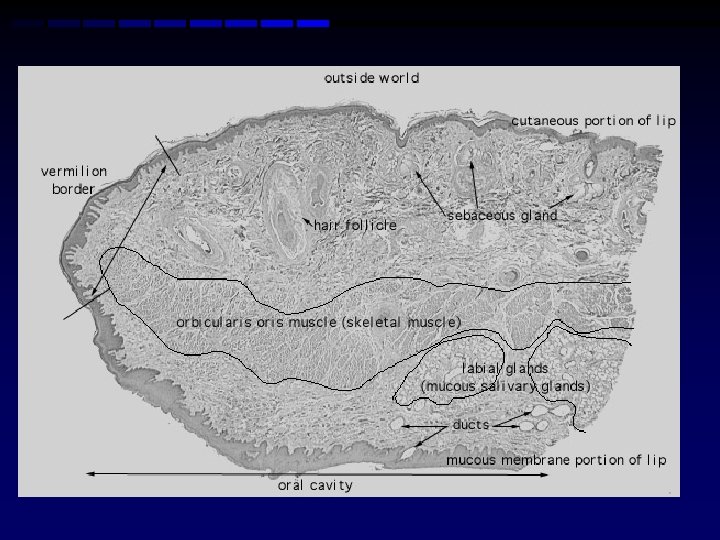
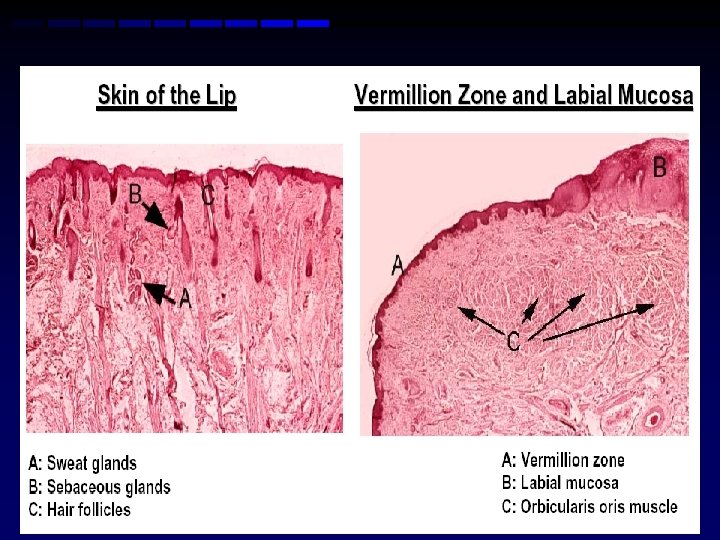
LIPS Cutaneous area Red area Oral mucosa
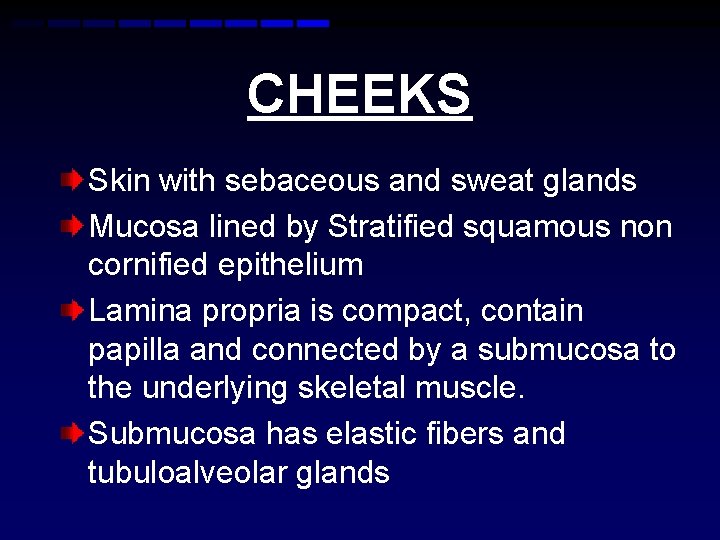
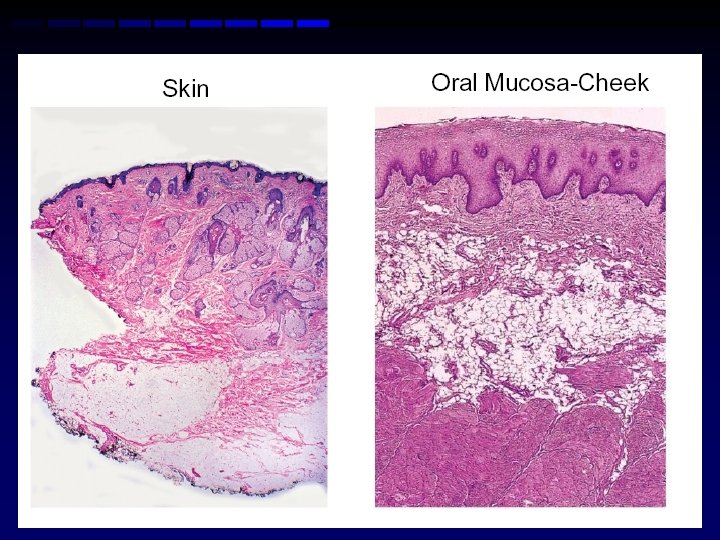
CHEEKS Skin with sebaceous and sweat glands Mucosa lined by Stratified squamous non cornified epithelium Lamina propria is compact, contain papilla and connected by a submucosa to the underlying skeletal muscle. Submucosa has elastic fibers and tubuloalveolar glands
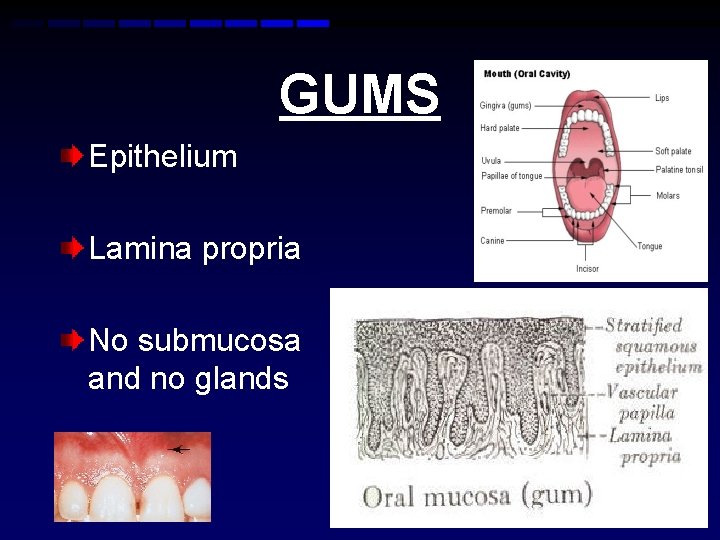
GUMS Epithelium Lamina propria No submucosa and no glands
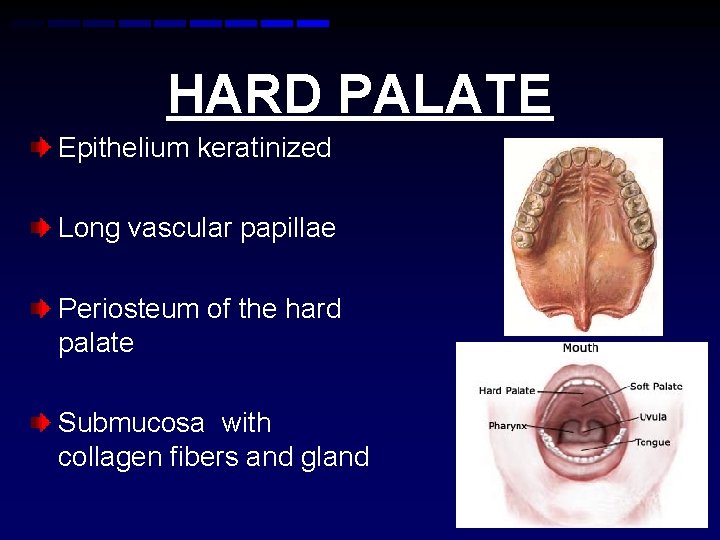
HARD PALATE Epithelium keratinized Long vascular papillae Periosteum of the hard palate Submucosa with collagen fibers and gland
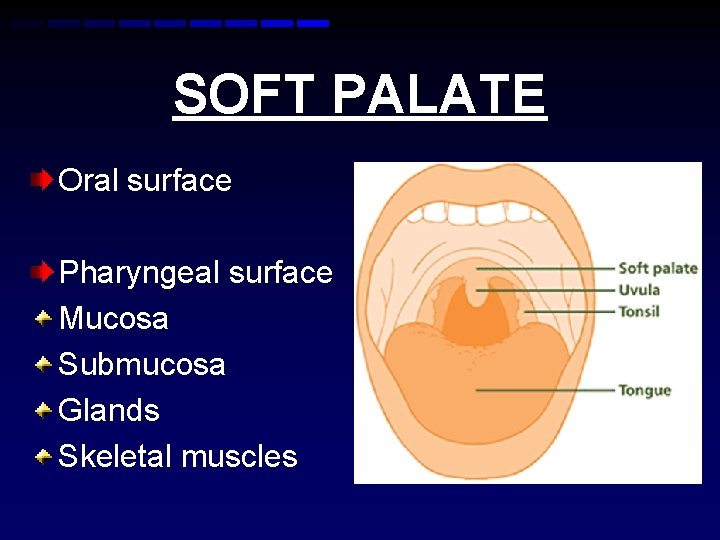
SOFT PALATE Oral surface Pharyngeal surface Mucosa Submucosa Glands Skeletal muscles
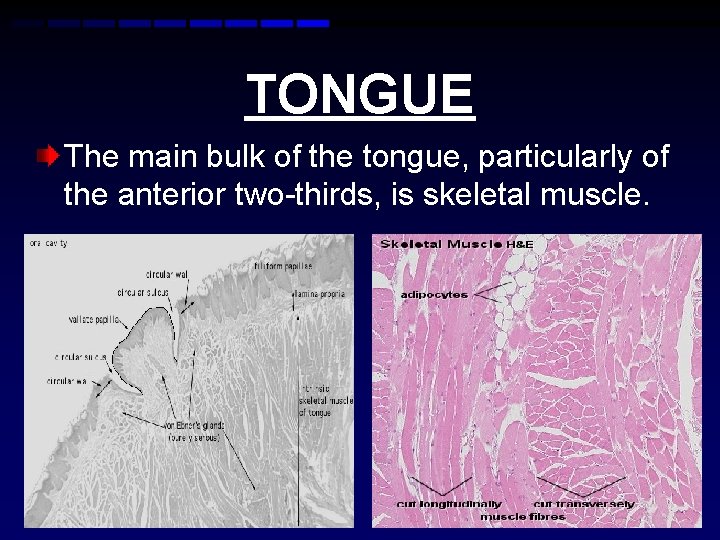
TONGUE The main bulk of the tongue, particularly of the anterior two-thirds, is skeletal muscle.
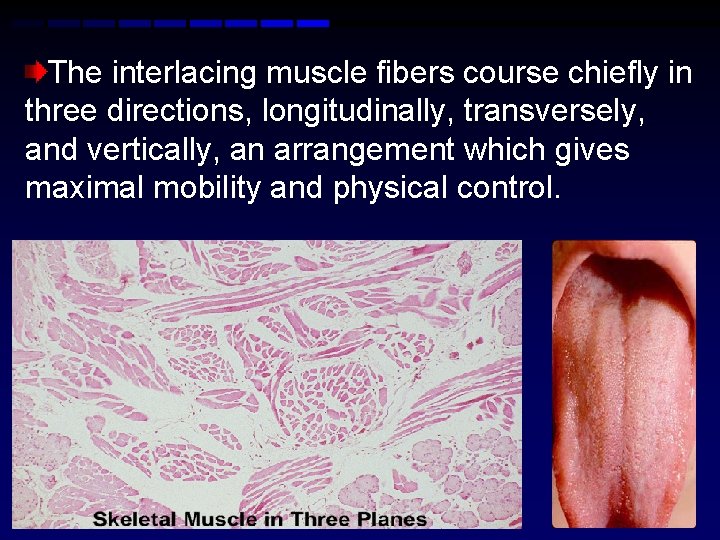
The interlacing muscle fibers course chiefly in three directions, longitudinally, transversely, and vertically, an arrangement which gives maximal mobility and physical control.
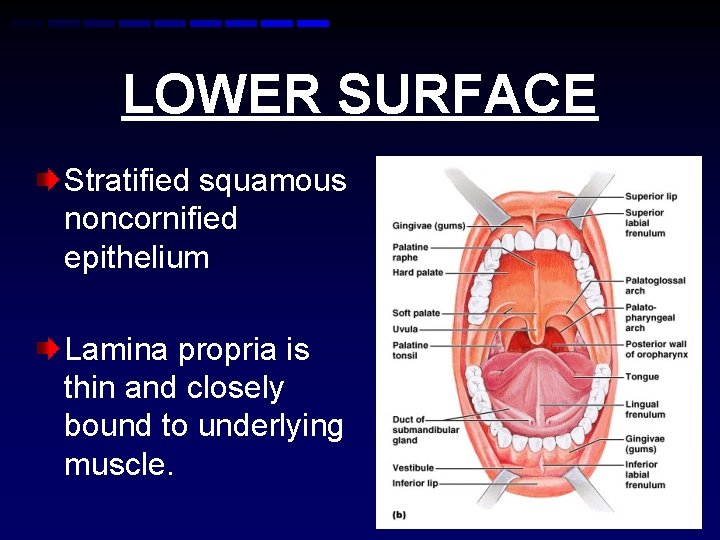
LOWER SURFACE Stratified squamous noncornified epithelium Lamina propria is thin and closely bound to underlying muscle.
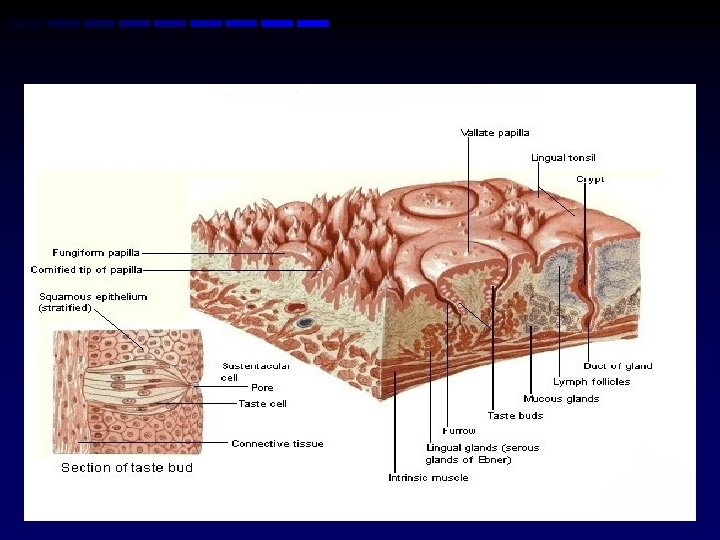
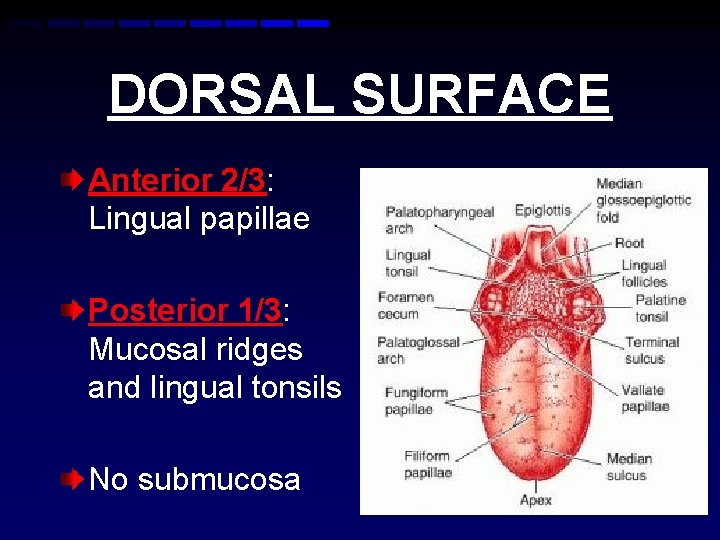
DORSAL SURFACE Anterior 2/3: Lingual papillae Posterior 1/3: Mucosal ridges and lingual tonsils No submucosa
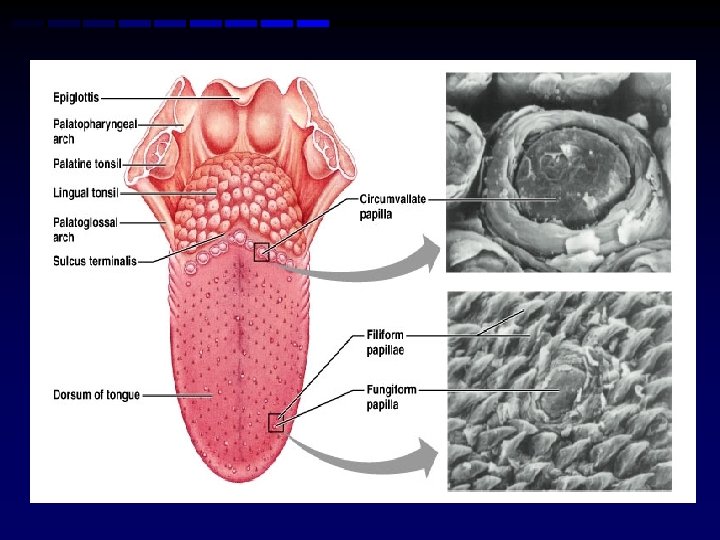
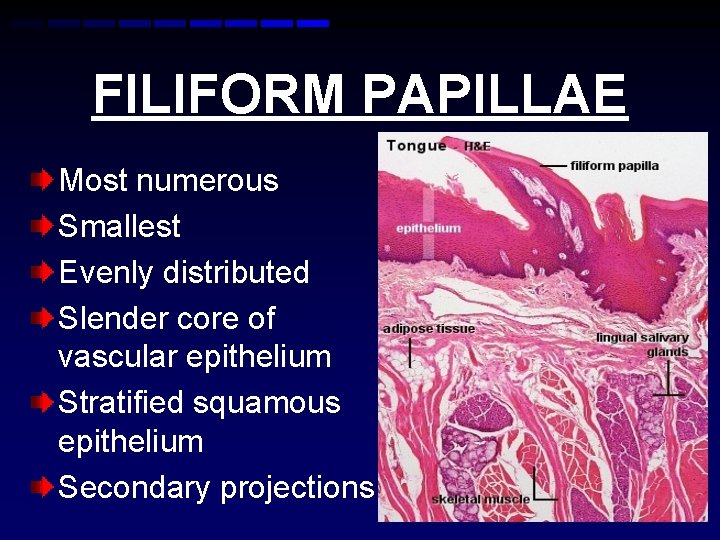
FILIFORM PAPILLAE Most numerous Smallest Evenly distributed Slender core of vascular epithelium Stratified squamous epithelium Secondary projections
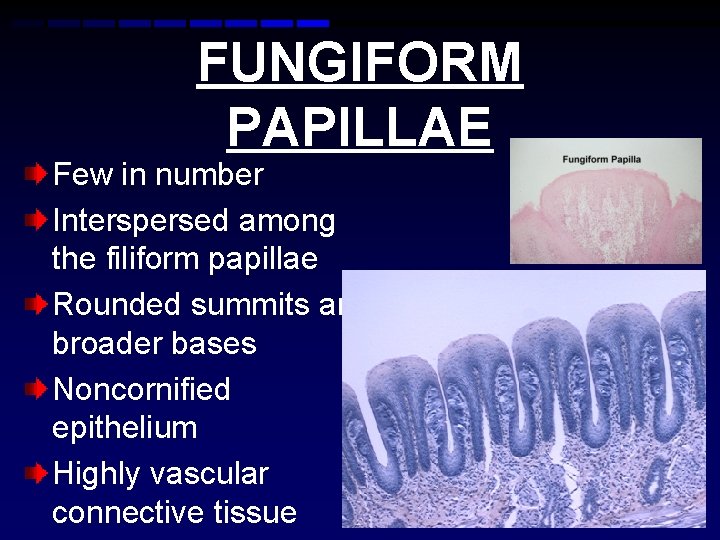
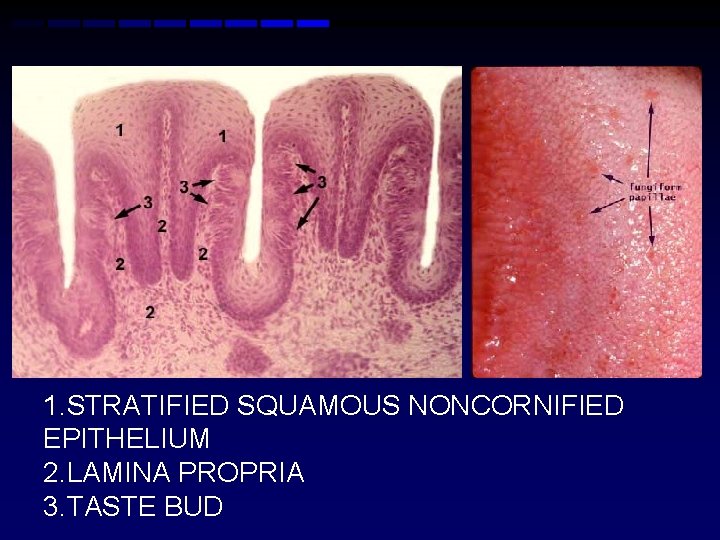
FUNGIFORM PAPILLAE Few in number Interspersed among the filiform papillae Rounded summits and broader bases Noncornified epithelium Highly vascular connective tissue
1. STRATIFIED SQUAMOUS NONCORNIFIED EPITHELIUM 2. LAMINA PROPRIA 3. TASTE BUD
FOLIATE PAPILLAE Along the posterolateral border of the tongue there are folds of the mucous membrane, sometimes called the foliate papillae. Not well developed in humans. In some animals, e. g. , rabbits, it constitute the principle site of aggregation of taste buds.
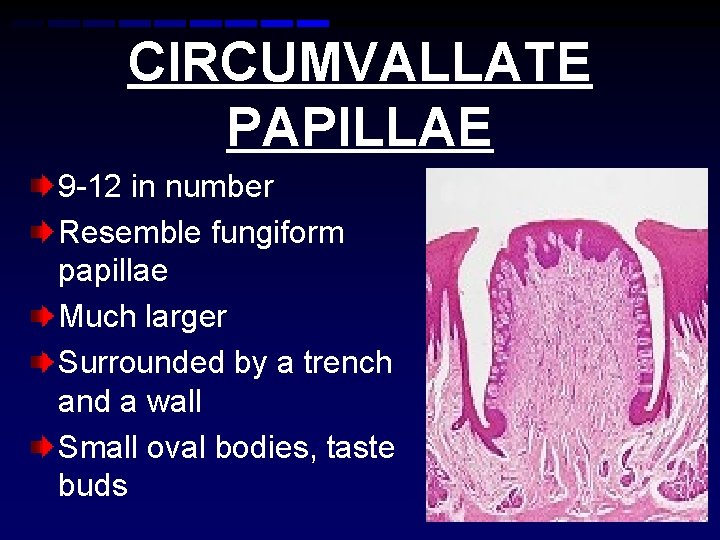
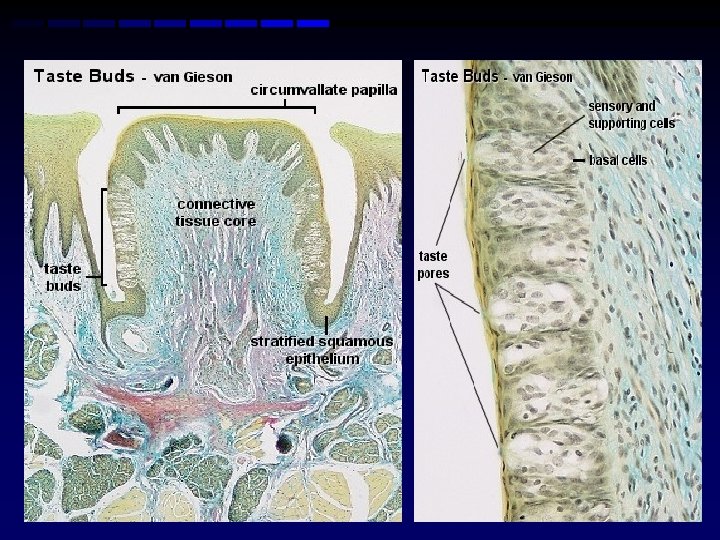
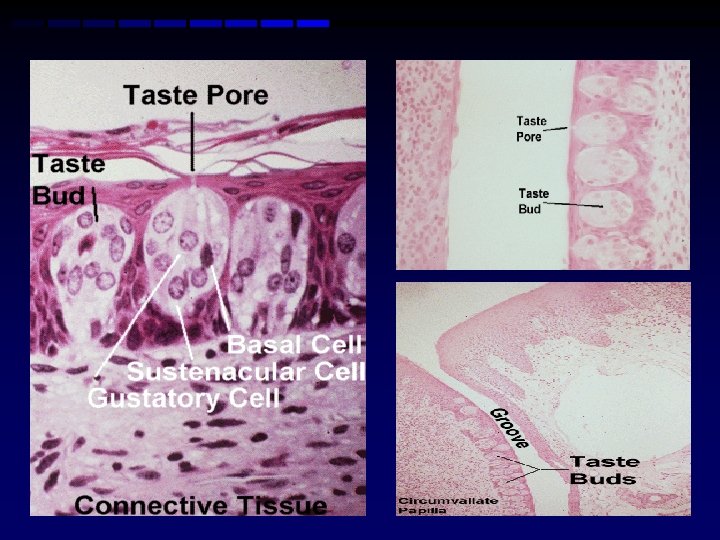
CIRCUMVALLATE PAPILLAE 9 -12 in number Resemble fungiform papillae Much larger Surrounded by a trench and a wall Small oval bodies, taste buds
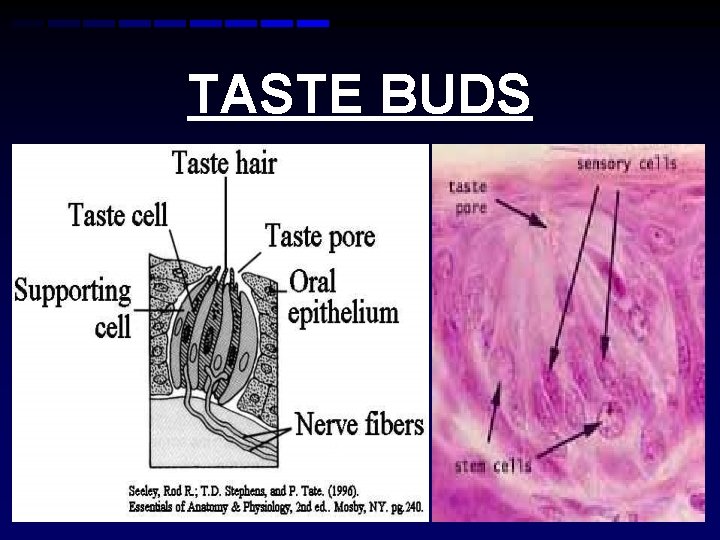
TASTE BUDS
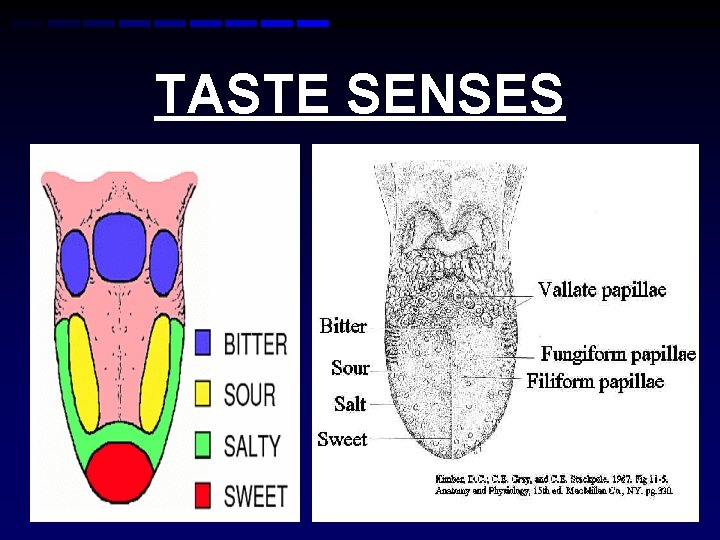
TASTE SENSES
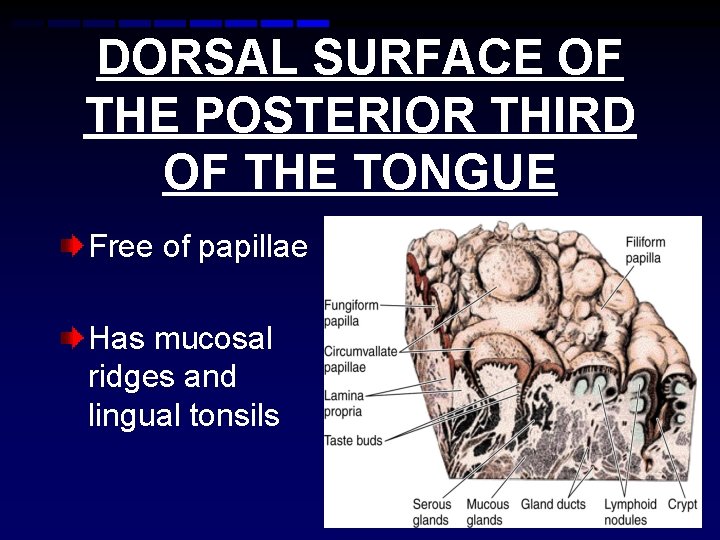
DORSAL SURFACE OF THE POSTERIOR THIRD OF THE TONGUE Free of papillae Has mucosal ridges and lingual tonsils
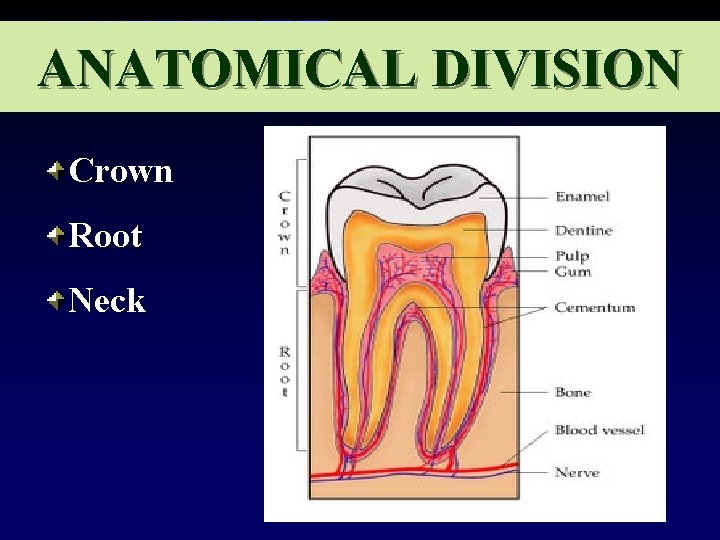
ANATOMICAL DIVISION Crown Root Neck
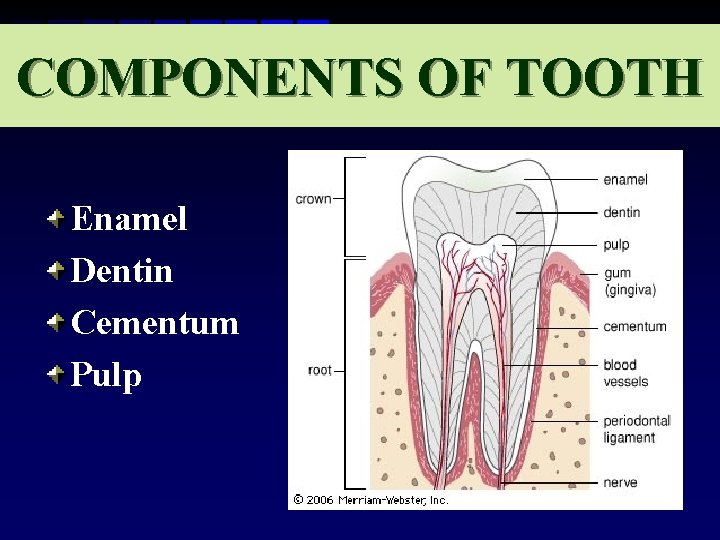
COMPONENTS OF TOOTH Enamel Dentin Cementum Pulp
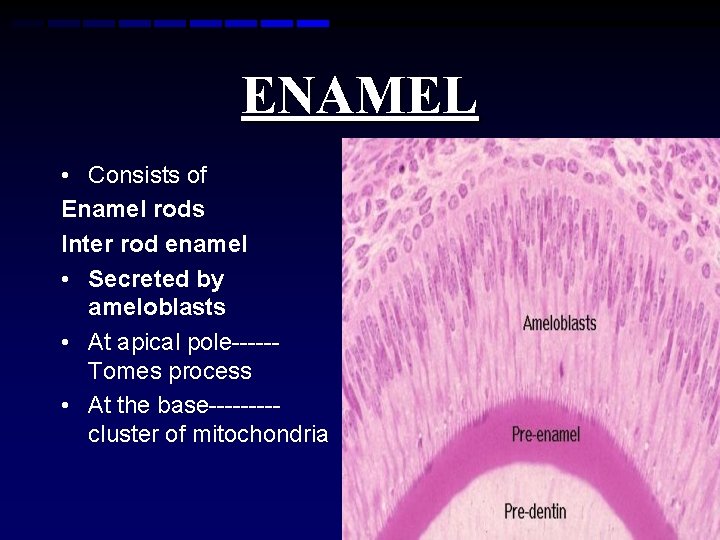
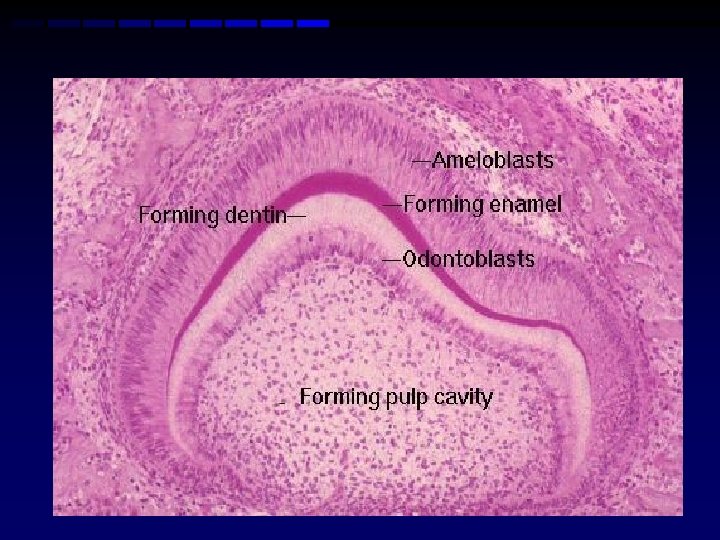
ENAMEL • Consists of Enamel rods Inter rod enamel • Secreted by ameloblasts • At apical pole-----Tomes process • At the base----cluster of mitochondria
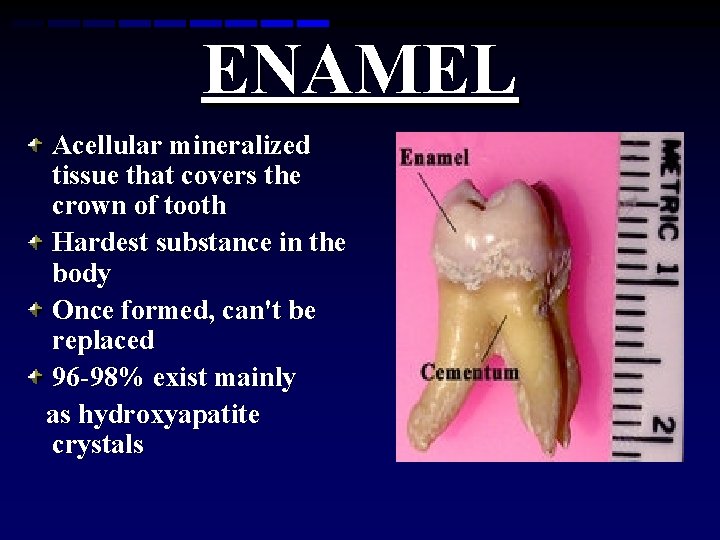
ENAMEL Acellular mineralized tissue that covers the crown of tooth Hardest substance in the body Once formed, can't be replaced 96 -98% exist mainly as hydroxyapatite crystals
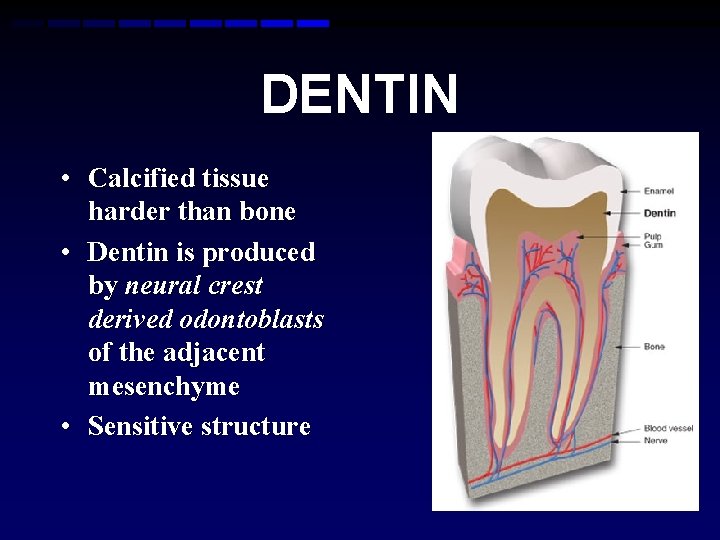
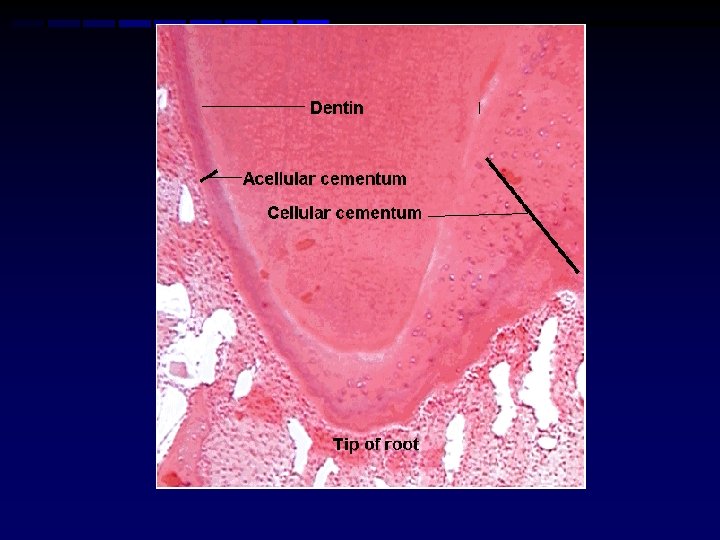
DENTIN • Calcified tissue harder than bone • Dentin is produced by neural crest derived odontoblasts of the adjacent mesenchyme • Sensitive structure
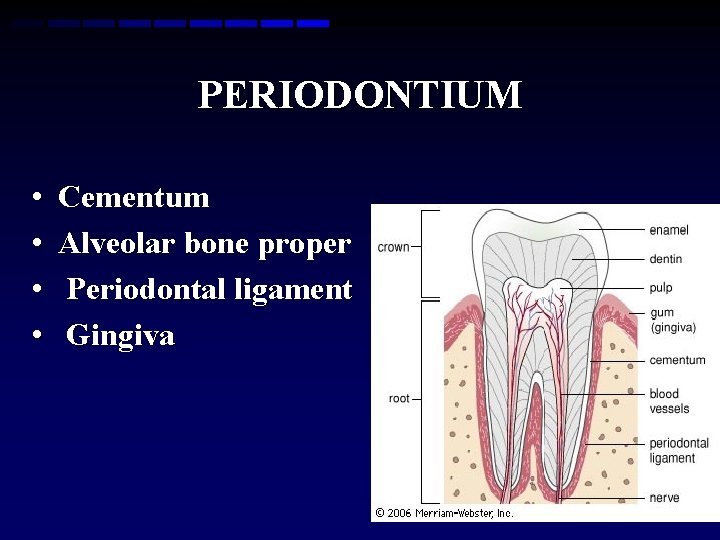
PERIODONTIUM • • Cementum Alveolar bone proper Periodontal ligament Gingiva
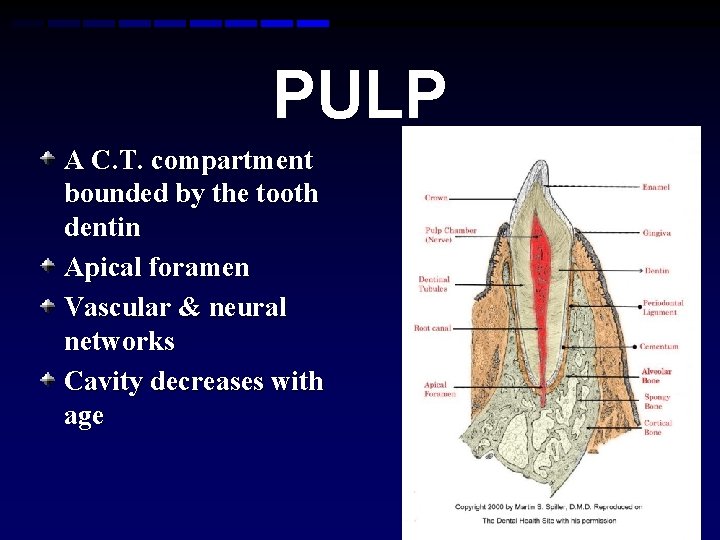
PULP A C. T. compartment bounded by the tooth dentin Apical foramen Vascular & neural networks Cavity decreases with age
THANK YOU