
Digestive System Mouth Digestion begins in the begins

Digestive System

Mouth • Digestion begins in the ____ begins the process of digestion Chewing • _________- is the physical Mechanical digestion breakdown of large pieces of food into smaller pieces. Chemical digestion • _________- large food molecules are broken down into smaller food molecules with the help of different enzymes.
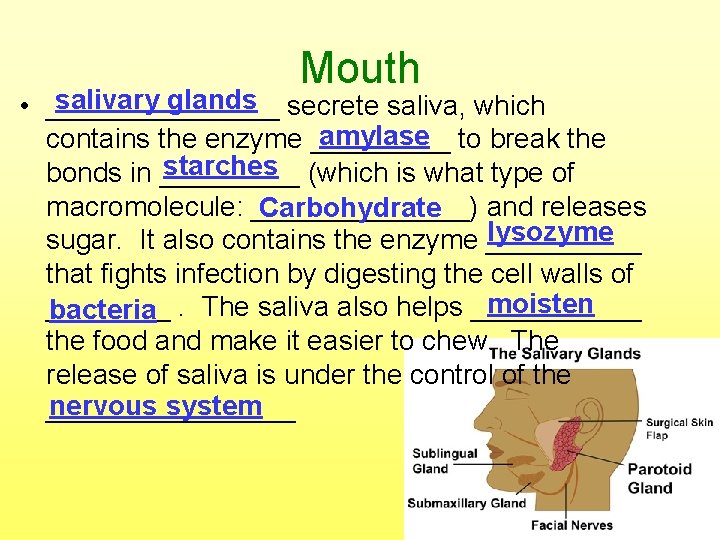
Mouth salivary glands • ________ secrete saliva, which amylase contains the enzyme _____ to break the starches bonds in _____ (which is what type of macromolecule: _______) and releases Carbohydrate lysozyme sugar. It also contains the enzyme _____ that fights infection by digesting the cell walls of moisten ____. The saliva also helps ______ bacteria the food and make it easier to chew. The release of saliva is under the control of the nervous system ________
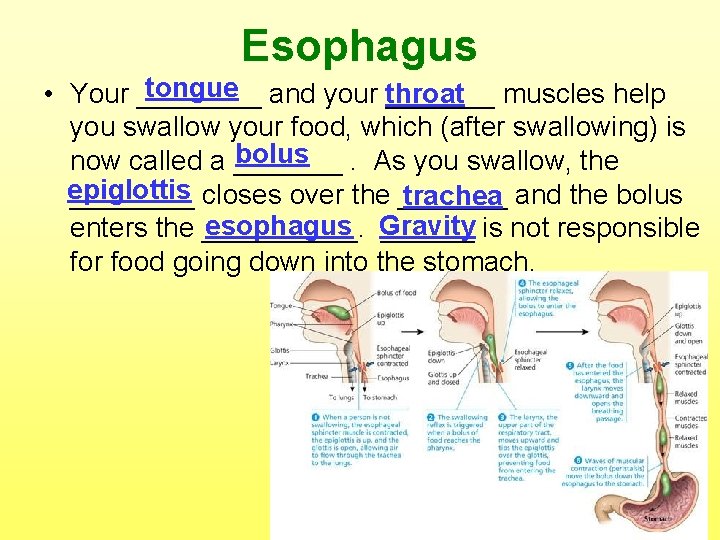
Esophagus tongue • Your ____ and your _______ muscles help throat you swallow your food, which (after swallowing) is bolus now called a _______. As you swallow, the epiglottis ____ closes over the _______ and the bolus trachea esophagus Gravity enters the ______ is not responsible for food going down into the stomach.
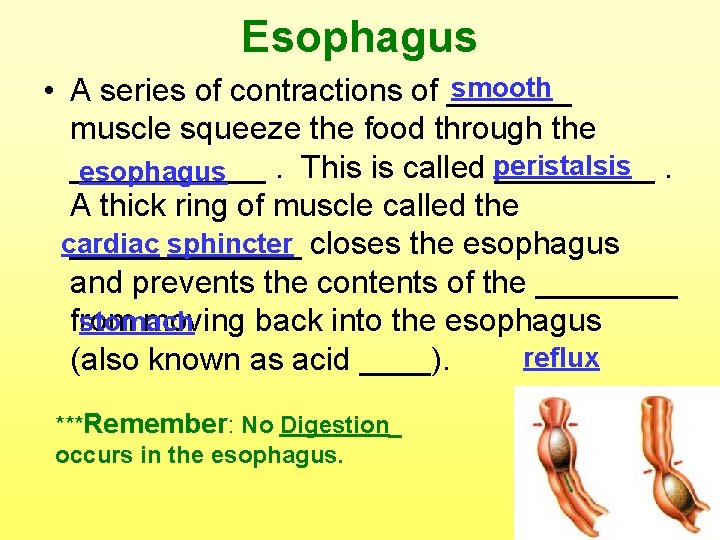
Esophagus smooth • A series of contractions of _______ muscle squeeze the food through the peristalsis ______. This is called _____. esophagus A thick ring of muscle called the cardiac sphincter _______ closes the esophagus and prevents the contents of the ____ stomach from moving back into the esophagus reflux (also known as acid ____). ***Remember: No Digestion_ occurs in the esophagus.
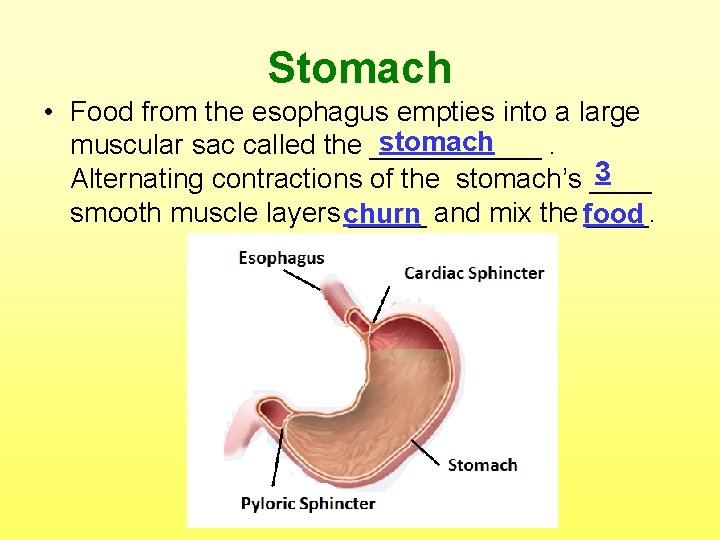
Stomach • Food from the esophagus empties into a large stomach muscular sac called the ______. 3 Alternating contractions of the stomach’s ____ smooth muscle layers _____ and mix the ____. churn food
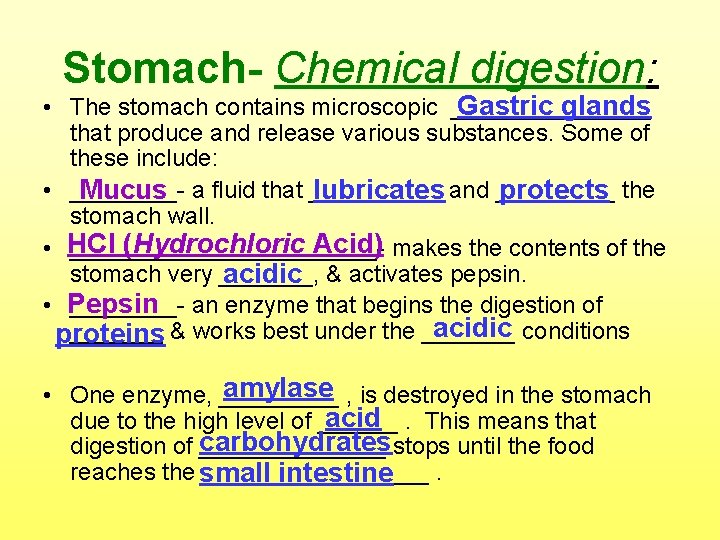
Stomach- Chemical digestion: • The stomach contains microscopic ________ Gastric glands that produce and release various substances. Some of these include: • ____- a fluid that _____ and _____ the Mucus lubricates protects stomach wall. (Hydrochloric Acid) • HCl ____________- makes the contents of the stomach very _______, & activates pepsin. acidic • Pepsin ____- an enzyme that begins the digestion of acidic _______ & works best under the _______ conditions proteins amylase • One enzyme, _____ , is destroyed in the stomach acid due to the high level of ______. This means that carbohydrates digestion of _______ stops until the food reaches the _________. small intestine

Stomach- Mechanical digestion: contract Stomach muscles ____ to churn and mix the food & fluids in the stomach, producing chyme a substance called ______. After some 1 2 time, usually about __ to __ hours, this new small intestine substance enters the ______ through the ____ valve. pyloric
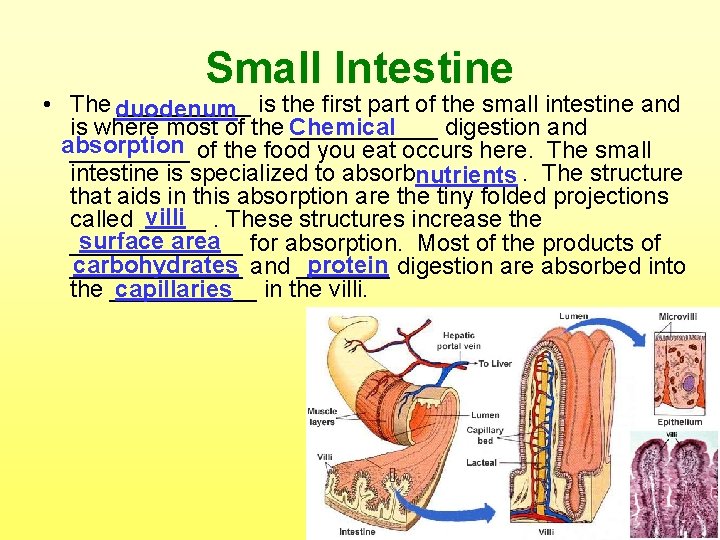
Small Intestine • The _____ is the first part of the small intestine and duodenum Chemical is where most of the ______ digestion and absorption _____ of the food you eat occurs here. The small intestine is specialized to absorb _______. The structure nutrients that aids in this absorption are the tiny folded projections villi called _____. These structures increase the surface area _______ for absorption. Most of the products of carbohydrates protein _______ and _______ digestion are absorbed into the ______ in the villi. capillaries

Small Intestine fat • Molecules of undigested ___ and some _____ fatty acids are absorbed by ____ vessels. By lymph the time food is ready to leave the small intestine, it is basically ____ - free…. . only nutrient celluluose water _____, _______, and other indigestible substances are left. Accessory structures that aid in digestion:
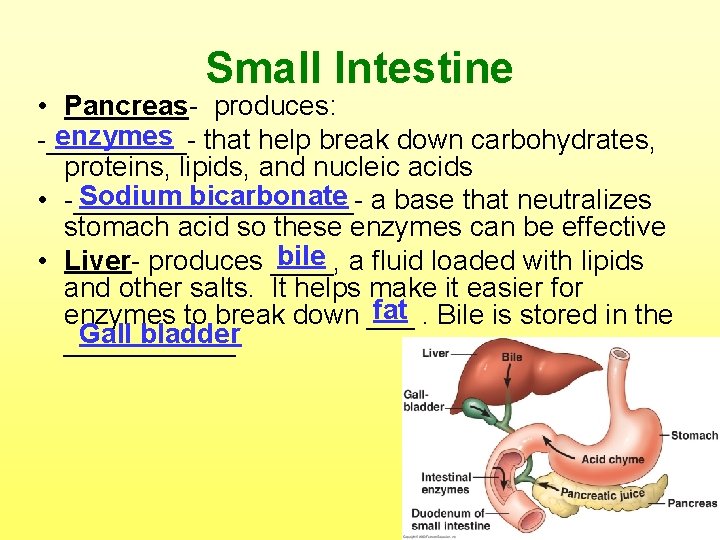
Small Intestine • Pancreas- produces: enzymes -_____- that help break down carbohydrates, proteins, lipids, and nucleic acids Sodium bicarbonate • -_________- a base that neutralizes stomach acid so these enzymes can be effective bile • Liver- produces ____, a fluid loaded with lipids and other salts. It helps make it easier for fat enzymes to break down ___. Bile is stored in the Gall bladder ______
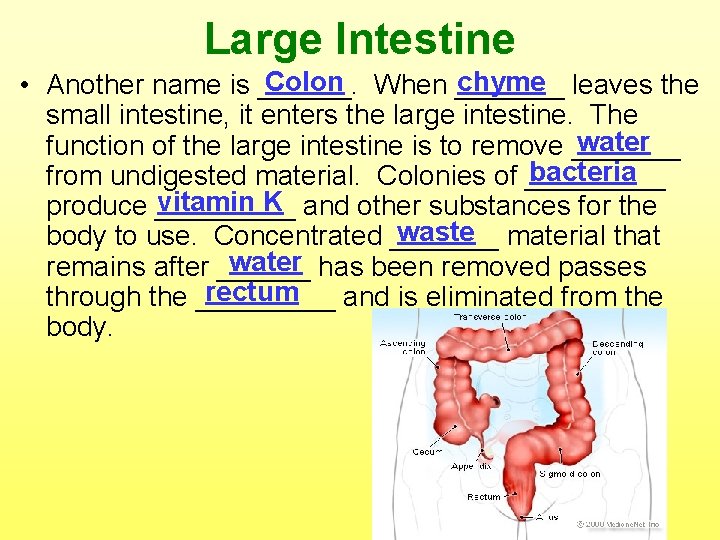
Large Intestine Colon chyme • Another name is ______. When _______ leaves the small intestine, it enters the large intestine. The water function of the large intestine is to remove _______ bacteria from undigested material. Colonies of _____ vitamin K produce _____ and other substances for the waste body to use. Concentrated _______ material that water remains after ______ has been removed passes rectum through the _____ and is eliminated from the body.
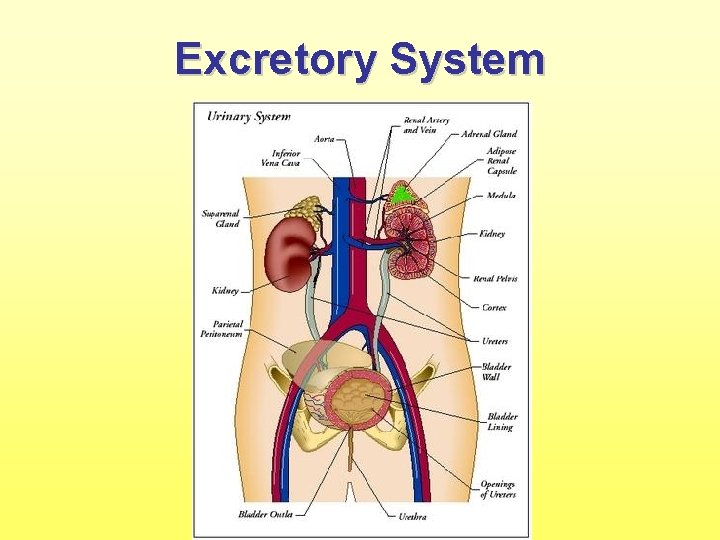
Excretory System
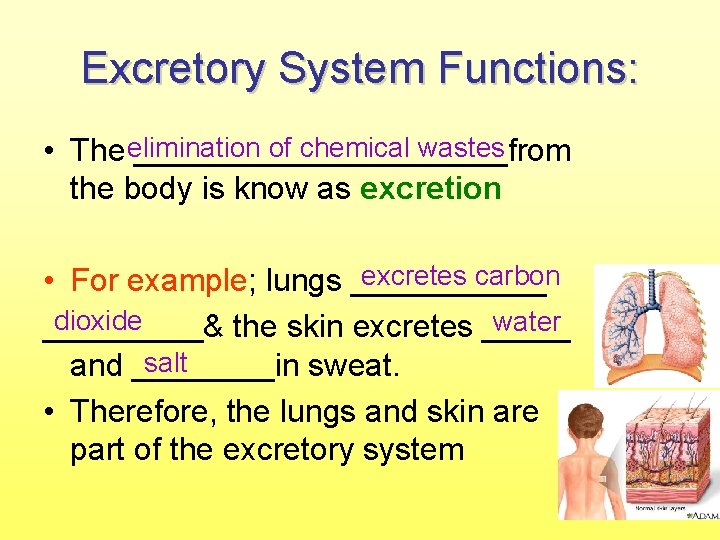
Excretory System Functions: elimination of chemical wastes • The ___________from the body is know as excretion excretes carbon • For example; lungs ______ dioxide water _____& the skin excretes _____ salt and ____in sweat. • Therefore, the lungs and skin are part of the excretory system
Excretory System Functions: • The excretory system is a system of organs that waste remove _______from the body. kidneys • The mains organ of the excretion are the _______ • Function: 1. The removal of urea- a substance that is the metabolism proteins result of ______ of ____in the body cells bloodstream water 2. regulation of _______ in the________, homeostasis 3. maintain______ blood p. H 4. Regulating ______
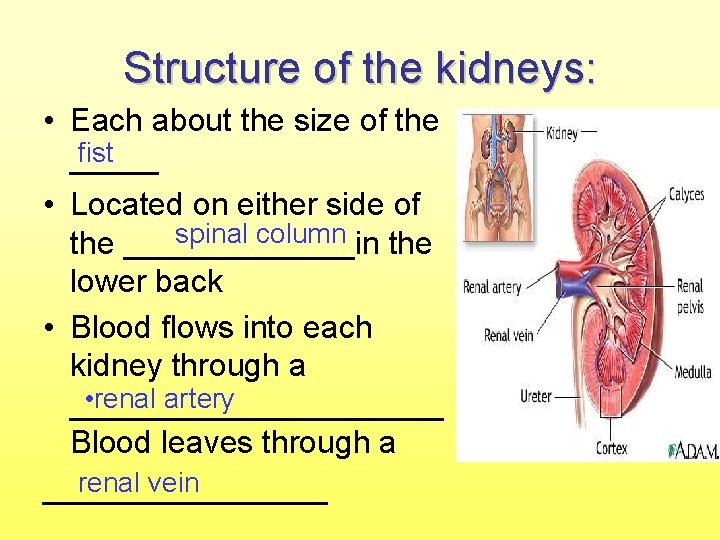
Structure of the kidneys: • Each about the size of the fist _____ • Located on either side of spinal column the _______in the lower back • Blood flows into each kidney through a • renal artery ___________ Blood leaves through a renal vein ________
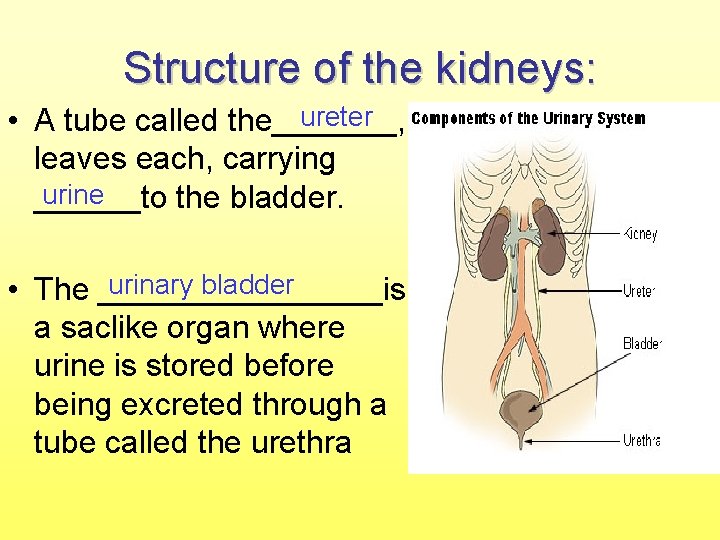
Structure of the kidneys: ureter • A tube called the_______, leaves each, carrying urine ______to the bladder. urinary bladder • The ________is a saclike organ where urine is stored before being excreted through a tube called the urethra
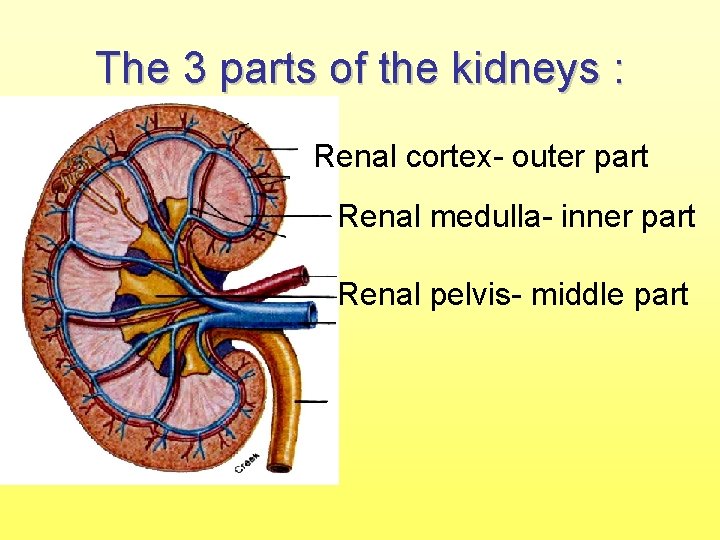
The 3 parts of the kidneys : Renal cortex- outer part Renal medulla- inner part Renal pelvis- middle part
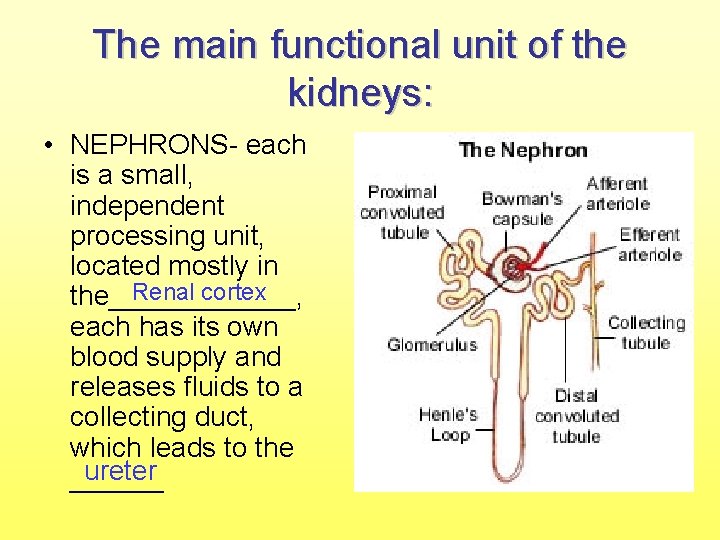
The main functional unit of the kidneys: • NEPHRONS- each is a small, independent processing unit, located mostly in Renal cortex the______, each has its own blood supply and releases fluids to a collecting duct, which leads to the ureter ______
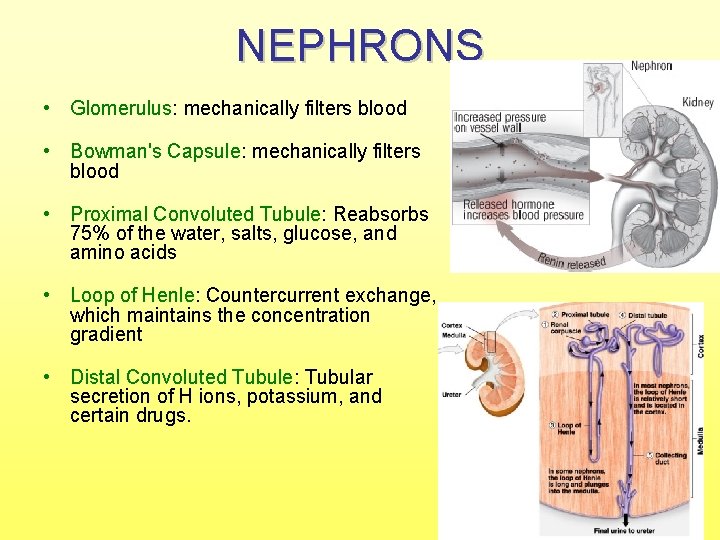
NEPHRONS • Glomerulus: mechanically filters blood • Bowman's Capsule: mechanically filters blood • Proximal Convoluted Tubule: Reabsorbs 75% of the water, salts, glucose, and amino acids • Loop of Henle: Countercurrent exchange, which maintains the concentration gradient • Distal Convoluted Tubule: Tubular secretion of H ions, potassium, and certain drugs.
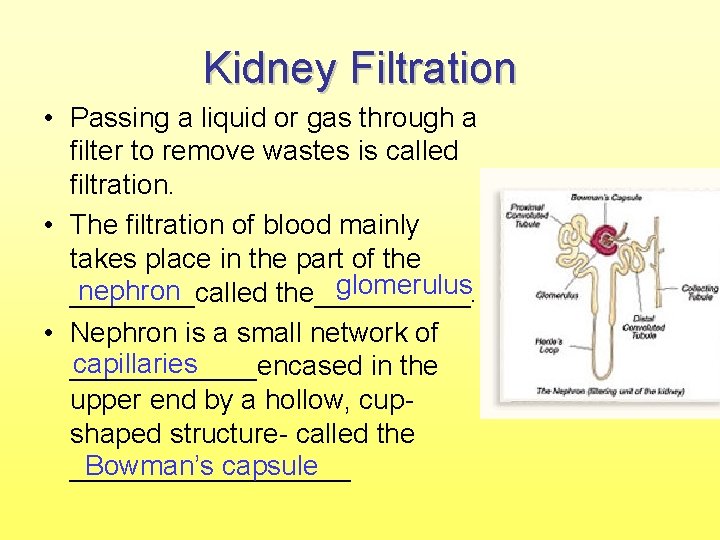
Kidney Filtration • Passing a liquid or gas through a filter to remove wastes is called filtration. • The filtration of blood mainly takes place in the part of the glomerulus nephron ____called the_____. • Nephron is a small network of capillaries ______encased in the upper end by a hollow, cupshaped structure- called the Bowman’s capsule _________
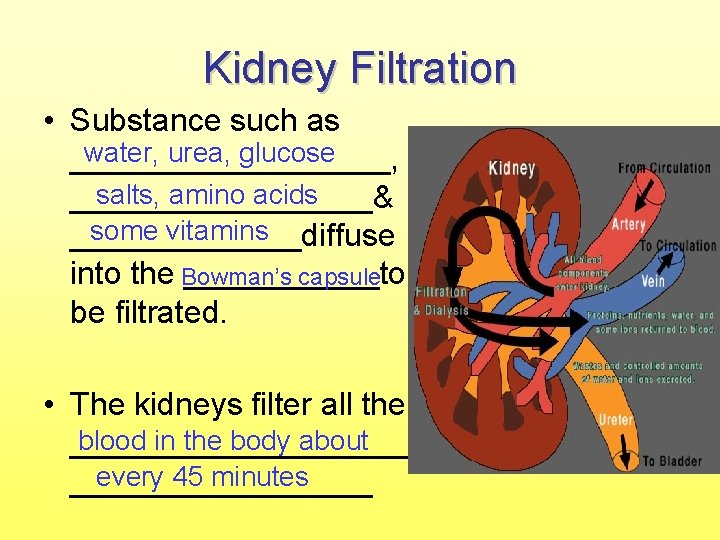
Kidney Filtration • Substance such as water, urea, glucose _________, salts, amino acids _________& some vitamins _______diffuse into the ______to Bowman’s capsule be filtrated. • The kidneys filter all the blood in the body about __________ every 45 minutes _________
Kidney Re-absorption: • Most material removed from the blood at Bowman’s capsule the _________makes its way blood into the _______ • Re-absorption is the process in which liquid is taken back into a vessel. Amino acids, fats, & glucose • ___________are reabsorbed active transport into the capillaries by_______. osmosis 99% • Water enters by_______of the water is reabsorbed into the blood
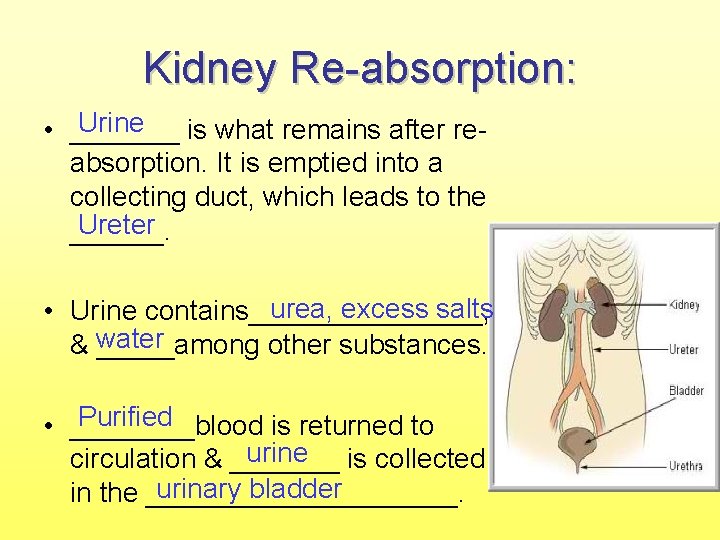
Kidney Re-absorption: Urine • _______ is what remains after reabsorption. It is emptied into a collecting duct, which leads to the Ureter ______. urea, excess salts • Urine contains________, water & _____among other substances. Purified • ____blood is returned to urine circulation & _______ is collected urinary bladder in the __________.
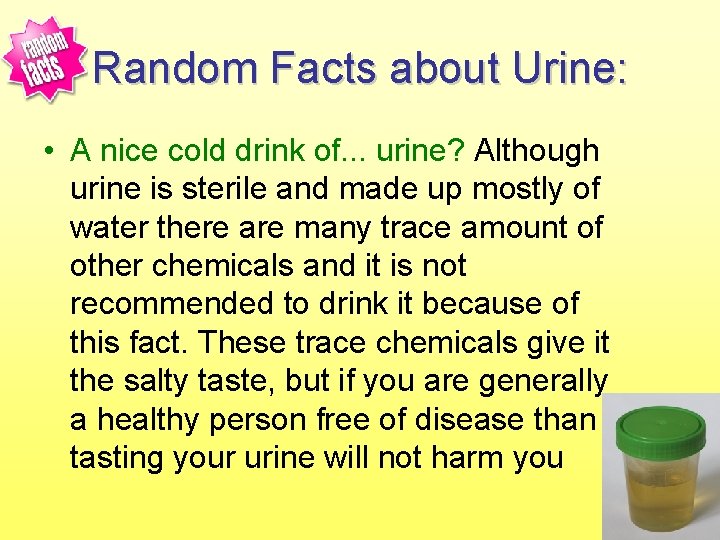
Random Facts about Urine: • A nice cold drink of. . . urine? Although urine is sterile and made up mostly of water there are many trace amount of other chemicals and it is not recommended to drink it because of this fact. These trace chemicals give it the salty taste, but if you are generally a healthy person free of disease than tasting your urine will not harm you
Random Facts about Urine: • There are 45. 2% of people that pee in the shower. • There are 44. 9% of people who pee in the ocean and there are 28. 1% of people who pee in the pool.
• • • 1. Pee can be a window to your overall health. It provides vital information about your kidney and heart health, and your liver function. And the amount of bathroom trips you take can also signal health issues: Infrequent urination could indicate dehydration or even a kidney problem. 2. It's 95% water. The rest is 2. 5% urea and a 2. 5% combination of salt, hormones, nutrients, and creatine. Over a lifetime, the kidneys will clean approximately one million gallons of water into pee. 3. Pee that smells isn't always a bad thing. Sometimes it's just the foods we eat, including asparagus, alcohol, coffee, and garlic. But, if your urine smells like any of the following you should take note: • A smell of ammonia could indicate dehydration. • A musty smell might mean liver disease. • A foul smell could indicate a bladder infection. • A sweet smell could mean diabetes. 4. The average adult produces 6. 3 cups of urine a day. The bladder can hold about 2. 5 cups of urine at a time for up two to five hours. (That's slightly larger than a pint of beer. ) And you'll usually start to feel the urge to pee when your bladder has about a cup full. In comparison, a Clydesdale horse can urinate more than 72 cups a day — that's 4. 5 gallons! And an elephant? A whopping 13 gallons or 208 cups.
• • • 7. Peeing on a jellyfish sting won't heal it. Sorry Friends fans, but this trick doesn't actually work. Instead, simply rinse the burn in hot water and apply a local anesthetic from your drugstore. 8. Pee is good for the skin. Sort of. A synthetic version of urea (which is a component of urine) is often used in moisturizers because it softens skin and in higher doses can be used as an exfoliator. Urea can also treat athlete's foot. However, there isn't enough urea in actual urine to support rubbing it on your face, so stick to the store-bought versions instead. 9. It can whiten your teeth. Ancient Roman doctors actually told their patients to rinse their mouths with pee for whiter teeth. And surprisingly, this wasn't an entirely crazy idea — the ammonia in urine can actually make your teeth whiter, but good luck finding the courage to swish it around in your mouth. Ancient Romans also used pee as invisible ink to write secret messages. The words would show up when the paper was heated. And in pre-industrial times, urine was used in cleaning fluids because of the ammonia. 10. You shouldn't drink your pee. If you happen to be lost in the desert without water, do not drink your urine. It's full of salt, which can actually make you more dehydrated instead of quenching your thirst. In fact, the US Army Field Manual strictly advises against drinking urine for survival. 11. As a man ages, the speed of his urine stream declines. Up until age 50, men pee faster than women. But then it starts to decline and women take the lead.
• 13. Cat urine glows under a black light. Actually, a black light can be used to detect many bodily fluids, but cat pee, in particular, lights up under the light. It contains phosphorus, which glows in the presence of oxygen, even when a black light isn't on. • 14. The World Record for the longest pee is 508 seconds. That's almost 8. 5 minutes.
- Slides: 29