
Digestive system Learning objectives Describe the structures and
Digestive system Learning objectives: • Describe the structures and functions of the human alimentary canal • Understand the processes of ingestion, digestion, absorption, assimilation and egestion • Explain how food is moved through the gut by peristalsis • Understand the role of digestive enzymes • Understand the role of bile in the digestive system • Understand how the small intestine is adapted for absorption, including the structure of a villus
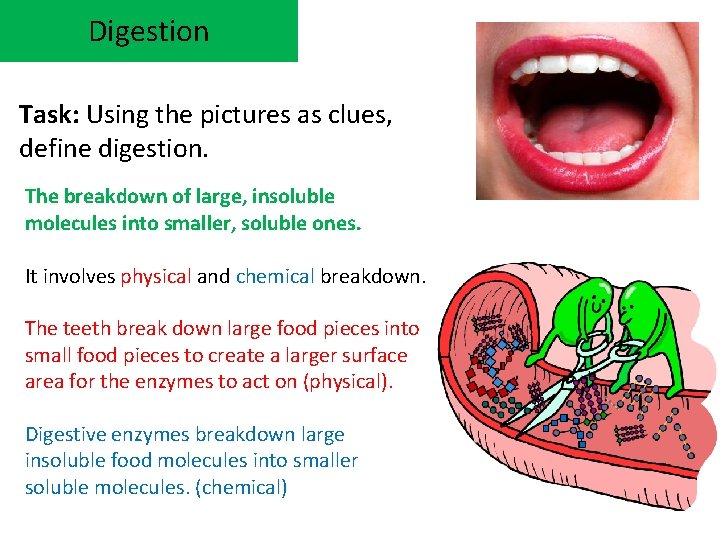
Digestion Task: Using the pictures as clues, define digestion. The breakdown of large, insoluble molecules into smaller, soluble ones. It involves physical and chemical breakdown. The teeth break down large food pieces into small food pieces to create a larger surface area for the enzymes to act on (physical). Digestive enzymes breakdown large insoluble food molecules into smaller soluble molecules. (chemical)
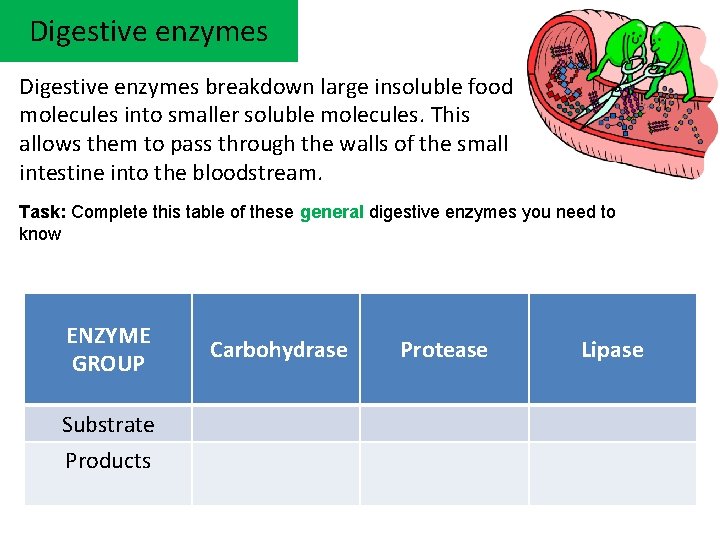
Digestive enzymes breakdown large insoluble food molecules into smaller soluble molecules. This allows them to pass through the walls of the small intestine into the bloodstream. Task: Complete this table of these general digestive enzymes you need to know ENZYME GROUP Substrate Products Carbohydrase Protease Lipase
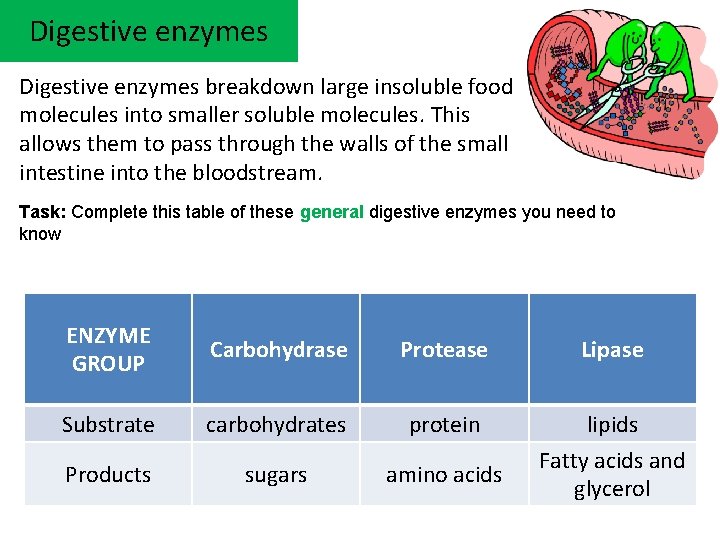
Digestive enzymes breakdown large insoluble food molecules into smaller soluble molecules. This allows them to pass through the walls of the small intestine into the bloodstream. Task: Complete this table of these general digestive enzymes you need to know ENZYME GROUP Carbohydrase Protease Lipase Substrate carbohydrates protein lipids amino acids Fatty acids and glycerol Products sugars
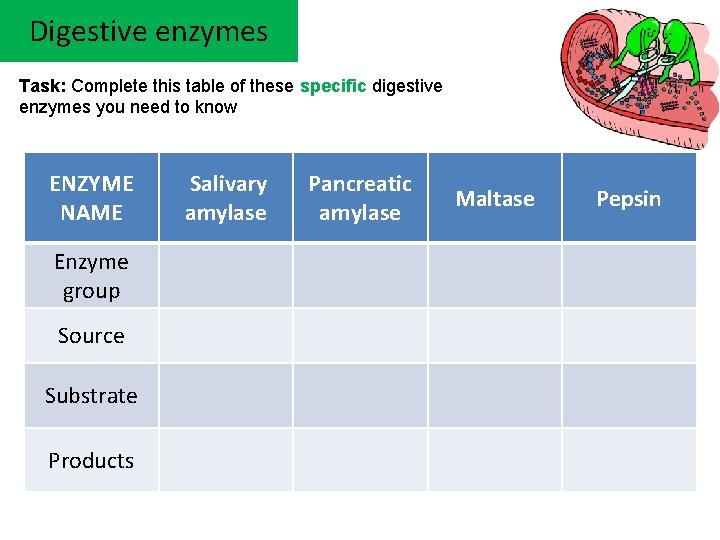
Digestive enzymes Task: Complete this table of these specific digestive enzymes you need to know ENZYME NAME Enzyme group Source Substrate Products Salivary amylase Pancreatic amylase Maltase Pepsin
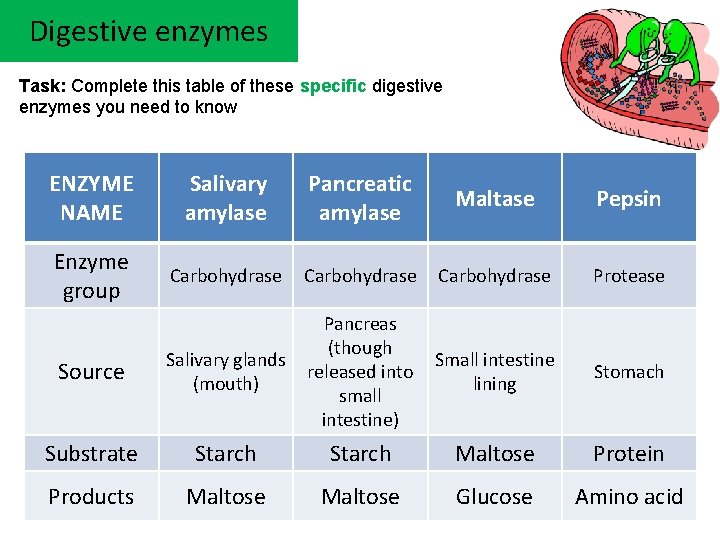
Digestive enzymes Task: Complete this table of these specific digestive enzymes you need to know ENZYME NAME Salivary amylase Pancreatic amylase Maltase Pepsin Enzyme group Carbohydrase Protease Source Salivary glands (mouth) Pancreas (though released into small intestine) Small intestine lining Stomach Substrate Starch Maltose Protein Products Maltose Glucose Amino acid
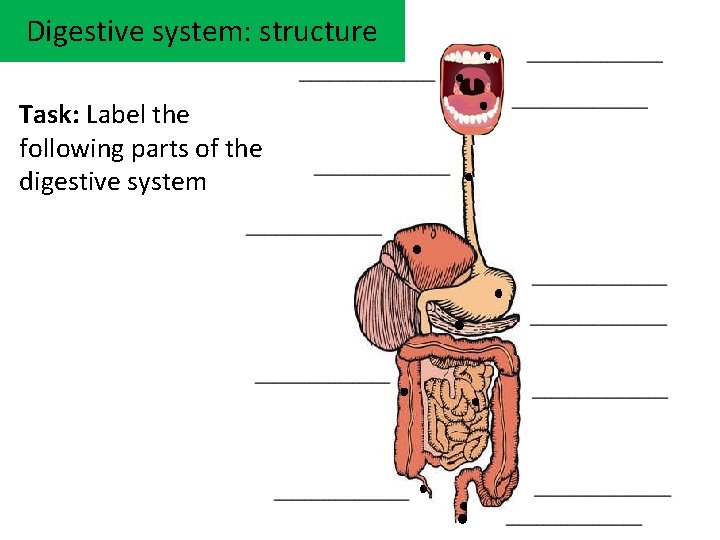
Digestive system: structure Task: Label the following parts of the digestive system
Digestive system: process Task: Each ‘station’ in the room is set up with the name of one organ involved in the digestive system. 1. Find a friend and then take a pen and head to a ‘station. ’ 2. You will have 2 minutes to write as much information relating to that organ as you can. After the time is up you will move clockwise to the next station. 3. You will then be given another 1 minute to add to the information at this station. You should only be writing new information. 4. Repeat for other stations.
Mouth • Food is ingested here. Ingestion: the consumption of a substance. • Mechanical and chemical digestion takes place. • Your teeth chew the food and break it down into smaller pieces mechanically. Why is this important? • Amylase contained within the saliva starts to break down starch into maltose. • With the help of the tongue food is rolled into balls of food called bolus and swallowed.
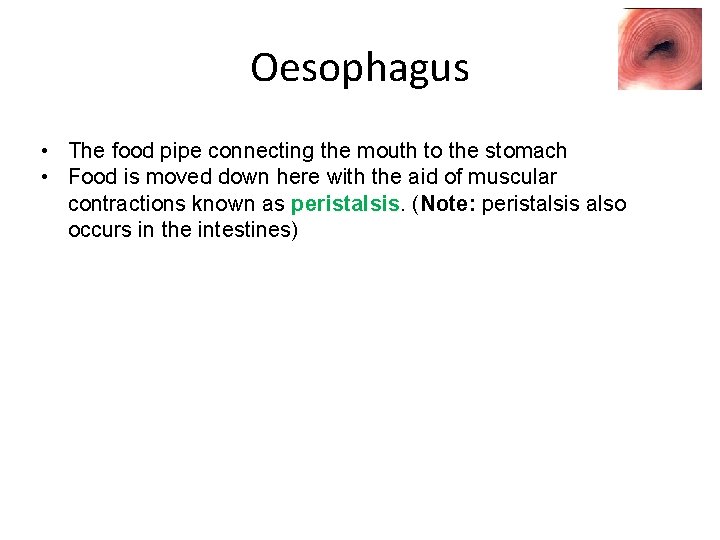
Oesophagus • The food pipe connecting the mouth to the stomach • Food is moved down here with the aid of muscular contractions known as peristalsis. (Note: peristalsis also occurs in the intestines)
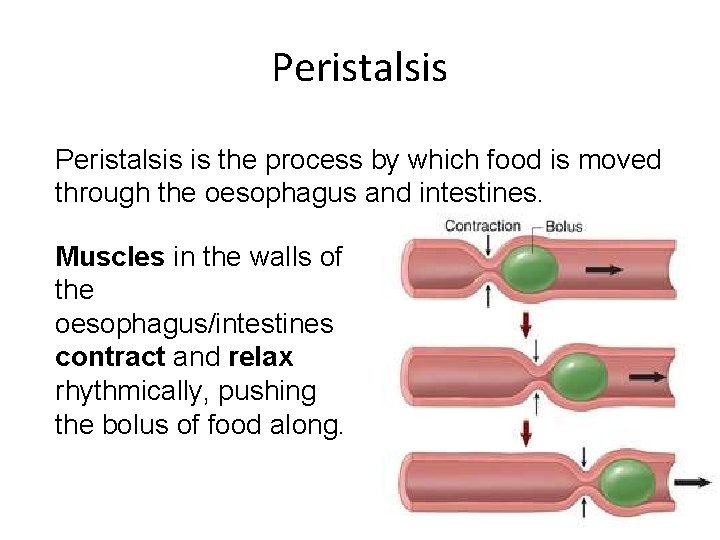
Peristalsis is the process by which food is moved through the oesophagus and intestines. Muscles in the walls of the oesophagus/intestines contract and relax rhythmically, pushing the bolus of food along.
Stomach - Large muscular bag – contracts and relaxes to churn the food. - Food can be held here for 2 -4 hours. - The food is mixed with gastric juice, produced by millions of gastric glands located in the stomach walls. Gastric juice consists of: • Pepsin – a protease enzyme released in an inactive form, activated by HCl. • HCl – kills bacteria and provides acidic (p. H 2) conditions which are optimal for pepsin. • Goblet cells produce mucus – lines the stomach to prevent damage from the hydrochloric acid.
Duodenum in the small intestines 5 metre long tube: • This is the first section of the small intestine • It is where digestion is completed. • Digestive juices are secreted from the pancreas (pancreatic juice) and the intestine walls. These include carbohydrases (including maltase and pancreatic amylase), proteases and lipases. • Bile is also released here
Duodenum in the small intestines Bile • Made in the liver. • Stored in the gall bladder. • Emulsifies fats providing a larger surface area on which lipase can act. • Also neutralizes the stomach content (bile is alkaline)
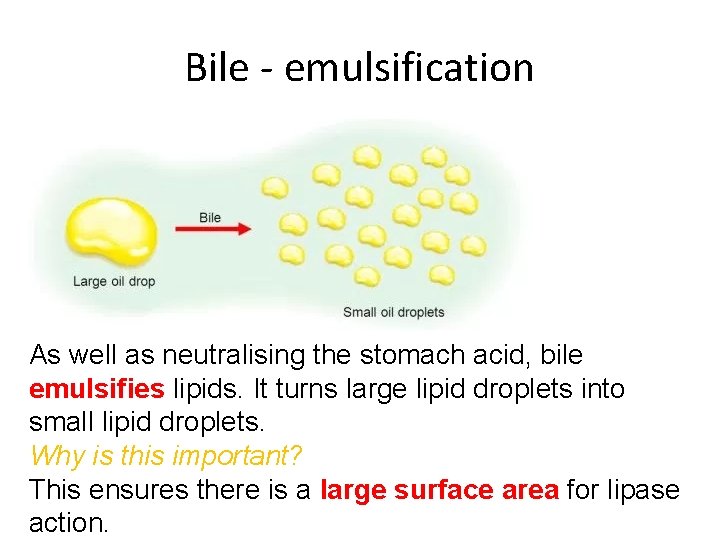
Bile - emulsification As well as neutralising the stomach acid, bile emulsifies lipids. It turns large lipid droplets into small lipid droplets. Why is this important? This ensures there is a large surface area for lipase action.
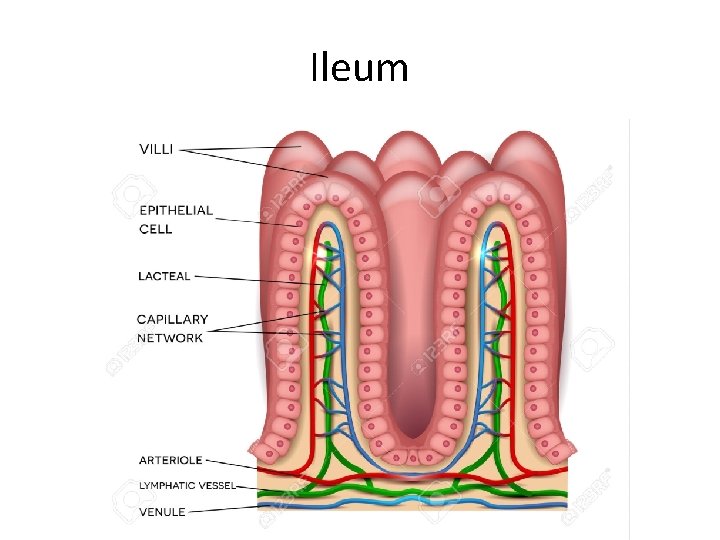
Ileum in the small intestines • The ileum is the part of the small intestine where most of the absorption of foods takes place. Absorption: digested food molecules are absorbed. • The inner surface is folded, producing finger-like projections called villi. • Absorption may take place passively or via active transport.
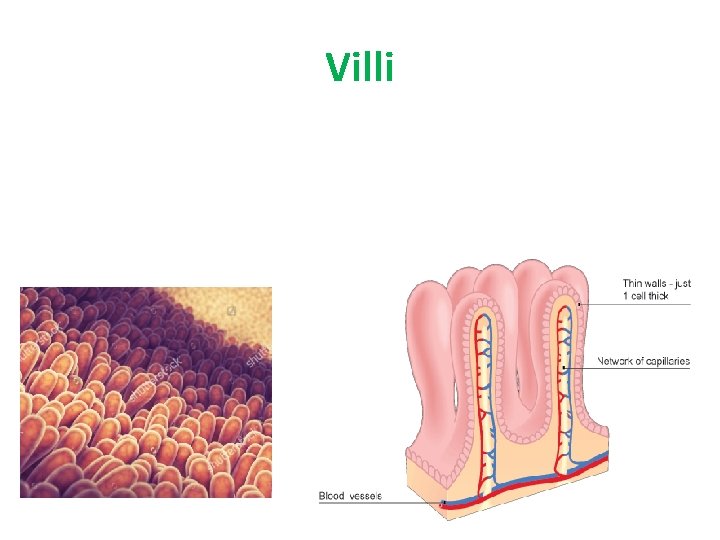
Villi
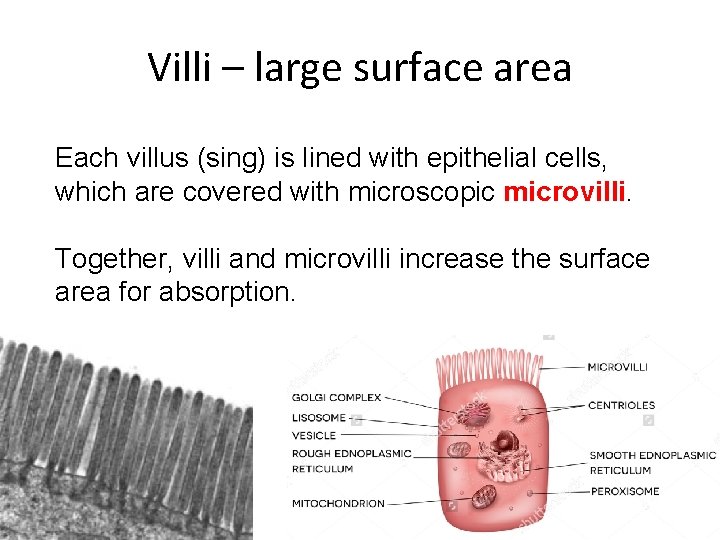
Villi – large surface area Each villus (sing) is lined with epithelial cells, which are covered with microscopic microvilli. Together, villi and microvilli increase the surface area for absorption.
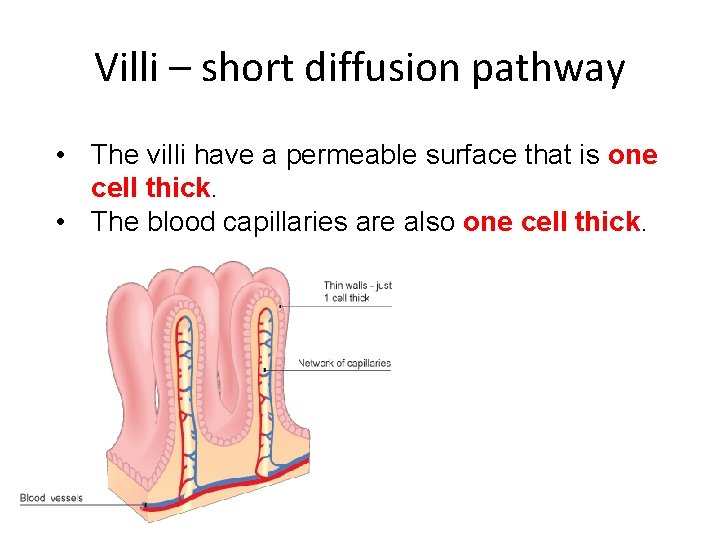
Villi – short diffusion pathway • The villi have a permeable surface that is one cell thick. • The blood capillaries are also one cell thick.
Villi – maintained concentration gradient The small intestine is very long to provide the time for absorption. The chyme is constantly moved through the ileum. Blood is constantly flowing, taking away the products of digestion. This ensures that there is always a concentration gradient between the food in the lumen of the ileum and the blood.
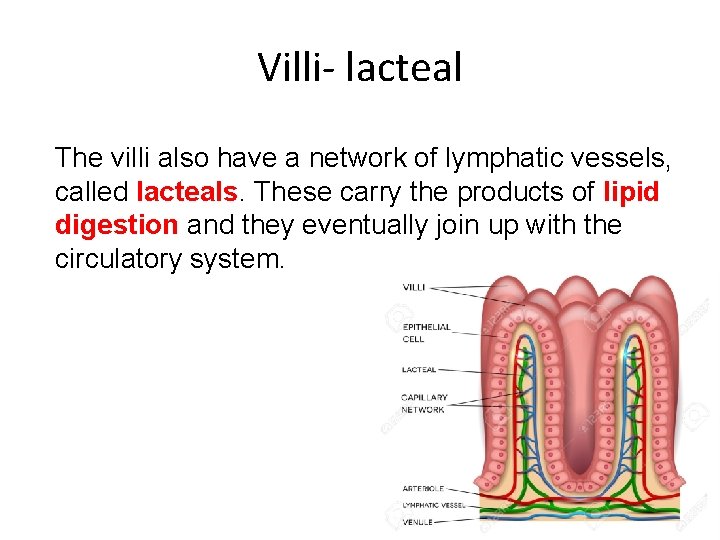
Villi- lacteal The villi also have a network of lymphatic vessels, called lacteals. These carry the products of lipid digestion and they eventually join up with the circulatory system.
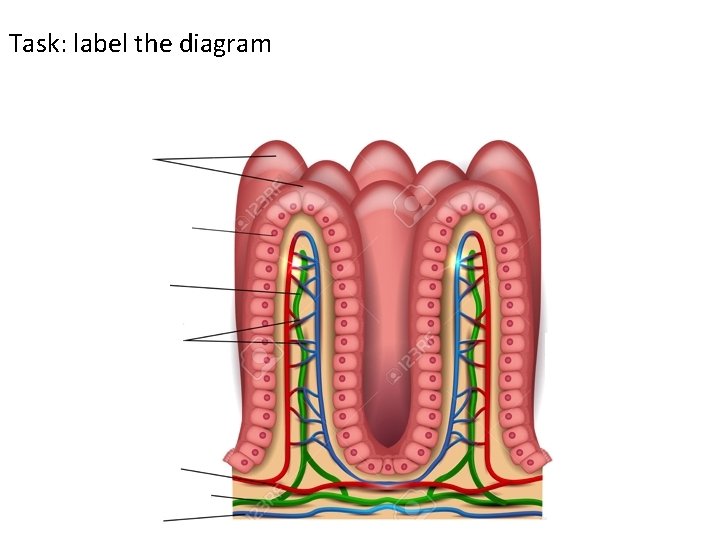
Task: label the diagram
Ileum
Villi • Increase surface area and therefore greatly improve the efficiency of the absorption process. • Have very thin walls to decrease diffusion distance. • Each villi has a network of capillaries and a lacteal (a small vessel of the lymphatic system). • Amino acids and glucose are absorbed into the bloodstream and taken via the hepatic portal vein to the liver for processing. • Fatty acids and glycerol are taken into the lacteals and travel in the lymphatic system.
Assimilation After food has been digested and absorbed, it is assimilated into the body (i. e. it is made part of). Assimilation – the process by which products of digestion are used or stored by the body cells.
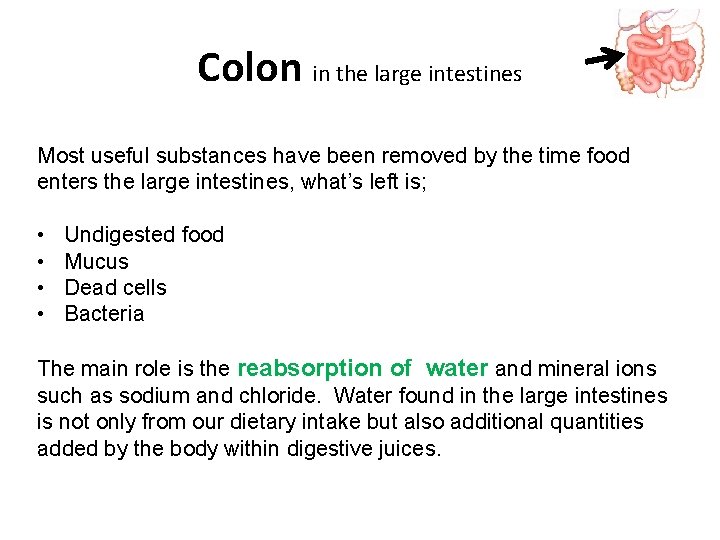
Colon in the large intestines Most useful substances have been removed by the time food enters the large intestines, what’s left is; • • Undigested food Mucus Dead cells Bacteria The main role is the reabsorption of water and mineral ions such as sodium and chloride. Water found in the large intestines is not only from our dietary intake but also additional quantities added by the body within digestive juices.
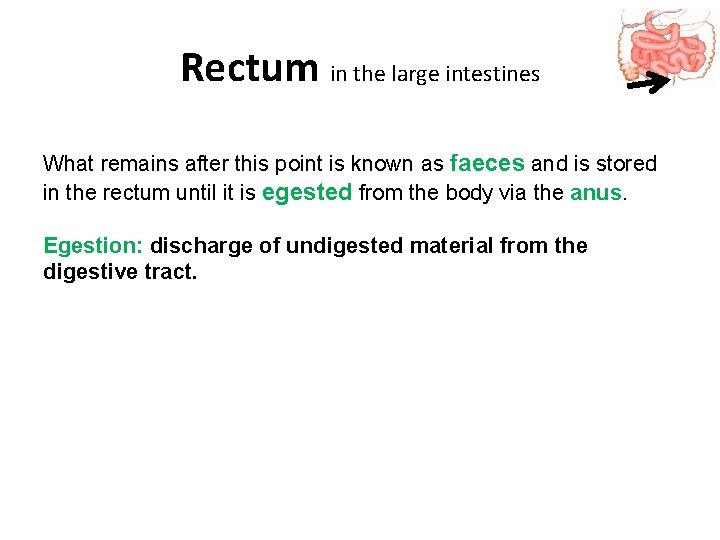
Rectum in the large intestines What remains after this point is known as faeces and is stored in the rectum until it is egested from the body via the anus. Egestion: discharge of undigested material from the digestive tract.
Multiple-choice quiz
Thumbs up or down Learning objectives: • Describe the structures and functions of the human alimentary canal • Understand the processes of ingestion, digestion, absorption, assimilation and egestion • Explain how food is moved through the gut by peristalsis • Understand the role of digestive enzymes • Understand the role of bile in the digestive system • Understand how the small intestine is adapted for absorption, including the structure of a villus
- Slides: 29